A Father’s Long Return: The Quiet Legacy of a Soldier’s Last Flight and the Healing Path
CHAPTER 1: The Weight of Gray
The truck cab smelled of stale coffee and the dry, metallic tang of the coming winter. Outside, the world was stripping down to its essentials: black cedar, gray sky, and the frozen brown of the field. Wendell kept both hands on the wheel, his knuckles pale, not from the cold, but from the deliberate, measured pressure he applied to the leather.
He didn’t look at the radio. He didn’t have to. The sound was a ghost he had invited back every morning for a decade, a signal designed to vanish into the vacuum of space. But tonight, the pulse shifted. It was a three-count beat—short, long, short—a cadence that belonged to a specific flight manual, a specific man.
He slowed the truck to a crawl, the tires crunching through the frost-rimmed ruts of the drive. The house sat ahead, a silhouette against the pale orange smear of the horizon, but he didn’t steer toward the light. He killed the engine.
The silence that followed was heavy, absolute, and invasive.
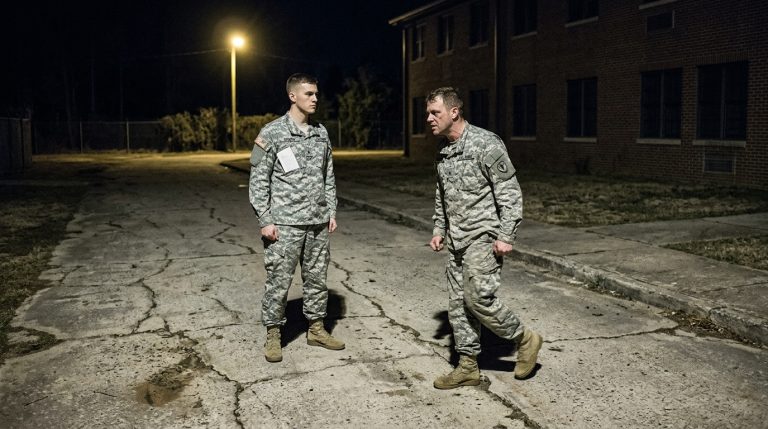
In the passenger seat, the program from the commissioning ceremony lay exactly where he had placed it. He reached out, his fingers tracing the edge of the paper. It was soft, worn thin by his own repetition. He thought of his nephew, Darnell, standing on that stage, the way the boy’s eyes had caught his own—a mirror reflecting a lineage of service that ended, or perhaps just transformed, in 2013.
The radio pulsed again.
Wendell didn’t reach for the dial. He simply watched the dashboard, the dim amber light flickering. If he answered, he broke the boundary between the living and the memory. If he remained silent, he was merely an old man in a cold truck, listening to the static of a dead frequency.
His hand hovered over the breast pocket of his jacket, feeling the sharp, rectangular outline of the envelope he had tucked away during the reception—the one Okafor had pressed into his hand as he turned to leave. He hadn’t opened it. He hadn’t needed to. He knew the weight of it.
He opened the door. The air hit him like a physical blow, clean and biting, smelling of damp earth and coming snow. He walked toward the north fence line, his boots finding the familiar, inch-deep groove in the grass.
He reached the fourteenth post.
He stood there, hands at his sides, breathing in the scent of cedar and old, unfulfilled promises. He placed his hands on the wood, feeling the subtle, rhythmic give of the earth. It was loose. It was perfectly, agonizingly incomplete.
Then, he heard the metallic click from the truck—a sound that shouldn’t have been possible. Someone was transmitting on a secure channel that required a physical key he had personally destroyed in 2013.
CHAPTER 2: Echoes in the Hangar
The radio didn’t just transmit; it vibrated against the plastic housing of the dashboard, a low-frequency hum that settled into the marrow of Wendell’s bones. It was the sound of a specific, narrow-band frequency used only for compartmented flight operations—a frequency that, by every law of military logistics and temporal decay, should have gone cold in the spring of 2013.
Wendell didn’t touch the dial. He kept his hand steady on the door handle of his truck, the cold metal biting into his palm. The pulse stopped as abruptly as it had begun, leaving the night air ringing with a phantom silence. He stood there for a long moment, watching the dark tree line resolve itself against the bruised purple of the pre-dawn sky.
He didn’t move toward the house. He didn’t move toward the fence. Instead, he pulled the envelope Okafor had given him from his jacket pocket. The paper was heavy, cream-colored, and smelled faintly of the same industrial cleaning fluid he’d encountered at the checkpoint. He tore it open with the precision of a man who had spent thirty years handling mission-critical documents.
Inside was a single slip of paper—a transit log from the Fort Campbell ops center, dated two weeks prior. It contained a list of names. Darnell’s was there, marked for his commissioning. But beneath it, in a different hand, were coordinates.
Wendell’s breathing didn’t hitch. He simply memorized the numbers, his mind translating the grid into a three-dimensional terrain map he could navigate in his sleep.
He walked away from the truck, his boots crunching on the frost-hardened dirt. He bypassed the fence post this time. The loose wood, the constant tether he had maintained for eleven years, suddenly felt insufficient. He navigated the path toward the barn, the heavy scent of old cedar and damp hay rising to meet him.
Inside, the shadows were dense, thick with the smell of oil and stale exhaust. He made his way to the back, to a workbench that hadn’t seen active use since the year his son left. He moved aside a heavy canvas tarp, revealing a short-wave receiver—a relic he had salvaged during his final month of service. It was a civilian model, modified with military-grade components that were technically prohibited, yet here they were, gathering dust.
He sat on a wooden stool, the wood groaning under his weight. He didn’t rush. He cleaned the dial with a corner of his jacket, watching the dust motes dance in the sliver of gray light filtering through the roof slats.
He turned the knob.
The white noise that erupted was textured, grainy, and deep. He tuned it by instinct, his fingers finding the precise resistance of the internal components. He wasn’t looking for a voice. He was looking for the carrier wave—the signature of the “Driftwood” protocol.
As he dialed, a memory surged, unbidden and sharp: the smell of that same cleaning fluid in a windowless room in 2013, the silence of the room after they told him his son was gone, and the way the colonel had avoided his eyes. The memory wasn’t a phantom; it was a physical weight, pressing against his chest. He closed his eyes, steadying his hands.
160. The compartment.
He found the frequency. It wasn’t a clear signal, but a faint, rhythmic modulation beneath the static.
“Driftwood,” he whispered.
He didn’t expect an answer. But then, the static broke. A voice, synthesized and thin, barely intelligible, whispered a single word that sent a shiver through the cold air of the barn.
“Authorized.”
Wendell’s heart didn’t race; it slowed, dropping into the rhythmic, measured cadence of a flight check. He realized then that the mystery wasn’t in the radio or the frequency. The mystery was the fact that someone—or something—had been keeping this channel open for him, waiting for the precise moment he would decide to pick up the receiver.
He didn’t speak again. He listened, his mind cataloging the background noise of the transmission: the faint, mechanical whine of a ventilation system, the rhythmic clicking of a solenoid. It was a sound he knew. It was the sound of the ops center at Fort Campbell, the place he had stood at the checkpoint only hours ago.
He stood up, his knees cracking in the silence. He tucked the transit log into his breast pocket, next to the folded program. The mission had changed. He wasn’t just here to watch his nephew commission; he was here to finish a flight he’d been grounded from for over a decade.
He walked out of the barn, the cold air bracing him for the next step. He didn’t look back at the fence. The post could remain loose; he had found a different kind of anchor.
He climbed back into the truck, started the engine, and pulled onto the gravel drive. He didn’t head back toward the house. He turned the truck toward the gate, toward the base, and toward the truth that had been waiting for him in the quiet, dusty corners of his own history.
CHAPTER 3: The Frequency Test
The drive from the barn to the secondary access gate was a study in muscle memory. Wendell didn’t need to look at the odometer or the fuel gauge; his hands simply knew the rhythm of the truck’s suspension, the way it dipped slightly at the wash near the creek, and the exact rotation of the steering wheel required to clear the narrow, frozen turns leading out of his property.
The cab was cold, but he didn’t adjust the heater. The chill kept him alert, a sharp, physical reminder of the boundary he was currently crossing. His mind was elsewhere, dwelling on the faint, synthesized voice from the barn. Authorized. It was a word that carried the weight of a decade’s worth of silence, a key turning in a lock he had assumed was welded shut.
He approached the secondary gate—the one rarely used, flanked by rusted jersey barriers and overgrown brush. A single guard sat in the booth, illuminated by the pale, flicker-prone glow of a halogen floodlight. Wendell didn’t slow down to contemplate the risk; he simply pulled up to the guard shack, his eyes fixed on the unit crest embossed on the glass.
The guard emerged, pulling his coat tight against the biting wind. He was young—younger than the ones at the main gate—with a face that hadn’t yet learned how to hide its own boredom. He leaned toward Wendell’s driver-side window, his breath blooming in the air like a sudden, white flower.
“Base is restricted, sir. You’re coming up on the secondary entrance. It’s closed to all non-authorized personnel.”
Wendell reached into his breast pocket. He didn’t pull out the visitor form or the commissioning program. Instead, he withdrew a small, laminated card he had kept tucked in the inner lining of his wallet for eleven years. It was old, the edges worn to a soft, felt-like texture. He held it out, his fingers steady.
The guard took it, squinting in the dim light. When he looked up, the boredom had vanished, replaced by a momentary, confused flash of professional uncertainty. He looked at the card, then back at the man in the faded olive jacket, his gaze lingering on the way Wendell held his posture—not like a civilian who had lost his way, but like a man who was exactly where he expected to be.
“This is… sir, this access level doesn’t register in the current log,” the guard began, his voice dipping into the reflexive, nervous pitch of a junior officer handling a discrepancy.
“Check the legacy database,” Wendell said. His voice was level, carrying the quiet, absolute authority of someone giving a flight coordinate. “The code is 160-Driftwood. Tell them the frequency check is active.”
The guard hesitated, his eyes darting toward the radio clipped to his shoulder. He looked like he wanted to ask for clarification, to demand to know who this man was, but the weight of Wendell’s gaze was like a physical pressure. He stepped back into the booth, his movements hurried.
Wendell waited. He didn’t check his watch. He didn’t look at the sky. He kept his hands on the steering wheel, watching the light reflecting off the frost-covered glass of the guard shack. He could hear the muffled, crackling sound of the guard speaking into the radio, the distinct, high-pitched whine of a secure connection being established.
There was a long, excruciating pause. The wind whistled through the gap in the jersey barriers, a low, lonely sound that echoed the emptiness of the valley behind him. Finally, the guard stepped back out, his face pale. He didn’t look at the card again. He simply reached over and keyed the electronic release for the gate.
The barrier groaned, a slow, metallic protest against the cold, and began to rise.
Wendell didn’t thank him. He simply shifted the truck into gear and rolled forward. As he passed the shack, the guard stood at a sharp, instinctive attention, a gesture that was entirely uncalled for, entirely out of protocol, and completely involuntary.
He was inside.
The compound was a series of shadowed, concrete canyons. He navigated the internal roads, his path illuminated by the stark, sterile streetlights that hummed with electricity. He was looking for a specific hangar—Hangar 4-Alpha. It hadn’t been on the transit log, but it was in his head, a coordinate he had memorized the moment the voice in the barn had whispered that single, impossible word.
He parked in the shadow of a fuel tanker, the silence of the base pressing in on him. He stepped out, his boots crunching on the gravel. The air smelled of aviation fuel, that sharp, bitter scent that meant either departure or arrival.
He moved toward the hangar door, a massive, corrugated slab of steel. There was no light beneath it, no sound of activity. But he knew it was open—or, more accurately, he knew how to make it open.
He reached the side door, his hand finding the keypad he remembered from the old days. He didn’t look for the code. He touched the buttons, his muscle memory acting faster than his intellect. Click.
The door slid open with a soft, pneumatic hiss. Inside, the hangar was vast, a cavernous space of concrete and shadow. And there, sitting in the center, bathed in the moonlight filtering through the high clerestory windows, was a silhouette he hadn’t seen in over a decade. A transport helicopter, its rotors lashed down, its fuselage matte black, blending into the dark like a piece of the night itself.
He walked toward it, his heart beating a steady, rhythmic pulse in his ears. This was the place. This was where the “compartmented” missions began and ended. And here, in the cold, dusty quiet, he felt the first true prickle of fear—not for himself, but for the answer he was about to find. He stepped closer, his fingers grazing the cold skin of the aircraft, feeling the faint, residual vibration of a machine that had been recently serviced.
The mystery wasn’t just in the frequency. It was in the fact that the machine was still here, waiting, as if it had been expecting him to come back to collect the debt of the past. He stood in the dark, the weight of the years pressing down, and realized that he hadn’t come here to find the truth; he had come to claim it.
CHAPTER 4: The Unfolding
The hangar didn’t react with sirens or shouting. It reacted with a sound like a giant’s breath being drawn in. Above, the high-voltage lights flickered from a warm, humming yellow to a stark, blinding white, and every magnetic seal on the perimeter doors engaged with a simultaneous, bone-jarring thud.
Wendell didn’t flinch. He didn’t pull his hand away from the fuselage of the transport. He stood still, letting the new, heightened tension of the environment sink into his skin. He was trapped, certainly, but the trap felt tailored—a cage of his own history.
He reached into his breast pocket and pulled out the transit log he’d retrieved earlier. He looked at Darnell’s name, then at the coordinates scribbled beneath it. He hadn’t just come to look at an aircraft; he had come to find the flight manifest for the final sortie of 2013. He turned, his boots echoing sharply on the concrete as he made his way toward the secondary maintenance office, a glass-walled box built into the hangar’s perimeter.
The door was locked, but the handle was worn—a common point of failure he remembered from his own time as a crew chief. He didn’t force it. He waited for the rhythm of the security system’s cycle, the faint, periodic dimming of the LED status indicator above the frame. He leaned his shoulder against the pane, applied a measured, constant pressure to the edge of the frame, and pushed. With a soft, protesting groan of metal, the latch gave way.
Inside, the office was a time capsule. Dust motes hung suspended in the stagnant air. A terminal sat on the desk, its screen dark, but a stack of physical flight binders remained—the old, low-tech way of logging data that had saved his unit more than once.
He opened the nearest binder. His hands were steady as he flipped through the pages. The dates were mundane, a chronicle of routine training flights and supply runs. Then, he hit the gap.
He didn’t find a report of a crash. He found a blank page, followed by a series of coordinates that matched the grid he had memorized from Okafor’s envelope. Beneath the coordinates, a single, typewritten note was stapled to the paper: Mission 2013-Alpha: Protocol Driftwood. Stand-down ordered due to unexpected terrain interference. Crew status: Reassigned.
Reassigned.
Wendell let out a breath he didn’t realize he’d been holding. He stared at the word. It was a lie, a clean, bureaucratic fiction designed to close a file without admitting the reality of the loss. He turned the page, looking for the manifest, the names of the pilots.
Instead, he found a photograph.
It was a candid shot, taken in the shadow of a rotor blade. It showed his son, younger, laughing at something off-camera, his hand resting on the shoulder of another pilot. Wendell’s fingers trembled—just for a fraction of a second—as he touched the boy’s face. He could feel the texture of the photo paper, the way it had been bent and straightened too many times.
He looked at the face of the other pilot. It was Darnell.
The realization hit him with the force of a physical impact. The commission he had attended that morning—it wasn’t just a ceremony for his nephew. It was a continuation of a lineage he thought had been severed.
Outside the office, the hangar lights shifted again, and the heavy sound of approaching boots resonated against the concrete. They weren’t moving in a tactical hurry. They were coming with the heavy, steady pace of people who knew exactly who they were going to find, and exactly why they were there.
Wendell closed the binder. He didn’t hide it. He didn’t try to escape through the back of the hangar. He turned toward the door, his posture relaxed, his hands at his sides. He had the answers he needed, even if they weren’t the ones he had expected. The sacrifice wasn’t a failure; it was a choice, a chain of events that started with a loose fence post and ended in a classified valley.
The door to the hangar groaned open. A figure stood in the silhouette of the doorway, framed by the blinding light of the compound’s exterior. It was Okafor.
She wasn’t wearing a sidearm. She wasn’t accompanied by MPs. She stood alone, looking at the man in the faded olive jacket who had broken into the most secure facility on the base.
“You weren’t supposed to find the manifest, Wendell,” she said, her voice devoid of threat, sounding only tired.
“I didn’t find the manifest,” Wendell replied, his voice calm. “I found the reason.”
He walked toward her, the space between them filled with the weight of everything that had remained unsaid for eleven years. He didn’t offer an excuse. He didn’t plead. He stopped a few feet from her, the silence of the hangar providing a buffer for the truth. He felt the cold iron of the hangar floor beneath his boots, a grounding, physical reality.
“Is he still flying, General?”
Okafor looked past him, at the matte-black transport sitting in the dark. She didn’t answer immediately. She looked at him with that same, assessing stillness, a mirror of his own.
“He’s not flying, Wendell,” she whispered, the words barely audible over the hum of the hangar’s life-support systems. “He’s waiting.”
CHAPTER 5: Bridging the Past
Wendell didn’t ask her to elaborate. He didn’t ask how a ghost could be waiting in a hangar that belonged to a world of classified logistics and redacted names. He simply moved. He walked past Okafor, his boots ringing hollow on the floor, and reached the ladder of the matte-black transport. He didn’t climb it with the frantic speed of a desperate man; he climbed it with the slow, deliberate care of a pilot performing a pre-flight inspection.
Okafor didn’t try to stop him. She stood at the base of the ladder, her silhouette a dark anchor in the expanse of the hangar. “There are protocols for a reason, Wendell,” she said, her voice carrying an edge of sorrow that felt sharper than any tactical warning. “If you open that hatch, there is no way to go back to the farm. No way to go back to the fence, or the coffee, or the silence.”
“The silence was never finished,” Wendell replied. He looked down at her, his face a mask of iron-gray resolve. “It was just held in place.”
He stepped into the cockpit.
The interior smelled of ozone and recycled air—the exact, indelible scent of a machine that had been running in a vacuum. It was dark, save for the faint, bioluminescent glow of the standby instruments. Everything was powered down, yet the panels hummed with a low-voltage readiness. He sat in the pilot’s seat, the leather worn in the places his son’s hands would have rested.
He didn’t touch the flight controls. He reached for the center console, for the flight recorder unit. It was the only part of the console that looked different—modified, retrofitted with a custom interface that looked more like the short-wave receiver in his barn than a standard military unit.
He keyed in the same frequency he had used in the barn. 160-Driftwood.
The instrument panel flickered. A display screen surged to life, casting a cold, blue light over the cockpit. It wasn’t a tactical map or a mission briefing. It was a loop of data—altitude, speed, and heading—the telemetry of a final flight that had never ended.
His vision swam. For a moment, the cockpit seemed to dissolve. He was back in the debriefing room, the smell of cleaning fluid choking him, the colonel’s voice telling him there was nothing left to recover. He blinked, shaking his head. Was he remembering that day, or was he experiencing a memory that didn’t belong to him? He felt the phantom pressure of a stick in his hand, the vibration of a rotor system straining against an impossible load.
17 degrees north. River blind.
The telemetry on the screen updated. It wasn’t historical data; it was live. The aircraft was maintaining a holding pattern, a virtual trajectory locked into the digital architecture of the hangar’s own systems. His son hadn’t just sacrificed himself to save a waypoint; he had encoded the mission into the aircraft’s logic, ensuring that if someone ever came looking—if someone ever truly understood the “drift”—the path would be revealed.
The hatch behind him creaked. Okafor was climbing the ladder.
Wendell didn’t look back. He kept his eyes on the data. “He didn’t crash,” he whispered, his voice cracking for the first time. “He pulled the aircraft out of the radar loop. He turned it into a ghost.”
“He turned it into a sacrifice,” Okafor corrected, her presence now filling the narrow space of the cockpit. She didn’t sit, but she placed a hand on the back of the co-pilot’s seat. “The mission wasn’t just about saving a valley. It was about creating a secure bridge. He knew the authorities would look for a crash site. He knew they would never look for a signal.”
“And the fence post?” Wendell asked, his voice trembling as he looked at the telemetry. The coordinates on the screen weren’t just for a valley. They were for the northern run of his own pasture—the exact line of his fence.
“The post was never loose because of the wood,” Okafor said softly. “It was loose because he used it as the ground-side anchor for the frequency. Every time you walked that line, every time you put your hands on that post to steady it, you were physically grounding the signal.”
Wendell froze. His hands, hovering over the controls, went cold. The realization wasn’t a revelation; it was an expansion of his own identity. He hadn’t been mourning a loss; he had been participating in a ghost-mission for eleven years, unknowingly maintaining the heartbeat of the man he thought he’d buried.
He looked at the instruments one last time. He saw the path—the 17-degree offset, the river-blind descent, the two-stage flare. He knew exactly what he had to do. He didn’t need to fly the machine; he needed to close the loop.
He reached out and pulled the emergency release for the telemetry loop. The screen went dark, and for the first time in over a decade, the hum of the aircraft died away. The hangar returned to a natural, suffocating silence.
He stood up, his body feeling brittle, like glass. He turned to face Okafor. There was no more mystery to protect, no more protocol to maintain. He had reached the end of the flight path.
“I’m going home,” he said, his voice quiet.
“The fence?” she asked.
“It doesn’t need fixing anymore,” he replied.
He walked past her, down the ladder, and out into the vast, freezing silence of the hangar. He didn’t look back at the aircraft. He didn’t need to. He knew exactly where the bridge was, and for the first time since 2013, he knew how to walk across it.
CHAPTER 6: The Final Post
The drive home was not a return to the past, but an arrival at the present. The sky was shifting from a deep, bruised indigo to the pale, fragile promise of a true morning. Wendell drove with his hands loose on the wheel, the weight of the last twenty-four hours settling into his shoulders not as a burden, but as a long-awaited exhale.
He didn’t think about the hangar. He didn’t think about the black transport, the telemetry, or the frequency that had haunted the airwaves for eleven years. He thought about the pasture. He thought about the north fence line, the way the frost clung to the wire, and the rhythm of the work he had performed every dawn.
When he pulled the truck to a stop by the barn, the world was still. No birds, no wind, just the soft, muffled sound of his own breathing in the quiet of the cab. He stepped out. The ground under his boots felt firmer than it had the previous morning, as if the earth itself had been waiting for him to recognize its stability.
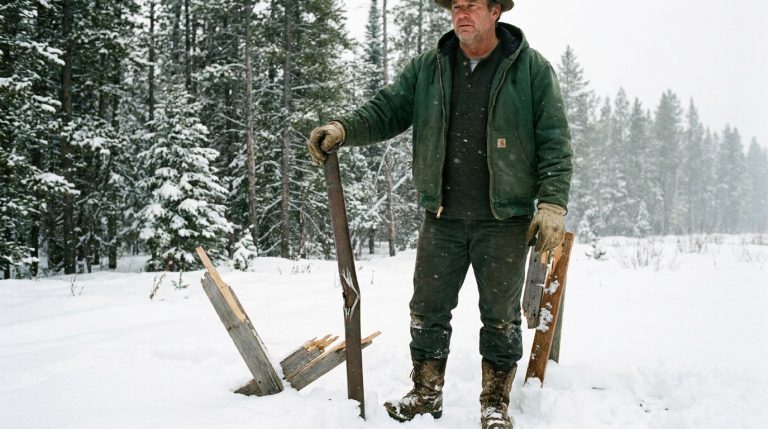
He walked the path. His stride was even, rhythmic, the groove in the grass appearing beneath his feet like a familiar narrative. He reached the fourteenth post.
It stood there, exactly as it had for over a decade: a weathered cedar post, stained by rain and kissed by rot at the base, swaying with that familiar, mocking quarter-inch of give. Wendell stood before it, his hands at his sides. For the first time in eleven years, he didn’t reach for it to test the looseness. He didn’t look for the signal. He looked at the post as a piece of wood, as an anchor for a wire, as the thing that had held his son’s hand on a summer morning long before the recruiter’s call or the silence that followed.
He reached into the back of his truck and pulled out the post driver—a heavy, iron-weighted tool he had kept buried under a tarp in the barn for years. It was heavy, a cold, unyielding weight that required every ounce of his remaining strength.
He lifted it. The swing was practiced, automatic. He brought it down onto the top of the post with a sharp, echoing thud. The wood jolted, settling deeper into the earth. He swung again. And again.
He wasn’t fighting the post. He was finishing the work.
With every stroke, the soil around the base packed tighter. He worked until his breath was a ragged, white plume in the air and his muscles burned with the heat of the effort. He measured the tension, felt the stability of the wire, and delivered one final, decisive blow.
The post stopped swaying. It held firm, immovable, a solid, vertical line against the vast, gray horizon.
He stood back, his chest heaving, the post driver resting at his feet. The pasture was silent, but it was a different kind of silence. It wasn’t the empty, hollow quiet of a missed frequency or a redacted mission report. It was the peaceful, solid silence of a field that was finally, completely, at rest.
He reached into his breast pocket and took out the folded program from Darnell’s commissioning. He didn’t put it back. He walked to the fence line, tucked the paper deep into the gap between the post and the wire, and used a small, sharp piece of fencing wire to secure it in place, shielded from the elements.
It wasn’t a shrine. It was a marker. A record of a flight completed.
He turned toward the house. The sun was cresting the tree line now, painting the fields in a wash of pale, liquid gold. He didn’t look back at the fence line, and he didn’t reach for the radio on his hip. He walked into the kitchen, the door clicking shut behind him with the sound of a period at the end of a long, complicated sentence.
He started the coffee. He watched the light resolve the details of the room—the familiar, worn edges of the counter, the dust on the windowsill, the stillness of the air. He wasn’t waiting for a pulse. He wasn’t waiting for a signal. He was simply waiting for the day to begin.
He poured the coffee, the steam rising in the morning light, and he drank it standing at the window. He was a man who had finally arrived home, the work done, the frequency closed, the post set straight. Outside, the world was alive, moving, and for the first time in his life, he didn’t need to be anywhere else to witness it.
He set the mug down, the sound of ceramic against wood firm and deliberate, and opened the window to let the morning in. The silence remained, but it was no longer a weight. It was simply the world, and he was finally a part of it again.