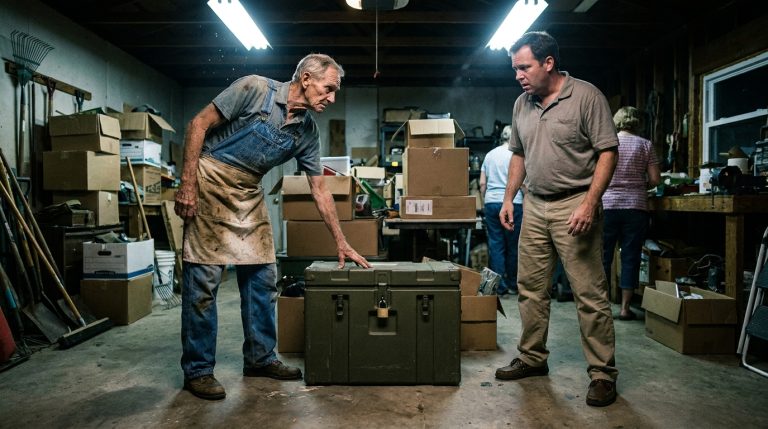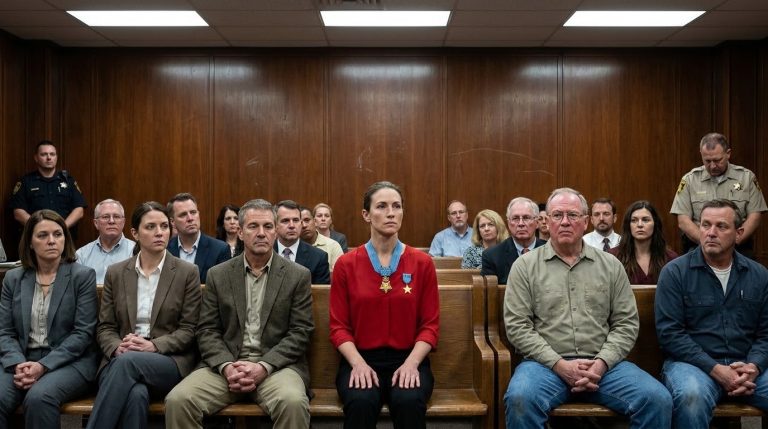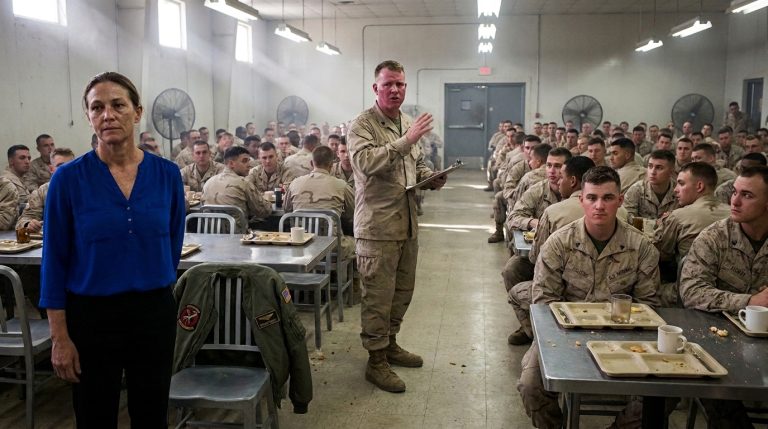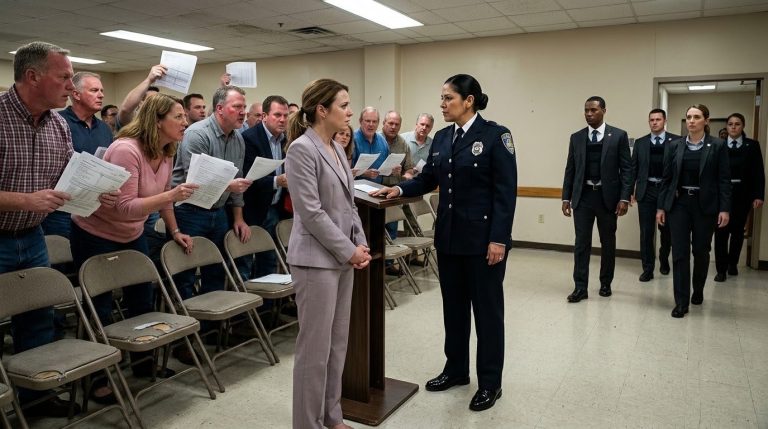
The Concrete Kingdom: A Disabled Veteran’s High-Stakes Battle Against Suburban Tyranny and Hidden Corruption Desert Winds Estates, where manicured lawns hide deeper fractures.. Source: Gregory Clifford / Getty Images
CHAPTER 1: THE BLADE IN THE GRAVEL
“You’re making a mess of my driveway, Brenda.”
The morning air in Desert Winds was razor-thin, carrying the chemical sting of backyard chlorine and cold asphalt. It was 6:47 a.m. The sun hadn’t yet cleared the red-rock horizon, leaving the stucco facades of the neighborhood cast in a flat, metallic gray.
Brenda Clearwater didn’t flinch. She remained crouched on her designer jeans, the heavy steel blade of her box cutter slicing through the final bright orange pathway marker. The plastic shrieked as it split, the orange reflective coating peeling back like dead skin. She stood up slowly, her knees making a dry, clicking sound in the silence.
“These are an eyesore, Miles,” Brenda said. She slid the brass button of the box cutter back with a heavy, deliberate snap. “Desert Winds has standards. If we let every resident with an ache and a pain decorate their walkways like a construction zone, property values would plummet by Tuesday.”
Miles shifted his weight, his fingers tightening inside his pocket around the cool, smooth cylinder of his spent 5.56 brass casing. His left leg felt hollow, a dull, pulsing heat radiating from the shrapnel scars deep in his thigh. The cold morning always made the metal inside him feel heavier.
Behind Brenda, her white Range Rover idle-rumbled, blocking the foot of his concrete driveway like a barricade. The vanity plate, HOA BOSS, gleamed under the streetlamps.
“Those markers are backed by a federal court order, Brenda. They are safety aids,” Miles said, his voice flat, drained of any heat. In the Army, they taught you that anger was a luxury that cost lives. In suburban Phoenix, the rules weren’t much different. “You’re tampering with a judicial accommodation.”
Brenda smiled, a tight, artificial stretching of pale lipstick. “A piece of paper doesn’t change the covenants, conditions, and restrictions of this community. I run this board, Miles. Not a judge in a downtown courtroom.”
She stepped closer, the heels of her boots crunching against the decorative gravel at the edge of his lawn. The scent of her expensive, clinical perfume cut through the desert dust. “You think because you wore a uniform, you get to dictate how my neighborhood looks? You’re a guest here, soldier. And guests follow the rules.”
She turned, her hand reaching for the chrome handle of her idling Range Rover. She didn’t look back as she pulled the heavy door open, leaving the shredded orange plastic scattered across the concrete like autumn leaves.
Miles didn’t move until the taillights of the SUV vanished around the manicured curve of the street. He looked down at his boots. His left foot was slightly crooked, a physical reality he fought every single second of the day. He leaned down, his joints protesting, to gather the ruined markers.
As his fingers brushed the cold, fractured plastic near the edge of his property line, something glinted in the gray gravel—a small, dark object that didn’t belong in the desert dirt. He picked it up.
It was a heavy, silver keycard. Embossed in small, red lettering across the top were the words: Novapharm Research Facility – Restricted Access. Beneath the name was a typed label: B. Clearwater.
Miles stared at the card. Brenda had retired from pharmaceutical sales five years ago. Yet the plastic card was pristine, unscratched, and still active enough to hum with static against his skin.
CHAPTER 2: THE DECK IS STACKED
The plastic edge of the keycard bit into the meat of Miles’s palm as he squeezed it shut. It was cold—colder than the high-desert air settling over the stucco rooftops of Desert Winds Estates. He stared down the empty street where the exhaust of Brenda’s white Range Rover still hung in a faint, sour mist. The silence returned in waves, broken only by the rhythmic, mechanical clicking of a neighbor’s automated sprinkler head three houses down.
He walked back up his concrete driveway, his left boot scraping a dry, uneven path through the loose gravel. His thigh throbbed, the old shrapnel ache acting as a biological barometer for the rising morning heat. Inside the house, the hallway was dark and smelled faintly of lavender and ground espresso.
Carmen was at the kitchen island, her hair pulled back into a tight nurse’s bun. She was still wearing her dark blue scrubs from the night shift, her eyes lined with the gray shadow of exhaustion. She didn’t ask what happened. She simply looked at the shredded orange plastic tucked under his arm, then down at his uneven stride.
“She did it again,” Carmen said. It wasn’t a question.
Miles set the ruined pathway markers on the granite countertop. Without a word, he placed the silver Novapharm keycard next to them. The red lettering gleamed under the under-cabinet LED lights.
Carmen picked up the card, turning it over. Her thumb traced the embossed lettering. As a trauma nurse, she recognized the name instantly. “Novapharm doesn’t have a retail division in Arizona. They’re a heavy-containment research outfit. Mostly clinical trials and high-end synthetic distribution. Why does a retired pharmaceutical sales rep have a restricted active pass?”
“She dropped it when she was tearing up my court-ordered markers,” Miles said. He pulled out a barstool, the metal legs scraping sharply against the tile floor as he sat. He reached into his pocket and placed his primary defense on the counter: a slim, black digital audio recorder. “I got her on tape. Every word. Arizona is a one-party consent state, and she practically sang for the microphone. She admitted she knew about the federal court order and explicitly stated she was destroying them to protect property values.”
Carmen leaned against the counter, her expression tightening. “It’s enough for a civil rights violation under the Fair Housing Act. But Miles, look at this card. Look at the logo.”
Miles leaned closer. In the bottom corner of the silver plastic, beneath Brenda’s name, was a microscopic, stylized shield emblem. Inside the shield was a stylized letter A.
“Aegis,” Miles muttered, his eyes narrowing. “The logistics contractor. I did some freelance network security auditing for one of their regional hubs last year. They handle high-value freight tracking. Why is a logistics shield on a research facility card?”
“I don’t know,” Carmen said, her voice dropping to a guarded whisper. She tapped the card against her palm. “But when I was charting inventory at the hospital last night, I noticed some discrepancies in our medical waste and surplus liquid drug disposals. The transport manifests were signed off by a third-party subcontractor. Aegis Logistics.”
Miles felt a cold, familiar knot tighten in his stomach—the same hypervigilant instinct that used to keep him alive on the paved roads of Kandahar. In the military, you didn’t look at isolated incidents; you looked for patterns. Brenda wasn’t just a petty suburban dictator obsessed with lawn height. The fanatical control, the systemic harassment of his family, the absolute refusal to allow any non-standard modifications to his walkway—it wasn’t about the neighborhood’s aesthetics. It was about surveillance, keeping the environment static, and keeping his eyes off the ground.
“We need to dig into the HOA financial records,” Miles said, his finger tapping the black recorder. “If she’s working with Aegis, she’s using the neighborhood’s accounts to mask something. A community of eighty hundred homes is a lot of hidden transactions.”
“Dale Pinkerton has the ledger locked in his home office,” Carmen reminded him, her brow furrowing. “He’s the board treasurer. He’s completely loyal to her.”
“Everyone has a breaking point, Carmen,” Miles said, his voice quiet, flat, and transactional. He picked up the keycard and slipped it back into his pocket, his knuckles brushing against the smooth brass shell casing he always carried. “Dale is an accountant. He cares about numbers, but he cares about self-preservation more. I’m going to start pulling the public property filings for every home Brenda’s targeted with fines over the last year. Let’s see where the money actually goes.”
He stood up, his bad leg locked tight, his gaze fixed on the quiet desert street outside their window. The battle lines were drawn, and Brenda had no idea he had just recovered her queen.
CHAPTER 3: THE DRIFT IN THE NUMBERS
Miles’s eyes remained locked on the quiet suburban street through the kitchen blinds. The morning light was gaining strength, cutting sharp, blinding lines across the dark granite island. The silver keycard rested on the counter next to his digital recorder, a silent testament to a conspiracy far deeper than broken plastic walkway markers.
“If she’s laundering or moving assets through our accounts, she’s not doing it alone,” Carmen murmured, her fingers still tracing the microscopic Aegis shield on the edge of the plastic. “Dale Pinkerton oversees the audit reports. He’s meticulous, Miles. If there’s a dollar missing, or a dollar too much, he knows exactly where it sits.”
Miles didn’t answer immediately. He walked over to the wooden cabinet near the pantry, his left knee giving a dull, dry click as he put pressure on it. From a lower shelf, he pulled out his laptop, laying it flat on the kitchen island beside his recorder. He opened a secure virtual private network.
“Last year, when I did the security audit for Aegis’s local tracking databases, I saved a baseline profile of their standard digital routing codes,” Miles said, his fingers moving methodically across the keyboard. “They use automated inventory logs. Everything has a digital footprint. Every shipment of high-end pharmaceutical waste, every disposal run. If Dale is masking their operations under local landscape maintenance, there has to be an entry point.”
“Where do we start?” Carmen asked, leaning over his shoulder. Her uniform smelled faintly of hospital antiseptic, a stark contrast to the scent of the desert dust rising outside.
“The public HOA tax filings for Desert Winds,” Miles replied. He bypassed the community’s public-facing portal and accessed the Arizona Corporation Commission’s database. “The community has an annual operating budget of nearly nine hundred thousand dollars. Most of it is earmarked for gate maintenance, pool chemicals, and the master landscaping contract with a firm called Desert Oasis Solutions.”
He tapped a key, pulling up the digital ledger from the previous fiscal year. “Look at the transaction history. Desert Oasis Solutions receives twenty-two thousand dollars every month. But look at the routing number.”
Miles zoomed in on the electronic transfer detail. Behind the merchant name was an administrative sub-tag: Ref: File Code 10-Alpha.
“File Code 10-Alpha,” Carmen read aloud, her voice tight. “That’s not an HOA filing code. That’s a clinical trial transport code. I’ve seen it on the hazardous medical waste sheets at the trauma center. It’s used to track high-potency research material through customs.”
“And the processing bank isn’t local,” Miles said, the flat green light of the screen reflecting off the sharp angles of his face. “It’s routed through a clearinghouse in Delaware, masked under the Aegis Logistics corporate umbrella. Brenda isn’t just skimming from the pool fund to fix a drainage leak. She’s leasing this entire development’s financial infrastructure to hide the movement of materials for Novapharm.”
He sat back, his chest rising and falling in a slow, calculated rhythm. The scale of the deception was breathtaking. The endless fines, the aggressive policing of resident property, the constant threat of foreclosures for minor violations—it was all a smoke screen designed to keep residents terrified, compliant, and isolated. A fractured neighborhood didn’t ask questions. They didn’t look at the landscaping trucks that rolled through the community gates at three in the morning.
“This is our leverage,” Carmen said, her voice trembling slightly. “If we take this to the local police—”
“No,” Miles interrupted, his tone sharp as broken glass. “Local police will handle this as a domestic dispute or a white-collar discrepancy. They don’t have the jurisdiction to touch Aegis, and Brenda would have the records wiped before a local deputy could draft a warrant. We need to go higher. And we need to break Dale first.”
He reached into his pocket, his knuckles grazing the smooth, cold brass casing of the 5.56 round. “Dale is an accountant. He understands risk-reward. If I show him this routing slip, he’ll realize Brenda has left him holding the bag when the federal inspectors look at File Code 10-Alpha.”
He closed the laptop with a soft, decisive snap, the screen’s glow vanishing from the room. The morning sun had fully cleared the horizon, flooding the desert sky with an unforgiving, high-contrast glare. It was time to pay Dale Pinkerton a visit.
CHAPTER 4: THE LEVERAGE IN THE DUST
The plastic latch of the laptop case cracked like a dry twig in the quiet kitchen. Miles stood up, his bad knee stiffening instantly, demanding a hard, uneven correction in his posture. He reached out and snatched his car keys from the counter. The metal edges dug deep into his palm—a grounding, physical pain that kept the phantom aches of his leg at bay.
“I’m coming with you,” Carmen said, her voice dropping an octave as she stepped in front of the kitchen exit.
“No,” Miles said. He didn’t raise his voice, but the flat, military cadence left no room for negotiation. “Dale is fragile. If he sees a nurse, he thinks of a witness. If he sees just me, he thinks of a calculation he can still survive. Stay here, keep the digital recorder active on the network, and watch the street camera feeds.”
He passed her, his shoulder lightly brushing hers, the clean smell of her hospital soap a fleeting contrast to the dry heat waiting just beyond the front door.
When Miles stepped outside, the desert had changed. The clear, sharp morning sky was gone, replaced by a low, amber-tinted haze crawling over the ridges of the Phoenix mountains. A seasonal haboob was rolling in from the south, carrying a wall of fine, static-charged dust that hissed against the stucco walls of Desert Winds Estates. The wind had already picked up, whipping dry palm fronds across the asphalt.
Miles walked with a deliberate, dragging rhythm down his driveway, his eyes narrowed against the grit. His left leg felt like a rusted pillar, but he didn’t slow down. He traversed the distance toward the community park—the desolated green patch where Dale Pinkerton walked his purebred spaniel every morning at precisely seven-thirty.
By the time Miles reached the edge of the dry grass, the dust storm had swallowed the sun. The park’s playground was empty, the metal swings swaying and creaking in the rising wind. Through the yellow fog, a small, hunched figure emerged near the concrete gazebo, clutching a leash.
Dale Pinkerton wore a spotless windbreaker, his thin hair plastered to his forehead by the sudden wind. He was checking his watch, his fingers twitching against his sleeve, when Miles’s uneven silhouette broke through the haze.
“Miles,” Dale said, his voice instantly swallowed by the wind. He pulled the spaniel closer to his leg. “Bad morning for a stroll. The storm is coming in fast.”
“The storm’s already here, Dale,” Miles said. He stopped five feet away, his boots planted firmly on the cracked concrete path of the gazebo. He didn’t offer a hand. He simply reached into his pocket and pulled out his phone, displaying the zoomed-in routing sheet from the Arizona Corporation Commission database. “I think you dropped some paperwork.”
Dale squinted through his wire-rimmed glasses, leaning slightly forward. His eyes darted across the screen, tracking the payment routes, the Delaware clearinghouse address, and the specific reference line: File Code 10-Alpha.
The accountant’s face didn’t just pale; it seemed to cave in. His fingers tightened on the dog leash until his knuckles went white. “Where did you get this?”
“The state database is public, Dale. But the connection to Aegis Logistics isn’t,” Miles said, his voice cold and steady. The wind howled around the metal
CHAPTER 4: THE SQUEEZE IN THE PARK
The laptop lid settled into its groove with a muted plastic click, leaving only the hard morning glare bouncing off the tile floor. Miles didn’t pause. He grabbed his keys from the granite counter and slipped the black audio recorder into his jacket pocket.
“I’m going with you,” Carmen said, her hand reaching out, her fingers catching the stiff fabric of his sleeve.
“No,” Miles replied. He stopped, looking down at her hand, then up into her tired, shadowed eyes. His voice remained quiet, leveled by military discipline. “If we both go, it looks like a confrontation. If I go alone, it’s a neighborhood dispute. It keeps Dale off-balance. I need you here monitoring the database traffic. If he tries to access the Aegis servers to scrub File Code 10-Alpha, you’ll see the spike.”
She hesitated, her grip tightening for a brief second before she slowly let go. “Keep your phone line open,” she warned. “Dale isn’t a fighter, but he’s desperate.”
Miles nodded once, stepped out through the front door, and entered the dry, unforgiving morning air. The heat was already rising off the concrete, shimmering slightly at the margins of the asphalt. Instead of taking his truck, he walked down the driveway. Every step sent a jolt of dry friction through his left hip, his boot heels striking the pavement with a rhythmic, mechanical crunch. He needed to be on foot. He needed Dale to see him coming from a distance, measuring the physical space between them.
He bypassed the main thoroughfare of Desert Winds, taking the narrow gravel path that wound through the community park. The park was a barren, xeriscaped patch of dry turf and decorative boulders, surrounded by a rusted iron fence.
There, near the edge of the playground, Dale Pinkerton was walking his golden retriever. Dale was fifty-four, his posture stooped from decades of desk work, wearing a starched polo shirt that looked absurdly clean against the dusty desert backdrop. He was holding a plastic bag in one hand and a tennis ball launcher in the other.
As Miles approached, the golden retriever pricked its ears and let out a low bark. Dale turned, his hand freezing on the handle of the launcher. His face, already flushed from the morning heat, grew visibly pale as he recognized the uneven, heavy stride.
“Miles,” Dale said, his voice carrying a nervous, high-pitched vibration. He tried to adjust his wire-rimmed glasses, but his fingers slipped against the sweat on his temple. “Good morning. If you’re out here about the path markers, Brenda’s already handled that. It’s a closed board matter.”
“It’s not about the markers anymore, Dale,” Miles said. He stopped exactly six feet away, utilizing his stature to shadow the smaller accountant. His posture was rigid, his weight balanced heavily on his good right leg. “It’s about the ledger. Specifically, the transfer records to Desert Oasis Solutions.”
Dale’s hand twitched, the ball launcher dipping slightly toward the dirt. “I don’t know what you’re talking about. The landscaping contract was approved by a majority vote two years ago. The records are public.”
“The records are dummy files, Dale,” Miles said. He took a step closer, his shadow completely covering Dale’s boots. “But the routing numbers are real. They route through an Aegis Logistics clearinghouse in Delaware. File Code 10-Alpha. I spent three hours this morning mapping the transaction history. You’re signing off on clinical trial transport payments and labeling them as lawn maintenance.”
A gust of dry wind kicked up, rattling the chain-link fence of the tennis courts behind them. A sudden, sharp crack sounded nearby as the park’s automated irrigation controller box sputtered, its plastic door swinging open with a screeching metallic whine, spraying a sudden, misted jet of water over the gravel path. Neither man blinked.
Dale’s breath hitched, the sound wheezing in his chest. “That’s… that’s standard corporate restructuring. It’s perfectly legal.”
“It’s wire fraud, embezzlement, and a direct violation of federal transportation laws regarding hazardous materials,” Miles said, his voice dropping to a harsh, transactional whisper. “The FBI is already tracking the logistics logs under Novapharm. When the warrants drop, they aren’t going to look at Brenda’s Range Rover. They’re going to look at the treasurer who signed the authorization sheets. That’s you, Dale.”
The accountant’s eyes darted toward the street, his chest heaving under his thin polo. “I just… I just balance the books. Brenda told me it was a tax mitigation strategy for the developer. She said it kept our monthly dues low.”
“She lied,” Miles said, pulling the silver keycard from his pocket and letting it catch the glare of the desert sun right in Dale’s field of vision. “She’s laundering for Novapharm, and she used your signature to build the wall between her and the federal prison. You have forty-eight hours before the grand jury convenes. You can either stay on her sinking ship, or you can hand me the unedited ledger from your home server today.”
Dale stared at the silver card, his mouth opening and closing like a landed fish. The dog tugged at the leash, but Dale remained frozen, his knuckles white around the plastic launcher. “If I give you the real files… if I show you the Aegis portal…”
“Then I tell the agent in charge that you were a cooperative witness,” Miles said, his eyes cold and unwavering as the steel pins in his leg. “Make your choice, Dale. Because tomorrow, the price of admission goes up.”
CHAPTER 5: THE OUTPOST IN THE SAGE
The plastic folder Dale Pinkerton pushed into Miles’s hands was cheap, translucent, and smelled faintly of stale garage air. Inside lay the physical backups—the hard decryption keys to the local server partition and the unredacted digital ledger of Desert Winds Estates.
“Take them,” Dale had whispered, his voice cracking as his golden retriever whined, sensing the terror radiating from the leash. “Just keep me out of the main indictment. Brenda has friends, Miles. Real ones. Not just people on the board.”
Miles hadn’t answered. He had simply taken the folder, turned on his heel, and let his uneven stride carry him back to his truck. Every step felt like grinding bone, his leg pulsing under the weight of the heat. But he didn’t stop.
Now, the heavy diesel engine of his truck rumbled beneath him, the steering wheel vibrating against his palms. The sky had turned a bruised, copper purple, choked by the oncoming dust storm. He drove north, past the neat, stucco margins of the developments, where the manicured lawns dissolved back into the dry, stony dirt of the Phoenix basin. The smell of hot asphalt and ozone coming through the vents made his throat tight, triggering a sudden, intrusive memory of a dusty bypass road outside of Lashkar Gah—the same heavy sky, the same prickle of static on his skin before the ground tore open.
He squeezed the steering wheel tighter, pushing the phantom back down. He kept his eyes on the dirt turnout.
Ahead, parked beside a clump of withered saltcedar, sat an unmarked black utility vehicle. Its lights were doused. The metallic glare of the desert sun hit its windshield, turning it into an opaque sheet of silver. Miles pulled his truck off the asphalt, the tires crunching loudly over gravel and broken glass. He cut the ignition. The sudden silence of the engine was replaced by the low, hollow whistle of the desert wind.
Miles opened his door and stepped down. He held the translucent plastic folder tight against his ribs, his knuckles white.
The door of the black utility vehicle clicked open. A man in a dark, dust-streaked polo shirt stepped out. Agent Walsh was lean, his features sharp and angular, his eyes shielded by dark, military-issue glasses that reflected the desolate flats around them. He didn’t look like a bureaucrat; he looked like a hunter who had spent too much time in the sun.
“You’re late, Miles,” Walsh said, his voice flat, competing with the rustle of the wind through the dry scrub.
“The wind was picking up,” Miles said. He approached the front of the vehicle, his left boot dragging slightly through the loose sand. He placed the folder onto the warm hood of Walsh’s car. “This is Dale Pinkerton’s internal server log. It details the transfer routing under File Code 10-Alpha. It’s all there—every transaction routed through the Aegis Logistics clearinghouse.”
Walsh didn’t touch the folder immediately. He stared at Miles, his expression unreadable behind the dark lenses. “You went around us to get this. We told you to stay quiet and let the paper trail build.”
“Brenda destroyed the pathway markers,” Miles said. His voice was cold, transactional. He pulled his hands back, resting them near his pockets where his smooth brass shell casing lay. “She was trying to isolate us. If I waited for your paper trail to build, she would have cleaned those accounts and vanished before the annual meeting on Friday. This folder doesn’t just show the landscaping fees. It shows the kickbacks. It shows the direct transfers from Novapharm accounts.”
Walsh reached out, his gloved hand flipping the plastic cover open. He ran a finger down the printed routing sheets, his eyes moving rapidly. “And Dale?”
“He’s broken,” Miles said. “He signed everything because he wanted to survive. He’s ready to testify. But you have to move fast. Brenda has a keycard that doesn’t belong to a retired sales rep. It’s an active clearance pass for the Novapharm research facility.”
Walsh paused, his head snapping up. The wind caught his collar, snapping the fabric against his neck. “Are you sure about the status of the card?”
“I held it,” Miles said, the memory of the cold plastic sharp in his mind. “It has the Aegis logistics shield embossed on the corner. She didn’t just coordinate the money, Walsh. She was coordinating the physical shipments through our gates. The HOA accounts were just the laundry mat.”
Walsh closed the folder with a sharp, heavy thud. He looked out over the dusty horizon, where the lights of Phoenix were beginning to blink on through the amber haze. “The annual meeting is in forty-eight hours. She thinks she’s going to stand up in front of the community and vote to foreclose on your house for non-compliance.”
“Let her try,” Miles said, his jaw tightening. “I want her to think she’s winning until the moment the doors lock.”
Walsh nodded slowly, slipping the folder under his arm. “Get back to your house, Miles. Lock your doors. We’re going to coordinate with Judge Hernandez’s office to get the federal warrants signed by tomorrow morning. When she steps into that community center on Friday, she’s walking into a net.”
Miles didn’t wait for a farewell. He turned back toward his truck, his bad leg complaining with every shift of his weight on the shifting gravel. He could feel Walsh’s gaze on his back, but his mind was already moving ahead, calculating the variables for Friday night. The battle was no longer in the courts. It was in the room, and he was going to make sure Brenda Clearwater saw the face of the man who brought down her kingdom.
CHAPTER 6: THE RECKONING IN BLUE
The deadbolt of Miles’s front door turned with a dry, heavy metallic rasp, locking out the howling Arizona wind. The air inside the house was cold, thick with the silence of a staging area before dawn. Carmen sat at the dining table, her fingers poised over the keyboard, her screen reflecting a pale blue cast onto her tired face.
She looked up, noting his uneven gait, the stiffness in his left hip. “Is it done?”
Miles laid the black audio recorder flat on the dark wood next to her. “Walsh has the files. The warrants are being signed by Judge Hernandez right now. Friday’s meeting starts in exactly twelve hours. We wait.”
For those twelve hours, time did not skip. It dragged across the desert, marked by the slow, shifting angle of the copper-colored dust storm outside. Miles did not rest. He sat in the dark living room, his fingers methodically rubbing the worn surface of his brass shell casing, keeping his breath even, his mind locked in a silent tactical rehearsal.
At 6:30 p.m., the wind finally died, leaving the Desert Winds community center bathed in a sickly, sulfur-yellow twilight.
Miles parked his truck in the gravel lot. When he opened the door, his bad leg almost buckled, the joint grinding under the pressure of twelve hours of anticipation. He forced himself to stand straight, adjusting his black jacket, and walked inside.
The community center smelled of damp floor wax and old coffee. Over fifty residents sat in rows of metal folding chairs, their voices a low, anxious murmur beneath the hum of flickering fluorescent tubes.
At the front of the room, behind a long folding table, sat Dale Pinkerton and Brenda Clearwater. Dale was hunched, his eyes fixed on his yellow legal pad, a fine bead of sweat glistening on his upper lip. Brenda, however, sat like a queen. Her hair was perfectly coiffed, her white silk blouse pristine, her fingers tapping lazily on a polished oak gavel.
“Quiet down, everyone,” Brenda’s voice echoed through the cheap PA speakers. She cracked the gavel once against the wood. “Let’s begin. Our first item of business is the foreclosure hearing for Lot forty-seven. We have repeated, unmitigated design code violations. We cannot allow non-standard, orange safety markers to compromise our property standards.”
She looked directly at Miles, her eyes hard, empty of empathy. “Miles, you have three minutes to state your case before the board votes to initiate the lien.”
Miles stood up. He didn’t rush. The scraping of his metal chair legs against the concrete floor made several people winced. He walked down the center aisle, his heavy, uneven tread echoing through the quiet hall.
“I don’t need three minutes, Brenda,” Miles said. He stopped five feet from her table, his shadow falling across her documents. “And I’m not here to talk about my walkway.”
Brenda’s lipstick-drawn smile didn’t waver. “If you’re not going to address the violations, you’re out of order.”
“Let’s talk about Aegis Logistics,” Miles said, his voice flat, cutting through the hum of the air conditioning. “Let’s talk about how the twenty-two thousand dollars our community pays monthly to Desert Oasis Solutions is actually routed to a Delaware clearinghouse under File Code ten-Alpha.”
A collective rustle went through the crowd. Brenda’s eyes narrowed to tiny, dark slits. “That is confidential board business. You have no right—”
“I have the unredacted ledgers, Brenda,” Miles interrupted, gesturing to the projection screen behind her.
From the back of the room, Carmen tapped a key on her laptop. The screen flared to life, displaying a massive, interlocking web of bank routing numbers, shipping manifests, and highlighted names.
“You weren’t maintaining our common areas,” Miles continued, his fingers resting on the edge of the board’s table. “You were using the HOA accounts as a laundering conduit for Aegis Logistics to mask the distribution of synthetic chemical trials for Novapharm. This neighborhood wasn’t a community to you. It was a clean cover for your old distribution network.”
Brenda’s composure cracked. She stood up, her hand flying to her pocket, her voice rising to a sharp, panicked screech. “This is a fabrication! Dale, tell them. Dale, show them the audits!”
Dale Pinkerton didn’t look up. He slowly pushed his glasses up his nose, his voice barely a whisper. “The files are real, Brenda. I gave them the decryption keys.”
Brenda spun on him, her fingers curling into claws. “You coward—”
The heavy double doors at the back of the community center slammed open.
The sound of several heavy leather boots striking the concrete floor cut her off. FBI Agent Walsh entered first, his windbreaker displaying the gold agency lettering, followed by two armed federal marshals. Beside them walked Judge Patricia Hernandez, her face grim.
“Brenda Clearwater,” Walsh’s voice rang out, cold and absolute. “Step away from the table. We have a federal warrant signed by Judge Hernandez for your arrest under charges of wire fraud, embezzlement, and civil rights violations under the Fair Housing Act.”
Brenda froze, her chest heaving, her eyes darting toward the emergency exit behind the stage. She took a step back, her heel catching on her chair, but a federal marshal was already behind her, his hand firmly locking around her wrist. The heavy steel handcuffs clicked into place with a dry, final snap.
The room erupted into a wall of sound—shouts of disbelief, gasps, and the scraping of chairs as neighbors stood up. Brenda was led down the center aisle, her face twisted in a silent, venomous glare as she passed Miles.
Miles didn’t smile. He watched her go, his hand sliding into his pocket, his fingers releasing the smooth brass casing. He didn’t need the weight of it anymore.
The cool-down of the evening was swift. By 9:00 p.m., the community center had emptied. The heavy hum of the fluorescent lights seemed softer now, almost peaceful.
Miles walked slowly down his own concrete driveway, the desert air cool against his face. The orange pathway markers were gone, but the path itself was clear, illuminated by the soft, warm light of his home.
He sat on the low stucco wall of his porch. From his pocket, he pulled out a small screwdriver and a fresh, solid rubber reflective stud. He leaned down, his joints quiet in the cool night, and carefully screwed the first of his new, low-profile safety markers into the concrete. It was neat, unobtrusive, and permanent.
Carmen came out, holding two mugs of warm coffee, and sat beside him, resting her head against his shoulder.
“It’s quiet,” she whispered.
Miles took a sip of the coffee, feeling the warmth spread through his chest, grounding him. He looked down at his crooked left leg, then out at the dark, peaceful street of Desert Winds. The battle was over. The ground beneath his feet was finally his own.