The Subterranean Ledger: A Blueprint for Blue-Collar Retribution
CHAPTER 1: THE DRIVEWAY SEVERANCE
“This unsightly cable was violating community aesthetics, Mr. Miller,” she said.
The yellow bolt cutters sat heavy in Karen Peterson’s grip, the jaws smeared with the greasy residue of industrial insulation. At her feet, the thick black line lay parted in the dry dust of the driveway, its copper core exposed like clean, bright bone.
Frank Miller didn’t move. The diesel engine of his truck gave a rhythmic, metallic click behind him as it cooled, the sound micro-timed against the sudden, absolute silence of the property. The industrial lathe inside the shop had died mid-rotation. The persistent three-phase hum that had underpinned his retirement for eighteen months was gone, replaced by the dry rustle of summer oak leaves against the metal roof.
Twenty years in the Marine Combat Engineers taught a man to read a site from the ground up. He didn’t look at her face; he looked at the tool. Bright yellow, heavy-duty, rated for hardened steel locks. She hadn’t found them in a kitchen drawer. She had bought them for this specific thickness of copper.
“Karen,” he said, his voice flat, retaining the low, level cadence used when assessing unexploded ordnance in a ditch. “Put the tool down. Step two feet back from the trench.”
“The board gave you notice, Frank. Industrial activity is strictly prohibited in residential zones under Section 4-B.” She didn’t drop the cutters. She held them across her chest like a rusted piece of ceremonial armor, her fingers twitching against the rubber grips. “We maintain standards here. If you won’t clear the common property easement, the association will do it for you.”
Frank reached into his canvas work vest, his fingers brushing the cool, laminated edge of the surveyor’s plat map tucked into the interior pocket. He didn’t pull it out. The data was already logged behind his eyes: ten-foot utility easement, grandfathered commercial allowance, county permit number 88-104.
He unclipped the phone from his belt. The glass screen was scratched from iron filings, but the lens was clear. He raised it, the steady green indicator recording the damp trench she had cleared with a garden spade, the severed 200-amp line, and the white letterhead paper sticking out from her pocket.
“You’re recording,” she said, her head tilting, the smug symmetry of her expression tightening at the edges.
“Every frame,” Frank said.
A low rumble vibrated through the asphalt five minutes later—the emergency response truck from the county utility grid. When the technician climbed down, his boots crunched on the gravel near the trench. He looked at the cable, then at the cutters, his face losing its color under the midday glare.
“Jesus lady,” the lineman muttered, stepping back toward his rig. “That’s live three-phase. You’re one dry day away from leaving your shoes melted into the dirt.”
The police cruiser arrived without its siren, the tires throwing up grey dust as it angled against Frank’s truck. The officer didn’t look at the binders Karen began to draw from her bag. He looked at the property stakes, the clear, clean cut of the line, and the yellow metal tool still resting against the fence post where she had set it.
Within thirty seconds, the metal rings closed around her wrists with a dry, double-click. Karen didn’t scream; she looked back over her shoulder as they angled her into the vinyl rear seat, her eyes fixed not on Frank, but on the specific spot where the severed cable disappeared beneath the property line into Parcel 402-A.
Frank stayed by the trench long after the cruiser left, the afternoon light catching the exposed copper strands as they began to dull in the open air.
CHAPTER 2: THE HUM OF THE GENERATOR
The red and blue light vanished from the perimeter fencing, leaving the driveway in a flat, heavy glare. Frank didn’t look up as the dust from the cruiser settled onto his boots. His attention remained three feet down, where the raw, jagged ends of the 200-amp cable caught the white heat of the three o’clock sun. The utility technician had already pinned a neon-orange tag to the main breaker box outside the workshop—Hazardous Condition: Disconnected by Authority—before packing his meters and leaving the corner lot to the silence.
It was a specific kind of quiet. For eighteen months, the background radiation of Frank’s life had been the low, steady sixty-cycle vibration of three-phase power flowing through the concrete slab under his boots. Without it, the metal building felt like a shipping container left out in the weeds. The air inside the office portion was already beginning to thicken, the ventilation fans dead in their housing.
Frank squatted, his palms resting on his knees. He evaluated the ditch. Karen had dug poorly—the trench was shallow, erratic, violating every safety protocol in the civil engineering manual—but the damage was total. The conduit was shattered, the PVC sheared into white, jagged teeth that bit into the black rubber jacket of the wire. Repairing this wasn’t a matter of splicing copper; it required a complete pull from the main transformer box near the county road, a ninety-foot run through packed clay.
He stood up, his joints popping in the dry air, and walked to the back of his flatbed truck. Ten thousand dollars in outstanding commercial orders sat on the floor of the shop: structural brackets for a historical restoration downtown, three custom iron gates for an estate three miles north. Deadlines didn’t calculate for neighborhood board presidents.
He unhitched his phone, dialed the commercial rental yard on Highway 9, and kept his voice transactional. “Miller Fabrication. I need a trailer-mounted industrial diesel unit. Forty kilowatt, minimum. Three-phase distribution block. Deliver to the Oak Creek corner lot within ninety minutes.”
The delivery truck arrived just as the shadows of the oaks began to stretch across the gravel driveway. The driver, a young kid with grease on his forehead, backed the massive yellow generator unit onto the grass line, unhooking the hitch with a metallic clang that echoed off the shop’s corrugated walls.
“She’s full of low-sulfur diesel, Mr. Miller,” the kid said, wiping his hands on a rag. “But she’s loud. Standard industrial mufflers, but in a tight residential pocket like this? You’re going to hear it.”
“I need the turn-key,” Frank said, handing over the clipboard after signing the liability waiver.
Ten minutes later, Frank wrapped his fingers around the heavy iron handle of the generator’s manual starter. He primed the fuel line, checked the oil pressure gauge, and pulled the toggle. The engine caught with a violent, smoky cough, the big four-cylinder block settling into a rhythmic, deafening roar that vibrated the gravel under his soles. He dragged the heavy rubber distribution cables across the grass, linking them directly to the shop’s external transfer switch.
Inside, the overhead fluorescent banks flickered, hummed, and then stabilized into a cold, hard light. The lathe’s cooling system whined as the pumps primed. Power was restored, but it wasn’t clean; it was mechanical, noisy, and expensive—costing eighty dollars a day in fuel alone.
As Frank stepped back into the driveway to adjust the exhaust flap, he noticed a crisp piece of white paper tucked under the wiper blade of his flatbed. The ink was fresh, the text printed in the clean, corporate font of the Oak Creek Estates HOA.
VIOLATION NOTICE: Section 9-C (Unauthorized Industrial Equipment).
Fine Schedule: $100 per calendar day until removal.
Signed: The Executive Board.
Frank held the paper by its edge, his thumb leaving a faint smudge of diesel soot on the white margin. He looked toward the house across the street—the blinds in Karen’s living room were drawn tight, the windows dark under the eaves, but the silhouette of an old land surveyor’s boundary post near her curb looked slightly out of alignment. Near the lower edge of the violation notice, printed in tiny, gray font near the legal disclaimer, was a small routing number labeled Meridian Ref: 402-A.
He didn’t tear the paper. He walked into the shop, opened a fresh, grey plastic binder, and slid the notice into the first transparent sleeve. The war hadn’t ended with the handcuffs; it had simply shifted from the dirt to the ledger.
CHAPTER 3: THE COLD BUREAUCRACY
The transparent plastic sleeve crackled slightly as Frank slid the paper into place. The ink on the notification page looked dark against the grid line background of his ledger book, a small blot of calculated malice sitting right below the signature line. Outside, the vibration of the rented generator continued to punch regular, heavy thuds through the concrete anchor pins, its sound filtering into the small, wood-paneled office space like a low-frequency storm.
Frank didn’t sit down at the desk. Instead, he unrolled the large, grease-stained layout map of Oak Creek Estates directly onto the zinc-topped workbench, anchoring the corners with two heavy iron alignment blocks from the shop floor.
The letterhead paper was stiff between his thick fingers. When he flipped it over to check the watermarking, his thumb caught on an indentation. There was a faint carbon tracing on the reverse side—the mechanical imprint of a ballpoint pen pressing through from a sheet that had been resting above it on a legal pad. It wasn’t standard corporate text. It was a sequence of crude surveyor coordinates, scribbled in a tight, geometric hand: N 45° 22′ W, 114 feet from intersection point 02-B. Below it, the word Meridian had been underlined three times until the paper fibers had frayed into white fuzz.
He picked up a high-intensity flashlight, angling the white LED beam across the back of the document until the raking light revealed the full depth of the pressure marks. It wasn’t a standard community violation log. It read like a blueprint for an extraction corridor.
Frank reached into the steel cabinet behind him, drawing out three thick, industrial-grade binders he had purchased from the county surplus outlet. The covers were a faded, matte green, the spines reinforced with coarse canvas tape. These were his defense perimeters.
Methodically, he began to execute his first return volley. He did not draft an emotional appeal; he opened the formal county regulatory code manual to Chapter 12, Section 4, which dictated the precise structural tolerances required for secondary noise-containment units within municipal limits. If the association wanted to claim the generator was an unauthorized industrial nuisance, they would have to prove its decibel level exceeded eighty-five units at a distance of fifteen feet from the property line—a parameter Frank had already checked by placing the machine precisely twelve inches inside his own engineering stake line.
His heavy metal pen scratched against the clean white response forms, the sound dry and sharp against the backdrop of the engine roar. To the Board of Directors, Oak Creek Estates, he wrote, his handwriting clean, angular, and devoid of stylistic flourish. Pursuant to State Property Code Title 7, Chapter 42, please find attached formal disputation of Citation Ref: 402-A. Demand is hereby made for a full evidentiary review panel within fourteen business days.
He knew how committees operated. They were built on the assumption of friction-free compliance. If a target gave them a flat surface, they slid over it. If the surface was covered in jagged, highly specific procedural barbs, the gears began to lock.
Frank checked his watch. It was four in the afternoon. The afternoon sun had left the front window, moving behind the long row of pines that separated his corner lot from the common greenspace. The light inside the room turned a pale, desaturated blue, catching the fine iron dust that floated near the shelves.
He compiled four identical packets, each sealed inside a heavy manila folder with reinforced fiber tabs. One for the county records office, one for the HOA archive, one for the police department file clerk to append to the property damage report, and one to remain inside his own steel drawer. Every single sheet was stamped with a professional, red-ink date marker he had brought home from his logistics tour in Cherry Point.
He didn’t run, and he didn’t call. He stood by the window for a long minute, watching the exhaust stack of the generator spit small, pale rings of smoke into the clear air. He could feel the vibration in his teeth—a constant reminder that every twenty-four hours cost him eighty dollars in fuel. The counter-strike had to be precise, or the overhead would bleed him out before the winter contract cycle even opened.
CHAPTER 4: WHISPERS BY THE FENCE
The four manila folders felt dense where Frank held them clamped beneath his forearm. Outside the window, the exhaust of the yellow generator caught the dying amber light of the sun, throwing long, pulsating distortions against the corrugated fence line. The steady diesel clatter had changed the air quality of the block, charging it with a heavy, industrial density that seemed to push the neighborhood’s standard domestic neatness right to the margins.
He unbolted the side security door, the heavy iron bolt drawing back with a dry, metal-on-metal rasp. The evening air was dropping fast, bringing the smell of damp grass and cooling asphalt with it.
As he stepped onto the perimeter gravel, two figures shifted out from the shadow of the old sycamore tree near the eastern property stake. They didn’t approach aggressively; their movements were cautious, their boots dragging softly through the loose stones to minimize the sound of their approach over the engine roar.
“Frank,” a low voice called out. It was Tom, three houses down. He was wearing an old, oil-stained utility jacket, his palms buried deep in his pockets. Behind him stood Dave, the Air Force veteran from the cul-de-sac, his posture straight but rigid, eyes sweeping the dark windows of Karen’s house across the street.
Frank stood his ground by the concrete step of the shop, his fingers remaining locked across the edge of the legal folders. “Tom. Dave. Generator too loud for you?”
“The noise isn’t the problem,” Dave said, stepping closer until the pale light from the workshop’s external safety fixture hit his face. His chin was tucked low into his collar. “She’s already sent two of her block captains down the street to log our plates. She’s looking for leverage, Frank. That notice on your truck—everyone on the block knows she’s running the daily fine protocol.”
Tom spat into the dirt, his shoe grinding the moisture into the dry soil. “She ran the same sequence on my kid’s play set last spring. Said the red plastic didn’t match the community palette. Three hundred dollars in accumulated penalties before I tore the frame down with a chainsaw. The board doesn’t hold open hearings anymore; they just send the invoices straight to collection.”
Frank looked down at the folders under his arm. The texture of the rough paper felt abrasive against his bare wrist. “The bylaws require a fourteen-day filing window for arbitration. She can’t collection-route without a physical signature from the full committee.”
“She doesn’t wait for signatures,” Dave interrupted, his voice dropping an octave as a vehicle passed the distant intersection, its headlights casting long sweeping bars across the fence boards. “Two years ago, I put up a four-inch aluminum flagpole by my patio. Clean work. Grounded properly. She threatened a property lien within a week, citing ‘unauthorized vertical projections.’ I fought it until the legal fees hit four figures, then I took it down. She’s got the whole board locked down, Frank. Nobody wants to be the next target.”
Frank didn’t answer immediately. He leaned back against the rusted metal doorframe of his workshop, feeling the mechanical vibration of the generator passing straight through the steel plate into his shoulder blades. The engine was consuming fuel at a fixed rate, but the information these men were dropping into the gravel was expanding the parameter map. This wasn’t a series of isolated aesthetic disputes. It was a systematic clearance pattern.
“She’s clearing the line,” Frank said quietly, almost to himself.
“What’s that?” Tom asked, squinting against the glare of the shop lights.
“Nothing,” Frank replied, his fingers tightening on the folders. He looked down at the corner of the top sheet, where the penciled coordinates from the back of the letterhead had been transcribed. Parcel 402-A. “Go back inside, both of you. Don’t leave your trucks parked on the curb tonight. If she’s building a ledger, don’t give her the lines to fill.”
Dave looked at the green canvas binders visible through the open office door, then gave Frank a brief, tight nod. “She thinks she’s the only architect in this valley, Frank. Don’t let her starve you out.”
The two men retreated into the shadows of the sycamore, their shapes dissolving into the gray dusk before the sound of their footsteps even reached the street. Frank remained on the step, the cold dew beginning to coat the rusted iron brackets he had welded the week before, his eyes fixed on the dark, unblinking windows of the house across the way.
CHAPTER 5: THE LEDGER IN THE DARK
The green canvas binders hit the passenger seat of the flatbed with a dull, heavy thud. Frank didn’t delay. He pulled his leather work gloves tight over his knuckles, climbed into the cab, and threw the shifter into reverse. The truck rolled backward off the gravel, its headlights cutting twin bars through the thick night air, illuminating the dark perimeter of the sycamore tree where Tom and Dave had stood moments before.
He drove in silence, the engine noise masking the distant hum of the industrial diesel generator still hammering away back at the workshop. The route out of Oak Creek Estates was a winding grid of uniform asphalt, but Frank’s mind was locked on the coordinates he had pulled from the back of the letterhead.
Forty minutes later, the truck idling in the gravel lot of the County Records Annex, Frank pushed open the heavy glass doors of the building. The air inside smelled of stale ammonia and deteriorating pulp. The midnight shift clerk, an elderly man with a copper-plated watch band that clicked against the counter, looked up without interest.
“Microfiche and plat maps are on the back carrels,” the clerk said, pointing a yellowed finger toward the dim rows of metal cabinets. “Ten cents a copy.”
Frank moved past the low partitions, his boots leaving faint gray tracks of driveway dust on the linoleum. He didn’t need a guide. He located the drawer labeled District 4: Residential Subdivisions (1980–2000). The handle was cold, the steel drawer sliding open with a high-pitched scrape that set the silence on edge.
He dragged out the heavy leather-bound volume titled Oak Creek Land-Title Ledger. The binding was cracked, flakes of dried brown material falling onto his thumbs as he laid it flat under the low-wattage desk lamp. His fingers traced the original property plats from twenty-five years ago, mapping the legal boundaries of the common spaces against his own grandfathered line.
There was a discrepancy. According to the master layout in the ledger, the green space behind his workshop wasn’t designated as a permanent environmental easement at all. It was marked in faded red ink as Parcel 402-A, a utility reserve zone held under a dormant corporate easement.
Frank drew the carbon-traced violation notice from his vest pocket, flattening it alongside the master page. The handwritten coordinates matched the red boundary lines exactly. But there was a fresh layer of white correction tape over the recent transaction log at the bottom of the ledger sheet.
He leaned in close, using his thumbnail to gently catch the corner of the dry adhesive strip. He peeled it back millimeter by millimeter, the paper fibers groaning softly in the quiet room. Beneath the tape, a transfer name was printed in sharp, mechanical type: Meridian Development Corporation.
The decoy secret was right there on the parchment. Karen wasn’t simply enforcing neighborhood rules to protect property values, nor was she merely trying to clean up the look of the block. She had rewritten the internal board minutes to show an active zoning violation on Frank’s lot, using the daily $100 fines as a legal crowding mechanism. If she could accumulate enough uncollected penalties, the association could file an expedited property lien, freezing his utility title and giving the developers clear, unencumbered access to run their private access road directly through the easement.
Frank took out his phone, the camera shutter clicking twice as he recorded the exposed ledger text. The metal watch band of the clerk clicked again in the distance, a reminder that the administrative clock was running down. The framework was clear now: the fines were a blockade designed to make him break before he discovered the underlying title transfer.
He closed the ledger, the heavy cover dropping with a hollow boom that stirred the dust around the carrel. He didn’t smile, and his pulse didn’t quicken. He simply packed the folders back into his canvas bag, walked back to the counter, and dropped a dollar bill onto the laminate surface.
“Keep the change,” Frank said.
He walked out into the cool night, the truck keys already resting between his fingers. The true battlefield wasn’t the driveway anymore. It was the community meeting scheduled for forty-eight hours from now, and he finally had the physical coordinates of the target.
CHAPTER 6: THE SOVEREIGN ASSEMBLY
The truck door shut with a heavy, unyielding metallic thuds that echoed off the brick walls of the records annex. Frank threw the canvas bag onto the floorboard, shifted into gear, and rolled out into the dark country highway. The return drive to Oak Creek Estates was calculated down to the minute; there were no skipped junctions, no lost miles. The rhythmic click of his turn signal kept time against the steady vibration of the steering column until he finally pulled back onto his corner lot, where the industrial generator was still coughing its steady, soot-rimmed breath into the midnight air.
He didn’t sleep. The remaining dark hours were spent at the zinc-topped workbench, sorting the photographic prints from his phone alongside his grandfathered permits.
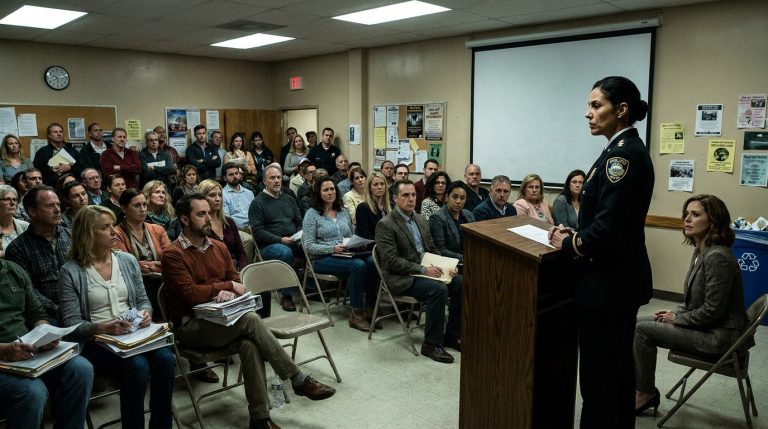
When the evening of the scheduled community meeting arrived, Frank walked across the asphalt toward the local recreational hall. The double doors were propped open, venting the stale scent of floor wax and anxious air into the parking lot. Inside, nearly sixty residents sat in mismatched plastic chairs, their low murmurs blending into a dull, anxious drone. At the front of the room, behind a long folding table, sat Karen Peterson, flanked by her two loyal board members. She looked different outside her neighborhood patrol element—her tailored blazer was buttoned tight, her fingers drumming an erratic pattern against the wood-grain laminate of her binder.
Frank took a seat in the back row, his green binders resting flat across his lap. He didn’t raise his hand, and he didn’t join the scattered side-whispers.
“We will begin with the architectural compliance review,” Karen announced, her voice projected through a small, tinny PA system that rattled the drop-ceiling tiles. “The board has logged persistent operational violations on the corner property of Parcel 402-A. The integration of unapproved heavy machinery has degraded local property standards, necessitating aggressive corrective enforcement.”
Dave stood up three rows ahead, his posture taut. “The machinery is a backup power unit because the main residential service line was deliberately vandalized with bolt cutters. We all saw the cruiser, Karen. We want to know why the executive fund is suddenly allocating three thousand dollars for an external title clearance attorney.”
“The allocation is private board business, Mr. Vance,” Karen cut in, her tone sharpening as she reached for her gavel. “Sit down. You are out of order.”
Frank stood up. He didn’t rush. He walked down the center aisle, the heels of his leather work boots striking the linoleum with an even, measured cadence. He laid the green canvas folder directly onto the table, right over her open agenda sheet. The impact caused her water glass to rattle against the laminate.
“It isn’t private business when the legal entity you’re representing doesn’t exist,” Frank said, his voice flat, carry-over engineering discipline pinning her focus.
Karen didn’t look up immediately; her thumb pressed hard against the corner of her binder. “Mr. Miller, this is an administrative hearing for your outstanding citations. If you cannot comply with the aesthetic standards—”
“This is the Oak Creek Land-Title Ledger,” Frank interrupted, his thick index finger tapping the laminated copy of the county record sheet he had extracted two nights prior. “Page forty-four. The board didn’t vote on a green space preservation initiative last winter. You filed an expedited title amendment to clear the grandfathered infrastructure line running to my workshop. You didn’t do it for the neighborhood. You did it because the Meridian Development Corporation has a secondary purchase agreement for the common parcel behind my fence, and their access corridor requires a clear title.”
A sudden, freezing stillness settled over the front table. The second board member, an older man with wire-rimmed glasses, leaned forward to read the text on the exposed sheet, his jaw slackening as his eyes caught the unredacted corporate names.
“This is an absurd misinterpretation of standard municipal filings,” Karen said, though her knuckles had turned a stark, bloodless white against the handle of her gavel.
“The county records clerk verified the signature on the hidden title transfer two hours ago,” Frank said, turning slightly to face the room. The crowd shifted forward in their plastic chairs, the low drone rising into a sharp, collective edge of realization. “She isn’t collecting fines to fix the signs or pave the cul-de-sacs. She’s using the association’s lien authority to clear a private right-of-way for a million-dollar commercial transit road. If my line stays cut, the title clears automatically by next month.”
Tom stood up in the middle row, his hand gripping the back of the chair in front of him. “The red plastic fines. The flagpole notices. You were clearing the entire eastern boundary line so the developers wouldn’t have to pay for a commercial setback variance.”
The room broke into a loud, discordant roar of shouting voices, the administrative order dissolving instantly under the weight of the physical evidence. Karen slammed her gavel twice, but the wood-grain mallet offered no authority against the structural breakdown of her board. She looked across the table straight at Frank, her eyes narrowing into the cold, calculating glare of an architect whose primary foundation line had just been kicked out of square.
CHAPTER 7: THE EVICTION OF THE CROWN
The microphone head hissed, a sharp peak of feedback cutting clean through the chaotic noise filling the recreation hall. Karen didn’t drop the wood-grain mallet; her forearm remained locked above the table, suspended by a sudden lack of leverage. The paper copies Frank had laid down lay flat between them, the red ink of the municipal timestamp catching the white glare from the ceiling panels.
“This board will not be subverted by manufactured documentation,” Karen said, her chin remaining high, though the rapid pulse at the base of her throat vibrated the thin gold chain around her neck. She reached for the phone resting beside her binder, her fingers dialing with a swift, defensive motion. “Security handles disruptions. You are trespassing on association properties, Frank.”
“The records are certified, Karen,” Frank said, his voice dropping below the room’s high hum, forcing her to lean in slightly to catch the cadence. He didn’t lean forward; his posture remained anchored, feet planted sixteen inches apart on the worn linoleum. “And you aren’t dialing security. You’re calling the courier at Meridian Development Corporation to tell them the quiet title clearance on Parcel 402-A just failed inspection.”
The board member to her left—the older man with wire rims—pulled his hands entirely away from the agenda packets as if the paper were charged with current. “Karen,” he muttered, his voice catching in a dry cough, “if the easement documentation matches the county plat files from eighty-eight, the indemnity clause in our director insurance doesn’t cover non-disclosure. We’re personally exposed.”
“Be quiet, Arthur,” she snapped, though her gaze remained fixed on the corner emblem of the Oak Creek Land-Title Ledger document.
Tom moved down the center aisle now, his boots heavy on the hollow floorboards, followed by three other property owners from the cul-de-sac. They didn’t shout; they formed a physical wall of observation two feet behind Frank’s shoulder. The collective weight of twenty years of unrecorded fines, sliced property stakes, and forced compliance had settled into a single administrative bottleneck.
“We are invoking Section 7-B of the community charter,” Dave announced from the third row, his hand holding a clean sheet of standard bond paper covered in blue ink signatures. “Special resolution for the immediate removal of the executive board due to material breach of fiduciary obligation. We have forty-two verified property signatures present in this room. That’s sixty percent of the voting stock.”
Karen’s hand tightened on her pen until the plastic casing gave a small, dry creak. “The charter requires thirty days’ written notice prior to an extraordinary election cycle. This assembly has no constitutional standing.”
Frank reached down, turning the next page of the ledger copy over. “Section 7-C, paragraph two. In cases involving potential real estate asset conversion without membership disclosure, the notification window is waived. The board is suspended the moment the affidavit is delivered to the secretary.” He looked at Arthur, who was already sliding a blue pen out of his breast pocket. “Arthur is the corporate secretary. The affidavit is on his blotter.”
Arthur didn’t wait. He pulled the signature page toward himself, his hand tracing his own name across the bottom line with a desperate, scratching haste. “Recorded,” he whispered, looking up at the ceiling lights rather than at the chairwoman. “The resolution is active.”
Karen stood up, her chair scraping backward against the wall baseboard with a violent shriek. She picked up her leather portfolio, her knuckles white against the grain of the hide. “This neighborhood will be an unzoned scrap heap within six months,” she said, her voice dropping its professional shell entirely, leaving only the raw, dry rasp of an architect whose grid had been folded in half. “You want to live in a machine yard, Frank? Enjoy the diesel smoke.”
She walked down the side aisle, her heels striking the floor with a rapid, irregular rhythm that faded out through the double exit doors into the summer air.
Frank didn’t follow her exit with his eyes. He turned toward the table, where the remaining board members were already clearing their personal files from the folders. The room behind him had gone quiet again—not the dead, mechanical silence of the cut power line, but the clear, open space that follows a structural clearing action.
CHAPTER 8: THE WEIGHT OF COPPER
The heavy double exit doors swung shut behind Frank, cutting off the low, lingering murmurs of the reconvened neighborhood association. He stood on the concrete portico for a brief second, his fingers wrapped tight around the handle of his canvas work bag. The night air was crisp, carrying a thin layer of ground fog that drifted low across the empty asphalt spaces of the parking lot. He walked back toward the residential block, his work boots rhythmic against the shoulder of the county road, tracking the exact physical route that led back to the corner lot of Parcel 402-A.
The yellow industrial generator was still maintaining its heavy, diesel-fueled thrum as he reached his driveway. A white utility truck from the commercial rental yard was already idling near the curb, its amber roof beacons casting rotating bars of orange light across the broken PVC casing of the trench.
A new crew was already on-site—not the emergency technician from the first afternoon, but a full county infrastructure team dispatched under the direct authority of the revised county easement permits Frank had filed. A massive spool of thick, insulated three-phase copper cable sat suspended on a hydraulic trailer rig, its dark sheen reflecting the work lights.
“We’re dropping the replacement straight into the original grandfathered path, Mr. Miller,” the foreman said, his voice straining slightly over the loud mechanical rattle of the rental engine. He was using a heavy iron spade to clear the loose shale from the base of the trench. “The corporate title hold from Meridian Development Corporation was flagged at the main station two hours ago. The title clear went through without the board encumbrance.”
Frank nodded, setting his canvas bag down on the flatbed truck’s tailgate. He didn’t offer a prolonged explanation. He reached into his truck bed, drew out a long, heavy pair of manual cable cutters, and stepped down into the damp earth of the trench. The raw, cold scent of deep soil mixed with the heavy exhaust smoke from the engine as he worked alongside the crew, threading the heavy, three-inch-thick distribution bundle through the clean conduit pipe they had driven beneath the driveway line.
Across the street, the driveway of the Peterson household was completely dark. A moving van sat parked against the curb, its side panels stenciled with a clean corporate logo, its rear ramp extended to receive the final crates of personal property. Karen stood near the rear door of the vehicle, her arms crossed tight against her canvas coat as she watched the utility crew execute the line drop. She didn’t approach the fence line, and she didn’t call out. When the final hydraulic latch on the trailer clicked closed, she climbed into the passenger side of her sedan and pulled away, the tires throwing up a final, faint cloud of gray road dust that quickly thinned into the damp night air.
Frank stayed in the trench until the final mechanical connection was secured. He took up his heavy iron crimping tool, its rusted hinges groaning softly as he applied maximum leverage, locking the raw copper lugs into the new external main breaker box. The metal felt ice-cold against his palm, the physical pressure of the lock requiring three distinct, heavy compressions until the connection was solid.
He walked over to the trailer-mounted generator, reached for the main fuel cutoff valve, and pulled it clean back.
The roaring mechanical clatter stuttered, coughed, and then died completely. The sudden absence of the four-cylinder block left a deep, expansive silence across the entire block. The air cleared quickly, the smell of low-sulfur fuel replaced by the clean scent of wet grass and the damp earth from the filled trench. Frank reached out his right hand, throwing the large, iron handle of the shop’s internal transfer switch straight into the On position.
Inside the workshop, the industrial lathe spun up with a smooth, silent sixty-cycle purr that vibrated the concrete without a single shake. The overhead light banks shed a wide, calm illumination across the zinc workbench where the old, grease-stained plat map still lay rolled out.
Frank walked to the edge of the fence line where the bright yellow bolt cutters had been left days ago. He picked them up, his thumb tracing the scratched serial numbers on the hinge plate, before carrying them inside to the tool rack behind his main iron anvil. He set them down beside his own clean alignment squares, his movements slow and deliberate as the neighborhood settled into its new, unencumbered quiet.