The Weight of the Mountain and the Warmth of the Light Found Beneath the Sideways Snow
CHAPTER 1: THE WEIGHT OF THE BADGE
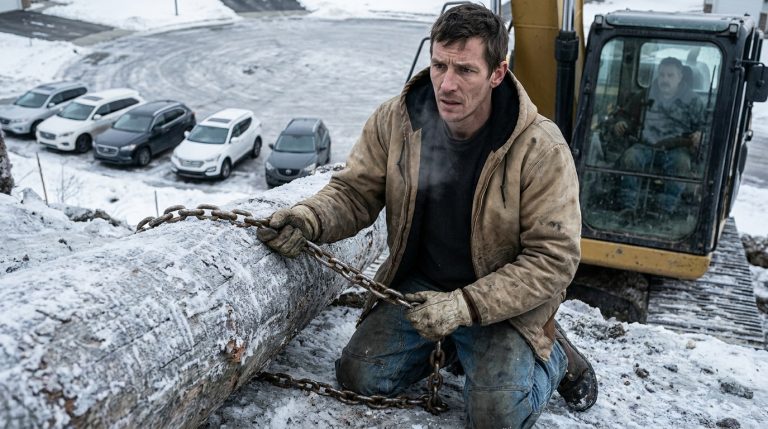
Snow came sideways, a thick, blinding curtain that turned the world into a series of gray shapes and sudden obstacles. Inside the cab, the air smelled of stale coffee and the comforting, oily scent of diesel, but outside, the mountain was trying to erase everything that wasn’t anchored. I felt the weight of the truck settle as the tires fought for purchase on the packed ice of Frostline Terrace.
A white SUV skidded to a halt inches from my front bumper, its headlights cutting through the white-out like twin spears. Marin Holt stepped into the glare, her heels skidding for a fraction of a second before she caught her balance. She didn’t look like a woman caught in a blizzard; she looked like a judge arriving for a sentencing.
She slapped the steel ramp again, the sound sharp and metallic. “Tow my SUV first,” she shouted over the howl of the storm. “Mine. Right now.”
I rolled the window down just enough to let the cold in. It bit at my cheeks, smelling of ozone and frozen pine. “I’m on the county rotation, Marin. Emergency calls take precedence.”
“My driveway is iced over,” she hissed, leaning closer. The warmth of her breath flared in the freezing air, momentarily cutting through the scent of road salt with a sharp, expensive perfume. “My SUV is stuck. I don’t care who else you’re helping. You rescue my vehicle first.”
My radio exploded. “Ten-four, all units. Rollover on Mile 9. SUV off the road. Multiple occupants. People trapped. Status: Critical.”
The sound of the word trapped hit me in the center of my chest, a physical pressure that made the cab feel too small. Mile 9 was a death trap—a switchback with no guardrail where the wind polished the black ice until it was as smooth as glass.
Marin’s face didn’t change. She reached into her coat and pulled out a laminated badge, pressing it hard against my windshield. It was stamped with the HOA logo, but there was something off about the typography—the ink looked slightly faded at the edges, the laminate peeling at the corner.
“HOA emergency priority,” she said, her voice dropping into a calm, terrifying cadence. “That means my SUV comes before everything else. You refuse, I write you up for non-compliance and issue a twelve-thousand-dollar fine. You’ll be invisible by sunrise.”
I looked at the badge, then back at her eyes. She wasn’t scared of the storm. She was using it. She saw the blizzard not as a danger, but as a mechanism for control. I shifted the truck into gear, the engine growling a low, gutteral response to the pressure in my foot.
“I have people on a cliff, Marin,” I said, my voice flat.
“You’re making a choice,” she replied, her smile not reaching her eyes. “Just make sure you can live with the bill.”
As I began to pull the ramp up, the light from my dashboard caught the back of her laminated badge. There, scrawled in a tiny, hurried hand across the security strip, was a string of letters and numbers that had nothing to do with the HOA: Sector 9-G – EXPIRED.
CHAPTER 2: THE ANCHOR POINT
My eyes stayed locked on the peeling corner of the laminate pressed against the glass. Under the yellow wash of the dome light, the letters Sector 9-G – EXPIRED looked less like an official designation and more like a warning left in the dust of a forgotten filing cabinet. The ink was a dull, bruised purple, the kind used in cheap municipal stamp pads before the digital transition.
Marin noticed the direction of my gaze. She didn’t flinch, but her hand retracted slightly, the plastic badge sliding down the cold glass with a faint, wet squeak that set my teeth on edge. The smell of her perfume—something sharp and artificial like winter lilies—hung in the narrow space between us, fighting the heavy, oily scent of the diesel exhaust creeping up from the floorboards.
“You’re lingering,” she said. Her voice was too quiet for the wind howling around the driver’s side mirror, but it carried perfectly. “The road doesn’t get any wider the longer you look at it.”
I didn’t answer her. The silence in the cab was its own kind of weight, the kind I used to feel back in the old district garage when the rafters would groan under six feet of wet pack. My hand slid down to the air brake valve, my fingers catching on the rough, split rubber of the knob. A sudden, cold memory flashed behind my eyes—the smell of charred copper and wet insulation from the night the third-bay generator blew, leaving us working in the dark while the water in the lines began to freeze. We had five minutes to clear the pumps before the ice split the casings. That was the first time I’d seen that specific stamp: Sector 9-G. It had been on the decommissioning order taped to the side of the ancient auxiliary pump.
I released the brake. The air hissed, a sharp, cold breath that died instantly in the roaring draft outside. “The road doesn’t get any safer either,” I muttered, my voice rough from the dry heat of the defroster.
“Then I suggest you start driving,” Marin replied. She stepped back from the running board, her boots making a dry, crunching sound on the gravelly ice. She didn’t close her door; she left it swinging slightly, the latch clicking against the strike plate with every shudder of the engine. “My driveway is at the top of the rise. The blue lights are already blinking on the county line, but they won’t reach this sector before the drifts block the gate.”
The engine whined as I touched the throttle, the cold iron of the block protesting the sudden load. The steering wheel had a stubborn, heavy drag to it, the hydraulic fluid thick as honey in the steering box. I could feel the tires searching through the loose powder, hunting for the hard, frozen ruts underneath.
To my left, the windshield wiper dragged a crescent of gray slush across the glass, leaving a greasy smear right in my line of sight. Through the blur, the tail lights of Marin’s SUV flared once, a sudden, angry red that dissolved into the swirling white before her brake lights even fully registered. She wasn’t waiting at her vehicle. She was already walking toward the leasing office, her small, dark figure silhouetted against the weak light of the security lamps.
The radio on the dash hummed, a low-frequency static that vibrated the small metal screws in the faceplate. A voice broke through, thin and shredded by the high ridge: “…dispatch to Unit 4… we have… visual on Mile 9… status is… clear the lane…”
I reached out and tapped the housing of the receiver. The metal was cold, almost sticky with the frost forming along the seams of the plastic dashboard. My fingers left three clear ovals in the gray grime on the casing. Beside the tuning dial, half-hidden by a strip of black electrical tape, was a small, brass-colored rivet holding the mount to the firewall. It was stamped with a tiny, circular emblem—the crest of the old Highgate Water District, the predecessor to the current municipal authority before the private developers bought out the valley under the The Frostline Amendment.
My thumb felt the cold indentation of the brass. The pieces were there, scattered like dry pine needles under the snow, but the wind was blowing too hard to see how they aligned. I shifted into low, the gears engaging with a dull, heavy clunk that vibrated through the frame and straight up my spine. The truck rolled forward, its nose dipping into the first drift at the edge of the terrace, the white spray rising up over the hood like a wave.
CHAPTER 3: THE ASCENT
The heavy iron nose of the flatbed hit the drift with a dull, physical thud that vibrated straight through the floorboards and into the soles of my heavy work boots. For a second, the steering wheel jerked violently to the left, fighting my grip as the thick, half-frozen slush grabbed the front tires. I braced my forearm against the door panel, my muscles tightening as I forced the wheels back to center.
The heater groaned, blowing a thin, dusty breath of hot air that smelled faintly of old copper and burnt grease. The draft around the door seal whistled a high, flat note, carrying the freezing scent of pine needles and raw ozone. Through the blurred glass, the headlights barely reached thirty feet ahead, swallowed by the thick curtain of white coming off the ridge.
Suddenly, both wiper blades shuddered and froze mid-stroke, trapped under a thick wedge of wet snow that had packed itself tight against the lower frame. The world outside dissolved instantly into a gray, featureless wall of static.
I didn’t have time to slow down. The momentum of the heavy diesel was the only thing keeping us from bogging down in the deep pack of the unplowed climb. Keeping my left hand firmly on the wheel, I leaned across the bench seat and hammered my right fist against the lower dash panel where the auxiliary fuse box sat. The plastic cover was cracked, a tiny strip of adhesive tape holding the latch shut. On the worn label inside, next to the circuit diagram for the wiper motor, was a small, faded stamp: The Meridian File – Reference Only.
I struck the panel again. The metal relay clicked, a sharp, metallic snap, and the wipers groaned back to life, dragging the heavy pack of slush off the glass with a wet, scraping sound.
The road began to tilt upward, the pitch growing steeper as the truck entered the narrow throat of the switchback. The gray walls of rock on either side pressed close, their rough surfaces slick with weeping ice that caught the yellow glow of my amber fog lights. I kept my eyes locked on the edge of the road, searching for the faded orange markers that designated the shoulder. Most of them were already buried, leaving only the dark, empty void of the ravine to my right as a guide.
A low, metallic rattle came from the bed of the truck. The heavy, greasy iron of the tow hook chain slid across the steel deck, its links clinking against the side rails with every shudder of the chassis. It was a familiar, grounding sound—a reminder of the physical laws that still ruled the mountain, no matter what claims of authority were written on laminated badges down in the valley.
The radio on the dashboard flickered, the green backlight dipping slightly as the generator worked to keep up with the load of the heater and the winch motor. The static smoothed out for a fraction of a second, revealing a faint, metallic clicking sound—not a voice, but the steady, rhythmic pulse of a digital beacon. It was a signal pattern I had heard during the county transit upgrades, the kind used by private security networks to bypass the public emergency channels.
I reached out and adjusted the dial, my cold fingers slipping slightly on the slick plastic knob. My eyes scanned the narrow shelf of the road ahead, looking for any sign of red taillights or the cold flash of emergency strobes. There was nothing but the steady, relentless fall of the white powder, burying my tracks as fast as I could make them.
The steering box grew stiffer as the altitude climbed, the fluid thickening in the lines until every turn required a deliberate, heavy heave of my shoulders. The truck was doing the work, but the mountain was claiming its price in friction and cold, and the real climb had only just begun.
CHAPTER 4: THE GHOST OF MILE 9
The high-pitched whine of the power steering pump protested as I cranked the wheel hard to the right, guiding the front tires along the absolute edge of the crumbling shelf. Beneath the fresh, powdery drifts, the tires slipped over a solid sheet of glaze, the chassis sliding sideways by a fraction of an inch before the deep tread caught a patch of exposed gravel. My shoulder burned from the constant, heavy leverage required to keep the wheel steady.
Through the erratic sweep of the wipers, the dark outline of the mountain loomed, closing off the horizon until there was only the immediate ten feet of road and the swirling white wall of the storm.
Up ahead, a faint, pulsing light cut through the white-out. It wasn’t the steady, familiar sweep of a county emergency beacon, but a fast, erratic flicker that cast long, distorted shadows across the snowbank. I slowed the truck, letting the engine brake do the work, the transmission groaning as the vehicle resisted the descent. The air in the cab grew even colder as the defroster struggled, the thin stream of dry heat barely keeping a small crescent of the windshield clear of frost.
The light belonged to a white SUV, identical to the one Marin Holt had driven down at the gateway. It had slid backward off the road, its rear bumper resting against a massive, snow-covered pine that was the only thing preventing it from tumbling into the ravine below. The front passenger door hung open, swinging slowly in the wind, its hinges creaking with a thin, metallic pitch.
I pulled the air brake, the sudden hiss of escaping pressure loud against the roar of the wind. I didn’t turn off the engine; the steady, rhythmic rumble of the diesel was my only anchor out here. Stepping out of the cab, the cold hit me like a solid wall, the sideways snow stinging my eyes as I pulled my collar up and adjusted my heavy leather work gloves.
The ground was slick, a smooth mirror of black ice covered by a deceptive dusting of powder. I walked toward the stranded vehicle, my boots finding tentative grip in the frozen ruts. As I approached, the erratic beacon on the roof of the SUV caught my attention. It was a magnetic-mount light, the housing cracked and taped with black vinyl adhesive. On the underside of the base, partially exposed where the rubber gasket had peeled away, was a stamped metal plate reading: Sector 9-G – Private Property.
Inside the cabin of the SUV, a dim dome light flickered. A man sat slumped over the steering wheel, his breath rising in slow, shallow plumes of gray steam. In the back seat, half-hidden by a pile of tangled safety blankets, a small child was huddled, crying softly—a thin, reedy sound that was nearly swallowed by the wind.
I reached for the door handle, the cold metal sticking to my glove. The latch was frozen solid, refusing to budge when I applied pressure. I leaned my shoulder into the frame, using my weight to break the seal of ice along the seam. With a sharp, cracking sound, the door finally gave way, releasing a wave of stale, warm air that smelled of spilled coffee and synthetic wool.
The man stirred, his head lifting slowly as his eyes struggled to focus on me through the gloom. He didn’t speak; his hand simply reached back toward the child, his fingers twitching against the fabric of the seat.
“I’ve got you,” I said, my voice sounding flat and muffled in the open air. “We’re getting you out of here.”
I reached in to secure the child first, wrapping her in one of the dry wool blankets from my own cab. Her small hands clung to the rough canvas of my jacket, her breathing shaky but steadying as I lifted her out of the vehicle. Every motion had to be calculated, every step weighed against the absolute slickness of the ice underfoot. The mountain didn’t care about the rescue; it only cared about the gravity pulling everything toward the bottom of the gorge.
CHAPTER 5: THE DESCENT AND THE SMEAR
The small child’s weight was surprisingly light, a tiny bundle of heavy, damp winter layers that clung to the rough canvas of my jacket as I stepped away from the tilting SUV. The ground under my boots felt like oiled glass. I kept my knees slightly bent, shifting my center of gravity down to ensure my soles didn’t lose traction on the black ice. Behind me, the father groaned as he managed to swing his legs out of the driver’s side door, his hands trembling violently as he gripped the frozen frame to support his weight.
“Keep your head down,” I told him, my voice muffled by the wind that whipped around the solid trunk of the pine tree holding the vehicle in place. “Focus on your footing. One step at a time.”
The man nodded slowly, his eyes wide and vacant from shock and the creeping cold. He placed his boots into the shallow ruts left by my tow rig’s heavy tires, utilizing the slightly textured snow to keep his balance. I carried the girl toward the passenger side of my cab, opening the door and letting the blast of warm air escape. The interior hummed with the steady, reassuring vibration of the idling diesel engine. I helped the child onto the bench seat, wrapping her head to toe in the thick wool emergency blankets I kept tucked behind the headrest, before turning to assist her father up the metal running boards.
Once both of them were securely inside the cabin, the heavy doors sealing out the raw scream of the mountain wind, I climbed back behind the wheel. The air inside smelled of wet wool, hot antifreeze, and the faint, sweet trace of the child’s cherry-flavored lip balm. My hands, encased in split-leather work gloves, felt stiff as I gripped the cold wheel and shifted the transmission back into low gear.
The descent from Mile 9 was an exercise in absolute concentration. I relied entirely on the low gear and the exhaust brake, allowing the truck’s weight to crawl down the icy switchback without touching the brake pedal, which would have instantly sent us sliding sideways over the edge. In my rearview mirror, the headlights of the stranded vehicle faded into the swirling white-out, a silent monument to how quickly the mountain could claim an unwary traveler.
By the time the tires finally touched the flatter, gravel-strewn roads at the base of the ridge, the first faint light of dawn was beginning to bleed through the heavy gray clouds. The blizzard had transitioned into a steady, quiet snowfall, the flakes drifting lazily under the streetlamps of Frostline Terrace.
I pulled the truck up to the main gate’s emergency lane, where a county ambulance was already waiting with its yellow strobe lights pulsing against the snowbanks. The medic, a woman named Clara whom I had worked with on three previous winter rotations, met us at the passenger door with a folding stretcher and a stack of thermal wraps.
“Good pull,” Clara muttered, her voice quiet as she helped the father step down. “Dispatch said they had a hard time getting the coordinates through the static.”
“The signals are crowded up there,” I said, my thumb brushing the edge of the brass rivet on the dash as I climbed back down. “Private networks are overriding the county frequencies. Check the base of their transceiver if you get a chance.”
She gave me a quick, puzzled look but didn’t question it, focus shifting entirely to her patients as she guided them into the warm interior of the emergency vehicle.
As the ambulance doors clicked shut, my phone vibrated in the dashboard cup holder. It was a rapid, rhythmic series of alerts that didn’t stop. I picked up the device, my gloved thumb awkward on the glass screen.
The local community forum for Frostline Terrace was flooded. A crisp, high-resolution photograph of my rig’s license plate had been posted less than an hour ago, my company logo circled in bright red. Above it, the caption read: “This tow driver refused emergency help for HOA leadership during a blizzard. Left residents stranded to pursue outside contracts.”
The comments below were already piling up like dry wood on a fire. Neighbors I had known for years, whose driveways I had cleared during the first ice storms of the season, were tagging my business page, calling for my contract to be terminated before the weekend.
I looked up through the windshield. Across the street, near the dark glass of the mail kiosk, two figures in heavy parkas stood watching my truck, their faces half-hidden by their hoods as they spoke in low, animated whispers. The cold air in the cab suddenly felt thin, the smell of diesel smoke carrying a heavy, bitter taste.
CHAPTER 6: THE VIOLATION
The red taillights of the ambulance dissolved into the falling snow, leaving only the soft, yellow pulse of the gate’s security lamps to illuminate the slush-slick street. Across the road, the two figures near the mail kiosk lingered for a heartbeat longer. When I shifted my gaze directly toward them, their posture stiffened; they turned in unison, their boots kicking up small puffs of fresh powder as they walked quickly toward the shadow of the leasing office.
I didn’t follow them. Instead, I let the heavy diesel truck crawl forward, keeping the speed below ten miles per hour to prevent the tires from spinning on the untreated streets of Frostline Terrace. The steering wheel felt stiff, the cold oil resisting the movement of my hands. Every yard traveled felt like dragging a anchor through wet sand, the quiet of the morning carrying an underlying tension that the peaceful snowfall couldn’t mask.
Ten minutes later, the truck rolled into the narrow driveway of my workshop. The metal garage door was dusted with a fresh layer of white, but right in the center, a bright orange piece of paper stood out against the weathered steel.
I pulled the air brake, cut the engine, and stepped down into the silence of the yard. The snow hissed as it met the hot exhaust pipe. Walking to the door, my boots sinking three inches into the fresh pack, I reached out to peel the paper from the metal. The adhesive was frozen, stubborn, tearing slightly along the edge as I pulled it free.
It was a formal HOA Violation Notice. It was labeled Commercial Nuisance with a pending fine, but what drew my attention was the small, printed line at the bottom of the form. Instead of a standard digital tracking number, it was marked with a pre-dated registration stamp: Ref: Sector 9-G / TFA-004.
My thumb rubbed the rough edge of the paper, feeling the stiff, cheap texture of the cardstock. The TFA prefix stood out immediately—a clear, shorthand reference to The Frostline Amendment. The private legal mechanism that had supposedly dissolved the old municipal district was being used to justify an administrative penalty on my personal property.
A quiet vibration in my coat pocket broke the silence. I pulled out my phone. The notifications on the local forum had slowed, but they had been replaced by a direct, private email. The sender’s address was a string of unformatted characters, but the subject line was clear: The Meridian File – Addendum.
I leaned my back against the cold steel of the garage door, my chest rising in slow, steady breaths as I opened the attachment. It was a scanned copy of a transition ledger dated four months ago. The columns were filled with transaction records, but one line was highlighted in faint yellow: Premium Renewal – Frostline Structural & Liability – STATUS: LAPSED / NON-PAYMENT.
The implications of that single line settled over me like the cold mountain air. An HOA operating a gated community without active liability insurance was a massive, catastrophic violation of state law. If a major winter storm caused property damage or injury, the entire financial burden would fall directly on the individual homeowners, not the association.
Through the small window of the garage door, I could see the silhouette of my tow rig, its heavy steel ramp dusted with a light layer of frost. The pieces of the puzzle were no longer separate. Marin Holt wasn’t just trying to control who got towed on the mountain; she was running a shell game to hide a massive financial void before the county inspectors arrived for the seasonal audit.
I folded the orange notice, sliding it into the deep inner pocket of my work coat. The paper crinkled against my chest, a small, tangible reminder that the game had shifted from a neighborhood dispute into a struggle for survival. I reached for the handle of the service door, my glove gripping the cold brass as I stepped inside to begin organizing the records.
CHAPTER 7: THE WHISPERED WARNING
The latch on the service door clicked shut, the small sound flat and dry in the crisp morning air. I turned away from the shop, my boots cutting clean, deep trenches into the fresh powder that had settled over the path leading down toward the central mail kiosk. The orange notice lay folded in my inner pocket, a stiff, flat weight pressing against my ribs with every step. I kept my chin tucked down against the rising wind, my eyes scanning the empty, snow-blanketed lanes of Frostline Terrace. The community was eerily quiet, the kind of silence that feels fragile, ready to break at the first hard vibration.
At the end of the block, the mail kiosk stood under a corrugated metal roof, its rusted support pillars crusted with salt and ice. I stepped under the overhang, my rubber-soled boots making a sharp, squeaking sound on the concrete slab. I reached for my brass key, my gloved fingers stiff as I slid it into the lock of Box 42. The metal cylinder turned with a dry, grinding resistance.
Inside lay a single, plain envelope—no postage, no return address, just my name written in a hurried, thin blue ink.
Before I could slip the envelope into my pocket, a shadow crossed the concrete. I didn’t turn my head too fast; I simply tracked the reflection in the polished metal surface of the neighbor’s mailbox door. A woman in a faded, oversized canvas coat had stopped at the parcel locker beside me. Her gloved hand fumbled with a key, her shoulders tense and pulled high. It was Evelyn, a resident who had lived near the old district pump station long before the valley was subdivided.
She didn’t look at me. She kept her eyes fixed on the keyhole, but her voice was a thin, quiet thread of sound that barely carried over the wind rattling the metal roof.
“She’s rigging the rotation,” Evelyn whispered. Her fingers trembled slightly against the cold brass of the locker door. “She’s been bragging to the board. They think they’re buying into a private, secure loop. They don’t know she’s already canceled the master structural coverage under the Frostline Amendment.”
I kept my hand on my mailbox door, my body still, absorbing the words. “Evelyn, what is she using to cover the gap?”
“The bond,” Evelyn said, her voice dropping even lower as she finally forced her locker door open, pulling out a small, empty cardboard box. “The twenty-four-thousand-dollar winter operations bond. It’s not a compliance deposit. She’s using it to pay off the immediate premium arrears on the Meridian File before the county inspectors run the seasonal audit on Sector 9-G.”
She stepped back, her boots crunching lightly on the ice at the edge of the concrete slab. She still hadn’t made direct eye contact, her gaze fixed on the empty box in her arms as if she were merely assessing its weight.
“If they audit a lapsed policy, the county shuts down the entire corporate charter of Frostline Terrace,” she added, her breath flaring in tiny, rapid bursts of gray steam. “The home values will bottom out by tomorrow evening. She’s desperate. Don’t go to the hearing tonight without the original transition ledger.”
Before I could ask her about the pre-dated stamp on my violation notice, Evelyn turned and walked away, her head bowed against the wind as she disappeared into the swirling gray powder at the corner of the drive.
I looked down at the concrete floor. Near the base of the parcel locker, where the salt had eaten away at the mortar, a small corner of a loose floor tile had been lifted, exposing a dark gap. Tucked inside was a tiny, folded strip of paper, its edges stained with grease and road grime. I reached down, my heavy leather glove scraping against the cold concrete as I pulled it free. Written on it was a single, ten-digit authorization code, marked with the initials S-9-G.
I slipped the paper into my pocket beside the orange notice. The pieces were beginning to bind together, the rusted mechanisms of the HOA