The Weight of Salt and Survey Lines: A Chronicle of Calculated Boundaries
CHAPTER 1: THE MIDNIGHT CHISEL
The high-pitched whine of a masonry drill bit chewing through fifty-year-old fieldstone tore through the 2:00 a.m. silence before the headlights even cleared the tree line.
I didn’t turn on the bedroom lights. In the gray dark of the hallway, my boots were already laced. The floorboards were cold, holding the deep frost of a late October night, but the air outside smelled worse—of diesel exhaust, damp earth, and the chemical heat of quick-setting mortar.
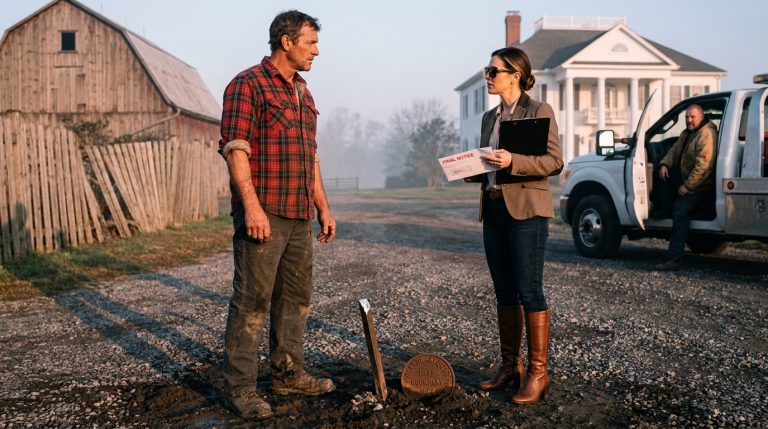
Through the narrow pane of the front door, the view was split into sharp, shifting high-beams. Two pickups idled on the shoulder of the county road, their tailpipes puffing white plumes into the chill. Four men in lime-green reflective vests stood grouped around my eastern gate pillar, their shadows stretching long and distorted across the gravel drive.
And then there was Tracy Harlo.
She stood just outside the swing radius of the iron gate, her arms crossed tight over a heavy woolen blazer. She wasn’t holding a tool. She didn’t need to. Her jaw was set in that familiar, polished angle that usually belonged in the community center conference room, directing the light of a three-thousand-lumen work lamp directly onto my stone boundary marker.
I stepped onto the porch. The motion-sensor floodlights snapped against the dark, turning the gravel into a field of bleached bone.
“Stop,” I said. The word wasn’t a shout. It was flat, weighted with the density of thirty acres of deeded independence. “You’re on private property.”
The foreman, a broad-shouldered man with a grease-stained ball cap, lowered the hammer drill. The sudden drop in decibels left a vibration in the teeth. He looked toward the road, then back to the pillar, where a square gray metal access box—the size of a heavy lunch cooler—sat half-inserted into a fresh, jagged cavity in the fieldstone.
Tracy didn’t flinch. She took three steps forward, her heels grinding into the loose dust where my driveway met the county asphalt. “Emergency compliance,” she said, her voice carrying that thin, practiced clarity she used for board meetings. “The association is establishing the secondary evacuation route. You cannot interfere with municipal safety protocols.”
“Who signs your checks?” I asked the foreman, ignoring her.
The man wiped his palm on his jeans, glancing at the clipboard tucked under his arm. “We were told the access was dedicated last month. The board order said—”
“The board doesn’t own the stone,” I said. “Leave. Now. Or the county sheriff handles the removal.”
Tracy’s smile didn’t reach her eyes. It stayed frozen, an official mask against the cold. “Call them,” she said softly.
My phone was already out. The screen showed the silent, green-tinted feed from the tree-mounted camera overhead—four men, two trucks, and a half-mixed bag of concrete drying fast against my grandfather’s masonry. I pressed the digits.
“Nine-one-one,” the dispatcher’s voice rasped through the speaker. “What is your emergency?”
“I have a commercial trespass in progress at forty-two-hundred Old Post Road,” I said, keeping my eyes on the foreman’s hands. “Property damage under way. The contractors are drilling into a private structure under the instruction of a third party. I have the video logged.”
Behind Tracy, the two workers didn’t wait for the law. They lifted a five-gallon bucket, tipping the gray, sluggish sludge of the mortar straight into the gap around the box. The wet cement hissed against the dry stone.
The deputy arrived twelve minutes later, the blue cruisers turning the dust into a strobe light of cold iron and rusted fence wire. As the tires crunched to a halt, Tracy was already moving toward the driver’s side door, her hand reaching into her blazer for a laminated map.
Near the base of the pillar, beneath the shadow of the old cedar, the yellow plastic of a freshly broken surveyor’s stake gleamed in the dirt—its stamped numbers clean, new, and completely missing from the original county registry.
CHAPTER 2: THE PRESERVATION NOTICE
The deputy’s flashlight beam swept down, catching the bright yellow fracture of the surveyor’s stake, cutting through the wet dark to spotlight the raw, unrecorded plastic jutting from the mud.
Deputy Miller squatted, her utility belt clicking as her knees bent. She didn’t touch the plastic. Instead, she used the tip of her metal pen to nudge a fallen cedar branch away from the base. “This wasn’t here during my afternoon patrol,” she said, her voice dry, carrying the flat cadence of someone who spent her nights sorting through neighbor disputes and deer strikes.
“It’s a standard utility marker,” Tracy said. Her heels dug into the muddy shoulder as she stepped closer, trying to look over Miller’s shoulder. “We had the boundary verified by a licensed firm before the installation. It’s all part of the county’s emergency egress program.”
I leaned against the rusted iron frame of my gate, my palm flat against the cold metal. The rust was rough, biting into the skin of my palm like coarse salt. “There is no county program that permits midnight concrete pours on a private deed,” I said. “And no licensed surveyor leaves a marker without filing a transit report with the clerk.”
A sudden, freezing drizzle began to fall. The drops were heavy, needle-sharp, and smelled of woodsmoke from the valley. Within seconds, the gravel driveway took on a dark, wet sheen. On the stone pillar, the gray mortar the workers had just smoothed around the lockbox began to run, dissolving into thin, dirty gray ribbons that trailed down the dry-stack fieldstone like soot.
The foreman swore under his breath, wiping his brow with a wet sleeve. “If this rain keeps up, the mix is going to wash right out of the joint. We need to tarp it or finish the cap.”
“You don’t touch it,” Miller said. She stood up, her boots squelching in the saturated loam. She shone the light directly into the foreman’s face, then drifted it over to Tracy. “The homeowner says there’s no easement. You don’t have a county permit on your clipboard. Until someone shows me a recorded deed with a utility signature, this work is done for the night.”
“This is a public safety matter, Deputy,” Tracy insisted, her voice rising slightly over the patter of the rain on the truck hoods. “The board has the authority to—”
“The board doesn’t override state property law,” Miller cut her off. She pulled a small pad from her breast pocket, the paper already curling from the dampness. “I’m writing an incident report. Everyone’s names go on it. Contractors, property owners, and you, Ms. Harlo.”
I watched the foreman. He didn’t look at Tracy anymore. He was already signaling his crew, his hand dropping in a quiet, downward motion. They began tossing their trowels and empty plastic buckets into the bed of the lead pickup, the metal clattering with a hollow, metallic ring. They wanted no part of a criminal trespass charge on a cold Tuesday morning.
As the trucks began to back out, their tires spinning once on the wet gravel before catching the county asphalt, I walked over to the broken stake. I reached down, my fingers sinking into the cold mud to pull the yellow plastic free. It came out with a wet pop.
Under the beam of my own pocket light, I turned the stake over. It wasn’t standard county issue. Stamped into the ribbed plastic on the reverse side, nearly obscured by a smear of clay, was a small, branded logo: a stylized transit level over the words Caliburn Transit. It meant nothing to me—the county surveyors used state-issued brass caps or unmarked orange pin flags. But the plastic was heavy, industrial, and completely out of place in a residential development.
“This isn’t over,” Tracy said from the road. She was standing under the yellow glow of the streetlamp now, her wet blazer clinging to her shoulders. “We will have the formal walkthrough on Saturday. The fire marshal will see the obstruction for himself.”
“I’ll be waiting,” I said.
I didn’t watch her walk back toward the subdivision. I turned, walking back up the dark gravel of my drive, the rain drumming a steady, relentless beat against the hood of my jacket. Inside the house, the silence was thick, smelling of old pine and linseed oil.
I sat at the kitchen table, the yellow plastic stake sitting on the clean oilcloth between us. I pulled my laptop open, the screen’s white glare reflecting off the kitchen window. I drafted the preservation demand first, my fingers hitting the keys with a deliberate, rhythmic click. To the Board of Directors: You are hereby directed to preserve all electronic communications, meeting minutes, and vendor agreements…
Every action from this moment on had to be documented. The process was the only lock that would hold.
CHAPTER 3: THE PUBLIC GATHERING
The click of the laptop keys on Wednesday morning didn’t just log the preservation demand—it initiated a seventy-two-hour countdown of silence, marked only by the green delivery receipts stacking in my inbox.
By Thursday morning, the physical reality of the conflict required a trip to the county records office. I adjusted the rearview mirror of my truck, watching the ruts of Old Post Road slide away in a cloud of dry, iron-rich dust. The heater in the cab rattled, blowing dry, metallic-smelling air against my boots. There were no shortcuts to this; to build a wall of paper, you had to touch the old ink yourself.
The records basement of the county courthouse smelled of decaying wood pulp and damp concrete. I sat at a scarred oak table, my fingers tracing the dry, textured edges of land registry maps from 1974. When I asked the clerk for the original township plot books, he pointed a blunt finger toward a locked cage in the back.
“Everything from the pre-development era is logged in the Ochre Ledger,” he murmured, his keys clinking against his belt. “But those old binding books aren’t digitized. Most of them are locked down for preservation.”
I memorized the name—the Ochre Ledger—leaving the records office with a thin manila folder of certified deeds and a lingering scent of dust on my coat sleeves. I spent Friday preparing the defensive binder, slipping each document into a clear plastic sleeve. Process is armor, and every sleeve was a plate of mail.
When Saturday morning arrived, the air was clear, cold, and dead silent.
At exactly 9:45 a.m., the sound of multiple tires grinding over the loose stone at the edge of my property broke the quiet. I stepped out onto the porch, carrying the black three-ring binder under my arm.
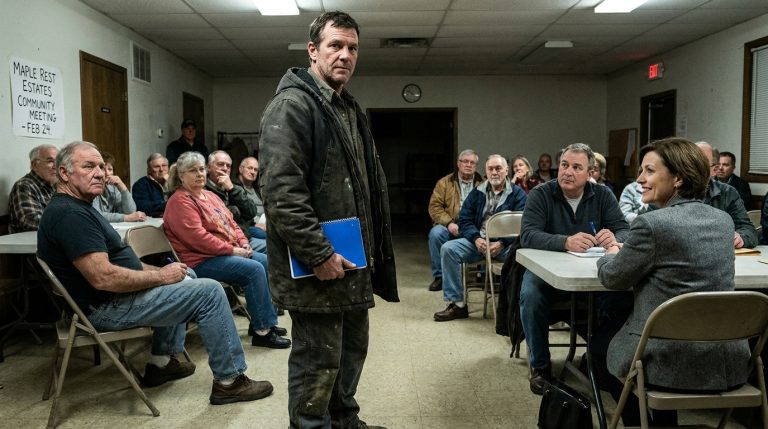
My driveway looked like a public parking lot. Tracy Harlo stood at the front of a small delegation, wearing a sharp navy blazer that contrasted sharply with the gray, frost-bitten weeds on the shoulder. Behind her were two members of the HOA board—older men in matching windbreakers—and a small cluster of curious neighbors whispering among themselves.
But the key players stood apart: Fire Marshal Vance, his red county SUV idling near the mailbox, and Deputy Miller, who had returned to keep the peace. Beside them stood the contractor foreman, holding a brand-new keyed access box in his gloved hands like a shield.
“Mr. Vance,” Tracy said, her voice raised so the onlookers could hear. “This is the gate in question. As you can see, the padlocked iron chain completely obstructs the designated emergency corridor. We have the community residents here to witness the inspection.”
I walked down the gravel incline, the grit crunching under my soles. I didn’t look at Tracy. I stopped three feet from the fire marshal, whose dark utility jacket was zipped to his chin against the morning breeze.
“Marshal,” I said, offering a nod. “I’m the property owner. Before we discuss corridors, let’s establish the legal boundaries.”
“This is a formal walkthrough, sir,” Vance said, his voice deep and measured. He pulled a heavy leather-bound clipboard from his side. “We received a safety complaint regarding a blocked egress route. My job is to verify if the obstruction violates county code.”
“It doesn’t,” I said. I opened the binder, the plastic sleeves crackling in the cold air. I pulled out my certified title record, showing the boundary lines highlighted in green. “My property line extends to the white stakes at the asphalt line. There is no recorded easement for public or community access.”
Tracy stepped closer, her leather glove snapping against her thigh. “The developer’s master plans clearly indicate a secondary evacuation route. Historic reliance has already established this pathway. We have forty families behind that tree line who need this exit.”
Vance looked at the title document, then turned his gaze to Tracy. “Ms. Harlo, do you have a copy of the recorded easement with the county registrar’s stamp?”
Tracy’s chest tightened beneath her blazer. She gestured toward her clipboard. “The administrative packet is being processed by our legal counsel. But the safety of the community cannot wait for bureaucratic delays.”
“Safety doesn’t draft property deeds, Tracy,” I said, my voice low. “And you don’t pour concrete on land you don’t own.”
I slid the next document from my binder—the fresh public records release I had picked up from the courthouse clerk just twenty-four hours earlier. On top was a printed copy of an email Tracy had sent to the fire prevention office on Wednesday afternoon.
The fire marshal took the sheet. His eyes scanned the text, his brow furrowing as he reached the second paragraph.
“According to this,” Vance said, turning his head slowly toward Tracy, “you informed our administration that the easement was already finalized and that the homeowner had consented to the installation of the lockbox.” He tapped the paper. “You wrote: ‘No easement issues remain.'”
A heavy, static silence fell over the gathered neighbors. The contractor foreman lowered the metal box to his side, his boots shifting on the gravel as he took a step toward his truck.
“We assumed the transition was understood,” Tracy said, her voice dropping its polished edge, replaced by a cold, defensive strain. “It’s a technicality.”
“Falsifying information on a municipal safety complaint is not a technicality, Ms. Harlo,” Vance said. He closed his clipboard with a sharp, heavy thud.
CHAPTER 4: THE DECOY SURVEY
The heavy, dead silence that followed the fire marshal’s words didn’t break; it hung in the cold morning air, hardening like concrete until Tracy Harlo finally let her clipboard drop against her side with a hollow, plastic slap.
“We need to clarify the documentation, Marshal,” Tracy said, her voice dropping to a rapid, clipped whisper that barely carried to the edge of the road. Her fingers clutched the edge of her navy blazer, pulling it tight against a sudden gust of wind that kicked up the dry post-oak leaves. “The development’s master plat—the Apex-7 Draft—was handed down to the association as an active easement. We have acted in good faith.”
Fire Marshal Vance didn’t look at her. He pulled a heavy pair of leather gloves from his pocket and slowly drew them on, smoothing the cowhide over his knuckles. “An unrecorded draft is a wish, Ms. Harlo. It isn’t a deed. You told my department this was resolved. It’s not.” He looked over at the contractor foreman, who was already coiled to retreat. “Take your equipment and clear off this lane. If I see unpermitted concrete work being scheduled here again, the state licensing board gets the incident report.”
The foreman didn’t wait. He threw his bucket into the truck bed, climbed into the cab, and started the engine. The diesel exhaust coughed gray into the cold air, smelling of unburnt fuel and wet carbon.
The neighbors who had gathered behind Tracy began to drift back toward the subdivision tree line, their quiet murmurs carried away by the autumn breeze. Tracy stood alone on the damp gravel, her jaw working as she watched her support disappear. She turned her eyes to me—cold, narrow, and entirely devoid of the polished community leader persona she’d worn an hour before.
“You think this is a victory,” she said, her voice shaking slightly but holding a sharp, metallic edge. “You’re holding onto thirty acres of weeds while a hundred families live with a single outlet. We will file a formal administrative easement petition on Monday morning. The board has the right of eminent domain through municipal utility routing.”
“File it,” I said, my hand resting on the cold binder. “But make sure you attach the county clerk’s rejection stamps from 1974.”
She didn’t answer. She turned on her heel and walked down the drive, her heels crunching with a sharp, angry rhythm on the damp stone.
Deputy Miller walked back to her cruiser, giving me a quiet nod as she opened her door. “Keep your gate closed, sir,” she said. “I’ll have the night shift run extra patrols down Old Post Road.”
I watched her cruiser pull away, its red and blue lights dark now, leaving only the dull gray morning to settle over the road. I walked back toward the stone gatepost, my eyes scanning the ground where the truck tires had chewed up the dirt.
Near the base of the pillar, where the rain had washed away the top layer of sandy loam, a strange, pale blue-white crust had formed in the ruts. I knelt, my boots sinking into the soft earth. I reached down and scraped a bit of the crust with my pocketknife. It didn’t look like limestone or run-of-the-mill concrete run-off. When I brought the blade closer, a faint, sweetish chemical tang—like copper and old battery acid—hit my nose.
I wiped the blade on a dry leaf and stood up. The yellow surveyor’s stake I had pulled earlier sat in the bed of my utility cart. The name Caliburn Transit was printed on it. Now Tracy was throwing around the term Apex-7 Draft like it was a legal shield.
The pieces didn’t fit. An HOA didn’t hire high-end industrial surveyors like Caliburn to locate a simple residential fire exit. They didn’t run concrete pours at two in the morning unless they were trying to bury something before the sun came up.
I walked back up the long, rising slope of my driveway, my eyes fixed on the tree line that separated my property from the sprawling, identical roofs of the subdivision. The wind rustled through the dry cedar branches, making them creak like old timber. The primary battle over the gate was won, but the foundation beneath my feet felt less stable than it had three days ago. There was a ledger somewhere in that courthouse basement, and I needed to find out why the developers of Tracy’s neighborhood had drawn a red line through my property fifty years ago—and what they had left behind in the dirt.
CHAPTER 5: THE UNRAVELING PAPERWORK
The pale blue-white crust on my pocketknife blade didn’t vanish as I wiped it; it left a dull, tarnished streak on the steel, a persistent chemical shadow that pulled my eyes back toward the county courthouse where the unrecorded truths lay buried in the damp dark.
I climbed back into the truck. The ignition caught with a dry, metallic rattle that vibrated through the steering column. My palms felt slick against the worn rubber of the wheel, the smell of the copper-sweet residue still clinging to my fingertips despite the damp autumn breeze. I didn’t head back to the house. Instead, I shifted into gear, the tires spitting loose gravel as I turned down Old Post Road, heading directly toward the county seat.
The drive was twenty-four minutes of absolute, calculated silence. The heater hummed, blowing dry dust through the dashboard vents. My father’s old voice rattled in my head, a psychological phantom triggered by the chemical smell—the way he used to talk about the old zinc mines on the northern ridge, warning me never to let the cattle drink from the low runoff creeks. “Some things are buried for safety,” he’d said, his boots caked in the same gray clay I’d just scraped from my gatepost. “But mostly, they’re buried because it’s cheaper than cleaning them up.”
I parked in the courthouse lot. The brick facade of the municipal building was salt-stained and peeling, representing decades of dry bureaucracy. I walked through the metal detector, my boots heavy on the linoleum, and went straight down the narrow stairs to the basement archive.
The clerk from Thursday wasn’t at the desk. Instead, a younger assistant with a quiet, indifferent stare pointed me toward the rear cages.
“The undigitized records require a written request form,” she said, her voice flat.
“I have the preservation docket number from yesterday,” I replied, placing my binder on the counter. “I need the physical volume. The Ochre Ledger.”
She hesitated, her eyes dropping to the seal on my attorney’s letterhead sticking out of the plastic sleeve. She turned without a word, her keys clattering as she unlocked the high wire gate of the secure stacks. When she returned, she carried a massive, leather-bound book. Its cover was a mottled, yellowish-brown, cracked with age, the spine held together by rotting black twine.
I pulled the ledger to my table. The paper was thick, handmade, and let out a dry, earthy sigh as I opened it.
I turned the pages slowly, my eyes tracking the hand-drawn survey maps from the mid-1970s. The entries were written in fading iron-gall ink, mapping out the transition of the old family parcels into corporate hands. At page 142, the handwriting shifted. A red ink seal was stamped over the margins: Reserved for Industrial Transit — Non-Residential.
Slipped between pages 144 and 145 was a folded sheet of onionskin paper. I opened it with careful, slow movements, my breath shallow.
It was a master map labeled Caliburn Transit — Hydrological Overlay.
The drawing didn’t depict property lines. It depicted underground water channels, colored in faint, blue-green washes. A massive, hand-drawn circle sat directly over what was now Tracy Harlo’s subdivision, labeled Apex-7 Decantment Area. The red directional arrows of the subterranean flow pointed directly across my driveway, channeling toward the county drainage ditch.
Beside the map was a typed memo from 1976, signed by the developers’ environmental testing firm. It outlined a critical containment failure: the soil beneath the planned housing foundations contained heavy concentrations of zinc sulfate and alkaline tailing runoff. To build, they had to divert the groundwater. The route they chose to lay the clay drainage conduits ran straight through my property.
And then I saw the final signature on the easement draft that never got recorded. It wasn’t Tracy’s. It was her father’s—the original land acquisition agent for the developer.
A floorboard creaked behind me.
I didn’t turn around immediately. I slowly folded the onionskin map, sliding it back into the yellowed pages of the ledger. Through the dusty glass of the archive partition, I caught the reflection of a dark navy blazer.
Tracy Harlo was standing near the entrance of the cage. Her hands were tucked into her pockets, her shoulders tense, her breathing shallow and loud in the absolute quiet of the basement.
“You don’t know what you’re looking at,” she said, her voice a hushed, trembling whisper that carried the cold, sharp rasp of iron.
“I’m looking at the reason you need my gate open, Tracy,” I said, keeping my hands flat on the open ledger. “It’s not for a fire engine. It’s because the clay conduits under my drive are starting to collapse, and if you can’t get heavy equipment in here to dig them up, the runoff is going to back up right into your neighborhood’s basements.”
She took a step closer, her face pale under the fluorescent tubes, her polished exterior completely eroded by the damp reality of the paper between us.
CHAPTER 6: THE RESTORED BOUNDARY
The shadows of the courthouse basement pooled deep around Tracy’s polished leather shoes, her voice catching on the dry air as she realized the crumbling onionskin map of the Caliburn Transit lay completely exposed beneath my hands.
“The board didn’t know,” she whispered, her hands twitching inside her coat pockets. “When I took over as president, the files simply showed the Apex-7 Draft as an approved egress. We had no idea the original developers bypassed the county registration to hide the runoff channels.”
“Your father knew,” I said, my fingers pressing against the cracked leather spine of the Ochre Ledger. “His signature is on the original transit easement that never made it to the registry. He ran the conduits through my gravel drive because it was cheaper than installing a real filtration block for your subdivision. And you tried to use a safety complaint to force my gate open so you could patch those collapsing clay pipes before the county inspectors smelled the sulfur.”
“If those pipes collapse completely, the silt backs up into thirty backyards,” she said, her voice turning sharp, defensive, and desperate. “The environmental fines will bankrupt the association. We had to fix it. We had to get the equipment in.”
“You should have asked,” I said. “Instead, you tried to steal the land.”
I closed the massive ledger, the dry thud of the old binding echoing off the concrete walls of the archive. I gathered my certified photocopies, slid them into the black binder, and walked past her. She didn’t try to stop me. She stood frozen in the narrow aisle between the metal shelves, her face shadowed under the flickering fluorescent tubes.
By Monday morning, the paper trail had done its grinding, unyielding work.
With the Caliburn Transit map and the unrecorded pages of the Ochre Ledger attached to our filing, my attorney secured the temporary restraining order before the court’s noon recess. The judge’s signature was dry on the page when I handed the copies to Deputy Miller and the county environmental inspector.
The legal mechanism was absolute. The HOA was ordered to immediately cease all access attempts, withdraw their safety complaints, and restore my gatepost to its original state. Confronted with the threat of systemic liability for the developer’s historic runoff cover-up, the neighborhood association board moved with frantic speed to save themselves. They held an emergency session on Sunday night, stripping Tracy of her presidency and passing a resolution that barred her from executive service permanently.
At 8:00 a.m. on Tuesday, the sound of chisels on stone returned to Old Post Road.
I stood by my fence line, the cold autumn sun warming the rusted wire. A county inspector stood nearby, a clipboard in his hand and a video camera recording the work. The contractor’s foreman, working under the direct supervision of a new, quiet HOA representative, carefully chipped the dried gray mortar from the fieldstone pillar.
Across the public asphalt, standing on the opposite shoulder, Tracy Harlo watched in silence. She wasn’t wearing her blazer today; her hands were tucked into a plain canvas jacket, her shoulders hunched against the biting wind as she watched her permanent solution get erased in real-time.
The metal access box came loose with a dull, hollow crack. The foreman lifted it out, leaving a raw, clean cavity in the gray fieldstone.
By mid-afternoon, they had finished. They mixed a matching lime-and-sand mortar, carefully rebuilding the damaged stone cap of my gate pillar. When the workers packed their tools and drove away, the seam where Tracy’s concrete had been was barely visible—just a slightly lighter shade of gray that would cure and fade into the weather within a month.
The quiet returned to my ridge, heavy and clean.
That evening, the temperature dropped, the frost creeping over the dry grass of my pasture. I walked down the gravel drive, the dry loam crunching under my boots. I stopped at the eastern pillar, reaching out to touch the newly pointed stone. It was cold, solid, and completely dry.
I checked the heavy iron chain, looped it through the gate frame, and snapped the padlock shut. The brass key felt heavy in my pocket, its old edges biting lightly into my thigh as I turned back toward the house.
From the porch, I could see two of my neighbors walking down the shoulder of the county road, carrying a cardboard box of supplies for a quiet dinner. There were no victory speeches, no grand celebrations. There was only the simple, restored boundary of my land, and the long, silent night ahead.