The Iron Boundary: A Chronicle of Calculated Friction and the Weight of Private Asphalt
CHAPTER 1: FIRST CONTACT ON THE SHOULDER
The plastic wheels of the heavy gray trash bin ground into the loose gravel of the shoulder, the vibration traveling clean through the bones of my forearm. Karen Dubois was already waiting by the mailboxes, her fingers hooked tightly into the leather strap of a clipboard. The morning air smelled of dry pine needles and the cold, metallic tang of rusted iron fencing left to weather in the woods.
“Hi, I’m Karen,” she said, stepping forward before the bin had even settled against the ditch line. Her smile was instantaneous, flat, and perfectly engineered for neighborhood consensus. “We’re updating the community emergency access route. Your drive happens to be the cleanest line for responders to clear the lower ridge. We’ll need cooperation to keep the lane compliant.”
I didn’t reach for the right hand she offered. My own hand stayed wrapped around the handle of the bin, the skin calloused from clearing the oak brush that tried to encroach on the driveway every spring. The parcel map was memorized behind my eyes: forty acres of private timber, a deed untouched by the Whispering Pines subdivision covenants, and a single ribbon of private asphalt that belonged exclusively to the tax ID printed on my mortgage statements.
“This is private property,” I said. The words were short, transaction-oriented, and stripped of the neighborly rhythm she expected. “If the association needs an easement, put the request in writing. Include the county planning permit number and the specific statutory code.”
The edges of her smile didn’t drop; they simply froze, the muscles around her jaw tightening until the skin over her cheekbones looked thin. “It’s a matter of community safety,” she replied, her voice dropping into a rhythmic cadence that suggested she had practiced the phrase in front of a mirror. “When seconds count, boundaries shouldn’t get in the way of a fire engine.”
“Then call the county surveyor,” I said, leaning my weight back against the bin to anchor it. “Until then, the asphalt ends where my pins are driven.”
She didn’t argue further. She simply noted something down on the yellow legal pad clamped to her board, the click of her ballpoint pen sharp against the morning silence. “We will,” she murmured.
Twenty minutes later, the porch camera footage was already transferred to the local drive. The digital clip showed the precise timestamp—07:42:11—and the steady, unblinking glare of the lens capturing her exact words. I logged the file under the primary directory. First contact. First claim.
The dirt shoulder near the mailbox remained empty for the rest of the day, but the air felt heavy, charged with the friction of two surfaces grinding together. Down in the ditch, half-buried under three seasons of decayed oak leaves, the rusted iron surveyor’s stake sat silent, marking the absolute limit of the gray road.
CHAPTER 2: THE COMPLIANCE INBOX
The gravel shifted beneath my boots as I turned back toward the house, Ranger pacing silently at my flank. The cold weight of the metal key ring pressed hard against my thigh, a reminder of the deadbolts that kept the interior secure. Behind us, the ditch remained silent, the rusted surveyor’s stake still holding the line against the encroaching oak brush. Inside the kitchen, the air was still, smelling faintly of old coffee grounds and the damp chill that seeped through the floorboards before the wood stove took catch.
I bypassed the stove entirely, stepping into the small office alcove off the rear hallway. The workstation hummed, its single cooling fan spinning with a low, mechanical vibration that matched the pulse in my forearm. The morning light through the small window was gray, casting long, sharp shadows across the clean surface of the desk. There were no decorative papers here; every folder was labeled by section and township coordinates.
The monitor flickered as the mouse woke the screen. The inbox notification was already waiting, a single bold line breaking the neat geometry of the directory listing.
From: [email protected]
Subject: Community Safety Compliance Notice – Immediate Verification Required
I clicked the message, my hand steady on the plastic mouse casing. The prose inside was structured exactly as the property manager’s form had been—cold, authoritative, designed to mimic the tone of a statutory citation. It claimed the Executive Board of Whispering Pines had formally adopted the revised emergency access protocol. It requested an immediate, electronic confirmation that the adjacent drive would remain clear of all obstructions, including parked machinery, gates, or unrestrained working animals.
I didn’t reply. Instead, I opened the raw text view to inspect the full transport headers.
The lines of code unspooled down the screen in narrow columns of character sets and IP addresses. My eyes tracked the routing path, moving from the receiving server back through the intermediate relays. A standard automated notice from the association should have cleared through the regional management company’s server bank in the city. But the third line down showed a distinct anomaly. The originating IP pointed toward a residential broadband package registered to a local exchange—the specific branch that served the older, northern sector of the valley where the larger estates sat.
I copied the string into a terminal window and ran a trace route. The packets jumped from the local node, stuttered against a private firewall, and terminated at a hardware address labeled 1143-Kuba.
The name matched the author field metadata I had noted in the early boundary sketches. It wasn’t an association broadcast; it was a targeted transmission sent from a private desk, routed through a masked domain alias to make a personal grievance look like a corporate directive.
I saved the entire header thread as a raw text file, duplicating the output to the external backup drive. The mechanical click of the secondary hard drive engaging was loud in the small room.
A shadow moved across the window. Ranger gave a low, single chuff from his position by the door, his ears shifting forward. Through the glass, the distant tree line was dark against the morning sky, but down by the road, a white utility truck pulled onto the shoulder, its idling engine sending a thin plume of exhaust into the damp air. On the door panel, a magnetic decal bore a name in faded lettering: Dubois Land Management & Forestry.
The driver didn’t get out. He sat with the engine running, a clipboard propped against the steering wheel, looking toward the private turnoff where the fresh asphalt met the ditch. I stood by the glass, my fingers resting on the cold wood of the sill, watching the exhaust slowly dissipate into the pines. The line was drawn, but the documentation was only beginning.
CHAPTER 3: THE PROXY ON THE PORCH
The white utility truck sat idling on the shoulder, its exhaust dissolving into the damp shade of the pines, when a sudden heavy thud rattled the front of the house. Ranger’s spine locked instantly, a low rumble vibrating deep within his chest as his front paws dug into the line where the office linoleum met the hallway floorboards. I stood motionless by the window for a fraction of a second, tracking the shadow that had just detached itself from the vehicle and ascended the porch stairs.
I walked down the narrow corridor, the floorboards emitting an unhurried, predictable groan beneath my weight. The solid inner entry door remained swung back against the wall, but the aluminum-frame storm door was latched tight, its glass cold and misted with condensation from the morning fog. On the outer step stood a man wearing a thick canvas jacket with a corporate logo stitched over the pocket: Northwest Property Logistics. A wide aluminum clipboard was tucked under his left arm, his index finger resting directly over the metallic clasp.
“Morning,” he said as I halted exactly one foot from the threshold, keeping the heavy wire-reinforced glass pane firmly between us. He offered a quick, defensive grin that didn’t reach his eyes. “Just doing the rounds for the association next door. We’re finalizing the community infrastructure layout. Need a quick signature to confirm we verified the physical driveway footprint.”
My left hand went to the brass lock mechanism of the inner door, my thumb resting against the metal, but I didn’t turn it. I looked down at the documents clamped beneath the clipboard’s heavy spring. The title at the top of the page was printed in clean, block lettering, but the small print below was dense.
“Who issued the work order?” I asked. My voice was level, deadened by the barrier of the glass.
His fingers shifted against the aluminum frame of his board, the metal clicking sharply. “It’s standard administrative routing,” he said, avoiding a direct name as he tapped the bottom line of the paper with a plastic pen. “The board just needs a signature acknowledging the emergency access lane corridor so they can file their quarterly updates. I’m just the messenger here.”
“Then carry this message back,” I said. My gaze dropped to the lower section of the form where the phrase Owner agrees to shared access lane was typed directly above the signature block. “Tell whoever printed that form that paperwork doesn’t buy consent. If there’s an easement on this property, it will be recorded in the county courthouse, not on a mobile clipboard.”
The messenger’s smile twitched, his shoulder dropping slightly as he realized the physical barrier wasn’t going to swing open. He began to slide the pen back into his breast pocket, his breathing audible through the weatherstripping. “Look, they told me this was already cleared with the adjacent owners. If you want to dispute the lane designation, you’ll have to take it up with the office.”
“The designation doesn’t exist,” I said.
I stood perfectly still, watching as he turned and descended the wooden steps, his heavy work boots dragging across the grit on the timber. He climbed back into the white truck, slamming the door hard enough to rattle the loose ladder racks mounted on the bed. The engine revved high as he backed out, tires spraying loose shale across the gravel apron where my boundary stake sat hidden in the brush.
Once the sound of the truck faded completely into the county road hum, I unlocked the storm door and stepped out onto the damp wood of the porch. Ranger followed, his nose immediately dropping to the top step where the proxy had stood. I reached down and pulled my phone from my pocket, opening the local camera utility. The porch lens had captured the entire interaction from a clean vertical angle, including a crisp, high-resolution frame of the Northwest Property Logistics logo and the exact layout of the signature form he had tried to pass through the wire glass.
I walked down to the edge of the asphalt, checking the iron stake. The shale had covered part of the rusted head, but the metal remained immovable, driven three feet deep into the clay. The association was escalating from digital notices to physical intimidation, using third-party contractors as shields to test the boundary line. I took three close-up photographs of the tire tracks cutting across the shoulder, matching the tread marks to the frame data from the driveway feed. The paper trail was widening, but every line was linking back to the same origin point.
CHAPTER 4: THE PLASTIC CONFIDENCE
The lens click of the mobile phone cut through the damp air as I locked the image data into local storage. Down the stretch of road, the tail lights of the contractor’s utility truck flared once before vanishing past the tree line, leaving the gravel shoulder enveloped in a fresh wave of diesel exhaust. I kept my boots planted firmly on the dirt transition zone, looking down at the exact coordinates where the vehicle had churned the earth.
But the proxy hadn’t just left tire tracks.
Three feet past the iron surveyor’s stake, deeply inside my deeded acreage, two day-glo orange cones stood blocky and rigid against the pale morning weeds. A heavy crossbar sign connected them, its reflective face gleaming with an artificial, piercing sheen. Printed across the center in block letters were the words: EMERGENCY ACCESS – NO PARKING. The plastic base of the left cone had been forcibly dug into the topsoil, pinning down a cluster of wild ferns I’d left to grow along the culvert.
I approached the obstruction, the loose stone shifting beneath my heels with a dry, scraping sound. Ranger walked wide, his shoulder muscles taut under his harness, his gaze fixed on the plastic barriers as if analyzing a new structural defect in his territory. I reached down and gripped the upper rim of the sign frame. The cold condensation on the material bit into my palms, slick and gritty with road silt.
There was no county seal anywhere on the face. No regulatory permit code was stenciled along the base, nor was there any authorized departmental signature. It was an unvarnished display of administrative theater—pure plastic confidence deployed to manufacture the illusion of legal weight.
I tilted the heavy plastic frame backward, exposing the underside of the support beam. Near the structural hinge, a small white weather-resistant label had been affixed to the molded plastic. I leaned lower, the scent of damp earth and cheap polymers hitting my nose. The label bore a tracking number and a customer routing line: Order Entry Ref: Dubois-WP-Indemnity-04. Beneath that text, a bold stamp identified the vendor: Morrow Traffic & Safety Supply.
My fingers traced the embossed edge of the tag. The name Dubois was predictable, but the integration of WP-Indemnity added a specific, distinct variable to the digital trail I was reconstructing back at the workstation. This wasn’t standard subdivision maintenance gear; it was corporate-grade mitigation hardware, purchased through a private account and set down like an occupying force.
I didn’t knock the barriers over. Instead, I stood upright, stepped back exactly two paces until the rusted boundary marker was perfectly centered in the foreground, and drew the camera back up to eye level. I snapped a sequence of six raw exposures, capturing the precise physical relationship between the unauthorized signs, the private asphalt lip, and the deep iron surveyor’s pin. Every angle was logged with geographic coordinates locked into the file’s internal headers.
A sudden gust of wind swept down the ridge, causing the dry pine branches overhead to grind against one another with a low, wooden shriek. The reflective sign rattled in its plastic housing, the vibration humming through the air. I reached into my pocket, my fingers brushing against the cold, notched edge of my pocketknife as I pulled out a small piece of yellow surveyor’s tape. I tied the bright ribbon tightly around the neck of the nearest cone, marking it formally as an unidentified foreign object under observation. They wanted the neighborhood to believe this dirt was public domain. My documentation was going to ensure that every square inch they touched carried a calculated invoice.
CHAPTER 5: THE MORNING MACHINERY
The yellow surveyor’s ribbon was barely knotted around the throat of the plastic cone when the mountain silence tore open. A heavy, syncopated rattle of diesel engines rolled down the ridge, vibrating directly through the cold stone beneath my boots. Ranger spun instantly, his ears flattened, a low, continuous warning rattling deep within his chest as the dense, freezing fog obscured the tree line. Out of the gray mist, the silhouette of a flatbed truck and a commercial utility van materialized, slowing down until their air brakes hissed violently right at my driveway apron.
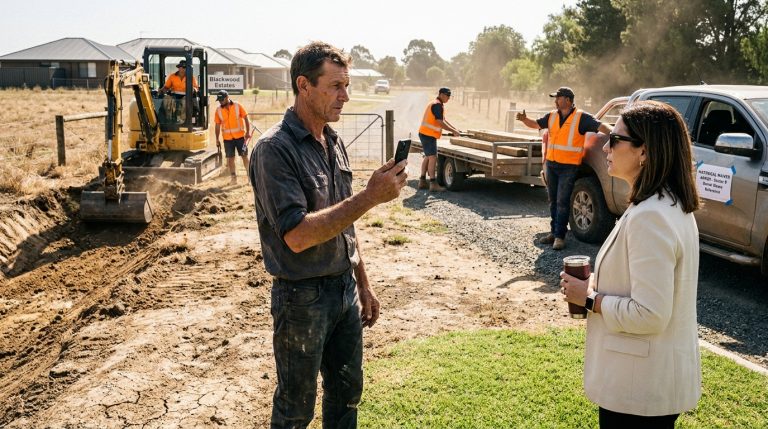
Three men in high-visibility vests stepped out of the van, their boots crunching heavily onto the gravel shoulder. The driver of the flatbed backed the rig closer, the backup beeper cutting through the damp air like a mechanical metronome. From the passenger side of the lead van, Karen Dubois stepped down, a rigid clipboard gripped against her parka, her face set in a look of rehearsed authority.
“This is the location,” Karen said, her voice carrying sharply over the diesel idle as she pointed at my private asphalt. “County mandated emergency marking. Keep the corridor clear. We’re laying the line today.”
The crew foreman, a thickset man with grease-stained sleeves, reached for a large metal stencil leaning against the side of the flatbed. I didn’t move from the center of the asphalt ribbon, my posture anchored, arms hanging relaxed but ready at my sides.
“Turn the engines off,” I said. The tone was quiet, devoid of anger, flat as an eviction notice. “You’re standing across a private boundary line. There is no county authorization on file for this parcel.”
Karen stepped forward, her heels clicking aggressively on the damp road lip. She held up her clipboard like a shield. “We are in the middle of an infrastructure compliance directive, sir. Do not interfere with public safety operations.”
“Show me the county permit number,” I replied, my gaze shifting from her to the foreman, who had stopped with the stencil half-lifted. “Not an association printout. A stamped, double-signed county variance showing an easement over this specific tax lot.”
The foreman looked at Karen, his eyebrows pulling together under his hard hat. “Ma’am? You told our dispatcher the owner signed off on the corridor infrastructure map.”
“He’s simply being uncooperative,” Karen snapped, her thumb pressing down so hard on the clipboard that her knuckles turned white. Her eyes darted toward the fog as if looking for reinforcement. “The board resolution is fully verified. Keep going with the paint layout.”
I didn’t engage in the shouting. I lowered my hand toward the leather loop of Ranger’s harness and gave a single, quiet command. “Ranger, post.”
The working dog moved out with deliberate, measured pace, stepping precisely to the edge of the dirt where the rusted surveyor’s stake sat embedded. He sat down directly over the marker, his working camera lens fixed squarely on the crew, his body completely still, an unblinking seventy-pound barrier of muscle and bone. He didn’t bark, he didn’t lung, but the silent posture made the two painters drop their marking cans back into the plastic crate.
“I’m not getting bit for an association contract,” the foreman grunted, stepping back toward his cab.
“I’ve already dialed the sheriff’s non-emergency line,” I said, pulling the recording device from my belt, the red indicator light catching the pale morning light. “The dispatch log is active. Deputy Morrow is en route with the trespass file. If that stencil touches my pavement before he arrives, it’s willful property damage.”
Karen’s face paled beneath her hood, her mouth twisting into a tight line as the foreman climbed back into his truck, shutting the door firmly against her protests. The heavy white fog continued to settle over the asphalt, capturing the bitter smell of unspooled industrial paint and the cold, unyielding stand on the gravel boundary.
CHAPTER 6: THE DIGITAL SMEAR
The foreman’s heavy door slammed shut, the latch catching with a metallic click that effectively isolated the paint crew inside their cabs. Karen Dubois remained stranded on the loose shale of the road shoulder, her boots half-submerged in the white mountain fog that rolled thick across the asphalt. Her jaw remained rigid, her fingers clenching the metal edge of her clipboard as Deputy Morrow’s cruiser finally crest the lower ridge, its yellow strobe lights cutting long, silent swaths through the gray mist.
The deputy didn’t leave his engine running. He cut the ignition, the sudden drop in decibels highlighting the wet, slow leak of a low-pressure air line on the contractor’s flatbed. He took the recording device I offered, stepping between the private boundary pins to inspect the wet, unpainted edge where the crew had halted their machinery. His notebook came out—weatherproof, bound in scarred black vinyl—and he began logging the incident number under the trespass statute.
Karen didn’t wait for the pen to stop moving. She turned on her heel, her parka rustling sharply as she retreated toward the Whispering Pines entrance without offering a formal statement. By the time Morrow handed me the card with the inked incident digits, the white fog had completely swallowed her silhouette, leaving only the damp tire tracks and the cold plastic cones behind.
I walked the seventy yards back up the driveway ribbon, the soles of my boots scraping rhythmically against the grit. Inside the kitchen, the workstation monitor was still active, the blue light reflecting off the dark wood paneling of the alcove. The inbox remained unchanged, but the local network drive had flagged a new external arrival.
It was an automated redirect from the auxiliary mail server I kept active for adjacent parcel alerts. A resident just inside the subdivision line—a retired surgical nurse who had traded city shifts for the timber—had bcc’d my administrative address on a community-wide bulletin blasted less than ten minutes after the standoff at the shoulder.
I pulled the full text file onto the primary display screen.
The subject line was set in bold capitals: URGENT COMPLIANCE SAFETY ALERT. The body of the message did not specify my name, but the text explicitly isolated the parcel coordinates, detailing a “hostile, non-compliant neighbor actively blockading mandated emergency evacuation channels.” It urged every homeowner within the Whispering Pines boundary to document any perceived safety vulnerabilities near the west access corridor and forward them directly to the executive desk.
My index finger rested on the plastic scroll wheel of the mouse. The layout was clear: she was building a public nuisance file, trying to manufacture a collective safety panic to override the lack of a legal easement. But as I opened the source code to trace the routing, the signature block at the base of the announcement revealed a standard document reference code: WP-IA-Ref-1143.
The combination matched the specific hardware registry I had pulled from the initial transport headers.
I reached into the lower desk drawer, my hand finding the heavy, cold handle of the high-speed flatbed scanner. I retrieved a physical statement form from the file rack—a clean, unlined sheet of grid paper—and drafted a single-sentence verification layout. If Karen wanted a resident file, I needed the raw testimony showing the push was unprompted.
I dialed the nurse’s private line, the mechanical click of the relays clicking inside the plastic casing of the desktop receiver. The conversation was sparse, transactional, stripped of neighborly fluff. Five minutes later, the digital return tone signaled the arrival of her signed confirmation via the secure local node: Sent to full community distribution list. Unprompted. Dubois directed.
I printed the document, the internal rollers of the machine emitting a low, rhythmic drone as the ink set into the paper fiber. I took a blue highlighter and marked the timestamp—10:14:02—aligning it directly with the trace route log from the 1143-Kuba Metadata Registry. The digital smear wasn’t an official association notice; it was an evidentiary link showing personal orchestration of a corporate entity. The line was thickening, but the architecture of her file was beginning to look less like a defense plan and more like a liability.
CHAPTER 7: THE FORGED PLAT
The high-speed laser printer dropped into its silent standby cycle with a final, metallic click, the warm scent of baked toner lingering in the narrow alcove. The fresh statement form sat in the delivery tray, the crisp ink of the witness verification still faintly warm against my thumb. Ranger remained at my side, his coat cold from the morning mist, his ears twitching toward the workstation as a sharp, rhythmic tone signaled an incoming notification through the contractor’s open email thread.
I leaned over the terminal, my hand dropping onto the mouse casing. The message was from the engineering foreman’s field account, sent directly from the cab of his truck idling down at the county road turnoff.
Attachment: Revised_Subdivision_Infrastructure_Map_WP.pdf
Text: Just received this updated schematic from the executive desk. Shows a recorded connector corridor cutting directly through your shoulder. Can you confirm these pins before we drop the machinery back down?
I saved the document straight to the local analysis directory, bypassing the standard viewer to open the file in a raw binary extraction tool. The architectural lines unspooled across the secondary monitor—a high-resolution engineering draft displaying the subdivision’s western limit. The line defining my property line had been artificially thickened with a digital overlay, a crimson path explicitly labeled Access Connector Corridor drawn over the topsoil where the wild ferns grew.
I didn’t stare at the red line. My fingers moved to the keyboard, striking the commands to parse the structural metadata blocks embedded within the file’s header records.
The screen flashed as the structural tags unspooled. The file wasn’t a certified county survey document. The original creation parameters showed the document had been extracted from the county archives three years prior, but the field marked Last Modified was stamped with a highly specific value: Yesterday, 23:43:11.
My eyes moved down to the authorization segment. The identity tag linked to the alteration software didn’t belong to a licensed surveyor or a public works coordinator. The registered author field read: kuba. Beneath that, the hardcoded network path traced back to a specific local directory: C:UsersKarenDocumentsHOAThe Dubois Plat Modification_Final.pdf.
The decoy was fully exposed. She had taken an obsolete planning draft, used private editing software to draw a fake easement path, and forwarded it to the commercial paving company to trick them into using their heavy equipment to establish physical possession.
I checked the master directory log, pulling up the trace route from Chapter 2. The hardware identifier matching the 1143-Kuba Metadata Registry mapped perfectly to the internal modification signature on the PDF.
The strategy was completely transparent now. The association wasn’t executing a routine safety upgrade. The document code matched a hidden file path I’d discovered buried in the automated email relays: The Whispering Pines Indemnity Audit. Karen had lied to her contractors, misled her board, and altered a public schematic because the neighborhood’s insurance liability shield was structural fiction, and my driveway was the only token she had left to play.
I opened the local legal folder, dragging the raw metadata logs, the traced IP receipts, and the altered PDF files into the encrypted directory linked to my attorney’s secure server. The mechanical drive chattered as the outbound transmission engaged, the progress bar creeping steadily across the dark display. The contractor was waiting down at the shoulder, his engines idling in the gray mist, expecting a boundary confirmation. He was about to receive a federal file that would pull the foundation out from under the entire operation.
CHAPTER 8: THE RED ORDER
The terminal screen pulsed with a single green checkmark as the secure directory closed, the mechanical chattering of the backup hard drive settling into a quiet, uniform hum. I pulled the master folder printouts from the document tray, the paper stiff and dense against my fingers. Ranger moved smoothly ahead of me down the narrow hallway, his paws clipping lightly on the oak floorboards as I reached the heavy storm door. Outside, the fog was beginning to lift, tearing into jagged white ribbons across the gravel shoulder where the county inspector’s utility vehicle had just pulled alongside Deputy Morrow’s cruiser.
I descended the front steps in real time, the damp air hitting my face with a cold, metallic bite. The crew foreman stood near the front bumper of his truck, his arms crossed over his canvas vest. Karen Dubois was already there, flanked by two subdivision board members who stood a step behind her, their lips pressed into thin, protective lines.
“We are pleased to resolve this coordination error,” Karen said, her hand extending a copy of the association mandate before the inspector had even unbuckled his binder. “The emergency access path is formally ratified by the executive council. The documentation is complete.”
The county inspector didn’t reach for the board document. He glanced down at the three records I laid out across the weathered steel hood of my truck. The first page was the certified county recorder ledger showing a blank easement registry; the second was the raw network header printout displaying the 1143-Kuba Metadata Registry; the third was the forensic breakdown of The Dubois Plat Modification, revealing the exact midnight timestamp where the public boundaries had been digitally forged.
“This layout isn’t an authorized public filing,” the inspector said, his voice level as he pushed Karen’s board printout back toward her chest. He turned his attention to the foreman. “Shut the painting gear down. This shoulder is private property. Set a red stop order on the nearest marker.”
Karen’s posture stiffened, a subtle tremor passing through her forearm as she looked down at the highlighted metadata lines on the truck hood. “This is an issue of community protection,” she said, her voice dropping into a tight, strained cadence. “The Whispering Pines Indemnity Audit required a verified secondary egress layout. Without this connector lane, the community faces absolute non-renewal. We are trying to protect the residents from systemic forfeiture.”
“You don’t cure an insurance deficiency by forging a county plat,” I said.
Deputy Morrow stepped forward, his heavy leather duty belt creaking as he placed the signed temporary restraining order directly on top of the modified maps. “The court service is active as of this minute, ma’am. The order bars any association presence or implied authority over this parcel. Your crew needs to clear the private asphalt immediately.”
The foreman didn’t wait for a second directive. He reached for the heavy plastic stencils, tossing them into the bed of the flatbed with a loud, metallic clang that signaled the end of the push. One of the accompanying board members quietly stepped back toward the subdivision line, his shoulder dropping as he deliberately broke alignment with Karen, leaving her standing alone against the damp shale. The inspector pulled a thick, fluorescent red adhesive sheet from his pocket, peeling the backing with a dry tear, and slapped the stop-work order firmly across the face of the unauthorized reflective sign.
By late afternoon, the valley had settled back into its original silence. The contractor’s trucks were gone, their departures marked only by the dark, wet patches where the pressure washers had erased the fresh white guide marks from the driveway lip. The iron surveyor’s stake sat clear in the dirt, its rusted top scraped bare of shale but firmly anchored three feet down into the mountain clay.
I sat on the lower porch step, a small iron file in my palm as I worked the burred edge of a gate hinge that had caught during the morning rush. The metal filings fell into the dry pine needles with a rhythmic, scratching sound. Ranger lay stretched across the cool grass below the step, his chin resting on his paws, his breathing deep and even.
A light truck engine hummed from the road, slowing down as it approached the turnoff. Lewis pulled his old green pickup onto the clean shoulder, leaning out the open window with a foil-wrapped container propped against the wheel.
“My wife figured you wouldn’t have time to fix a proper meal after spending the morning fighting the board with ink,” Lewis said, his voice carrying the dry, easy drawl of the ridge. He nodded toward the clean gray pavement. “Looks like the boundaries stayed put.”
“They stayed put,” I said, taking the warm plate through the window.
He offered a brief nod, shifted the truck back into gear, and rolled away, the sound of his tires fading smoothly into the general hum of the county road. I set the iron file down on the step beside the repaired hinge, the surface smooth and aligned once more. The woods were dark now, the shadows stretching long and gray across the deeded timber, but the line was clean. The receipts were filed, the borders were locked, and the silence belonged entirely to the land.