The Iron Edge of the Acreage: A Neo-Western Account of Mountain Boundaries and Unbending Proof
CHAPTER 1: THE LAMINATED CLOSURE
The idle of the diesel engine was the only steady sound against the early morning wind off the Aspen Vale ridge. It vibrated through the floorboards of the truck, a low, rhythmic rattle that matched the tightness in my jaw. The lower gate—my gate, the one I had hung from five-inch steel posts sunk four feet deep into reinforced concrete—was blocked. Two men stood in front of the crossbar. They wore dark blue tactical trousers and heavy nylon jackets that didn’t have city or county patches, just small, generic gold shields pinned above the pocket.
Between them, zip-tied to the galvanized chain-link mesh, was a square of white cardstock sealed in thick, reflective plastic. The letters were bold, black, and completely devoid of a legal citation. Route Temporarily Restricted Under Interim Safety Authority.
I shifted the truck into park but left the engine running. The air outside smelled of dry pine needles, dust, and the faint, chemical scent of heated brake pads from the descent. As my boots hit the gravel, the loose stones shifted with a dry, metallic crunch. The older guard, a man with a graying mustache and a face shaped like an old boot, didn’t move his hands from his belt. The younger one looked down the road toward the paved county lane, his fingers tapping against the side of his thigh.
“Who issued the closure?” I asked. I didn’t lower my phone. The camera was active, recording the scene in high-definition, capturing the slight rust bubbling around the bottom edges of the gate posts where the winter salt had settled.
The older guard shifted his weight, his boots grinding a piece of shale into gray powder. He glanced at the sign, then back at the lens. “Board instruction, sir. We’re here until the route gets finalized.”
“By who?” I took a step closer. The wind caught the edge of the laminated sign, making it click sharply against the metal gate frame. I noticed something off about the lock. The hardened steel padlock I’d put on the chain had been slid along the link, and a second, brass-bodied lock with a stamped serial number—not standard county hardware—was linked into the loop. A small physical discrepancy, a new tooth in a gear that didn’t belong to them.
“Ms. Harmon,” the guard said. He didn’t blink, but his voice lacked the heavy weight of law. It had the dry, rehearsed tone of a man paid by the hour to stand in the sun and look like a wall. “We have the paperwork from the road committee inside the vehicle.”
“You have a board notice,” I said, my voice flat, holding the phone steady until I saw the timestamp counter hit the one-minute mark. “You don’t have a county seal. You don’t have a court order. And you don’t have a sheriff’s signature.”
I turned back to the truck. The metal door handle was cold and coated in a thin layer of gray dust. The reality of the mountain was simple: if you didn’t cut the grade yourself, you didn’t own the dirt. Celeste Harmon wanted a secondary emergency route for the lower subdivision, but she wanted to take it with administrative theater before the courts could look at the deeds.
I sat in the cab, the smell of old coffee and warm upholstery filling the space. I dialed the sheriff’s non-emergency line, my eyes locked on the brass padlock gleaming against the gray steel of my gate.
CHAPTER 2: THE EAST LINE SURVEY
The dispatcher took the details with the rhythm of someone typing with one hand—log the location, note the lack of an official county seal, file the names. I hung up the phone, the glass screen smudged with a thin streak of red dirt from my thumb. The two contract guards hadn’t moved. The older one had his hands hooked back into his belt, his posture designed to look heavy, a human obstacle meant to drag out the clock until the morning sun burned the fog off the ridge.
I didn’t argue with them. You don’t waste breath on leverage that doesn’t own itself.
I cut the truck’s ignition. The sudden drop in sound left the cab cold, filled only with the click-tick of the cooling manifold. Reaching behind the passenger seat, I hauled the yellow hard-shell case out of the footwell. The latches snapped open with a sharp, metallic bite that made the younger guard glance up. Inside sat the drone, its four carbon-fiber arms folded like a dead spider, its lens cap scratched from three seasons of high-altitude line checks.
Instead of driving back down toward the paved county road, I stepped out, slammed the heavy steel door, and turned toward the eastern slope. The path here wasn’t a road; it was a rough cut through black timber and broken shale, a boundary line where my property met the lower subdivision’s common acreage. The incline was steep enough to force my boots to dig into the slick, wet clay, each step a calculated weight against the gravity pulling toward the creek bed below. The air was thick with the scent of damp pine needles and the cold, sharp edge of mountain mud.
Four hundred yards up, the trees thinned into a wide, flat turnout I’d cleared two summers ago to catch runoff. Now, it sounded like a construction site. The low, guttural chug of a diesel engine echoed through the timber, followed by the metallic ring of a spade hitting buried granite.
I didn’t walk out into the open. I stopped at the edge of the screen, where the wild raspberry bushes grew thick and thorny against the rotting trunk of a fallen yellow pine. I set the yellow case down on a flat stone, pulled the drone out, and flicked the toggle. The small internal rotors whined to life, a high-frequency buzz that sounded like a hornet caught in a tin can. I sent it up, keeping the chassis low under the pine canopy until it cleared the brush, its camera feed streaming clean, unedited geometry back to the handheld screen.
The screen didn’t lie. Below, five men in orange vests were working the dirt. A small, tracking excavator with a rusted bucket was trenching directly into the packed gravel of my turnout, chewing up the base rock I’d paid three thousand dollars to haul up from the canyon floor. A dark, oily sheen coated the machine’s hydraulic arm; a failing seal was weeping fluid down the arm, the smell of burnt mineral oil drifting into the damp air.
Beside the trench, a man with a heavy steel saw was cutting through a length of galvanized pipe, the sparks flying white against the gray dirt. Another worker was holding a wooden grade stake, hammering it down with a short sledge.
And ten feet back from the grease-stained excavator sat a white heavy-duty pickup. Stenciled in low-visibility gray matte paint across the rear quarter panel were three words: Vane Land Group.
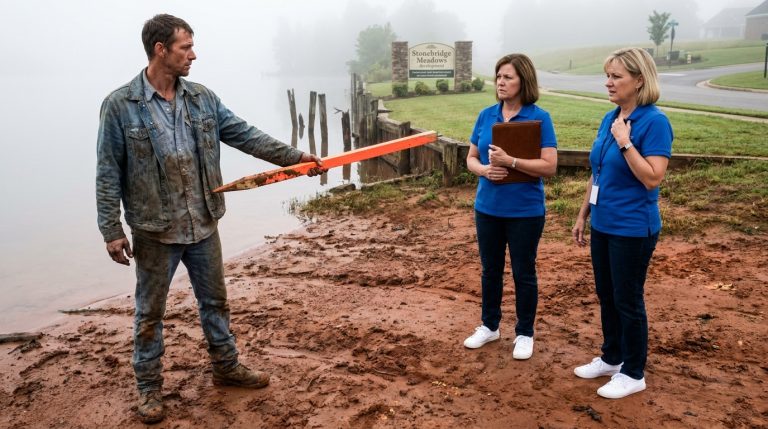
Celeste Harmon stood near the truck’s open door. Her clean, tan leather boots didn’t touch the mud; she remained on the dry, unplowed section of the old grade, a clipboard tucked under her arm like a weapon. She pointed with a silver pen toward the center of my turnout, her mouth moving as she gave instructions to a man in a greasy canvas jacket who could only be the foreman.
I brought the drone down to fifteen feet, the downwash from the rotors kicking up small dust rings in the dry dirt near her boots. The foreman looked up first, squinting through the glare, his hand rising to shield his eyes. Celeste didn’t look up immediately. She finished writing a note on her pad, her fingers moving with deliberate, professional slowness, before she finally raised her chin toward the machine in the air.
I left the controller on the rock, active and recording the coordinates, and stepped through the briars into the clearing. The mud immediately clutched at my heels, thick and smelling of iron.
“Who’s the client on this?” I asked, my voice flat enough to cut through the low thrum of the leaking excavator.
The foreman stopped, his hand resting on the machine’s grease-slick frame. He looked at the white pickup, then at Celeste, his jaw working a piece of tobacco. “Aspen Vale Road Committee,” he said, wiping a streak of black oil onto his thigh. “Got a problem with the alignment?”
“I have a problem with the line,” I said, pointing down at the trench where the bucket had already crossed four feet past my red-capped survey pin. “Got a county permit for this cut?”
He didn’t answer. He looked at Celeste again, his silence transactional. He was waiting to see who owned the checkbook before he decided who owned the mouth.
CHAPTER 3: THE PRESERVATION DEMAND
Celeste didn’t speak immediately. The silence between us stretched, filled only by the raw, irregular rhythm of the excavator’s leaking engine and the sharp hiss of mountain wind passing through the upper pine needles. She walked past the foreman, her steps precise, avoiding the thick, iron-rich mud with the practiced balance of someone who calculated every surface before stepping down. Her gaze remained neutral, lingering briefly on the drone humming steadily above the ditch line before settling on my collar.
“This is an operational evaluation for the mountain infrastructure,” she said, her voice dropping into that rhythmic, low-register calm she used to control public meetings. “The survey alignments are being clarified under the current safety mandate. The crew is simply establishing a baseline.”
“The baseline is marked in red iron,” I said, pointing down at the buried survey pin currently being choked by the fresh, wet clay her contractor had kicked out of the trench. “You crossed four feet over the parcel line. That makes this a criminal trespass, not a baseline calculation.”
She turned her clipboard slightly, and for a fraction of a second, the harsh glare of the alpine sun caught the document header clamped under the steel clip. It was an application for a commercial engineering variance, the font dense and official, but the logo at the top right was unmistakable—the sharp geometric crown of the Vane Land Group. Underneath, a line item was highlighted in faded pink ink: Section 4 Assessment – Structural Flow Capacity.
She cleared her throat, a small gesture that masked the swift movement of her thumb obscuring the text. “We are working within the administrative purview of the road committee. Any formal boundary discrepancies can be mediated at the county level next month.”
“We aren’t waiting for next month,” I said.
I turned my back on her without waiting for a reply, the mud releasing my boots with a heavy, wet pop as I stepped out of the trench perimeter. The foreman didn’t restart the excavator; he simply stood there, his greasy canvas sleeve dragging against the cold iron of the tracking arm as he watched me walk back to the yellow hard-shell case. I picked up the drone controller, cut the power, and watched the four carbon-fiber arms plunge down into the low brush as the rotors died. I packed the unit, secured the plastic latches with two heavy clicks, and began the steep descent back down the eastern line.
Every step was a calculation of mechanical and legal velocity. The loose shale slid beneath my heels, forcing my weight into my knees as I navigated the raw cut through the black timber. Reaching the truck at the lower gate, I threw the case into the cab, climbed behind the wheel, and twisted the key. The diesel engine woke with a hard, metallic roar that vibrated through the steering column.
I didn’t turn back toward the cabin. I shifted into gear and drove straight down the mountain, the truck’s heavy suspension jarring against the deeply rutted washboard sections of the public access lane. The transition from the gravel to the paved lower highway took twelve minutes of real-time driving—twelve minutes where the smell of warm upholstery and hot brake dust filled the small interior, the tires changing their song from a coarse rattle to a high, rhythmic whine against the hot asphalt.
By the time I pulled into the gravel lot of the county seat’s only legal office, the sun was high enough to bake the scent of old tar out of the street.
Marcus was already waiting by the front window, his sleeves rolled up to the elbow, exposing thin wrists coated in silver hair. The air inside the office was ancient, smelling of old wood glue, toner ink, and the dry chemical scent of bound legal papers. He looked at the handheld screen I laid flat on his desk—the unedited drone footage showing the Vane Land Group truck, the leaking tracking arm, and the specific coordinates burned into the lower left corner of the video file.
“She’s moving fast,” Marcus said, his finger tapping the glass screen where Celeste stood with her clipboard. His voice was a dry rasp, the product of thirty years of dealing with small-town boundary disputes. “She isn’t trying to win a title suit. She’s trying to alter the physical topography of the site so that when the county inspector walks it, the turnout looks like it’s been shared for a decade. It’s an administrative occupation.”
“We file the temporary restraining order before the sun goes down,” I said, my hand resting on the smooth wood of his desk chair. “And I want a formal civil standby request on the sheriff’s desk by three o’clock.”
Marcus pulled a stack of heavy white bond paper from the drawer, the pages clean and coarse under his fingers. He dipped his pen, the metal nib scratching against the surface as he began to outline the preservation notice. “If we hit them with the preservation demand, every piece of paper Celeste or the Vane Land Group has touched since the thaw becomes evidence. If they wipe a server or shred a work order, it’s a spoliation charge.”
“Draft it,” I said, my teeth catching the inside of my lip as I watched the black ink dry on the page. “I’m going back up to the cabin to dig out the original build logs. If she wants to fight about what this road used to be, I’m going to show her the receipts for every yard of gravel I put into the ground.”
CHAPTER 4: THE CABINET ARCHIVES
The truck tires bit into the lower gravel switchback thirty minutes later, throwing coarse stones against the wheel wells as I completed the return ascent. The shadows of the black timber had lengthened, stretching across the road like dark iron bars. When I reached the cabin, the air was already turning cold, carrying the sharp scent of evening pine resin. The structure sat silent on its granite footings, its dark cedar siding weathered to a dull gray by seasons of mountain sleet.
Before stepping inside, my eyes caught a small mark near the corner of the low foundation block. A surveyor’s disk, usually buried in pine straw, had been uncovered. Someone had scraped the moss away, leaving a fresh gouge across the cold iron cap. I bent down, my fingers touching the cold metal. The stamp didn’t read like the county baseline markers I knew; a numeric sequence was crudely cross-hatched, a raw physical discrepancy left behind in the brush.
I left it for now, stepped through the heavy timber door, and walked straight to the built-in storage lockers behind the wood stove.
The brass hinges groaned with a dry, ungreased rasp as I pulled the lower panel open. The scent of wood smoke and ancient spruce sap spilled out from the dark recess. Deep in the corner sat the green metal footlocker, its finish scratched down to the dull gray primer from years of moving between work sites. The padlock was cold, resisting the key for a fraction of a second before the internal tumblers dropped with a solid, heavy thud.
Inside lay the complete anatomical record of the road.
I lifted the first binder, its black vinyl cover warped from the summer heat and coated in a fine layer of gray stone dust. I carried the stack to the heavy pine table, the paper weights clicking together as I spread the history wide under the low hanging bulb. These weren’t speculative plans or neighborhood brochures; these were the hard metrics of displacement.
The first sheet was a commercial quarry ledger from nine years ago. The paper was coarse, yellowed at the edges, and stamped with the ink of the canyon crushing mill. Forty-two loads, three-inch base rock. Fourteen loads, crushed granite top-course. Stapled to the corner was the original weight slip, the thermal print faded but legible, showing the exact tonnage that had been compacted into the slope before the first foundation of the Aspen Vale subdivision had even been surveyed.
Below the ledgers lay the mechanical logs from the rented excavator. Each page was tracked by hand in a grease-penciled hand—diesel consumption sheets, hydraulic line replacements, and hourly meter readings that documented the exact week the lower switchback had been carved out of the solid shale ridge.
Then I reached the bottom of the chest and pulled out the physical media. Three compact discs sealed in hard plastic cases, their labels typed in the precise shorthand of the firm I’d hired to run the grade lines. I slid the first disc into the old laptop on the desk, the drive spinning up with a high, mechanical whine that filled the quiet room.
The file directory opened. The data structural layout was pure code—raw coordinate streams extracted directly from the GPS guidance systems of the grading machinery. When I mapped the points over the current county grid, the red trail aligned perfectly with the gravel path outside my door, centimeter by centimeter, proving the road’s geometry had been established by an independent contractor long before Celeste Harmon had ever signed a board petition.
As I scrolled through the metadata properties of the final grading export, my cursor hovered over a referenced base layer map code in the margin: Ref: Altamont Survey – Historical Overlay 1974.
I leaned closer, my thumb tracing the text on the screen. The name was unfamiliar, a relic from the old county mining records that didn’t appear in my current title deed. It was a single line of data, an old ghost buried in the registry, but its presence here meant Celeste’s legal team wasn’t just guessing—they were searching for a specific historical blind spot to drop their decoy map into.
The wind hit the cabin’s western glass, making the heavy frames rattle against the pine casing. I pulled the data discs from the drive, packed the quarry receipts back into the black binder, and snapped the heavy brass ring closed. The click was loud in the small cabin, a clean signal that the architecture of the defense was ready. The paper was in my hands, but the field was already shifting beneath the ridge.
CHAPTER 5: THE MIDPOINT SHIFT
The rain began as a dull strike against the tin roof, turning the dry dust of the yard into a slick, gray emulsion before I even reached the lower porch steps. I loaded the heavy binder into the waterproof storage box behind the driver’s seat, the plastic latches sealing with a wet pop. The drive down the ridge path was a lesson in low-gear friction; the tires slid through the fresh clay, their sidewalls grinding against the raw granite cuts I had chiseled out by hand. There was no time-skip, no sudden shift in perspective; every switchback required the full weight of my arms on the steering column as the truck fought the grade for twenty solid minutes until the gravel finally smoothed into the valley asphalt.
The county commissioner’s side room was already sweltering when I pushed through the solid oak door. The air inside smelled of wet wool coats, stale machine coffee, and the faint, chemical bite of ammonia from the freshly scrubbed linoleum.
Celeste Harmon sat at the far end of the long conference table, her spine rigid against the wooden slats of her chair. She had traded the mud-spotted leather boots for a pair of dark, sensible flats, but her posture carried the exact same institutional weight. Next to her sat a man with a narrow, clean-shaven jaw and an expensive linen jacket that looked entirely out of place in a room dedicated to local tax assessments and timber rights.
Between them lay a large, unrolled sheet of heavy vellum paper. It was an archival reproduction, its margins yellowed and brittle, but the ink lines across the center were crisp and clear.
“We have verified the historical baseline with the district registry,” Celeste said, her voice dropping into that calm, flat cadence that always preceded an administrative maneuver. She didn’t look at my phone or the yellow hard case Marcus had set near the door. Instead, she tapped the center of the vellum sheet with the tip of a black fountain pen. “The document indicates that the alignment currently utilized by the upper parcel is not a private improvement. It is the original public bypass corridor established under the Altamont Survey of 1974.”
I closed the distance between the door and the table, my boots leaving a pair of wet, gray mud tracks on the floor. I leaned over the table, my knuckles resting on the cold grain of the wood.
The map was an intricate piece of forgery. The line indicating the old wagon route didn’t follow the natural contours of the gulch; it had been shifted exactly forty yards to the west, tracing the precise path of my gravel switchbacks, tucking my lower gate and the entire retaining wall directly into what the legend defined as a “historically relied upon public access corridor.” The seal at the bottom right carried the correct county stamp, but the ink had an artificial uniformity, a lack of natural bleeding that only occurred when an old plate was run through a modern flatbed plotter.
“This layout shows a public easement that clears the entire ridge line,” the man in the linen jacket added, his fingers adjusting the knot of his silk tie without a hint of hesitation. “Under the mountain safety mandate, the road committee has the authority to reclaim any pre-existing route that has been obstructed by recent private construction. The current gate structure is a code violation.”
Marcus stepped up beside me, his thumb hooked into the pocket of his faded tweed vest. He didn’t pull out our binders or mention the drone footage yet. He simply reached out and ran his fingernail along the edge of the vellum paper, the sound a sharp scrape in the quiet room. “The Altamont filing was vacated by judicial decree in 1981 when the lower mining tract was liquidated,” Marcus said, his voice a dry, gravelly rattle. “This map shouldn’t even be in the current registry index.”
“It was re-indexed during the winter parcel review,” Celeste replied, her eyes meeting mine with a cold, transactional stillness. She didn’t flinch. She had the board vote locked, she had the paper weapon on the table, and she knew the county planner wouldn’t challenge a certified historical document without a formal title search that would take months to clear. “Until the board completes its infrastructure alignment, the lower gate remains under interim safety restriction. The guards will stay on site.”
The failure was total, clean, and perfectly executed. They hadn’t tried to disprove my receipts; they had simply changed the definition of the ground beneath the gravel. By reviving a dead survey layer, Celeste had created a legal gray zone large enough to justify keeping her contract guards at my gate and her trenching crew on my turnout.
I looked at the vellum sheet, noticing a small, faint serial number printed along the extreme bottom margin, half-hidden by the wooden roller: VLG-74-PROP. The letters were tiny, but the layout matched the specific shorthand used by the land use firm owned by her brother-in-law. The decoy was fixed in place, but the paper trail had just left its first true physical link.
CHAPTER 6: THE METADATA EXTRACTION
Marcus didn’t speak as we exited the side room, but his breathing was short, a shallow rattling sound that filled the narrow, paneled hallway. The local owners down the corridor were murmuring in small clusters, their voices low and dense, but we walked past them without breaking stride. We moved through the heavy glass double doors of the main entrance and back into the steady downpour. The rain hit the asphalt with a dull, rhythmic hiss, the cold drops cutting through the humidity of the afternoon.
We climbed into the truck cab. The small space immediately smelled of damp fabric and the persistent, bitter oil of the diesel engine. I didn’t turn the key toward the hills; I shifted into reverse, backing out of the county lot and navigating the three blocks toward Marcus’s firm in absolute silence. No steps were summarized, no miles skipped; every gear change was a calculated pull against the transmission until the truck’s tires rolled onto the familiar, oil-stained stones of his clinic of law.
Inside, the light was the same gray hue that had hung over the desks since dawn. Marcus walked straight to the network terminal by the vault, his thin coat dripping onto the dark floorboards.
“If that map was re-indexed during the winter review,” he said, his fingers hitting the plastic keys with a dry, mechanical clicking, “then the original file upload has to reside within the county planning portal’s database. Every document has an intake log, no matter who handles the physical print.”
I leaned over his shoulder, my arm pressing against the cold steel rim of the monitor casing. The interface was an old, sluggish county system, the green text bars blinking with painful slowness as the system parsed the public records.
It took seven minutes of real-time searching—seven minutes of watching the progress bar crawl across the glass screen while the rain rattled the windowpanes. Finally, the entry appeared: Document 74-A: Altamont Survey Overlay (Restored).
Marcus didn’t look at the image on the screen. He bypassed the render completely, clicking directly down into the system’s raw file properties window. The table of technical properties opened, a long column of strings and timestamps that documented the file’s journey through the county servers.
The first line under the creator property didn’t read County Surveyor Office. It read: Vane Land Group LLC – Internal Architecture Asset.
“The decoy has a signature,” I said, my finger tracing the text on the glass.
“Look at the linked data blocks,” Marcus muttered, his thumb scrolling deeper into the technical data properties. He pointed to a series of hidden layers embedded within the digital file structure—layers that didn’t appear on the printed vellum sheet Celeste had unrolled. One specific hidden property string was labeled: Proposed Infrastructure / Sub-Surface Aquifer Easement Phase II.
The structure of the theft was suddenly transparent. Celeste wasn’t trying to open a public fire lane to protect the mountain community; she was using the board’s emergency authority to claim a historical corridor, which would then automatically establish a primary utility easement for her brother-in-law’s firm. The trenching crew up at my turnout wasn’t preparing a roadbed—they were testing the choke point for a deep-bore commercial water line to feed the luxury resort extension planned below the ridge line.
A physical discrepancy caught my eye in the lower attachment log. A separate file had been uploaded alongside the survey, an instruction manual labeled Scope_Sheet_Revised.docx. Marcus clicked it open. It was a cold, transactional checklist containing explicit directives for the field crew: Move existing owner gate uphill. Reclaim private turnout into neighborhood pull off. Mask prior drainage cuts for continuity. Present as pre-existing route during county walk.
The text was plain, unvarnished instruction, a blueprint for altering both the earth and the administrative history before the state could intervene. The ultimate reality was still locked within their board minutes, but Layer 1 had cracked wide open in the dark of Marcus’s office.
“Print the entire metadata tree,” I said, the sound of my voice flat against the click of the network printer waking from its idle state. “Every stamp, every user ID, and the full text of that scope sheet. We go back to the county chair before the main hearing closes.”
CHAPTER 7: THE CONFRONTATION UNDER THE BEAM
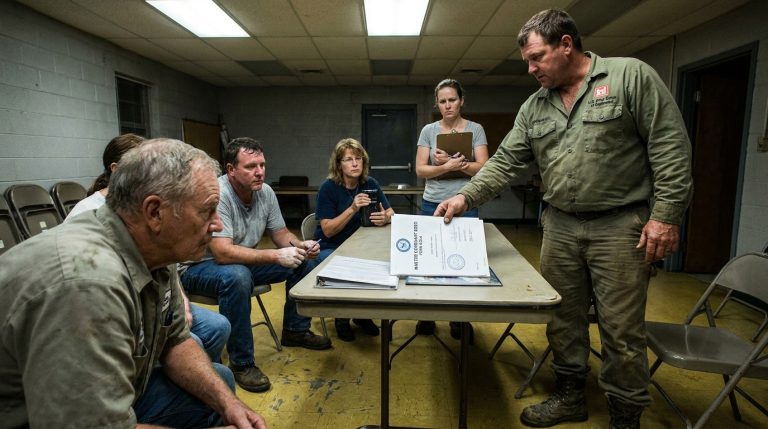
The heavy oak door swung shut behind us, cutting off the drafty moisture of the hallway. Every seat in the county hearing room was taken, the local landowners packed shoulder-to-shoulder along the rows of metal benches. The air was thick, laden with the smell of wet mud, steaming wool coats, and the ozone tang of the large projector humming at the back of the room. Celeste Harmon remained at the front table, her posture perfectly aligned with the carved balustrade, her hands clasped loosely over the unrolled vellum map. The man in the linen jacket stood next to the podium, his voice echoing off the plaster walls as he delivered the road committee’s structural report.
“The historical documentation clearly denotes a public corridor,” he stated, his pen marking the air. “Any claim of exclusive private interest is structurally inconsistent with the Altamont Survey records.”
Marcus didn’t wait for the chair to offer the floor. He stepped directly down the center aisle, his worn leather briefcase swinging against his knee with a rhythmic clunk. He laid our file flat on the clerk’s desk, the heavy paper stack making a solid, definitive thud that cut through the speaker’s cadence.
“The records are clear,” Marcus said, his voice a dry, gravelly bark that carried to the back rows. “But the layout presented by the committee isn’t an archive. It’s a freshly compiled asset.”
The county chair tilted his glasses forward, looking over the bench. “Mr. Vance, we have already logged the certified reproduction from the registry.”
“Then you need to look at the digital host,” I said, walking to the edge of the projector stand. I plugged the drive straight into the interface box. The screen on the wall flickered once, the green loading icon giving way to the raw metadata tree we had pulled from the server three blocks away.
The room went completely silent. The harsh white light of the projector beam illuminated the tiny particles of dust dancing in the air, cutting a clean path across the room to strike the ten-foot display.
“This isn’t an unedited record from 1974,” I said, pointing to the creator field displayed in giant, pixelated block letters. “The upload originated three weeks ago from an account owned by the Vane Land Group. The lines were shifted forty yards west to match the exact grade I cleared with my own machinery. It’s a manufactured overlap.”
Celeste’s lawyer stood up, his sleeve catching the edge of his water glass. “Mr. Chairman, the source file properties are secondary to the historical context—”
“Sit down,” the county chair said. His voice wasn’t loud, but it had the flat weight of an elected official who didn’t tolerate administrative theater in his chamber.
I hit the toggle, advancing the screen to the extracted text file. The words Scope_Sheet_Revised.docx appeared right next to her name. The instruction sheet was clear, detailing the precise steps to move my gate uphill, convert my private turnout into a neighborhood pull-off, and mask the prior drainage cuts to deceive the county walk. It linked the guards at the lower gate, the excavator trenching my dirt, and the vellum map into one deliberate mechanism.
Celeste didn’t move. Her expression froze into the exact stillness of a person who realized the floor beneath her feet had just been dismantled. The polished confidence didn’t soften; it hardened into a cold, defensive wall as her fingers clutched the edge of the clipboard until her knuckles showed white under the low-wattage bulbs.
The sheriff, sitting by the side exit, leaned forward. His eyes locked onto the stenciled name of the developer on the screen, then moved directly to Celeste. “For the record,” he said, his heavy voice cutting through the rising murmur of the crowd, “armed contract personnel were posted at that lower access point without lawful county authority. My office doesn’t recognize claims built on altered site conditions.”
The chair brought his wooden mallet down with a sharp, dry crack that ended the argument before the board could even call for a vote. “The corridor petition is frozen pending a formal review for fraud. The road committee’s interim safety authority is revoked, effective immediately.”
Celeste stood up slowly, her chair scraping the floorboards with a long, shrill shriek. She didn’t look back at the room, nor at the local owners who were already moving toward the doors. She walked out through the side exit, her shoulder brushing against the dark frame, leaving the forged map abandoned on the table like a piece of useless skin.
CHAPTER 8: THE PROPER NAME
The courthouse corridor cleared in small, muted groups, their murmurs deadened by the heavy plaster walls. I didn’t join them. I stood by the rear exit with Marcus, watching the technician coil the thick black video cables from the projector. The paper printouts of the metadata audit were still clamped under my arm, the crisp white edges slightly warped from the damp heat of the room.
Outside, the mountain downpour had settled into a slow, rhythmic mist that hung gray over the valley asphalt. The journey back up the ridge took twenty-four minutes of continuous, low-gear climbing, the truck’s tires slinging wet grit against the inner wheel wells with a steady, rasping hum. Every switchback I had carved years ago felt heavier now, solidified by the county record that had just been scrubbed clean of Celeste’s forged lines. There were no shortcuts, no skips in the physical terrain; the truck rolled past the lower gate point where the temporary restricted sign had once been zip-tied. The guards were gone. The non-standard brass lock had been snapped off the main chain, its broken shackle lying in the wet cheatgrass like a discarded tooth.
When I reached the upper turnout, the foreman’s crew had already cleared their machinery. All that remained of their occupation was a raw, red trench across the gravel, the open earth smelling strongly of iron and the low-grade hydraulic fluid that had wept from the excavator arm.
I cut the truck’s ignition and stepped down into the gravel. The air was cold now, clean and stripped of the valley’s humidity. From the back of the pickup bed, I hauled the heavy iron spade and the long post-hole digger I had purchased when the first boundary line was set. My palms found the rough grain of the wooden handles, the friction familiar against the calluses of my palms.
For the next forty-five minutes, I worked the shoulder in real-time. I shoveled the displaced base rock back into the cut, leveling the grade by hand until the red-capped survey pin stood completely clear of the mud. Every stroke of the blade against the granite stone was a physical calculation of force, a calculated labor to repair the specific violence done to the topography.
By the time Marcus, the surveyor, and the county road inspector drove up the final switchback in the surveyor’s utility vehicle, the turnout was level again. The gray stone paths matched the original coordinate exports exactly.
The three men climbed out, their boots crunching softly on the fresh gravel top-course. Marcus carried an unsealed bottle of small-batch bourbon and four plastic cups nested together. Nobody made a speech. The dynamic of the victory was transactional, quiet, and bounded by the laws of the soil.
I took the small plastic cup from Marcus. The amber liquid was warm against my throat, tasting of charred oak and leather, cutting through the damp chill of the mountain air. We leaned against the iron crossbar of the gate, looking down the long, steep slope toward the valley where the lights of the subdivision were beginning to blink white through the black timber.
The Land Use firm owned by Celeste’s brother-in-law had already withdrawn their engineering variance applications from the county portal before the afternoon session had officially adjourned. The Aquifer Easement project was dead on the ledger, its corporate code strings exposed to the public registry. Celeste had been removed from the road committee presidency by a unanimous vote of the board members three hours after she walked out of the chamber, not because they found a sudden conscience, but because her institutional theater had become too expensive to defend against a verified deed.
I reached down and touched the heavy steel latch of my gate, checking the tension of the welded hinge. The metal was cold, wet with the mountain mist, but it didn’t give a millimeter under my hand. The mountain was silent again, the low hum of the wind through the spruce trees the only architecture left standing. The road wasn’t a negotiable corridor or a public safety asset. It was gravel, iron, and labor, returned finally to the absolute clarity of its proper name.