The Quiet Echo of Steel: A Veteran’s Final Lesson on the Fragile Art of Human Connection
CHAPTER 1: THE DUSTY REVELATION
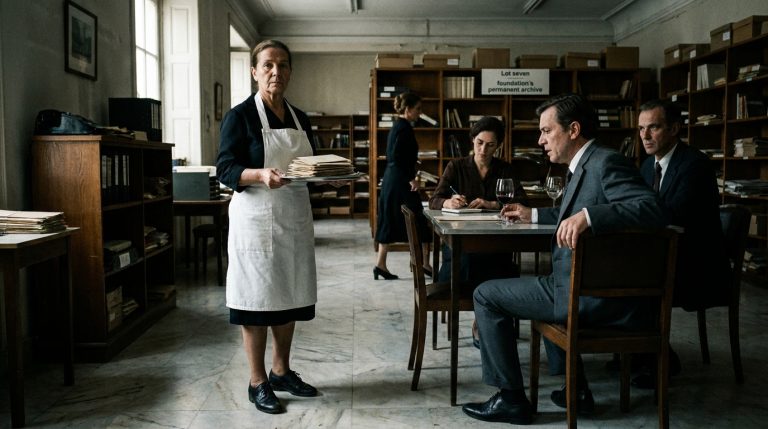
The basement air was thick with the scent of decaying paper and ozone. Cade squinted at the monitor, his eyes burning from three hours of scanning grainy, black-and-white reconnaissance footage. Beside him, Bowen and Javi were equally still, their faces pale in the flickering glow of the screen.
“It’s not there,” Javi whispered, his voice cracking. “The gunner… he just drops. No shot, no trajectory, just silence.”
Cade leaned back, the plastic chair groaning under his weight. He rubbed his eyes, the memory of Leo Sterling’s steady hands at the range burning in his mind. He had come here expecting a blueprint for the impossible—a masterclass in long-range precision. Instead, he had found a haunting piece of history that refused to fit the narrative Captain Reyes had painted at the range.
The official report for the Panama operation was brief, cold, and entirely clinical. It described the neutralization of the ZPU-4 threat but conveniently omitted the logistics of the shot. But here, in the raw, unedited footage from an accompanying aerial drone, Cade saw something else.
He moved the mouse, scrubbing the playback back ten seconds.
There.
In the bottom left corner of the screen, just beneath the target building, a small, dark shadow moved near a cluster of foliage. It wasn’t an enemy combatant. It was a person, small and slight, standing near a corrugated metal shack. A second later, the ZPU-4 gunner slumped over, hit by a bullet that had traveled from an impossible distance.
But the bullet hadn’t just struck the gunner. The impact caused a secondary structural failure—a rusted steel support beam snapped, falling directly toward the shack where the shadow had been standing just a heartbeat before.
“Stop,” Cade commanded, his voice sharp.
Javi hit the pause button. They leaned in, pixels blurring into the shape of a life caught in the crossfire of a legend.
“The gunner was neutralized,” Bowen said, his voice unusually quiet, stripped of its usual bravado. “But look at the shack. Look at the distortion in the roof.”
Cade zoomed in. The roof had caved in, not from fire, but from the sudden, violent collapse of the support beam. The figure by the shack was gone, replaced by a plume of dust that lingered in the stagnant air of the recording.
The silence that followed was heavy, a physical weight pressing down on the three men. They had come to the archives to learn how to be gods of the range, to master the physics of the “Pathfinder.” Instead, they had stumbled upon a ghost.
“He wasn’t just shooting at a gunner,” Cade said, the realization settling into his bones like lead. “He was shooting through a storm, through foliage, at a target he couldn’t see clearly. He did the impossible, but he didn’t know what was behind it.”
He looked at his companions. The awe they had felt at the range—the sense of standing in the shadow of a giant—was suddenly replaced by a hollow, aching question. Leo Sterling hadn’t looked like a man who had conquered the world. He had looked like a man carrying a burden that had no name.
“We aren’t leaving until we find the rest of this file,” Cade said, reaching for the next reel. “There’s a part of this story that wasn’t in the official history.”
As he slotted the new reel into the machine, a thin, yellowed envelope slipped from the back of the case. It was addressed to the Commanding Officer, dated three months after the mission. Cade opened it, his fingers trembling slightly as he pulled out a hand-written note on stationery that smelled faintly of old, dry earth.
It wasn’t a report. It was an apology.
CHAPTER 2: THE WEIGHT OF THE APOLOGY
The note was simple, written in a cramped, disciplined hand on parchment that had yellowed into the color of a bruised apple. As Cade held it, the ambient hum of the archive’s climate control system—a low, rhythmic thrum—suddenly felt like the beating of a pulse. He didn’t read the words immediately. He looked at the ink, which had faded from black to a ghostly, washed-out charcoal. It was an artifact of a moment that had occurred decades before he had even been born, yet it felt as heavy as a weapon in his grip.
“Well?” Bowen whispered, his voice uncharacteristically jagged. “What does it say?”
Cade turned the paper toward the dim light of the monitor. The message was sparse, the kind of direct communication stripped of all unnecessary emotion, yet saturated with an unspoken, suffocating regret.
To the Commander, Detachment Alpha. Regarding the target at coordinates 09-14-22. The collateral was not accounted for in the primary briefing. Request that this file remain restricted. The error is mine. I will carry the consequence. Pathfinder.
The basement seemed to shrink. Cade felt a phantom chill creep up his spine—the psychological weight of realizing that the man they had idolized at the range, the man who had hit a target at 2,000 meters with the indifference of a clockmaker, had lived his entire life in the shadow of this single, handwritten admission.
Javi reached out, his fingers hovering near the note, but he didn’t touch it. “He didn’t report it to the brass as a failure,” Javi murmured, his eyes darting to the screen where the dust still swirled in the grainy playback. “He took the burden of the error entirely onto himself.”
“Because if it had been reported as a failure, the mission would have been classified as a disaster,” Cade reasoned, his mind racing. “The entire operation would have been scrubbed. The team that he saved—the one Reyes mentioned—would have had their lives overshadowed by the investigation.”
Cade looked at the note again, noting the indentation of the pen on the back of the paper. Leo Sterling hadn’t just written a note; he had pressed down hard enough to mark the desk underneath. It was a physical manifestation of a man trying to exert control over a world that had spiraled into chaos.
“We shouldn’t be looking at this,” Bowen said, though he didn’t move away. He shifted his weight, his boots scraping against the concrete floor—a sharp, grating sound that echoed too loudly in the cramped space. “If Reyes or the senior chief finds out we’re digging into the Pathfinder’s files, we’re finished. This isn’t just history, Cade. It’s a closed-door secret.”
“It’s only closed if we decide it is,” Cade replied, his voice hardening. He felt a strange, jarring disconnect. He had spent his entire career wanting to be the kind of shooter who could hit the impossible shot, the kind of person who could act with absolute, detached precision. But staring at this apology, he realized that the “stillness” Leo Sterling spoke of wasn’t the absence of emotion—it was the containment of an immense, burning regret.
Cade pulled his phone out, the light from the screen reflecting in the glass of his watch. He began to scroll through the digital archives of the base, cross-referencing the coordinates in the note with regional incident logs from 1989.
“What are you doing?” Javi asked, leaning over his shoulder.
“The note mentions a specific location,” Cade said, his fingers flying across the screen. “If this wasn’t an official disaster, there has to be a local record. A death certificate, a police report, something that wasn’t filed through military channels. Someone had to account for that shack and the person who was inside it.”
The atmosphere in the room shifted. It was no longer about training or target acquisition. It was about the architecture of a lie. Cade felt the distinct, tactile grit of the desk under his elbows, a rough surface that felt like sandpaper. Every sensory detail of the room—the stagnant, dusty air, the cold, hum of the server racks, the smell of burnt electrical tape—seemed to amplify his focus.
“You’re not going to find it,” Bowen said, though his hand subconsciously reached out to brace against the archive shelf. “If he wiped the record, he wiped it clean.”
“Nobody is clean,” Cade muttered, his eyes locked on a search result that blinked into existence—a digitized scan of a local Panama City civil registry from November 1989. “There are always echoes. You just have to know how to listen for them.”
He tapped the screen. The document was in Spanish, listing names of civilians who had been displaced or injured during the conflict. Most were casualties of the crossfire, but one entry, tucked away in the supplementary index, caught his eye. It was a file for a property owner near the coordinates.
Cade’s breath hitched. He wasn’t just looking at a name anymore. He was looking at a legacy. And for the first time, he realized that the “impossible shot” hadn’t just changed the tactical landscape of a battle; it had changed the trajectory of at least one family’s entire existence.
He didn’t tell Bowen or Javi yet. He simply stood up, the chair clattering backward as he tucked the note into his pocket. The silence of the basement now felt different—not empty, but expectant. He felt as if he were walking out of the archives into a reality that was fundamentally fractured, and he knew, with a sudden, sinking certainty, that he couldn’t go back to being the shooter he was just yesterday.
“We’re going to his workshop,” Cade said, his voice quiet, leaving no room for argument. “We need to know if he knows that we know.”
CHAPTER 3: THE THRESHOLD OF THE MASTER
The drive to Leo Sterling’s workshop took forty minutes, every mile of which felt like a tightening screw. The California sun was beginning to dip, casting long, bruised-purple shadows across the high desert, but inside the SUV, the air felt cold. Cade kept his hands firmly on the wheel, his knuckles white. Beside him, Bowen and Javi were silent, their usual banter replaced by the heavy, thick stillness of three men contemplating the fragility of their own worldviews.
Cade pulled the vehicle off the paved road and onto a winding dirt track that snaked toward the base of the mountains. The workshop wasn’t a commercial structure; it was a low-slung, weathered cabin surrounded by a clutter of discarded machinery and rusted parts that looked like the skeletal remains of forgotten industrial eras. There was no perimeter fence, no security, just the vast, uncaring expanse of the desert pressing in from all sides.
He killed the engine. The silence that followed was absolute, punctuated only by the ticking of the cooling metal beneath the hood.
“If he’s a ghost,” Javi whispered, his hand resting on the door handle, “maybe he doesn’t want to be found.”
“We aren’t looking for a ghost,” Cade replied, his voice steadier than he felt. “We’re looking for an explanation.”
He stepped out. The smell hit him first—not the sterile, ozone-scented air of the archives, but a rich, layered cocktail of gun oil, cedar shavings, and dry, baked earth. It was the scent of a life lived in proximity to the work. Cade walked toward the entrance, his boots crunching against the gravel. Every step felt intentional, a slow, deliberate movement toward a truth he was starting to suspect he didn’t actually want to possess.
As he reached the heavy, oil-stained wooden door, he saw it wasn’t locked. It was held shut by a simple iron latch that had been worn smooth by years of contact. He paused, his hand hovering over the cold metal. He thought about the apology note in his pocket—the physical weight of the ink, the indentation of the regret. If they knocked, they were guests. If they entered, they were intruders.
He didn’t knock. He lifted the latch, the iron groaning in protest, and pushed the door inward.
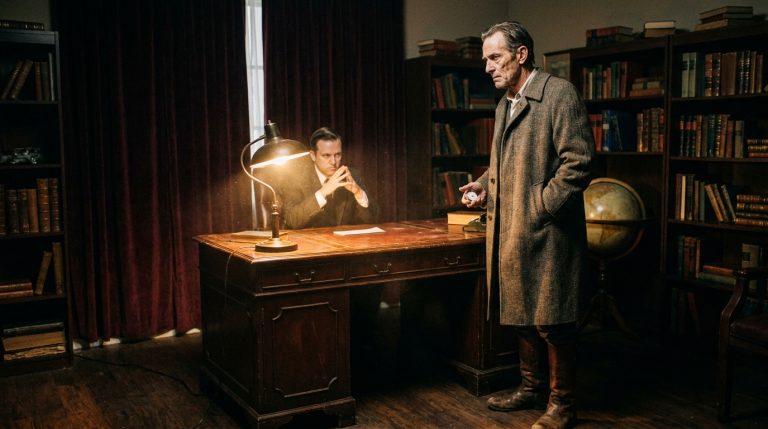
The workshop was a cavern of organized chaos. Walls were lined with hand-tools hung in precise, shadow-traced outlines—a testament to a mind that demanded order in every detail. In the center of the room, perched on a heavy oak workbench, sat the Remington 700. It looked different here, stripped of the desert light and the context of the range. It looked small, vulnerable, a piece of wood and steel that had been asked to carry the weight of a conscience.
Leo Sterling was standing at the far end of the room, his back to them. He was hunched over a grinding wheel, a spark of orange light dancing in the semi-darkness as he smoothed a piece of metal. He didn’t turn. He didn’t stop. He moved with a rhythm that felt ancient, a metronomic efficiency that filled the room.
“I didn’t think you boys would make it this far,” Leo said, his voice soft, cutting through the whir of the grinder. He killed the power, the machine spinning down to a slow, mournful whine.
Cade stepped inside, his heart hammering against his ribs. He felt a sudden, sharp surge of paranoia. Had they been followed? Was this part of a larger, more complex game than he had imagined? He scanned the room, his eyes catching on a shelf in the corner—an array of dated photographs, some frayed at the edges, others clearly copied from records he had just seen in the archives.
“We went to the archives, Mr. Sterling,” Cade said.
Leo finally turned around. He looked older in the dim light, his face a map of deep-set lines and muted memories. He wasn’t surprised. He wasn’t even defensive. He simply wiped his hands on a rag that was stained with years of grease and soot.
“The archives hold a lot of paper,” Leo said, his pale blue eyes pinning Cade to the floor. “But paper doesn’t know the weight of the air, or the specific pitch of the wind on that day. It only knows what the authors chose to keep.”
Leo stepped away from the bench, his movements slow and deliberate. He walked toward Cade, his gaze flickering briefly to the bulge in Cade’s jacket where the apology note resided.
“You’re looking for a hero, son,” Leo continued, his voice devoid of judgment, saturated only with a heavy, profound exhaustion. “You’re looking for someone who stands on a pedestal and never wobbles. But out here, in the gray, there are no pedestals. There are only choices that have to be made, and the nights that follow them.”
Cade felt a flicker of the “Unreliable Perception” again—a dizzying sensation that the walls of the workshop were moving, closing in. He looked at the photographs on the shelf again. The faces in them weren’t just targets; they were people. And in the center of them all was a younger, unrecognizable Leo, standing not in the triumphant pose of a warrior, but in the hunched, burdened stance of a man who had seen too much.
“We want the truth,” Cade insisted, but the words felt hollow in the vast, dusty silence of the shop.
Leo leaned back against the workbench, his arms folded across his chest. He looked at Cade, then at Bowen and Javi, seeing the reflection of his own past in their eyes. “Truth is a luxury, Cade. One you earn only after you’ve realized that the legend you worship is just a cage you’ve built for yourself.”
He reached out and picked up a small, smooth stone from the bench, turning it over in his fingers. “Before we speak of the mission, you need to understand the cost. And you need to decide if you’re strong enough to carry the payment.”
CHAPTER 4: THE PRICE OF THE LESSON
Cade didn’t move. He watched the way Leo’s thumb traced the edge of the stone, a repetitive, absentminded motion that spoke of long hours spent in solitude, weighing things that had no measurable mass. The workshop felt smaller now, the shadows in the corners deepening as the afternoon light bled into the horizon.
“You’re talking about payment,” Cade said, his voice sounding thin against the backdrop of the desert wind rattling the cabin’s corrugated siding. “But we didn’t come here to buy anything. We came to understand.”
Leo’s gaze shifted from the stone to the workbench. He didn’t look angry; he looked disappointed, as if he were watching a student struggle with a math problem he had already solved decades ago. He reached out and pushed the Remington 700 slightly toward Cade. “Understanding is expensive, son. It costs you the illusion that you’re the hero of your own story. Once you see the threads, you can’t unsee them.”
He moved past Cade, his gait steady despite the slight stoop in his shoulders, and reached for a heavy, iron-bound ledger hidden beneath a stack of grease-smeared schematics. He laid it flat on the bench. The cover was scarred, the leather peeling back to reveal a grain that looked like dried, cracked soil.
“Bowen, Javi—take a look,” Leo murmured.
The two SEALs hesitated, glancing at Cade for permission. When Cade nodded, they stepped forward, their movements stiff. Leo flipped the ledger open. The pages weren’t filled with ballistics data or tactical summaries. They were lists. Names, dates, and locations—a sprawling, frantic record of a man trying to track the long-term impact of a life spent in the shadows.
Cade peered over Javi’s shoulder. His eyes locked onto a page dated 1990. Entry: 09-14-22. Restitution: Delivered to the clinic in Panama. Anonymous.
“That shot in Panama,” Cade said, his throat suddenly dry. “It wasn’t just a mission. You stayed.”
“I stayed because the bullet didn’t just end a threat,” Leo replied, his voice a low, gravelly rasp. “It tore through the wall of a home. I watched it happen through the scope. The gunner fell, but the collapse was immediate. I saw the shadow of a woman—not a combatant, not a target—just someone who was in the wrong place at the wrong time.”
Leo turned to look at the workshop window, watching the desert sun disappear entirely, leaving the room bathed in a deep, melancholic twilight. “I spent the next three years using every scrap of leave, every saved cent, and every contact I had to track what became of the family in that house. I didn’t want glory. I didn’t want a commendation. I wanted to pay for the roof that fell.”
The revelation hung in the air, a physical pressure. The “Pathfinder” wasn’t a legend built on success; he was a man defined by the desperate, quiet attempt to heal a wound he had inflicted himself. Cade looked at the ledger, then at the rifle on the bench. He realized now why the weapon felt so small—it wasn’t a tool of conquest anymore. It was a penance.
“Why are you telling us this?” Bowen asked, his voice barely audible. “This is classified. This is…”
“This is the reality of the trade,” Leo interrupted. He turned back, his expression turning sharp, suddenly alert. “You think you’re in this for the adrenaline? For the status? That’s the decoy. That’s the thin film of paint over the rot. If you want to be a professional, you have to be willing to hold the ledger. You have to be willing to look at the wreckage you leave behind and start the work of rebuilding, knowing that the victim will never know your name, and that the history books will never print your confession.”
Leo walked to the shelf where the photographs were kept and pulled one down. He handed it to Cade. It was a picture of a young girl, standing in front of a modest, newly painted house. She was smiling, holding a schoolbook, looking entirely oblivious to the fact that her future had been bought with the proceeds of a ghost’s penance.
Cade took the photo. His fingers brushed the surface—it felt cool, smooth, and achingly real.
“I’m not a hero,” Leo said, his voice fading into the shadows of the room. “And neither are you. You’re just men with weapons. The only thing that separates the monster from the guardian is the willingness to admit when you’ve broken something.”
A sudden, jarring metallic thud echoed from outside—the sound of someone, or something, colliding with the pile of rusted scrap in the yard. The trio of SEALs went rigid. Cade’s hand instinctively drifted toward his belt.
Leo didn’t flinch. He simply reached out and dimmed the single, hanging lightbulb over the workbench. “You wanted the truth, Cade. Now, you’re about to find out how hard it is to protect it.”
The atmosphere in the workshop shifted from contemplative to suffocatingly tense. The silence outside was no longer just the desert; it was a void, waiting to be filled. Cade realized with a chilling clarity that the history of the Pathfinder wasn’t just a memory—it was a target, and someone else was finally closing in on it.
CHAPTER 5: THE FRAGILITY OF SECRETS
Cade’s hand moved in a blur, his training taking over before his conscious mind could process the potential threat. He gestured for Bowen and Javi to flank the workshop door, his movements fluid and efficient—a sharp contrast to the slow, heavy atmosphere of the room moments ago. Leo, however, remained rooted to the spot, his posture unchanged, his pale eyes tracking the darkness outside the window with a calm that bordered on chilling.
“Don’t,” Leo said, his voice a low, steady command that cut through the tension. “You aren’t going to solve this with a sidearm, Cade.”
The metallic thud happened again—louder this time, followed by the distinctive, grinding screech of a heavy vehicle chassis scraping against the desert floor. The headlights of an SUV swept across the workshop’s windows, turning the dust motes in the room into a chaotic, swirling galaxy of gold.
Cade ignored the warning, his focus locked on the doorway. He caught a glimpse of a silhouette stepping from the vehicle—a man, broad-shouldered and wearing a tactical vest that caught the moonlight. The visitor didn’t move like an intruder; he moved with the practiced, predatory confidence of someone who owned the land he walked on.
“It’s not an attack,” Leo murmured, moving toward the workbench to secure the ledger. “It’s a collection.”
The door swung open, the latch screaming as it hit the wall. The man who stepped inside was middle-aged, his face a hard, weathered mask of indifference. He carried a small, reinforced metal case. He looked at Cade and his team, then at Leo, his gaze resting on the Remington 700 with an expression of cold, professional recognition.
“Mr. Sterling,” the man said, his voice flat. “The time for the annual adjustment has arrived. I trust you haven’t been keeping any additional records.”
Cade’s pulse thrummed in his ears. The “adjustment.” The word felt like a physical blow. He glanced at Leo, whose face had hardened into a map of weary defiance.
“I told you, Elias,” Leo said, stepping into the center of the room. “The books are closed. The ledger is finished.”
The man, Elias, laughed—a sharp, mirthless sound. He set the case on the workbench, the metal clinking against the wood. “The ledger is never finished. You know that better than anyone. You keep records of the ghosts you’ve made, and you expect the organization to just turn a blind eye? We’ve kept you in the shadows for thirty years because you were a legend, Leo. But legends that start talking… they become liabilities.”
Bowen stepped forward, his hand still near his holster. “Who the hell are you?”
Elias turned his attention to the young SEAL. “I’m the auditor. And you three are currently in the way of a very important conversation.”
Cade felt a surge of adrenaline, but he forced himself to breathe. He looked at the reinforcement case on the bench, then at the photograph Leo had handed him earlier. The girl in the photo, the schoolbook, the modest house—the entire foundation of Leo’s penance was being threatened by this man’s sudden appearance.
“We’re not going anywhere,” Cade said, his voice low and dangerous.
Elias shrugged, a dismissive gesture that signaled his lack of concern for their presence. “Suit yourself. But understand this: what Leo is protecting isn’t just a memory. It’s a breach. The truth about Panama, the ‘collateral damage’ that wasn’t supposed to be found—if that gets out, it doesn’t just ruin a legend. It unravels an entire decade of covert assets.”
The room seemed to vibrate with the tension. Cade looked at Leo, seeing the veteran struggle to maintain his calm. Leo’s hands, usually so steady, were now trembling—not from fear, but from the raw, volcanic rage of a man seeing his legacy being systematically dismantled.
“You won’t touch the file,” Leo said, his voice thick with a sudden, violent intensity.
“I already have,” Elias replied, tapping the case on the bench. “I have the digital copy of your entire ledger. And if you think you can stop us, you’re forgetting one thing, Leo. You’re not the ghost anymore. You’re just a target.”
Cade stepped between them, his tactical instincts overriding his hesitation. He realized the “decoy” wasn’t the heroic story—it was the belief that Leo was safe because of his legend. He was only safe as long as he stayed silent.
“Get out,” Cade said, his voice echoing in the small room.
Elias looked at him, then at the two other SEALs, his eyes gleaming with a malicious anticipation. “Fine. We’ll take the file. But when the truth of Panama comes out, and the families start asking questions that no amount of anonymous restitution can answer… don’t say I didn’t warn you.”
Elias turned and walked out, his stride long and measured, leaving the door swinging in the desert breeze. Cade didn’t follow. He stood motionless, his mind reeling from the realization that the “anonymous” restitution Leo had worked so hard to maintain had been a surveillance target all along.
Leo slumped against the workbench, the adrenaline leaving him as quickly as it had arrived. He looked at the empty space where the ledger had been, his face a hollow mask of defeat.
“It’s gone,” Leo whispered, his voice cracking. “All of it.”
Cade looked at the photograph in his hand—the girl, the house, the life that was now vulnerable to a world that didn’t know the meaning of mercy. He felt a fire ignite in his chest, a resolve that had nothing to do with the range or the records. It had to do with protecting the last, fragile piece of humanity in a landscape of ghosts.
“Not all of it,” Cade said, clutching the photograph. “We know what’s in the ledger. And we know who they are.”
CHAPTER 6: THE BUREAUCRATIC WALL
Cade didn’t let the photograph go. He held it with such force that the edges began to curl against his thumb, the image of the young girl in Panama serving as a sharp, painful contrast to the cold indifference Elias had displayed. The workshop felt diminished now, the shadows stretching across the floor like reachers, and the air seemed to have thinned, making every breath a conscious effort.
“We need to move,” Cade said, his voice clipped. He turned to Bowen and Javi, who were still standing near the door, their expressions a mixture of shock and the beginning of a cold, hard resolve.
Leo was still leaning against the workbench, his breathing shallow. He looked smaller than he had only minutes before, the weight of his secret finally stripped away, leaving him exposed. “Moving won’t help, Cade,” he murmured, not looking up. “Elias doesn’t just work for an organization. He is the organization. He’s the one who maintains the order, who cleans up the messes that the ‘legend’ creates.”
“He’s not omnipotent,” Cade replied, moving toward the workbench to grab his gear. “He has an office, he has a network, and he has a paper trail. If he’s that worried about the Panama file getting out, then we have the only leverage that matters.”
“You think you have leverage,” Leo countered, finally meeting Cade’s gaze. His eyes were no longer the pale blue of a quiet veteran; they were burning with a desperate, frantic clarity. “You think you’re holding the truth, but you’re holding a live grenade. Elias didn’t come here to warn us. He came here to set the bait.”
Cade stopped. The thought hit him like a physical blow, a sudden, sickening realization that the entire interaction—Elias’s calculated entrance, the dramatic revelation of the ledger’s theft, the warnings—had been a performance. Elias wanted them to fight back. He wanted them to go to the archives, to dig deeper, to build a case that he could then systematically dismantle in a public, devastating way.
“The registry,” Cade muttered, his mind racing back to the archives. “The file I found on the family… if that was part of the ledger, then he already knew I was looking for it.”
“He let you find it,” Leo said, his voice barely a whisper. “He needed a reason to pull the trigger on the whole operation. By tracking the family, you’ve essentially handed him the breadcrumbs to a trail that leads right back to us.”
Cade looked down at the photograph again. The girl, the house, the small, mundane details of a life he had been trying to protect—they were all markers in a game he didn’t realize he was playing. He felt a phantom chill, a sense that he was being watched, not by a man, but by the weight of a system that had been designed to absorb and erase people like Leo Sterling without a second thought.
“We can’t go to the authorities,” Javi said, stepping forward. “If we do, we’re just handing them more evidence. We’re confirming everything they want to claim.”
“We go to the source,” Cade said, a cold, hard determination setting into his bones. “If Elias wants a trail, we’ll give him one. But we’re going to force him to look at the very thing he’s trying to bury.”
Leo shifted, his posture straightening slightly. The weariness in his face began to recede, replaced by the ghost of the man who had written the playbook for their entire existence. “You’re talking about a breach, Cade. A direct confrontation with the institution. You realize that if you do this, you won’t just be questioning the past. You’ll be declaring war on the present.”
Cade looked at his team, then at the rifle on the bench. It was a tool of precision, and for the first time, he realized that the precision wasn’t just about the shot. It was about the choice. He didn’t answer Leo with words; he simply tucked the photograph into his breast pocket, close to his heart.
“They expect us to be heroes,” Cade said, his voice devoid of any bravado. “Let’s show them what we’re actually made of.”
As they left the workshop, the desert wind seemed to rise in a crescendo, a mournful, sweeping sound that rattled the dry scrub and turned the night air into a stinging abrasive. Cade walked to the SUV, the gravel crunching under his boots with a finality that echoed in the silence of the high desert. He didn’t look back at the workshop, or at the figure of Leo Sterling standing in the doorway—a relic of a different time, now witnessing the first step of a new, dangerous movement.
As he keyed the ignition, his eyes caught a flash of movement in the distance—a pair of headlights, dim and distant, tracking them from the mouth of the canyon. They weren’t just being followed; they were being shepherded. Cade shifted the gear, his grip on the wheel firm and deliberate. He wasn’t just driving back toward the base. He was driving toward the absolute limit of what he was willing to lose.
CHAPTER 7: THE BUREAUCRATIC WALL
The SUV lurched as Cade slammed it into a lower gear, the chassis groaning against the uneven, rock-strewn path of the canyon floor. Behind them, the pursuing headlights remained locked to their tail, a pair of artificial eyes that refused to blink. Cade’s hands were slick against the leather of the steering wheel, his eyes scanning the periphery for a break in the terrain—a way to lose the tail that didn’t involve an outright firefight.
“They’re not trying to stop us,” Bowen shouted over the roar of the strained engine. “They’re herding us. Look at the road ahead!”
Cade squinted into the gloom. Ahead, the canyon narrowed into a bottleneck, the rock walls rising sharply like the teeth of a trap. A blockade of heavy transport vehicles was positioned across the path, their silhouettes hulking and immovable against the moonlight. This wasn’t just pursuit; it was containment.
“Hold on,” Cade said, his voice tight.
He didn’t hit the brakes. Instead, he hammered the accelerator, aiming for a narrow, precarious drainage ditch to the left of the blockade. The SUV tilted violently, the suspension screaming as it bottomed out, sending a spray of grit and dry shale showering against the undercarriage. For a heart-stopping second, the vehicle felt like it was suspended in a vacuum, balanced on the edge of a rollover, before the tires found purchase on the mud-slicked rock.
They shot past the blockade, the dark, shadowed faces of the security detail barely visible through the dust. The pursuit vehicle behind them, realizing the maneuver, veered hard to follow, but its wider frame clipped a jagged outcrop of rock, sparks showering like fireflies as it skidded to a halt.
Cade didn’t slow down. He pushed the SUV through the gap, into the uncharted, scrub-filled desert beyond the canyon. His pulse was a frantic rhythm in his throat, but his mind had settled into a cold, clinical focus.
“The registry,” Cade said, glancing at Javi, who was typing furiously on his laptop, the screen’s backlight bathing his face in a ghostly, unnatural blue. “If they know we have the photograph, and they know we were at the archives, then our digital footprint is compromised. They aren’t tracking the car—they’re tracking the search query.”
Javi didn’t look up. “I’m trying to spoof the signal, but the encryption they’re using is military-grade. It’s like trying to break into a vault with a lockpick made of glass.”
The silence in the SUV was heavy, permeated by the scent of burnt rubber and the lingering, metallic tang of the chase. Cade glanced at the photograph still tucked into his breast pocket. The image of the girl seemed to weigh more now, a physical anchor connecting him to the truth Elias wanted erased.
“They’re not just trying to stop us from finding the truth,” Cade realized, his hands firming on the wheel. “They’re trying to prevent us from ever reaching the family. If we make contact, the ‘anonymous’ restitution isn’t anonymous anymore. The truth of Panama becomes a living, breathing accusation.”
“So, we pivot,” Bowen suggested, leaning forward, his eyes fixed on the horizon where the lights of a distant, isolated township flickered like embers. “If they’re following our digital trail, we stop using the road. We head into the grid, we go dark, and we find the family through the old-fashioned way—paper, leads, and human beings.”
Cade looked at the display, where the GPS signal flickered and died. They were off the grid, stripped of the technological crutches they had spent years training to master. It was exactly where they needed to be.
The desert was a labyrinth of dry washes and jagged ridges, a landscape that demanded total, uncompromising presence. For the first time, Cade felt a strange sense of clarity. The “decoy” of his career—the pursuit of the impossible shot, the need to be the elite among the elite—had fallen away, replaced by a singular, urgent necessity. He wasn’t playing the game anymore; he was dismantling it.
“We find them,” Cade said, his voice dropping into the quiet, steady cadence of a man who had accepted the weight of his own path. “We don’t need the digital records to tell us what happened. We only need the people who lived it.”
He navigated the SUV toward the town, moving at a pace that was slow, deliberate, and entirely uncharacteristic of a man who had spent his life moving at the speed of sound. He watched the rearview mirror. The road behind them was dark, empty, and silent. They had managed to break the tether, but he knew, with a sinking, cold certainty, that the bureaucratic wall was not just a blockade—it was a shadow that would follow them until the truth was laid bare.
CHAPTER 8: THE FINAL LEDGER
The village was a collection of faded, sun-bleached structures clinging to the hillside like barnacles. Cade stepped out of the vehicle, his boots sinking into the soft, rain-dampened earth. The silence of the place was profound, a stark departure from the aggressive, metallic tension of the high-desert range. Here, the air smelled of woodsmoke and blooming jasmine, a heavy, sensory contrast to the cold, sterile reality of the archives.
He approached the porch slowly. A woman sat in a wicker chair, her hands folded in her lap, her eyes tracking his movement with a calm, weathered curiosity. She was the woman from the photograph, though time had woven a tapestry of fine, delicate lines across her face. She was not a victim, he realized with a jolt; she was the survivor of a storm that had happened long ago.
“You look like the others,” she said, her voice soft, carrying the cadence of a language he barely understood but intuitively grasped. “The ones who come with quiet words and envelopes that do not have return addresses.”
Cade stopped. He reached into his pocket and pulled out the photograph. He didn’t speak immediately, letting the weight of the moment settle between them. He felt the phantom presence of Leo Sterling, the ghost who had lived in the shadow of this exact porch for thirty-five years, sending his penance in the dark.
“I’m not here to drop off an envelope,” Cade said, his voice steady. He sat on the edge of the porch, the weathered wood creaking beneath him. “I’m here because he couldn’t come himself. And because he needed someone to know that the apology wasn’t just about the money. It was about the life.”
He placed the photograph in her lap. She didn’t look at it; she looked at him, her eyes searching his face for the reflection of the man she had never met, but who had shaped the architecture of her survival.
“He was the one,” she said, not as a question, but as a realization. “The one who watched.”
“He was the one who corrected the error,” Cade said, and for the first time, he understood the true meaning of the “stillness” Leo had preached. It wasn’t about the shot; it was about the act of holding the responsibility.
The revelation didn’t come with the drama of a confession. It came in the quiet, steady flow of her story—of how the money had helped them rebuild, how the anonymity had allowed them to grow without the specter of a foreign government hovering over their shoulders, and how, in the end, they had made their peace with the ghost.
Cade realized that the “Core Truth” wasn’t that the institution was evil, or that Leo was a hero. It was that the world was built on these small, fractured connections, and that the only way to heal the “Layer 2” reality—the hidden casualty—was through the deliberate, painful act of acknowledging the cost.
As the sun began to set, painting the hills in shades of deep amber and violet, Cade took the ledger he had recovered from Elias—which had been empty of truth, as Elias only ever understood the mechanism of the system, not the soul of it—and left it in the dust. He had no more need for records.
When he finally drove away, he didn’t look for the following headlights. The pursuit was over, not because they had outrun the system, but because the truth they carried was now unmoored from the archives and the ledger. It was a memory, a story that belonged to her.
He stopped at the edge of the village and pulled out his old, damaged compass—a tool he had carried since the beginning of his training. The glass was cracked, the needle shaky, but it still pointed north. He opened the back casing, fiddling with the dial until it clicked into a perfect, steady alignment.
It was a small, symbolic repair, but it felt like the closing of a cycle. He wasn’t the elite shooter he had been at the range. He was someone who understood that the most dangerous man in the room wasn’t the one with the best gear or the longest range. It was the one who knew when to lay his weapon down.
He looked back one last time. The village was fading into the dark, a small, vibrant pocket of life that would continue, regardless of the ghosts that had tried to claim it. Cade started the engine, his movements fluid and relaxed. He was heading home, but the road he was on felt entirely new. The “Narrative Horizon” had shifted; he was no longer looking for the target. He was just looking at the view.