A Ghost in the Garden: The Silent Siege of Project Ivory Serpent and the Weight of Shadows
CHAPTER 1: THE WEIGHT OF COLD STEEL
The rifle stock was cool against Patrick’s thigh, a steadying presence in the middle of a world that had grown too soft, too loud, and far too careless. He kept his cloth moving in rhythmic, measured strokes—lengthwise, then a circle, then lengthwise again. It was a meditation, a way to keep the steel clean and the mind sharp.
“Sir, I need you to put the weapon down right now.”
The voice was thin, sharpened by the kind of unearned authority that usually came from a cheap uniform and a thick rulebook. Patrick didn’t look up. He didn’t have to. He could map the guard’s position by the rhythm of his breathing and the slight, nervous scuff of his polished synthetic leather shoes on the flagstone.
“It’s a beautiful day, son,” Patrick said, his voice a low, gravelly hum that seemed to vibrate against the stillness of the courtyard. “I’m just cleaning my rifle. The humidity is bad for the action.”
“This is private property. No firearms in common areas,” the guard, Mark, barked. His shadow stretched long and distorted over the bench, reaching for the rifle like a claw. “You’re done, old man. Hand it over.”
Patrick paused. He stopped the cloth mid-stroke. His pale blue eyes drifted up, catching the young man in a gaze that held the weight of a thousand miles of untracked jungle and silent, singular decisions. The guard’s posture was a mess of practiced aggression—shoulders hunched, jaw tight, hands trembling with a cocktail of adrenaline and ego.
“This rifle hasn’t been fired in fifty years,” Patrick said quietly. He traced the faint, deliberate etching on the receiver. Project Ivory Serpent. “It’s not a weapon anymore. It’s a ghost.”
“I don’t care if it’s an heirloom from the Revolutionary War. It’s a risk,” Mark snapped, stepping closer, his hand hovering dangerously near the barrel. “We have procedures for this.”
Patrick felt the shift in the atmosphere—the sudden, static charge of a situation spiraling toward a point of no return. He reached into his back pocket and pulled out his wallet, a fraying piece of leather that had outlived two wives and a dozen cover identities.
Mark snatched it. The sound of the plastic sleeve ripping was like a gunshot in the serene quiet of the community. The guard flipped through the contents, his face curling into a sneer as he pulled out a small, tattered patch—faded silk, stitched with a symbol that looked like a serpent coiled around a blade.
“Playing soldier, huh?” Mark scoffed, his fingers digging into the patch. “What kind of cult is this? Ivory Serpent?”
As Mark’s thumb smeared a streak of oil across the engraving, the courtyard didn’t just blur; it shattered. The scent of roses was suddenly, violently replaced by the thick, metallic tang of cordite and rot. The sunlight on the flagstone turned into the oppressive, suffocating heat of a triple-canopy jungle, where every shadow was a threat and every breath was a calculation.
Patrick’s hand, weathered and steady, shot out like a spring-loaded trap. He didn’t strike; he simply clamped onto Mark’s wrist. The boy yelped, his eyes widening in genuine, panicked surprise as the old man’s grip held him fast—a grip that felt not like skin and bone, but like tempered steel.
“You will not touch that again,” Patrick whispered, his voice stripped of all warmth.
Behind the potted trees, a young woman named Sarah stiffened, her thumb hovering over the dial on her phone. She saw the old man’s eyes shift—a cold, calculated light entering them that turned the courtyard into a battlefield. And then, she saw the guard pull his arm away, his eyes wild, reaching for the handcuffs on his belt. The air in the courtyard began to hum, a deep, rhythmic vibration that didn’t come from the ground, but from the sky, as if the very heavens were beginning to turn.
CHAPTER 2: THE ANATOMY OF AN INTRUSION
The skin on Patrick’s wrist felt raw where the guard’s fingernails had dug in, a sharp, localized heat that grounded him in the present. The courtyard was too quiet. The birds had stopped their chatter, and the distant, polite murmur of the retirement community’s mid-afternoon social hour had been severed as if by a razor.
Mark yanked his hand back, his face a mottled mask of shock and wounded pride. He hadn’t expected the resistance. He certainly hadn’t expected the stillness that followed it. Patrick didn’t let his gaze wander. He kept his eyes locked on the younger man—calculating the distance between them, the guard’s center of gravity, and the proximity of the heavy, stone-rimmed planter behind him.
“You’re making a mistake, son,” Patrick said. His voice was a flat, low-frequency hum that seemed to rattle the very air between them.
“I’m doing my job,” Mark hissed, though his voice lacked the earlier snap. He shifted, his hand instinctively hovering near his radio. “You don’t get to lay hands on security staff. You don’t get to carry hardware that—that looks like it belongs in a museum, let alone a common area. You’re done. Move, or I’m calling for backup.”
Patrick barely registered the threat of backup. His mind was elsewhere, drifting through the architecture of a memory he hadn’t visited in decades—the specific, suffocating scent of damp earth and kerosene in a Quonset hut. He could feel the weight of the rifle, not resting on the bench, but cradled in his arms, the metal biting into his palms. It was a phantom weight, but it provided a strange, cold clarity. He wasn’t a resident of Room 3G. He was a piece of equipment that had been left in the field too long, and he knew exactly how a chain of command functioned—and how it broke.
“Dave,” Patrick said, not looking at the older guard who was hovering in the background. “Tell him. Look at the receiver. Read the inscription.”
Dave stepped forward, his expression caught somewhere between weary indifference and genuine unease. He leaned in, his face inches from the walnut stock. Mark, frustrated by his partner’s hesitation, shoved forward, his ego demanding a display of dominance.
“I don’t care what it says! It’s a weapon!” Mark reached out again, his fingers closing around the barrel, intending to yank it from the bench.
Patrick didn’t move his feet. He didn’t raise his voice. He simply shifted his weight, his knee coming up to block the guard’s path, his hand catching the rifle’s stock in a grip that looked effortless but was immovable. The friction between them was palpable—a silent collision of two different worlds. One built on compliance and the comfort of rules, the other forged in a reality where the only rule was the survival of the mission.
“You are handling something you do not understand,” Patrick said, his eyes narrowing. “That is not a weapon. That is a signature.”
“A signature?” Mark’s laugh was brittle, high-pitched. He looked over his shoulder at the small cluster of residents—Mrs. Gable, Mr. Chen—who were watching with wide, terrified eyes. “You hear this guy? He’s a nutjob. He’s rambling.”
The intrusion of the guard’s hand on the rifle was no longer an annoyance; it was a breach. Patrick felt the shift in his own physiology. His heart rate slowed, dropping into a steady, predatory rhythm. He realized then that Mark wasn’t just a guard enforcing a policy. The man was a symptom of a deeper complacency, a civilian belief that the world was orderly, safe, and governed by polite agreements. It was a dangerous delusion, and Patrick saw the cracks in it.
He looked past Mark, his gaze finding Sarah Jenkins. She was tucked behind the fus tree, her silhouette small but focused. He saw the tension in her neck, the way her thumb moved over her phone screen. He knew that look. It was the look of someone waiting for a signal, or perhaps someone already waiting for help.
The realization hit Patrick with the force of a physical blow. He wasn’t just defending a rifle; he was defending a secret that was never meant to survive the end of the war. If this escalated—if the police were called, if records were checked—the “Ivory Serpent” would be dragged out of the dark and into the light. And there were people who wouldn’t tolerate that. People who would ensure that the ghosts stayed buried, one way or another.
“Mark,” Patrick said, his voice dropping to a dangerous, low register. “Take your hands off the rifle. Walk away. Go back to your desk. File your report. Say you encountered a confused resident and left it at that.”
“Is that a threat?” Mark’s eyes widened, a flicker of genuine fear finally surfacing beneath the arrogance.
“It’s a mercy,” Patrick replied.
The air grew heavy. A sudden, sharp breeze rattled the leaves of the great oak, and for a fleeting second, the shadow of a cloud obscured the sun. The silence that followed was total. Patrick felt the itch of a phantom scar on his forearm, a memory of a mission in a place that didn’t exist, where they had operated for three weeks on nothing but rain and the conviction that they were already dead. He saw the guard’s finger twitch toward his belt, reaching for the radio—the decision made.
The escalation was no longer avoidable. The mechanism was in motion, and all Patrick could do now was prepare for the impact. He tightened his hold on the rifle, his fingers finding the familiar grooves of the stock, and felt the cold, hard reality of the steel return to him. The game had changed. The garden was no longer a place of rest; it was a tactical bottleneck.
CHAPTER 3: THE VIOLATION OF THE ARCHIVE
The silence that followed Patrick’s warning wasn’t the peace of a garden; it was the suffocating stillness before a landslide. Mark’s face, previously flushed with a petty, bureaucratic rage, had gone pale, his features tightening into a mask of frantic, unthinking insecurity. He didn’t see an elderly veteran; he saw a threat to the tidy, frictionless reality he had curated for himself.
“I said, step back,” Mark repeated, his voice cracking, betraying the veneer of control he was desperate to maintain. His hand wasn’t just near his radio anymore; it was hovering over his belt, inches from the heavy, plastic-cased handcuffs.
Patrick watched the movement with the detached, analytical focus of a man who had spent years observing the behavioral patterns of high-value targets. He noticed the way Mark’s pulse throbbed in his temple, the unevenness of his breathing, and the tell-tale hesitation in his eyes. The boy was terrified, and a terrified man was a volatile variable.
“Mark, don’t,” Dave whispered, his voice barely audible over the sudden, sharp rustle of the oak leaves above. He took a hesitant step forward, reaching out as if to physically restrain his partner, but he stopped short, seemingly paralyzed by the sudden intensity radiating from the bench.
Patrick didn’t glance at Dave. He didn’t need to. His entire world had narrowed to the ten-inch radius around the rifle and the guard’s reaching hand. He felt the cold texture of the walnut stock against his palm—a grounding, tactile anchor. He thought of the patch Mark had pulled from his wallet. It was still clutched in the guard’s left hand, crumpled and discarded. The realization that his history, his identity, was being treated as trash in the hands of a man who couldn’t even stand steady on his own feet stung more than the threat of arrest.
It was a violation. Not just of his property, but of the silent pact he had made decades ago. We who are not. He hadn’t just been a soldier; he had been a cipher, a tool designed to operate in the blind spots of the world. Now, those blind spots were being filled with LED lights, private security, and the loud, intrusive demands of a modern world that felt no obligation to understand its own foundation.
“You have no idea what you are holding,” Patrick said, his voice dropping into that same, resonant hum that had stopped Mark’s previous advance. He gestured toward the crumpled patch in the guard’s grip. “That is not a piece of cloth. It is a record. A record of things that were never meant to be read.”
Mark hesitated, his eyes flickering toward the patch. For a second, his expression shifted from rage to something bordering on genuine confusion. He looked at the crude, coiled serpent stitching, then back at Patrick. “It’s garbage. It’s old, disgusting garbage. This whole place is falling apart because people like you are allowed to sit here and… and pretend.”
The comment was meant to insult, but it only confirmed Patrick’s assessment: Mark wasn’t evil; he was just profoundly, dangerously ignorant. He was the product of a system that valued efficiency over truth.
Patrick’s hand, steady as a plumb line, shifted on the rifle. He didn’t lift it—he simply adjusted his grip, a microscopic movement that nonetheless commanded the space between them. He felt a sudden, sharp, and entirely unwelcome memory: a rain-slicked ledge in a valley that appeared on no official map, his fingers slick with cold mud, waiting for a signal that never came. He shoved the memory aside, sealing it back behind the mental barricade he had spent forty years building.
“I am not pretending,” Patrick said, his eyes drilling into Mark’s. “I am simply waiting. And if you force this, if you call the police, if you open up a line of inquiry that shouldn’t be opened, you will trigger a reaction that neither you, nor this facility, nor the company you represent can contain.”
“Is that a threat?” Mark barked, though he took a half-step back, his boot scuffing the flagstone. “Because I’ve got enough here for an assault charge, and maybe a mental health evaluation on top of it. You’re delusional.”
“I am a patient man,” Patrick countered. He glanced toward the potted tree. Sarah was still there. He could see the tip of her phone’s camera lens, or perhaps just the reflection of the screen. She was recording.
The presence of the camera changed the calculus. If this was being documented, then the timeline was already accelerating. He needed to maintain the blockade, to keep the guard occupied, to keep the focal point of this entire “incident” narrowed down to this single bench. He didn’t need to win a fight; he needed to hold the ground until the variable he was waiting for arrived.
“Dave,” Patrick said, his voice turning sharper, authoritative. “Ask yourself why your partner is so desperate to seize an old rifle that hasn’t fired a round since the moon landing. Ask yourself why he’s so afraid of a man who hasn’t spoken a word above a whisper in three years.”
Dave’s eyes widened. He looked at the rifle, really looked at it, for the first time. The wear on the stock, the deliberate, handmade quality of the oiling, the precision of the engraving. He seemed to see, for a fleeting moment, the weight of the history resting on the stone bench. He looked at Mark, who was still trembling, his face a mess of exertion and irrational, mounting fear.
“Mark,” Dave said, his voice stronger this time. “Maybe he’s right. Maybe we just walk away and report it to the office.”
“No!” Mark shouted, his composure shattering completely. He lunged, not for the rifle, but for Patrick’s shoulder, his hand outstretched in a clumsy, panicked attempt to force the old man up from the bench.
Patrick didn’t dodge. He moved with the fluid, economical grace of a man whose reflexes had been honed by decades of survival. He stepped into the space, his shoulder shifting to deflect the guard’s momentum, his hand catching Mark’s forearm and guiding him, almost gently, into the vacant space beside the bench.
It wasn’t an attack; it was redirection. But as Mark stumbled, his heel caught on the edge of the stone, and he went down, sprawling onto the manicured grass. The patch fluttered from his hand, landing in the dirt. Patrick leaned forward, his eyes never leaving the fallen guard, and for the first time, he felt the heavy, rhythmic thumping—not from his own heart, but from the air itself.
The sound was faint, a distant, mechanical heartbeat rising from the horizon. Patrick knew that sound. It was the sound of a closing cycle, the sound of a ghost story finally reaching its last chapter. He didn’t look up, but he knew the sky was changing. The intrusion was no longer just a guard and a bench; it was a collision of two eras, and the modern one was about to be forcefully reminded of the cost of its peace.
CHAPTER 4: THE TRIGGER
The vibration wasn’t just in the air. It was in the marrow of Patrick’s bones. He remained seated, his hand anchored to the walnut stock of the rifle, feeling the tremors of the distant, approaching helicopters travel through the bench’s stone surface. Mark, still sprawling on the grass, stared up at the sky, his mouth slightly agape, the color entirely drained from his face.
“What is that?” Mark’s voice was a thin, tremulous wheeze, stripped of all its former bluster. He scrambled to his knees, his eyes wide and tracking the horizon where the first black specks began to mar the pristine, mid-afternoon blue of the sky.
Patrick didn’t answer. He watched the horizon with a steady, impassive gaze. The smell of gun oil on his hands—the refined, sharp scent of his hobby—was being overwhelmed by the memory of burning jet fuel and the metallic ozone that always preceded a combat insertion. For a heartbeat, the manicured rose bushes of Tranquil Pines blurred, replaced by the dense, suffocating emerald of a jungle canopy. He saw the face of Miller, twenty years old, freckles across a nose that had been broken three times, eyes wide with the desperate, burning loyalty of a soldier who knew he was already a ghost.
Don’t look back, Pat. Just go.
The memory was so vivid that Patrick felt the phantom strap of his gear digging into his shoulder. He blinked, and the courtyard snapped back into focus. Sarah was still hidden behind the fus tree, but she had moved, stepping slightly out of the shadows. Her phone was raised, but her hands were shaking, the device captured in a jerky, terrified arc. She had seen the helicopters, too.
“Dave,” Patrick said, his voice cutting through the rising, rhythmic thumping of the rotors like a blade through silk. “Move your partner. Get him away from the grass.”
Dave, who had been staring at the sky in a trance, blinked and looked at Patrick. The older guard’s face was etched with a new, sober understanding. He didn’t ask why. He simply moved to Mark, grabbing him by the back of his uniform and hauling him toward the concrete walkway. Mark didn’t resist; he was paralyzed by the scale of the intrusion.
“We have to—we have to report this,” Mark stammered, his eyes darting toward the security office building. “This isn’t… this isn’t authorized. Nobody told us about—”
“Be quiet,” Patrick commanded.
The helicopters were closer now, moving with a predatory speed that defied the physics of civilian aviation. They were two black, featureless silhouettes against the sun, descending at a steep, aggressive angle that threatened to blow the tops off the hedges. The residents who had been milling about in the courtyard were frozen, their faces reflecting a spectrum of shock—from Mrs. Gable’s confusion to Mr. Chen’s stoic, wide-eyed observation.
Patrick felt a strange, cold peace settle over him. The “domestic militant” narrative that Mark had tried to pin on him was about to be incinerated. But in its place, something far more dangerous was arriving. He knew General Pierce. He knew the breed of man who commanded these units. They were not here to fix a security complaint. They were here because a dormant asset had been tickled, and the bureaucracy—the vast, tangled machine of cold-war secrets—was finally waking up to pull him back in.
He stood up from the bench, his joints popping, his back stiff. He didn’t pick up the rifle; he let it lie where it was, a central pivot point for the scene. He stood tall, his posture shifting almost imperceptibly, his shoulders squaring, his head lifting in a way that hadn’t been seen in this retirement community for decades. He was no longer just a resident of Room 3G. He was a piece of history that had been forced out of its display case.
The rotor wash hit the courtyard. It was a physical wall of wind, a hurricane that sent patio chairs tumbling, ripped the caps from the heads of the startled residents, and flattened the rose bushes. The sound was a roar, a continuous, deafening pulse that swallowed all rational thought. Patrick stood in the eye of the storm, his grey hair whipping around his face, his pale blue eyes fixed on the lead helicopter as it leveled out, hovering barely ten feet above the pristine, edged lawn.
The side door of the lead bird slid open. A man in a simple, olive-drab tactical uniform—no insignia, no nameplate—leaned out, his hands gripped on a fixed mount, but his focus wasn’t on the ground. He was scanning the perimeter with the cold, hungry intensity of an apex predator.
Patrick watched him. He recognized the man’s stance, the way he held his weapon, the way he moved his weight. They were sons of the project. They were the next iteration of the ghost. He felt a fleeting, bitter satisfaction—the work had survived him, even if the world hadn’t.
Mark and Dave were huddled against the wall of the main building, their faces masked by the spray of dirt and mulch kicked up by the rotors. They looked small, insignificant, and utterly lost. They had demanded order, they had demanded compliance, and now they were facing the raw, unpolished, and terrifying reality of a power that existed entirely outside their rulebooks.
Patrick reached down and picked up the rifle. The weight was familiar, a heavy, solid reassurance. He didn’t clutch it like a weapon; he held it like a part of his own anatomy. He looked toward the fus tree. Sarah was still there, peering out, her phone forgotten in her hand, her eyes wide with the realization that she had just opened a door that would never close.
The lead helicopter descended another few feet, the skids nearly touching the grass. The man in the doorway gestured downward, and a thick, black rope snaked toward the lawn. The descent was happening, and for Patrick, the “dusty gray” of his retirement was officially, violently over. He felt the phantom weight of his past pulling him down, and for the first time in years, he didn’t fight the gravity. He simply prepared for the inevitable.
CHAPTER 5: THE DESCENT OF THE GHOSTS
The rope didn’t just hang; it snapped taut, the nylon weave groaning under the sudden lateral stress as the lead helicopter dipped slightly in a gust of crosswind. The metal hook at the end of the line caught the jagged corner of the stone bench where Patrick sat, and with a sound like a pistol shot, the bench groaned, sliding two inches across the flagstone.
The impact was kinetic. It yanked the bench out from under Patrick, forcing him to rise, his boots finding purchase on the grass just before the wood gave way. The entire courtyard seemed to tilt. Mark, scrambling away from the encroaching perimeter team, tripped over his own feet again, his face a portrait of sheer, unadulterated panic as the tactical operators descended. They didn’t move like men; they moved like a cascading wave of gray and black, boots hitting the turf with a rhythm that felt like a drumbeat of judgment.
Patrick didn’t look at the helicopter. He didn’t look at the operators. He held the rifle against his chest, his eyes locked on the man emerging from the side door—the man who would command this clearing.
General Pierce didn’t wait for the rope to be retracted. He stepped onto the deployed metal ladder, his uniform devoid of rank or patch, yet radiating an authority that silenced the very wind of the rotors. He dropped to the grass, his boots making no sound, and began to walk. The perimeter team fanned out, their weapons held at low ready—not pointed at the residents, but held with an efficiency that signaled total dominance over the environment.
The residents were pinned against the far walls, some clutching their purses, others simply staring, their world of bingo and garden clubs having been vaporized by this sudden arrival of cold, tactical professional lethality. Mark had frozen in place, his hands raised, his breath coming in jagged, wheezing hitches. He looked like a child caught in a thunderstorm.
“Mr. Snyder.”
The General stopped five feet away. The roar of the helicopters, which had been deafening, suddenly seemed to fade into a background hum as the man’s voice took command of the air. Pierce didn’t salute, didn’t bow; he simply stood there, his posture mirroring Patrick’s own—stiff, focused, and absolute.
“General,” Patrick replied, his voice maintaining its low, steady rasp. “You’re late.”
The admission hung between them, a dangerous, brittle thing. Pierce’s expression, a rigid mask of combat-hardened discipline, didn’t crack, but his eyes—hard, sharp, and intelligent—flickered with a momentary, fleeting shadow of something almost like relief. Or perhaps, fear.
“The bureaucratic loops are getting wider, Pat,” Pierce said, his voice dropping. “It took some time to isolate the channel. But we’re here.”
“You’re here,” Patrick repeated, his gaze drifting past the General toward the operators securing the courtyard. “But you’ve ruined the garden.”
“The garden was already compromised,” Pierce countered, his gaze shifting to the rifles—the relic Patrick held, and the way the entire, quiet life of the facility had been punctured by the guard’s intrusion. “We saw the transmission. We heard the call.”
Patrick shifted his grip on the rifle. The weight was still there, but it felt different now, more like a burden he was ready to set down. “She saw it, then. Sarah.”
“She’s currently under protection,” Pierce confirmed. “But the data is out there, Pat. The digital footprint of this ‘incident’ is being scrubbed, but the eye-witnesses—” He gestured to the residents, to Mark and Dave, who were trembling against the wall. “They’re a problem.”
“They aren’t the problem,” Patrick said, his eyes hardening. “The problem is that you’re here, and you’re wearing the uniform of a project that doesn’t exist.”
Pierce stepped closer, his voice a low, gravel-edged whisper that was meant only for Patrick. “The project is over, Pat. It’s been over for thirty years. But the ghosts don’t retire. They just move into the woodwork. And right now, the woodwork is on fire.”
The air in the courtyard was thickening with the scent of aviation fuel and the ozone of high-end, suppressed weaponry. Patrick felt the itch of a phantom scar, a sharp, cold burn on his forearm. He looked at Mark, who was watching them with wide, vacant eyes, the arrogance entirely hollowed out of him. The guard had tried to play the role of the authority, and he had been crushed by a force he didn’t even have the vocabulary to describe.
“What are you going to do?” Patrick asked.
“What we always do,” Pierce said, his tone turning into the cold, detached register of a command decision. “We secure the perimeter. We contain the leak. And we move the asset.”
“I’m not an asset,” Patrick said, and for the first time, his voice carried the sharp, cutting edge of the old man he had been in the jungle. “I’m a man who wanted one quiet day.”
“You never had one, Pat,” Pierce said, his eyes locking onto Patrick’s. “You never will. Not until the job is actually done.”
The helicopter above them gave a sudden, sharp lurch as the hook released, the rope coiling up like a striking serpent. The silence that rushed back into the void was heavy, pregnant with the weight of the coming decision. Patrick looked at the rifle in his hands—the piece of cold, dead history he had been cleaning. He realized then that he hadn’t been cleaning it because it was dirty. He had been cleaning it because he was waiting for the inevitable. And now, the inevitable had arrived in the form of a man who had once been his subordinate, his student, his ghost.
The standoff had evolved. The courtyard was no longer a garden; it was a front line. And as Patrick looked around at the faces of his neighbors, he saw the mirror of his own history. They were the people he had protected, and they were the collateral damage of a truth that was finally, brutally, breaking through the surface.
CHAPTER 6: THE FORMAL ADDRESS
The wind had died down, replaced by a suffocating, heavy silence that felt like the intake of breath before a scream. Patrick stood in the center of the courtyard, his boots planted firmly on the flagstones. Around him, the tactical operators had formed an impenetrable human wall, their weapons lowered but their stances coiled, ready to spring at the slightest twitch of a muscle.
General Pierce stood before him, the disparity between his unadorned uniform and the sterile, high-tech gear of his men highlighting the divide between two worlds. Patrick tightened his grip on the rifle. The weight was no longer just a piece of history; it was a pivot, the fulcrum upon which the entire scene balanced.
“You’re making a spectacle of this, Alan,” Patrick said, his voice low but audible, carrying the weight of command he hadn’t relinquished in fifty years. He looked past the General at the residents. They were huddled, terrified, watching as if they were seeing a film strip of their own lives being edited in real-time. “These people don’t know who we are. They don’t need to know.”
“They know enough,” Pierce replied, his gaze flickering toward the security guards, Mark and Dave, who were currently being processed—if that was the word for the rough, efficient way the operators were zip-tying their wrists and herding them toward the far side of the courtyard. “The security company is a liability. It’s being liquidated as we speak. By tomorrow, this facility will have a new management firm, one with zero interest in resident records.”
“And what about Sarah?” Patrick asked.
“She’s an outlier,” Pierce said, his voice turning cold. “She made a call. She opened a channel. She’s being debriefed.”
Patrick felt a jolt of ice in his chest. “If you harm her, Alan, this becomes a different conversation.”
Pierce allowed himself a thin, humorless smile. “I’m not the enemy, Pat. I’m the custodian. There’s a difference. But the truth is, the Ivory Serpent isn’t just a designation on a rifle anymore. It’s an open file. Your presence here—the fact that you’ve been living in plain sight—is the greatest breach of protocol I’ve ever seen. We’re here to fix that.”
“By what? Disappearing me?” Patrick asked. “You’ve had fifty years to do that. Why now?”
“Because the world is changing,” Pierce said, gesturing toward the sleek, unmarked helicopters hovering silently overhead. “The shadows are shrinking. Every camera, every sensor, every digital trail… it’s all closing in. We can’t keep the secret if the asset refuses to stay hidden.”
Patrick looked down at the rifle. Project Ivory Serpent. We who are not. The engraving was worn, a testament to the passage of time. He felt a sudden, sharp, and entirely unwelcome pang of loss. He hadn’t just been a ghost; he had been a man who had chosen to vanish, to trade his identity for the peace of a quiet, forgotten existence. But even a ghost couldn’t hide forever if the world kept hunting for him.
“I’m not coming back,” Patrick said, his voice ringing with a finality that seemed to ripple through the air.
“You don’t have a choice,” Pierce countered, his tone turning into the detached, rigid register of a military ultimatum. “The file is being reactivated. The unit is being reconstituted. And you, Pat… you’re the only one who knows the architecture of the early nodes. We need you.”
Patrick stood his ground. The courtyard was a battlefield of nerves. He could see the operators watching him, waiting for the signal. He could see Mark’s terrified face as he was hauled away, his world of petty rules obliterated by the arrival of true, unyielding power. The contrast was stark: the arrogance of the small-minded versus the cold, calculated logic of the architects.
“I am an old man,” Patrick said. “I am a retired soldier. I have no more wars to fight.”
“There is no such thing as a retired ghost,” Pierce said. He took a step forward, his hand extending in a gesture that was half-invitation, half-command. “Come with us, and we’ll handle this professionally. Stay, and I can’t guarantee what will happen when the next team comes for you. And trust me, Pat—there will be a next team.”
The threat was implicit, delivered with the professional detachment of a man who dealt in the currency of tactical necessity. Patrick looked at the General—the man he had trained, the man he had mentored, the man he had trusted—and realized he was looking at the logical, inevitable conclusion of the very philosophy they had once shared.
He didn’t move. He felt the cold steel of the rifle against his palm, a weight he was finally ready to set down, but only on his own terms. The courtyard was quiet, the only sound the faint, distant hum of the helicopters. He could see Sarah in the distance, being led toward a gray sedan, her expression a mix of bewilderment and profound, dawning understanding. He had dragged them all into the light, and now, the light was going to burn them.
“I’ll go,” Patrick said, his voice a low, steady rumble. “But not because you ordered me, Alan. And not because I’m afraid of your teams.”
“Why, then?” Pierce asked.
“Because the secret needs to end,” Patrick said, his eyes locking onto the General’s. “And if I have to walk back into the dark to ensure that nobody else—not Sarah, not these people—ever has to see the face of the Ivory Serpent again, then I will.”
The General’s expression shifted, a flicker of something ancient, something buried deep, crossing his features. He stepped back, gesturing to his men. The perimeter wall opened, creating a path through the gray, tactical phantoms. Patrick looked at the bench, then at the rifle, and finally, he stepped forward, walking into the center of the formation. The ghost was leaving the garden, but he wasn’t going back to the project. He was going to finish it.
CHAPTER 7: THE AFTERMATH OF THE GHOSTS
The silence that followed the helicopters’ departure was not the peaceful quiet of the retirement home; it was a pressurized, hollow stillness that rang in Patrick’s ears. The operators were gone, the General had receded into the sky, and the courtyard was left in a state of utter, jarring disarray. Chairs were overturned, the rose bushes were shredded, and the very air smelled of burnt kerosene and ozone.
Patrick remained standing near the center of the lawn, the rifle held at his side. He didn’t feel like a hero; he felt like a relic. He looked toward the side of the building where Mark and Dave were being loaded into a nondescript dark van by the last of the support detail. Mark looked smaller than he had only twenty minutes ago, his arrogance stripped away and replaced by a hollow, vacant shock. He wasn’t even fighting the zip-ties anymore; he was a shell.
“Mr. Snyder?”
The voice came from behind him. Patrick turned slowly. It was Sarah, escorted by two plain-clothes men who moved with the same fluid, predator-like grace as the tactical team. She looked pale, her skin flushed from the stress, but her eyes were steady. She had seen the truth, and she hadn’t looked away.
“You’re safe,” Patrick said, his voice a low, gravel-edged rasp. It wasn’t a question. He saw the way the men released her near the edge of the patio, their deference to her—or perhaps to the situation—apparent in their posture.
“I’m safe,” she confirmed, though her voice wavered. “They didn’t… they didn’t do anything. They just asked me what I saw. I told them.” She glanced at the rifle. “They took the recording. They said it was classified. Is it, Patrick? Is all of this classified?”
Patrick looked at her, and for a moment, he saw the mirror of his own past: a person who had stumbled upon the truth and, by the very act of observing it, had become a participant. “Everything is classified, Sarah,” he said, his voice flat. “That’s the nature of things that aren’t supposed to exist.”
“Then why did you help me?” she asked. “Why didn’t you just let them take the rifle and forget about me?”
“Because,” Patrick said, his gaze drifting to the empty bench, now scarred and misaligned on the flagstone, “there has to be someone who remembers that it wasn’t always a lie. You saw the truth today. Don’t let it become a ghost story. Keep it grounded.”
She looked at him, and for a brief, fleeting instant, a profound understanding passed between them—a recognition that she was now the keeper of a memory that the world would systematically try to erase. She reached out, placing a hand on his forearm, the touch light but firm. “I won’t forget, Patrick.”
He nodded once, a sharp, precise movement. Then, he turned and began to walk. The perimeter guards didn’t stop him. They fell into step behind him, a phalanx of shadows, guiding him toward the waiting black car that had pulled onto the grass. He didn’t look back at the residence. He didn’t look back at his room, his life, or the carefully curated silence he had built for decades.
As he approached the vehicle, he felt the heavy, phantom weight of the rifle, even though he had already handed it over to one of the operators. It was a weight that lived in his muscle memory, a part of his anatomy he would never truly be rid of. He climbed into the backseat, the leather cold against his skin, and the door closed with a solid, definitive thud—a sound that signaled the finality of his transition.
The car moved, rolling over the grass toward the main gate. Through the window, he saw Mr. Chen, who had stepped out from the shelter of the building, his trowel still clutched in his hand. The old man was staring at the disappearing vehicle with a look of profound, quiet sorrow. He knew. Perhaps he hadn’t seen the helicopters, perhaps he hadn’t understood the General, but he knew the weight of the man who had lived in Room 3G. He knew the weight of the ghost.
Patrick leaned his head back against the seat and closed his eyes. The tension that had held his body together for the last hour began to recede, leaving behind a cold, hollow fatigue. He had stepped back into the dark, not to lead, not to command, but to close the door behind him. The Ivory Serpent was waking up, but he was going to be the one to put it to sleep. For good.
The car turned onto the main road, leaving the Tranquil Pines Senior Living Community behind. It was a blur of brick and manicured lawn in the rearview mirror, already beginning to fade into the landscape of the ordinary. Patrick didn’t watch it go. He kept his eyes closed, listening to the rhythmic, hypnotic hum of the tires on the asphalt, the sound of a countdown that had finally, inevitably, reached its end.
CHAPTER 8: THE GHOST IN THE ARCHIVE
The car door opened into a cathedral of brutalist concrete. The air here was thin, scrubbed sterile by heavy-duty ventilation systems, and smelled faintly of floor wax and old paper. This was not a military base in the traditional sense; it was a tomb for the things the world had agreed to forget.
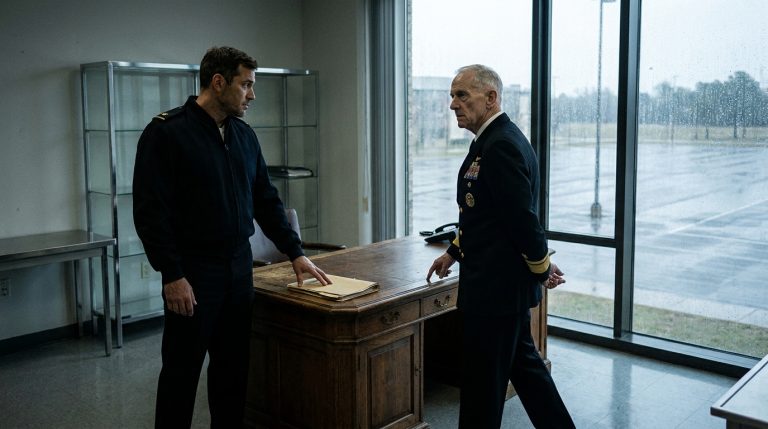
Patrick stepped out, his joints stiffening against the chill of the hangar. General Pierce was already waiting, standing a dozen paces away in the center of a cavernous, dimly lit floor. He wasn’t flanked by tactical operators this time. He was alone, his hands tucked behind his back, looking up at a single, massive steel door at the far end of the facility.
“The final node, Pat,” Pierce said, his voice echoing in the vast space. “Everything we did. Everything we built. It’s all in here.”
Patrick walked toward him, his boots clicking with rhythmic finality against the floor. He felt no adrenaline now, only a cold, crystalline clarity. He stopped beside the General and looked at the steel door. “Why me, Alan? You have the keys. You have the access. Why drag me out of the garden for this?”
“Because you were the only one who didn’t keep a copy,” Pierce said, turning his head to look at him. The General’s face was a map of years spent in the dark, his eyes reflecting the harsh, overhead fluorescent lights. “Every other operative, every handler, every suit—they all kept leverage. They kept files, transcripts, photos. They wanted a safety net. You? You were the only one who believed the ‘We who are not’ doctrine.”
“I believed in the mission,” Patrick corrected.
“And now the mission is the liability,” Pierce said. He reached into his pocket and pulled out a small, encrypted drive, holding it up like a holy relic. “This is the master decryption key for the Ivory Serpent archive. The Pentagon wants it destroyed. The Director wants it sold. And the surviving members of the board… they want it burned.”
“And you?” Patrick asked, his gaze shifting to the General’s face.
“I want it to end,” Pierce said, his voice dropping to a whisper. “I want the archive deleted, the servers wiped, and the memory of what we did in the Valley of the Shadow completely purged from the record. But I can’t do it alone. The system requires a verification—a manual override from the original project lead.”
Patrick reached out, his hand steady as granite, and took the drive. It was light, almost insubstantial, yet it held the weight of a thousand silenced voices. He walked toward the heavy steel terminal mounted to the wall, his movements precise, almost mechanical.
He slotted the drive into the port. A screen flickered to life, bathing the room in a pale, sickly green glow. Names, dates, coordinates—they scrolled past in an unending, cascading waterfall of data. He saw the mission where he had met Miller. He saw the operation that had saved the border, and the one that had toppled the regime, and the one that had… he turned his head, refusing to look at the bottom of the list.
“It’s all there,” Pierce said from behind him. “Every ghost. Every shadow. Every life we took to ensure the sun kept rising for people who didn’t even know we existed.”
Patrick began to type, his fingers moving with the familiar, muscle-memory speed of a man who had been the best of them. He wasn’t just deleting files; he was erasing the evidence of his own existence. He felt the phantom weight of the rifle again, the smell of the jungle, the heat of the sun on his back—it was all dissolving, replaced by the sterile, cold logic of the terminal.
He pressed the final, blinking command. DELETE ALL.
The screen went black. The hum of the facility’s ventilation system faltered, then groaned, and then fell silent. The lights overhead flickered and died, leaving them in the dim, grey twilight of the emergency backup lighting.
“It’s done,” Patrick said, his voice quiet, almost lost in the sudden, absolute silence of the room.
Pierce moved beside him, looking at the blank screen. He didn’t speak for a long time. Then, he reached out and placed a hand on Patrick’s shoulder—a brief, un-military touch that carried the weight of everything they had shared. “They’ll still come for you, Pat. The ones who wanted the data… they won’t believe it’s gone until they see you dead.”
“Let them come,” Patrick said. He walked toward the exit, his step lighter than it had been in years. “I’m not a ghost anymore, Alan. I’m just a man. And there’s nothing left to fear from a man who has already finished his work.”
He stepped out of the hangar and into the cool, night air of the runway. A single vehicle was waiting for him—not an official transport, but a simple, nondescript sedan parked on the edge of the tarmac. He didn’t ask who was driving. He didn’t look back at the bunker. He climbed in, and as the car drove off into the darkness, he watched the facility shrink in the rearview mirror until it was nothing more than a dark, indistinct shape against the horizon.
He pulled a small, tattered piece of cloth from his pocket—the patch Mark had torn from his wallet earlier that day. He held it in his hand for a long moment, feeling the fraying edges, the faded, bitter history of the serpent and the blade. Then, he rolled down the window and let the wind take it. He watched it flutter, catch the air, and disappear into the night, a final, silent piece of the ghost he had spent his life becoming. He closed his eyes, for the first time in years, truly alone, truly free, and finally, truly, himself.