A Cold Reckoning: How a Soldier of Silence Dismantled a House of Lies and Stolen Foundations
CHAPTER 1: The Weight of Granite
The marble was cold under my fingertips. It was the same granite I had picked out three years ago, chosen for its durability and the way it caught the morning light. Now, a crystal vase sat in the center of it, overflowing with flowers that felt too vibrant for the room. I didn’t reach for the vase. I didn’t touch the flowers. My hands stayed planted on the stone, absorbing the chill, feeling the slight vibration of the house—a house that no longer recognized me.
Mallerie stood across from me, her manicured hand resting near my own. Her fingers were steady. She wasn’t nervous; she was expectant. The subtext in her posture was loud: she believed she was doing me a favor by relieving me of the burden of ownership.
“You’re never here, Audrey,” she said, her voice smooth, calibrated to sound like a reasonable solution to a non-existent problem. “It’s stagnant. Ethan needs a yard. He needs a school district that actually challenges him.”
I looked past her. My mother, Beatrice, sat at the kitchen table, her back so straight it looked painful. She was watching me with that familiar, predatory patience. She wasn’t a mother in this room; she was a participant in an operation.
“My things,” I said. My voice was a flat line. “Where are they?”
Mallerie waved a dismissive hand, a gesture that barely fluttered the air. “In storage. Don’t worry about it. We had to make room for the new set. The old stuff was… dated.”
I shifted my weight. The movement was small, calculated—a habit from ten years of intelligence work where a shift in stance could be the difference between a secure perimeter and a compromised position. I looked at the wall where my bookshelf had stood. It was gone, replaced by a piece of abstract art, all jagged lines and neon streaks that clashed with the soft gray paint I had painstakingly rolled onto the drywall myself.
The subversion of my space was total. They hadn’t just moved in; they had scrubbed the identity of the occupant.
“The deed, Mallerie,” I said, ignoring the art. “I’m on the deed.”
Mallerie’s smile didn’t flicker. It was a lock-tight expression, practiced in front of a mirror until the edges softened into something that looked like concern. “And that’s why we’re here. We need you to sign the quitclaim. Today.”
There it was. The deadline. They weren’t just taking the space; they were demanding I validate the theft. I felt a cold, clear focus settle into my chest. It wasn’t the heat of anger; it was the sharp, metallic tang of an impending, unavoidable collision.
I looked at my mother. “Practicality,” I said, a faint, humorless smile touching my lips. “Is that what we’re calling this?”
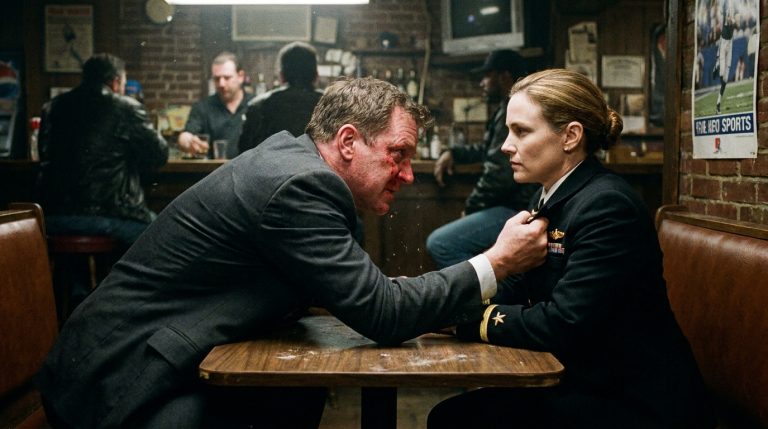
Beatrice finally spoke, her voice dropping into a register of controlled authority. “We are calling it the necessary evolution of this family. Don’t be difficult, Audrey. It doesn’t suit your station.”
I looked at them—two strangers wearing the faces of people I had once trusted. The air in the room seemed to vibrate with their absolute certainty that I would break. They thought the uniform, the deployment, the exhaustion made me weak. They had no idea that those things had simply removed the parts of me that cared about keeping the peace.
I picked up my duffel bag. The zipper screamed as I pulled it shut, the sound tearing through the curated silence of the house. Mallerie blinked, her confidence wavering just a fraction of a millimeter.
“What are you doing?” she asked, her voice dropping the rehearsed sweetness.
I walked toward the front door. “I’m leaving,” I said, my voice steady, stripped of all emotion. “But I wouldn’t get too comfortable in that kitchen if I were you.”
I reached for the handle, the brass cool and heavy in my palm. Behind me, the house—my house—seemed to hold its breath. I didn’t look back. I stepped out into the cool evening air, feeling the first, sharp sting of a truth that neither of them would be able to contain by morning.
CHAPTER 2: The Digital Audit
The door clicked shut, and I threw the deadbolt. Two turns. Mechanical, rhythmic, a habit etched into my nervous system by a dozen deployments. I stood in the center of the hotel room for a moment, listening. The hum of the air conditioner was a low, steady drone that masked the silence of the city outside.
It was 2:47 a.m. The beige walls of the room felt like a neutral mask. There was no personality here, no history, just temporary space. I liked it that way.
I set my duffel bag on the floor and walked to the small desk, pulling out the laptop. My movements were automatic—scan the perimeter, clear the deck, isolate the variables. I plugged in the power cable, the plastic interface feeling heavy and real compared to the fake, airy atmosphere of the house I’d just left.
I opened the lid. The screen glowed, a harsh rectangle of light in the dim room. My fingers hovered over the keys for a split second, a hesitation born not of doubt, but of tactical anticipation. I logged into my secure military financial portal. The multi-factor authentication screen demanded a token code. I tapped the request on my phone, waited for the prompt, and entered the sequence.
The dashboard loaded. It was a grid of stability—or it should have been.
My eyes moved to the credit score indicator. I stopped breathing. The number stared back at me, a sharp, jagged drop that felt like a physical blow to the sternum. 612.
I blinked, thinking it was a cache error, a glitch in the server. I hit the refresh icon. The wheel spun, a digital hourglass measuring the disintegration of my security. 612.
I leaned in, the desk light casting long, sharp shadows across my hands. My credit report was a map of disaster. New addresses. New accounts. My eyes tracked down the lines, scanning for the origin point of the contagion. Then, the entry popped out, bold and damning: Home Equity Line of Credit. Authorized. $250,000. Balance: $249,873.
I stared at the screen, and for the first time in an hour, I felt the cold—not the ambient temperature of the room, but the glacial shift of realization. I didn’t have a HELOC. I had paid for that house in cash specifically to avoid the vulnerability of debt. This wasn’t a mistake; it was an architecture of theft.
I clicked into the account activity. Each withdrawal was a surgical strike—timed, precise, and completely unauthorized. As I traced the digital breadcrumbs, I noticed something else. The dates. The recent activity was tied to an address I didn’t recognize, and then, a secondary search revealed a series of smaller, bizarre anomalies.
I opened the folder of my digital backup, looking for the scanned photos of my study—the original office in the house. I needed to cross-reference the file names. I clicked the directory, but the folder was empty. I checked the cloud sync. Empty.
The Butterfly Detour hit me then—not just the house, but the digital erasure. They hadn’t just changed the rugs; they had purged the record of my life. My childhood journals, the scans of my father’s letters, the archives of my early career—gone. It was as if they were trying to rewrite my history from the foundation up. It wasn’t just about the money; it was about removing any evidence that I had ever been the primary occupant.
I felt a sudden, sharp ache in my throat. It wasn’t sadness. It was the realization of the scope. They didn’t just want the asset; they wanted the narrative.
I pulled up the county clerk’s public records database. My hands were steady, but the rhythm of my typing had slowed. I searched the address.
The PDF of the quitclaim deed loaded. I opened it, my eyes locking onto the signature line. My own name, rendered in a stroke so precise, so unnervingly accurate, that it felt like looking at a mirror in a dark room. I studied the notary stamp. October 14th.
I stood up, the chair scraping sharply against the carpet. I walked to the window and pulled back the curtain just an inch. The streetlights below were orange and clinical. October 14th. I had been at the forward operating base in Iraq, running a night briefing. I had the time-stamped logs, the witnesses, the mission reports.
I turned back to the screen. The document was a masterpiece of fraud. Legally sound, technically perfect, and entirely impossible.
I didn’t yell. I didn’t throw the laptop. I sat back down, opened a new, blank document, and began the list.
Evidence of deployment on the date of execution.
Financial audit of the $250,000 disbursement.
The notary’s credentials—verify if they are a real entity or a shell.
The room felt tighter now. The beige walls seemed to close in, but I welcomed the pressure. It helped me sharpen. They had made a fatal error: they had assumed I would be too exhausted by my service, too damaged by the war, to look. They thought they were dealing with a ghost who didn’t want to haunt her own home.
They were wrong. I wasn’t a ghost. I was the one who kept the files.
I opened the folder labeled Evidence and started the import. Every screenshot, every PDF, every time-stamped log. I built the case piece by piece, a digital fortress designed to withstand whatever lies they had prepared for the morning. I worked in the silence, the rhythm of my breathing matching the hum of the computer.
Outside, the city was asleep, unaware that one of its residents was currently dismantling a family tree from the roots up. My phone vibrated on the desk. A message from Mallerie. We’re waiting for the paperwork. Don’t be difficult.
I didn’t open it. I dragged it to the trash folder.
I was no longer the daughter who kept the peace. I was the intelligence officer who mapped the battlefield. And right now, the battlefield was the fraudulent life my sister had built on the wreckage of mine. I looked at the forged signature one last time before closing the document.
Fine, I thought. If you want a war, I’ll show you what a deployment actually looks like.
CHAPTER 3: The JAG Briefing
I didn’t sleep. Sleep is a luxury for people who have the luxury of time, and I was currently operating on a different schedule. The morning light filtered into the hotel room, gray and uninviting, reflecting off the glass of the window. I had the laptop packed, the duffel bag zipped, and my uniform pressed and laid out on the bed—every crease sharp enough to cut.
I walked into the JAG office at 0800 sharp. The building smelled of floor wax and stale coffee, a sensory profile I had memorized over a decade of service. It was the smell of order, and today, it felt like the only anchor in a world that had suddenly gone fluid.
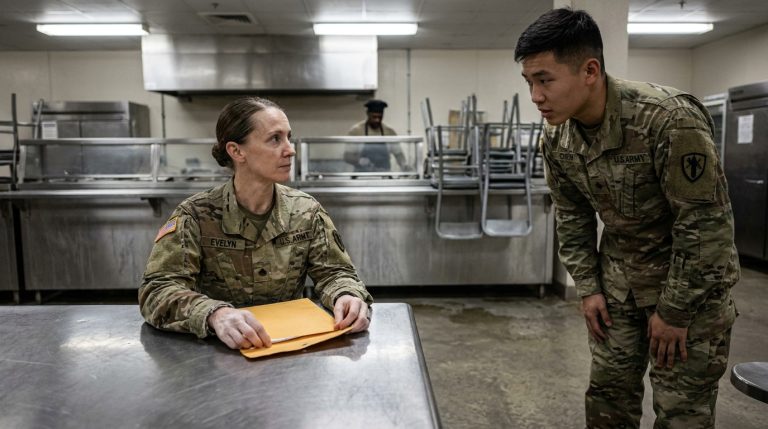
The clerk at the front desk was young, a Specialist with the tired eyes of someone who spent their days navigating the bureaucratic minefields of military law. He looked up, saw the Major’s oak leaves on my collar, and his posture straightened instinctively.
“Major Hayes,” he acknowledged, his voice dropping into professional register. “Can I help you, ma’am?”
“I have an appointment with Captain Miller,” I lied. I didn’t have an appointment, but I knew the Captain’s schedule. He was a stickler for protocol, but he was also the only man in this building who treated property fraud against a deployed officer as a personal insult.
“Let me check, Major,” the clerk said, tapping his keyboard. He frowned, his brow knitting as he scanned the screen.
“I know it’s not on the books,” I said, my voice low, steady, and devoid of the pleading note usually found in a walk-in. “Tell him it’s an active case of SCRA violation involving identity theft and federal wire fraud. Tell him it requires immediate internal classification.”
The clerk froze. He looked at me, then at the folder in my hand—a thick, black binder that I had organized into sections with color-coded tabs. He clicked his mouse once, twice, and then picked up the phone.
“Sir? Major Hayes is here. She’s… she’s reporting a federal violation.”
A moment later, he nodded and gestured toward the heavy door behind him. “He’ll see you, Major.”
Captain Miller was already standing when I entered. He was a man of medium build with hair cropped close to the scalp and eyes that didn’t miss details. He didn’t offer a chair. He simply gestured to the folder.
“Major,” he said, his tone clipped. “You’ve been back twenty-four hours. Tell me this isn’t a domestic dispute.”
“It’s not, Captain,” I said, placing the folder on his desk and opening it to the first tab. “It’s a systematic extraction of assets executed while I was deployed in an active combat zone. They utilized a forged power of attorney and a fraudulent quitclaim deed to leverage a home equity line of credit.”
I turned the pages as I spoke. Miller’s eyes tracked the documents with the intensity of a surgeon. He was silent for a long time, the only sound the rustle of paper and the distant hum of the office beyond the door.
“The notarization date,” he muttered, pointing to the stamp on the deed. “You were in Iraq.”
“I was at the FOB, sir. I have the mission logs, the communications record, and the CO’s signature verifying my presence on that exact date.”
Miller leaned back, his chair creaking under his weight. He looked at me, his gaze lingering on my face for a heartbeat longer than necessary. “This isn’t just a mistake, Major. This is a deliberate attempt to erase you. Who stood to gain?”
“My sister,” I said. “And my mother. They’ve moved into the property. They’ve liquidated the equity.”
“And they think you won’t move against them because of the blood connection?”
“They think I’m soft,” I corrected him. “They think my service was a distraction that left me vulnerable.”
Miller looked back at the binder. He pulled a yellow legal pad toward him and began writing, his pen carving deep, forceful lines into the paper. “If this is what I think it is, we are going to bypass the local authorities. They’ll want to treat this as a civil matter, a ‘family disagreement’ to save their own time. We aren’t going to give them the chance.”
“What do you need from me, sir?”
“Documentation of the accounts they opened. Any correspondence. If they’ve sent you emails, texts, voicemails—I want it all. You are a federal asset, Major. Using your identity to defraud a financial institution is a direct attack on the integrity of this service.” He stood up, his face set in a hard, determined line. “You build the case. You make it airtight. If there is a single hole in this, they will wiggle out of it. Do you understand?”
“I understand,” I said.
“Good. Don’t confront them. Don’t warn them. If you go back to that house, you go as a visitor, not as a Major. Keep your hands clean. Let the system do the heavy lifting.”
I nodded, the weight of his words settling into my bones. It was the validation I needed—not of my feelings, but of the tactical reality. I wasn’t just defending my house; I was defending the parameters of my own existence.
As I walked out of the JAG office, the hallway felt different. The air was colder, the fluorescent lights humming with a sharper frequency. I had the authorization to track, to document, and to prepare. My sister and my mother were currently enjoying the luxury of my house, planning their next move with the confidence of people who thought they had already won.
They were working with an outdated version of me. They were playing by the rules of family, where blood is supposed to override morality. But I was playing by the rules of the intelligence community, where facts are the only currency that matters. And right now, I was wealthy beyond their imagination.
I walked to my car, the gravel crunching under my boots. I had a long day ahead of me. The forensic accountant was waiting for my call, and the county clerk’s records needed to be pulled into a permanent, encrypted archive.
I sat in the driver’s seat and looked at my reflection in the rearview mirror. My eyes were clear, my expression neutral. The internal noise—the hurt, the shock, the residual phantom of what my family should have been—was gone. In its place was the cold, efficient machinery of resolve.
I started the engine, the engine’s idle a steady, low-frequency pulse. I didn’t drive toward the house. I drove toward the future. Every mile I put between me and that property felt like a tightening of the knot I was tying around their necks. They thought they had pushed me out. They didn’t realize they had just given me the distance I needed to see exactly where they had left themselves exposed.
The hunt hadn’t begun yet, but the trap was set. And it was going to be a long, quiet, and absolutely final end for everything they had stolen.
CHAPTER 4: The Forensic Audit
The forensic accountant, a man named Elias who operated out of a repurposed industrial loft on the edge of the district, didn’t talk much. He liked data, and he liked it when that data was clean. I had arrived at his office thirty minutes after leaving the JAG building, the folder of evidence still sitting on the passenger seat of my car like a live grenade.
I stepped into his workspace. It was a cathedral of screens—four monitors stacked in a grid, all glowing with shifting lines of transactional code. The room smelled of ozone and scorched electronics.
“Major,” Elias said, not turning around. His fingers were dancing across a mechanical keyboard, the sound like rapid, rhythmic gunfire. “I got your upload. It’s… interesting.”
“Define interesting,” I said, staying near the door. My boots felt heavy on the concrete floor.
He spun his chair around. His eyes were bloodshot behind thick-rimmed glasses. “Usually, when people commit property fraud, they’re messy. They make mistakes—wrong dates, missing seals, shoddy paperwork. Your sister? She was coached. Or she hired someone who knows how to move through the cracks of a federally backed institution.”
He gestured to one of the monitors. It showed the HELOC disbursement. “This wasn’t a standard withdrawal. They routed the funds through three different shell accounts before landing in the destination account—a trust managed by your mother.”
I walked over to the desk, my shadow stretching long and distorted across the floor. “And the signature?”
“That’s where it gets weird.” Elias tapped a key, and a high-resolution scan of the forged deed appeared on the screen, split-screen with a scan of my actual signature from my military records. “Look at the pen pressure. At a granular level, a human signature has inconsistencies—variations in how the ink pools at the start of a stroke or the slight hesitation at a curve. These two are nearly identical, which is impossible for a human hand to replicate that perfectly.”
I leaned in, my eyes narrowing. “A machine?”
“Or a very sophisticated digital overlay printed onto physical paper to bypass standard scanners,” Elias said. “They didn’t just trace it. They manufactured it. This isn’t just theft; it’s an operation. They had access to your digital profile long before they initiated the paperwork.”
I felt a chill that had nothing to do with the office’s aggressive air conditioning. Access. That was the keyword. How did they get the high-res scans of my signature? My military files were encrypted. My personal records were guarded.
“Check the meta-data on the notary seal,” I said, my voice barely above a whisper.
Elias clicked through a series of sub-menus. “The notary seal is registered, but the person it belongs to? She’s been out of practice for three years. Retired in Florida. She’s never seen this document in her life.”
“So they’re using her identity as a blind.”
“Exactly. It’s a closed loop, Audrey. If you go to a local bank, they see a valid notary stamp, a clean deed, and a ‘consenting’ property owner. The system is designed to trust the paperwork, not the person.”
I stood straight, my back aligning with the rigid posture of a soldier on parade. The puzzle was fitting together, and it was significantly more dangerous than a simple family argument. This was a systematic attempt to erase my ownership status using professional-grade techniques.
“What can you track?” I asked.
“I can track the destination,” Elias said. “The trust is funded by the HELOC, but there’s a recurring outflow of cash. Every Wednesday, a sum is moved to a private security firm in the city. Not a bank. A security firm.”
I froze. “What kind of security firm?”
“The kind that specializes in ‘asset protection’ and physical privacy. It’s a high-end firm, the kind that guards corporate executives or private estates. Why would your mother and sister be paying for private security?”
“Maybe they aren’t paying for it,” I realized, the thought hitting me with the force of a physical impact. “Maybe they’re paying for protection from something. Or someone.”
Elias looked at me, his expression turning grave. “Major, if they’re using your house as leverage to pay for high-level security, they aren’t just living there. They’re running a bunker. They’re scared of something that’s coming for them.”
I looked at the screens, the glow reflecting in my eyes. The decoy secret—the house—was just the front. The Layer 2 truth was starting to shimmer through the static: this wasn’t just greed. My family had stepped into a game they didn’t understand, and they had used me as the currency to buy their way into the game.
“Keep tracing the payments,” I commanded, my voice cold, hard, and precise. “Every cent. I want to know who is receiving those funds and what specifically they’re providing in return.”
“It’ll take time,” Elias warned.
“Take it,” I said. “But don’t lose the thread.”
I turned and walked toward the exit, my mind already running the scenarios. The housewarming party, the frantic spending, the blackmail—it was all defensive, all posturing to keep up appearances while they were being bled dry by whatever force they had engaged.
I reached my car and sat in the silence for a long time before starting the engine. I wasn’t just fighting for a piece of property anymore. I was fighting to expose whatever shadow my family had allowed into their lives. They had tried to erase me, but in the process, they had left their own tracks in the digital sand. And I was the only one who knew how to read the terrain.
As I pulled away from the industrial park, the skyline of the city seemed different—less of a home and more of a map. I had the JAG office to secure the law, and I had Elias to map the money. Now, I needed to see what they were so afraid of.
I checked my watch. 1400 hours. The housewarming party was only days away. They expected me to show up and surrender. They had no idea that I was coming to the party not as the guest of honor, but as the auditor of their ultimate, hidden failure.
CHAPTER 5: The Housewarming Infiltration
I killed the engine and sat in the darkness for a full minute, watching the house. It was a beacon of artificial warmth in the dim street. The windows were lit, casting long, rectangular glows onto the manicured lawn. I could see silhouettes moving behind the curtains—Mallerie, orchestrating the final touches, her movements brisk and energetic.
I didn’t step out of the car immediately. I needed to calibrate. I reached into the glove compartment and pulled out the small, flat earpiece—a backup, something I’d kept since my last tour. I checked the connection to the burner phone I’d set up earlier.
The plan was simple: surveillance, documentation, and the final acquisition of physical proof that the blackmail attempt wasn’t just a threat, but a premeditated strategy. I had the JAG office on notice, and Elias was currently scraping the server for the security firm’s data. Everything was aligned.
I stepped out of the car. The evening air was cool, biting against my skin. I wasn’t wearing my uniform this time; I was in dark, tactical-casual clothes, blend-in attire that allowed me to move through the background without drawing the eye. I didn’t walk up the driveway. I moved along the side of the property, sticking to the shadows of the hedges, my boots making no sound on the damp grass.
My target was the study window. I knew the layout of that room better than anyone. It was where my father had kept his records, and where I had kept my own. It was the nerve center of the house.
As I neared the back of the property, I caught a glimpse of someone standing by the side door. It was Winston. He was holding a cigarette, the ember glowing like a dying star in the dark. He wasn’t moving. He was just looking at the house, his posture slumped.
I paused, dropping into a crouch behind a large decorative planter. I watched him. Something about the way he held himself—the tension in his shoulders, the way he kept glancing at the street—felt wrong. He wasn’t a man preparing for a party. He was a man waiting for an execution.
A shadow moved in the doorway, and Mallerie stepped out. She didn’t look at him with affection; she looked at him with the cold, measured intensity of a handler. She said something, her voice too low to carry, but Winston flinched. He dropped the cigarette and stomped it out, then followed her back inside.
My suspicion, which had been a quiet hum in the back of my mind, flared into a sharp, jagged realization. Winston wasn’t just a victim of my mother and sister’s ambition. He was being squeezed. The financial records I had seen, the rapid drain of assets—it wasn’t just to support their lifestyle. It was to pay off someone else.
I waited until they were gone, then moved to the study window. It was cracked open an inch, just enough to catch the drift of conversation. I pulled the earpiece into place and adjusted the frequency.
Inside, the room was brightly lit. My mother was sitting at the desk—my desk—looking at a stack of documents.
“The funds have to be cleared by tomorrow,” Beatrice said, her voice crisp. “If the firm doesn’t get their payment, they pull the security detail. And if they pull the detail, we have nothing to stop them from walking in.”
Them. The word hung in the air like smoke. Who were they?
“I’m doing everything I can, Mother,” Mallerie snapped. “The HELOC is tapped out. We’re waiting for Audrey to sign. If she doesn’t sign, the legal validation doesn’t go through, and the bank initiates a clawback on the funds we already spent.”
“Then make her sign,” Beatrice said, her tone devoid of emotion. “Blackmail her, threaten her career, break her—I don’t care. We cannot be exposed. Not after everything we’ve done to secure this future.”
I gripped the windowsill, my knuckles turning white. They weren’t just stealing the house. They were using it as a shield to hide from someone far more dangerous than a disgruntled sister.
I felt a sudden, sharp tremor in my hands—not fear, but the adrenaline of a hunter who has finally found the scent. I wasn’t just tracking a fraud anymore. I was tracking a conspiracy. And I was the one holding the keys to the room they were currently locked inside.
I pulled out my phone and tapped the recording icon. The audio stream synced to the cloud, a digital record of the confession.
Just as I was preparing to retreat, the back door opened again. I held my breath, pulling back into the absolute darkness of the hedge. A man stepped out—not Winston, not a guest. He was wearing a dark suit that stood out in the festive atmosphere of the backyard. He didn’t look like an event worker. He looked like an enforcer.
He walked up to the study window and knocked twice.
Beatrice stood up and moved to the window. The man leaned in, his voice a low, gravelly rasp. “You have two days, Mrs. Hayes. My employers aren’t known for their patience. If the house isn’t clear of the title dispute by then, we stop playing by the rules.”
“We’re handling it,” Beatrice whispered.
“Handle it faster,” the man said. He turned and walked away, disappearing into the shadows toward the driveway.
I waited until the sound of his footsteps faded before I let out my breath. My heart was hammering against my ribs, a steady, frantic beat that forced me to focus. The situation was spiraling beyond the legal boundaries I had established. This wasn’t just a case for the JAG office anymore.
This was a situation that was about to explode, and I was sitting at the center of the blast radius. I checked the recording. It was solid.
I moved back the way I came, my movements fluid and silent. I had enough for now. I didn’t need to do anything more tonight. The party was still two days away, and I had enough leverage to ensure that when it finally happened, it wouldn’t be a celebration. It would be a demolition.
As I reached my car, I caught one last look at the house. It looked smaller now, less like a fortress and more like a cage. And they were finally starting to realize that the cage was being locked from the outside.
CHAPTER 6: The Recording and the Ultimatum
I didn’t retreat to the hotel. I stayed in the car, parked in the shadows of a neighboring street, and listened to the recording again. The quality was crisp. Every word, every inflection of my mother’s voice as she plotted the erosion of my life. It was a digital map of intent.
I took the burner phone, synced the audio to the cloud, and set up a dead-man’s switch. If I didn’t check in by the time the party was scheduled to conclude, the recording, the bank records, and the deed forgery would be automatically routed to the JAG Captain and the federal fraud division. It was a safety measure, a cold, logical contingency I had learned to respect during my years in intel.
My phone buzzed. It was an alert from Elias.
Payment verified. Destination: ‘Apex Private Solutions.’ Address: 442 industrial loop. It’s not a security firm, Audrey. It’s an extraction company. They don’t guard assets. They move people.
I sat still, the glow of the phone screen illuminating the interior of the car. My family wasn’t just hiding from the law; they were preparing to run. That explained the urgency. The housewarming wasn’t a party; it was a distraction, a final attempt to liquidate the assets and consolidate their position before they vanished.
I started the engine, my movements deliberate. I had to change the timeline.
I pulled the car away from the curb and drove toward the house, but not to the front door. I pulled into the alley behind the property, the space tight, smelling of damp earth and rotting garbage. I turned off the headlights.
The house looked different from this angle. It was exposed. I could see the glow of the kitchen, the movement of the caterers, and the silhouette of Mallerie near the patio door. She was agitated, checking her watch, moving from the kitchen to the study and back again.
I checked my equipment. I had the physical documents, the recording on the burner phone, and a copy of the federal mandate from Captain Miller. I was ready.
I walked to the study door, the same one I’d stood outside of only hours ago. I didn’t knock this time. I stepped through the mud and turned the handle. Locked, but the lock was a simple mechanism, easily bypassed with a standard tension tool.
The door swung open with a soft, metallic click. The study was empty. My mother’s desk sat in the center of the room, a sprawling mahogany surface littered with papers, receipts, and a laptop that was still running.
I walked to the desk. The screen was active, displaying a bank portal—not the one Elias had tracked, but a private, offshore interface. I didn’t touch the keyboard. I just took a photo with my phone.
A footstep sounded in the hallway. I didn’t move. I simply stood by the desk, my posture relaxed but ready.
Mallerie walked into the room, her hand on her hip, a drink in her other hand. She stopped dead when she saw me. The glass in her hand wobbled, a splash of liquid hitting the floor.
“Audrey,” she said, her voice dropping into a sharp, defensive register. “What are you doing here?”
“Taking back my office,” I said, my voice quiet.
She looked at the desk, at the laptop, and her face went ashen. She took a step forward, her confidence evaporating. “Get out. You don’t have a right to be here. You signed over the deed.”
“We both know that signature is a forgery, Mallerie,” I said, stepping toward her. “I have the deployment logs. I have the notary’s testimony. And I have a recording of everything you and Mother said in this room an hour ago.”
Mallerie froze. Her eyes flicked to my hand, where the burner phone was resting. The panic in her eyes was palpable, a frantic, desperate search for an exit. “You’re bluffing,” she whispered, though her voice lacked conviction.
“I’m not,” I said. “I’m auditing.”
I reached into my jacket and placed a physical copy of the federal fraud notice on the desk. “You’ve engaged with an extraction company called Apex. Do you know who they actually are? Because they aren’t here to protect you. They’re here to ensure you don’t talk when the federal agents finally arrive.”
Mallerie’s hand began to shake. She looked at the door, then back at me. “We were just trying to… we needed the money.”
“You committed federal crimes,” I said, my voice cutting through her excuses like a blade. “And you used me to do it. You thought I wouldn’t fight back because you saw me as an asset, not a person. That was your biggest mistake.”
I stepped closer, until I was directly in her personal space. She didn’t retreat; she seemed to shrink. “You have two choices. You call the party off, you open the door to the federal agents when they arrive, and you tell them exactly who helped you forge those documents. Or I release everything to the public domain tonight, and let the people you’re hiding from find out exactly where you are.”
Mallerie’s breathing became ragged. She looked at the door, at the party happening on the other side of the wall, and then at me. For a second, I saw it—the sister I’d once known, scared and small and lost. But then it was gone, replaced by the hardening of her resolve.
“You won’t do it,” she said, her voice a low, dangerous whisper. “You’d destroy the family name.”
“My family name is mine to protect,” I said, turning toward the door. “And right now, the only way to save it is to burn the rot out.”
I left her standing in the study, surrounded by the physical evidence of her own undoing. I didn’t wait for her answer. I didn’t need to. I had the recording, I had the documents, and I had the leverage. The party was reaching its peak, the music loud, the laughter artificial.
I walked out the back door, into the cold, sharp air of the night. I had crossed the line. There was no going back to the way things were. The escalation had reached its limit. Now, it was just a matter of time before the pressure inside the house became too much to contain.
CHAPTER 7: The Federal Arrival
The darkness of the alley was absolute, broken only by the rhythmic, strobe-like flicker of the house lights visible through the rear window. Inside, the party was still vibrating, a chaotic symphony of false laughter and clinking glasses. I checked my watch. 2100 hours. The federal mandate was active, and the jurisdictional clearance had been granted by Captain Miller’s office an hour ago.
I stood there, feeling the weight of the burner phone in my pocket. It felt heavier than any weapon I’d carried in Iraq. It wasn’t a tool of violence; it was a tool of finality.
A set of headlights swept across the alley, the beams cutting through the gloom. Not one car, but three. They moved with the silent, predatory grace of federal vehicles—no sirens, no unnecessary flair, just the crushing momentum of law. They pulled to a stop at the street entrance, flanking the driveway.
I didn’t move. I watched from the shadows as doors opened in unison. Figures in tactical gear, windbreakers emblazoned with the bold, unmistakable letters of the FBI, stepped out. They were moving with a surgical precision that made my pulse steady. This wasn’t a police call; this was a takedown.
I watched the lead agent walk toward the front door. He didn’t knock. He didn’t wait. He simply took control of the threshold. I turned and walked toward the side of the house, my own path intersecting with the main action just as the front door was kicked open.
The house reacted instantly. The music—that upbeat, expensive-sounding pop track—cut out with a jarring, mechanical thud. The sudden silence was more violent than a gunshot.
I stepped into the patio door, catching the moment of impact. The guests, those who had been drinking and networking in the belief that they were part of something exclusive, were scattering like insects when the light hits them. Mallerie was standing by the center island, her face drained of all color, her hands raised in a reflexive, useless gesture of innocence.
Beatrice, my mother, was frozen near the study door. She didn’t look at the agents. She looked at me.
Her eyes found me in the doorway, and in that gaze, I saw the true weight of her failure. It wasn’t the loss of the house. It wasn’t the looming prison sentence. It was the absolute, crushing realization that her daughter—the one she had dismissed as the “strong” one, the one she had treated as a disposable resource—had been the architect of her destruction.
“Audrey,” she whispered, the name almost lost in the sudden, frantic murmur of the room.
I didn’t answer. I didn’t even acknowledge her. I watched as the lead agent stepped toward Mallerie, his presence filling the room. He didn’t shout. He spoke with the quiet, terrifying authority of a man who held a binder full of crimes that had already been proven.
“Mallerie Hayes,” he said, his voice echoing off the hardwood. “You are under arrest for federal bank fraud, wire fraud, and aggravated identity theft. You have the right to remain silent…”
I watched the metal cuffs click into place. The sound was sharp, definitive. It was the same sound I had heard in my nightmares, but now, it felt like the closing of a tomb.
Winston was huddled by the wall, his head in his hands. He wasn’t resisting. He looked relieved. For him, the constant, suffocating pressure of my mother’s machinations was finally over. He was a prisoner, yes, but he was no longer a pawn.
My mother tried to move, to offer a rebuttal, but two agents moved to her side with a speed that made any attempt at defiance look pathetic. They didn’t treat her like a matriarch; they treated her like a target.
I walked slowly into the center of the room. The guests were being ushered out by a second team of agents, their faces a mixture of shock, disgust, and the frantic desire to disassociate themselves from the scene. They looked at me, seeing the Major’s uniform, the rigid posture, and the cold, unblinking eyes of someone who had just finished a mission.
I stopped in front of Mallerie. She was shivering now, the expensive dress she wore looking suddenly like a costume that didn’t fit. She looked up at me, her face a mask of shattered entitlement.
“You really did it,” she said, her voice a hollow, broken thing. “You destroyed us.”
“I didn’t destroy you,” I said, my voice barely audible over the hum of the agents’ radios. “You built this on a foundation of theft. I just removed the support.”
I didn’t feel the surge of triumph I had expected. There was no joy, no rush of vindication. There was only the heavy, quiet satisfaction of a job performed to standard. The mission was complete. The house was secured, the evidence was in federal hands, and the people who had tried to erase my history were now being removed from it.
I walked to the kitchen island, the place where she had stood only forty-eight hours ago and demanded my life as if it were a casual request. I placed the burner phone on the marble—the final piece of evidence, the final proof.
I turned my back on them. I walked out of the kitchen, through the living room, and out the front door. The air outside was cold, crisp, and empty.
As I reached my car, I paused. I looked back at the house. The lights were still burning, but the house was no longer theirs. It was no longer a stage. It was just a structure—wood, stone, and glass—waiting to be returned to the world.
I didn’t look back again. I got into my car and drove away, the tires humming against the asphalt. My work here was done. The system had taken over. The correction had been applied. And for the first time in a long time, the silence behind me felt like peace.
CHAPTER 8: The Architecture of Aftermath
The drive back to base was a study in stillness. My hands remained at the ten-and-two position on the wheel, my gaze fixed on the road, while the events of the last hour replayed in my mind with the clinical precision of a debriefing. The sirens had faded into the distance, but the memory of the agents’ faces, the cold click of the handcuffs, and the hollow, bewildered look in my mother’s eyes remained etched against the dark windshield.
I didn’t head straight to my quarters. I needed to see it finished. I pulled into the small, gravel-strewn lot overlooking the county clerk’s office—the building where it had all started with a piece of forged paper.
The building was dark, a monolith against the night sky. In a few days, this building would process the reversal. My name would be back on the title. The fraudulent liens would be scrubbed, and the financial institutions would be busy untangling the web my mother had spun. But the legal resolution, as necessary as it was, felt like the smallest part of the process.
I walked to the trunk of my car and pulled out the small, heavy box I’d salvaged from the storage unit days ago. It was the only thing of mine they hadn’t bothered to throw away, probably because they hadn’t realized its value. Inside was the small, hand-built shelf I had constructed when I first bought the house—the one I had mentioned during our first confrontation. It was scarred, the wood a bit worn, but it was solid.
I set the shelf on the tailgate of my car. I traced the grain of the wood. It was an artifact of a version of me that still believed in family as a sanctuary rather than a battlefield. I had spent so much of the last week dismantling their lies that I hadn’t realized I was also dismantling the version of myself that had allowed them to happen.
The payoff hadn’t been the arrests. The payoff was the quiet.
I looked up at the stars, feeling the weight of the uniform on my shoulders. I was a Major in the United States Army. I was trained to protect, to serve, and to command. And yet, I had let the most fundamental perimeter of my own life be breached because I was afraid of the conflict. I had let them treat my resilience as a vulnerability.
The poetic justice, I realized, wasn’t just that they were headed to federal prison. It was that they had done exactly what I had been taught to do in my career: they had executed an operation based on faulty intelligence. They thought I was a resource they could exploit until I was hollow. They never considered that I was the one who could—and would—shutdown their entire infrastructure when the cost exceeded the benefit.
I picked up the shelf. I wouldn’t be putting it back in that house. I didn’t want the house anymore.
The repair was internal. I was going to sell the place—liquidate the asset entirely, remove the physical memory of the rot, and start from a foundation I built in silence. The house was a structure, and structures could be replaced. My peace, however, was something I had to rebuild from the ground up.
My phone buzzed. It was an email from Captain Miller. The file is complete. We’re proceeding with the full prosecution. Your presence is required at the preliminary hearing on Monday.
I typed a single word: Acknowledged.
I closed the laptop and put it away. The night air was turning colder, a shift in the season that felt appropriate. I started the car again. I didn’t drive toward the city. I drove toward the base.
The path ahead was simple. No more ambiguity. No more “family” as an excuse for dysfunction. The lines were drawn, and for the first time in years, I knew exactly where I stood. I was the architect of my own life, and the foundation was now made of something much harder than granite. It was made of the truth.
I reached the base gate, the guards saluting as I passed. I returned the gesture, my hand crisp, my posture perfect. I pulled into my parking spot and sat in the dark for a final moment.
The war was over. The casualties had been calculated, the losses were permanent, and the mission had been accomplished. I looked at the dark sky, took one final, slow, steady breath, and stepped out of the car. I walked toward my quarters, the sound of my boots on the pavement clear, rhythmic, and absolute. I was done with the noise. I was ready for the rest.