The Subterranean Grid: A Chronicles of Suburban Sovereignty and Cold Retribution
CHAPTER 1: THE VOLTAGE BURDEN
The glass dome on the electric meter did not spin. It whirred. The thin aluminum disc inside blurred into a silver haze, humming against its housing like a trapped hornet.
I stood six inches from the glass, watching the black marker notch pass five times in three seconds.
My coffee had gone tepid in my palm. The backyard was dead quiet—just the damp 6:00 AM fog clinging to the grass and the low, resonant thrum radiating from the shed. My shed door sat three inches ajag. The latch had been broken since November, the iron hinge rusted solid at an angle I never got around to oiling.
I didn’t open it with a jerk. I pushed the cedar panel with two fingers.
The white nose of a Tesla Model Y filled the interior. It sat wedged between my riding mower and a stack of pressure-treated lumber, its cooling fans whirring softly in the enclosed space. An orange heavy-duty extension cord snaked out from under its rear bumper, dragged through the dirt floor, and plugged directly into the quad-outlet junction mounted above my workbench.
Outside the rear wall, the cord stretched through a gap in my chain-link fence, crushed a patch of hydrangeas, and vanished into the side yard of house 412.
Karen’s house.
I didn’t yell. I didn’t reach for my phone. The confusion cleared out, leaving something heavy and ice-cold in the back of my throat. I set my coffee cup down on the hood of the Tesla. The metal was warm under my palm.
I pulled the heavy brass padlock out of my jacket pocket. I slid the key into the tumbler, clicked it back out, and let the brass slap against my knuckles. Click. Clack.
A shadow blocked the morning light at the fence line.
Karen stood by her rose bushes, bypass clippers in hand. She wore her thick white sun hat, tinted oversized glasses, and a tailored beige jacket. She didn’t flinch when I stepped into the gap between our properties. She simply snipped a thorn, her face fixed in that rigid, practiced composure she used at the annual budget meetings.
“Karen,” I said. My voice was level.
She didn’t look up from the stem. “Good morning, Mark. You should really do something about your dandelions. The seeds blow right over the partition.”
I pointed down at the grass between us. The orange cord sat taut against the damp earth. “Your car is parked in my shed.”
“It’s an electric vehicle, Mark,” she said, her tone smooth, condescending, as if explaining long division to a child. “We all have a collective responsibility to reduce emissions. Your garage has a dedicated twenty-amp breaker. Mine was tripping the main.”
“You dragged a cable onto my property and plugged into my panel.”
She finally paused the clippers. She turned her head, looking at me over the rim of her dark lenses. “You weren’t using the outlet. It sat idle all winter.”
“It’s my power, Karen. It’s on my meter.”
“Don’t be dramatic.” She waved a gloved hand, dismissing the sentence before it reached the fence. “It’s a few kilowatts. Frankly, you should be glad. My technician looked at your panel last month—your circuit handles the draw far better than your home setup.”
Last month.
I rolled the brass key across my knuckles. Click. She had been in my yard a month ago. Not just browsing—evaluating infrastructure.
“You’re taking it off my property today,” I said.
Karen smiled—a thin, tight stretch of skin that didn’t reach her eyes. “We live in a community, Mark. Shared infrastructure benefits everyone’s property values. If you want to file a formal inquiry with Arthur Vance at the HOA board, feel free. But until the quarterly review, we use what works.”
She turned her back to me and went back to her roses.
I didn’t argue. I didn’t raise my voice. Arguing with a woman who mistook her own entitlement for municipal law was a waste of breath. I walked back to the shed, picked up my cold coffee, and pulled the orange plug from the wall socket.
The Tesla’s internal fan spun down to a quiet whine.
I didn’t leave the cord on her side of the fence. I left it coiled neatly on the hood of her car inside my shed, right where she’d have to squeeze her hands past my rusty mower to reach it.
By noon, I was at my workbench with an electrical multimeter, a three-phase relay module, and a wiring diagram supplied by a friend from the local utility depot.
Tesla charging ports run on active communication protocols. The car talks to the power source, checking voltage, ground integrity, and line resistance before drawing a single amp. But if you manipulate the neutral return loop through a step-down transformer—keeping the signal light green while reversing the polarity across the induction coils—the system doesn’t shut off.
It doesn’t throw an error code.
It thinks it’s feeding. Instead, the battery drains into the grounded load bank.
It took me two hours to rewire the sub-panel behind my workbench. I replaced the standard circuit with a modified reverse-polarity bridge. To the car’s onboard computer, my shed outlet looked like a high-capacity wall connector.
To the battery cells inside her vehicle, it was an open drain plugged straight into the earth.
At 11:45 PM, I sat in my darkened kitchen, a cold beer resting against my leg.
The yard was pitch black. A shadow moved across the fence line. The fence wire groaned under weight. Karen stepped through the gap, dragging the orange cord behind her like a dead snake. She slipped into the shed, her flashlight beam flicking across the wooden walls.
A moment later, a soft, high-pitched chime sounded from inside the shed. A pale green aura lit up the gap in the broken door.
Karen stepped back out into the yard. She patted the rear quarter-panel of her car, pulled her cardigan tight around her shoulders, and walked back to her house with the brisk, rhythmic stride of someone who believed the universe existed solely to serve her schedule.
I took a sip of the beer.
Over in the shed, the green light glowed steadily in the dark. On my phone, the utility monitor app registered a steady, continuous 240-volt draw—not flowing into the car, but bleeding out of it, cell by cell, dropping the voltage into the cold, silent ground.
CHAPTER 2: THE DEPLETION TRAP
The screen of my phone cast a faint blue glare across the kitchen counter. The utility monitoring app flickered once, then locked on a flatline.
0.0 kW.
Over in the dark outline of the shed, the pale green glow behind the broken door panel sputtered, turned amber for two seconds, and died.
I took a slow sip of the cold beer. The amber bottle was slick with condensation against my knuckles. Outside, the silence of the cul-de-sac settled back in, thick and heavy under the damp midnight air.
Click. Clack. I slid the brass key back into the lock tumbler in my pocket.
It worked. The reverse-polarity bridge had drawn the pack down to absolute zero. The car was sitting on dead lithium. Two thousand pounds of useless aluminum and battery cells wedged firmly between my lawnmower and my lumber stack.
I turned from the window to head toward the hall, but something on the phone screen caught my thumb before I could lock the display.
The main circuit reading showed zero, but the sub-panel secondary feed—the small, unmetered leg I’d spliced through the back wall—was still pulling four hundred watts.
Four hundred watts was not a car charger idling. It wasn’t a trickle feature or a battery heater. It was a continuous, mechanical draw.
I stood motionless in the dark kitchen. The house was dead quiet, save for the faint hum of my own refrigerator. I tapped the screen, isolating the circuit leg labeled Junction-7. The line had been tapped directly into the shed’s structural conduit before the main breaker. It wasn’t just feeding the outlet on the wall. Someone had run a bypass relay under the floorboards long before I ever bought the house.
A shadow shifted near the fence line outside.
I didn’t turn on the kitchen light. I leaned closer to the glass.
Karen had stepped back onto the grass. She wasn’t carrying the extension cord anymore. She had her phone out, illumination washing over her face, turning her features into stark, pale angles. Her fingers flew across the glass. Even from thirty yards away, I could see the rigid, furious tension in her shoulders.
She walked up to the side door of her garage, hit a keycode, and stepped inside. For three seconds, before the automatic closer pulled the door shut, a harsh white light spilled across her driveway. Through the gap, I didn’t see garden tools or storage boxes. I saw steel racking units, heavy black cables, and the industrial glint of exhaust cowlings mounted near the ceiling.
Then the door clicked shut, and the yard went black again.
I didn’t sleep much that night. By 6:15 AM, the fog was lifting off the asphalt, turning the street into a washed-out gray ribbon. I sat on my front porch steps with a fresh mug of black coffee, watching the neighborhood wake up.
At 6:40 AM, Karen’s front door opened.
She wore a crisp navy-blue blazer and carried a leather binder under one arm—her standard uniform for the monthly HOA executive meeting. She marched down her driveway toward the Tesla with the brisk, untouchable confidence of a regional manager auditing a branch office.
She reached the shed, grabbed the latch, and yanked the door open.
I took a slow drink of coffee. The steam rose into the cold air, smelling of burnt chicory.
Ten seconds passed. Then fifteen.
A screech tore through the quiet cul-de-sac—a raw, high-pitched noise that sounded less like a human voice and more like a fan belt snapping under load.
“Mark!”
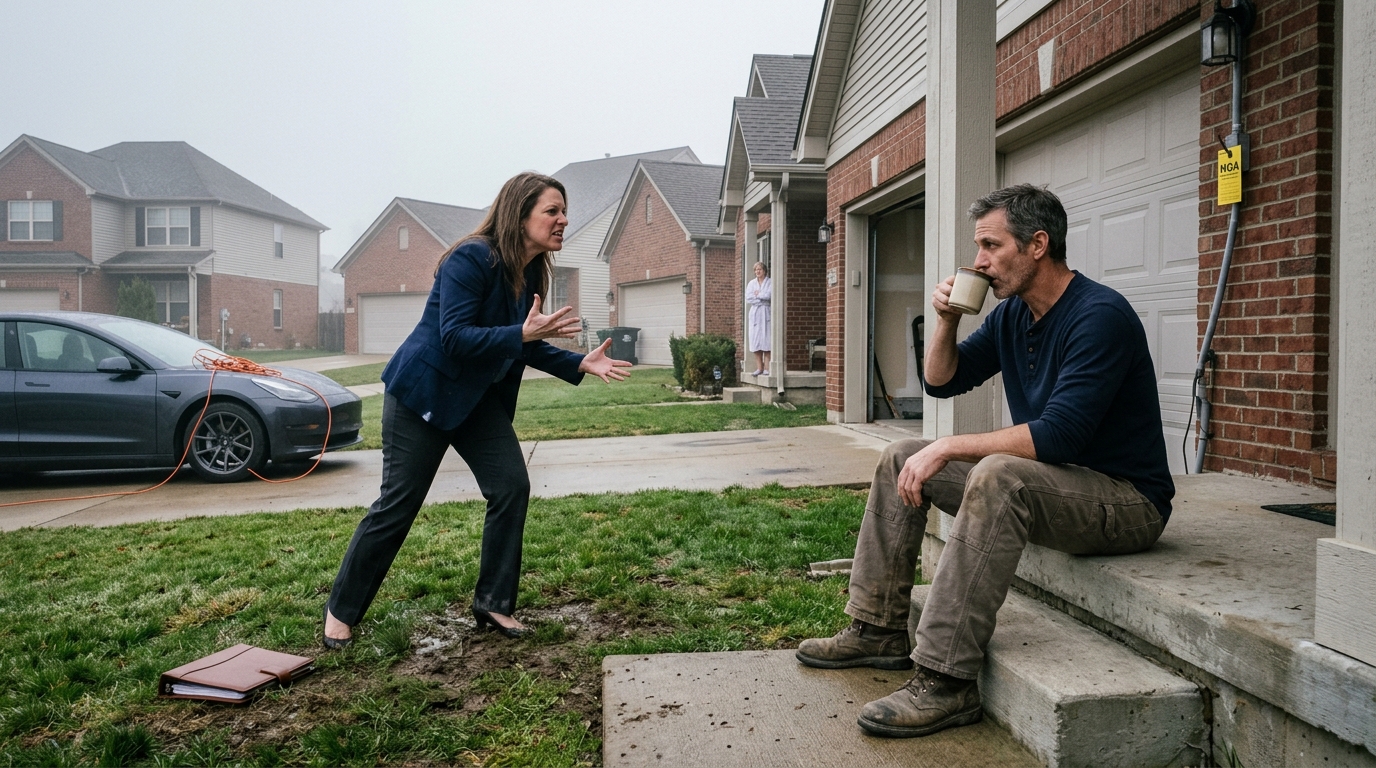
Karen materialized from the shed door, her leather binder dropping into the wet grass. Her face was flushed, the calculated composure entirely gone, replaced by a red, blotchy fury. She tripped over the orange cord she’d left coiled on the hood, caught herself against the doorframe, and glared across the yard directly at my porch.
“What did you do to my vehicle?” she shouted. Her voice bounced off the aluminum siding of house 410 across the street. “What did you put in that outlet?”
I didn’t stand up. I kept both hands wrapped around the warm ceramic mug. “Good morning, Karen.”
“Don’t ‘good morning’ me!” She strode across the property line, her heels sinking two inches into my un-mowed lawn. She stopped five feet from the porch steps, pointing a trembling finger at my chest. “My battery is at zero. The console won’t even boot the display. You tampered with your electrical panel!”
“My shed isn’t a charging station,” I said smoothly. My voice stayed down in my chest, low and flat. “I told you yesterday. The outlet isn’t rated for heavy vehicles.”
“That is a standard NEMA configuration!” she snapped, her knuckles white as she balled her hands into fists. “It was charging fine on Tuesday. You deliberately installed an illegal bypass to damage my property!”
Down the street, a garage door rumbled open. Mrs. Gable from 408 stepped out in her bathrobe to grab the morning paper, her eyes immediately locking onto us.
Karen saw her. Her posture shifted instantly. The wild rage snapped back into a rigid, performance-ready stance. She turned slightly toward the street, elevating her voice so it carried down the sidewalk.
“This is a safety hazard!” Karen declared, gesturing back toward my shed. “He has ungrounded, uninspected wiring operating right next to residential property lines! It destroyed my vehicle’s internal computer. I am calling Arthur Vance and the code enforcement committee immediately.”
I set the coffee mug down on the wooden step beside my boot. I stood up slowly, taking one step down so I was eye-level with her.
“Call them,” I said.
Karen blinked. The conviction in her eyes flickered for a fraction of a second.
“Call Arthur,” I repeated, stepping closer. “Tell him your car broke because you were plugged into an unlatched shed on my deeded land at two in the morning. Tell him about the extension cord stretched across the fence line. Make sure he writes down the exact amperage draw.”
Her lips pressed into a thin, colorless line. Her chest rose and fell in short, shallow breaths. She reached down, picked up her leather binder from the wet grass, and wiped a smudge of mud off the cover with her sleeve.
“This isn’t over, Mark,” she whispered. Her voice was barely audible now, stripped of its public authority, leaving only a sharp, toxic edge. “You think you’re clever because you know how to wire a breaker. You have no idea what runs through this neighborhood.”
She turned on her heel and marched back toward her house, her heels tearing small divots out of my lawn.
I stood by the porch steps, watching her walk away. I didn’t feel the surge of victory I’d expected.
My eyes drifted past her retreating figure, landing on the side wall of her garage where a thick, gray conduit emerged from the ground, ran along the foundation, and vanished behind her utility meter. On the side of the junction box, a small yellow inspection tag hung by a wire lead.
The text on the tag was faded, but the stamped code at the bottom was clean: Junction-7 / HOA Clearance Granted – A. Vance.
The car wasn’t the play. It was just the noise she was using to cover the line.
CHAPTER 3: THE SUBPANEL DISCREPANCY
The latch on Karen’s garage door dropped into place with a hollow, metallic thud.
I didn’t move from the porch steps. The morning sun was cutting through the high mist, casting long, pale shadows across the dew-soaked turf. My thumb slid down the side of my coffee mug, feeling the rough, unglazed ceramic near the bottom.
Junction-7.
The yellow inspection tag dangling from her external conduit flickered in the breeze. I knew every breaker, every junction, and every legal drop on this block. Two years ago, when the city replaced the primary transformer on the corner of Oak and 4th, the crew had spent three days digging a trench right along the utility easement. I remembered the heavy black rubber cabling they pulled through the PVC—four-inch main lines rated for high-density suburban distribution.
A residential garage didn’t need four-inch conduit. Not unless someone was running a commercial load behind a residential facade.
I set the mug on the wooden railing, walked down the steps, and circled around to the rear of my shed.
The wet grass soaked straight through the canvas of my work boots. Behind the shed, hidden by three overgrown elderberry bushes, sat the secondary sub-panel I’d inherited when I bought the property. It was an old Square D steel enclosure, painted gray, rusted along the bottom lip where the soil touched the metal.
I pulled a flathead screwdriver from my back pocket and jammed the tip into the rusted latch. The metal groaned, flaking orange dust onto my knuckles, before the door popped open.
Inside, the layout was wrong.
A standard sub-panel feeds off the main breaker in the house—two hot legs, a neutral, and a ground. But behind my six standard twenty-amp switches, tucked deep into the dark recess of the backplate, sat an unauthorized secondary bridge. A heavy, industrial-grade Meter-Bypass Relay had been bolted directly into the structural aluminum bus bars.
The insulation on the leads wasn’t house wire. It was thick, liquid-tight armored cable, snaking down through a freshly drilled hole in the concrete floor and heading straight underground—toward Karen’s property line.
I reached out, my fingers hovering an inch from the insulated casing. Even with no car plugged into the shed outlet, the casing was warm. A faint, high-frequency hum vibrated through the air, vibrating against my teeth.
This wasn’t just a neighbor running an extension cord to steal a few miles of range for a commuter car. This was an active, high-amperage siphon.
I pulled my phone from my pocket, turned on the LED torch, and angled the beam into the dark cavity behind the bus bars. Printed on the side of the bypass relay in faded white ink was a serial stamp: VANCE-GRID-CTL / MOD-4.
My thumb rubbed the cold steel frame of the box. Arthur Vance. The HOA president didn’t just sign off on neighborhood fence heights and paint swatches; he was an electrical contractor by trade before he retired onto the board. He had the key to the main utility vault at the end of the cul-de-sac.
I didn’t touch the wires. I didn’t snap the leads.
Instead, I pulled a digital thermal imaging camera out of my tool belt—a compact unit I used for finding insulation leaks in the attic. I plugged it into my phone port and pointed the sensor directly at the underground conduit entrance.
The screen lit up in vivid heat gradients.
The soil around my shed foundation was blue and green—a cool fifty-two degrees. But running five feet down, crossing directly beneath the chain-link fence, was a bright, searing line of orange and crimson. The line didn’t split toward her kitchen or her central AC unit. It ran straight into the back corner of her garage, fanning out into eight distinct, high-intensity thermal plumes.
Server racks. High-density processing units running twenty-four hours a day, disguised behind the silent residential siding of a suburban cul-de-sac.
“Find what you were looking for?”
The voice came from three feet behind me.
I didn’t jump. I slowly lowered the phone, folded the thermal camera into my palm, and turned around.
Arthur Vance stood on the other side of my elderberry bushes. He wore a crisp yellow polo shirt, ironed khaki trousers, and carried a clip-board under his arm. His hair was silver, parted neatly to the left, his expression mild and inquisitive—the picture of a retired civil servant keeping the neighborhood tidy.
“Morning, Arthur,” I said, leaning my elbow against the top of the open sub-panel door, blocking his view of the internal bus bar.
Arthur stepped closer, his boots crunching on the gravel path. He looked at the rusted gray box, then up at my face. His eyes were small, gray, and completely unreadable behind rimless reading glasses.
“Karen filed an urgent maintenance report at seven this morning,” Arthur said softly, tapping the brass clip on his board. “Claimed there was an uninspected power spike originating from your rear outbuilding. She was quite agitated. Mentioned vehicle damage.”
“The outlet is fine, Arthur,” I said. “Her car had a battery management failure.”
Arthur nodded slowly, his gaze drifting down toward the gap in the bushes where the rusted steel door hung open. “We have strict codes about uncertified electrical work in this quadrant, Mark. Fire hazards affect collective insurance rates. You know how the board views unauthorized grid modifications.”
“I do,” I said. I slid the screwdriver into my back pocket. Click. Clack. The brass padlock key in my front pocket clinked against my pocketknife. “Which is why I was just checking the lines. Seems like someone tapped a heavy industrial relay into my floor panel before I closed on the title.”
Arthur didn’t flinch. His smile didn’t slip. But his thumb pressed down hard against the wooden edge of his clipboard, the nail turning stark white.
“Old properties have legacy wiring,” Arthur said smoothly, his voice dropping an octave into a low, patronizing purr. “It’s best not to poke around in things installed before current code compliance. You might trip something the whole street relies on.”
He took half a step forward, his shadow falling across my boots.
“I can have my private contractor swing by on Friday to seal that box permanently,” he added, looking me straight in the eyes. “No charge to you. We’ll handle the filing internally.”
I looked at the white nail on his thumb, then down at the crimson heat line still glowing on the screen of the phone tucked in my palm.
“I’ll keep the box open for now, Arthur,” I said softly. “I like to see where the current goes.”
CHAPTER 4: THE PUBLIC AMBUSH
Arthur’s thumb stayed locked against the top of the clipboard for three long seconds before he let the tension go. His nail flushed pink again. He offered a tight, professional nod, pivoted on his heel, and walked back toward his golf cart without another word.
I stood behind the shed until the whir of his electric motor faded down the street.
I didn’t close the sub-panel door. I pulled out my phone, snapped three high-resolution stills of the VANCE-GRID-CTL stamp, and uploaded the raw image files to a secured cloud folder.
By Saturday afternoon, the humidity had settled over the cul-de-sac like a hot, damp blanket. The Annual Green Living & Sustainability Fair was in full swing on the central parkway lawn. Three white pop-up tents stood on the grass, surrounded by folding chairs, potted native saplings, and a folding table stacked with glossy HOA pamphlets.
Karen stood at the center of the lawn beside her dead Tesla.
She had towed it fifty yards down her driveway using a utility strap just so it could sit under the main banner. It glistened under the bright afternoon sun, washed and waxed to a mirror sheen. She wore a white linen suit, oversized sunglasses, and held a wireless microphone connected to a battery-powered PA speaker on a tripod.
Arthur Vance sat at the head table, hands folded over a thick, leather-bound notebook marked with a gold HOA seal—The Vance Protocol Ledger. He looked serene, nodding along as Karen addressed the twenty-some neighbors gathered on the grass.
“—a prime example of private commitment to ecological responsibility,” Karen’s voice cracked slightly through the horn speaker as she patted the hood of the car. “While some residents in our quadrant choose to maintain outdated, high-risk electrical hazards that threaten grid stability, others invest in the future.”
Mrs. Gable sat in the second row, nodding along nervously while clutching her sunshade.
I stood near the back tree line, leaning my shoulder against the trunk of a red oak. In my right hand, I held a portable laser projector no larger than a hardcover book, wired to a high-capacity lithium bank resting in my jacket pocket.
Karen swept her gaze across the crowd, her eyes locking onto me for a fraction of a second. Her smile tightened. “We cannot allow individual negligence to drag down community standards. Which is why the board will be voting this Tuesday on new infrastructure enforcement guidelines.”
Arthur picked up his pen, tapping the tip against his ledger. “Well said, Karen,” he called out into the microphone. “Clean energy requires clean compliance.”
I stepped out from the shade of the oak.
“Speaking of clean energy, Karen,” I called out, my voice cutting through the hum of the PA system. “We should probably talk about where that charging current actually comes from.”
The chatter along the seating rows died instantly. Mrs. Gable turned around in her chair. Karen’s hand tightened around the microphone handle until her knuckles turned ivory.
“Mark,” Arthur warned, half-rising from his folding chair, his tone dropping into that familiar, authoritative purr. “This is a scheduled presentation. If you have an agenda item for open floor, you submit it forty-eight hours in advance.”
“I don’t need forty-eight hours,” I said.
I pulled the white bedsheet I’d borrowed from my hall closet out of my canvas bag and hooked its grommets onto two low-hanging branches of the oak tree behind me. The fabric hung taut, six feet wide, bright white in the shadow.
I clicked the power switch on the projector.
A bright beam of blue light cut through the afternoon haze, slamming into the sheet.
“What is the meaning of this?” Karen snapped, taking two quick steps toward me, her heels digging into the soft turf. “Arthur, tell him to clear his equipment off public park space.”
“Let it run, Karen,” I said smoothly.
The projector screen flickered, resolving into a crystal-clear, forty-inch thermal video recorded at 11:48 PM on Thursday night.
The crowd gasped.
On the white sheet, a glowing infrared figure snaked across my lawn, dragging a thick, luminous orange line through the fence line and plugging it straight into my outbuilding. A timer in the corner of the frame ticked off the minutes. Beside the video feed, a real-time current readout showed thirty-two amps being pulled off my main panel, while a secondary split highlighted the subterranean line feeding directly into Karen’s garage racking system.
“That’s a fabrication!” Karen’s voice shrieked over the PA speaker, static popping violently as she gripped the mic. “He altered those images! He’s using illegal surveillance!”
“The cord is on the screen, Karen,” I said quietly, taking one step toward the head table. “Look at the plug housing.”
I tapped my phone screen, zooming the image in by three hundred percent.
Stenciled clearly across the orange rubber casing of the extension cord, written in permanent black marker, were two bold letters: K.B.
Karen froze. The microphone in her hand lowered two inches. Her mouth opened, but no sound came out through the speaker—just the dull, hollow whistle of feedback.
The neighbors turned as one. Mrs. Gable looked from the glowing screen to Karen’s face, her jaw dropping open.
Arthur Vance didn’t look at the screen. He looked at me. His face had gone stone gray. His hand slowly slid over the cover of The Vance Protocol Ledger, pulling it six inches closer to his ribs as if trying to shield the leather-bound book from view.
“This meeting is adjourned,” Arthur said abruptly, slamming his pen down onto the table. “Board business is suspended until further notice.”
“Not yet, Arthur,” I said, rolling the brass key across my knuckles as I stepped between his golf cart and the table. Click. Clack. “We haven’t looked at the line draw on Junction-7 yet.”
CHAPTER 5: NIGHT RAID AND KINETIC BREACH
Arthur Vance didn’t look at the crowd as he pulled The Vance Protocol Ledger tight against his ribs. He turned his back on the lawn, climbed into his golf cart, and clicked the key into reverse. The backup beeper gave three sharp, pathetic chirps before he floored the accelerator, cutting across the grass toward his driveway.
Karen stood paralyzed beside her dead car. Her hand shook so violently that the microphone head clattered against the stainless-steel bumper of her Tesla.
Nobody cheered. Nobody spoke. The neighbors just drifted away, two by two, looking down at their feet, leaving her standing alone under the bright blue glare of the projector beam.
I didn’t say another word to her. I packed my lens, pulled down my bedsheet, and walked back to my house.
The afternoon bled into evening. Shadows stretched across my living room floor, long and dark, until the streetlights flickered to life at 8:30 PM. I didn’t turn on my interior lights. I sat in the armchair beside the front window, a heavy steel pry-bar resting across my knees, watching the cul-de-sac die down.
At 2:45 AM, the storm rolled in. Rain began to drum against the glass, heavy and relentless, drowning out the ambient hum of the neighborhood transformers.
Through the curtain of water, a dark silhouette slipped out of Karen’s side door.
She wasn’t wearing her linen suit or her tinted glasses. She wore dark jeans, an oversized hooded raincoat, and carried a three-foot iron pry-bar in her gloved right hand. She didn’t hesitate at the fence line. She pushed through the elderberry bushes, her boots sinking loud and deep into the churned mud behind my outbuilding.
I didn’t wait for her to break the hinges. I moved through my dark kitchen, slipped out the back door, and stayed flat against the cedar siding of the main house.
The metal door of the Square D sub-panel screeched as her iron bar jammed into the lip.
CRACK.
The rusted latch gave way, flaking wet orange rust across her black coat. She dropped the crowbar into the mud, reached into her pocket, and pulled out a pair of heavy-duty insulated wire cutters. She leaned her entire body weight into the opening, aiming the hardened steel blades straight at the main neutral return lead of Junction-7.
If she cut that lead under load, the floating neutral would dump two hundred and forty volts directly into my house’s internal panel. It wouldn’t just kill her mining rig—it would fry every appliance I owned and set my outbuilding on fire before the main breaker tripped.
I moved.
My boot hit the wet gravel behind the bushes. She heard the crunch and spun around, her face pale under the dripping nylon hood, her teeth bared in a desperate, animalistic snarl.
She didn’t run. She lunged forward, swinging the heavy wire cutters straight at my collarbone.
I didn’t dodge into the wet brush. I stepped directly into her leverage.
I caught her forearms mid-swing, the crushing momentum of her stroke driving us both back against the rough cedar wall of the shed. The wood groaned under our combined weight. Rain poured off the roof edge directly onto our heads, soaking through my collar, the freezing water running down my neck.
Her gloves were slick with mud. She tried to twist her right wrist, trying to drive the blunt steel jaws of the cutters into my ribs, but I locked my shoulder under her elbow joint, using gravity and her own forward weight to trap her arm against the doorframe.
THUD.
Her back slammed against the iron panel. The cutters slipped from her muddy fingers, dropping uselessly into the wet grass below.
She panted, her chest heaving, her eyes wild and bloodshot in the dark. The smell of wet wool and ozone was suffocating between us.
“You’re done, Karen,” I breathed, my weight pinned firm against her upper arms, locking her shoulder against the panel frame. “It’s over.”
“You ruined everything!” she hissed, her voice a ragged whisper against the roar of the rain. She kicked her boot out, her heel scraping violently against my shin, but she had no leverage left to push me off. “He promised me the line was unmonitored! He said the board owned the easement!”
“Arthur lied to you,” I said, leaning closer until she could see her own terrified reflection in my eyes. “He used your garage to hide his arbitrage, and he let you take the fall.”
A sudden beam of blinding white light cut through the rain from the front driveway, sweeping over the elderberry bushes and locking us both in a sharp, clinical glare.
A siren gave two short, low yelps.
A police cruiser had parked at the curb, its spotlights washing across my backyard, illuminating the splintered sub-panel door, the dangling bypass cables, and the heavy iron tools scattered in the churned mud at our feet.
CHAPTER 6: CHECKMATE AND THE PURGE
The spotlight cut through the sheeting rain like a solid white pillar, locking us both against the cedar siding.
Karen didn’t move. Her shoulders slouched under my forearm, all the frantic kinetic energy draining out of her in a single long, shuddering exhale. Her gloved fingers relaxed, letting her wet hood slip back over her matted hair.
“Keep your hands where I can see them,” a voice boomed over the cruiser’s external speaker.
I slowly eased my weight off Karen’s upper arms. I stepped back two paces into the wet gravel, keeping my hands open at chest height. Karen slid down the rough wood of the shed wall until her knees hit the mud, staring blankly at the wire cutters lying half-buried beside the open sub-panel.
Two officers stepped around the elderberry bushes, their flashlights tracking across the scene. The lead officer took in the splintered metal latch, the iron pry-bar in the mud, and the heavy armored cable hanging loose from the casing.
“He rigged it,” Karen rasped, her voice barely carrying over the drum of rain on the shed roof. She pointed a trembling, muddy finger at my face. “He set a trap. He modified the utility line.”
The lead officer didn’t look at me. He looked at the secondary conduit running straight through the fence line toward her house, then down at the thermal printouts and digital video logs I’d laid out on my dry workbench inside the open shed door.
“Sir,” the officer said, turning to me. “Are you the homeowner?”
“I am,” I said quietly, the cold rain running down my neck. “The thermal logs and utility records are on the bench. The line running into house 412 is an unmetered junction. She was cutting the neutral return to destroy the evidence.”
The second officer stepped forward, pulled Karen up by her arm, and brought her hands behind her back.
Click. Clack.
The steel bracelets snapped shut around her wrists. Karen didn’t scream this time. She didn’t invoke the HOA guidelines or cite property values. She just stared at her muddy boots as they led her down the driveway toward the idling cruiser.
“There’s one more thing, Officer,” I said, stepping past the bushes toward the street. “She didn’t install the tap herself. The bypass requires access to the street-level transformer vault.”
I picked up the waterproof pouch resting on my porch steps. Inside was the USB drive containing the raw high-res stills of Junction-7 and the thermal video from the green fair.
“Arthur Vance,” I said, pointing down the cul-de-sac toward house 402. “He holds the master key to the neighborhood utility easement.”
Before the officer could reply, the front door of 402 opened.
Arthur Vance stepped onto his porch. He didn’t have his golf cart, and he wasn’t wearing his executive polo. He wore a heavy trench coat and carried his leather-bound binder tight under his left arm. He made it three steps down his walk toward his sedan before the second patrol car swung around the corner, its red-and-blue lights strobing off his wet windshield.
Arthur stopped at his driveway apron. His jaw clenched tight, his rimless glasses fogging in the cold night air.
I walked down my driveway until I stood twenty feet from him on the wet asphalt.
“The grid arbitrage is over, Arthur,” I said, my voice low and steady.
Arthur slowly turned his head to face me. The calm, patronizing posture he’d maintained for years finally cracked, revealing the raw, cornered beast underneath. His fingers dug into the leather cover of the book.
“You think you solved something, Mark?” Arthur spat, his voice dropping into a harsh, bitter whisper. “You broke the system. That tap balanced the entire quadrant’s peak-load baseline. Without the Meter-Bypass Relay on Junction-7, the utility company audits every panel on this block next month. Everyone’s rates spike thirty percent.”
“Then we pay what we owe,” I said. “On our own meters.”
The lead officer stepped between us, taking The Vance Protocol Ledger directly from Arthur’s hands. Arthur tried to hold onto the leather spine for a split second, his knuckles white against the damp binding, before the officer pulled it clean out of his grip.
“Arthur Vance,” the officer said, pulling a laminated card from his pocket. “You’re coming with us for questioning regarding commercial utility theft and unauthorized grid tampering.”
Arthur didn’t answer. He let them guide him into the back of the second cruiser, his silver hair plastered across his forehead by the rain, his untouchable suburban authority completely dismantled in less than ten minutes.
The cruisers pulled away, their red taillights disappearing around the bend of Oak Street, leaving the cul-de-sac in deep, undisturbed silence.
By 10:00 AM the next morning, the rain had stopped. The sun broke through the gray clouds, baking the wet pavement and making the neighborhood smell of wet pine and damp soil.
An industrial truck from the city power company sat parked on my lawn. Two linemen in heavy yellow rubber coats were finishing up the repairs behind my shed.
I stood by the open Square D sub-panel, watching them work. They had completely disconnected the unauthorized underground cable leading to Karen’s house, capped the subterranean PVC conduit with solid concrete, and installed a brand-new, certified bus bar inside my box.
“All clean, buddy,” the senior lineman said, wiping grease off his hands with a rag as he slammed the gray steel door shut. He clicked a fresh, heavy-duty brass lock through the latch and handed me the key. “You’re isolated, legal, and grounded. Nothing pulls off this box unless you plug it in yourself.”
“Thanks,” I said, taking the cold brass key.
I walked back inside my shed.
The white Tesla was gone, towed away at dawn by a flatbed truck. The space where it had been wedged was empty now, leaving only the damp concrete floor and the faint scent of ozone and tire rubber.
I picked up my old riding mower, rolled it back into its corner, and set my tool crate on the workbench. Then I pulled out my screwdriver, a bottle of 3-in-1 oil, and a pair of new stainless-steel hinges I’d bought at the hardware store three months ago.
I unbolted the rusted, crooked hinges from the shed door one by one. The old screws came out stiff, flaking red dust across my knuckles. I oiled the wood, lined up the new steel plates, and drove six fresh screws straight into the solid cedar frame.
I swung the shed door open and closed.
It didn’t groan. It didn’t stick. The heavy cedar panel glided smoothly on the new ball bearings, aligning perfectly with the jamb.
I stepped outside, pulled the door shut, and slid the brass padlock through the new latch.
Click.
The lock engaged with a clean, solid snap.
Across the street, Mrs. Gable was sitting on her porch steps, drinking her morning tea. She looked over at my shed, then at me. She didn’t wave, but she offered a long, slow nod of appreciation—a quiet recognition that the rules of the block had finally been restored to solid ground.
I picked up my cold coffee from the porch railing, took a slow sip, and sat down on my steps in the warm morning sun.
The electric meter on the side of my house was turned toward me. Inside the clear glass dome, the silver aluminum disc spun at a slow, predictable crawl—one steady, quiet rotation at a time.