The Measured Breath of Rusted Iron: A Legacy Forged in the Quiet Fields of Memory
CHAPTER 1: THE WEIGHT OF THE AM RADIO
The 1998 pickup truck had no business at a precision rifle expo, its bench seat cracked by decades of sun and its AM radio picking up more static than signal. Earl Hollis shifted his weight, the truck’s suspension groaning under the vibration of a passing semi-truck on the interstate half a mile away. He sat in the cab for a long minute after killing the engine, his hands resting on the steering wheel. They were dry, calloused, and currently held the tremors of a man whose bones had spent too many years enduring the damp chill of a forgotten valley.
He reached down and felt the gear shift, the metal pitted and worn smooth by years of shifting into second, into third, into reverse. It was a texture he understood. He didn’t look at the banners flapping in the distance or the white tents that looked like a gathered army. He didn’t care for the optics. He cared for the ground.
He stepped out of the truck, his boots crunching into the dry, sun-baked dirt of the parking area. The air smelled of burnt grass and industrial gun oil—the scent of a range that had forgotten what it was like to be a place of consequence. He adjusted his faded ball cap. It was heavy with the dust of the road, a barrier between himself and the noise of a world that measured success in microseconds and expensive polymer stocks.
He didn’t head for the tents. He headed for the fence line, his eyes tracking the way the wind moved across the tall grass in the distance. It wasn’t random. It was a pulse, a slow, rhythmic sway that mirrored the movement of the swinging plate down range. He saw the target, a thin steel disc suspended like a hanging man, and felt the familiar, cold pressure settle in his gut.
A younger man, dressed in gear that cost more than Earl’s truck, stepped into his path. “You’re in the wrong place, Pops,” the man said, his voice dripping with the casual cruelty of someone who had never had to worry about the wind. “This is for the heavy hitters. You want the VFW bingo hall, it’s back the way you came.”
Earl didn’t answer. He didn’t look at the man’s face; he looked at the man’s feet, noticing how he shifted his balance, how he relied on his expensive equipment to hold his center. Earl didn’t need a machine to hold his center. He just needed the wind to stand still, and he was the only one on this field who knew exactly how long that would take.
He pushed past the younger man, his shoulder brushing against a synthetic, high-tech jersey that felt like paper against his weathered windbreaker. He didn’t look back. He kept walking, the rust of his own life grinding against the polished surface of the expo, heading straight for the loaner rack. He saw the M1A sitting there, neglected and coated in a thin layer of fine, grey dust. It looked like an old friend waiting to be called back into the service. He reached out, his fingers hovering over the cold, unyielding iron.
CHAPTER 2: THE FIRING LINE
The range officer, a woman with eyes as sharp and unforgiving as a firing pin named Dana Whitfield, watched Earl with a skepticism that bordered on pity. She held the clipboard like a shield. Around them, the atmosphere was thick with the scent of unburnt propellant and the metallic tang of cooling barrels. The heat shimmer was already rising off the mowed grass, a dancing, liquid haze that turned the 800-yard target into a wavering, unreliable ghost.
Earl stepped into the designated lane. The concrete was grit-covered and stained with oil. He didn’t look at the other shooters. Tanner Voss was still lingering nearby, his arms crossed over a custom-built rifle that looked more like a space-age tool than a firearm. Tanner let out a sharp, dismissive huff, the sound carrying easily over the wind that whipped across the open field. “Loaners have triggers that travel two miles before they break, Pops. Don’t blame the rifle when you put your rounds into the dirt.”
Earl ignored him. He was focused on the M1A. He ran the action again, listening to the heavy, mechanical clunk—the sound of steel finding its home. It was a familiar language, one he had spoken in another life, under a sky that didn’t hold the sun but instead rained fire. As he worked the bolt, the scent of the CLP—the gun oil—suddenly shifted. For a split second, the polished, manicured range vanished. He was back in the red clay of the Khe Sanh perimeter, the air thick with the suffocating, sweet-acrid rot of the valley. He felt the phantom pressure of a corporal’s hand on his shoulder, a silent directive to hold the line.
He blinked. The vision receded, leaving him standing on hot concrete, but the phantom weight of the corporal remained. His hands, which had been trembling moments ago, now steadied with a glacial, terrifying calm. He didn’t look at the optics or the fancy tech that surrounded him; he looked at the support structure of the moving target. It was a crude, rusted frame, oscillating with a mechanical, hypnotic rhythm.
He didn’t aim at the steel disc. He aimed three inches to the left, at a jagged bolt head protruding from the support pole. He knew from forty years of muscle memory that the shadow of that bolt, at this specific angle of the sun, would intersect with the path of the target in exactly four seconds. It wasn’t math; it was memory.
He sat down. The movement was slow, deliberate, a choreography of joints that had forgotten the meaning of agility but remembered the meaning of stability. He looped the leather sling up his support arm, the friction of the strap against his bicep grounding him. He felt the cold iron of the rifle against his cheek. It was a rough, honest connection.
Tanner Voss leaned in, his voice a low, needling whisper. “You’re reading the wind off the grass? Seriously? The telemetry in my app says the crosswind is shifting four degrees every thirty seconds. You’re going to be shooting at ghosts, old man.”
Earl didn’t turn his head. He watched the seed heads of the tall grass in the creek bottom 400 yards out. The wind moved them in waves, a green tide flowing beneath the horizon. He wasn’t looking at the wind’s current speed; he was timing the pulses. The grass leaned, stood, and leaned again. It was a heartbeat.
“The wind doesn’t care about your app,” Earl murmured, his voice sounding like gravel shifting in a stream. It was the first time he had spoken, and the range suddenly seemed to go quiet, as if the air itself was waiting for him to finish the thought.
He didn’t explain that the wind wasn’t a set of numbers, but a physical force that moved through the valley in predictable, rhythmic breaths. He waited. The M1A was heavy against his shoulder, a dense, comforting burden. He watched the target, a blurred motion in the shimmer, and he watched the grass. He was no longer at a 2026 expo. He was in the low ground. He was waiting for Danny to tell him the wind was right.
He felt the pulse in his own neck, the rhythm of his own blood, and he synchronized it with the sway of the target. He didn’t think about the $25,000. He didn’t think about the people watching, or the laughter that had died out behind him. He thought about the weight of the rifle and the singular, impossible duty of holding a position until the world stopped shaking.
He held his breath, the world narrowing down to the front sight post and the rusted bolt head. The tension in his chest was not fear; it was the quiet, hollowed-out space where a lifetime of grief had been kept under lock and key. He was going to pull that trigger, not to win, but to finally let the air out of his own lungs.
He began to squeeze. The trigger broke, not with a click, but with the snap of a dry branch in a silent forest. The recoil didn’t surprise him; it was a conversation he had been having for decades, and for the first time in his life, he didn’t flinch.
CHAPTER 3: THE INTERNAL CLOCK
The rifle settled back into the cradle of his hands with a leaden, familiar weight. The silence that followed the shot wasn’t empty; it was pressurized. Earl remained in his sitting position, the sling still biting into his upper arm, his breathing regulated to a slow, controlled cadence. He didn’t look at the target. He didn’t look at the range officer. He stared at the dry, parched dirt between his boots, his eyes tracing the path of a small, industrious beetle navigating the cracked earth.
Behind him, the air had shifted. The derisive chatter that had characterized the afternoon was gone, replaced by a low, dissonant murmur—the sound of a hundred people trying to process a physical impossibility.
“Did he…” someone whispered, the voice trailing off into disbelief.
Earl felt a shift in his own internal landscape. The fatigue, which had been a dull background noise, now surged forward, clawing at his joints. His vision, sharp as a razor only seconds ago, began to cloud at the edges. The heat shimmer on the field intensified, turning the 800-yard line into a distorted, liquid nightmare where the target seemed to pulse, expanding and contracting with a life of its own. He blinked, but the effect remained—the target was dancing, not just with the wind, but with his own fading acuity.
He leaned forward, adjusting his grip on the stock. His knuckles were white, the skin stretched thin over bone. He felt a sudden, sharp pang of doubt—not in his ability, but in the nature of the reality before him. Had he actually hit the plate? Or was this another trick of the light, another phantom memory masquerading as a target?
Dana Whitfield stepped forward, her footsteps crunching rhythmically on the gravel. She was staring downrange through a high-powered spotting scope, her posture rigid. She didn’t look at Earl. “The plate is swinging,” she said, her voice flat, devoid of its earlier skepticism. “It’s moving, but not from the motor. It’s spinning.”
Earl shifted his position, his elbows pressing harder into his knees. He felt the rust of the field in his bones. He knew that sound—the erratic, disjointed spin of steel struck by a round moving at just the right velocity, at just the right angle. It wasn’t a clean center hit; it was a strike that had exploited the geometry of the support, an angle that only existed if one understood that the target wasn’t the disc, but the tension of the chain holding it.
Tanner Voss had gone unnaturally quiet. Earl could feel the man’s gaze, a hot, prickly sensation against the back of his neck. It was the look of a man whose world had just been fundamentally altered, someone whose expensive, high-tech map of the world had suddenly become useless. Tanner wasn’t mocking him anymore. He was observing, searching for the crack in the armor, the secret he could take and call his own.
Earl pushed himself up. The motion was painful; his lower back protested, a sharp, white-hot line of agony that grounded him in the present. He kept his face neutral, a mask carved from years of hiding his intent. He needed to keep moving, to maintain the momentum, because if he stopped—if he allowed himself to think about Danny, or the letter he hadn’t written, or the reason he had really driven four hundred miles—the weight of it would crush him.
He reached for the rifle, his fingers brushing against the worn wood of the stock. There was a small nick in the wood near the receiver, a scar from a previous owner, perhaps from a time when these rifles were used for something other than sport. He traced it with his thumb, the tactile sensation anchoring him.
“Reset the motor,” Earl said, his voice raspy, as if he hadn’t used it for years. “The plate is off-center.”
Dana looked at him, her eyes widening slightly. She seemed to realize then that he wasn’t looking at the money, or the crowd, or the prestige. He was looking at the target with the same clinical, detached intensity a surgeon might reserve for a complex procedure.
“You want another shot?” she asked, her voice dropping to a near-whisper.
“The rules say one cold shot per attempt,” Earl replied, his eyes finally shifting to hers. His gaze was ancient, heavy with things that didn’t belong on a firing line. “But I haven’t finished the count.”
He turned away from her and scanned the field again. The wind had picked up, a steady, low-frequency hum that vibrated through the tall grass. He saw the movement—a subtle, undulating wave that crept toward the firing point. It was a pattern he knew, a rhythm that hadn’t changed in fifty-seven years. He realized then that he wasn’t just competing against the younger shooters; he was engaging in a dialogue with a terrain that remembered everything, even if the world had chosen to forget.
He didn’t look at Tanner again. He looked at the horizon, where the sun was beginning its slow descent, casting long, bruised shadows across the valley. The world was narrowing down to a single, inevitable conclusion, and he was the only one who realized that the shot he had taken wasn’t the climax. It was merely the opening movement of a much longer, much colder requiem.
CHAPTER 4: THE SHOT
The echo of the first shot had barely died against the far berm when the world betrayed him. The wind, which had been pacing itself in a rhythmic pulse, suddenly fractured. A rogue gust swept across the creek bottom, whipping the seed heads of the tall grass into a frantic, chaotic dance that defied the pattern Earl had spent the last hour observing. The oscillation of the target, previously steady and hypnotic, turned violent, the steel plate jerking erratically on its chain like a trapped animal.
Earl felt the shift in his gut before he saw it in the grass. His pulse, which had been perfectly synchronized with the rhythm of the field, suddenly felt out of phase. He didn’t break his position, but his muscles tightened, the leather sling digging into his arm with a biting, persistent pressure.
“The wind’s holding at twelve,” Tanner Voss called out from behind him, his voice no longer sneering, but strangely sharp, bordering on desperate. “If you’re waiting for the lull, you’re going to be here until dark.”
Earl didn’t respond. He couldn’t. His entire consciousness was poured into the small, iron aperture of the M1A. He watched the rusted bolt head on the support frame, the point he had designated as his anchor. It was still there, a tiny, immovable speck in the shimmering haze, but the target was now dancing a wild, unpredictable jig around it.
He felt the sweat beading beneath his cap, a slow, stinging rivulet trickling down his temple. He didn’t wipe it away. He kept his eyes fixed on the front sight, his world distilled to the relationship between the front post and the dancing steel. He was in the “Exhale” now—the moment where the planning ended and the physics took over.
The gust intensified, a low roar that he could hear even over the ringing in his ears. The grass in the foreground laid almost flat, a wave of grey-green motion that signaled a significant pressure drop. He knew that this wasn’t just a shift in the air; it was a complication he had to improvise around.
He didn’t chase the plate. He adjusted his aim—just a fraction, an infinitesimal movement of his support elbow against his knee. He felt the friction of his sleeve against the concrete, the microscopic grinding of bone against muscle. He was compensating for the wind not by following it, but by anticipating the exact point where it would inevitably fail to overcome the momentum of the target.
He took a breath, holding it not in his lungs, but in his marrow. The world around him—the expo, the crowd, the $25,000, Tanner’s desperate gaze—vanished. All that remained was the rusted iron of the rifle and the distance that felt like a lifetime.
He saw the target dip, a momentary, stuttering pause in its frantic oscillation. It was the “Butterfly Detour”—a fraction of a second where the wind caught the edge of the plate and held it suspended in the air.
He didn’t hesitate. He pulled.
The recoil hit him harder this time, a punishing jolt that drove the stock into his shoulder with a dull, ringing thud. The rifle jumped, his view of the field obscured for a heartbeat by the dancing front sight. And then, the silence.
It lasted longer than the first time. The bullet was traveling through a chaotic, swirling medium, its path dictated by the very elements that had conspired to ruin the shot. He held his position, his breathing shallow, his finger still resting against the trigger guard.
Then, it came. A sound so faint it was almost a memory: the metallic ‘ping’ of lead hitting steel. It wasn’t the clean, centered ring of a target-shooter’s success. It was a glancing, hollow sound—a hit that had caught the edge of the plate as it spun away, a strike earned through improvisation rather than intent.
The chain jerked, the plate swinging wildly now, spinning on its axis until it became a blurred, silver disc in the sunlight. Earl didn’t smile. He didn’t exhale. He stayed exactly where he was, his body a monument to the endurance required to hold a position when the world was trying to tear it away.
Tanner Voss let out a breath that sounded like a sob. “That shouldn’t have hit,” he muttered, the words barely audible. “That shouldn’t have hit.”
Earl slowly, painfully, began to break his position. His limbs felt heavy, as if the gravity of the field had increased ten-fold. He felt a deep, resonant ache in his lower back, the reminder of every day he had spent in a valley that smelled of smoke and wet earth. He set the rifle down, his hands steady, though his skin was cool to the touch.
He looked down at his own hands, the callouses worn and deep, and he realized with a sudden, sinking clarity that he hadn’t come here to win money. He had come here because the silence of his life was becoming too loud to bear, and the only way to quiet it was to return to the math of the wind, to the geometry of survival, and to the ghost of the man who had died waiting for him to make the shot.
The plate was still spinning, its rhythm now completely disconnected from the motor. It was a chaotic, beautiful failure of mechanics. Earl looked at it, and for a moment, he wasn’t 79. He was 22, standing on the edge of a world that didn’t know what it had lost, and he knew, with a certainty that chilled him, that he wasn’t done yet.
CHAPTER 5: THE RECOGNITION
The firing line was no longer a place of sport; it had become an arena of ghosts. As Earl stood, his knees popping in the quiet air like small-arms fire, he didn’t turn to face the murmuring crowd. He focused on the rifle, his movements clinical. He cleared the action, the empty brass casing clinking against the concrete—a sound so mundane it felt like a sacrilege in the heavy, expectant silence. He went to set it down on the mat, intending to walk away, to leave the weapon and the money and the questions behind, when the space around him was abruptly displaced.
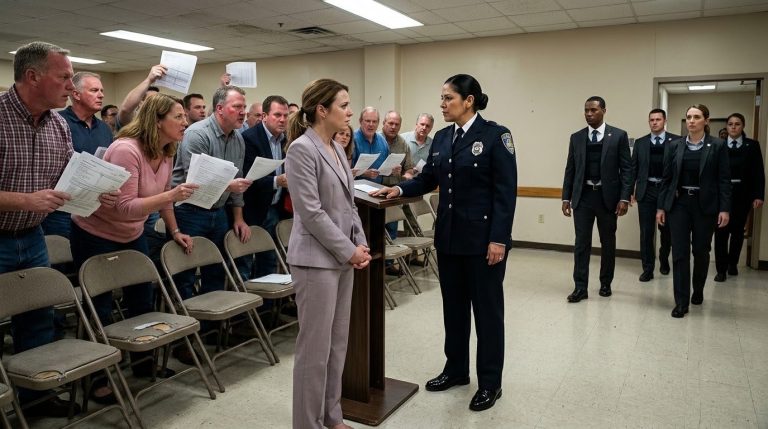
A man in a navy-blue blazer stepped into his peripheral vision. He was older, his hair a close-cropped silver, his posture so rigid it seemed to defy the natural slouch of age. Sergeant Major Reuben Castillo. Earl recognized the bearing before he saw the face; he had seen that same stillness in a hundred men who had learned, as he had, that moving without purpose was a death sentence.
“Say your name,” Castillo said. The voice wasn’t an interrogation; it was a rhythmic, measured cadence that cut through the noise of the expo like a flare in the dark.
Earl kept his gaze lowered, focusing on the grit-stained surface of the rifle stock. “Hollis,” he said. The name felt strange in his mouth, a label for a man he had spent half a century trying to leave in that valley.
“Earl Hollis.” Castillo didn’t ask it; he stated it, verifying a coordinate on a map that existed only in their shared memory. He stepped closer, his presence a heavy, undeniable gravity. “Scout sniper platoon, 7th Marines, Khe Sanh, 1969.”
The mention of the year, the place, the unit—it hit Earl like a physical blow to the solar plexus. The air around them seemed to contract. For a heartbeat, the smells of the expo—the fairground coffee, the fresh-cut grass, the expensive colognes—vanished, replaced by the suffocating, cloying humidity of a jungle that never stopped breathing. He felt the phantom pressure of a pack strap on his shoulders, the bite of a mosquito against his eyelid, and the quiet, steady hum of Daniel Reyes’s voice whispering windage corrections in his ear.
“I didn’t come here for this,” Earl said, his voice brittle. He started to turn, his intent clear—he was going to walk to his truck, start the engine, and drive until the static of the AM radio drowned out the sound of his own thoughts.
Castillo moved with him, his hand catching Earl’s arm. It wasn’t a grab; it was a stabilizer. The contact was electric, a jolt of recognition that transcended the decades. “I know why you came, Earl,” Castillo murmured, the roughness in his voice betraying a long-suppressed tremor. “And I know who you were carrying.”
Earl froze. The crowd was a blur at the edges of his vision—Tanner Voss, mouth slightly agape; Dana Whitfield, her eyes wide with a realization she couldn’t name. But Earl saw none of them. He saw only the Sergeant Major, a man who represented the final, immutable account of a debt he hadn’t known was still being tracked.
“Reyes,” Castillo said, the name sounding like a prayer. “He was my uncle.”
The word hung in the air, vibrating. It wasn’t just a fact; it was an accusation, a revelation, and a pardon all at once. The decoy secret—the need to hit the target, the money, the competition—shattered completely. The real secret, the heavy, rusted truth Earl had hauled across four hundred miles, was now standing directly in front of him, waiting for an answer he didn’t have.
“I brought him as far as I could,” Earl whispered, the words forcing their way past a constriction in his throat that felt like lead. It was the first time he had confessed the truth of that day to another living soul. “I carried him off the hill, and I never let him go.”
Castillo’s expression didn’t soften; it deepened. He looked at Earl with a recognition that was almost painful to witness—the look of a man seeing a legend he had been taught to revere, only to find the man was as broken and tired as the history he helped build.
“The wind,” Castillo said, his voice barely a breath. “You read it off the grass. Just like the doctrine says. Just like he told us.”
Earl looked up then, meeting the Sergeant Major’s gaze. He saw the pride there, and the grief, and the profound, crushing weight of a family built on the memory of a nineteen-year-old corporal who never came home. The firing line, the expo, the modern world—it was all a thin, flimsy veneer over the dark, unyielding reality of that valley.
“He did the math,” Earl said, his voice gaining a sudden, terrifying clarity. “I was just the trigger-puller. He was the one who kept us alive until the light went out.”
The Sergeant Major nodded, a single, decisive movement. He stepped back, but he didn’t leave. He turned, his gaze sweeping the crowd, and Earl knew what was coming. The truth was about to be unpacked, layer by layer, and there was nowhere left to hide. The final act had begun, and for the first time in fifty-seven years, Earl realized he wasn’t going to have to finish it alone.
CHAPTER 6: THE QUIET PEACE
The silence on the range was absolute. Every eye in the crowd was fixed on them—Tanner Voss, his face drained of its aggressive color; Dana Whitfield, holding her breath; and the hundreds of others who had come for the sport and stayed for the history. Earl felt the weight of that gaze, a physical pressure, but he didn’t pull away. Castillo’s hand on his arm was firm, a tether holding him to the ground while his mind circled the memory of the hill one last time.
“Tell them,” Castillo said, his voice quiet but resonant, carrying clearly in the stillness. “Tell them what you carried.”
Earl looked at the Sergeant Major, then past him, to the plate. It was finally still. He realized then that the decoy—the shot, the money, the need for validation—was gone. All that remained was the truth, and he was ready to set it down. He reached into his windbreaker and pulled out a small, worn photograph he had kept in his breast pocket for decades. It was faded, the edges curled, a picture of a nineteen-year-old corporal with a wide, confident grin.
“Daniel Reyes,” Earl said, his voice gaining a resonance that surprised him. He didn’t look at the crowd; he spoke to the space between him and Castillo. “He was my spotter. We were in a hole in the ground outside Khe Sanh. The wind was whipping over the ridge, and we were the only ones who knew where the enemy was gathering in the low ground. He did the math for me, call by call, round by round. When the overrun started, he wouldn’t leave the scope. He held the position so I could work. And when I had to move, I carried him. He was nineteen, and he was the bravest man I ever knew.”
He handed the photograph to Castillo. The Sergeant Major’s hand trembled as he took it. He looked at the face of his uncle, and in that moment, the entire firing line seemed to exhale. The antagonism, the vanity, the competitive posturing—it all evaporated, replaced by a sudden, heavy gravity.
Tanner Voss stepped forward, his head bowed. He reached out and took the ball cap from his own head, holding it over his chest. He didn’t say a word; he didn’t have to. The arrogance had been replaced by a raw, unvarnished recognition of something larger than his own pride.
“The scholarship fund,” Earl said, turning to Dana Whitfield. His voice was steady now, the tremor in his hands completely gone. “The money goes to the Scout Sniper Association. For the ones coming after. For the ones who need the math to be better than it was in my day.”
Dana nodded, her eyes bright. She signaled to her team, and the locked case was moved to the side, forgotten. The physical tension of the challenge had dissolved, replaced by a deep, atmospheric peace. Earl took the M1A from the rack once more. It was a borrowed tool, and he had promised to return it clean. He spent the next few minutes meticulously breaking it down—the methodical, rhythmic motion of a man who found comfort in the mechanics of things he could control. He wiped the steel, the smell of the gun oil a final, cleansing scent, and placed each piece back on the rack with the reverence of a man storing a holy relic.
The crowd began to disperse, not in a rush, but slowly, as if reluctant to break the spell. Earl felt a sudden, profound exhaustion, a settling of his spirit that mirrored the way the sun was now dipping below the horizon. The heat shimmer was gone. The field was bathed in a soft, golden twilight.
Castillo walked with him toward the 1998 pickup. They didn’t speak. They didn’t need to. The debt had been acknowledged, the truth had been spoken, and the ghost of the valley had finally been brought home. When they reached the truck, Earl opened the door. The bench seat creaked. He looked at the Sergeant Major and offered a small, thin smile—the first one he had given all day.
“He would have liked this,” Earl said, gesturing to the range. “He always loved the math.”
“He would have been proud of you, Earl,” Castillo replied.
Earl climbed into the truck, his movements slow and deliberate. He started the engine, the familiar groan of the starter a comforting sound. He put the truck into gear and pulled away, the tires crunching softly on the gravel. He didn’t look back at the expo, or the tents, or the plate. He kept his eyes on the road ahead.
As he drove, he reached over to the passenger seat and patted the worn upholstery. The air in the cab was cool, the scent of the dry, open earth drifting in through the cracked window. For the first time in fifty-seven years, the silence in his head wasn’t a weight. It was a space. A quiet, empty space where he could finally breathe. He turned the AM radio dial, listening to the static fade into a soft, melodic hum of a song he hadn’t heard in years. He wasn’t running anymore. He was just going home.