The Weight of Quiet Waters: How a Retired Legend Reclaims His Purpose in the Deep
CHAPTER 1: The Sky Over Alfalfa
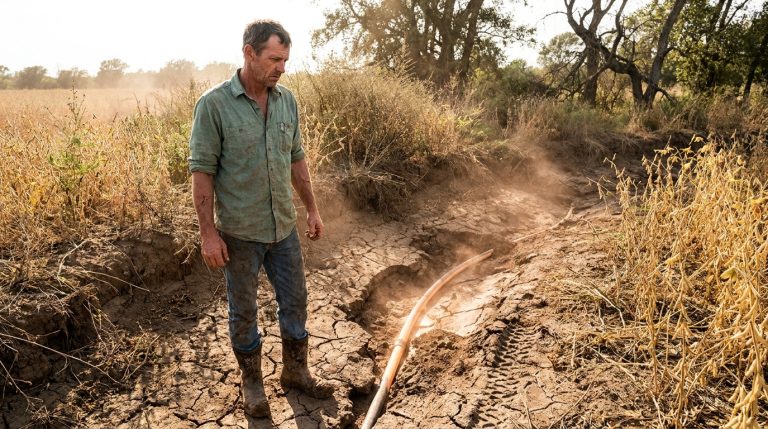
The dragonfly had been circling the cattail for ten minutes, a rhythmic, shimmering violet needle stitched into the humid afternoon. Samuel Keene sat on his folding campstool, his knees popping with a familiar, dry ache that he chose to ignore. He watched the red and white bobber sit motionless on the lake’s glassy surface. It was a perfect, stagnant moment. He had paid for this stillness with three decades of silence.
Then, the air changed.
It wasn’t a visual shift. The sky remained a cloudless, mocking blue, and the grass in the pasture stayed motionless. It was a pressure shift—a low-frequency thrum that started in the soles of his boots and worked its way into his marrow. His hand, resting on the cork handle of his graphite rod, didn’t tighten, but his nerves hummed.
The wind shifted. It flickered from the west-southwest, carrying the scent of dry heat and, unmistakably, the ionized tang of jet exhaust.
A Cessna wouldn’t sound like this. A Cessna was a bumblebee; this was a thunderclap waiting to happen. Samuel calculated the vector without turning his head. Five knots of wind. The helicopter was heavy, likely a twin-engine rotorcraft, bleeding off speed for a tactical descent. If they were looking for the flat pasture to the north, they would overcompensate for the tree-line lean. They would touch down exactly two hundred yards from his shoreline.
The roar blossomed, a wall of sound that shoved the pastoral quiet aside. Birds erupted from the weeping willow, a chaotic explosion of feathers. The lake’s surface, a mirror for his sanctuary, shattered into ripples that smacked against the mud bank.
He didn’t run. He didn’t cower. He slowly reeled in his line, the smooth click of the reel a singular, steady note in the cacophony. He hooked the lure into the keeper ring and laid the rod on the grass with the tenderness of a man placing a child to sleep.
The helicopter crested the trees—a haze-gray MH-60 Seahawk, its massive blades whipping the tall grass into a horizontal frenzy. The rotor wash blasted him, the grit and debris stinging his cheeks, but he merely raised a hand to shield his eyes.
As the craft settled, the ground-shaking thud of the landing rattling his teeth, the cabin door slid open. Two figures emerged, framed by the blinding sky. They were silhouettes of urgency. They were stepping into his kingdom, and as Samuel watched them navigate the dying whine of the turbines, he felt the familiar, heavy, and unwelcome iron of his own past settling back into his bones.
He didn’t stand. He simply waited for them to notice that the farmer they were looking for was already gone.
CHAPTER 2: The Architecture of Displacement
The air in the pasture was still settling, the tall grass slowly shivering as if trying to stand upright again. Samuel remained on his stool, his calloused hands resting on his knees. He didn’t offer to stand. He watched the two figures approach—the lieutenant commander with the sharp, piercing blue eyes and the younger crewman who looked as though he had walked into a history book and wasn’t entirely sure if he was welcome.
“Excuse me, sir,” the officer began. Her voice was steady, refined, but as she reached a distance of ten feet, Samuel saw it. Her right hand, clutching the tablet, wasn’t just holding it; her knuckles were white, and a slight, involuntary tremor danced in her index finger. It was the mark of someone who had already calculated the odds of failure and found them unacceptable.
“We’re on a critical timeline,” she continued, her gaze locking onto his. “We’re looking for a man. We were given these coordinates.”
Samuel didn’t move. He felt the cold iron of his old life pressing against the soft, warm fabric of his flannel shirt. He thought of Martha, of the way the light hit the kitchen table at dawn, and of the profound, simple silence he had spent thirty years cultivating. If he spoke, he was committing to the end of that silence.
“That name,” he finally said, his voice a gravelly rumble that seemed to catch on the humid air. “That name’s been retired a long time, Commander.”
The woman—Eva, he noted from the name tag, though he hadn’t yet looked—didn’t blink. She took a breath, a shallow intake of air that betrayed a flicker of desperation. “Not for us, it hasn’t.”
He stood then, the movement fluid for a man of seventy-two. It wasn’t the slow, labored rise of a farmer; it was the practiced, efficient motion of a man who still understood the physics of his own body. He picked up the smooth, grey stone he had been turning in his hand and dropped it back into the mud at the lake’s edge.
“The wind’s shifting to the east,” Samuel said, his tone detached, observational. “If you’re planning on staying, you’ll need to secure the tail rotor. The ground here is marshy; the weight of that Seahawk will start to sink if the soil gets any softer.”
The young crewman, the one who had looked awkward, blinked. He turned to glance at the skids of the massive aircraft, clearly surprised by the shift in the conversation. Eva didn’t look back at the bird. She kept her eyes on Samuel, her blue gaze stripping away the pretense of the flannel and the muddy boots.
“Sir,” she said, her voice softening, losing some of its military starch. “We need you.”
The walk back to the helicopter felt like stepping through a veil. Every step he took away from the lake felt heavier, the damp earth of the pasture clinging to his soles as if trying to hold him back. He didn’t look at the farmhouse. He didn’t look at the garden he had turned just that morning. He kept his eyes on the open cabin door of the Seahawk, a dark, yawning mouth of technology and duty.
Inside, the smell was immediate and overwhelming: jet fuel, hot ozone, and the sterile, recycled scent of an environment designed to keep death at bay. It was the smell of the North Atlantic. It was the smell of the freezing dark.
“Take a seat,” Eva said, gesturing to the jump seat opposite her.
Samuel sat. The harness was a familiar, constricting embrace. As he buckled it, he looked down at his hands—thick, calloused, and stained with the honest dirt of the farm. They looked entirely out of place here, in a world of vibration-dampened flooring and high-definition screens.
The engines began to whine, a high-pitched, rising frequency that seemed to vibrate in the very center of his skull. He closed his eyes. For a heartbeat, he wasn’t in a helicopter; he was back in a prototype diving suit, the crushing pressure of the deep sea pressing against the polycarbonate faceplate, his fingers dancing across mechanical wheels that were the only thing standing between him and the end of his oxygen.
“At 0400 this morning,” Eva began, her voice cutting through his reverie, “we lost contact with the deep-sea research submersible Odyssey.”
She tapped a command on her tablet, and the main bulkhead screen flickered to life. A 3D bathymetric map of a Pacific canyon appeared, deep and unforgiving. A red dot blinked in the center—a tiny, trapped ember in a vast, dark expanse.
Samuel watched. His mind, dormant for decades, began to partition the information. He didn’t just see a map; he saw topography, current velocity, and thermal gradients. He saw the physics of a trap.
“She’s a privately owned vessel,” Eva continued, her voice clipped, professional. “Crew of four. Lead scientist is Dr. Alistair Finch. Last transmission indicated a primary power failure followed by a cascade of system shorts. They’re running on emergency battery. No propulsion. No comms.”
Samuel opened his eyes. He looked at the map, his gaze narrowing on the narrow fissure depicted in the rendering. The depth was immense—10,800 meters. The pressure at that depth wasn’t just a number; it was a physical weight that could shear metal and crush the human spirit.
“They’re wedged,” he said, his voice flat. “The fissure. It’s not just the depth; it’s the lack of maneuverability.”
“Exactly,” Eva said, her eyes widening slightly at his immediate grasp of the tactical geometry. “Our DSRVs are too large. We tried ROVs, but the fissure is unstable. The rockslide risk is critical.”
She zoomed in on a schematic of the Odyssey. It was sleek, modern, and utterly alien to the mechanical world he understood. But then, she highlighted a small, circular port on the ventral engineering section.
“There’s an emergency egress port,” she said. “Manual. Mechanical. It’s an analog prototype. No current documentation survives, and the lead engineer passed away years ago.”
Samuel stared at the port. He remembered the smell of the test pool, the taste of the cold water, and the exact, intricate sequence of wheels. He remembered Walter Sobol, a man who believed that if something could be broken, it could be built to be fixed.
“It’s not just a port, Commander,” Samuel said, his voice quiet, heavy with the weight of things remembered. “It’s a puzzle. And if you force it, you lose everything.”
The helicopter lurched, lifting off the ground, and as the valley fell away beneath them, Samuel looked out the window one last time. His farm was already a small, insignificant patch of green against the vast, indifferent landscape. He felt a sudden, sharp ache in his chest—a reminder of the silence he had left behind, and the storm he was flying straight into.
CHAPTER 3: The Cathedral of Cold Steel
The interior of the USS Stalwart was not a ship; it was a pressurized, fluorescent-lit tomb for human ambition. As the Seahawk’s rear ramp cycled shut, sealing them into the belly of the vessel, the transition hit Samuel like a physical blow. The air here was processed, stripped of all life, filtered through layers of charcoal and chemical scrubbers until it tasted like nothing at all.
He didn’t move toward the exit hatch immediately. He let the rhythm of the ship—the low, insistent thrum of diesel engines and the distant, metallic ringing of pipes—settle into his senses. This was the language of the ocean’s keepers. It was a cold, precise dialect.
“Follow me, Master Chief.”
Lieutenant Commander Eva Rostova didn’t wait to see if he was behind her. She moved with a purpose that felt honed by years of Navy discipline, her boots clicking sharply against the steel grating. Samuel followed at his own pace, his muddy work boots making a soft, muted thud in contrast to the staccato rhythm of the crew.
Every corridor they passed was a vein of high-tech urgency. Sailors moved past them with their heads down, their eyes fixed on clipboards or handheld terminals. He caught snatches of conversation—”battery cascade,” “thermal venting,” “negative buoyancy”—that told the story of the Odyssey far better than any briefing. The ship was dying in real-time, and the Stalwart was failing to catch it.
They reached the operations center, and the door slid open to reveal a cavern of blue, artificial twilight. The space was dominated by a massive, floor-to-ceiling screen that turned the ocean floor into a glowing, hostile topographic map. It was beautiful in a terrifying way, a jagged, violet-and-black landscape that humans were never meant to walk upon.
“Admiral,” Rostova said, her voice dropping into the respectful, clipped tone of a subordinate.
Admiral Davies was standing by the primary console, a man whose face seemed carved from the very salt and stone he had spent his life fighting. He turned as Samuel entered, and the room seemed to quiet. It wasn’t the silence of someone waiting for an order; it was the silence of recognition.
“Master Chief,” Davies said, his voice a gravelly mirror to Samuel’s own. “I didn’t think we’d see you back in a hangar again.”
“Neither did I, Admiral,” Samuel replied. He didn’t offer a salute. He simply stood, his shoulders relaxed, his gaze sweeping the console. He wasn’t looking at the tech; he was looking for the tension in the room.
He found it in a man standing near the secondary display. He was younger, perhaps in his mid-forties, wearing a polo shirt that looked too crisp for the environment. He was holding a tablet with a death grip, his posture stiff, his eyes flicking from the screen to Samuel with a mixture of resentment and intellectual alarm.
“This is Dr. Thorne,” Davies said, gesturing to the man. “He’s the lead systems engineer for the Odyssey project.”
Thorne didn’t move forward. He stayed behind the safety of his console, his lip curling slightly as he took in Samuel’s flannel shirt and mud-caked boots. “Admiral, with all due respect, we have less than twelve hours before the emergency oxygen levels hit critical. I have developed a remote solution using micro-charges to clear the obstruction. Bringing in… external consultants… who aren’t familiar with current deep-submergence protocols is a liability we can’t afford.”
Samuel didn’t look at Thorne. He looked at the main screen, at the 3D rendering of the Odyssey wedged into the trench. He saw the way the hull was angled, the stress fractures visible in the light-blue thermal overlay. He saw the way the canyon walls pressed against the sub’s frame like an closing fist.
“Micro-charges,” Samuel said, his voice calm, echoing in the quiet center of the room. “The internal bulkheads on the Odyssey are reinforced for pressure, not shockwave propagation. You fire those charges in a confined space like that fissure, and you won’t just clear the obstruction. You’ll collapse the entire housing unit onto the crew.”
Thorne let out a sharp, dismissive laugh. “You’re talking about thirty-year-old engineering theories. Modern composites behave differently under stress. My team has run three thousand simulations, and each one confirms that a precise explosive severance of the hinge bolts is the only viable path.”
Samuel stepped forward, his boots making a soft, crunching sound on the pristine floor. He reached out and touched the console screen, his fingers hovering just inches from the glowing image of the manual egress port. He felt a sudden, sharp, phantom sensation—the biting cold of a test pool in Connecticut, the weight of the water, the resistance of a gear that refused to turn.
“Simulations work in a vacuum, Doctor,” Samuel said, his eyes finally meeting Thorne’s. “But they don’t account for what happens when a machine meets the ocean after three decades of neglect. You’re assuming the titanium housing will contract and seize the mechanism. You’re right about that.”
Thorne’s face hardened. “Exactly.”
“But you’re assuming the internal gears are just as affected,” Samuel continued. “If you understood the metallurgical properties of the beryllium copper alloy used in those original release assemblies, you’d know they have a different expansion coefficient. The problem isn’t the seizure of the housing. It’s the lubricant. It’s turned to crystalline paste. You fire your charges, and the shockwave travels through that solidified grease like a hammer against a bell. The whole mechanism shatters.”
The room went silent. Even the technicians at the keyboards stopped their rhythmic clicking. Thorne looked at the screen, then back at Samuel, his arrogance momentarily fractured by the sheer, unassailable logic of the claim.
“He’s right, Doctor,” Admiral Davies said, his voice low and dangerous. “If the gears shatter, we lose the tertiary port entirely. We don’t have a backup to the backup.”
Samuel didn’t wait for Thorne’s response. He looked at the Admiral. “I need the specs on the current HS 2000 atmospheric diving suit. If I’m going down there, I need to know the torque thresholds on the manipulator claws. And I need a pot of coffee that actually tastes like coffee.”
As the room began to scramble in response to his words—the hum of activity rising again, but this time with a new, focused intensity—Samuel turned away from the screen. He looked toward the bay where the diving gear was kept, a cavernous, dark space that smelled of oil and heavy, pressurized air. He felt the weight of his own age, the fatigue in his joints, but beneath it, the old, familiar fire was starting to burn.
He wasn’t here to save a mission. He was here to ensure that a mistake made thirty years ago didn’t become a grave for four people who had nothing to do with it. He walked toward the bay, his stride steady, his mind already calculating the pressure, the depth, and the precise, agonizingly slow work that awaited him in the dark.
CHAPTER 4: The Calculus of Survival
The transition between the bustling chaos of the hangar and the high-tension quiet of the command center was more than a change in geography; it was a shift in reality. Samuel felt the heavy, lingering phantom of a memory—the 1988 hangar, the smell of damp concrete, and the way Walter Sobol’s hands had looked, bruised and greased, as they tore down that same manual port assembly. That version of the past was so sharp it eclipsed the present, making the Stalwart’s sleek, blue-lit consoles seem like holograms, fragile and fleeting.
Dr. Thorne stood his ground, though the color had drained from his face, leaving him looking like a man who had suddenly realized the floor beneath him was made of glass. “Your hypothesis about the lubricant is… speculative,” Thorne muttered, though he didn’t meet Samuel’s eyes. He was looking at his own tablet, his thumb hovering over the screen, perhaps searching for a simulation that could explain away the old man’s certainty.
“It’s not speculation, Doctor,” Samuel said, his voice flat, devoid of the oratorical flourishes the room seemed to expect. “It’s a known failure mode for that batch of synthetic grease. It degrades into a crystalline paste under extreme pressure and long-term exposure to seawater. Your micro-charges are a sledgehammer. You need a scalpel.”
Admiral Davies stepped into the space between them, his presence acting as a physical barrier. He was a man who knew the value of experience over raw data. “We’re running out of time, Sam,” he said, turning to Samuel. “If we move forward with the suit deployment, can you guarantee the port will open?”
Samuel took a breath. He looked at the main display, where the red dot signifying the Odyssey seemed to blink with the frantic, irregular rhythm of a failing heart. The crew was in there, in the dark, breathing the last of their air while committees argued over metallurgy.
“There are no guarantees at that depth, Admiral,” Samuel said. “But the alternative is certain failure. If I’m in the suit, I can feel the resistance. I can modulate the torque on the T-bar. I can break up that paste. But it requires time, and it requires that no one—not the ROV, not the charges—interfere with the hull’s integrity until I’m clear.”
Thorne cleared his throat, a sharp, defensive sound. “If you fail, we’ve wasted four hours of critical life support.”
Samuel turned to look at him, and for the first time, he let his gaze linger. It wasn’t the look of a farmer; it was the look of a man who had seen things Thorne couldn’t begin to simulate. “Doctor, if I fail, you won’t have to worry about the time. The sub will be at the bottom of the trench, and the Odyssey will be a footnote in your next technical report.”
The silence that followed was absolute. Even the ship’s ambient drone seemed to recede, leaving the room feeling unnaturally hollow. Thorne looked at the Admiral, then back at the screen, his arrogance finally replaced by a cold, hollow realization of his own powerlessness.
“Prepare the HS 2000,” Davies commanded, his voice final. “Commander Rostova, you’ll be the dive supervisor. You’ll maintain constant comms with the Master Chief. If he calls for a stop, the ROV ops cease immediately. Is that understood?”
“Yes, Admiral,” Rostova said, her tone sharp, professional, and relieved. She moved toward the terminal, her fingers flying across the keys, her blue eyes bright with a sudden, fierce purpose.
Samuel followed her movement with his eyes. He felt a familiar, creeping weariness, the kind that came from knowing exactly what a job would cost before it even began. He wasn’t just a farmer anymore; he was a machine being integrated into a larger, more complex mechanism, and he could feel the cold precision of it closing in on him.
“Master Chief,” a voice said. He turned to find Petty Officer Chun standing nearby, holding a pair of heavy, insulated gloves. “The suit’s in the bay. We’ve finished the seal check.”
Samuel took the gloves. They felt thick, cumbersome, yet they were the tools of his trade. He looked at his own hands again—they were steady, the calluses ingrained with the work of his life, but they were about to be put to a different kind of task. They were about to become the bridge between the living and the dead.
“Let’s go,” Samuel said.
As they walked back through the corridors, the ship seemed to pulse around them, a living, breathing entity of steel and cable. He felt the weight of the Stalwart’s mission, the pressure of the ocean outside the hull, and the quiet, mounting dread of the four people waiting in the dark. He didn’t think about the medals or the recognition the Admiral had mentioned. He thought about the turn of the wheels, the tactile sensation of the grease yielding, and the single, simple objective of making a dead machine move again.
They entered the dive bay, and there it was—the HS 2000, standing in its cradle like an empty, upright sarcophagus. It was a masterpiece of human ingenuity, designed for the most inhospitable place on the planet, and yet it looked so painfully fragile in the flickering light of the bay. Samuel stopped in front of it, his heart a steady, rhythmic thud in his chest.
He wasn’t going back to the farm. Not yet. He was going down into the dark, and for the first time in thirty years, he was letting go of the silence he had built, because the only way to find it again was to make sure that those four lives were not extinguished in the cold, unyielding silence of the trench.