The Weight of the Brow: A Commander’s Journey Through the Silence of Unspoken Pride and Resolution
CHAPTER 1: THE BROWS EDGE
The wood of the pier was cold, damp with the morning mist that clings to the San Diego coastline like a second skin. It smelled of salt and diesel, a scent that had defined my life for nearly three decades. I didn’t see the lance corporal’s face clearly—only the sharp, rigid line of his jaw and the hollow, frantic certainty in his eyes.
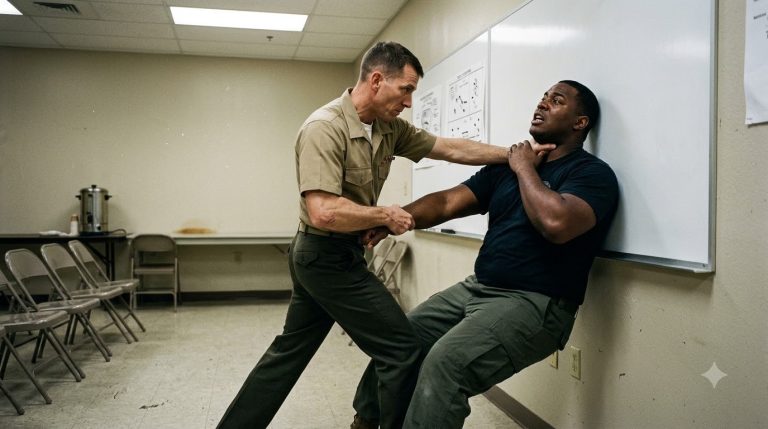
When his palms hit my chest, the world tilted. It was a clean, precise motion, the kind of reflexive violence the Marine Corps excels at teaching. I didn’t have time to process the indignity. I only had time to feel the sudden, jarring absence of the brow beneath my feet and the rush of air as I left the relative safety of the USS Tripoli.
The impact was quiet. My tailbone hit the concrete first, a sharp shock that radiated up my spine, followed immediately by the dull ache of my right elbow striking the hard surface. My coffee cup, a simple paper thing, crumpled in my grip. The dark, lukewarm liquid splashed across my jeans, spreading in a stain that looked blacker than the gray deck of the pier.
I didn’t move. I sat there, looking down at my sleeve, where the fabric was darkening and the stinging bite of a scrape began to emerge beneath the tear. The silence that followed the impact was heavy. It was the silence of a warship waking up—the low hum of machinery, the distant rhythm of the tides, and the sudden, breathless stillness of the quarterdeck above me.
From the platform, Lieutenant Junior Grade Tate’s voice shattered the quiet. “Stay back! Hands where I can see them!”
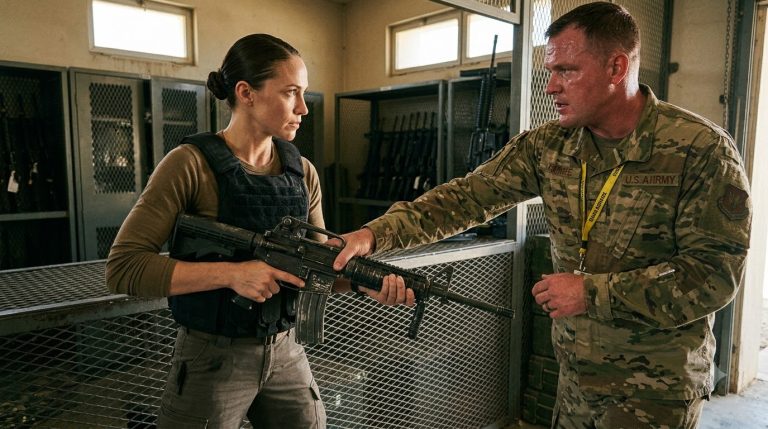
I looked up. The lance corporal was standing at the head of the brow, his M4 carbine held in the low-ready position. He looked young—terrifyingly young. His knuckles were white against the grip of his rifle, his shoulders hunched with a tension that spoke of a boy who had been told the world was divided into ‘us’ and ‘them’ and had finally decided where he stood. He wasn’t looking at me; he was looking at the threat he had been trained to imagine.
I reached slowly into the pocket of my quarter zip, my fingers brushing against the leather of my wallet. I could feel the lance corporal’s eyes lock onto the movement. I didn’t rush. I pulled the wallet out, the leather cool and worn under my touch, and held it up.
“It’s not a threat,” I said, my voice steady, though it sounded strange to my own ears in the vast, empty space of the pier.
Tate leaned over the railing, his face a mask of sudden, cold dread. He looked at the ID in my hand, then back at me. The color drained from his face until he looked like a statue. He turned toward the boatswain’s mate, his movements jerky, frantic.
“Pipe the admiral aboard,” he whispered, but the command carried through the damp morning air, sharp as a blade. “Now.”
I stayed on the concrete, the cold seeping into my skin. This was the moment. The silence was no longer empty; it was waiting for me to stand up. I felt the ache in my elbow, the sting of the scrape, and the strange, sudden lightness of the brace I’d been carrying for twenty-four years beginning to fray at the edges.
CHAPTER 2: THE QUARTERDECKS COLD
I remained on the cold concrete of the pier, watching the tableau above me with the detached precision of a bird of prey. The lance corporal was a statue now, frozen in a posture of abject defeat. The M4 carbine, which moments ago had been an instrument of territorial defiance, hung limp at his side, tethered to him by a single-point sling like a discarded toy. His face, scrubbed clean and young, had lost all its defensive rigidity. It was white, drained of blood, the expression of a man who had suddenly seen the abyss he had been walking toward.
Lieutenant Junior Grade Tate was still at the railing, his hand hovering over the scanner. He hadn’t moved. The boatswain’s mate, a seasoned petty officer whose eyes had been glued to the scene, finally broke his trance. He didn’t look at the lance corporal. He looked at me, down on the pier, and there was a flicker of something in his expression—not pity, but a profound, weary recognition of the chain of command.
I pushed myself up. My elbow throbbed, a dull, rhythmic pulse that synced with the distant slap of water against the pier pilings. I didn’t rush. I wanted them to see me move. I wanted them to see the way my hand went to the bandage on my arm, the way I steadied myself against the bollard, and the deliberate, unhurried pace I set for the brow.
As I began the climb, the ship felt different. It was the same steel, the same gray paint, the same smell of ozone and hydraulic fluid, but the atmosphere had curdled. I could feel the eyes of the crew—the duty section, the maintenance teams—hidden behind bulkheads and hatches. They were watching the Admiral walk up the brow with blood on her sleeve. The news would be at every mess deck before I reached the bridge.
The lance corporal didn’t look at me as I passed. He was staring at a point in space somewhere above the ship’s radar mast, his breath hitching in his chest. His posture was perfect—the “at attention” he had been drilled to hold until his lungs gave out. I didn’t stop. I didn’t offer him the comfort of an acknowledgment. To do so would be to treat this as a personal injury, and it wasn’t. It was a structural failure, and structural failures are not corrected with compassion; they are corrected with rigor.
I crossed the quarterdeck and stepped onto the nonskid deck. The boatswain’s mate saluted, his arm snapping up with a violence that betrayed his anxiety. I returned the salute, my movements sharp, practiced. My eyes swept the quarterdeck, noting the condition of the deck log, the placement of the watch stations, and the way the shadows gathered in the corners of the hangar bay.
“Admiral McNeal,” a voice barked from the shadows.
Captain Wade Caulfield emerged from the hatchway at a sprint, his service khakis crisp, his face a complex map of professional alarm and sudden, sinking realization. He stopped five paces from me, his eyes darting to my blood-stained elbow, then to the shivering lance corporal, and finally to the empty coffee cup still sitting on the pier below.
“Ma’am,” he began, his voice strained, “I had no idea—the morning routine was—”
“Captain,” I cut him off, my voice even, lacking the tremor of the adrenaline still surging through my veins. “Your sentry shoved me off the brow.”
The world seemed to pause. Caulfield’s jaw tightened. He didn’t offer an excuse, which I noted with a flicker of internal approval. He looked toward the Marine Detachment hatch, his eyes hard. He knew exactly who was responsible for the training standards that had led to this, and he knew exactly how much damage this would do to his ship’s reputation if it went beyond these lifelines.
“I am going to take care of this, ma’am,” Caulfield said, his tone shifting into the low, dangerous register of a man protecting his legacy.
“I expect you will, Wade,” I replied. “But first, I am going to the wardroom. I want the morning readiness brief. And I want the Corpsman.”
He hesitated, a momentary lapse that signaled the weight of the moment. He wanted to deal with the Marine first, to bury the incident in a flurry of disciplinary action before the staff got wind of it, but he couldn’t. I was the Admiral, and I was holding the thread.
“Yes, ma’am,” he said, and for the first time, he stepped aside, granting me the passage that had been violently denied to me only minutes before.
I walked past him, my footsteps echoing against the steel bulkheads. As I headed toward the wardroom, I caught a glimpse of my reflection in the glass of an informational board. I looked exactly as I had felt for the last twenty-four years: guarded, composed, and absolutely immovable. The scrape on my elbow felt like a brand, a physical manifestation of the reality I had kept hidden for decades.
I reached the wardroom door and paused. Inside, I knew they would be waiting—the department heads, the XO, the men who lived by the clock and the log. They wouldn’t know the full story, but they would know that the Admiral had arrived under fire. I took a breath, feeling the air fill my lungs, cool and metallic. The brace was still there, but it was thinner now, worn down by the friction of the day. I pushed the door open, ready to begin the work.
CHAPTER 3: THE WARDROOMS COST
The wardroom was a study in controlled tension. Eleven sets of eyes were fixed on the bulkhead-mounted display screens, but as I entered, the collective gaze shifted to me. It was a rapid, involuntary movement, the way a school of fish turns in unison at the shadow of a predator. Captain Caulfield followed me in, his expression set into a rigid, professional mask, but I could see the tightness at the corners of his mouth.
“Take your seats,” I said, my voice cutting through the stale, recirculated air.
I didn’t take the head of the table. I moved to the side, maintaining a vantage point where I could see both the screen and the faces of the department heads. My right elbow throbbed, a steady, burning sensation that served as a grounding reminder of the morning’s reality. I placed the casualty report on the table, the paper crisp and white against the dark, polished surface.
“I am here for the readiness brief,” I continued, ignoring the slight tremor of concern in the Chief Engineer’s posture. “But before we start, let us be clear about the climate on this ship. The quarterdeck is the face of this command. Today, that face was turned away from the reality of the uniform I wear.”
A heavy silence descended. The XO, a man named Miller who had been with Caulfield for two deployments, cleared his throat. “Admiral, we’ve already initiated a review of the watch bill—”
“I am not interested in the review yet,” I interrupted, keeping my tone even, though I felt the familiar urge to suppress the empathy that threatened to soften my delivery. “I am interested in why your standards allowed for a breakdown that endangered the integrity of this brow.”
I picked up the fuel state casualty report, flipping to the eleventh page. My finger traced the line regarding the number two main engine. It was a buried detail—a footnote in a sea of operational data.
“Chief Engineer,” I said, looking directly at him. “This fuel state casualty. You categorized it as a routine maintenance delay. Explain the discrepancy between this report and the actual engine performance data I reviewed in the log.”
The engineer, a veteran who looked as though he hadn’t slept since the ship left the pier, stiffened. He began to speak, his voice technical, rapid, filled with the jargon of his trade. He spoke of heat soak, of injector timing, of the logistical hurdles of sourcing components during an active workup. It was a well-crafted explanation, polished by years of navigating the bureaucratic labyrinth of the fleet.
But as he talked, I noticed something that didn’t align. He was avoiding the data in the twelfth paragraph—the one that mentioned a spontaneous pressure drop. It was a small detail, likely obscured on purpose, a ghost in the machine. Why hide a pressure drop? It didn’t affect the fuel state directly, but it was a symptom of something else. Something older.
I let him finish. I watched his hands, which were clasped tightly behind his back, and the way he shifted his weight. He wasn’t lying to protect his career; he was lying to protect the ship’s status. He was a gatekeeper, just like the lance corporal on the pier. They were all participating in the same performance, a theater of competence designed to keep the reality of their struggles away from the eyes of a flag officer.
“That is a professional assessment, Chief,” I said, finally allowing a small, sharp edge to enter my voice. “But it is incomplete. Do you need a moment to re-evaluate the data, or shall I have my staff look at the engine room logs directly?”
The room went deathly quiet. Caulfield shifted, his eyes darting toward the engineer. This was the moment where the performance broke down. If the engineer confessed, the crack in the facade would widen. If he held, he was betting that I wouldn’t spend the time to dig deeper.
“I… I may have missed the entry regarding the pressure drop, Admiral,” the Chief said, his face reddening. “I’ll submit a corrected report by 1400.”
“Do that,” I said, closing the folder. “And Chief? Accuracy is not an inconvenience. It is the only metric that keeps this ship afloat.”
The brief continued, but the energy in the room had shifted. The performance was over; they were working now. I watched them, noting the subtle shifts in their alliances, the way the XO stepped in to bolster the engineer, the way Caulfield leaned into the narrative I was constructing. They were no longer trying to hide the truth—they were trying to figure out how much of the truth I was willing to see.
When the last slide flickered off the screen, I stood. The corpsman, who had been hovering near the door, stepped forward with his green case.
“Admiral, if I could just take a look at that bandage,” he murmured, his tone deferential.
I nodded and pulled back the sleeve of my quarter zip. The wound was shallow, a scrape against the sharp edge of the pier, but it was already beginning to bruise. As the corpsman worked, dabbing at the skin with a sterile cloth, I caught sight of the ship’s clock on the bulkhead. It was nearly 08:00. The colors were being hoisted. Somewhere on the pier, my ball cap was gone, and the lance corporal was beginning the longest month of his career.
I looked at my reflection in the darkened screen of the monitor. The brace I had carried for twenty-four years was still there, but it was becoming an burden I could no longer justify. The engine room logs, the shove on the pier, the way Caulfield looked at me—they were all echoes of the same, stifling demand for perfection I had been raised on. I wasn’t just fixing a ship; I was finally, after all this time, starting to take the weight off my own shoulders.
“Captain,” I said, as the corpsman finished the bandage. “I want to see the Marine Detachment’s training schedule. And I want to see it before I leave this ship.”
Caulfield nodded, his expression grim. “Yes, ma’am. Right away.”
I walked toward the door, my movements fluid, purposeful. I didn’t feel like the admiral who had to prove her worth anymore. I felt like the woman who was finally, at long last, done with the performance.
CHAPTER 4: THE CABINS WEIGHT
The transit to the captain’s at-sea cabin was not a path, but a gauntlet. The ship, usually a humming organism of controlled motion, felt stifled. Sailors stepped into doorways as I passed, their eyes averted, their posture slightly more rigid than usual. They weren’t just avoiding an admiral; they were avoiding the fallout of the morning. I didn’t acknowledge them. My focus was entirely on the architecture of the ship’s social climate. I had disrupted the status quo, and in the Navy, that disruption ripples through every deck, from the bilge to the bridge.
When I reached Captain Caulfield’s door, I didn’t knock. I waited a beat, listening to the muffled sounds of movement inside. The cabin was a compact space, a functional cube of steel where a commanding officer was supposed to maintain the illusion of order. I pushed the door open.
Caulfield was standing at his desk, his back to the door. He was looking at a set of blueprints for the ship’s exterior, a stark, technical document that seemed to mock the messy, human chaos currently unfolding on his decks. He didn’t turn around immediately, and I let the silence hang, a heavy, suffocating presence that filled the small room.
Finally, he turned, his face wiped clean of the professional alarm he had displayed in the wardroom. He looked tired. It was the weariness of a man who had spent his entire career building a house of cards and had just realized the wind was picking up.
“Sit,” I said, my voice quiet, devoid of the command tone I used on the quarterdeck.
He obeyed, taking the chair behind his small, spartan desk. I remained standing, moving to the small, circular porthole. The marine layer was beginning to burn off, revealing the gray, indifferent surface of the harbor.
“Wade,” I began, my eyes still on the horizon. “How long have you been captain of this ship?”
“Three years, Admiral,” he replied.
“And in those three years, have you ever felt that the ship was…performing for you, rather than operating?”
He paused, his fingers tracing the edge of his desk. He was a smart man; he knew exactly what I was asking. He knew that I wasn’t just talking about the incident on the pier. I was talking about the entire, fragile structure of his command.
“The Navy is a performance, ma’am,” he said, his voice measured. “We are a visible, kinetic arm of the state. We have to look the part.”
“There is a difference between looking the part and believing the lie,” I turned to face him. “The lance corporal didn’t push me because he was following orders. He pushed me because he was terrified that if he didn’t, the illusion would shatter. He is protecting a version of the Corps that doesn’t exist anymore, and you are allowing him to do it because it’s easier than forcing him to face reality.”
Caulfield didn’t argue. He leaned back in his chair, his gaze dropping to his hands. “It’s not just him, Admiral. It’s the entire culture of the detachment. They see themselves as the last line of defense, not just against an enemy, but against the evolution of the service itself. It’s a closed loop.”
“A loop that has now brought an admiral to the deck with a bloody elbow,” I noted.
He flinched. “I’m going to change it, ma’am. I’ve already spoken to the Marine Detachment commander. We’re rewriting the gangway protocols, starting with the selection of the sentry itself. No more green recruits for the morning watch until they’ve been properly indoctrinated.”
“Indoctrinated is the wrong word, Wade,” I said. “I want them trained to see. I want them to look at someone walking up that brow and see a person, not a violation of their narrow definition of duty.”
I stepped away from the porthole, the small, cramped nature of the cabin feeling suddenly claustrophobic. “The fuel state casualty in the engine room,” I added, switching topics with a sharp, abrupt motion. “Is that part of the loop? Is that another performance?”
Caulfield’s head snapped up. “That was a maintenance issue, ma’am. Not an attempt to mislead.”
“Are you sure?” I asked, my voice barely a whisper. “Because I’ve spent twenty-four years watching men convince themselves that small, operational failures are just the price of doing business. But they aren’t. They’re the symptoms of a ship that’s stopped being honest with itself.”
I walked to the door, stopping with my hand on the handle. “I’m giving you forty-eight hours to provide a full, unvarnished report on the engine room logs, not just the fuel state, but the pressure drop logs from the last three months. If I find even a hint of a ‘performance’ in those numbers, we are going to have a very different conversation about your command.”
I didn’t wait for his reply. I stepped out into the passageway, the cold air of the ship hitting my face. The conversation had been necessary, but it had left me feeling raw, exposed. I hadn’t come here to destroy Caulfield; I had come to see if he was capable of being the captain I needed him to be. And as I walked toward the ladder, the echo of his silence in the cabin told me that he was, at least, beginning to understand that the performance was over.
CHAPTER 5: THE BRIDGE AT TWILIGHT
I didn’t head straight for the bridge. Instead, I found myself drawn to the internal ladders, the vertical arteries of the ship. Every step I took against the steel grating felt heavy, grounded in the reality of the morning. The rhythm of the ship’s engines—a low, visceral thrum that resonated through the soles of my shoes—suddenly shifted, mirroring a cadence I hadn’t felt in years.
Without warning, the sterile air of the passageway faded, replaced by a sensory ghost: the sharp, acrid scent of creosote and the damp, salt-laden breeze of the Oceanside Pier. 1986. I was seven, my hand swallowed by my father’s calloused grip, watching that gray destroyer push its way through the surf. The laugh, the dismissive “Floating hotel,” echoing in the small, cramped space of the ladder well. It wasn’t just a memory; it was the foundation of the bridge I was currently trying to dismantle.
I stopped on the third landing, my hand resting on the smooth, cold railing. The sensation was so vivid it almost knocked the wind out of me. For twenty-four years, I had treated that memory as a motivation—a source of friction to sharpen my resolve. But standing there, amidst the rhythmic pulse of the ship, I realized it had been a cage. I had spent my entire career trying to prove that the ship was not a hotel, that I was not the punchline, all while the man who had planted that doubt continued to hold the key to my validation.
I descended the final rungs and reached the weather deck. The sun was dipping low, casting the Pacific in a bruised, violet light. I moved toward the bridge wing, the door sliding open with a soft, pneumatic hiss. The bridge was dimmed for night operations, the red glow of the instrument panels painting the faces of the watch team in shades of fire and blood.
They didn’t see me at first. I stood in the doorway, watching them. The officer of the deck was focused on the radar screen, his hands moving with practiced efficiency. The quartermaster was recording entries in the log. It was a scene of perfect, clockwork operation. They were performing their duties with a level of precision that was both admirable and, in the wake of the morning’s failure, suspicious.
“OOD,” I said, my voice barely above a whisper, yet the entire bridge snapped to attention in an instant.
“Admiral on the bridge!” the OOD barked, his eyes wide as he turned.
I walked to the railing, looking out over the dark expanse of the water. “Carry on. I just wanted to feel the motion of the ship.”
I watched the bow wave as it curled away from the hull, a white, frothy wake that seemed to stretch back to the very moment I had left that pier. I had spent a lifetime trying to outrun that wake, trying to prove I was headed somewhere different, somewhere more significant. But the truth, the uncomfortable, quiet truth I was only now beginning to admit to myself, was that I was still on the same ship. I was just steering it differently.
Caulfield appeared at my side, his presence a quiet, disciplined shadow in the dim light. “The reports are being compiled, ma’am. You’ll have the pressure logs by morning.”
“Thank you, Wade,” I replied, not looking at him. “Do you ever wonder what they’re thinking? The crew, when they look at us from the railings? Do they see a command, or do they see a performance?”
He stood silent for a long moment, the wind whipping through his hair. “I think, Admiral, that they see what we give them. If we give them a performance, they’ll play their parts. If we give them the truth, they’ll respect the weight of it.”
“The truth is a heavy thing to carry, Wade,” I said. “Especially when you’ve spent three years pretending it didn’t exist.”
He didn’t respond, and for the first time, I didn’t need him to. I looked down at my elbow, the bandage peeking out from beneath my sleeve. It wasn’t just a wound anymore; it was a physical testament to the reality I had finally allowed into my life. The brace was gone. The weight I was carrying wasn’t the ship’s anymore—it was my own. And as the ship surged forward into the darkening ocean, I realized that for the first time in twenty-four years, I wasn’t just sailing; I was arriving.
CHAPTER 6: THE VFW THRESHOLD
The drive to the VFW felt like a descent. I took the 5 north, the coastal highway that had been the backdrop of my entire life, but the landscape looked different through the windshield. The sycamores were turning a brittle, dusty brown, and the sprawling suburban patches seemed to lack the vibrancy they’d held only days before. My phone sat in the passenger seat, dark and silent, but its presence felt heavy, like an anchor. My mother’s call—that careful, rehearsed invitation—kept replaying in my mind.
I parked the SUV in the gravel lot behind the VFW hall, the sound of crunching stone unnervingly loud in the quiet afternoon. The building itself was a relic, a squat, brick structure that smelled of decades of spilled beer, wood polish, and the lingering, sweet-sour scent of cigarette smoke that no amount of ventilation could ever truly purge. It was the temple of the generation that had raised me, a place where men like my father gathered to trade stories of battles I only knew through books.
I stood by the driver’s side door for a long minute, letting the transition from the ship’s hyper-disciplined environment to the disorganized, dusty reality of the hall settle in. I smoothed my civilian sweater, checking that the bandage on my elbow was concealed. I wasn’t here as an Admiral; I was here as a daughter, and that felt like a far more precarious deployment.
When I pushed open the heavy steel door, the interior hit me with a blast of warm, stagnant air. The hall was sparsely populated. A few old men huddled over mugs at the far end of the bar, the television above them muted, showing clips of a game I didn’t recognize. My father sat at a corner table, his back to the door, hunched over a glass of water. Even from across the room, the fragility of his frame was shocking. He looked smaller than I remembered, his shoulders sagging beneath a windbreaker that seemed a size too large.
I walked toward him, the soles of my shoes clicking against the scuffed linoleum. He didn’t look up until I was right at the table. When he finally turned, his eyes flickered with a raw, unfiltered recognition that made my throat tighten.
“You came,” he said, his voice gravelly, barely audible over the low hum of the refrigerator behind the bar.
“I said I would,” I replied, pulling out the chair across from him. The metal legs scraped harshly against the floor.
He looked at me, really looked at me, and I realized he wasn’t measuring my uniform or my rank. He was searching for something else. “Your mother told me about the pier. About the shove.”
I didn’t answer immediately. I took a breath, letting the smell of the hall—the stale, tired reality of it—fill my lungs. “It wasn’t a big deal, Dad. It was just a misunderstanding.”
“It wasn’t a misunderstanding,” he countered, his hand shaking slightly as he reached for his water. “It was a failure. My failure.”
The words hung between us, heavy and unadorned. I hadn’t expected an apology. I hadn’t even wanted one. I wanted, for the first time in my life, for him to see the work I had done—the twenty-four years of quiet, unrelenting labor that had built the woman sitting in front of him.
“You didn’t raise me to handle failure, Dad,” I said, my voice low and steady. “You raised me to be a Marine. But I became a sailor. And the difference between those two things is the difference between defending a wall and navigating a sea.”
He frowned, struggling to process the nuance, his brow furrowed in a way that reminded me of our old kitchen debates. “I never saw the sea, Nikki. I saw the beach. I saw the landing.”
“I know,” I said, and for the first time, I felt a spark of genuine, aching pity. “And that was enough for you. But it wasn’t enough for me.”
The conversation felt like a series of gentle probes into an old, jagged scar. Every word was chosen with care, a delicate navigation of the distance we had cultivated for three decades. He asked me about the strike group, about the ships, about the mechanics of the work, and I answered him with the same professional rigor I used in the wardroom. He listened, his head tilted slightly, his eyes reflecting the flickering light of the TV.
But then, he shifted. He leaned in, his voice dropping to a conspiratorial whisper. “There’s talk, Nikki. About the Tripoli. About the sentry.”
The shift was jarring. The air in the hall seemed to drop a few degrees. He wasn’t asking as a father; he was asking as a man who still tracked the internal politics of the service like a religion. The decoy secret—the idea that the ship was being scrutinized for systemic failure rather than a single, isolated incident—was clearly the only way he knew how to engage with my world.
“It’s being handled,” I said, my tone shutting down the conversation before it could turn into an interrogation.
He nodded, but his eyes narrowed. He looked at me, then down at the table, his fingers tapping a nervous rhythm against the glass. There was something else he wanted to ask, something behind the question, a shadow that didn’t fit the picture he had built of me.
“I’m not the same person who left this house,” I said, watching him closely. “I’m not the Admiral you want, and I’m not the daughter you expected. I’m just the one who came back.”
I stood up, the chair scraping again. The atmosphere in the room was thick with the weight of everything we weren’t saying. I had come here to see if he had changed, but as I looked down at him, I realized he hadn’t. He was still waiting for the war to end, still bracing for an impact that had happened years ago. I left him sitting there, a fragile monument to a finished conflict, and walked back out into the bright, indifferent afternoon. The road ahead felt longer than it ever had before, but for the first time, I knew exactly where I was going.
CHAPTER 7: THE LANGUAGE OF SHIPS
The bridge was a hive of chaotic, muted intensity. The storm had arrived earlier than predicted, a churning mass of low-pressure gray that had turned the Pacific into a landscape of jagged, colliding peaks. I stepped through the pneumatic doors, my civilian attire feeling absurdly out of place against the backdrop of sailors in fire-resistant coveralls, their eyes fixed on the illuminated radar screens that glowed like angry embers in the dark.
“Admiral on deck!” the OOD announced, though his attention never left the sea-state readout.
“Carry on,” I said, my voice barely audible over the sudden, violent shudder that ran through the hull as the Tripoli bit into a massive swell.
I moved to the captain’s chair, which sat empty, the leather polished to a high sheen. Caulfield was in the chart room, his voice a low, rhythmic growl as he coordinated with the combat information center. The ship was no longer performing; it was surviving. This was the moment where the performance was stripped away, where the veneer of administrative perfection was pulverized by the raw, unthinking physics of the ocean.
“Engineering reports a pressure fluctuation on number two,” a voice crackled over the net. It was the Chief Engineer.
I looked at the radar repeater. The pressure fluctuation wasn’t just a symptom of the weather; it was the failure I had flagged, now exacerbated by the strain of the sea. I walked toward the chart room, my feet sliding slightly on the nonskid as the ship pitched.
Caulfield looked up, his brow slick with sweat, a pencil gripped so hard in his hand that his knuckles were white. “Ma’am, we’re managing the load, but the engine is struggling with the intake pressure. We have to drop speed, or we’ll lose the main.”
“If we drop speed, we lose our stationing for the exercise,” I said, looking at the display.
“We lose the stationing, or we lose the engine,” he said, his eyes locking onto mine.
For the first time since I’d come aboard, there was no performance. There was no pretense of a “proper” Navy response. There was only the brutal, honest necessity of the command. I looked at the log, at the data points that had been manipulated in the past, and realized that for all their attempts to polish the surface, they had neglected the depth. They had been trying to hide the rust, and now the rust was threatening to stall the entire mechanism.
“Drop the speed,” I commanded, the decision feeling like a release of tension that had been coiled in my chest since morning. “Inform the task group. We prioritize the machinery over the schedule.”
Caulfield exhaled, a ragged, uneven sound. He keyed the mic, his voice calm, clear, and stripped of all the posturing I had come to despise. “Task group, this is Tripoli. We are reducing speed to fifteen knots due to mechanical constraints. Maintain stationing as best as possible.”
I stood on the bridge wing, watching the dark water churn alongside the hull. The storm wasn’t just weather; it was a mirror. It was the same chaotic, unpredictable force I had been trying to navigate in my own life. My father had spent his entire existence trying to control the uncontrollable, building fences and labels and definitions to keep the world manageable. I had spent twenty-four years following the same pattern, trying to prove I was the better sailor, the better Marine, the better daughter.
But as the ship fought the swell, I saw the truth of it. You don’t beat the sea by force. You beat it by understanding its rhythms, by knowing when to push and when to yield. My father hadn’t been a bad man; he was just a man who had never learned how to yield.
“Admiral?” Caulfield stood beside me, his silhouette framed against the driving rain.
“The engine room logs,” I said, my voice barely carrying over the wind. “When we clear this, I want them on my desk. Every single one. No omissions, no summaries. Just the truth of what’s happening in those pipes.”
He nodded. There was no hesitation now. The storm had cleared the air, leaving behind the cold, hard reality of the ship. We were no longer playing a game of status; we were just trying to keep the lights on in the dark. And as I turned back toward the bridge, the weight of the last twenty-four years finally seemed to dissipate into the spray of the ocean, leaving me with nothing but the ship, the storm, and the work that remained.
CHAPTER 8: THE GIFT OF THE COVER
The storm eventually broke, leaving behind a sky the color of a bruised plum and a sea that rolled in heavy, rhythmic swells. I remained on the bridge wing for hours, the cold air seeping into my marrow. I watched the dawn break—a thin, gray line on the horizon—and with the light came the delivery I had been waiting for. A young petty officer, his movements stiff with the formality of the watch, handed me a sealed envelope.
“From the engineering department, Admiral,” he said, saluting.
I took the envelope. It was heavy. Inside, the pages were thick with maintenance records, pressure graphs, and the unvarnished logs of the number two main engine. I went back to my flag cabin, the ship’s motion feeling more steady now, almost purposeful. I sat at my desk, the small, cramped space that had become my sanctuary, and I began to read.
It was all there. The history of the neglect, the subtle, repeated overrides of the engine safety protocols designed to keep the ship within its operational window—a window that had clearly been shrinking for months. It wasn’t just a failure; it was a choice. The Chief had been hiding the reality to ensure the ship remained “ready” for inspection, a decision that had pushed the engine to the brink of collapse. It was the same logic the lance corporal had used on the pier, the same logic my father had used to construct his world: the belief that the appearance of strength was more important than the reality of the structure.
I looked at the logs, and for the first time, I didn’t see failure. I saw fear. They were terrified of being seen as anything less than perfect. They were terrified of the same judgment I had spent twenty-four years avoiding.
I pulled the small, soft object from my pocket: the Marine cover my father had given me in that garage in 1993. It felt fragile in my hand, the fabric worn down to the weave, the anchor insignia nearly smooth. I looked at it, then at the technical, cold graphs on the desk. They were two sides of the same coin. Both were artifacts of a life defined by the necessity of proof.
I heard a soft knock at the cabin door. It was Caulfield. He stood in the doorway, his uniform impeccable, his face pale. He had already seen the reports; he knew what I had found.
“Ma’am,” he said, his voice quiet. “I’ve reviewed the logs. The Chief is ready to provide his full statement.”
“And what will that statement be, Wade?” I asked, not looking up.
“The truth,” he said. “He’s going to tell them he was scared. That he thought he was protecting the ship.”
I looked up at him then. He looked older, the stress of the last forty-eight hours having etched new lines into his face. He was finally seeing the cost of the performance.
“The truth is a good place to start,” I said, sliding the folder across the desk toward him. “But it doesn’t fix the engine, and it doesn’t fix the detachment. What are you going to do about the internal culture? The gatekeeping?”
“I’m replacing the detachment leadership,” he said, his voice firm. “And I’m making the maintenance logs transparent to the whole department. No more burying the data. If the ship is broken, we tell them it’s broken. We stop pretending.”
He turned to leave, but stopped at the door. “Admiral, when we get back to port, what happens to them? To the Chief, to the sentry?”
“They stay,” I said. “They stay, and they work. They learn how to be part of a ship that doesn’t need to hide. That’s the only way they’ll ever understand that they’re not protecting anything by lying.”
I watched him walk away. I turned the cover over in my hands one last time. It was an object of such intense, suffocating loyalty, and yet, it was empty. It was just a piece of cloth. The meaning I had attached to it—the weight of my father’s approval, the burden of the “brace”—it was all mine. It had never been in the object. It had been in the way I had chosen to carry it.
I placed the cover on the desk, right next to the logs. I didn’t need to wear it. I didn’t need to return it. I just needed to see it for what it was. I walked to the cabin’s porthole, the sun finally hitting the water, turning the gray sea into a field of brilliant, dancing light. The work wasn’t finished, but for the first time, I wasn’t waiting for the finish line. I was just living in the rhythm of the ship, one honest, unsteady step at a time.
CHAPTER 9: THE PIER AT MIDNIGHT
The transition was not geographical, but temporal. Driving back up the 5 felt like retracing the path of a ghost. The world outside the window was the same—the same brown hills, the same distant shimmer of the Pacific—but the interior landscape had shifted. I wasn’t the daughter who drove to the VFW anymore. I wasn’t the Admiral who guarded the brow. I was simply a woman returning to the source of the silence.
The house was dark when I arrived. I didn’t go through the front door; I walked around to the back, toward the pier. The midnight air was cool, biting against the skin, and the scent of salt was sharp and clean. I reached the wooden planks of the pier, my footsteps hollow and rhythmic, a sound that pulled me back to that Sunday in 1986.
I stood at the railing, the darkness of the water below hidden from sight, illuminated only by the distant, blinking lights of a ship moving south. It was a destroyer, just like the one I had watched as a child. I gripped the railing, the wood rough and splintered, and for the first time, I didn’t look for a reflection of my father in the ship’s silhouette. I looked at the ship itself. It was steel, it was machinery, and it was a city that moved. It was not a hotel. It was not a punchline. It was a machine that required the work of people who believed in the reality of their own existence.
“I knew you’d come,” a voice said.
I turned. My mother stood at the edge of the pier, wrapped in a thick, wool coat. She looked frail against the vast, dark sky, but there was a stillness in her posture I hadn’t seen in years. She didn’t approach; she just stood there, the silence between us no longer a barrier, but a bridge.
“How is he?” I asked, my voice caught in the wind.
“He’s tired,” she said, her tone devoid of the performative masking she’d used for decades. “He’s been carrying that hat, Nikki. Every day, he puts it on like he’s wearing a uniform, but he doesn’t know how to talk about it. He spent his whole life building a wall, and now he’s trapped on the other side of it.”
“Why did you stay?” I asked, the question hanging in the air like a confession.
She sighed, a long, shivering breath. “Because I thought I was protecting the peace. But I wasn’t protecting peace. I was protecting a cage. I’m done with that.”
I looked at the water. The ship was a fading dot on the horizon. The truth—the real, raw truth—wasn’t that my father was a villain, nor that he was a victim. He was just a man who had been shattered by the world he chose to live in, a man whose pride had been his only armor until it became his tomb. The realization brought a strange, cooling calm. There was no catharsis in the revelation, only a profound, hollow understanding.
“I’m leaving in the morning, Mom,” I said, turning back to her. “The strike group is deploying.”
“I know,” she replied. She reached out, her hand resting briefly, tentatively, on my arm. “He wants to see you one more time. Before you go.”
I didn’t answer right away. I looked at the pier, the place where I had learned to measure the world against my father’s laugh. I had built my life on that measurement, and now, standing in the dark, I was finally letting it go.
“I’ll go,” I said. “But not for him. For me.”
She nodded, understanding the shift. We walked back toward the house together, two women moving through the shadows of a past that no longer had the power to define our future. The pier remained behind us, a skeleton of wood and memory, disappearing into the dark. I wasn’t the same person who had stood here as a child, and I wasn’t the person who had arrived yesterday. I was simply the woman who had walked the brow, and who now, finally, was ready to sail.
CHAPTER 10: THE FINAL DEPARTURE
The screen door whined on its hinges, a sound that transported me back to a thousand humid afternoons, yet the air on the porch was different—still, expectant. My father sat in his recliner, the Navy ball cap perched on his head with a simplicity that made my heart ache. He wasn’t watching the door; he was watching the dust motes dance in the late-morning sunlight. When he saw me, he didn’t try to stand. He simply nodded, a slow, deliberate movement.
“You’re going,” he said.
“I am,” I replied, sitting on the ottoman. “The Tripoli sails at 0800 tomorrow.”
I looked at him. The stroke had etched his fatigue into his features, but his eyes were clear, focused on me with a quality of attention I had been starving for since I was a girl. I realized then that his inability to reconcile his pride with his reality wasn’t an act of malice; it was a profound, limiting poverty of spirit. He had spent his life in a world of binary definitions—Marine or not, warrior or not—and he lacked the vocabulary to see the woman who had navigated the vast, gray ocean between those two points.
“I brought something,” I said, reaching into my cardigan pocket.
I took out the cover he had given me in 1993, the one I had taken back from the top shelf of my closet. I held it out to him. This time, I didn’t hold it like a burden; I held it like a gift.
He took it with his good hand, his fingers trembling as they traced the faded eagle, globe, and anchor. He looked up at me, and for the first time, he didn’t try to fill the silence with a performance of strength. “I never asked you about your life,” he whispered. “I just told you what mine was.”
“I know,” I said, and for the first time, the “brace” didn’t just feel loosened—it felt gone. I wasn’t waiting for him to validate my service, my rank, or my choices. I realized I didn’t need the validation of a man who was still fighting a war that had ended before I was born. “I’m not looking for an apology, Dad. And I’m not looking for you to understand the Navy. I just wanted you to see me.”
He looked at me, a long, lingering stare that spanned the decades. “I see you, Nikki.”
The words weren’t a grand declaration, but in the quiet of the room, they felt like a tectonic shift. He wasn’t the father I had imagined in the years of my resentment, and he wasn’t the monster I had built in my fear. He was just a man, finally tired of his own armor.
We sat in the silence for a long time. My mother came in from the kitchen, bringing a tray with tea, and she sat in the armchair nearby. We didn’t talk about the ship, or the shove, or the Article 15. We talked about the garden, the sycamores, the way the light hit the hills in the afternoon. It was the most ordinary conversation I had ever had with them, and it was the most important.
When the sun began to dip, I stood to leave. My father stood with me, his movements slow, his hand resting on the back of my neck—a gesture that bridged the gap between the eight-year-old on the pier and the Admiral in the uniform. “Sail safe,” he said.
“I will,” I promised.
I walked out to the car, the gravel crunching under my boots. I didn’t look back at the house, but I could feel it standing behind me—a structure of wood and history that no longer held me. I got into the SUV, the engine turning over with a steady, reliable hum. I drove toward the coast, the lights of San Diego beginning to glow on the horizon like a beacon.
I was heading toward the ship, toward the crew, toward the reality of the work that demanded everything I had. But the weight was gone. The brace, the performance, the desperate need for the approval of a man who couldn’t give it—I had left it all in that living room. As I merged onto the highway, the Pacific breeze rushing through the open windows, I knew that tomorrow, when I walked up that brow, I wouldn’t be walking as a daughter, or an Admiral, or a symbol. I would be walking as myself. And for the first time in my life, that was enough.