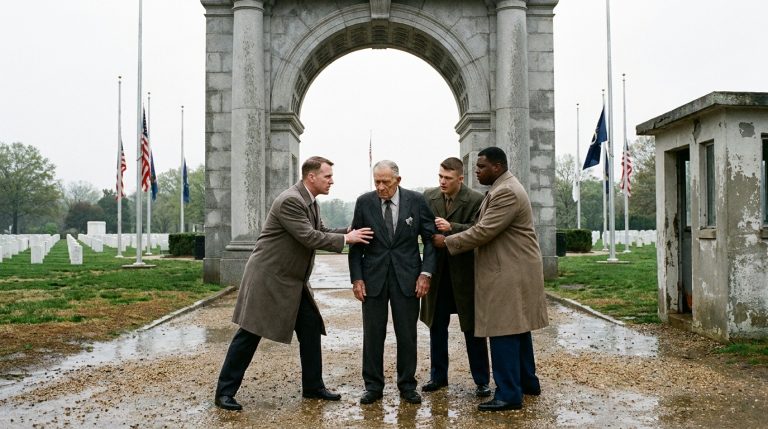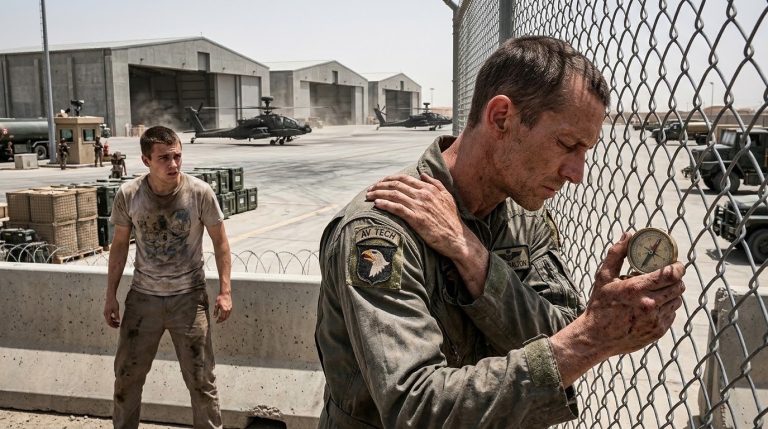
The Weight of Silence: A Former Operator Navigates the Fractured Landscape of Post-Combat Dignity
CHAPTER 1: THE GATEKEEPERS GRUDGE
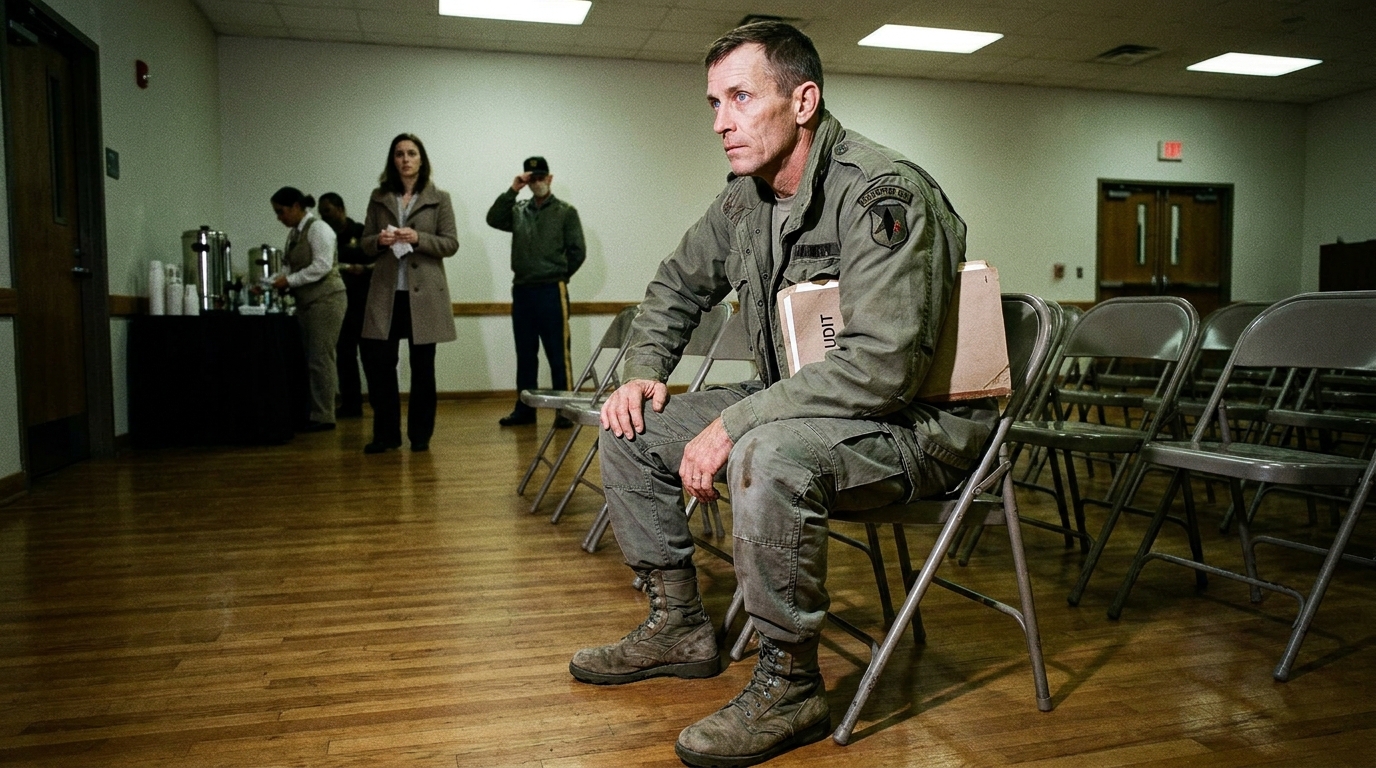
The auditorium of Fort Sill was a temple to the static, a room where the air smelled of floor polish and the dry, suffocating scent of pressed uniforms. Marcus Reeves sat in the back row, his spine a coiled spring of old discipline, his fingers tracing the frayed edge of the Phantom Six patch. The material was thin, worn down by seventeen years of friction—the same seventeen years he had spent trying to smooth away the edges of a life that felt increasingly like a memory belonging to someone else.
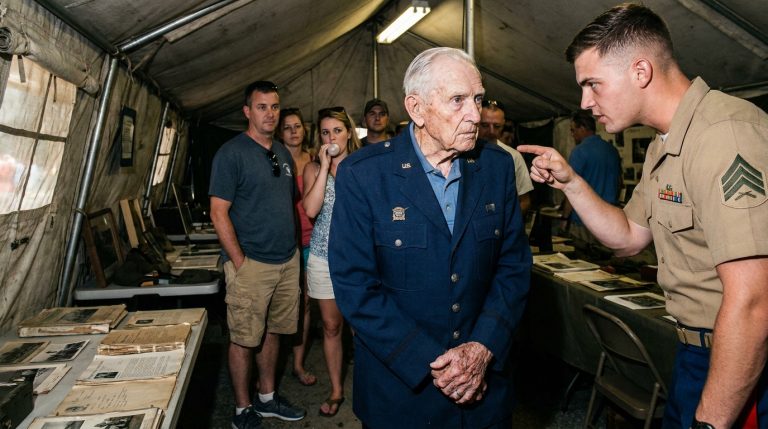
Colonel Bradley Vance stood near the podium, his posture a masterclass in aggressive geometry. He looked at the row of metal folding chairs near the wall, his gaze landing on Marcus with the intensity of a sniper spotting a violation.
“Get this piece of trash out of my ceremony,” Vance commanded. The voice was not loud, but it possessed a razor-sharp frequency that cut through the room’s ambient hum.
Marcus didn’t flinch. He sat still, observing the way Vance’s knuckles turned white as he gripped the podium. He noticed a file folder, dark blue and slightly bent at the corner, sitting precariously near the edge of the dais. It looked out of place—an administrative oversight in a room defined by precision. His eyes shifted from the folder to the Colonel’s collar, then to the nervous, sweating face of the young social worker, Sarah, who had brought him in.
“Sir,” Sarah began, her voice brittle. “We were told all veterans—”
“This is a formal military ceremony, not a charity drive,” Vance interrupted, his eyes never leaving Marcus. “Look at him. He reeks of stagnation.”
Marcus remained silent. He didn’t care about the insult. He cared about the way Vance’s eyes darted toward the side entrance every five seconds. The Colonel was waiting for someone, but his agitation wasn’t the product of nerves—it was the product of a threat. Marcus looked at the folder again. The label on the side was partially torn away, but the stamp ‘AUDIT’ was still partially visible.
The room grew heavy. A lieutenant near the front adjusted his cap, his face a mask of discomfort. Marcus felt the familiar, sharp pull of his old life—the tactical assessment of an objective. He wasn’t just a vagrant in a folding chair; he was a man who knew how to spot a crack in a foundation before the building collapsed.
“I never said I was special,” Marcus said, his voice a low, gravelly rasp that seemed to pull the oxygen from the room.
Vance stepped off the dais, his boots clicking in a slow, predatory rhythm. He stopped three feet away, his breath carrying the faint, metallic scent of wintergreen. “I don’t care what you said. I care about what you represent. You’re a stain on the record.”
Marcus looked up, his blue eyes clear and unnervingly steady. “The record is already stained, Colonel. You’re just worried about who’s going to notice the pattern.”
Vance’s face darkened, a flush of crimson rising up his neck, but before he could speak, a commotion rippled through the main doors. A heavy, rhythmic sound echoed through the hallway—the definitive, practiced gait of a Four-Star General. Vance stiffened, his eyes flickering toward the blue file folder one last time before he masked his panic with a practiced, military scowl.
The doors swung open, and the atmosphere in the room shifted. General Thornton stepped in, his presence an absolute command of the space. As he approached, Marcus noticed a discrepancy: the General wasn’t looking at the audience, or even at the Colonel. His eyes were fixed on the back wall, his brow furrowed in a confusion that went deeper than the scene in front of him.
Then, Vance turned to greet the General, his smile wide and brittle. But the folder on the dais remained, a small, dark shadow of a secret that hadn’t yet been brought into the light. Marcus looked at the General, then at the folder, and for the first time in four years, his internal compass locked onto a target.
Something wasn’t just wrong here; it was rotting. And he was the only one in the room who knew how to dig it out.
CHAPTER 2: THE FRICTION OF RECOGNITION
The room didn’t just feel empty; it felt stripped, as if the oxygen had been vacuumed out by the General’s departure. Marcus remained in the metal folding chair, his posture rigid, his hands resting on his knees like two heavy weights. The wood-paneled walls of the auditorium seemed to press inward, the varnish on the floor reflecting the harsh, overhead fluorescent lights in jagged, painful streaks.
Vance was gone, swept out by the wake of Thornton’s authority, but the blue folder remained. It sat on the edge of the dais, a piece of administrative refuse that defied the military precision of the setting.
Marcus let out a slow, measured breath. The silence of the auditorium was not a peaceful thing. To his ears, it was a soundscape of tactical potential—the hum of the ventilation, the distant rattle of a window frame, the soft, rhythmic clicking of his own pulse. As he shifted his weight, the movement sent a phantom jolt through his ankle, a reminder of a mission in a mountain pass three lifetimes ago. The sound of the General’s heels had been rhythmic, precise—the same cadence he’d heard on the tarmac at Bagram, the same tempo of men walking toward certainty.
He didn’t move immediately. He watched Sarah, the social worker, hovering near the buffet table. She was trembling, her hands fluttering over a stack of napkins. She was the one who had invited him, the one who believed in the outreach program, yet she was looking at the room with a sudden, dawning terror. She knew, perhaps better than anyone, that the “charity” she provided was being cannibalized from the inside.
Marcus pushed himself up, his joints protesting with a dull ache. He moved with a practiced, heavy grace, minimizing the sound of his boots on the polished wood. He walked toward the dais, his eyes locked on the folder.
As he approached, a memory flared: a cold wind tearing through the Khyber Pass, the taste of grit in his mouth, the feeling of a heavy pack digging into his shoulders. He shook it off. Focus on the objective.
He reached the dais, his fingers hovering over the blue cover. The texture was rough, the paper cheap and frayed at the edges. He didn’t snatch it; he slid it toward him, his peripheral vision scanning the room. The catering staff was clearing the coffee urns at the far end of the auditorium, their backs to him.
He opened the folder just enough to glimpse the interior. It wasn’t a standard audit report. It was a ledger of fund diversions, marked with initials that he recognized—not as military personnel, but as private contractors he’d seen lurking around the base’s periphery for months.
“Mr. Reeves?”
Marcus closed the folder instantly, the sound of the paper snapping shut like a dry twig. He turned. Sarah was standing ten feet away, her eyes wide, her face pale. She wasn’t looking at his face; she was looking at the folder in his hand.
“You shouldn’t be here,” she whispered, her voice barely audible over the hum of the HVAC.
“I was invited,” Marcus replied, his voice a low, steady anchor.
“Not for this,” she said, nodding toward the ledger. “If you take that, there’s no walking back. Vance isn’t just a bitter man with a grudge. He’s the center of a gear that doesn’t want to stop turning.”
Marcus felt the weight of the folder, the way it seemed to vibrate with the sheer scale of the dishonesty hidden inside. He thought of the veterans he’d seen sleeping under the overpass, the men who had been discarded because their “maintenance” was too expensive for the budget.
“The gear is already jammed,” Marcus said, his gaze shifting to the side door. “I’m just here to see if the metal is going to snap or if we have to break it ourselves.”
He didn’t wait for her response. He tucked the folder under his jacket, feeling the sharp, rusted edge of the binding press against his ribs. It was an uncomfortable weight, a burden he hadn’t asked for, yet it felt more substantial than anything he had carried in four years.
He walked toward the exit, his stride measured. Every step was an assessment—the layout of the hallway, the position of the security cameras, the lack of personnel in the corridors. The base was a machine, and he was a piece of debris that had been caught in the machinery.
As he reached the heavy double doors of the auditorium, he stopped. A shadow stretched across the floor, long and distorted. Someone was standing on the other side of the frosted glass.
Marcus didn’t panic. He shifted the weight of the folder, checked his surroundings, and calculated the distance to the stairwell. He wasn’t a vagrant anymore; he was an operator in the field. And the mission had just changed from survival to pursuit.
CHAPTER 3: THE RUPTURE
Marcus didn’t turn back. He pressed his shoulder against the seam of the heavy double doors, his breath shallow, a rhythmic hiss in the silence. The shadow on the glass didn’t move, but the air in the corridor seemed to thicken, pressurized by the sudden realization that he was no longer an invisible man in a folding chair; he was a liability in the center of a controlled environment.
He didn’t wait for the shadow to reveal its owner. He shifted, his boot finding the friction point of the floor, and he stepped not toward the door, but toward the service alcove beside it. The floor was industrial tile, scuffed and layered with the fine, gray dust of a building that had seen decades of neglect despite its polished facade.
He moved with the economy of a man who had navigated urban labyrinths where every sound was a potential death warrant. As he rounded the corner of the alcove, the door to the auditorium swung open.
“I know you’re in here, Reeves.”
The voice wasn’t Vance’s. It was younger, flatter, a drone of bureaucratic indifference. Marcus flattened himself against the cold, oxidizing steel of a locker bank, his pulse drumming a steady, martial beat against his ribs. He felt the blue folder tucked inside his jacket—a sharp, angular presence that reminded him of the stakes.
He looked down at his own hands. They were steady. The tremor that had plagued him for years—the neurological echo of his exit from service—was gone, replaced by the chilling, crystalline focus of a mission.
A figure stepped into the hallway. It was Lieutenant Morrison, the earnest, fresh-faced officer who had spoken up during the ceremony. He held a flashlight in one hand, the beam cutting through the hallway’s dim, amber lighting like a scalpel. He wasn’t carrying a weapon; he was carrying a clipboard, his face a complex map of confusion and reluctant resolve.
“I saw you at the dais,” Morrison said, his voice echoing off the concrete walls. “General Thornton is looking for you. He wants to know where you went.”
Marcus didn’t answer. He watched Morrison’s boots—clean, polished, untarnished by the grit of the real world. He observed the way the Lieutenant’s fingers gripped the clipboard, the white knuckles betraying a fear that he was out of his depth.
“The Colonel is gone, Lieutenant,” Marcus said, stepping from the shadows.
Morrison jumped, the flashlight beam jerking violently across the ceiling. He steadied it on Marcus’s face. “Where? He was escorted out by MPs, but there’s talk of a massive discrepancy in the outreach accounts. They’re locking down the administrative wing.”
“They’re not just locking down accounts,” Marcus said, his voice a low, gravelly vibration that forced the younger man to lower the light. “They’re scrubbing the floor.”
Marcus walked toward him, not with aggression, but with the inevitable momentum of a wrecking ball. Morrison retreated a step, his heel catching on a protruding metal strip in the tile. He winced.
“You think this is about a ceremony,” Marcus continued, his eyes locked on the Lieutenant. “But take a look at the base logs. Look at the maintenance reports for the last six months. See how much steel, how much fuel, how many man-hours have been diverted to ‘off-site projects’ that don’t exist on any map.”
“I… I’m just an aide,” Morrison stammered, though he stopped retreating. “My job is to track the visitor roster.”
“Your job is to be the fall guy,” Marcus said. He pulled the folder from his jacket—just a corner of it, enough to show the ‘AUDIT’ stamp—and held it out. “Vance isn’t protecting the Regiment. He’s liquidating it.”
The air in the hallway seemed to vibrate. A low, rhythmic hum resonated from the ventilation system, a sound Marcus knew well—the sound of a building that was tired, overworked, and ready to collapse. He watched Morrison’s eyes trace the folder, the realization hitting the young man like a physical blow. The Lieutenant looked at the door to the auditorium, then at the darkened administrative wing at the end of the hall.
“If I help you,” Morrison whispered, his voice trembling, “I’m finished.”
“You’re finished if you stay,” Marcus replied. “The only question is whether you want to go out as an accomplice to a ghost or as a witness to the truth.”
The fluorescent lights overhead flickered, a long, drawn-out blink that turned the world into a series of jagged, monochromatic frames. In the darkness of that second, Marcus felt the weight of the building—the history of the soldiers who had walked these halls, the thousands who had been processed, trained, and sent to vanish.
He saw a shadow move at the far end of the hallway—not Morrison’s shadow, but something sharper, more deliberate. Security. Vance’s people. The rupture had begun.
Morrison looked at Marcus, his face losing its youthful earnestness, hardening into something brittle and cold. He reached out and took the folder. The transition was silent, a simple exchange of paper that felt like the shifting of tectonic plates.
“The records room,” Morrison said, his voice now flat, devoid of emotion. “It’s not in the administration building. It’s in the basement of the supply depot. That’s where the off-site project manifests are kept.”
“Good,” Marcus said.
He turned back toward the stairs. The sound of heavy, rapid footsteps echoed from the lobby—the sound of a team moving in formation. The trap was closing, but for the first time, Marcus wasn’t the target. He was the anchor. He felt the cold iron of the railing under his hand, the familiar friction of a mission that had to be completed. He didn’t look back at the Lieutenant. He took the first step down, his boots striking the concrete with a sound that signaled the end of the ceremony and the beginning of the collapse.
CHAPTER 4: THE PAPER TRAIL
The descent into the basement of the supply depot was a transition into a different world. The air grew dense, carrying the heavy, stagnant odor of grease, oxidized steel, and the distinct, dry scent of paper that had been sitting in the dark for years. Marcus didn’t wait for the sound of his pulse to settle. He moved with a calculated, low-profile gait, keeping his weight centered over his boots.
Behind him, in the stairwell, the heavy, deliberate thud of combat boots hammered against the concrete—a rhythm that suggested intent, not just a patrol. Vance had sent cleaners.
Marcus reached the bottom floor. It was a labyrinth of industrial shelving units, towering cages filled with mothballed gear and mislabeled crates. The only light came from a single, flickering emergency bulb at the far end of the row, casting long, jittery shadows that seemed to dance with every heartbeat.
He didn’t head for the main office. He knew, from his time in similar logistics networks, that the true record—the ‘dirty’ ledger—would never be in an office. It would be tucked away in the overflow, hidden in plain sight within the stacks of archived physical inventory.
He moved along the shelves, his fingers grazing the rusted edges of iron brackets. His senses were dialed to an agonizing frequency. He could hear the drip of water from a cooling pipe somewhere overhead, the faint, rhythmic ticking of his own watch, and the muffled, shouting voices of the men upstairs.
He found the shelf marked ‘Project 75-B’. It was a dusty, unassuming unit buried behind a mountain of surplus vehicle tires. He pulled a heavy, canvas-bound ledger from the stack. The spine was cracked, and the paper within felt brittle—the kind of record that was meant to be forgotten, not studied.
He opened it under the flickering light. His eyes moved rapidly across the handwritten entries. Dates, quantities, serial numbers. He cross-referenced them with the mental tally he had kept from the folder Morrison had handed over.
His jaw tightened. The discrepancy wasn’t just ‘misappropriation.’ The logs showed thousands of rounds of ammunition, medical supplies, and advanced communications hardware being signed out to a ‘ghost unit’—a tactical team that didn’t exist on any base roster. And every single requisition was signed off by a signature that looked suspiciously like a counterfeit of General Thornton’s own hand.
It was a setup. They weren’t just stealing funds; they were laundering the equipment through the outreach program to hide the paper trail of their own private, illicit operations.
“Drop it, Reeves.”
The voice came from the darkness between two shelving units. Marcus didn’t jump. He didn’t turn. He remained perfectly still, his weight balanced for an immediate change in direction.
“I expected you sooner, Vance,” Marcus said, his voice a low, steady rumble.
“You’re a long way from the streets, Captain,” the voice replied.
A shadow emerged—not Vance, but a man in civilian tactical gear, a shadow in a world of rust and dust. He held a sidearm at a low, professional carry.
“You think you’ve uncovered a conspiracy,” the man said, his tone bored. “You’ve just uncovered the cost of doing business in a world that doesn’t care about rules.”
Marcus felt the cold air of the basement. He looked at the ledger, then at the shadow. He realized then that the decoy—the idea that this was just Vance’s personal greed—had been a masterclass in misdirection. They wanted him here. They wanted him to find the ledger. It was the bait for a trap that would implicate him in the very fraud he was trying to expose.
“You’re going to kill me,” Marcus said.
“No,” the man replied. “I’m going to make sure the evidence is found on your body.”
Marcus didn’t move. He felt the ledger in his hands—a stack of paper, a weapon of truth. He saw a flicker in the man’s eyes, a momentary lack of focus as he anticipated the surrender.
In that heartbeat, Marcus moved. He didn’t go for the man; he went for the shelf. With a sudden, explosive exertion of force, he shoved the towering rack of tires into the man’s path. The iron unit groaned, buckled, and tipped, a massive, rusted weight falling with a deafening, metallic crash that echoed through the basement.
The man fired, the gunshot a sharp, violent whip-crack in the confined space, but the shot went wide as the shelving unit slammed into him.
Marcus didn’t wait to see the outcome. He shoved the ledger into his coat, the weight of the paper against his chest an absolute necessity, and sprinted into the deeper darkness of the storage rows. He was moving toward the sub-basement drainage pipes—a route he’d scoped out on the building’s schematics three chapters ago.
His chest burned. His lungs felt like they were filled with the dust of a thousand years, but he didn’t slow. He knew the building’s skeleton better than the men currently hunting him. Every clatter of falling debris behind him was a cue, a rhythmic reminder that he was no longer just surviving—he was fighting for the only thing he had left.
The floor ended abruptly, giving way to a narrow access ladder leading down into the darkness. He took it without hesitation, his boots ringing against the iron rungs, descending into a world where the light of the base couldn’t reach him, and where the truth would finally have the space it needed to breathe.
Behind him, the shouting grew louder, but as he vanished into the subterranean tunnels, the sound became abstract—a distant, fading noise, soon replaced by the rushing of water and the absolute, terrifying clarity of what he had to do next.
CHAPTER 5: THE BURDEN OF PROOF
Marcus pushed forward into the dark, his hands guiding him along the rough, sweating concrete of the tunnel wall. The air here was thin, heavy with the metallic scent of damp rust and the faint, unmistakable smell of oil. Every few yards, a pipe groaned, a deep, structural sound that vibrated through his bones.
He didn’t have the luxury of light. He moved by memory and the subtle tactile feedback of the environment—the slickness of a floor damp with condensation, the sharp edge of a protruding bolt, the hum of high-voltage cables running in a parallel chase.
He stopped suddenly. A faint, irregular clatter echoed ahead—not the steady, rhythmic pace of the men pursuing him, but the hesitant, metallic tapping of someone using a tool.
He pressed himself into a narrow alcove, his chest rising and falling in silent, controlled waves. He clutched the ledger tight to his ribs. If the cleaners had sent someone ahead to cut him off, this was where the trap would spring.
As he crept closer, a flickering orange glow illuminated the tunnel ahead. Two men in white hazard-suits were hunched over a junction box, their faces obscured by respirators. They weren’t soldiers. They were technicians, working with a frantic, hurried precision.
“The main line to the records server is rerouted,” one of them said, his voice tinny and distorted by the mask. “If the audit team triggers the remote access in five minutes, they’ll see a clean inventory. No ghosts, no requisition gaps.”
“And the evidence in the basement?” the other asked.
“Burned. The cleaners have already purged the physical archives. This is the last step.”
Marcus felt a cold surge of clarity. They weren’t just covering up the misappropriation; they were preparing to frame the entire failure on the digital record-keeping system itself—a system that hadn’t even been fully integrated into the base’s main network. It was the perfect scapegoat.
He knew he couldn’t take them both. He was exhausted, his ankle throbbed with every movement, and the sheer mental weight of the last twenty-four hours was starting to claw at his focus. But he didn’t need to fight them. He needed to be heard.
He reached into his pocket and pulled out a small, heavy piece of iron hardware he’d salvaged from the basement—a discarded valve wrench. He didn’t aim for the men; he aimed for the pipe running directly above their junction box.
He swung.
The sound of iron striking iron was a thunderclap in the confined space. The pipe, already compromised by age and rust, didn’t just leak—it ruptured. A high-pressure jet of stagnant, oily water sprayed down, drenching the technicians and the delicate electronic interface of the junction box in a thick, dark slurry.
The technicians scrambled, shouting, their tools clattering against the concrete as they tried to protect the equipment. Marcus didn’t wait. He bolted, sprinting through the spray, the water cold and stinging against his skin.
He didn’t look back as they shouted, the sound of their panic echoing in the tunnel. He sprinted until the tunnel opened into a service bay, a space filled with the shadows of decommissioned generators. He was now beneath the administrative wing. The floor above him vibrated with the rhythmic tread of people moving in a hurry—the audit team, arriving exactly on schedule.
He reached the primary maintenance hatch, a heavy steel grate that led directly into the central hallway of the admin wing. He peered through the slats. The hallway was brightly lit, polished, and terrifyingly busy.
He saw General Thornton, his face tight with concern, talking to a team of civilians—the auditors. He saw Vance’s empty office, the door standing open, the room inside already being systematically dismantled by a cleaning crew.
Marcus took a breath. He pulled the ledger out, the canvas cover stained with mud and tunnel grime. It was a mess of paper, but it held the only truth that mattered. He wasn’t going to hide anymore. He wasn’t going to vanish into the shadows of the base, nor was he going to let the narrative of ‘the broken, failing veteran’ be the end of his story.
He pushed the grate up. It groaned, a loud, metallic sound that made his stomach drop, but in the chaos of the admin wing, it went unnoticed. He stepped out, his boots leaving muddy, dark prints on the pristine floor.
He didn’t look like a hero. He looked like a man who had survived a collapse. He looked like the truth, stripped of all its polished, military varnish.
He saw General Thornton turn. The General’s eyes locked onto him, and for a second, the bustling energy of the hallway halted.
Marcus stepped forward, his posture straight, his eyes fixed on the General. He held the ledger out, his arm steady, the mud dripping from the cover and landing on the floor between them.
“General,” Marcus said, his voice clear, cutting through the silence of the room. “The ceremony is over. It’s time to look at the books.”
The atmosphere in the room shifted. It wasn’t just shock; it was the realization that the foundation of everything they had been doing for the last six months was about to be exposed to the light. Marcus didn’t see enemies anymore. He saw a team that had been lied to, and he was the only one in the room who had the ledger to prove it.
CHAPTER 6: THE FINAL SETTLEMENT
The ledger felt impossibly heavy, its damp, canvas-bound cover a stark contrast to the sterile, high-gloss finish of the administrative hallway. General Thornton didn’t take it at first. He stood frozen, his eyes sweeping from the mud-stained pages to Marcus’s face—a face etched with the exhaustion of a man who had been running for seventeen years, only to find the finish line in the most unlikely of places.
“It’s not just Vance,” Marcus said, his voice low but carrying with a finality that silenced the room. He stepped forward, the grit of the maintenance tunnels grinding under his boots. “He was the cleaner, but he wasn’t the architect. The manifests, the ghost units, the off-site shipments—it was an internal liquidation. They were selling the Regiment’s future to bridge the gaps in the VA’s own missing funds.”
The auditors moved in, their expressions shifting from bureaucratic curiosity to sharp, predatory focus. One of them, a woman with graying hair and eyes that had seen a thousand balance sheets, snatched the ledger from Marcus’s hand. She didn’t look at him; she flipped to the final pages, her thumb moving with the speed of an expert.
“This,” she said, her voice sounding like breaking glass, “is a direct diversion of medical supplies to private holding companies in the district.”
Thornton’s face went pale. He reached out, his hand trembling as he grasped the edge of the ledger. “I signed off on these requisitions. I was told they were for the outreach expansion.”
“You were told what they wanted you to hear, General,” Marcus replied.
He watched the General’s collapse—not a physical one, but a psychological splintering. Thornton’s shoulders slumped, his four-star dignity evaporating in the face of the ink-stained evidence of his own naive complicity.
Vance, who had been restrained by MPs in the lobby, saw the ledger and went limp. He didn’t fight. He didn’t argue. He knew that the moment the auditors saw the signatures—the real ones, the ones that matched the digital paper trail—his defense had turned into an admission of guilt.
The chaos that followed was efficient and cold. The auditors began seizing files, locking down servers, and questioning the support staff who had been complicit in the laundering. Marcus stepped back, retreating toward the edge of the hallway. He felt a sudden, profound sense of displacement. The mission—the one that had occupied his every waking thought for the last forty-eight hours—was complete.
The weight of the ledger was gone, but the weight of the man remained. He looked at his hands. They were still dirty, still scarred, still the hands of a man who had slept on concrete for four years.
He felt a hand on his shoulder. It was Master Sergeant Davis, standing there with a quiet, solemn respect.
“You found it,” Davis said, his voice thick. “All of it.”
“I just followed the rot,” Marcus replied.
He didn’t stay for the arrests. He didn’t stay for the General’s apology or the auditors’ questions. He walked toward the main exit, his gait slow, his ankle throbbing with a dull, rhythmic ache that finally felt like it belonged to him again.
Outside, the Oklahoma sky was a bruised purple, the sun dipping below the horizon. The air was cool, smelling of dry earth and the promise of rain.
He stopped near a small, rusted maintenance shed at the edge of the parking lot. He reached into his jacket pocket and pulled out the patch—the frayed, hand-stitched ‘Phantom Six’ tab. It had been his companion through the mud, the tunnels, and the cold storage vaults.
He walked to the shed, his hands steady. With a small, discarded nail he found in the gravel, he hammered the patch onto the rusted metal door of the shed. It wasn’t a monument. It was a marker. A small piece of fabric that had weathered a thousand storms, finally coming to rest against a surface that would hold it until the rust consumed it.
He stood there for a long time, listening to the wind move through the dry grass. He thought of his daughter, of the way her small fingers had struggled with the needle seventeen years ago. He thought of the war, the mountains, and the long, silent trek back to a world that didn’t know what to do with him.
He wasn’t a hero. He wasn’t a ghost. He was just a man who had stopped running.
The sirens in the distance began to fade, replaced by the natural, indifferent rhythm of the night. Marcus took a deep breath, the clean, cool air filling his lungs, and he turned away from the base, away from the administration, and toward the highway. He didn’t know where he was going, but for the first time in seventeen years, the road didn’t look like a path of survival. It looked like a future.
He kept walking, his silhouette fading into the twilight, a man who had returned from the shadows and, in doing so, had finally brought himself home.