A Promise Kept in Chrome and Compassion: One Waitress’s Journey Toward a Life of Healing
CHAPTER 1: THE WEIGHT OF THIRTY CENTS
The fluorescent hum of Mel’s Diner was a sound Lynette Morrison could feel in her teeth. It was 4:17 a.m., that hollow hour when the air outside the glass doors felt heavy with the damp chill of the Oregon pines. Lynette wiped the counter for the third time, her movements practiced and sparse. She wasn’t just cleaning grease; she was erasing the day-old evidence of a life that felt like it was shrinking by the hour.
Behind the radiator in her kitchen, a mason jar sat, holding $237. It was a meager sum, a pitiful fortress against the encroaching tide of unpaid medical bills and the fading, fragile rhythm of her mother’s breathing.
The bell above the door chimed, a sharp, metallic intrusion.
He didn’t just walk in; he drifted, carried by a sudden gust of rain. His leather jacket was a map of hard miles—patched with the names of distant places, Sturgis and Route 66, etched into the dark hide like scars. When he reached the counter, he didn’t look up. He poured his exhaustion onto the formica: a pile of quarters, dimes, and a few bent pennies.
Fifty-five cents.
The man’s hands trembled, a subtle, rhythmic shudder that Lynette recognized instantly. It was the tremor of someone who had run out of road. He stared at the coffee pot as if it were a distant, unreachable planet. His shoulders sagged, not from the weight of his gear, but from the crushing indignity of the count.
Lynette didn’t think about the ledger. She didn’t think about Dale, whose eyes were likely watching from the office through the security glass. She didn’t think about the nursing school acceptance letter that felt like a phantom in her pocket. She reached into her own apron, her fingers brushing against the cold metal of her tip jar—the jar she was building, penny by agonizing penny.
She slid the quarters into his pile without a word. She poured the coffee, the steam rising in a thin, ethereal plume between them. Then, with a flick of her wrist, she added a slice of day-old apple pie—the kind that was destined for the bin by morning.
“Thank you,” he whispered. The gravity in his voice was unexpected. It wasn’t the thanks of a stranger for a meal; it was the thanks of a man who had forgotten that people still looked, truly looked, at one another.
As he turned to leave, he left a small, rusted washer on the counter—a simple, deliberate token. Lynette stared at it, the metal still slick with rain, when the heavy tread of Dale’s boots echoed from the back of the diner.
“Lynette,” Dale’s voice was as cold and sterile as the fluorescent lights. “That pie. That coffee. We aren’t a charity, and we certainly aren’t a bank.”
Lynette felt the air in the room turn thin. She reached for the washer, but Dale was already moving toward her, his gaze locked on the empty plate. The silence that followed wasn’t just the absence of noise; it was the closing of a door.
CHAPTER 2: THE COST OF DISOBEDIENCE
The silence in Mel’s Diner was absolute. It pressed against Lynette’s eardrums, heavy and suffocating, replacing the usual low-frequency hum of the coffee machine. Dale stood in the center of the linoleum, his uniform shirt tucked with military precision, his expression as unyielding as the concrete floor beneath their feet. He was holding the receipt—the evidence of her “crime”—like a judge holding a sentence.
“Clean out your locker,” Dale repeated, his voice devoid of heat, which somehow made it feel colder. “You know the policy, Lynette. Thirty cents is a discrepancy. A slice of pie is theft. It doesn’t matter if it’s for a king or a transient.”
Lynette felt the blood drain from her face, leaving her skin tight against her cheekbones. She looked down at the counter. The rusted washer the stranger had left behind lay there, a small, stubborn piece of iron that seemed entirely out of place in the sterile, corporate-mandated environment of the diner. She reached out and covered the washer with her palm, shielding it as if it were a fragile bird.
“He was starving, Dale,” she said, her voice sounding thin and distant in the vast, empty room. “He was thirty cents short for a cup of coffee. It’s not about the inventory. It’s about not letting a man disappear in front of us.”
“It’s about the bottom line,” Dale countered, stepping closer. The scent of his aftershave—sharp, clinical, and synthetic—clashed with the lingering aroma of the day-old apple pie. “If everyone decided to play hero, we wouldn’t have a diner left. You’ve made your choice. Now, you live with the consequences.”
He turned on his heel, signaling the end of the conversation with the brisk, dismissive energy of a man who had already filed her absence in his mental spreadsheet. As he moved toward the office, he dropped a stack of end-of-shift paperwork onto the counter. “I need these logs finalized before you leave. Company protocol, Lynette. Don’t make me get the owner involved.”
Lynette stood frozen. The sheer, banal cruelty of it—to be fired and then tasked with the paperwork of her own obsolescence—felt like a blow to the solar plexus. The diner was a sea of faded, cracked vinyl booths and dim, yellowed lights, a space she had inhabited for two years of double shifts and holidays. Every scuff on the floor was a memory; every stain on the table was a moment of her life she had traded for a future that now felt like a vapor.
She began to move, but her limbs felt heavy, as if she were walking through shallow water. She went to the back, to the employee locker room, a cramped space that smelled of wet mop and industrial degreaser. Her locker was at the end, the paint chipped away to reveal the gray, rusted metal beneath.
She opened the door. There wasn’t much to take. A spare uniform, worn thin at the elbows; a pair of comfortable shoes that had walked thousands of miles across this floor; and the small, hidden box where she kept her personal belongings. She placed the items into her bag, her movements mechanical.
As she pulled out her sweater, a corner of the nursing school acceptance letter caught on a hook. She pulled it free, the thick cardstock slightly crinkled. She ran her thumb over the embossed seal of the university. It was a promise she had made to her mother, a quiet pact born in the dark hours of the night. Losing this job didn’t just mean losing a paycheck; it meant the collapse of the shaky bridge she had been building toward a life where she wasn’t just surviving, but healing.
She heard the heavy thud of the office door closing. Dale was occupied with the morning inventory, oblivious to the fact that his actions were rearranging the geography of her entire world.
Lynette walked back out into the main dining area. The morning sun was just beginning to bleed through the front windows, turning the dust motes into tiny, suspended diamonds. She looked at the counter where she had served the man. The washer was still there. She picked it up, feeling its rough, oxidized surface against her thumb. It was a weight, a real, physical thing in a world that was suddenly feeling very insubstantial.
She picked up the pen to sign the termination logs. The ink felt heavy, the paper brittle. Every stroke of her signature felt like an erasure of her own history. She wasn’t just leaving a job; she was being ejected from the only reality she had known. As she finished the last signature, a strange, low vibration began to manifest. It was subtle at first—a rhythmic pulsing that she felt in the soles of her feet, a tremor that seemed to emanate from the pavement of the street outside.
She paused, the pen hovering over the ledger. The vibration deepened, a mechanical, guttural purr that made the coffee cups rattle in their racks. It wasn’t thunder. It was something organized, something coming from a distance with a singular, inexorable purpose. She walked to the window, peering through the glass. The horizon was still, but the air in the diner felt charged, as if a storm were passing over, though the sky was a clear, unyielding blue.
Her heart hammered against her ribs. She was leaving this place, walking out into a morning that held no security, no promise, and no plan. The vibration grew, a rhythmic, powerful heartbeat that was beginning to shake the very foundations of the diner, and for the first time in two years, Lynette felt a surge of something other than fear: a strange, terrifying sense of momentum.
CHAPTER 3: THE VIBRATION OF POSSIBILITIES
The walk from the diner to her front door had felt like a descent into a dream. Every step on the cracked sidewalk was heavy with the echo of Dale’s voice, the finality of the termination paperwork still clinging to her mind like static. Lynette reached her porch, the wood beneath her feet worn smooth by years of weathering, and sat down hard on the swing.
She felt small. The world was too big, too indifferent, and far too expensive.
Inside the small cottage, her mother’s voice was a fragile, intermittent rasp, calling out from the bedroom. “Lynette? Is that you, baby? How was the shift?”
Lynette’s throat tightened. The lie was waiting on the tip of her tongue, a practiced, bitter concoction. “It was fine, Mama. Just the usual morning rush.” She didn’t have the heart to tell her that the usual morning rush was over, that the diner—the only reliable source of income she had—was now a closed door. She stared at her hands. Her knuckles were raw from the industrial soap, the skin dry and cracked. She looked like a woman who had worked for a future that was dissolving in real-time.
She pulled the nursing textbook from her bag. It was heavy, the cover a soft, matte blue that felt almost alien compared to the grime of the diner. She opened it to the chapter on cardiac output, trying to focus, but the words swam before her eyes. Every formula, every physiological process felt like a cruel reminder of the gap between where she was and where she needed to be.
Then, the ground beneath the porch began to hum.
It wasn’t a car. It wasn’t the distant rumble of the logging trucks that sometimes rolled through town. This was lower, deeper—a rhythmic, mechanical throb that traveled up the legs of the porch swing and into her spine. The mason jar sitting on the kitchen table inside the house vibrated, the coins clinking together with a hollow, metallic sound.
Lynette stood up, her grip tightening on the edge of the swing. The street lamps, which usually flickered in their own lonely rhythm, seemed to hold their light with newfound intensity. The sound built, shifting from a tremor into a roar that filled the suburban air. It was a sound of immense, coordinated force—the unmistakable, synchronized thunder of engines.
She moved to the edge of the porch, clutching the blue textbook against her chest. At the end of the street, the darkness was suddenly punctuated by a string of lights. Not street lamps, but headlights—dozens, perhaps hundreds of them, appearing like a constellation of fallen stars. They moved in perfect, disciplined formation, their chrome surfaces catching the ambient glow of the neighborhood.
“What is that?” she whispered, the question lost in the swelling volume.
Her mother appeared in the doorway, wrapped in the frayed family quilt, her eyes wide with a mixture of confusion and sudden alarm. “Lynette, what’s happening?”
“Stay back, Mama,” Lynette said, though she found herself stepping forward.
The convoy rolled down the quiet residential street, an ocean of black leather and glistening metal. Riders sat tall, their faces obscured by helmets, their posture conveying a sense of solemnity that was completely at odds with the typical perception of a biker gang. They weren’t revving their engines for effect; they were moving with the precision of a military march. The ground shook with every rotation of their tires.
Lynette felt her breath hitch. She searched the lead riders, her eyes darting between the patches and the silhouette of the figures. Then, at the very front of the formation, a rider signaled the group to a halt directly in front of her home. The silence that followed the sudden cessation of the engines was deafening—a physical void that seemed to suck the oxygen out of the street.
The lead rider throttled down, the engine coughing once before dying into a heavy, metallic click. He lifted his helmet, revealing a weathered face, eyes that had seen the depth of the road, and a look of profound, calculated determination.
Lynette recognized him. It was the man from the diner. The man who had been thirty cents short. The man whose trembling hands had mirrored her own desperation.
He didn’t look like a man in need anymore. He looked like an anchor. He looked at her house, then at her, and finally, he touched his chin in a respectful, measured nod. The transformation was so absolute that Lynette felt the floorboards beneath her feet almost tilt. He had returned, but he hadn’t come alone. He had brought an entire chapter, a wall of iron and leather, to her doorstep.
She stood rooted to the spot, the weight of the nursing textbook suddenly feeling like a shield. This wasn’t a mistake. This wasn’t an accident. This was a response, a physical manifestation of a debt she hadn’t known was being recorded. As more riders dismounted, the sound of boots hitting the pavement became a rhythmic, intimidating, yet oddly comforting percussion. They were coming for her, and for the first time in years, the crushing weight of her struggle felt as if it were being lifted, replaced by a terrifying, beautiful sense of momentum.
CHAPTER 4: THE CURRENCY OF COMPASSION
Lynette stood on the porch, her fingers white-knuckled around the blue spine of her textbook. The air around her house felt different—thick with the scent of hot engine oil and the ozone smell of cooling metal. A hundred pairs of eyes were fixed on her, shadowed by the brims of helmets or the weathered creases of tired faces. It was a pressure that could have easily flattened her, yet the man named Jake stood in front, his posture open, his hands resting naturally at his sides.
“Ma’am,” Jake said again, the gravel in his voice softening as he gestured toward the line of bikes. “That was my brother you helped this morning. The one they call ‘Doc’.”
Lynette shifted her weight. Her heart was a frantic bird against her ribs, but the immediate, crushing terror of the morning’s firing was being replaced by a strange, humming curiosity. “I just gave him a cup of coffee,” she said, her voice barely rising above the wind. “And a slice of pie. It wasn’t… it wasn’t anything.”
“It was everything,” a voice called out from the back of the formation. A rider stepped forward, his leather vest worn to a shine. He pulled a thick, tightly wrapped bundle of cash from his saddlebag. “That man has been on the road since the bottom fell out of his world. He lost his boy to the same system that just decided you weren’t worth a piece of pastry.”
Lynette felt a chill run down her spine that had nothing to do with the evening air. She looked at Jake, and as he shifted to take a step toward the porch, the moonlight caught the patch on his chest. It was a simple, hand-stitched emblem: a caduceus intertwined with a wrench. Her breath hitched. She knew that symbol—or, at least, she remembered it from somewhere deep in the attic of her childhood, etched onto the side of her father’s old, heavy medical kit that he’d carried before he grew too weak to practice.
She didn’t ask about it. She didn’t have the space to process the impossible coincidence. Instead, she watched as Jake motioned to the others. It wasn’t a rally; it was a ritual. One by one, men began to dismount. They were older, most of them. Their hands were stained with grease, their faces mapped with the trials of decades.
They didn’t approach like creditors or like heroes. They approached with the awkward, deliberate grace of people who knew the specific sting of a lost job and a hungry stomach. They didn’t ask her for details. They didn’t ask for receipts.
One rider stepped forward, a man with graying hair and a heavy, drooping mustache. He held out an envelope. “For the tuition,” he said, his eyes avoiding hers, as if he were embarrassed by the simplicity of the gesture. Another followed, tossing a handful of crumpled bills onto the wood of the porch swing—the sound of coins hitting the wood sounded like a slow, deliberate rain.
“Sometimes,” Jake said, keeping his eyes on hers, “the smallest act of kindness is the only thing that keeps the engine turning. You saw him. You didn’t look away. That’s a kind of medicine they don’t teach in your books, kid.”
Lynette looked down at the porch swing. It was filling with money—not fresh, crisp bills from a bank, but crumpled, worn-down cash. There were stained fives, creased twenties, and even handfuls of loose change that must have been emptied from pockets at gas stations and toll booths across a dozen state lines. It was a mess of currency, a chaotic, beautiful pile of survival.
She looked back at Jake, searching his face for some kind of leverage, some hidden string that would be attached to this sudden mountain of charity. But there was only the same weary, determined kindness she had seen in him at 4:00 a.m.
“Why?” she asked. The word felt heavy, necessary.
Jake looked toward the street, where the other riders were standing in quiet, contemplative clusters. “Because we all have a ‘Doc’ in our past,” he said quietly. “And we all know what it’s like to reach for a cup of coffee and find nothing but empty air.”
He reached out and tapped the cover of the book she was still holding. “Get that nursing degree. It’s a long road, but you aren’t walking it alone anymore.”
Before Lynette could respond, he signaled to the rest of the group. With a chorus of muffled clicks and the sharp smell of gasoline returning to the air, the riders began to move back to their machines. There were no grand speeches, no demands for recognition. It was as if they had simply performed a maintenance task on a broken piece of the world and were now moving on to the next one.
Lynette stood on the porch, surrounded by the sudden, overwhelming silence of the departing roar. The money lay there on the swing, a heavy, silent witness to the evening. Her mother stepped out onto the porch, her eyes moving from the fading taillights of the convoy to the pile of cash on the swing.
“Lynette?” she whispered, her voice trembling.
Lynette didn’t answer. She walked to the porch railing and looked out at the street. The taillights were just tiny, red sparks fading into the distance, but the ground was still warm. She reached down and picked up a single, stray quarter that had rolled toward the edge of the boards. It was cool against her palm, a solid, heavy piece of reality. She realized then that this wasn’t just money for a semester of school. It was proof that the world was not as cold, nor as transactional, as Dale had led her to believe.
She looked at her mother, who was now clutching the quilt to her chest, her face illuminated by the porch light. “They were just friends, Mama,” Lynette said, her voice steadier than it had been all day. “Just friends who know what it’s like to be short on change.”
She looked back at the blue book, then at the money. The weight of the evening—the loss, the sudden, violent shift in her circumstances, and the inexplicable arrival of a hundred strangers—had left her exhausted, but for the first time in years, the crushing anxiety in her chest had loosened. She knew, with a sudden, sharp clarity, that she was going to have to account for every dollar, every cent. She was going to have to prove to these men—and to herself—that their sacrifice wasn’t a loss.
She took a deep breath, the smell of the night air—clean, damp, and smelling of distant rain—filling her lungs. The road ahead was long, and she was already exhausted, but as she picked up the first stack of bills, she felt the first, faint spark of a purpose that was entirely her own.
CHAPTER 5: THE WEIGHT OF THE GIFT
The morning sun did not feel like a new beginning; it felt like a spotlight. Lynette walked toward the entrance of the community college, the heavy canvas bag slung over her shoulder pulling at her tired muscles. Inside, the sheer mass of the cash—the crumpled twenties, the heavy rolls of quarters, the strange, mismatched envelopes—pressed against her hip with every step. It was a physical burden, a tactile reminder that her future was currently being carried in a duffel bag like illicit contraband.
She paused at the campus gates. The institution loomed ahead, a sprawl of mid-century concrete and tinted glass that looked less like a temple of learning and more like a fortress. Her palms were sweating. The transition from the grease-stained counter of Mel’s to the polished, antiseptic halls of the nursing program felt like a chasm she wasn’t sure she could cross.
As she stepped onto the concrete walkway, a sudden memory flashed—not the glory of a graduation she had imagined, but the day the collectors had come for her father’s things. She remembered the way they had pried the old, dented medical kit from his hands, their fingers leaving greasy prints on the metal. The panic she felt then, a frantic, hollow ache in her chest, returned now with stinging precision. She reached out, gripping the strap of her bag, and for a terrifying second, she felt as though she were being watched.
She turned quickly, her eyes scanning the parking lot. A delivery truck pulled away, and a group of students laughed nearby, but no one was looking at her. She let out a shaky breath, forcing her shoulders to drop. The paranoia was a new shadow in her life, a byproduct of the spectacle the bikers had made. She was no longer just Lynette, the waitress. She was now the girl who had been “saved,” a label that felt as heavy and unwieldy as the money she carried.
She navigated the halls with a navigator’s caution. The walls were lined with bulletin boards covered in flyers for internships, study groups, and campus activities—a language of opportunity she didn’t yet speak. She found the administration office, a suite of rooms that smelled of floor wax and printer toner.
“I’m here to register,” she said to the woman behind the desk. The woman was older, with sharp glasses perched on the bridge of a narrow nose and a demeanor that suggested she had seen everything and was impressed by none of it.
“Name?”
“Lynette Morrison.”
The woman tapped keys with rhythmic, annoying efficiency. “You’re late for the tuition deadline, Ms. Morrison. We sent out the notices weeks ago. Your spot was effectively forfeited.”
“I have the money,” Lynette said, her voice sounding louder than she intended. She reached for the bag, but the woman didn’t look up.
“It’s not just about the money, dear. It’s about the prerequisite paperwork, the background verification, and the health screenings. Without those, you’re just a person with a pile of cash in a bag.” The woman finally looked up, her expression softening only slightly. “We have a waitlist that’s three years long. Why did you wait until today?”
Lynette felt the familiar heat of shame rising in her cheeks. How could she explain? That she had spent two years working double shifts to save a meager sum that had been wiped out by an illness she couldn’t cure? That she had lost her job because of a slice of pie?
“I had a… complication,” Lynette said, carefully choosing her words. “But I have the funds, and I’m ready to do whatever it takes to catch up.”
The woman looked at the bag, then back at Lynette’s face. She seemed to notice, for the first time, the dark circles under Lynette’s eyes, the way her posture remained coiled, as if she were expecting to be kicked out at any moment. “Take a seat,” the woman said, gesturing toward a row of plastic chairs. “I’ll see if the registrar is in. But don’t expect miracles. This isn’t a soup kitchen.”
Lynette sat down. The chair was cold and unyielding. She looked at her hands—they were clean, but she could still feel the phantom sensation of the counter-wipe in her grip. She was an outsider here, a ghost in a uniform she hadn’t yet earned.
As she waited, she overheard two students talking near the door. They were discussing a clinical rotation, their voices filled with the casual, confident jargon of people who had never had to worry about the cost of a textbook. They talked about the “rigor of the program” as if it were a game, a challenge to be conquered.
Lynette’s jaw tightened. She didn’t want a game. She wanted the life her mother had held in that old, yellowing photograph. She wanted the weight of the stethoscope, the smell of the sterile ward, the purpose of a shift that ended with a life saved rather than a dish rack cleaned.
She looked down at the money-laden bag again. Every dollar in there was a piece of someone else’s struggle—the discarded quarters of a toll booth collector, the hard-earned tens of a mechanic, the very livelihood of a man who had lost his own son to a system that didn’t care. The realization hit her with the force of a physical blow: this wasn’t just tuition. It was a collective investment. If she failed, she wasn’t just failing herself. She was wasting their pain.
The door to the inner office creaked open. The woman beckoned her inside. “The registrar is willing to speak with you,” she said, her voice neutral. “But be prepared. They’re going to ask why you’re worth the exception.”
Lynette stood up, her legs feeling steady for the first time that morning. She adjusted the strap of her bag and walked toward the door. She wasn’t just the waitress from Mel’s anymore. She was the sum of all those ripples, a vessel for a promise that had traveled across highways and through the rain. She crossed the threshold, the cool air of the inner office hitting her face, and she knew that the walk to the desk was going to be the most important part of her journey.
CHAPTER 6: THE SHADOW OF THE RIPPLE
The registrar had been polite, in the way a stonewall is polite when you try to walk through it. She had pointed out that while the tuition was settled, the “irregular nature” of the funding—a chaotic mixture of loose currency and unverified checks—required a financial audit. It was a bureaucratic wall, soft-spoken and firm. Lynette had left the office with the promise that someone would be “in touch,” a phrase that felt less like a deadline and more like a sentence of indefinite waiting.
Now, sitting in the dim, stale air of her living room, Lynette stared at the telephone mounted on the wall. Her mother was sleeping in the next room, the rhythmic, rattling hum of the oxygen concentrator providing the only pulse to the house. It was a sound that had defined Lynette’s life for two years, a constant, mechanical reminder of the frailty of her world.
She looked at the duffel bag, now tucked under the coffee table. The “miracle” had become an anchor. She felt exposed. The community college was an environment that demanded transparency, but her current reality was built on a foundation of secrecy. How could she explain to the financial aid board that her tuition was gathered by a hundred strangers in leather jackets?
The phone rang. The sound was so sharp it made Lynette jump, the noise vibrating through the floorboards. She grabbed the receiver before the second ring could wake her mother.
“Hello?”
There was a silence on the other end. Not the empty silence of a wrong number, but a heavy, textured silence—the sound of someone breathing, someone listening.
“Is this Lynette?” A man’s voice, raspy and low. It didn’t sound like Jake. It sounded younger, sharper.
“Who is this?”
“I’m a friend of the guys who visited your porch,” the voice said. It wasn’t friendly. It was transactional. “They’re good people, Lynette. But they don’t always understand the optics. You’ve brought a lot of attention to this block. You’ve brought a lot of eyes to this house.”
Lynette felt the blood drain from her face. She looked at the window; the curtains were drawn, but the street light outside cast a long, narrow beam across the carpet. “I didn’t ask for any of this,” she whispered, keeping her voice low so as not to disturb her mother. “I just… I just tried to help someone.”
“I know,” the voice said. “But in this world, helping someone has a cost. The guys who came by? They’re going to be watched now. And by extension, so are you. The people who pay attention to things like ‘spontaneous charity’ are not the kind of people you want looking at your mother’s medical records.”
The line crackled with static—a sharp, digital distortion that made Lynette’s skin crawl. The paranoia she had felt on campus rushed back, overwhelming and absolute. She clutched the receiver until her knuckles ached. “What do you want?”
“I want you to be careful,” the voice said. “The ‘Doc’ they helped? He’s not just a brother. He’s a liability. You didn’t just buy a cup of coffee for a stranger, Lynette. You touched a gear in a machine that’s been grinding for a long time. They’ll be coming to check on you. Not to help. To see if you’re a loose end.”
The line went dead.
Lynette stood there, the dial tone a flat, unending drone in her ear. She hung up the phone, her hand trembling. She moved to the window and pulled the curtain back just a fraction. The street was empty. The neighborhood was quiet, the same sleepy Oregon block it had always been. But she felt the shift—the air outside seemed to have narrowed, the shadows stretched longer than they had any right to be.
She walked to her mother’s room, watching the steady, shallow rise and fall of the quilt. Her mother looked so small, a fragile silhouette against the floral pattern of the bedding. This was the core of everything. This was the reason she had stayed, the reason she had worked, the reason she had finally, recklessly, stepped out of her comfort zone to help a man who looked like he had nothing left to lose.
If the brotherhood were in danger, if she were now a target, then the nursing program was no longer a path to a future; it was a distraction. She knelt by her mother’s bed, the scent of antiseptic and dust filling her nose. She reached out and touched the edge of the blanket, the fabric worn thin and soft.
She had planted a seed of kindness, and now she was watching the weeds grow. She realized that the “decoy” of her struggle—the lack of money, the diner, the firing—had been the easy part. The real conflict was only just beginning. She wasn’t just fighting for an education; she was fighting for the right to remain invisible in a world that had suddenly decided she was worth tracking.
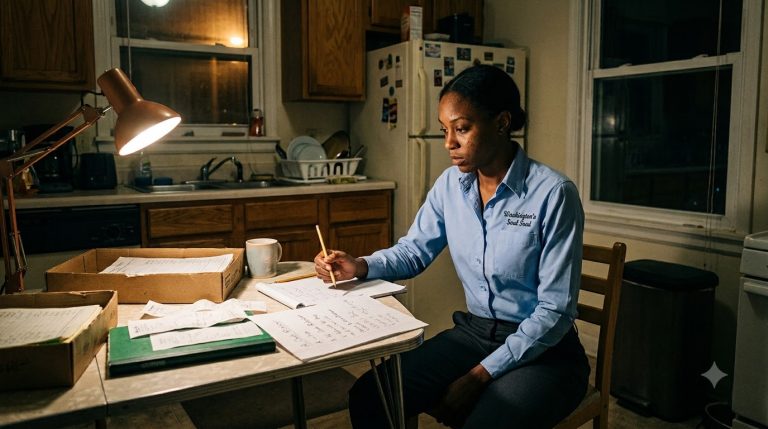
She pulled a small notebook from her pocket—the one where she tracked the shifts and the bills—and began to write down the events of the day, not as a ledger, but as a record. If she was going to be a liability, she needed to know why. She needed to understand what the ‘Doc’ had really meant, and what the brotherhood was truly hiding behind their patches. She closed the book, the sound of the snap echoing in the small room, and turned her back to the window, deciding that if she couldn’t be invisible, she would, at the very least, be prepared.
CHAPTER 7: THE BLACKOUT OF TRUTH
The darkness was not merely the absence of light; it was a physical weight, a thick, velvet curtain that dropped across the room with violent suddenness. One moment, the living room had been illuminated by the dim, orange glow of the street lamp; the next, Lynette was blind, anchored only by the smell of ozone and the sudden, terrifying silence of the oxygen concentrator.
“Mama?” she called out, the word barely escaping her throat.
There was no response. The machine, which had been the steady, reliable rhythm of her mother’s life, had died.
Lynette didn’t think; she moved. She pushed herself off the floor, her hands grazing the sharp corner of the coffee table. Her heart was a frantic, muffled drum against her ribs. She navigated the room by memory—three steps to the hallway, two to the bedroom door. Her fingers found the frame, the wood cool and solid.
“Mama, I’m here.”
She felt the edge of the bed. Her mother was still, her breathing soft and thin in the sudden quiet of the room. Panic spiked in Lynette’s chest, a sharp, cold needle. She pressed her ear to her mother’s chest, the faint, rhythmic flutter of a heartbeat reassuring her that the silence was not the end. Not yet.
But the machine. Without the power, the concentrator was just a hollow box. The neighborhood outside was a graveyard of shadows, the street lights extinguished, the house feeling as though it had been plucked from the map and cast into a void.
She scrambled for her flashlight—the old, yellow plastic one she kept in the junk drawer for emergencies. She found it, the switch clicking stiffly. A narrow, yellow beam cut through the darkness, illuminating dust motes dancing in the air.
Then, she heard it.
The sound came from the front porch. A slow, deliberate crunch of gravel beneath a heavy boot. Then, another.
Lynette froze. The flashlight in her hand began to shake, the beam dancing wildly across the bedroom walls. The anonymous caller’s words echoed in her mind: They’ll be coming to check on you. Not to help.
She turned the flashlight off. The darkness rushed back in, absolute and suffocating. She moved toward the window, creeping along the floor to avoid the creaky boards near the center of the room. She peeked through the slit in the curtains.
A figure was standing on her porch.
The beam of a powerful industrial flashlight cut through the darkness, scanning the front door, then moving to the windows. The light was harsh, surgical. It didn’t look like a burglar. It looked like someone searching for something they knew existed.
Lynette pressed her back against the wall, her lungs burning. She looked at the duffel bag sitting in the living room—the stash of money, the crumpled bills, the proof of a brotherhood that was now casting a long, dangerous shadow over her home.
This was the “check.” The anonymous caller hadn’t been a warning; it had been a countdown.
She looked at her mother, who stirred in her sleep, a soft, confused whimper escaping her lips. Lynette reached out, taking her mother’s hand. Her own skin felt cold, clammy. She had to move. If they found the money, they would find her. And if they found her, the promise of the nursing school—the goal she had fought for, the future she had built—would evaporate in an instant.
She crawled toward the closet. Her hands found the old medical kit her father had left behind. She hadn’t opened it in years, but in the dark, she remembered the latch, the weight of the steel. She needed a way to buy time. She needed a way to shift the focus away from the house.
She heard the sound of the porch door testing the lock—a slow, metallic grind of the key in the mechanism.
Lynette didn’t wait. She grabbed the duffel bag and shoved it under the loose floorboard in the closet—a space her father had used for his own private things. She covered it with a pile of old linens, the fabric smelling of mothballs and dried flowers.
She moved to the back door, her movements silent, honed by years of navigating the diner’s kitchen after hours. She reached the threshold, her hand on the handle, when she stopped.
If she left, she was abandoning her mother. If she stayed, she was walking into a trap.
She looked back at the bedroom, the beam of the intruder’s flashlight now creeping through the living room, reflecting off the glass of the television screen. The light was like a blade, cutting the house into slices.
She took a deep breath, the taste of ozone and fear metallic on her tongue. She wouldn’t run. If they wanted a confrontation, she would give them one that didn’t involve the money. She would use the environment. She would use the darkness.
She stepped into the hallway, the floorboards silent beneath her feet. She wasn’t just a waitress anymore. She was a woman who had been backed into a corner, and she realized that the “decoy” of her struggle—the money—hadn’t just bought her an education. It had bought her a transformation. She was no longer afraid of the dark; she was simply waiting for the right moment to turn on the light.
She reached for the heavy iron fire poker propped against the living room wall, its weight familiar and grounding. She knew every creak of this house, every shadow, every hiding place. The intruder was playing a game of search and destroy, but he was playing it in her territory. And she was ready to teach him exactly what happened when you tried to take a future that had been paid for in blood and quarters.
CHAPTER 8: THE MIRROR OF THE ROAD
The hallway was a tunnel of shifting gray shapes as Lynette tightened her grip on the iron poker. Her breath came in short, measured bursts, a technique she had practiced in the quiet hours of her diner shifts to keep her nerves from fraying. The intruder was in the living room, his movements clumsy and sharp, the beam of his flashlight cutting a chaotic path through the darkness.
She stepped around the corner, her body coiled, ready for the strike. She didn’t want to fight, but the sight of her mother’s bedroom door, still slightly ajar, was a goad she couldn’t ignore.
“Drop it,” she said, her voice dropping into a register she hadn’t known she possessed—low, steady, and devoid of tremor.
The light swiveled, blinding her. She squinted, raising the poker in a defensive arc. The intruder stumbled back, his boot catching on the rug. As the beam hit the floor, it illuminated a face that was not the face of a hardened criminal. It was a man, middle-aged, with deep, exhausted lines around his eyes and a patch on his denim jacket that matched the wrench-and-caduceus emblem she had seen on Jake.
He didn’t strike back. He simply lowered the light, his shoulders slumping as if the weight of the moment had finally broken him.
“I’m not here to hurt you,” he said. His voice cracked, the sound jagged and raw. “I’m looking for the bag. Jake… he’s in trouble. The chapter, they… they’re being dismantled. I thought if I could get the money, I could pay off the debt, I could stop the investigation before it reaches the clinic.”
Lynette didn’t lower the poker. “Who are you?”
“My name is Elias. I was the one who drove the truck that night, years ago. The night ‘Doc’ lost his boy.” He looked at the floor, his head hanging low. “I’ve been carrying that debt for a lifetime. When I heard you helped him… when I saw that kindness… I thought maybe, just maybe, I could do something right. But I’m just like the rest of them. I’m just scared.”
The reality hit Lynette like a tide. This wasn’t an antagonist. This was a mirror. This was a man who had been shattered by a single mistake, a man who had lived his entire life trying to pay back a debt that could never be settled. He wasn’t a threat; he was a ghost, trapped in the same loop of shame that had once kept her mother from looking at her own reflection in the old uniform photos.
“The money isn’t for the debt,” Lynette said, her voice softer now. “The money is for the future. You’re trying to fix the past by destroying the only thing that’s moving forward.”
She reached out and flicked the light switch on the wall. The power had flickered back to life, the house suddenly flooded with a warm, yellow glow that revealed the sheer vulnerability of the man standing in her living room. Elias shielded his eyes, looking small and broken in the stark light of the hallway.
Lynette lowered the poker, letting it clatter softly against the floor. She walked to the closet and pulled out the duffel bag, setting it on the coffee table. She opened it, the pile of crumpled bills and coins spilling out like a messy, human history of the last few days.
“You want to pay the debt?” she asked, her gaze steady. “Then stay. Help me fix the power, help me get the concentrator running again, and tomorrow, you go to the college with me. You testify to what you saw. You tell them that this wasn’t a bribe, it was a lifeline.”
Elias looked at her, his eyes wet. He didn’t answer immediately; the silence in the room was now heavy with the weight of choices. He looked at the poker, then at the girl who had been ready to defend her home with everything she had.
He stepped forward, his hands shaking as he reached for the power cord to her mother’s concentrator. As he plugged it back in, the machine gave a low, reassuring hum, the sound of life resuming its natural pace.
The next few hours were spent in a strange, quiet cooperation. They talked—not about the brotherhood or the money, but about the small things: the weather, the cost of medicine, the difficulty of breathing when the air felt too thick with regret. By dawn, the house felt different. It was still the same cramped cottage, but the tension had evaporated, replaced by a weary, shared understanding.
When the sun finally crested over the trees, casting a golden light through the living room windows, Elias stood by the front door. He had helped her reorganize the bag, counting the money with a meticulous, reverent care.
“I won’t be back,” he said, his hand on the knob. “But I’ll be there. At the college. I’ll tell them the truth.”
He left without looking back. Lynette watched him walk down the driveway, a single, solitary figure disappearing into the bright, morning light. She turned back to the room. The money sat on the table, no longer a burden, but a tool.
She walked into her mother’s room. Her mother was awake, looking at the window with a faint, hopeful smile. “I heard voices, Lynette. Were there friends?”
Lynette sat on the edge of the bed, the familiar, soft fabric of the quilt under her fingers. She thought of the brotherhood, of the stranger in the diner, of the man who had come to steal the bag only to end up helping her fix a broken machine.
“Yes, Mama,” she said, her voice a promise. “Friends. And we’re going to be just fine.”
She went to the kitchen and made a pot of coffee. She took a cup out to the porch, sitting on the swing. The air was cool, smelling of damp earth and the promise of a long, arduous day ahead. She didn’t have the final answers, and she knew that the audit, the college, and the life she was building would be a climb that might never end. But as she watched the sun reach the tops of the trees, she realized that she was no longer looking for an exit. She was looking at the road, and for the first time in her life, she was ready to drive. She picked up the blue textbook, opened it to the page she had left off on, and began to read.