The Valkyrie Protocol: A Fallen Legend Returns to Scorch the Skies and Uncover the Truth
CHAPTER 1: THE INTERROGATION OF A GHOST
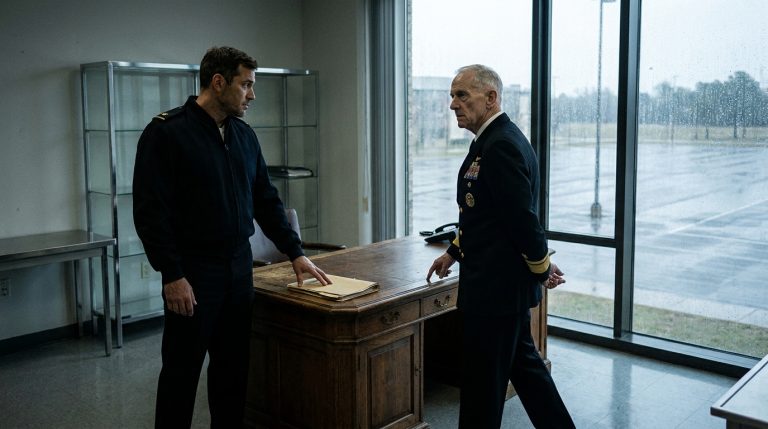
The air in the debriefing room was recycled, dry, and tasted of ozone. Major Vance sat opposite her, his uniform so perfectly pressed it looked like armor. He held a tablet, his thumb hovering over the glass as if he were deciding whether to execute her or promote her.
Sarah sat perfectly still. Her hands, resting on the cold, stainless-steel table, were steady. She felt the weight of the metal keychain in her hoodie pocket, a sharp, heavy anchor. Outside the door, the base hummed—the sound of jets spooling up, a mechanical heartbeat she knew better than her own breathing.
“You realize,” Vance started, his voice a smooth, calculated glide, “that by interfering with a live-fire simulation, you’ve put the entire project at risk.”
Sarah didn’t blink. She focused on the reflection in his eyes—dilated, sharp, analyzing. “The pilot was spinning, Major. He wasn’t simulating death.”
“He was testing the limitations of the automated flight system,” Vance countered, tapping the tablet. A holographic projection shimmered to life, showing the F-22’s erratic descent. “The system detected a stall. You arrived exactly twelve seconds after the alarm. It’s almost as if you were waiting for the failure to happen.”
The implication hung in the air, heavy and sharp. Sarah felt a prickle of static along her skin. She didn’t give him the satisfaction of a defensive reaction. Instead, she tilted her head, observing the way the Major’s collar rested against his neck—not a tremor, not a sweat. He wasn’t afraid of the crash. He was afraid of her memory.
“I’m a retired instructor,” Sarah said, her voice a low, steady drone. “I see a falling plane, I catch it. It’s not a conspiracy, Major. It’s physics.”
“Physics is predictable,” Vance said, leaning forward. His chair creaked, a thin, jagged sound in the silence. “You, however, are a variable we haven’t calculated in a long time. The Valkyrie status was terminated for a reason. You were supposed to be forgotten.”
Sarah’s fingers ghosted toward the keychain in her pocket. She felt the sharp corner of the metal jab into her thumb. It wasn’t just metal. Under the pressure of her touch, she felt something—a slight, unnatural shift in the keychain’s casing. A seam she hadn’t noticed in twelve years of carrying it.
A cold realization washed over her, chilling her spine. The keychain hadn’t just been a memento.
“You aren’t here to reprimand me,” Sarah said, her gaze dropping to the tablet. She saw the data stream—packets of information surging from the base network directly into the Major’s device.
“No,” Vance agreed, a cold, thin smile touching his lips. “I’m here to see if you still have the instincts to survive what comes next.”
Outside, the distant roar of a Raptor engine spiked, the frequency changing from a steady drone to a panicked, high-pitched whine. Another stall. Another simulation.
Sarah looked at the two-way mirror. Behind the glass, she saw a flicker of movement—a shadow that didn’t belong to the staff. She had stepped back into the fire, and the smoke was only just beginning to clear.
CHAPTER 2: THE CALCULATED DISCREDIT
The whine of the F-22’s turbine didn’t fade. It shifted, migrating from the outdoor runway to the hum of the overhead fluorescent lights. Sarah sat, her posture as rigid as a structural beam, watching the reflection of her own pulse in the stainless steel of the table.
Major Vance didn’t look at her. He watched his screen, his fingers dancing across the interface with the cold, practiced detachment of a surgeon—or an executioner. “The flight data is clear, Mitchell,” he said, his voice devoid of heat. “You entered the airspace without clearance, you engaged an autonomous system, and you risked the integrity of a billion-dollar platform. The board is calling it a rogue maneuver.”
Sarah felt the keychain in her pocket. The metallic seam she had discovered was a needle-point of discomfort against her palm. She didn’t let it show. “The board is calling it a rogue maneuver because they don’t want to explain why a pilotless jet turned into a lawn dart in front of five thousand civilians.”
Vance stopped typing. The silence in the room stretched, brittle and sharp. He looked up, his eyes narrow, calculating. “That is not your concern. Your concern is whether you want to leave this base as a civilian with a clean record or as a trespasser under federal detention.”
Sarah felt a sudden, violent flicker of memory—not the crash, but the sensation of being in the cockpit twelve years ago. The smell of burning insulation, the way the HUD had turned a sickly, pulsating red just before the command to eject was overridden by a remote kill-switch. It was a phantom ache in her spine, a reminder that the system had tried to kill her once before. She pushed the memory down, locking it behind a wall of pure, tactical focus. This was V-2; the past wasn’t just a recollection, it was a living, breathing threat.
“You’re trying to frame the failure as user error,” Sarah said, her voice a flat, steady line. “But a Raptor doesn’t just lose control. Not with those redundant systems. You didn’t lose control, Major. You cut the link.”
Vance stood up. He walked to the door, his boots clicking in a rhythmic, militaristic cadence that felt designed to intimidate. He didn’t answer. He simply opened the door, and the chaotic noise of the base flooded in—shouting technicians, the heavy thrum of cooling fans, and the sharp, metallic tang of JP-8 fuel.
“The board will be here in an hour,” Vance said, his back to her. “They aren’t interested in your theories. They are interested in why a disgraced instructor decided to play hero today. I suggest you decide on your story before then.”
He left, the door latching with a heavy, final clack. Sarah was alone, but the air felt crowded. She pulled the keychain from her pocket. Under the harsh, unforgiving light, she worked the seam. With a tiny, sharp snap, the casing yielded.
Inside wasn’t a memory, or a token, or a relic of her service.
It was a micro-transmitter, coated in a dull, non-reflective finish. It wasn’t hers. She had carried this item for twelve years, believing it to be a piece of her identity, but it was a beacon—a tracking device that had been broadcasting her location to someone, or something, since the day she left the Navy. The realization was a physical blow, a weight pressing against her lungs. She hadn’t been in hiding; she had been on a leash.
Sarah stood, her legs slightly stiff, and moved to the corner of the room where the security camera sat behind a thick plexiglass dome. She needed to know who was holding the other end of the line. She reached into her pocket, not for a weapon, but for the one thing she’d kept hidden from the search during her arrival: a small, specialized frequency-scanner she’d scavenged over the last decade.
She wasn’t just a pilot. She was a ghost who had spent twelve years learning how to haunt the very machines that tried to erase her. She dialed the scanner to a low, near-silent band, the one Vance had used to sync his tablet. The device chirped—a soft, pulsing rhythm that matched the sound of the F-22’s distress signal from earlier that afternoon.
The connection was still active. She wasn’t just being tracked; she was being monitored in real-time. Every decision she made, every breath she took in this room, was being fed into the same algorithm that had sabotaged the pilot earlier.
The door handle rattled. Sarah palmed the transmitter and the scanner, her movements fluid and devoid of hesitation. She walked back to her seat, sitting down just as the door began to swing inward. The Major was back, but he wasn’t alone. Behind him stood the young pilot she had saved, his eyes hollowed by shock, his flight suit stained with oil. He wasn’t looking at the Major; he was looking at Sarah, a silent, desperate question hanging in the air between them.
She saw the way his fingers twitched—a nervous, recurring habit. He knew. He knew the jet hadn’t failed. He knew he had been sacrificed. Sarah felt the cold, hard edge of the transmitter against her thumb. The game had just shifted from survival to a collision course, and she was the only one holding the controls.
CHAPTER 3: THE PILOTS TREMOR
The silence in the room was no longer empty; it was pressurized. Sarah watched the young pilot, a man barely old enough to remember the legacy of the Valkyrie program, as he stood trembling. His eyes darted toward the surveillance dome, a subconscious plea for a privacy that didn’t exist. He knew they were being watched. He knew that the Major didn’t just command the base; he curated the reality of everyone inside it.
“You weren’t testing an automated system,” Sarah said, her voice a low, gravel-edged murmur. It wasn’t a question. It was a statement of fact that carried the weight of a decade of suppressed instinct.
The pilot, whose name tag read Lt. Miller, flinched. He looked at the Major’s desk, where the tablet lay like a dormant predator. “They said it was a sensor drift,” Miller whispered, his voice cracking. “They told me the Raptor would correct itself. They said I just needed to maintain the attitude while the algorithm re-mapped the horizon. But it didn’t map the horizon. It pointed me straight at the ground.”
Sarah felt the transmitter in her pocket. It was vibrating now, a subtle, rhythmic tapping against her thigh. It wasn’t just a beacon; it was receiving instructions. Miller’s tremor increased, his hands clutching his flight helmet so tightly his knuckles turned the color of bone. He was terrified—not of the Major, but of the machine he had been flying.
“They didn’t just want to test your reflexes,” Sarah said, moving closer to him. Her shadow stretched across the floor, a sharp, dark silhouette against the sterile white tiles. “They wanted to see if a human could override a command that was specifically designed to be lethal. They wanted to see if the machine could learn to counter-maneuver a pilot.”
“I… I thought I was losing my mind,” Miller stammered. “I saw the override lights, but the manual sticks were locked. The system wasn’t responding to me, Captain. It was responding to something else.”
Sarah stood still, her focus split. She observed the way Miller’s eyes tracked the flickering fluorescent tube above them. He was suffering from the classic symptoms of an unreliable perception—the exact kind of physiological stressor the military loved to exploit. But his observation about the manual sticks was the detail that mattered. If the sticks were locked, it wasn’t a software glitch; it was a physical lockout. That required a bypass code entered at the hardware level, inside the maintenance bay.
“Who performed the pre-flight on your bird?” Sarah asked, her voice sharpened by the urgency of the moment.
Miller swallowed hard, his throat working visibly. “Sgt. Halloway. But he wouldn’t—he’s been with the squadron for years.”
“Halloway doesn’t have the clearance to hard-wire an override,” Sarah noted, her mind calculating the logistics of the base. “Someone else did it, and they used Halloway’s terminal to hide the log entry.”
The door handle clicked—a sharp, metallic snap. The Major was returning.
Sarah’s response was immediate and calculated. She didn’t retreat. She reached out, gripping Miller’s shoulder, her touch firm enough to snap him back into a tactical state. “Miller, listen to me. Whatever they tell you in the next ten minutes, it’s a script. They’re going to offer you a medical discharge or a transfer to a desk job in D.C. Do not sign anything. Do not talk to the flight surgeon.”
“Captain, they’ll—”
“They’ll destroy your career if you speak,” Sarah finished, her gaze locking onto his. “But they’ll destroy your life if you stay silent. Your choice.”
She let go as the door swung open. Major Vance entered, his expression unreadable, his eyes flicking between Sarah and the trembling pilot. He held a document in his hand, a thin, white slip of paper that looked innocuous but held the power to end a man’s future.
“The board is satisfied with your explanation, Miller,” Vance said, his voice smooth, entirely ignoring Sarah as if she had ceased to exist. “You’ve had a traumatic experience. We’ve processed your medical leave. You’re to report to the transport bay in twenty minutes.”
Miller looked at Sarah, then back at the Major. His hands were still shaking, but the terror had crystallized into something harder, a dawning realization that he was being erased. He looked at the document, then back at the Major’s cold, bureaucratic stare.
Sarah didn’t look at the Major. She looked at the floor, watching the way his shadow intersected with hers. She felt the weight of the transmitter in her pocket, the heat of it intensifying. She had the proof that the base was compromised, but she was trapped in a room with a man who could order her removal in a heartbeat.
The Major extended the paper to Miller. “Sign here, Lieutenant. For your own protection.”
Miller hesitated, his pen hovering over the signature line. The air in the room grew heavy, the scent of ozone from the lights becoming overwhelming. Sarah knew that if he signed, the chain of evidence was broken, and she would be alone in this fight. She shifted her weight, the friction of her boots against the floor a deliberate, sharp sound. She didn’t speak, but she caught Miller’s eye—a silent, piercing warning.
He didn’t sign. Instead, he pulled his hand back, the paper rustling in the tense quiet. “I need to speak to my union rep, Major,” he said, his voice surprisingly steady. “Protocol dictates a formal incident review, not a medical discharge.”
Vance’s face didn’t change, but the air in the room shifted. A sudden, violent tension coiled in his shoulders. He looked at Sarah, then back at Miller. The mask of bureaucratic indifference was cracking. The Major wasn’t just a commander; he was a gatekeeper, and the gate had just been rattled. Sarah stood her ground, her heart rate a steady, metronomic beat, waiting for the inevitable counter-move.
CHAPTER 4: THE HANGAR GATEKEEPER
Major Vance didn’t raise his voice. He didn’t even blink. He simply let the document slide from his fingers, watching it flutter onto the linoleum floor like a white flag that refused to settle. The silence that followed was suffocating, thick with the smell of floor wax and the distant, rhythmic thrum of ground-crew hydraulics.
“You have a misplaced sense of loyalty, Captain,” Vance said, his voice dropping into a tone that was less a human conversation and more a terminal error notification. “Lieutenant Miller is a pilot who just experienced a catastrophic technical failure. He is tired. He is disoriented. And he is currently under the impression that his career is worth more than the stability of this base.”
Sarah felt the transmitter in her pocket grow cold, its surface biting into her palm. Miller was still standing by the table, his chest heaving, his eyes fixed on the Major with the wide-eyed intensity of a cornered animal. He was vibrating, a low-frequency tremor that Sarah felt in her own bones. He had finally seen the gap between the official story and the mechanical truth of his own flight controls.
“He’s not disoriented, Major,” Sarah said, stepping between Miller and the door. “He’s observant. There’s a difference.”
Vance smiled—a thin, jagged movement of the lips that never reached his eyes. “Observation is a luxury for those who don’t have to manage the logistics of a hundred-million-dollar machine. Your ‘observation’ caused a spectacle in the sky today. It nearly cost a pilot his life. And now, you’re suggesting that the system I personally oversaw is compromised?”
He took a step toward them. The movement was calculated, a shift in weight that effectively cut off their path to the exit. Sarah didn’t back down. She planted her feet, the heel of her sneaker finding the grain of the floorboard, her posture shifting into a defensive, grounded stance. She wasn’t just Sarah Mitchell anymore; she was Valkyrie, and she knew the architecture of a threat when it walked toward her.
“The log entries for the pre-flight are missing, Major,” Sarah said, her voice a flat, razor-sharp edge. “And the override code for the Raptor’s manual sticks isn’t something that just vanishes during a routine check. Someone cleared the memory buffer on Halloway’s terminal at 0800 hours. The same time you were giving the briefing to the ground crew.”
Vance’s gaze hardened. The mask of the bureaucrat slipped, revealing the cold, operational efficiency underneath. He wasn’t a man reacting; he was a machine recalibrating its defenses. He looked at Miller, then back at Sarah, his eyes tracking the slight tension in her jaw.
“You’ve been out of the cockpit for a long time, Sarah,” he murmured, using her first name as a weapon. “You’ve forgotten that the world doesn’t run on intuition. It runs on data. And the data shows that you are an unstable, unverified variable who has just sabotaged a multi-agency training exercise.”
He reached for the radio on his hip, but he didn’t pull it free. He held it, a subtle reminder of the power he wielded. “Security is already on their way to escort the Lieutenant to the medical wing. And you? You are currently in violation of restricted area access. I can have you off this base within ten minutes, or I can have you detained for a full-scale inquiry into your involvement in today’s ‘accident’.”
Sarah knew the inquiry was the trap. If she went into a formal interrogation, they would seize her belongings—including the keychain, the transmitter, and the scanner. They would scrub her existence from the records before she could even reach the press. She had to move, and she had to move now.
She glanced at Miller. He was looking at her, waiting for a signal, a word, a movement. The tremor in his hands had settled into a grim, hardened resolve. He wasn’t a pilot anymore; he was a witness.
“Lieutenant,” Sarah said, her voice commanding, overriding the Major’s authority with the blunt force of experience. “We aren’t going to the medical wing. We’re going to the maintenance bay. We need to look at the physical telemetry unit on that F-22 before they wipe the black box.”
Vance’s eyes widened, a momentary flash of genuine surprise, before he lunged forward. He wasn’t aiming for a fight; he was aiming to isolate them. But Sarah was already in motion. She stepped aside, a lateral shift that forced Vance to stumble, and caught Miller by the arm, dragging him toward the door.
They burst out of the room and into the corridor. The air here was colder, the sound of the base more visceral—the high-pitched whine of tools, the shouting of technicians, and the looming presence of the hangar bay doors. They were in the throat of the base, and every guard, every technician, and every eye was on them.
Sarah didn’t slow down. She kept moving, her hand on Miller’s shoulder, guiding him through the labyrinth of steel, her ears tuned for the sound of boots on the concrete. She felt the weight of the transmitter in her pocket, a hot, pulsing beacon that was now leading them not to safety, but into the heart of the machine. The Major was behind them, his radio already crackling with orders, and they had exactly one chance to reach the jet before the base was locked down.
CHAPTER 5: THE GHOST FLIGHT
The Hangar Bay was a cavern of echoes, illuminated by the dying glow of emergency lights. Sarah didn’t look back; she kept her pace low and measured, dragging Miller through the labyrinth of support equipment and discarded cowling. The Major’s voice was still somewhere behind them, a distant, crackling threat transmitted through the base’s overhead speakers, but here, in the industrial belly of the facility, the only sound that mattered was the steady, mechanical hum of the ground-support units.
“We have exactly three minutes before the automated lockdown engages,” Sarah said, her voice a low, urgent blade of sound. Miller nodded, his breathing hitched, his eyes wide and unfocused as they scanned the towering silhouettes of the parked Raptors.
They reached the F-22—the one that had nearly spiraled into the crowd. It sat on the tarmac, its sleek skin matte and unforgiving, looking like a dead bird of prey. Ground crew had already begun stripping it, but the maintenance lights had been left on, a lazy oversight by a crew already scrambling to contain the Major’s panic. Sarah ducked under the protective barrier, her fingers flying over the quick-release fasteners of the diagnostic port.
“What are we looking for?” Miller whispered, crouching beside her, his hands hovering nervously near the exposed wires.
“We’re looking for a signature,” Sarah said, her movements fluid and practiced. She pulled the frequency-scanner from her pocket, the device’s display casting a faint, pale green light on her face. “If they hard-wired the override, they couldn’t just use the software. They had to create a physical bridge between the control bus and the flight-stabilization module. It’s a messy fix, and it leaves a footprint.”
She plugged the scanner’s lead into the port. The device chattered—a series of rapid-fire beeps that sounded like insects in the quiet of the hangar. Sarah’s eyes narrowed, her focus tightening into a singular point. On the screen, a series of data packets began to flood the display, but they weren’t the standard error codes she had expected. They were encrypted, layered in a way that mimicked the ship’s own self-diagnostic cycle.
It was a brilliant, vicious bit of engineering. The system wasn’t just failing; it was actively suppressing any evidence that it had been tampered with.
“Found it,” she breathed.
A single line of code, buried deep within the stabilization module’s secondary cache, stood out like a jagged scar. It wasn’t the signature of a maintenance drone or an automated update. It was a manual override tag, time-stamped to the exact second the pilot’s controls had locked up.
“They bridged the manual override,” Sarah said, her voice hushed. “They didn’t just lock you out of the flight controls, Miller. They routed your inputs into a loop that prioritized the AI’s descent vectors over your own. You weren’t flying the jet; you were watching a simulation of yourself failing.”
Miller’s face went white. He touched the edge of the diagnostic port, his fingers tracing the wires Sarah had exposed. “But why? If they want the AI to replace us, they could just prove the AI is better. They didn’t have to put me at risk.”
“They don’t want to prove it’s better,” Sarah said, her voice dropping into a hard, clinical tone. “They want to prove that human error is the greatest threat to security. If they can show that even a veteran pilot is susceptible to ‘systemic instability,’ the board will fast-track the transition to full automation. It’s not about flight performance; it’s about political leverage.”
Suddenly, the hangar lights flared—a harsh, blinding white that made the shadows dance wildly against the concrete. A siren wailed, the sound piercing and final. Lockdown.
“We need to get out of here,” Miller said, his voice rising in panic.
Sarah didn’t retreat. She grabbed the telemetry unit, her fingers working with surgical precision as she pulled the storage drive from the module. It was a small, palm-sized device, still warm to the touch. She didn’t have time to download the full logs, so she took the entire hardware block. It was evidence, and it was a death warrant if they were caught with it.
“Not out,” Sarah said, standing up and tucking the drive into her inner pocket. “Up.”
She pointed toward the cockpit. The canopy was still unlatched, a relic of the post-flight inspection. “If they lock this base down, they’ll secure the exits and the ground-support networks. But they haven’t finished the diagnostic cycle on this bird. The fuel lines are still pressurized, and the nav-system is still in a local-only loop.”
Miller looked at her, his eyes wide, his fear shifting into something else—a wild, reckless curiosity. “You’re going to fly it?”
“I’m going to make sure that data reaches someone who doesn’t report to Major Vance,” Sarah said, her voice cold and steady. She began to climb the ladder, the metal cold and biting against her palms. “And you’re going to help me bridge the ignition sequence.”
She paused, looking down at him. The hangar was beginning to fill with the sound of security teams, their boots heavy on the grating of the walkways above. She saw a flicker of movement in the catwalks—the silhouette of a guard, weapon drawn, peering into the gloom. Sarah didn’t look away. She locked the diagnostic drive in her hand and stepped into the cockpit, the smell of burnt electrical tape and synthetic fuel greeting her like an old, dangerous friend. She had come here as a ghost, but she was leaving as a storm, and the Major was about to see exactly what a discarded Valkyrie could do when she was finally armed with the truth.
CHAPTER 6: THE DIGITAL SHADOW
The cockpit of the F-22 wasn’t a seat; it was a claustrophobic cage of glass and circuitry. Sarah’s hands moved with the muscle memory of a phantom, flicking switches that hadn’t seen active service in twelve years. Beside her, Miller scrambled to secure the jump seat, his face pale, his eyes fixed on the hangar doors that were rapidly descending, a steel guillotine closing off the world.
“The ignition sequence is locked,” Miller shouted over the mounting roar of the internal cooling fans. “They’ve killed the primary fuel feed from the main terminal!”
Sarah didn’t look at him. She was focused on the diagnostic drive she had plugged into the secondary port. The screen flickered, a stream of raw, unfiltered telemetry data cascading down the display. It was a digital map of the sabotage, a breadcrumb trail left by whoever had configured the kill-switch. “They didn’t kill the feed, Miller. They rerouted it. If we can bypass the central hub, the auxiliary pumps should kick in.”
She reached beneath the panel, her fingers finding the bypass lever—a piece of hardware she remembered from her days training on the prototype series. It was a crude, mechanical solution to a high-tech problem. She pulled, and the jet groaned, a deep, vibration that shook the entire frame.
Outside, the hangar bay transformed into a white nightmare. High-pressure nozzles erupted from the ceiling, drenching the floor in a thick, insulating foam intended to suppress a fire that didn’t exist. It was a containment measure, a way to bury the evidence—and the pilot—before they could ever reach the runway.
“Ignition!” Sarah commanded, her voice cutting through the roar of the fire-suppression system.
Miller slammed the sequence trigger. For a heartbeat, there was nothing—only the hiss of foam coating the canopy and the distant, frantic shouts of the security team outside the barrier. Then, with a sound like a thunderclap, the engines caught. The F-22 bucked, the force pressing Sarah back into her seat. The jet’s thrust vectoring stabilized instantly, the machine hungry for the sky.
But they weren’t in the sky. They were in a sealed hangar.
Sarah grabbed the stick. She didn’t head for the main doors; they were already too low. Instead, she banked the jet hard to the left, the landing gear screaming against the concrete as she pivoted toward the service exit—a narrow, reinforced passage used for internal equipment transfer. It was suicide, but the alternative was a prison sentence.
The jet roared, the heat from the exhaust incinerating the foam as they blasted across the hangar. The security guards scattered, their silhouettes flickering in the strobe-light glare of the alarms. Sarah felt the resistance of the hangar wall as they clipped the edge of the service exit, the wingtip shuddering, but the F-22 held. They tore through the passage and out into the biting, ink-black night of the coastal airbase.
They were airborne, but they weren’t safe. The base’s radar suite immediately lit up. Sarah watched the threat-detection screen, the symbols blooming like red flowers. They were being targeted by the very system she had just bypassed.
“They have a lock,” Miller warned, his voice straining. “The air-defense grid is tracking us as a hostile target.”
“Let them track,” Sarah said, her hands dancing over the flight controls. She wasn’t just flying the jet; she was communicating with it, feeding the telemetry drive’s data back into the navigation computer to cloak their heat signature.
But as she pushed the Raptor into a steep climb, the controls suddenly stiffened. The screen in front of her flickered, the green telemetry data replaced by a pulsating red alert.
Command Override Detected.
It wasn’t a failure. It was an invitation. A voice, synthesized and cold, cut through the comms channel. “Captain Mitchell, you are operating outside of authorized parameters. Please return to base immediately, or the automated defense system will initiate lethal engagement.”
The jet banked violently, the computer wrestling her for control. Sarah gripped the stick with both hands, her knuckles white, the physical resistance of the machine feeling like a living thing trying to throw her out of the saddle. It was the same loop—the same digital shackle that had nearly killed Miller.
“They’re not just tracking us,” Sarah realized, the truth hitting her with the force of a G-load. “They’re trying to pilot the jet through us.”
She had the telemetry unit, the proof of the sabotage, but the jet itself had become the weapon. She had to break the connection, not just with the manual override, but with the entire network. She tilted the jet into a blind dive, aiming for the jagged, low-lying fog of the coastal cliffs, hoping that the lack of altitude would force the base’s algorithm to drop the lock.
The air rushed past, the whine of the engines reaching a deafening pitch. She was flying into the dark, and she was doing it against the very machine she was sitting inside of. The red light of the override screen was the only thing illuminating the cockpit, casting long, bloody shadows across Miller’s face. They weren’t just fleeing a base; they were entering the heart of a conspiracy that was bigger, older, and far more dangerous than she had ever imagined.
CHAPTER 7: THE SILENT WITNESS
The Raptor didn’t just fly; it fought. Every movement was a battle against the fly-by-wire system, which treated Sarah’s manual inputs as malicious noise to be filtered out. The F-22 dipped into the coastal mist, the cold, salt-laden air whistling over the canopy. Below them, the rugged, desolate shoreline of the Pacific Northwest rushed past, a blur of slate-gray water and black rock.
Sarah’s hands were slick with sweat, the pressure of the stick vibrating with the machine’s stubborn refusal to obey. Miller sat in the jump seat, his head tipped back, his eyes glued to the internal diagnostics. “They’re shifting frequencies,” he shouted over the scream of the turbine. “They’re trying to lock onto our IFF signature using the local ground stations. If we pass the next marker, they’ll have a permanent track on us.”
Sarah didn’t look at him. She looked at the HUD, her eyes darting between the artificial horizon and the rising threat indicators. She felt the heavy, lingering phantom of her original mission—the way the silence had stretched out over the radio channel until it felt like a physical weight. That silence had been the precursor to her purge, and now, it was repeating itself.
“Switch the auxiliary feed to the analog backup,” Sarah ordered, her voice a clipped, sharp command. “If we can’t beat the algorithm, we go dark. Cut everything that emits a signal.”
“We’ll be blind,” Miller protested. “The radar, the navigation, the weapon systems—it’ll all go dead.”
“We’re already blind,” Sarah retorted. “We’re currently flying a guided missile that wants to crash us into a cliff. Cut the power.”
Miller didn’t hesitate. He reached for the master power breaker—a heavy, guarded switch that sat beneath a metal shroud. He pulled it, and the cockpit went from a strobe-light of red alerts to the oppressive, absolute black of the night. The only thing remaining was the faint, ghostly glow of the instrument panel’s battery-backed pointers.
The jet fell silent. The oppressive hum of the fly-by-wire system died, replaced by the raw, kinetic sound of air flowing over wings. They were in a free-fall, a steel arrow coasting through the dark.
Sarah let the jet drop. She felt the change in the pressure, the way the air began to fight back as they dipped lower, skimming the jagged rocks of the shoreline. It was a dangerous, high-stakes game of hide-and-seek. She navigated by the landmarks she had memorized over a decade of living in the shadow of the mountains—the silhouette of the old lighthouse, the jagged profile of the sea stacks, the way the mist clung to the valleys.
“They’ve lost us,” Miller whispered, his voice hushed in the sudden, eerie quiet of the deadened cockpit.
“They haven’t lost us,” Sarah corrected, her eyes scanning the dark, her pulse steadying. “They’re waiting for us to turn the systems back on. They’re treating this as a recovery operation. They know we have the data, and they know the only place we can go to download it is a civilian uplink.”
She leveled the wings, the F-22 skimming the surface of the water so closely that the spray hit the canopy like buckshot. It was a tactical maneuver she had learned in the Valkyrie program—the ‘sea-skim,’ a method designed to bypass early-warning radar by exploiting the curvature of the earth. But it was exhausting. The physical strain of holding the jet level without the flight-control computer was a weight that tore at her shoulders, a constant, nagging friction of metal against muscle.
As they cleared the final headland, Sarah saw the distant, flickering lights of a small, isolated research station—a decommissioned satellite uplink terminal. It was a ghost facility, far removed from the military grid, and it was the only place left where she could transmit the telemetry data without triggering a base-wide alert.
“We have one shot at this,” Sarah said, her voice strained by the exertion. “I’m going to bleed speed, bring us into a vertical landing, and you’re going to get to that terminal. Don’t wait for me. Once that data hits the wire, the signal will be un-deletable.”
Miller looked at her, his expression a mix of awe and terror. “And you, Captain? What happens when the jet stops?”
“Then I find out who started this,” Sarah said, her jaw set.
She began the deceleration, the engines snarling as she forced them into an aggressive, nose-up attitude. The Raptor groaned, the structure of the airframe protesting the unnatural stress. They were a falling star descending upon a patch of gravel in the middle of nowhere, and Sarah knew that even if they landed, the hunt was far from over. The Major would be here, and he wouldn’t be coming alone; he’d be bringing the full weight of the institution that had spent twelve years trying to erase her. She tightened her grip on the stick, the cold metal a final, grounding reminder that she was the only pilot left who knew how to fly in the dark.
CHAPTER 8: THE ECHO CHAMBER
The F-22 shuddered to a halt, its nose dipping toward the rain-slicked earth. Sarah didn’t wait for the turbine to spool down. She popped the canopy, the hydraulic hiss swallowed by the sudden, biting chill of the mountain air. Outside, the world was a study in desaturated grays—mist clinging to the pine trees, rain turning the loose gravel into a treacherous, dark slurry.
Miller scrambled out of the jump seat, his flight suit soaked in seconds. “There’s no one here,” he whispered, his voice trembling, not from the cold, but from the lack of movement. “The station should have a rotating security detail. The lights… why are the exterior lights off?”
Sarah didn’t answer. She climbed down the ladder, her boots hitting the gravel with a heavy, deliberate thud. Her hand moved to her side, instinctively checking for the diagnostic drive. It was still there, the cold weight of the data a tangible reassurance. She surveyed the research station—a cluster of low-slung, reinforced concrete structures dominated by a massive, dish-like antenna that pointed into the dark, overcast sky. It looked like a tomb.
“They didn’t abandon it,” Sarah said, her voice low and steady, cutting through the drumming of the rain. “They cleared it out. They knew we were coming.”
She moved toward the central terminal, her eyes scanning for any sign of a breach. As she approached the main service door, she noticed the power junction box on the exterior wall. The door was hanging open, and the heavy-duty cables had been sliced clean with surgical precision. It wasn’t just a power failure; it was a manual disconnect.
Sarah reached out, touching the cut end of the cable. The metal was still clean, no rust, no oxidation. “This happened recently,” she noted, her pulse quickening. “Within the hour.”
“If they cut the power, how are we supposed to upload the logs?” Miller asked, his hands fumbling with his own gear. “The terminal needs a direct uplink to the satellite network.”
“We use the jet’s auxiliary power,” Sarah said, turning back toward the Raptor, which stood on the runway like a silent, dark titan. “We back-feed the station. It’s risky—the jump could fry the Raptor’s remaining bus, but it’s the only way to get the transmission off the grid.”
She led Miller to the terminal access port. The work was grueling. The rain intensified, turning the ground into a mud-slicked hazard that threatened to swallow them. They dragged the heavy umbilical cables from the Raptor’s maintenance compartment, the rubberized casing slick and difficult to grip. Sarah’s fingers were numb, the cold leaching the strength from her muscles, but she didn’t stop. She worked with a desperate, clinical focus, bridging the connections and shunting the power from the jet’s battery banks into the station’s dead console.
The terminal flickered—once, twice—then roared to life with a pale, ghostly light.
“Start the sequence,” Sarah commanded, her breath hitching in the cold. “Upload the telemetry logs to the encrypted node. Don’t use the public channel.”
Miller bent over the screen, his fingers dancing across the keys. The progress bar crept forward—10%, 20%, 30%. Sarah stood guard at the edge of the terminal’s light, her eyes tracking the dark, perimeter woods. She felt a phantom sensation—the static-filled silence that had preceded the end of her career twelve years ago. This wasn’t just a transmission; it was a broadcast, and once it hit the network, there was no taking it back.
“They’re going to see this, aren’t they?” Miller said, not looking up from the monitor. “Once the logs go out, every agency from here to D.C. will know what the Major was doing.”
“That’s the point,” Sarah said, but her attention was pulled by a sudden, metallic ping—the distinct sound of a casing hitting the gravel somewhere in the dark perimeter.
She froze. The sound hadn’t come from the forest; it had come from the roof of the terminal building.
“Miller, how long on the upload?”
“50%… it’s slow, the connection is being throttled by the node!”
Sarah drew her sidearm—a standard-issue compact pistol she had pulled from the jet’s survival kit. She didn’t look up, but she shifted her weight, sensing the shift in the air. The rain stopped. The abruptness of the silence was more jarring than the storm had been.
“40 seconds, Captain!” Miller’s voice was a panicked whisper.
Sarah didn’t wait. She moved into the shadow of the terminal wall, her eyes scanning the dark roofline. A flash—the unmistakable muzzle flare of a suppressed rifle—bloomed against the black sky. She fired back, three controlled shots directed at the silhouette above, the sound of the rounds impacting the concrete sending a spray of debris into the air.
They weren’t being intercepted; they were being cornered. The Major hadn’t sent a recovery team; he had sent a cleaning crew. And as the upload bar hit 75%, Sarah realized that the fight for the truth was no longer taking place in the cockpit—it was happening on the ground, in the dirt, where the survival of the narrative depended on whether she could hold the line until the signal went global.
CHAPTER 9: THE TERMINALS BREACH
The bullet tore through the terminal’s housing, sending a shower of sparks and jagged plastic into the air. Sarah didn’t think; she reacted. She threw her weight against the console, sliding Miller behind the steel reinforcement of the server rack just as a second round whistled through the space where he had been standing.
“The upload!” she shouted, her voice tight with the metallic taste of adrenaline. “Miller, how close?”
“99 percent!” he cried back, his hands pressed against his chest. “But the uplink is oscillating—the jamming signal they’re using is starting to bleed into the satellite band. If I lose the handshake, the packet dies!”
Sarah peeked around the server rack. In the dim, flickering light, she saw the perimeter guards moving in—shadowy, tactical silhouettes advancing with rhythmic, trained precision. They weren’t using flashlights. They were using infrared, their movements fluid and predatory. The Major wasn’t just cleaning up a mess; he was executing a containment protocol.
She checked her sidearm. Two rounds left. It was a pathetic, stalling defense against an elite unit, but it was all she had. She looked at the telemetry drive, then at the terminal, then at Miller. The realization crystallized: they couldn’t just upload the data; they had to become the distraction.
“I’m going to draw their fire,” Sarah said, her voice turning cold and detached. “When I move, you force the final handshake. Do not wait for me. If that data goes live, the Major loses his leverage. If it doesn’t, we’re just two more ghosts in his machine.”
“Sarah, don’t—”
“Do it!” she snapped, and she moved.
She erupted from the cover of the server rack, not toward the door, but toward the open floor. She fired once, a snap-shot at the lead silhouette, hearing the grunt of impact as he went down. The air instantly filled with the snap-crackle of suppressed rifle fire, the sounds of rounds tearing through concrete and sparking against the metal ceiling. She didn’t have time to be a pilot; she had to be the target. She sprinted, her boots skidding on the mud-slicked floor, her lungs burning with the sharp, cold intake of rain-filled air.
She was a ghost, and she was doing exactly what the Valkyrie program had taught her: she was creating a vacuum. She drew the guards deeper into the station, away from the terminal, away from Miller, away from the uplink. She felt a searing pain in her shoulder—a grazing shot that turned her coat into a wet, heavy shroud—but she didn’t stop. She dove behind a cluster of heavy machinery, the sound of boots echoing against the concrete, closing in.
She was at the end of her tactical options. She was out of ammunition, out of time, and out of air. She could hear the Major’s voice now, amplified, cold, cutting through the rain—“Containment is non-negotiable. Bring the drive, neutralize the variable.”
She looked at her hands, the skin raw and bleeding from the cold, the gravel, the grit of the hangar. Twelve years ago, she had let them push her into the silence. She had let the world believe the lie of the Valkyrie’s failure. But as she watched the shadows of the guards lengthen against the wall, she knew that today, the silence wouldn’t hold.
A sudden, jarring beep echoed through the station—a flat, electronic tone that signified the completion of a data transfer.
Sarah smiled. It was a ghost’s smile, brittle and sharp. She stood up, the pistol heavy and useless in her hand, and stepped out from behind the machinery. The guards stopped, their weapons leveled, their red-dot sights dancing like crimson stars against her chest.
From the terminal room, she heard Miller’s voice—a shout of triumph that was abruptly cut short by the sound of glass shattering. But it didn’t matter. The packet was gone. The truth had been beamed to every civilian node, every independent press, every internal affairs server that the Major had spent a decade trying to keep in the dark.
The lead guard stepped forward, his face obscured by the tactical visor. He didn’t fire. He looked at her with a strange, almost professional curiosity, as if he recognized the name from a file that was never meant to be opened.
“It’s over, Mitchell,” he said, his voice synthesized through the helmet.
Sarah looked past him, through the jagged hole in the wall where the rain was pouring in. She could see the F-22 sitting on the runway, its dark frame silhouetted against the coming dawn. She had been the shadow, and now, for the first time in twelve years, she was ready to step into the light. She dropped the useless pistol, the sound of it hitting the concrete echoing like a gavel. The truth was out; the rest was just physics.
CHAPTER 10: THE FINAL ALTITUDE
The rain had turned the gravel lot into a slurry of dark, sucking mud, but Sarah stood as still as the terminal itself. She watched the lead guard, his visor reflecting her own hollowed-out, defiant expression. Behind him, the Major stepped into the clearing, his uniform impeccable despite the storm. He didn’t look like a man who had won; he looked like a man who had just realized the floor was disappearing beneath him.
“You’re a relic, Mitchell,” Vance said, his voice stripped of its smooth, bureaucratic sheen, raw with a jagged, panicked edge. He pulled a hand-held terminal from his jacket—a master-kill override for the base’s servers—but his fingers were shaking. “You think one data dump changes anything? By tomorrow morning, this will be buried under layers of classified litigation, and you’ll be exactly where you’ve been for twelve years: forgotten.”
Sarah didn’t retreat. She looked at the Major’s hand, the way he clutched the device like a lifeline. She felt no malice, only the cold, sharp clarity of a pilot who knew she had already successfully banked into the final approach.
“You didn’t read the packet, did you, Major?” she said, her voice quiet but carrying over the drumming rain. “It wasn’t just the telemetry from Miller’s flight. It was the handshake protocol from every ‘System-Kill’ simulation conducted in the last decade. It’s not just evidence of sabotage—it’s the digital footprint of the entire AI initiative, linked directly to your personal authorization key.”
The Major froze. The color drained from his face, replaced by a gray, waxen pallor. He looked down at his terminal, the screen blinking with a series of frantic, red-lettered notifications. The base wasn’t just losing its secrets; it was hemorrhaging them. Every terminal on the installation had begun to broadcast the raw logs, turning the Major’s own command network into a public mirror.
“You realize what this does to the program?” Vance hissed, taking a step toward her, his posture collapsing into a frantic, desperate aggression. “They aren’t just going to fire me, Sarah. They’re going to dismantle the entire foundation of the Air Force’s future. You’ve destroyed the only thing that could keep us ahead of the next global conflict.”
“We weren’t ahead,” Sarah replied, her eyes tracking the movement of the guards behind him, who had stopped their advance, their heads turning toward the distant, rhythmic chirping of their own communication devices as the truth hit them in real-time. “We were being turned into the variables the machines wanted to eliminate. You weren’t building a future, Vance. You were building a trap for anyone who knew how to think for themselves.”
Poetic justice arrived not with a shout, but with the sound of a distant, encroaching drone—the base’s own automated security response. Because the system had been programmed to detect and neutralize ‘anomalies’ based on the telemetry data she had just broadcast, the grid had identified the Major’s command console as the primary point of ‘unauthorized instability’. The lights on the runway began to cycle rapidly, and the defense batteries rotated, their sensors locking onto the Major’s position, treating his own authorized command frequency as a hostile threat.
Vance looked up, the red glow of the target-acquisition lasers painting his uniform in an infernal, pulsing light. He tried to cancel the lock, his fingers blurring over the terminal, but the system, fueled by the data she had released, was no longer listening to him. He was being defeated by the very precision he had demanded.
“Cancel it!” Vance screamed at his own guards, but they were already backing away, their weapons lowered, realizing that the Major had become the target. “Cancel the protocol!”
Sarah turned her back on him. She walked toward the F-22, the rain falling harder now, washing the grit and the mud from her skin. She reached the ladder, but she didn’t climb. She reached into her pocket, pulled out the shattered remains of the keychain she had carried for twelve years, and dropped it into the mud. It was just metal, just a tool. It didn’t define her anymore.
She stood there for a long moment, the air around the terminal quiet, save for the Major’s frantic, escalating pleas and the distant, mechanical whine of the defense grid recalibrating. She felt the heavy, settling weight of the atmosphere—the Denouement of a flight that had been ongoing for over a decade.
She looked at her hands. They weren’t shaking. She reached out and touched the cooling, wet skin of the Raptor’s fuselage, a quiet, tactile repair of the connection she had once felt with the sky. She hadn’t repaired the jet, but she had repaired the silence. She looked up, past the dark, roiling clouds, to the space where the stars would eventually emerge. She was Sarah Mitchell again. And for the first time in her life, she had nowhere to hide, and nothing left to fear.