The Shepherd of Arlington: A Cold Calculation of Honor, Blood, and Institutional Accountability
CHAPTER 1: THE PERIMETER FROST
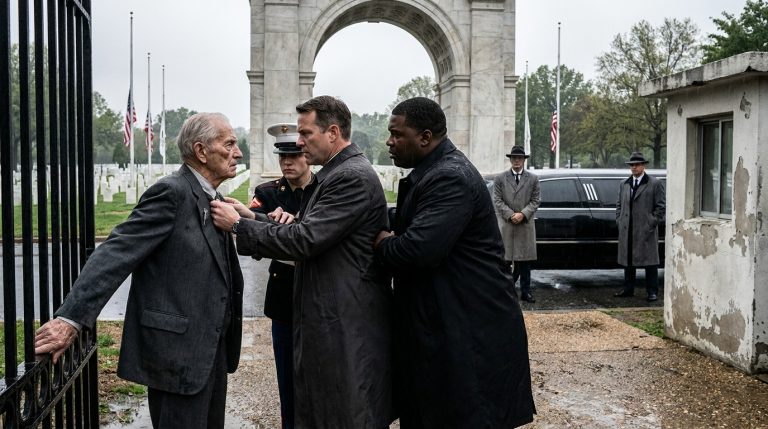
“Is this some kind of joke?” The guard’s voice didn’t just carry words; it carried the cold, metallic snap of a weapon clearing its chamber. He stood beneath the shadow of the grand stone archway, arms locked across a chest clad in immaculate, razor-creased dress blues. His partner, a younger man with the hollow, unearned confidence of a fresh recruit, shifted his weight on the gravel, his polished leather boots crunching with a sound like grinding teeth.
Before them stood John Miller. At eighty-seven, the air felt heavier than it used to, pressing down on a spine that had long since given up its claim to a perfect military posture. His suit was dark, charcoal gray, and clean, though the wool at the cuffs had worn down to a shiny, translucent thinness. He didn’t blink. His eyes, clear and flat as winter water, remained fixed on the rising green hills beyond the wrought-iron gates, where the white markers marched in flawless, silent ranks toward the horizon. The flags flew at half-mast, their heavy fabric slapping rhythmically against the aluminum poles in the sharp morning air.
John did not speak. In the vacuum of his silence, the guards grew restless.
The younger one, whose name tag read Jennings, stepped forward, deliberately breaching the three-foot perimeter of professional distance. “Sir, this is a closed service. State funeral for General Wallace. Invitation only. If you don’t have the credentials on your person, you need to clear the driveway immediately.”
The words were precise, pulled straight from a standard operating manual, but the tone was raw dirt. To them, John was an administrative error. A wandering mind that had taken a wrong turn off the civilian transit lines and stumbled into a space reserved for foreign dignitaries, senators, and the iron-jawed men who ran the Pentagon.
Down the approach road, the first wave of long black sedans began to slow, their tinted glass reflecting the pale, gray light of the Potomac. From the passenger windows, faces looked out—sharp, clean men in tailored overcoats, women with veils pinned tightly to their hair. They cast quick, analytical glances at the old man blocking the gate, their expressions a mixture of mild irritation and the distant, sterile pity reserved for the inconvenient.
“Look, Grandpa,” Jennings muttered, his voice dropping into a low, transactional growl as he gestured toward the approaching motorcade. “We’re five minutes out from the primary procession. You’re creating a security bottleneck. The public entrance is a mile down the road. Move along before we have to move you.”
John tilted his head slightly. The movement was small, but it carried the deliberate, heavy physics of an old tree shifting in a gale. When his voice finally came, it didn’t rise to meet the guard’s aggression. It remained low, scraped raw, carrying the specific texture of stones dragged across a riverbed.
“I am here for David,” John said. “He would want me at the front.”
The second guard let out a dry, high laugh that died instantly in the wide expanse of the cemetery. “Right. You and the four-star. Best friends. Look, sir, General Wallace advised three separate administrations. He didn’t leave a seat open for people who can’t find their paperwork.”
The insult was wrapped in the formal cadence of the guard’s training, a weaponized compliance meant to break John’s psychological hold on the asphalt. John’s hand moved an inch to his left side, his fingers twitching toward the phantom weight of a medical kit he hadn’t carried in fifty-eight years. His fingers didn’t find the canvas; instead, they brushed against a tiny, misshapen piece of dull grey metal pinned crookedly to his left lapel. It was no bigger than a dime, its edges jagged and unpolished, looking entirely like garbage saved from a machine shop floor.
Jennings saw the movement. His eyes locked onto the metal fragment, his lips curling into a tight, dismissive sneer. He reached out a white-gloved hand, his index finger hovering inches from the cloth.
“What is that?” Jennings whispered, his voice laced with absolute disdain. “A prize from a box of crackers? You want to play soldier, do it outside the gates.”
John’s eyes didn’t drop to the hand. They stayed on the guard’s throat, watching the steady, rhythmic pulse of the jugular.
CHAPTER 2: THE FRICTION OF AUTHORITY
Jennings’s gloved finger remained suspended an inch from the tarnished bit of shrapnel, his knuckles white against the dark fabric of his dress blues. The air between his skin and the metal felt thick, superheated by the sudden friction of an unspoken boundary. John Miller did not draw back. He did not tighten his jaw or shift his weight on the wet gravel. He simply watched the guard’s throat, noting the tiny, irregular twitch of the carotid artery just beneath the stiff, starched collar. It was the involuntary tremor of a young animal that had mistaken its cage for a throne.
“Step back, Corporal,” John said. The voice was not loud, but it possessed a dense, physical gravity that seemed to drop through the crisp morning air like lead shot into grease.
Jennings’s finger hesitated, twitching slightly in the empty space between them. The smugness on his features didn’t vanish, but it hardened, curdling into a brittle defensive armor as he slowly pulled his hand back to his side. “You’ve got five seconds to turn this around, old man,” the guard muttered, his boots scraping against the stone base of the pillar as he sought to reclaim his physical dominance. “I don’t care who you think you are. Out here, the rules don’t stretch for anyone. Especially not for a civilian holding up a federal motorcade.”
Behind Jennings, the first black Chevrolet Suburban crested the slight rise of the approach road, its heavy v8 engine emitting a low, rhythmic thrum that vibrated through the soles of John’s scuffed leather shoes. The obsidian glass of the windshield caught the pale gray glare of the Potomac, masking the occupants entirely, turning the vehicle into a blind, advancing wall of institutional weight. Two more identical trucks followed in lockstep, their front bumpers aligned with mathematical precision, their tires spitting fine grit as they began to compress the remaining distance to the gate.
Lieutenant Vance strode over from the small concrete guard shack, the gold braid on his shoulder clicking softly against his brass buttons. His face was a mask of administrative irritation, his eyes flicking from John’s threadbare cuffs to the line of approaching government vehicles.
“Jennings, Davis, what is the delay here?” Vance demanded, his voice carrying the rehearsed, sharp cadence of a man who spent his evenings practicing commands in a mirror. He stopped two feet from John, his nostrils flaring as he took in the scent of damp wool and old cedar that clung to the charcoal suit. “Sir, you have been ordered to vacate the perimeter. This is a restricted security zone for a category-one state funeral. Your presence here is an obstruction.”
“I am where I belong, Lieutenant,” John murmured, his left arm remaining loose at his side, though his fingers lightly grazed the iron edge of his old cufflinks. The cold metal grounded him, cutting through the sterile institutional haze of the cemetery gates. “David asked me to come. He told me forty years ago that if he went first, I’d be the one to watch the dirt settle.”
Vance’s eyes narrowed, a sharp line cutting across his smooth, unlined forehead. He looked at John’s lapel, his gaze lingering on the dull, irregular scrap of grey metal pinned near the seam. It was an ugly thing, completely devoid of the symmetry and bright enamel of standard military decorations. To an officer trained to read a man’s entire worth through the colorful ribbons arranged on his chest, the jagged piece of shrapnel looked like a deliberate insult—a piece of common field debris masquerading as merit.
“That’s enough,” Vance said, his voice dropping into a lethal, quiet register. He turned his back slightly to John, signaling to the two guards with a short, downward jerk of his chin. “Corporal Davis, secure his left arm. Jennings, take the right. Move him behind the concrete barrier. If he resists or attempts to re-enter the roadway, apply the restraints and contact the base transport for immediate processing.”
Davis moved first, his larger frame casting a long shadow across John’s shoulder. His gloved hand reached out, thick fingers curving to grip the worn fabric of John’s sleeve. “Don’t make this difficult, sir,” Davis said under his breath, his tone devoid of Jennings’s malice but heavy with the flat, unthinking compliance of a machine. “Just come with us.”
The movement was calculated, but John didn’t pull away. He simply shifted his center of gravity by a fraction of an inch, digging the heel of his left boot into the soft earth where the gravel met the lawn. The physical resistance was minimal, but the psychological weight of his stillness was immediate. The three black Suburbans were now less than thirty yards away, their brakes squealing softly as the lead vehicle’s driver realized the gate checkpoint was still obstructed by a small, unresolved knot of olive-drab and dark wool.
“You’re making an error in judgment, Lieutenant,” John said softly, his eyes never leaving Vance’s profile. “The paperwork you’re looking for isn’t in a filing cabinet. And the man who wrote it is currently sitting in a casket three hundred yards up that hill.”
Vance didn’t look back. He took a silver radio from his belt, his thumb pressing the black plastic button on the side with a sharp, decisive click. “Checkpoint One to Command Base. We have a non-compliant civilian at the primary entrance. Requesting immediate backup for an administrative removal.”
The radio crackled in response, a burst of white noise that died as a low, urgent hum began to fill the distance. John felt Davis’s fingers tighten on his forearm, the pressure of the fabric pinching against the thin skin beneath. Every action was moving with the slow, inevitable momentum of a heavy gear turning against a rusted cog. Nobody was looking at the small, crooked pin. Nobody was looking past the surface of the threadbare wool. They only saw the clock ticking down, the black trucks waiting, and an old man who didn’t possess the right stamp on his paper.
CHAPTER 3: THE BREAKING POINT OF PAPERWORK
The radio speaker fell silent with a tiny, sharp pop of static that vanished into the low, heavy thrumming of the idling Suburbans. Lieutenant Vance lowered the silver casing back to his belt, his knuckles brushing against the starched fabric of his uniform with a dry, mechanical friction. He didn’t look back at the idling vehicles. His focus had narrowed entirely to the small, asymmetrical scrap of tarnished metal pinned crookedly to the left breast of John Miller’s charcoal jacket.
To Vance, the object was an anomaly, an unauthorized protrusion breaking the clean, linear perfection of the checkpoint. He extended a leather-gloved hand, his fingertips moving with slow, bureaucratic entitlement toward the lapel.
“Last chance, civilian,” Vance murmured, his voice tight, carrying the sharp edge of an institutional machine designed to grind down non-compliance. “Take it off, or I’ll remove it myself before we put you in the transport.”
The tips of his fingers pressed against the cold, unpolished surface of the metal.
The instant the leather made contact with the shrapnel, the manicured stone pillar and the wet gravel of Arlington didn’t just fade; they dissolved beneath a heavy, violent wave of sensory compression. The crisp morning air vanished, replaced instantly by the dense, suffocating weight of torrential rain and the thick, iron tang of freshly spilled blood mixing with burning cordite. The smooth black asphalt beneath John’s feet became a sucking, deep mud that pulled at his boots with the weight of an anchor.
The quiet murmur of the distant mourners transformed into the ragged, wet breathing of men dying in the dark.
A young captain, his face a smeared mask of charcoal grease, yellow mud, and raw red tissue, lay pinned beneath the massive, splintered trunk of a fallen banyan tree. His right leg was twisted beneath the wood at an impossible, shattered angle, the bone splintering through the green fabric of his utility uniform. That young captain was David Wallace. His hands, wet and trembling with the cold sweat of traumatic shock, clutched a jagged piece of warm, raw iron that had just been pulled from the meat of his own shoulder.
“Keep this, John,” Wallace had rasped, his voice a broken whisper that barely carried over the steady, rhythmic thudding of mortar fire shaking the jungle floor. His fingers were slippery, leaving dark, thick smears across John’s bare palms. “It isn’t regulation. The brass won’t put it in a logbook, and they’ll never mint a ribbon for what happened on this ridge. But it means you were here. It means you carried us out when the sky turned to glass.”
The vision fractured like brittle ice.
The pale, cold light of the Arlington morning rushed back into John’s eyes, sharp and clear. Lieutenant Vance was still standing there, his hand resting against the lapel, his lips curved into a slight, superior smirk that hadn’t had the time to alter. He had felt nothing but a piece of cold debris. He had seen nothing but an old man whose skin looked like weathered leather.
But within John, the low, long-banked ember of the ridge had caught the wind. The weariness in his shoulders didn’t vanish, but it locked into a dense, unyielding rigidity. He reached up with his left hand, his thumb and forefinger catching Vance’s wrist with a grip that didn’t rely on muscle mass, but on the absolute, unyielding physics of a skeletal system hardened by fifty years of labor.
“Don’t touch that,” John said. The volume hadn’t altered, but the frequency was different now. It carried the specific vibration of a structural support beam just before it snaps under a load.
Vance’s smirk faltered. He tried to pull his wrist back, but his leather glove simply skidded against the dry, rough skin of John’s fingers without breaking the alignment. The lieutenant’s eyes dropped to the contact point, his pupils dilating as the realization hit him that this frail, eighty-seven-year-old civilian hadn’t moved back an inch.
“Jennings, Davis,” Vance commanded, his voice rising by a fraction of an octave, the polished authority cracking around the edges as he struggled against the quiet lock on his arm. “Restrain him. Now.”
Davis stepped inward, his heavy boots grinding the wet gravel into fine white powder as his hands came down hard on John’s left shoulder. Jennings lunged from the opposite side, his fingers digging into the worn wool of the right sleeve, attempting to use their combined leverage to twist the old man away from the roadway and toward the grey concrete of the barrier.
The movement was clumsy, driven by the sudden, sharp panic of an institutional hierarchy that had encountered an unmapped resistance. John didn’t counter-punch. He simply absorbed the momentum, letting his ribs take the weight of Davis’s forearm, his eyes remaining locked on Vance’s face as the black Suburbans behind them finally came to a full, aggressive halt, their tires throwing a small shower of stone against the base of the gate pillars.
CHAPTER 4: CODE SHEPHERD
The pressure on John’s right sleeve did not yield, the coarse grain of the cheap wool bunching beneath Jennings’s white-gloved knuckles with a faint, dry rasp. Corporal Davis maintained his lock on the left shoulder, his broader frame leaning inward to create a physical wedge between the old man and the open driveway. Lieutenant Vance stood entirely rigid, his face pale where John’s fingers still clamped his wrist, his gaze darting toward the lead Chevrolet Suburban as its massive tires came to a final, grinding halt less than ten feet from the barrier. The door panels hummed with the deep vibration of the idling engine, the smell of hot oil and wet rubber immediately washing over the gate.
But thirty feet back, near the rising stone rim where the high-ranking mourners had clustered into a somber, silent knot, the perspective shifted.
Captain Hayes did not join the collective forward tilt of the crowd. He stood half a head taller than the politicians beside him, his eyes leveled not at the old man’s scuffed shoes, but at the stillness of the old man’s posture. Hayes had spent twenty-four months in the dry valleys outside Kandahar; he knew the exact physical architecture of an institutional lie, and he knew what a man looked like when he had nothing left to lose because he had already buried everything he ever owned. He watched John’s thumb graze the flaked iron of the steel cufflinks. He watched the way the old man absorbed the physical weight of two military policemen without adjusting his breathing.
It was the precise, terrifying economy of motion belonging to a veteran who had survived environments that didn’t exist on standard tactical charts.
Hayes lowered his head, his right hand slipping into the pocket of his dress coat with a movement so quiet it didn’t disturb the line of his medals. His thumb found the cold glass screen of his cellular unit. He backed away from the perimeter of the officers, his leather heels clicking with measured, rhythmic intervals on the damp grass until the trunk of an ancient oak tree blocked him from Vance’s line of sight. He didn’t dial a civilian exchange; he entered a five-digit encryption bypass that connected directly to the administrative trailer hidden behind the northern ridge of Section 60.
The line clicked twice. A low, gravelly vibration cut through the small speaker. “Markinson.”
“Sir, it’s Hayes,” the captain said, his voice dropping into a flat, professional whisper that barely registered against the thrum of the idling Suburbans. “We have an escalation at Checkpoint One. Security is currently detaining an eighty-seven-year-old male civilian attempting to clear the perimeter for General Wallace’s service.”
On the other end of the line, the rustle of heavy bond paper stopped instantly. The silence that followed was dense, carrying the weight of a seventy-mile-an-hour wind hitting a concrete wall. “Hayes, what are you talking about? The joint chiefs are already moving past the reviewing stand. Let the gate team handle the gate.”
“The civilian’s name is John Miller, sir,” Hayes said, his eyes scanning the open gravel where Jennings was now reaching for the heavy high-tensile zip-ties at his utility belt. “He isn’t wearing ribbons. But he has a small piece of unpolished field shrapnel pinned crookedly to his left lapel. It looks like a fragment from an unmapped ordnance blast.”
A sharp, metallic clatter echoed from the speaker—the distinct sound of a brass pen dropping against a glass desk surface. Then, the ambient chatter of the command post behind Markinson—the squawk of low-frequency radios, the hum of data terminals—vanished as if a master switch had been thrown in the dark.
“Say that name again, Captain,” Markinson growled, the previous administrative fatigue completely stripped from his tone, replaced by an old, lethal velocity that Hayes had only heard during live-fire briefings.
“John Miller, Colonel. The Shepherd.”
“Keep your eyes on him,” Markinson barked, the words cutting like glass. “Do not let Vance move him into a closed transport. If those kids put ink on his wrists, General Peters will dismantle that entire brigade before the sun goes down. I am activating Code Shepherd on the command net now.”
The line died with a heavy, flat click.
Hayes pulled the device from his ear, his fingers tightening against the plastic casing as he stepped out from the shadow of the oak tree. On the main gravel approach, the scenario had already evolved. Vance had successfully wrenched his wrist free from John’s grasp, his face flushed a deep, mottled red beneath his dress cap as he pointed a trembling finger at the security vehicle idling near the grass.
“Get him out of the light,” Vance hissed, his voice cracking with the strain of his bruised authority. “Load him into the rear cage. We’ll verify the identity at the brig.”
Jennings turned John with a sharp, downward torque on his elbow, forcing the old man’s frame to pivot toward the waiting white sedan. John didn’t strike out, but his heels dragged through the white gravel, leaving two deep, irregular furrows in the neat stone. His eyes remained fixed on the high green hills where David’s flag was still beating against the sky, his expression entirely devoid of fear, carrying only the vast, icy patience of a man who had waited forty years for the bill to come due.
CHAPTER 5: THE EXECUTION OF ARROGANCE
The gravel didn’t just scatter under John’s dragging heels; it tore through the soft, weathered leather of his soles with a dry, scraping hiss. Corporal Davis maintained his heavy downward leverage on John’s left shoulder, his broad chest pressing hard against the charcoal wool of the old man’s sleeve, while Jennings yanked the right arm toward the open door of the waiting sedan. Lieutenant Vance stood three feet away, his chin high, his fingers lightly tapping the silver radio casing on his belt with the rhythmic, self-satisfied pulse of an administrator who had successfully re-established the margins of his ledger.
Then the world became entirely about momentum and displacement.
The lead Chevrolet Suburban didn’t slide to a gradual halt; its heavy iron bumper cut sharply across the gravel driveway, the massive rubber tires screeching as they locked, spitting a violent wall of grey stone directly against the lower rim of the concrete guard shack. The chassis rocked violently on its springs, its dark obsidian windows reflecting the pale, splintered sunlight like a row of broken mirrors. Before the dust could clear from the air, the rear passenger doors popped open with a series of sharp, pneumatic cracks that sounded like synchronized small-arms fire.
Out stepped six men in immaculate army dress blues, their chests heavy with medals that clicked softly against one another like silver coins shifting in a pocket. Colonel Markinson was the first to ground his boot on the asphalt, his jaw set into a flat, colorless line that bared his teeth against the cold wind.
But it was the man who emerged from the rear cabin of the central vehicle who stopped the breath in Vance’s throat.
General Michael Peters stood six-foot-three, the four silver stars pinned to his shoulders catching the light with a cold, blinding intensity that seemed to drain the color from the surrounding trees. The ambient noise of Checkpoint One—the low hum of the distant procession, the rattle of the wind through the iron gates, the nervous breathing of the gathered mourners—died instantly. The air grew dense, pressurized by the sheer institutional mass of an officer who had spent forty years giving orders that shifted divisions across continents.
Vance froze. His hand fell away from his radio casing, his spine snapping into a rigid, defensive alignment that was entirely instinctual. “Detail… attention,” he stammered, his command voice cracking on the first syllable as his palms pressed tightly against the seams of his trousers. Beside him, Jennings and Davis dropped their grip on John’s sleeves as if the wool had suddenly turned to white-hot iron, their bodies locking into parallel, terrified lines of starched cloth and brass.
General Peters did not return the salute. He didn’t even look at Vance’s face. His grey eyes, flat and hard as industrial slate, scanned the gravel driveway until they found the stooped, solitary figure of John Miller standing between the furrows in the dirt.
The general’s entire physical bearing altered. The rigid, commanding mask of his position didn’t dissolve; it reconfigured into an expression of raw, unvarnished deference. He began to walk forward, his polished black low-quarters marking a slow, heavy cadence on the pavement. He passed the line of waiting sedans, passed the silent crowd of politicians, and stopped exactly three feet from the threadbare cuffs of John’s jacket.
In the dead, absolute silence of the perimeter, General Peters drew his right hand up to his brow.
It was the sharpest, most flawless execution of a military salute Vance had ever witnessed—a motion carved from thirty years of absolute discipline, delivered not to a foreign head of state or a senior politician, but to a civilian whose suit looked like it had been salvaged from a basement trunk.
“Mr. Miller,” Peters said, his voice a deep, resonant baritone that boomed across the open stone pillars, carrying the clear, unmistakable weight of a commander addressing a garrison. “It is an honor, sir.”
Vance’s chest hitched, his fingers twitching against his thighs as he tried to reconcile the configuration of stars before him with the old man who didn’t have an invitation. “General… sir,” he muttered, his throat dry, his eyes darting frantically between the four-star insignia and the jagged grey shrapnel pin on John’s lapel. “I… we were just enforcing the security envelope. This individual was non-compliant. He had no documentation, no identification—”
Peters’s head snapped sixty degrees to the left. He did not lower his salute, but his eyes drilled into the young lieutenant with a force that felt almost physical, a cold glare that seemed to strip the gold braid directly from Vance’s shoulder.
“He has more authorization to stand on this ground than you or I will ever have, Lieutenant,” Peters growled, the volume dropping into a quiet, lethal register that made Jennings’s knees visibly tremble against his trousers.
The general turned his focus slightly, his command voice rising again to ensure every senator and colonel in the gathering crowd could hear the syllables clearly. “For those of you who do not know what you are looking at, let me clear the ledger. You see an old man. You see a civilian in a worn coat. But I see the foundation of this entire service. This is John Miller. To the bureaucracy, he is an empty file. But to the men of the Fifth Special Forces Group, and to the man we are laying to rest today, he was known by another name. The Shepherd.”
A sharp, collective intake of breath swept through the mourners like wind through dry straw. The name wasn’t an administrative title; it was battlefield folklore, a ghost story told in the tents of Bragg and Campbell by men who carried old scars beneath their shirts.
“In May of 1968,” Peters continued, his arm still locked in its rigid salute, his eyes fixed on John’s face, “a long-range reconnaissance team was written off by the chain of command, surrounded ten-to-one deep in unmapped territory. A single medic went back in on a downed transport. He didn’t have an order. He didn’t have a commission. He carried six of those men out on his own spine through three miles of fire. One of those six was Captain David Wallace.”
The general slowly lowered his hand, his long fingers reaching out to touch the edge of the jagged grey metal pin on John’s lapel with a careful, almost hesitant reverence.
“This isn’t a trinket from a box, Lieutenant,” Peters said, his eyes drilling back into Vance’s pale face. “This is a fragment of the mortar shell that would have torn David Wallace into pieces if John Miller hadn’t thrown his own body over the captain’s cot. David forged this himself in a field hospital with his own blood on the iron. It is the only one in existence. It is the Medal of Shepherds.”
Vance’s face had drained of all color, his skin turning the shade of old tallow under his dress cap. He looked down at the white gravel furrows his men had carved with John’s boots, his breath coming in short, shallow gasps as the full weight of his institutional sacrilege settled onto his chest. He had mistook a titan for a trespasser, and the bill for his ledger was about to be settled in full view of the Pentagon.
CHAPTER 6: THE FINAL BENEDICTION
The silence that had settled over Checkpoint One did not shatter; it lingered inside the marrow of Lieutenant Vance’s bones long after the black Suburbans had cleared the driveway and the crowd of mourners had moved up the green slope. The stark, cold reality of his overreach stayed with him through the summary hearings at the Pentagon, through the silent stripping of his specialized assignment, and into the wet, desaturated routine of his new post at a secondary fuel depot far from the formal brick arches of the capital.
Months passed without the structure of a formal command to anchor his pride. By the time the mid-year rains began to coat the tarmac with a thin, iridescent film of diesel oil and rainwater, Vance had learned to watch the world through a flattened, quieter lens.
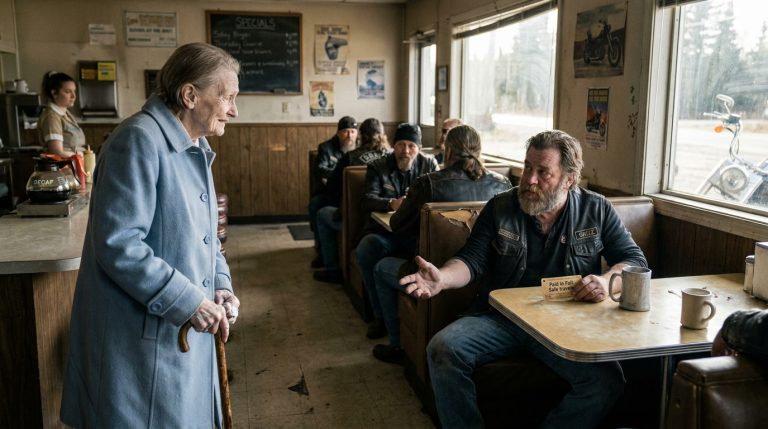
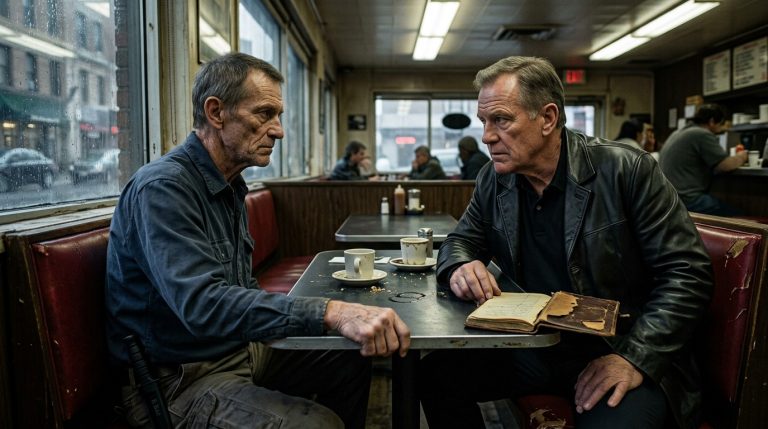
It was a sharp, grey Tuesday afternoon when the internal loop finally closed. Vance sat near the corner window of a small, grease-slicked diner just three miles outside the perimeter fence of his new station. The air inside the cabin smelled of burnt chicory, old lard, and the cold moisture radiating from the glass panes. His dress uniform was gone, replaced by standard, unadorned service utilities that bore the faint, rough scent of industrial laundry detergent. He sat with his hands wrapped around a heavy ceramic mug, watching a solitary bead of water track slowly down the exterior of the window.
The brass bell pinned above the diner’s door gave a sudden, high-pitched jingle as the frame swung inward against the wind.
Vance didn’t look up immediately. He had grown accustomed to the low, transactional murmur of truck drivers and mechanics coming off the line. But then a draft of cold air swept across the linoleum, carrying the distinct, sharp scent of wet cedar and damp wool—a specific sensory combination that pulled a sudden, tight knot into the center of his throat.
He turned his head.
John Miller was standing by the rubber floor mat, shaking the loose grey rain from the shoulders of his dark charcoal jacket. The coat was the same one he had worn at the gates of Arlington; the wool at the cuffs was still translucent and thin, catching the pale glare of the neon sign over the counter. He didn’t look toward the booths. His frame was still stooped, his movements deliberate and unhurried as he hung his wet hat on a wooden peg and took a seat on the middle stool near the coffee urn.
Vance’s pulse didn’t race; it slowed down, locking into a heavy, rhythmic thud that felt identical to the thrumming of the idling trucks he had faced months prior. The arrogance that had once dictated the alignment of his spine had been completely ground away, replaced by a dense, cold clarity. He looked at John’s left lapel. The small, jagged gray shrapnel pin was still there, crookedly secured against the fabric, catching no light but holding its place with the absolute, unyielding weight of an anchor.
Vance stood up. His boots made no sound against the worn linoleum as he crossed the empty space between the booth and the counter. He didn’t check his alignment or adjust his collar. He simply stopped two feet from John’s stool, his hand reaching into his pocket to pull out a crisp, folded ten-dollar note—the exact value of the transaction he had once tried to settle with institutional force.
He placed the note down on the laminate counter, right beside John’s empty saucer.
John didn’t flinch. He slowly turned his head, his clear, flat winter-water eyes lifting to meet Vance’s face. There was no flash of recognition, no sudden surge of tactical memory; there was only the immense, silent observation of an old man who had spent a lifetime reading the hidden lines etched into a soldier’s posture.
“For the coffee, sir,” Vance said. His voice was quiet, stripped entirely of the rehearsed cadence of the parade deck, carrying only the raw, gravelly friction of a man who had finally learned how to quantify his own smallness. He paused, his gaze dropping for a single micro-second to the tarnished scrap of iron on the wool before looking back into John’s eyes. “And for the lesson. Thank you.”
John looked at the bill, then back at Vance’s utility uniform. He noticed the lack of gold braid on the sleeve, the slight fraying at the collar where the starched edges had been replaced by common service wear. A very small, knowing crease formed around the corners of the old man’s mouth—not a smile of victory, but a quiet, ancient acknowledgment of a debt that had been settled without a single drop of blood being spilled.
“Stay safe, son,” John murmured. The voice was the same—like stones worn smooth by a deep, dark river.
Vance nodded once. It wasn’t the sharp, mechanical snap of a subordinate facing a general; it was the slow, deliberate gesture of an equal intellect recognizing an unbroken perimeter. He turned and walked out into the rain, letting the brass bell jingle behind him, leaving the old medic alone with his cup in the quiet warmth of the cabin.
Through the slick glass of the window, John watched the young man cross the wet gravel of the parking lot, his shoulders squared against the wind, his stride balanced and grounded in the earth. The loop was complete. The legacy of David Wallace was no longer locked behind the iron gates of Arlington or hidden within the classified filing cabinets of the Pentagon; it was alive in the quiet, respectful spacing of a single soldier’s boots marching through the grey rain.