The Frozen Asphalt Protocol: A Hard-Bitten Account of Bureaucratic Warfare and Survival
CHAPTER 1: THE ICE CUT
The thermometer on my porch read twenty-two degrees. The asphalt didn’t care.
I knelt at the apex of the dead-end curve, pressing my bare palm flat against the black top. It wasn’t just cold. It was slick, a glassy coat of black ice forming over the dip where the neighborhood runoff pooled every December. Liquid water shouldn’t have been standing there at twenty-two degrees. Something was leaking onto the road, but right now, the immediate problem was kinetic: two tons of steel hitting this bend at thirty miles an hour would end up in my living room.
I stood, my brass tire-tread depth gauge clicking rhythmically between my thumb and forefinger. Click. Click.
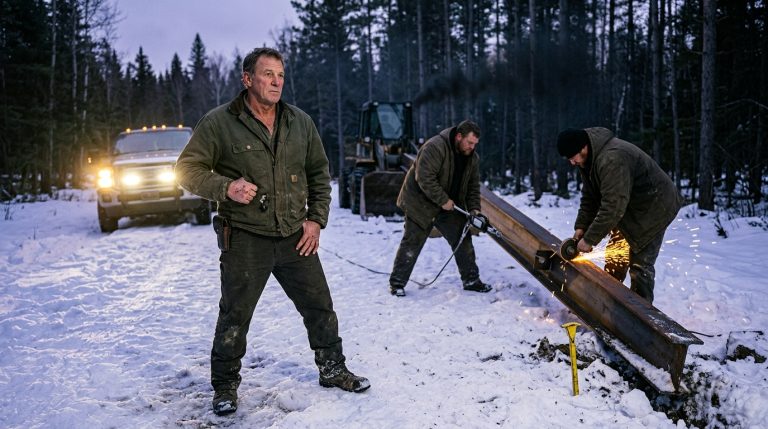
Behind me, the yellow-painted steel barricade sat heavy against the shoulder. Two hundred pounds of welded angle iron, retrofitted with industrial reflective tape. I hauled it two feet onto the public right-of-way, set the base down hard, and kicked the locking pin into place. The dull metal thud echoed down the quiet, manicured cul-de-sac of Clear Haven Estates.
High beams cut through the gloom.
A white Porsche Panamera rounded the lower crest, engine purring with low, arrogant power. It didn’t slow down for the curve until the driver spotted the yellow frame blocking half the lane. Tires chirped. The heavy sedan skidded three inches to the left before the anti-lock brakes pulse-fired, bringing the vehicle to an awkward stop angled straight at my chest.
The driver’s side window slid down with a smooth, electric hum. Cold air met the hot interior.
Selena Hart didn’t look at the road. She looked at me. Her hands locked on the leather-wrapped wheel, knuckles pale despite the dark cab light.
“Move it, Caleb,” she said. Her voice carried the flat, polished edge of a court summons. “Now.”
“Road’s freezing,” I said. I didn’t move an inch from the barricade’s steel spine. “It’s a twenty-foot sheet of glass past the crest.”
“I don’t care if it’s liquid nitrogen.” She didn’t blink. “You don’t have authorization to drop construction equipment on municipal property. The Board didn’t approve this.”
“It’s a public right-of-way, Selena. And your home is three doors down. You almost slid into the curb just now.”
She smirked, a thin, bitter line that didn’t reach her eyes. Her thumb tapped against the steering wheel, rhythmic and impatient. “I control the visual standards of this estate, Monroe. That hideous frame drops property values the second a buyer drives through the gate. Take it down, or I’ll have the maintenance crew haul it to the dump by morning.”
“Try it,” I said quietly.
She revved the engine. The Panamera twitched forward, its rear right tire catching the glaze over the asphalt and spinning for a fraction of a second—a high-pitched whine of rubber losing friction—before gaining traction. She didn’t correct course. She pulled around the steel leg, her side mirror clearing my hip by less than four inches, and disappeared down the dark avenue.
I looked down at the tire mark she left behind. The melted ice was already refreezing into a jagged, opaque ridge.
Click. I pressed the brass gauge into the fresh ice seam. Three millimeters of solid glaze, growing thicker by the minute.
Down the street, a porch light flickered on, casting long, twisted shadows across the frozen pavement.
CHAPTER 2: THE PAPER TRAP
Nineteen degrees.
The brass gauge felt like an icicle against my bare palm. I held my position at the lip of the asphalt until the hum of Selena’s dual exhausts vanished down the avenue, replaced entirely by the low, dry rattle of winter wind through bare oak branches.
Click. Click.
I reset the depth pin against the frame of my belt, turned back toward my driveway, and froze.
At the bottom of the cul-de-sac, idling beside the storm drain under a dead street lamp, sat an unmarked white Ford F-350. No city decals. No municipal orange plates. Just a rusted contractor’s bed packed with heavy-duty plastic drums and a magnetic stencil on the driver’s door that had been scraped off, leaving only a dark outline of adhesive grit: Blackwood Drainage.
A figure in a heavy canvas parka jumped down from the passenger side, dropped a steel hook into the iron grate, and yanked. The heavy storm cover groaned against its frame, popping free with a sharp, metallic screech that cut through the freeze.
“Hey!” I called out, taking three fast, heavy strides down the incline. “That’s a private utility line!”
The worker didn’t look up. He tipped a five-gallon bucket into the exposed vault. A thick, white slurry poured down into the dark, smelling faintly of calcium chloride and industrial detergent. He slammed the iron grate back into its seat, threw the hook into the truck bed, and leapt into the cab. The F-350 lurched forward, its rear tires throwing up a shower of dry road salt and crushed gravel as it sped out of the subdivision without burning headlights.
I reached the drain two seconds after the exhaust cleared.
The iron grate was dry, but beneath the bars, three inches below the street level, the runoff channel was backed up solid. Water wasn’t draining into the culvert. It was being diverted by a fresh slab of quick-set mortar, forced sideways through a cut-out in the curb to spill directly onto the apex of the curve.
They weren’t just ignoring the hazard. They were feeding it.
By morning, the barricade was gone.
I walked down my driveway at six a.m., thermogun in my jacket pocket, to find a bare patch of scuffed asphalt where two hundred pounds of welded angle iron had sat eight hours ago. Deep scrape marks ran from the shoulder to the curb, exposing raw steel paint. They hadn’t unbolted the locking pins; they had hooked a chain to a tow hitch and dragged it off the concrete.
My phone buzzed in my glove. Cold air bled the battery down to forty percent as I unlocked the screen.
An alert from the Clear Haven Estates HOA Portal populated the display: Official Notice of Non-Compliance & Safety Hazard Removal.
To All Residents of Clear Haven Estates:
At 11:45 PM, the Board executed an emergency removal of unauthorized, non-compliant industrial debris placed along the East Curve. The obstruction posed a severe liability to emergency response vehicles and violated Community Visual Standard 4.1. Residents are reminded that panic-inducing measures, illegal signage, and unvetted structural additions to public right-of-ways will result in immediate fines ($250 per calendar day) billed directly to property accounts.
Signed,
Selena Hart, Vice President & Architectural Review Director
I let out a slow, frosty breath that crystallized in the morning light.
They thought this was a turf war over curb appeal. They thought if they pulled the iron and dropped a fine on my portal, I’d retreat into my kitchen, file a grievance, and wait six months for an arbitration committee that Selena chaired.
I turned back to the garage, pulled my grease-stained leather notebook from the workbench, and sat down at the desk. I didn’t open the HOA portal to file a contest. I opened a web browser, routed through the municipal public records database, and pulled up the county clerk’s plat maps for Section 4, Block 9 of Clear Haven.
The public right-of-way extended twelve feet inward from the asphalt curb line. My barricade had sat three feet inside that margin. The HOA didn’t own the asphalt, they didn’t own the curb, and they had zero legal jurisdiction to execute a seizure on county land.
I opened a fresh spreadsheet. I didn’t write down feelings or angry responses. I created columns: Timestamp, Surface Temp (°F), Visual Glaze Thickness (mm), Runoff Source, Vehicle Impact Events.
At 8:15 a.m., the local delivery van rounded the lower crest. The driver hit the curve at twenty-two miles per hour. The front left tire struck the artificial ice shelf created by the modified drain, locked up, and swung four feet wide into the oncoming lane before the driver managed to correct the skid, missing the telephone pole by eighteen inches.
I stood behind the snowbank, camera raised, clicking three high-resolution stills of the tire tread losing contact with the pavement, followed by a clear shot of the vehicle’s speed-display readout.
Clack.
My phone chimed again. A private message from Diane, the night-shift nurse who lived two doors down:
Caleb, I saw them tow your barrier last night around midnight. Selena’s workers took it behind the community clubhouse. They threw a tarp over it. Be careful. She told the Treasurer at the holiday mixer that she’s building an injunction against your deed.
I typed back with cold, stiff thumbs: Let her build.
I spent the next three hours mapping the paper trail. I cross-referenced the county maintenance schedule for winter de-icing with the public ledger for Clear Haven’s annual operating budget. The county had assigned a secondary safety grant to our sector for cold-weather infrastructure upkeep—fourteen thousand dollars annually meant explicitly for road salting, drain clearance, and hazard signage.
Yet the ledger showed zero line items for salt purchases over the last three years. Every cent of the winter allotment was coded under a single vendor header: Consulting & Environmental Services — Blackwood Drainage.
I printed three copies of the county easement map, the weather log from the local sensor, and the timestamped photos of the delivery truck skidding on the curve. I stacked them neatly inside a manila folder, pressed the brass depth gauge flat against the top corner to hold the sheets down against the draft, and pulled on my work boots.
The Board thought they had cleared the road. They had only given me the exact coordinates of the trap.
CHAPTER 3: THE DRAINAGE LEAK
The brass gauge clicked once against the paper stack, holding the corner firm against the draft sneaking under the garage bay door.
My work boots crunched over the frost-dusted floorboards as I walked back out to the street. A needle-sharp sleet had started to fall, ticking softly against the dry oak leaves in the gutter. The air smelled of wet stone and frozen sulfur.
Down at the curve, the road had taken on a dull, greasy sheen.
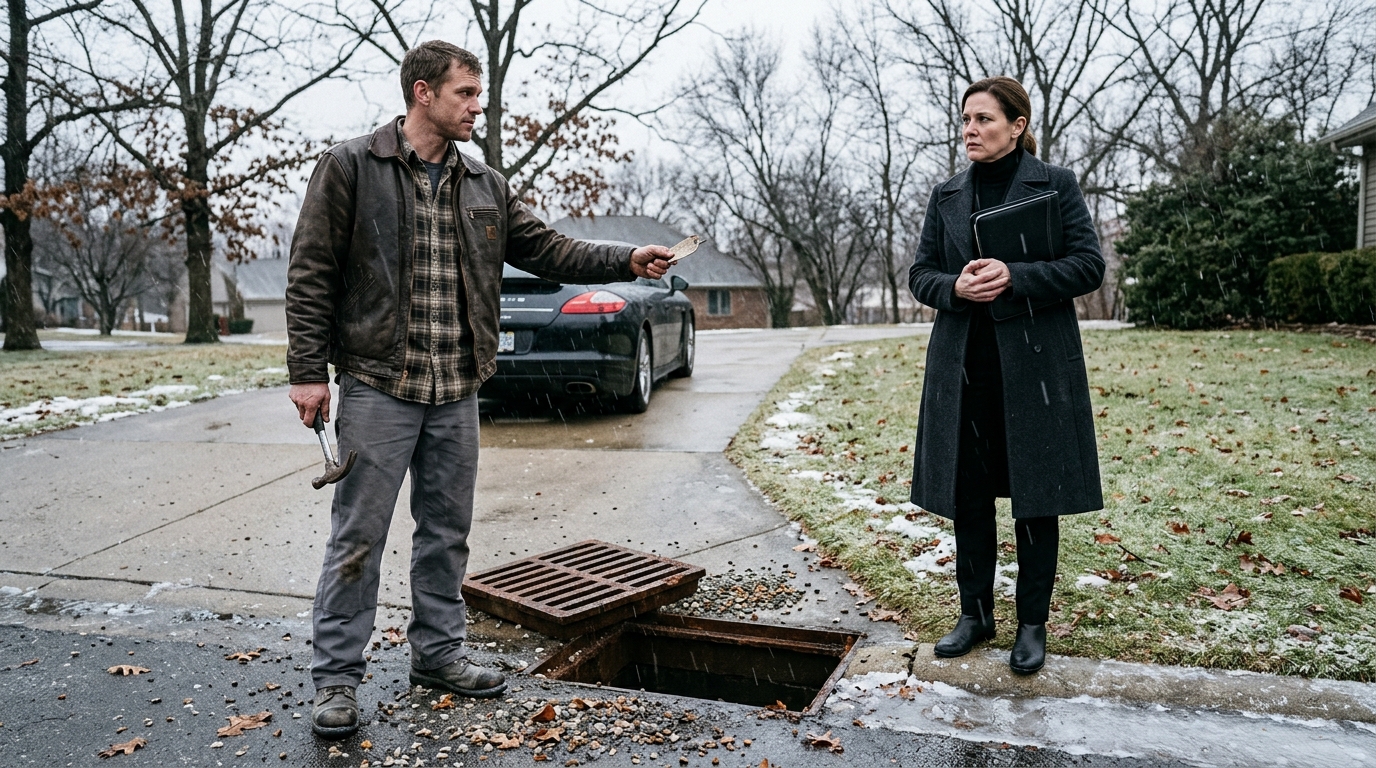
I squatted by the storm drain, pulled a claw hammer from my heavy belt, and wedged the steel nose beneath the corner of the iron grate. I drove my heel against the shank. Iron scraped against frozen concrete with a sharp, dry screech that vibrated straight through my shins.
The grate popped loose two inches. Cold air rushed up from the dark, carrying the heavy stink of damp lime and stagnant chemical runoff.
I hooked my gloved fingers beneath the edge and swung the hundred-pound plate back onto the asphalt.
Inside the vault, six feet down, a six-inch PVC pipe bypassed the municipal storm main entirely. It wasn’t an overflow valve. It was a fresh, hand-cut bypass header clamped directly into the culvert wall with stainless steel bands. A hand-written maintenance tag hung from the upper bracket by a piece of copper wire, its plastic coating yellowed and brittle from the frost.
I reached down into the dark vault, cold masonry scraping the sleeves of my canvas jacket, and snapped the tag free.
Printed across the bottom in clear, thermal-ink type was a job code and an authorization stamp:
PROJECT: BLACKWOOD DRAINAGE – RUNOFF REDIRECTION
REF: VOUCHER 408 / MUNI-BYPASS
AUTHORIZATION: ARCHITECTURAL REVIEW BOARD
I turned the tag over in my hand. The back was smudged with grease, but the ink beneath was unmistakable—a line item noting that the natural gravel absorption bed beneath the street had been capped off with non-porous grout to prevent groundwater seepage into the golf course sub-basin.
They hadn’t just accidentally diverted water. They had deliberately sealed the soil under the road, forcing every drop of winter melt up through the curb cut and onto the coldest apex of the asphalt.
“Looking for lost change, Monroe?”
The voice hit me from ten feet away, dry and flat as a slate tile.
I didn’t jump. I let the copper wire drop into my pocket, straightened my knees slowly, and turned around.
Selena stood at the edge of her manicured lawn, wrapped in a ankle-length charcoal wool coat. Her leather boots didn’t touch the mud. She held a thick leather binder tucked against her ribs like a shield, her knuckles stiffened by the biting wind. Behind her, parked in her driveway, the Panamera sat silent, its hood cold.
“Just measuring the drainage,” I said, my voice low. “Your workers left a mess beneath the grate.”
“The Board handles utility infrastructure,” she said. Her lips barely moved, keeping out the cold. “You are currently standing on a public street, tampering with community property after receiving a formal notice of violation. I’ve already logged your photo from this morning.”
“Voucher 408,” I said.
Her eyes twitched—a micro-fraction of a millimeter shift toward the storm drain before snapping back to my nose. Her fingers tightened around the leather spine of her binder until the grain stretched white.
“What did you say?”
“I said the drain is rigged, Selena. Someone capped the absorption bed with grout. The water has nowhere to go except over the curb, right into the path of every car coming around the blind crest.”
“That is a municipal engineering spec,” she said smoothly, though her tone dropped an octave into cold, precise calculation. “The developer installed those culverts fifteen years ago. If you had any understanding of civil grading, you’d know that runoff management requires specific directional flow to protect foundation integrity across the entire sector.”
“It’s a two-week-old grout job,” I said. I pointed the head of the claw hammer toward the lip of the concrete cut-out. “The mortar isn’t even fully cured. It’s leaching calcium chloride into the road surface.”
“You are out of your depth, Caleb,” she said, stepping forward. The heel of her boot struck the ice on the curb with a sharp clack. “You think because you can weld a piece of scrap metal together that you understand how a sixty-million-dollar subdivision operates. You’re causing panic over routine winter maintenance. The Board meets tomorrow night. If you bring this hysterical drama into that room, I will personally move to place a lien on your property for legal fees incurred by your harassment.”
She didn’t wait for a response. She turned on her heel and walked back up her heated driveway, her posture rigid, her coat snapping in the icy wind.
I looked down at the dark opening of the storm vault. The sleet was picking up, small white beads bouncing off the raw iron of the removed grate.
I didn’t put the cover back on right away. I took my camera out, leaned over the lip, and took four close-up shots of the fresh grout seal, the stainless steel bypass clamps, and the stamped job code on the PVC pipe.
They weren’t just protecting the aesthetics of the cul-de-sac. They were covering up an illegal infrastructure alteration that diverted water to protect the lower development at the expense of everyone driving down the East Curve.
And Voucher 408 was the receipt.
I wrestled the heavy iron grate back into its seat, the thud reverberating up through my spine, and headed back up the hill toward my garage. My fingers were numb, but my head was clear.
The meeting was in thirty hours. I had the physical evidence, I had the photos, and now I had the paper link connecting Selena’s review board directly to the mortar beneath the street.
CHAPTER 4: THE DEPOSITION
My fingers throbbed as warmth returned to them in the kitchen, the brass depth gauge sitting cold beside three printed sheets on the counter. Thirty hours dissolved into a blur of cross-referencing ledger entries, printing high-resolution photos, and mapping county easement boundaries.
The community clubhouse smelled of pine disinfectant, damp winter coats, and cheap urn coffee.
Seventy folding chairs lined the parquet floor, filled to capacity. The air hummed with low, anxious murmurs as residents shook off the sleet outside. At the front folding table sat Jim Roar, the HOA President, rubbing his temple with a calloused thumb. To his right, Selena Hart sat erect in a tailored navy blazer, her leather-bound binder resting neatly beside a printed agenda.
“Item four,” Jim announced, his voice echoing off the concrete-block walls. “Emergency safety protocols and unauthorized physical obstructions on the East Curve.”
Selena leaned forward, her microphone picking up the soft rustle of her silk blouse. She didn’t look at the crowd. She looked directly at Jim.
“As noted in yesterday’s community dispatch,” Selena began, her voice steady and smooth, “an unauthorized barrier was placed on the public easement. It presented a clear sightline hazard for turning traffic and failed every municipal safety standard. Maintenance acted under Board directive to clear the roadway and restore visual compliance.”
She turned a page in her binder. “The Board has issued a formal reprimand to the party responsible. We have also contracted our certified vendor, Blackwood Drainage, to conduct a complete survey of the culverts. Their preliminary report confirms no civil defects exist on the curve.”
I stood up from the fifth row. The metal legs of my chair scraped hard against the floor.
The room went quiet.
“The preliminary report is a lie, Selena,” I said.
Jim straightened up, waving a hand. “Caleb, you’ll have three minutes during open forum—”
“I don’t need three minutes,” I said, walking down the center aisle. I laid a heavy manila folder flat on the center table directly in front of Selena. The sharp slap of paper against laminate cut through the hum of the overhead fluorescents. “I need you to look at page two.”
Selena didn’t touch the folder. She crossed her hands over her binder, her knuckles pale, her thumb making small, frantic circles against her wrist.
“This meeting is governed by parliamentary procedure, Monroe,” she said softly, her eyes narrowing into cold slits. “You don’t get to present evidence without prior board submission.”
“Page two is a photo of the storm vault taken yesterday at four p.m.,” I said, speaking over her. “It shows a six-inch PVC bypass header clamped directly into the culvert. It shows a quick-set grout seal capping off the natural absorption bed, forcing runoff up through the curb cut and onto the coldest twenty feet of asphalt in this county.”
A murmur rippled through the back rows. Diane, the nurse, stood up two seats over. “I slid on that curve three nights ago! My anti-lock brakes barely caught before the curb!”
“Order,” Jim said, knocking his knuckles against the wood, but his eyes were locked on the photo I had placed on the table. He reached out and pulled the folder toward himself.
“That infrastructure work was performed by a licensed contractor,” Selena said, her voice rising half an octave, losing its smooth cadence. “It was authorized to mitigate basement flooding in Sector B!”
“It was authorized under Voucher 408,” I countered, leaning over the table until I was looking straight into her eyes. “A voucher drawn from the county winter safety grant. Fourteen thousand dollars meant for road salt and hazard clearing. Except there’s no salt in that drain. There’s a grout seal designed to dump water on the road.”
“That is a complete mischaracterization of municipal engineering—”
“Where is Salt-Log 9, Selena?” I asked quietly.
Her mouth snapped shut. The color drained from her cheeks, leaving two sharp red spots over her cheekbones.
Jim looked up from the folder, his brow furrowed as he flipped to the third sheet. “Selena… what is Salt-Log 9? The county invoice requires a physical log of de-icing runs for every draw on the safety grant.”
“It’s an administrative file,” Selena said quickly, her hand darting out to cover the corner of the paper Jim was reading. “It’s kept at the management office. It has nothing to do with Caleb’s illegal barricade.”
“It has everything to do with why the road is a sheet of ice,” I said. “You didn’t buy salt. You didn’t clear the curve. You paid Blackwood Drainage to alter the pipe so the lower properties stayed dry, and you used the winter safety grant to cover the bill.”
The heavy double doors at the back of the clubhouse clattered open.
Cold air swept into the warm room, bringing the smell of wet exhaust and wet leather. A high-visibility utility coat moved through the doorway, followed immediately by the khaki uniform and dark Stetson of Sheriff Miller.
The Sheriff didn’t take off his hat. He walked down the center aisle, his heavy service boots clicking rhythmically against the parquet floor.
“Jim,” Sheriff Miller said, nodding once to the President before his eyes shifted to Selena. “We need to pause this meeting.”
The room went dead silent. Nobody moved. Nobody breathed.
“What’s going on, Sheriff?” Jim asked, his voice dropping into a low register.
“We just took a dispatch five minutes ago,” Miller said, pulling a yellow pad from his jacket pocket. “Single-vehicle collision at the apex of the East Curve. A white Lexus Panamera spun off the glaze, clipped the telephone pole, and sheared the transformer housing.”
Selena gasped, her hand flying to her throat as her binder slid off the edge of the table, hitting the floor with a loud, hollow thud.
CHAPTER 5: THE IMPACT VECTOR
The binder lay open on the floorboards, its plastic sleeves fanning out like white feathers against the dark wood.
Nobody moved to pick it up.
“Is… is she hurt?” Jim asked, his voice cracking slightly as he stood up, his palms flat on the folding table.
“Driver walked away with a bruised shoulder and a shaken jaw,” Sheriff Miller said, his boots squeaking softly on the floor as he stepped toward the head table. “Airbags deployed. But the car’s wrapped around the utility pole right where Monroe’s barricade used to sit. The front axle is snapped clean off.”
Selena’s throat worked silently. Her fingers twitched against her wool blazer, searching for a pocket that wasn’t there. “I… I was driving carefully. I wasn’t—”
“The dashcam on your Panamera was still running when the deputy arrived, Selena,” Miller interrupted. His voice was flat, carrying the cold weight of thirty years on country backroads. “It captures the whole thing. You hit the glaze at twenty-eight miles an hour. The tires never touched dry asphalt. The car drifted straight past the curb cut—the same curb cut Monroe took four pictures of yesterday afternoon.”
The room exhaled in one collective, sharp breath.
I didn’t say a word. I reached into my coat, pulled out the printed county ledger sheet, and laid it flat beside my manila folder on Jim’s desk.
Miller glanced down at the paper. “What’s this?”
“That’s Voucher 408,” I said, pointing to the line item. “Fourteen thousand dollars from the county winter safety grant, paid directly to Blackwood Drainage for ‘de-icing operations.’ But Blackwood didn’t bring salt. They brought a bucket of quick-set mortar to seal the drain so water would pool on the curve instead of flooding the lower development.”
Miller looked from the sheet to Selena. “Where’s the work order, Selena?”
“It was an emergency drainage adjustment,” she whispered. Her arrogance had evaporated, replaced by a desperate, rapid calculation. Her eyes darted from Miller to the front row of residents, then to the doors. “The Board has discretionary authority over vendor selection. We didn’t need county approval for a private line—”
“The winter safety grant isn’t private money,” Miller said. He pulled a folded manila envelope from inside his coat and tossed it onto the table. It landed with a dull thump. “The county auditor flagged Voucher 408 two hours ago. They matched the payment routing to a shell account registered under Blackwood Drainage—managed out of a PO Box in town. Signed by you, Selena. And cross-referenced against Salt-Log 9, which turned out to be completely blank.”
A murmur surged through the clubhouse, loud and ugly.
“She pocketed the salt budget,” Diane yelled from the aisle. “She let us drive over black ice for three winters so she could skim county subsidies!”
“Order!” Jim shouted, but his voice was hollow. He looked at Selena like he was seeing a stranger. “Selena… is this true?”
She straightened her neck, her chin coming up in a last, bitter gesture of defiance. “The lower sector was sinking, Jim. The foundation walls were cracking from water buildup. The county refused to re-grade the main line. I did what was necessary to protect thirty million dollars in real estate value!”
“You protected your own property value at the expense of every person driving down that hill,” I said.
She turned on me, her eyes burning with pure, unadulterated venom. “You think you won something here, Monroe? You’re a contractor with a grease-stained notebook and a scrap-metal gate! You ruined this community’s reputation over a scrape on the road!”
“The road doesn’t care about your reputation,” I said quietly. “It only cares about physics.”
Sheriff Miller rested a heavy hand on her shoulder. “Selena Hart, I need you to step outside with me. County prosecutors are waiting at the station to go over these vouchers.”
She didn’t cry. She didn’t struggle. She pulled her arm back from Miller’s grip with cold precision, smoothed down the lapels of her navy jacket, and walked down the center aisle without looking left or right. Her leather heels struck the parquet floor in a slow, rhythmic cadence until the double doors swung shut behind her.
The silence that followed was suffocating.
Jim sat down heavily in his metal chair. He stared at the folder, then looked up at me. “Caleb… the curve. What do we do about the road?”
“We uncap the drain,” I said, pulling my brass depth gauge from my pocket and setting it on the table. “And tomorrow morning, we put the steel barrier back where it belongs.”
CHAPTER 6: COLD SETTLEMENT
The brass gauge sat on the table between us, reflecting the harsh buzz of the overhead fluorescents.
Jim didn’t touch it. His hands stayed clasped together over the manila folder, his thumbs digging into his own knuckles until the skin turned bone-white. Beyond the high windows of the clubhouse, the storm had settled into a steady, freezing drizzle that rattled against the glass like thrown sand.
“We have to clear the ledger,” Jim said, his voice barely carrying past the first row of empty chairs. “The county’s going to audit every dollar drawn since Blackwood Drainage took the maintenance contract.”
“Let them audit,” I said. “The paper trail is clean on my end. I’ve got three years of weather sensor logs, speed readouts, and photo timestamps saved on a physical drive. You hand that to the county prosecutor along with Voucher 408, and the liability stays exactly where it belongs—on Selena and the shell firm.”
Jim gave a single, heavy nod. He stood up, grabbed the folder, and held out his right hand. “I should’ve looked at the culvert myself two winters ago. I let her run the review board because nobody else wanted the headache.”
“Regret doesn’t salt the road, Jim,” I said, taking his hand. My grip was rough, calloused from steel wire and cold handles. “Action does.”
Thirty minutes later, the parking lot was dark.
I walked down the middle of the avenue toward the East Curve, my work boots crunching over the thin layer of road grit that county trucks had finally spread after the Sheriff’s call. The air was twenty-one degrees, sharp enough to burn the back of my throat with every breath.
At the apex of the bend, the white Lexus Panamera was gone. Only a flatbed tow truck’s oil slick and a deep, jagged gouge in the wooden telephone pole marked where Selena’s car had taken the impact. The snapped transformer housing was wrapped in yellow safety tape, humming faintly in the damp dark.
Behind the clubhouse shed, where Selena’s crew had dumped my barricade under a blue tarp, I found the two hundred pounds of welded angle iron resting against a rusted lawnmower frame.
I didn’t call for help. I grabbed the center crossbar, lifted the frame until my knees locked, and dragged it three hundred yards through the slush, the steel feet grinding a dark, clean track through the snow along the curb.
When I reached the curve, I dropped the barricade exactly three feet inside the county easement.
Clang.
The sound echoed through the quiet cul-de-sac, solid and final.
I reached into my pocket, pulled out a cold cold-chisel and a three-pound sledge, and knelt beside the storm grate. I wedged the chisel blade into the fresh grout seal that Blackwood Drainage had poured over the natural gravel absorption bed.
I struck the butt of the chisel once. Thwack.
A hairline crack webbed across the grey mortar. I struck it again. A four-inch chunk of grout popped free, dropping into the dark vault below. Cold, trapped runoff immediately surged into the opening, gargling loudly as it drained down into the sub-surface gravel instead of pooling on the road.
I worked for twenty minutes in the freeze, knocking out chunk after chunk until the original municipal channel was completely clear. The water receded from the asphalt within sixty seconds, leaving only a damp, salt-dusted surface that froze dry under the wind.
I stood up, my lower back aching, my breathing heavy against the silence of the street.
My phone chimed in my pocket. A mass broadcast from the HOA Board, signed by Jim Roar:
To All Residents of Clear Haven Estates:
Effective immediately, all previous non-compliance notices regarding safety structures on the East Curve are rescinded. The Board has terminated its agreement with Blackwood Drainage and is cooperating fully with county authorities regarding financial discrepancies under Voucher 408. Permanent, municipal-grade reflective barriers and automated de-icing systems will be installed at the apex by county highways next week.
I slid the phone back into my pocket without replying.
I walked over to the barricade, pulled my brass depth gauge from my belt, and checked the pavement. Zero glaze. Just raw, high-friction asphalt.
I took the gauge in my thumb and forefinger, adjusted the sliding scale back to zero, and set it on the steel top-rail of the barricade. The brass clicked sharply against the yellow paint—a small, solid weight anchored against the winter cold.
Down the hill, a pair of headlights rounded the lower crest. A mid-sized sedan slowed as it approached the curve, its tires gripping the dry, treated road with a steady, reassuring hum. The driver didn’t slide. The vehicle held its line, passed the yellow steel frame, and disappeared safely into the dark.
I turned back up my driveway, the cold air quiet around me, and pulled the garage door down shut behind my back.