The Iron Perimeter: A Story of Bloodlines, Broken Boundaries, and the Price of Unyielding Soil
CHAPTER 1: THE LINE IN THE BARK
The orange paint was still wet.
I rolled the flat of my thumb over the rough bark of the white oak, pulling away a smear of bright, synthetic enamel. The tree was older than the county courthouse. It stood twelve feet inside my property line, deep within the shade where the deer bed down before dusk.
Someone had marked it with a thick, arrogant stripe.
I reached into my canvas coat and pulled out my grandfather’s brass timber-marking gauge. The metal was cool, pitted by eighty years of salt and sweat. I set the notch against the trunk, checking the old blaze mark carved into the wood back in 1938. The paint was fresh. Less than an hour old.
A twig snapped near the gravel drive.
I didn’t jump. I thumbed the corner of the brass gauge until the corner dug into my callus, grounding myself in the iron smell of the soil. I turned slowly.
She stood at the edge of the porch steps, perfectly framed by the leaning cypress posts. Tailored gray suit. Dark sunglasses reflecting the treeline. Two men in dark coats stood ten paces behind her, their hands folded neatly over their belts like private security pretending to be paralegals. A younger woman held a thick leather clipboard like a shield.
“Mr. Sloan?” Her voice was smooth. Factory-calibrated.
“You’re standing on private gravel,” I said. I didn’t step toward her. I kept my boots planted in the loam.
She pulled off her sunglasses with a slow, deliberate slide, revealing eyes that had calculated the value of every square foot before her heels touched the dirt.
“Alice Strange. President of the Maple Ridge Homeowners Association.” She didn’t offer a hand. She didn’t need to. “I trust you received our preliminary notice regarding the municipal corridor?”
“I don’t belong to your association, Mrs. Strange.”
“It’s Ms. Strange,” she corrected softly. “And geography dictates reality, Aiden. Maple Ridge requires a direct utility and access corridor to Highway 9. Fifty meters wide. A clean slice through the eastern quadrant of your timber.”
She gestured to the young woman, who pulled a glossy folder from her bundle and held it out. I didn’t reach for it.
“We’re prepared to offer $5,000 as a courtesy settlement for the easement,” Alice said. Her lips curved—a tight, practiced movement that didn’t reach her eyes. “It’s more than generous for undeveloped brush.”
I looked at the folder, then down at the wet orange paint on my thumb. “Five thousand doesn’t cover the diesel to haul away the oak you just vandalized.”
“The mark is a survey boundary,” the young woman with the clipboard blurted out.
Alice held up a single, manicured finger, cutting her off instantly. The silence returned, heavy and suffocating under the canopy.
“We’ll see who holds the right to mark this land, Aiden,” Alice said gently, as if she were explaining property taxes to a child. “Law is simply a matter of organization. And we are very organized.”
She turned on her heel, her silk skirt swishing against the dry brush. The two men fell into step behind her, their dress shoes crunching rhythmically against my stone driveway.
I stood by the porch, the old house creaking as the afternoon temperature dropped. I turned the brass gauge in my hand, clicking the iron notch against my thumbnail, calculating the distance between her promise and the weaponized paperwork already heading my way.
CHAPTER 2: PAPER SHADOWS
The tail lights of the black SUV flickered through the pine trunks, then vanished onto the state highway. A cloud of fine dust and unburnt diesel hung in the damp air, settling slowly onto the porch steps.
I didn’t move for three minutes. I listened to the forest return to itself—the dry click of an acorn falling through oak canopy, the distant, scolding call of a blue jay over the ridge.
I looked down at my right hand. The bright orange enamel from the oak tree was already setting in the cracks of my skin. I pressed the flat edge of my grandfather’s brass timber-gauge against my palm until the metal bit into the flesh, leaving a sharp red crescent.
Alice Strange wasn’t a land speculator. Speculators bargained. They dropped prices, made threats about tax liens, or brought alcohol to the porch to talk about legacy. She had spoken with the dry, terrifying certainty of a clerk recording an entry in a ledger that had already been closed.
I walked down the three porch steps, my work boots sinking half an inch into the packed dirt. On the bottom step, where her lead security man had stood, lay a small card. I picked it up. Heavy linen paper, embossed in matte gray ink: Maple Ridge Development Committee — Public Utility Access Phase 4.
Near the bottom, in small, sterile font, was a permit routing code: VG-440-BLK.
I tucked the card into my coat pocket next to the brass gauge and walked north, following the gravel spur that led toward the property line.
The silence of the woods felt different now. It didn’t feel like peace; it felt like a room where someone had quietly turned off the lights. A hundred yards from the house, right where the old fence line met the marshy creek bottom, I stopped.
A faint, low whine cut through the trees. It wasn’t an engine on the highway. It was higher, thinner—like a dentist’s drill muffled by wet leaves.
I looked up. Fifty feet above the canopy of the red oaks, a black quadcopter drone hovered in a tight, lazy grid pattern. Its camera lens glinted in the dying afternoon sun, tilting down toward the creek bed.
It wasn’t taking scenic photos. It was mapping topography.
I reached down, picked up a heavy piece of river-washed granite, and let the weight of it settle in my fingers. My thumb traced a jagged seam of quartz running through the rock. I didn’t throw it. Throwing a stone at a machine fifty feet in the air was an act of frustration, and frustration was a waste of calorie.
Instead, I turned my back on the drone, walked back to the house, and pulled the heavy oak door shut behind me.
The kitchen smelled of cold wood ash and old coffee. I went straight to the corner desk—the one my grandfather had built out of heart-pine in 1952—and opened the bottom drawer. Inside were three steel filing boxes containing every tax receipt, boundary survey, and deed transfer since the county was carved out of the territory.
I pulled the 1978 deed and spread it across the scarred table. The paper was yellowed, smelling faintly of cellar mold. The ink was thick and raised where the county clerk’s stamp had bitten into the page.
Beginning at the red oak marked with three blazes on the south bank of Blackwood Creek… thence running south 88 degrees east, three hundred poles to an iron pin…
The boundary was clear. Unbroken.
A sharp knock rattled the front glass. Not the soft, polite tap of a visitor. A hard, metallic strike.
I left the deed on the table and walked into the front hall. Through the glass panel, I saw a white envelope taped directly to the wood of the doorframe. Outside, the gravel was empty. The sound of a light truck engine was already fading down the access road.
I opened the door and peeled the envelope off the frame. The tape pulled a thin strip of green paint off the wood.
It was an official notice. Printed on crisp, bright white paper with the seal of the County Environmental and Zoning Board at the top.
COMPLIANCE NOTICE: UNAUTHORIZED LAND USE AND ENVIRONMENTAL RISK ASSESSMENT.
It cited three separate municipal codes regarding “Unmanaged Biomass Hazards” and “Improper Drainage Obstruction.” It gave me fourteen days to clear the brush along the northern perimeter or face mandatory county intervention and a daily fine of twelve hundred dollars.
At the bottom was a signature line. Not a judge. A deputy director for county planning whose name I had never heard.
Below his signature, stamped in faint red ink, was a reference code for the regional master plan: Project Blackwood Annexation — Vanguard Infrastructure Corp.
I stared at the name. Vanguard.
Alice Strange hadn’t mentioned Vanguard. The glossy brochure in her assistant’s arms hadn’t said a word about infrastructure corporations.
I folded the notice into thirds, creasing the paper until the fibers split along the edge. The paper was cheap, but the threat behind it was expensive. They weren’t trying to buy three-quarters of my land. They were setting up a legal paper trail to declare it abandoned, hazardous, and subject to eminent domain before I even hired a lawyer.
I walked back into the kitchen, picked up the land deed, and slid both documents into my leather satchel. My hands were steady, but my pulse was a quiet, rhythmic thud against my jaw.
I reached for the wall phone, lifted the receiver, and dialed the home number of Ben Mercer—the only attorney in the county who still remembered how to read an un-digitized survey ledger.
The line rang twice.
“Ben,” I said when the receiver picked up. “They put orange paint on the grandfather oak today.”
There was a long pause on the other end, followed by the dry rustle of paper and the click of a lighter.
“Aiden,” Ben said, his voice gravelly and slow. “Don’t touch the paint. And don’t throw anything at their surveyors. I just came back from the clerk’s office. Someone pulled your family’s plat map four days ago. When they put it back, the northern section wasn’t shaded green anymore. It was marked in red ink.”
“Phase 4,” I said.
“Phase 4,” Ben agreed. “And Aiden… the county clerk didn’t file that change. A private runner brought it in from the city.”
CHAPTER 3: THE TRESPASS SHIFT
“A private runner,” I said into the receiver. My thumb rubbed the seam of the hard plastic, pressing until the joint turned white.
“Out of the capital,” Ben replied, his voice thin against the crackle of the landline. “Filed an amended easement attachment under a secondary docket. I’m staring at the photocopy right now. They didn’t just re-shade the northern ridge, Aiden. They logged it as a dedicated drainage servitude under Phase 4.”
“They’re on the land right now,” I said softly.
Silence hung on the line, heavy as wet felt.
“Don’t do anything reckless,” Ben warned. “If you touch their men, they’ll turn a property dispute into a criminal assault charge before nightfall.”
“I won’t touch their men,” I said, and set the receiver back into its cradle.
The latch clicked shut with a dull metallic thud. I reached across the kitchen counter, picked up my grandfather’s brass timber-gauge, and slid it into my coat pocket next to a pair of heavy steel wire cutters.
I didn’t take the truck. An engine gives warning, and warning gives men time to prepare a speech.
I walked out the rear door, stepping off the porch into the shadows of the hemlocks. The ground dropped steadily toward Blackwood Creek, the damp air carrying the sharp, iron smell of wet shale and decaying leaf mold. The forest was thick here—dense thickets of mountain laurel and wild blackberry that had grown undisturbed since the second felling in 1922.
Halfway down the ridge, the quiet was broken by the guttural chug of a diesel engine.
It wasn’t a road vehicle. It was a tracked survey rig, its two-stroke pump idling hard in the marshy bottomland.
I moved along the natural terrace of the slope, keeping behind the gray trunks of the beech trees until the creek came into view.
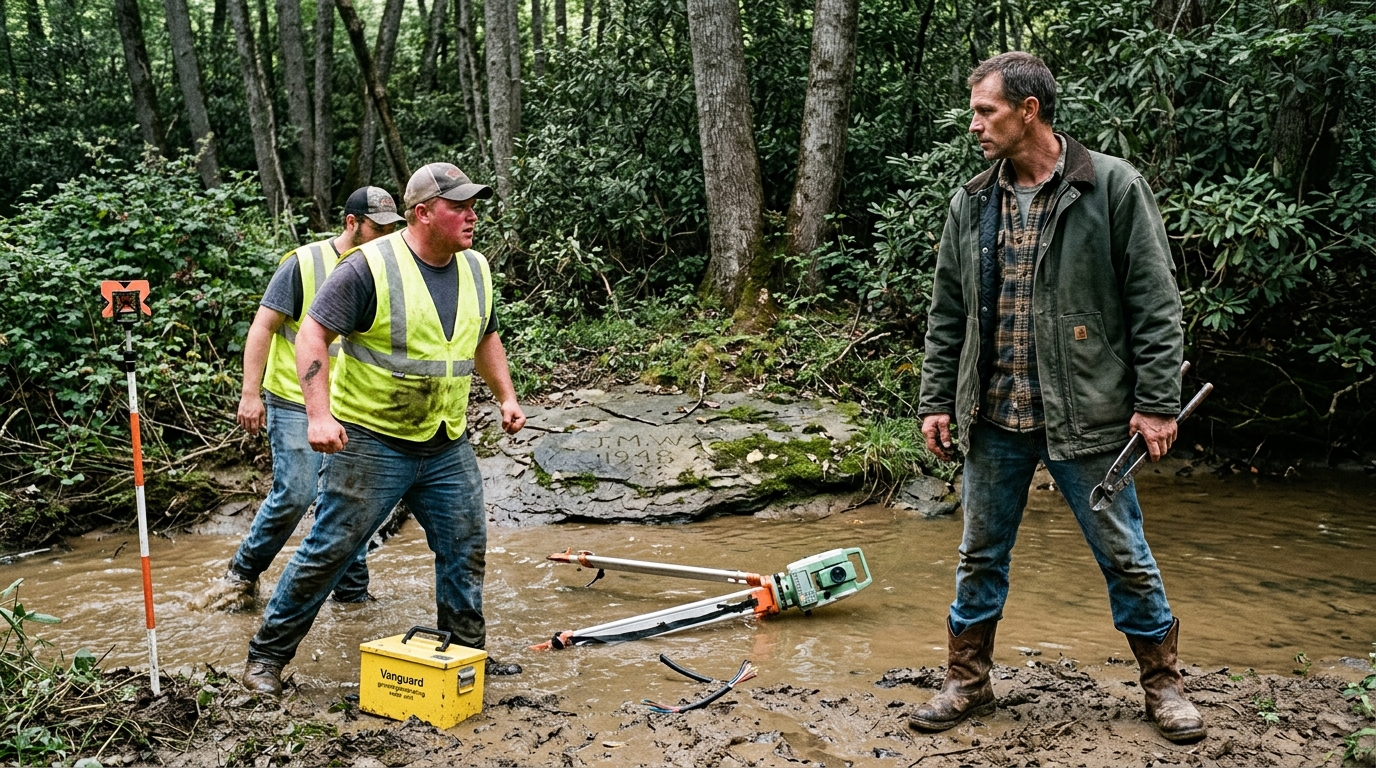
Two men in high-visibility vests stood near the water’s edge. One was leaning over an optical total station mounted on a yellow aluminum tripod, adjusting the brass leveling screws. The other held an iron prism pole planted squarely on the mossy rock where my grandfather had carved his initials into the granite bedrock eighty years ago.
A yellow steel box sat on a flat rock beside them—a commercial ground-penetrating radar unit, its cable snaking into the shallow water. On the side of the casing, stamped in black block lettering, was the mark: Property of Vanguard Infrastructure — Field Unit 09.
They weren’t surveying a road. They were taking subsurface density readings of the bedrock.
I stepped out from behind the beech trunk. My boots sank three inches into the mud near the creek bank, the suction making a soft, wet sound.
The man holding the prism pole snapped his head around. He was stocky, mid-forties, with a grease-stained ballcap pulled low over his forehead. His hand dropped instinctively to the heavy radio clipped to his chest harness.
“This is private property,” I said. My voice didn’t rise. It didn’t need to. The acoustic vault of the trees carried it straight across the water.
The surveyor at the tripod didn’t look up from his eyepiece. “Work site’s marked, chief. Phase 4 corridor. We’ve got a work order from the county planning office.”
“The county doesn’t own the deed,” I said. I walked forward until I reached the yellow tripod. I stood between the lens and the man holding the pole, breaking the laser line.
The man at the eyepiece finally straightened up. He wiped sweat from his upper lip with the back of a canvas glove. “Look, pal. We’re subcontractors. We get paid by the line-mile. You got an issue with the easement, you talk to the site coordinator at the Maple Ridge office.”
“You’re standing six feet past the county right-of-way,” I said. I pointed down at the base of the yellow tripod. “And your anchor spikes are driven through a bed of wild ginseng that’s been on this bank since before your company was incorporated.”
The stocky man stepped forward, his boots churning the marsh grass into dark slurry. “We aren’t moving the rig. We’ve got four miles of transit to shoot before five o’clock.”
He reached for the prism pole, intending to reset his line.
I didn’t grab his arm. I didn’t push him. I simply stepped sideways, planted my right boot on the base of the yellow tripod, and applied fifty pounds of lateral pressure.
The aluminum leg buckled with a sharp crack. The optical head tilted wildly, the glass lens catching the gray sky before the whole rig tipped sideways, splashing into eighteen inches of freezing creek water.
The man at the eyepiece gasped. “Are you out of your mind? That’s a twenty-thousand-dollar head!”
“It’s a trespass violation,” I said, pulling the steel wire cutters from my pocket. In one clean motion, I reached down, clamped the jaws over the black data cable running to the Vanguard radar unit, and squeezed.
The steel teeth bit through the rubber housing and sheared the copper wiring clean through. A faint blue spark crackled, then died.
The stocky surveyor took a sharp step toward me, his face flushing dark red under his cap. His hands clenched into fists at his sides. “You just bought yourself a lawsuit, you hillbilly bastard.”
I held his eyes. I didn’t raise the cutters. I let them hang loose at my side, the heavy steel jaws resting against my thigh.
“The survey is over,” I said softly. “Pack the broken gear in your truck and leave through the south access. If I catch this rig north of the creek again, I won’t cut the cable. I’ll seize the engine under county impound law for illegal dumping.”
The surveyor at the tripod was already pulling the dripping optic out of the mud, swearing under his breath as he wiped the lens with his sleeve. He looked at his partner, then at me. He saw the cold mud on my boots, the brass gauge peeking out of my pocket, and the complete lack of panic in my shoulders.
He knew what men look like when they are bluffing. I wasn’t.
“Grab the box, Gary,” the instrument operator muttered, his voice trembling with furious restraint. “Grab the damn box. We’re calling the sheriff from the gate.”
“Call him,” I said. “Tell him to bring the 1978 boundary map. He’ll need it to find where you parked.”
I watched them for ten minutes in complete silence as they unbolted the shattered tripod, packed the heavy yellow box into a canvas transport bag, and dragged the rig up the muddy embankment toward their utility vehicle.
When the sound of their engine finally died away toward the highway, I knelt by the creek bank.
The water was running brown where their boots had torn up the silt. Floating in the eddy near the initialed rock was a laminated equipment tag that had fallen from the severed radar cable.
I picked it up. The water dripped off the plastic corner onto my thumb.
Printed on the back was a site location code: Project Blackwood — Sub-Surface Core Analysis / Target Zone Alpha.
Below it was a single sentence: Do not discharge ground samples into municipal water lines without Vanguard safety clearance.
I stared at the black ink as the cold creek water soaked through the leather of my boots, feeling the first crack in their story widening under my feet.
CHAPTER 4: THE DECOY BOUNDARY
The plastic tag felt cold and slick against my thumb. I shook the creek water off the corner, folded it inside a dry handkerchief, and slid it into my coat pocket next to the brass gauge.
The chill in my boots worked its way up through my socks as I climbed the embankment, but I didn’t slow down. I walked straight past the house, got into my truck, and fired the diesel engine. The heater blew cold air against my knuckles for the first five miles before finally warming up as the gravel gave way to county asphalt.
Forty minutes later, I pushed open the frosted glass door of the County Records Office.
The room smelled of old cellulose, damp wool, and floor wax. High above the rows of oak cabinets, fluorescent tubes hummed a low, erratic B-flat. Behind the high marble counter, Arthur Vance—the assistant registrar whose family had farmed the west ridge for three generations—was sliding a steel ledger back into its slot.
He looked up when the door latch clicked. His eyes dropped instantly to the mud drying on my boots, then rose to my face. He didn’t offer a polite greeting.
“Ben Mercer called me,” Arthur said softly, his voice barely carrying over the hum of the lights. He wiped his spectacles on his tie. “I told him the same thing I’m going to tell you, Aiden. The floor vaults are open to the public until four, but the historical folios are restricted.”
“I don’t need a historical folio, Arthur,” I said, walking up to the marble counter. I set my grandfather’s 1978 deed flat on the wood. “I need Book 412, Page 88. The original plat survey for the Blackwood Creek basin.”
Arthur looked at the deed. His right hand twitched, his fingers curling into his palm. “That volume was pulled for re-indexing two weeks ago.”
“Re-indexing doesn’t take two weeks in a county with six thousand tax parcels,” I said. “Who pulled it?”
Arthur didn’t answer. He turned his back to me, pulled a brass key ring from his belt, and walked toward the iron gate that guarded the basement stairs. He unlocked the latch, left the gate standing open three inches, and kept walking down into the shadow of the stairwell without looking back.
I followed him down.
The basement vault was colder than the woods. Unpainted concrete walls held rows of heavy steel shelving loaded with leather-bound land folios going back to the Civil War. Arthur stopped in front of Section G, where the township surveys were stored in massive, three-inch-thick binders.
He pointed a thin finger at a black binder sitting on the middle shelf. The spine label read Township 4 North — Ranges 2 and 3.
“Look at the binding seal,” Arthur whispered.
I leaned in. The red wax seal over the corner binding screw—the official county stamp meant to prevent pages from being removed or swapped—was cracked. A fresh layer of clear, synthetic glue had been smeared over the fracture, holding the leather flap in place.
I pulled the binder off the shelf. The leather was heavy, cold, and stiff. I flipped through the heavy parchment pages until I reached Page 88.
My grandfather’s signature was there at the bottom, written in dark blue ink in 1978. The property description was identical to the deed in my coat pocket. But when I held the page up against the bare bulb hanging from the concrete ceiling, the light revealed the fraud instantly.
The original paper had been chemically scraped along the northern margin.
Over the faded ghost marks of the old survey line, a new line had been drawn in sharp, modern black ink. It took a thirty-degree turn south at Blackwood Creek, slicing off seventy-five acres of old-growth oak and re-labeling it as Municipal Utility Reserve — Phase 4 Expansion.
Tacked to the back of the page with a rusty steel staple was a single-page addendum stamped with a notary seal from two counties over.
It listed the owner of the annexed reserve not as the county, and not as Maple Ridge.
It listed the holder as Vanguard Land Holdings LLC.
“They didn’t just alter the map,” I said, my voice echoic against the concrete walls. “They filed a false dedication deed directly into the master index.”
“Three weeks ago,” Arthur said, staring at the floor. “A man came in with an authorization letter signed by the Zoning Board chairman. He had the key to the vault room. I wasn’t even in the building when he stamped it.”
“Alice Strange told me they were building a road,” I said, turning the heavy parchment page over.
“A road?” Arthur let out a short, bitter sound that wasn’t a laugh. “A road doesn’t need subsurface density surveys, Aiden. They aren’t trying to pave a highway over your ridge. The zoning board granted them an environmental annexation order. Under state law, if a property is classified as an unmanaged hazardous basin, a private utility can assume management rights without a public hearing.”
I stared at the scraped parchment. This was Layer 1. The grand scheme Alice Strange and her board had constructed: fake an environmental risk, forge the county index, use the HOA as a legal wedge to declare my land a hazard, and take seventy-five acres under the guise of suburban expansion.
It was clean. It was clever. It was legal fraud wrapped in bureaucratic linen.
“They think I’m fighting an HOA over an access road,” I murmured.
“Aren’t you?” Arthur asked.
I reached into my pocket, pulled out the laminated radar tag I had cut from the creek unit, and laid it on top of the forged folio page.
Arthur bent down, his eyes scanning the black lettering: Project Blackwood — Target Zone Alpha. Do not discharge ground samples.
His face went pale. The color drained from his lips so fast it looked like he had stepped into a draft of freezing air.
“Where did you get this?” he whispered.
“In the creek bed,” I said. “Where their surveyors were running subsurface core drills through my bedrock.”
Arthur backed away from the steel shelf until his spine hit the concrete wall behind him. “Aiden… put that folio back. Put it back on the shelf and walk out of here.”
“Why?”
“Because Maple Ridge didn’t hire those surveyors,” Arthur said, his voice trembling as he reached out and slammed the heavy leather book shut. “Alice Strange doesn’t have the authority to order core drills. That paper in your hand isn’t about a road, and it isn’t about the HOA. You need to call Ben Mercer right now, before they realize what you took out of that water.”
CHAPTER 5: THE CONTRACTOR TRAP
Arthur Vance’s knuckles turned white where he held the heavy folio closed against the steel shelf. The dull thud of the binding still vibrated through the cold basement floor.
“I’m keeping the tag, Arthur,” I said quietly.
I picked up the laminated tag from the metal casing, slipped it back into my coat pocket next to the brass timber-gauge, and walked past him toward the stairs. He didn’t try to stop me. He stood rooted between Section G and the concrete wall, his breathing fast and shallow under the humming fluorescent tubes.
I climbed the iron stairs, pushed through the gate, and walked out into the afternoon air.
Shadows stretched long across the county parking lot. Two miles down the state route, past the entrance to Maple Ridge, sat the staging yard for Miller Earthworks—the primary civil contractor hired by the HOA to carve the Phase 4 access road.
I got into the truck, turned the key, and backed out onto the asphalt. The steering wheel was cold against my palms. My grandfather had always said that when a man tries to hide a hole, he usually leaves the shovel lying in plain sight. Alice Strange was the clipboard; Miller Earthworks was the shovel.
Fifteen minutes later, I turned the truck through the chain-link gate of the contractor’s yard.
Heavy equipment sat in rows under the fading light—yellow excavators with mud caked to their treads, flatbed trailers, and diesel fuel tanks mounted on skids. In the center of the yard stood a weathered aluminum trailer with Miller Contracting — General Engineering painted on the side.
I parked beside a diesel derrick truck, killed the engine, and stepped onto the packed gravel.
A tall man in a flannel shirt and a grease-stained canvas vest was unrolling a set of blueprints across the hood of a Ford pickup. He had graying stubble along his jaw and a pair of reading glasses perched on his nose.
“Yard’s closed, pal,” he said without looking up, his thumb tracing a red pencil line across the blueprint paper. “Parts desk opens at seven tomorrow.”
“You’re Dan Miller?” I asked, stepping up to the fender.
He paused, his thumb stopping on the paper. He looked up, squinting through the smudged lenses. “Depends on who’s asking.”
“Aiden Sloan.”
Miller’s posture changed instantly. His shoulders hitched, his jaw setting hard. He slowly folded his reading glasses, tucked them into his vest pocket, and straightened up. “You’re the guy with the timber lot on Blackwood Creek.”
“The same,” I said. “And your survey crew left a buckled optical head and thirty feet of severed radar line in my creek bed two hours ago.”
Miller let out a slow breath, the air whistling through his teeth. He turned toward the trailer, then looked back at me, his eyes dropping to the clay drying on my boots. “They told me you tripped the tripod and threatened them with an axe.”
“They lied about the axe,” I said. “Just like they lied about who owns the dirt under their boots.”
I reached into my coat, pulled out the folded copy of my 1978 deed, and laid it flat over his blueprints on the hood. I set my grandfather’s brass timber-gauge on top to hold the corner down against the evening wind.
Miller looked down at the parchment. He knew how to read a legal survey. His thumb traced the property boundary, moving slowly from the initialed granite rock to the red oak on the ridge.
“This is an un-subdivided baseline,” Miller muttered, his brow furrowing. “The HOA paperwork listed this entire bottomland as dedicated municipal easement under Phase 4.”
“Alice Strange gave you a forged plat sheet,” I said. “The county folio was altered three weeks ago by a runner out of the capital. If you drop a blade into that timber, you aren’t clearing an HOA access corridor. You’re committing felony criminal trespass and timber conversion.”
Miller pulled off his cap and rubbed his bald crown. “We signed a two-hundred-thousand-dollar site prep contract with Maple Ridge last month. Half the mobilization money is already sitting in my payroll account.”
“Who signed the check?” I asked.
Miller didn’t answer right away. He looked across the yard, where two mechanics were washing down a bulldozer with a high-pressure hose.
“The check came from an escrow account in the city,” Miller said, his voice dropping an octave. “Look, Sloan… I run earthmovers. I don’t get involved in boundary fights between neighbors.”
“It’s not a boundary fight between neighbors, Dan,” I said. I pulled the laminated radar tag out of my pocket and laid it beside the brass gauge on his blueprints. “Read the site code.”
Miller leaned over the hood. He read the printed black lettering once, then twice. The color in his weathered cheeks faded slightly.
“Project Blackwood,” Miller read aloud. His thumb twitched against the steel fender. “They told me Blackwood was just the internal project code for the drainage culvert.”
“They brought ground-penetrating radar onto my land,” I said. “They weren’t measuring elevation for a road. They were taking density core samples of the bedrock shale forty feet down. What kind of road contractor needs to know the permeability of deep shale, Dan?”
Miller stared at the tag. His hand moved involuntarily, rolling the corner of the paper blueprint into a tight, desperate spiral.
“Vanguard,” Miller whispered. The word came out dry, like sand scraping over iron.
“You know them?”
“Two years ago, Vanguard bought the abandoned chemical processing facility six miles up-river,” Miller said, his eyes darting to the open door of his trailer. “They tried to lease four of my heavy haulers for a night-shift excavation project back in November. High-containment trailers. Special lining. I turned them down because my liability insurance wouldn’t cover the transport codes.”
He looked at me, his face grim under the yard work lights.
“They aren’t building a road to the highway, Sloan,” Miller said softly. “The HOA is just the shell they’re using to acquire the buffer land. If Vanguard gets title to your seventy-five acres on the creek, they control the entire drainage basin leading into the deep bedrock vault.”
The realization hit like a cold draft through a broken pane of glass. Layer 1 had completely collapsed under my feet. The HOA wasn’t trying to expand their manicured suburb. Alice Strange was an operative—or a puppet—clearing a path for an industrial entity to bury toxic runoff directly into the shale beneath my family’s trees.
Before I could speak, the gravel at the yard entrance crunched under heavy tires.
A sleek black sedan with tinted windows pulled through the gate, its headlights cutting through the dusk and sweeping across the hood of Miller’s truck. The driver didn’t park. The car idling thirty feet away, its engine emitting a low, mechanical hum.
The passenger window rolled down two inches. Through the gap, I saw the pale outline of a man in a dark coat holding a mobile phone against his ear. He didn’t get out. He just watched us standing over the blueprints.
Miller swallowed hard, his thumb crushing the paper under his grip. “You need to leave, Sloan. Right now.”
“Who is that?” I asked, keeping my back to the headlights.
“That’s Vanguard’s site inspector,” Miller said, his voice shaking with sudden, cold discipline. “He shows up every time a check clears. Take your deed and get off my yard before he logs your license plate.”
I reached down, picked up the deed, the radar tag, and the brass timber-gauge. As I slid the gauge back into my pocket, the cold metal bit into my palm—a harsh reminder that the perimeter was no longer just about property lines. It was about survival.
CHAPTER 6: THE BLEEDING LEAK
The dark sedan didn’t follow me onto the state route. It stayed idling at the gate of Miller’s yard, its high beams reflecting in my side mirror until the curve of the hill cut off the light.
Rain began to hit the windshield three miles later—fat, heavy drops that smelled of cold ozone and wet asphalt. I ran the wipers on low, the rubber blades dragging across the glass with a rhythmic, dry squeak.
I pulled into the gravel drive at seven o’clock.
The forest was completely black. The porch light was off. When I stepped out of the truck, the smell hit me before my boots even touched the dirt—a sharp, chemical stench like burning solvent mixed with stagnant creek water.
I reached for my flashlight on the passenger seat, clicked it on, and walked toward the northern boundary.
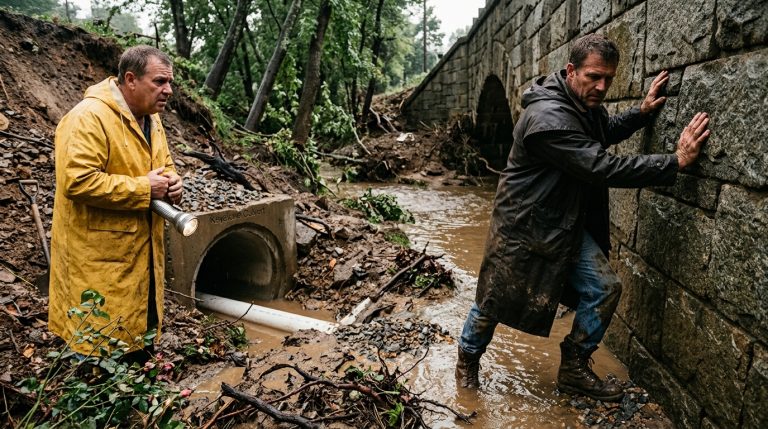
The three-strand barbed-wire fence my grandfather had strung in 1965 was gone. Not broken—cut. The heavy steel wire had been snapped cleanly at three posts, the loose ends coiled back into the mud like dead copper snakes.
Beyond the cut line, where the slope dropped toward Blackwood Creek, a trench twenty feet wide had been carved through the underbrush by a tracked skid-steer.
A white plastic drum, crushed flat along its side, sat half-submerged in the mud at the center of the cut. Black stencil ink showed through the slick layer of rain: VANGUARD INDUSTRIAL — HAZARDOUS CONTAINMENT SAMPLE — PROJECT BLACKWOOD.
Thick, iridescent sludge was seeping out of a seam in the barrel, curling into the fresh rainwater running toward the creek bed.
They weren’t waiting for a court order. They weren’t waiting for the county board to clear Phase 4. They were dumping test loads directly onto my soil to trigger an immediate environmental emergency, forcing the state to condemn the parcel under municipal hazard laws before Ben Mercer could file a motion to stay.
A stick snapped in the laurels behind me.
I didn’t turn around quickly. I slowly brought the beam of the flashlight down, pointing it at the mud three feet in front of my boots. My right hand reached into my coat pocket, my thumb hooking over the pitted notch of the brass timber-gauge.
“You’re trespassing, Aiden,” a voice said from the darkness.
It wasn’t a surveyor. It was Alice Strange.
She walked out from under the drip edge of an old hemlock, holding a large black umbrella over her tailored wool coat. Her leather boots were splashed with red clay, but her hair was pinned back without a single stray lock. Standing three steps behind her was the pale man from the sedan, his hands tucked deep into the pockets of an oilskin jacket.
“You cut my perimeter wire, Ms. Strange,” I said.
“The perimeter wire was an illegal obstruction on an designated hazard zone,” she replied softly. Her voice was flat, robbed of the polite, sugary tone she’d used on my porch two days ago. “The County Environmental Board issued an emergency remediation warrant forty-five minutes ago. This land is under state sequestration.”
“Under Vanguard’s name,” I said.
She didn’t flinch at the word. She didn’t look at the leaking drum in the mud.
“You’re a biologist, Aiden. You know how property law works in this state. Once a watershed is designated as contaminated, private title is suspended. You have no standing to file an injunction. You have no right to enter the zone.”
“You brought the contamination here,” I said, pointing the light at the black stencil on the drum. “You brought it in on a skid-steer from the old chemical site up-river.”
The pale man behind her took one slow step forward. “The origin of the barrel is irrelevant under the emergency statute, Mr. Sloan. What matters is where it sits right now. It sits in your watershed. The water feeds the county reservoir three miles south.”
“You’re poisoning the basin to validate a forged survey,” I said.
“We are securing a regional infrastructure asset,” Alice corrected quietly. She pulled a thin, leather-bound booklet from her coat—an official court summons stamped with a red seal. “You’ll be served with a formal restraining order at eight tomorrow morning. If you step north of your house before the preliminary hearing on Thursday, the sheriff will arrest you for interfering with a hazardous site.”
She extended her hand, holding the summons out in the rain.
I didn’t take it. I let the paper soak up the falling water until the ink began to run across the seal.
“Thursday,” I said.
“Thursday at nine,” she said, letting the paper drop into the mud between us. “Bring your deed, Aiden. Bring your grandfather’s maps. See if seventy-year-old ink can stop a state environmental mandate.”
She turned and walked back up the trench, her umbrella swaying gently through the pines. The pale man stayed behind for three seconds, his eyes fixed on my face, before stepping back into the dark.
I knelt in the mud beside the crushed drum. The chemical sludge was inching closer to the water’s edge, black oil swirling on top of the clear rain pools.
I pulled a glass sample bottle from my coat pocket—the tool I used to test creek water for wild orchid soil chemistry—and dipped the lip directly into the run-off. I sealed the rubber stopper, wiped the glass against my sleeve, and tucked it into my inner pocket next to my heart.
The decision had been taken out of my hands. It wasn’t about property lines or timber value anymore. It was a fight for the bone-deep truth of the land.
CHAPTER 7: THE COURTROOM ANVIL
The glass sample bottle felt cold against my ribs as I stood up from the mud.
The rain had turned into a steady, freezing drizzle that trickled down the back of my neck. I didn’t dry my hands. I walked back up the ridge through the pitch dark, the soles of my boots heavy with wet clay.
Ben Mercer was waiting on my porch when I got to the house. His wool coat was soaked at the shoulders, and his fingers were wrapped around a lukewarm paper cup of coffee from the gas station on Highway 9. He didn’t ask about the mud on my knees. He just looked at the glass vial in my hand, then pulled two thick yellow legal pads from his briefcase.
“Thursday morning,” Ben said quietly, his voice raspy from the cold air. “Judge Vance is presiding. Alice Strange filed an ex parte emergency petition for a environmental containment order under Phase 4.”
“They dropped a barrel of industrial waste into the creek bottom an hour ago,” I said, setting the glass bottle on the porch table. The oily black liquid inside swirled, leaving a dark film against the glass.
Ben leaned down, his eyes narrowing as he looked at the floating sheen. “They’re trying to force the court to sign a land transfer order before we can present the deed.”
“Then we don’t present the deed,” I said. “We present the chain.”
Shadows stretched long across the polished oak floorboards of Department 3 when the bailiff called our case at nine o’clock Thursday morning.
Alice Strange sat at the defense table, immaculate in a midnight-blue blazer. Her attorney, a tall man named Miller with silver hair and a five-thousand-dollar suit, had three thick white binders stacked neatly in front of him. Next to them sat two men in dark gray jackets with small silver lapel pins—Vanguard Infrastructure’s legal representatives.
“Your Honor,” Miller began, standing up and smoothing his tie with a quick, practiced movement. “This is a matter of immediate public safety. The Maple Ridge Homeowners Association, acting in conjunction with county environmental authorities, has identified an unmonitored chemical hazard on Mr. Sloan’s property. Under the regional annexation mandate for Phase 4, we are requesting an immediate order of interim possession so containment crews can secure the watershed.”
Judge Vance looked over his reading glasses at the defense table, then down at his docket. “Mr. Mercer?”
Ben stood up slowly. He didn’t open a binder. He reached into his leather satchel and pulled out three items, laying them side by side on the mahogany railing in front of the judge.
The first was the 1978 original land folio page Arthur Vance had unsealed from Section G. The second was the laminated equipment tag I’d cut from the creek unit. The third was the glass sample bottle, its rubber stopper sealed with red electrical tape.
“Your Honor,” Ben said, his voice flat and steady as iron on stone. “We aren’t contesting an environmental hazard. We’re presenting the chain of custody for the hazard.”
Alice Strange’s attorney frowned, his hand hovering over his stack of binders. “Your Honor, this is procedural nonsense—”
“Sit down, Mr. Miller,” Judge Vance said softly. He leaned forward, pointing at the glass bottle on the rail. “What is that?”
“That is a core sample of industrial runoff, collected forty-eight hours ago from Blackwood Creek,” Ben said. “And this tag, recovered from an unauthorized radar rig on Mr. Sloan’s land, identifies the material as part of Project Blackwood—an internal containment operation belonging to Vanguard Infrastructure.”
Alice Strange didn’t move her head, but her fingers twitched against her purse, her nails digging into the soft leather.
“Vanguard holds no title to the Blackwood Creek basin,” Ben continued, stepping closer to the bench. “What they hold, Your Honor, is a series of shell agreements signed with the Maple Ridge HOA board. They altered the county register—cracking the vault seal on Book 412—to re-label Mr. Sloan’s ancestral timber as an unmanaged hazard zone. They dropped the waste on his soil themselves to trigger this very hearing.”
“That is an unsubstantiated accusation!” Miller snapped, standing up so fast his chair scraped loudly against the hardwood floor. “The HOA acted under standard municipal expansion guidelines for Phase 4—”
“Phase 4 does not exist,” Ben interrupted, his voice dropping into a cold, lethal register. He pulled a folded sheet of paper from his pocket—a certified affidavit signed by Dan Miller of Miller Earthworks. “This is a statement from your primary contractor. He has withdrawn his machinery from the site. He confirms that Vanguard’s escrow account funded the survey work directly, bypassing the county clerk’s office entirely.”
The judge’s eyes shifted slowly from the affidavit to Alice Strange.
She sat completely motionless, but her face had gone pale—a stark, bone-white contrast against her dark blazer. The two men from Vanguard beside her didn’t look at her. One of them slowly reached down, picked up his briefcase, and unclipped his pen from his lapel.
“Ms. Strange,” Judge Vance said, his voice dropping an octave into a low, terrifying calm. “Did your board authorize the alteration of County Folio Book 412?”
Alice looked at her attorney. Miller opened his mouth to speak, but the judge raised a single finger, cutting him off instantly.
“I am asking you, Ms. Strange,” the judge said. “Under oath.”
Alice swallowed hard. Her hand dropped from her purse, resting flat on the mahogany table. Her thumb rubbed against the polished wood, searching for leverage that wasn’t there.
“The board… acted on the advice of regional planning consultants,” she said, her voice tight and thin as drawn wire. “We believed the expansion was properly logged.”
“You believed,” Judge Vance repeated slowly. He leaned back in his leather chair, pulled off his spectacles, and set them on his desk with a quiet click. “What I see in front of me is not an environmental emergency created by a property owner. What I see is a coordinated attempt to execute a fraudulent land grab using altered public records and deliberate soil contamination.”
He picked up his gavel. The heavy brass head glinted under the court lights.
“The petition for emergency possession is denied,” Judge Vance declared, his voice echoing through the silent room. “Furthermore, this court issues an immediate injunction against the Maple Ridge Homeowners Association and Vanguard Infrastructure. All personnel and equipment are to be removed from the Blackwood basin within twelve hours. I am referring the altered county folio and the chemical sample directly to the State Attorney General’s Environmental Crimes Division for immediate criminal investigation.”
The gavel came down with a sharp, final strike that sounded like a rifle shot in the quiet room.
Alice Strange didn’t stand up when the judge rose. She sat staring at the empty wooden railing in front of her, where the glass bottle of black water still caught the light.
I stood beside Ben at the plaintiff’s table. I reached into my coat pocket, pulled out my grandfather’s brass timber-gauge, and let my thumb rest against its notched edge.
The perimeter was holding. But as I watched the two Vanguard representatives walk out the rear doors of the courtroom without saying a single word to Alice, I knew the dirt on my ridge was finally clear.
CHAPTER 8: THE UNCUT HORIZON
The double doors at the back of Department 3 swung shut behind Vanguard’s attorneys, the heavy leather padding muffling the noise of the hallway outside.
I stood at the counsel table, my right hand still deep in my coat pocket. My thumb rested against the cool, pitted notch of my grandfather’s brass timber-gauge. Across the aisle, Alice Strange slowly gathered her papers into her leather portfolio. Her fingers trembled so faintly that only the rustle of the parchment gave her away. She didn’t look at her lawyer, and she didn’t look across the aisle at me.
Ben Mercer snapped his briefcase shut, the brass clasps giving two sharp, metallic clicks that signaled the end of the proceeding.
“State police hazardous materials team is already en route to the creek bottom,” Ben said, his voice quiet as we stepped out onto the courthouse steps. The rain from Tuesday night had cleared, leaving a sky as pale and hard as polished slate. “Arthur Vance turned over the basement access logs twenty minutes ago. The state’s attorney isn’t just looking at the land forgery, Aiden. They’re subpoenaing Vanguard’s entire holding structure for Project Blackwood.”
“They wanted a containment trench,” I said, looking out over the town square.
“They wanted a dump site,” Ben corrected, pulling a cigarette from his pocket and flicking a silver lighter. “Vanguard’s chemical plant six miles up-river was facing forty million dollars in federal compliance fines for unlined solvent storage. The Phase 4 expansion through your timber was designed as a closed-loop drainage conduit to bleed that runoff into your deep shale bed under the cover of municipal development. Alice Strange was promised a vice-presidency at their regional logistics subsidiary once the transfer cleared.”
He took a slow drag, exhaling a thin stream of gray smoke into the crisp air.
“It was never a road, Aiden. It was a corporate liquidation plan for industrial waste.”
I didn’t answer. I walked down the stone steps toward my truck, the heel irons on my boots striking the granite with a steady, rhythmic bite.
A week passed before the silence returned to the ridge.
The state remediation crew worked with surgical precision along Blackwood Creek. They set up yellow containment booms, pumped out the tainted silt, and hauled the crushed drum away in a sealed steel container marked with federal hazardous transport codes. The state police served formal arrest warrants on Alice Strange at her home in Maple Ridge on Monday morning for falsification of public records and conspiracy to violate the state water security act.
By Friday afternoon, the yellow warning tape along my northern boundary had been rolled up and removed. The diesel equipment was gone. The forest belonged once again to the wind in the hemlocks and the dry rustle of red oak leaves.
I spent Saturday morning working along the perimeter.
I carried a coil of heavy twelve-gauge galvanized steel wire, a box of iron staples, and a pair of fencing pliers down to the cut line near the creek. The air smelled of damp earth and sun-warmed pine resin.
I set a new post of seasoned white cedar into the posthole my grandfather had dug sixty years ago. I tamped the clay firmly around the base with the butt of a iron bar until the wood didn’t yield an inch to my shoulder.
I pulled the first strand of wire tight with the pliers, wrapping it twice around the cedar post.
From my coat pocket, I pulled out the brass timber-gauge. I held the notch against the fresh wire, checking the height against the old blaze on the red oak five feet away. Exactly three feet, six inches off the deck. Exactly where the line had run when my grandfather walked these trees after returning from the Pacific in 1945.
I drove the first steel staple into the cedar. The hammer blow rang out through the valley—clean, sharp, and absolute.
A soft crunch of gravel came from the slope behind me.
I didn’t reach for a tool. I stood up slowly, wiping sweat from my forehead with the back of my canvas sleeve, and turned around.
An elderly man in a flannel coat and a canvas cap stood ten feet back on the public side of the creek bed. He was one of the older residents from Maple Ridge—a man I’d seen riding a lawnmower along their pristine curb line for years. In his hands, he held a brown glass bottle wrapped in brown paper.
“Mr. Sloan,” he said. His voice was soft, worn smooth by age and mountain air.
“Morning,” I said.
He stepped forward, set the bottle carefully on a flat granite rock beside the water, and backed away three paces. “The board held a special meeting last night. Alice Strange is officially removed. The community voted to dissolve the Phase 4 corridor committee entirely.”
I looked at the bottle on the rock, then back at his face. “Appreciate you letting me know.”
“That water in the creek,” the old man said, looking down at the clear current washing over the mossy stones. “We drink from the same aquifer three miles down. None of us knew what she was signing off on.”
“Most people don’t look at the signatures until the trees start dying,” I said.
He nodded once, a slow, heavy movement of his chin. “You did what the rest of us were too tired to do.”
He turned and walked back up the access trail toward the pastel houses of Maple Ridge, his boots clicking softly against the loose shale.
I walked over to the flat rock, picked up the bottle, and unpeeled the paper. It was an unlabelled fifth of small-batch bourbon from the distillery in the next county over.
I set the bottle on my truck’s tailgate, sat down on the cedar post I had just set, and pulled my grandfather’s brass gauge from my pocket. I took a small steel file from my toolkit and gently dressed a burr off the corner of the metal—the small imperfection left behind when the surveyor’s tripod had tipped into the water three days ago.
The metal shined bright and yellow under the autumn sun.
Legacy isn’t something you inherit in a leather-bound folder. It isn’t a deed filed in a basement vault where men with brass keys can scrape away the ink with a razor blade. Legacy is the physical resistance of the dirt against the blade. It’s the decision to stand on a line you didn’t carve, holding a boundary you didn’t buy, and telling everything in a suit that some things are simply not for sale.
I stood up, picked up the hammer, and set the second staple against the wire.
The hammer fell. The iron bit deep into the cedar. The line held.