The Cold Arithmetic of Property Lines and Paper Trails: A Story of Sovereign Autonomy
CHAPTER 1: THE FIRST MARK
The orange plastic tab didn’t belong in the clay.
I stopped ten paces from the western boundary pin. A four-foot surveyor’s lath stuck out of the dry dirt, its top wrapped in fresh fluorescent ribbon that snapped against the ridge wind. Three more ran in a straight line toward my foundation forms, cutting sixty feet inside my deeded parcel chain.
My thumb pressed into the brushed-steel drive in my pocket. The edges were cold.
“You’re standing in the setback,” a voice called out.
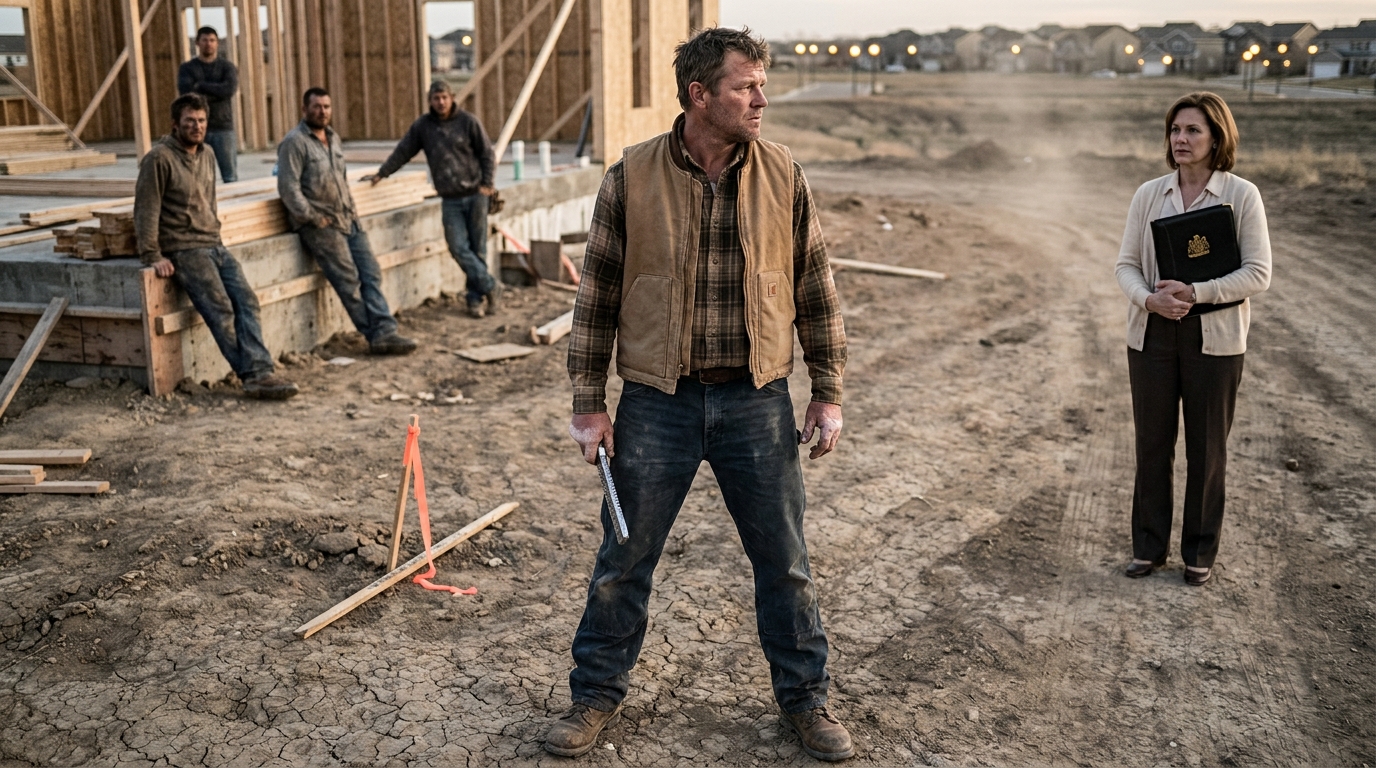
Karen stood on the access track, twenty feet down the grade. Her cream-colored cardigan was buttoned to the neck. Her hands were folded over a black leather binder printed with the gold crest of Golden Summit Estates.
“This is Parcel 14,” I said. My voice stayed low, flat. “Your jurisdiction ends at the asphalt.”
“The ridge panorama belongs to the entire watershed,” she said. She didn’t step onto the dirt. She didn’t have to. “We mailed the architectural notice on Tuesday. You haven’t adjusted your roof line.”
“I don’t open mail from organizations I don’t belong to.” I walked to the first lath. The wood was raw, fresh-cut pine. The dirt around the base was still dark with ground moisture. It had been driven into the soil less than two hours ago while my framing crew was down at the lumber yard.
“We have a scenic easement,” she said. Her expression remained clean, polite, completely empty of heat. “If you pour the deck cantilever on that mark, you impair the western corridor. The board will file for an emergency stay before the concrete cures.”
“Show me the county recording number.”
Karen adjusted her binder. Her fingers were steady. “It’s in the community covenant database.”
“That database covers twenty-four lots downhill,” I said. “This lot was carved off the old Miller homestead in seventy-eight. No covenants. No board.”
“Everything on this ridge affects property values.” She turned toward her SUV parked on the shoulder. Her driver-side door was half-open, engine idling. “Adjust the framing height by four feet, or the county inspector flags the site at eight tomorrow morning.”
She got into the vehicle and pulled away without hitting the horn.
I didn’t follow her. I pulled the lath out of the clay, split the pine over my knee, and dropped the pieces beside the survey pin.
Then I pulled out my phone and dialed the county planning desk.
“This is Miller,” I told the clerk. “Check the portal log for Permit 4091. Who requested an easement audit this morning?”
The line went quiet for six seconds. Keyboards clicked in the background.
“Request came through two hours ago,” the clerk said. “Submitted under the subdivision’s internal review account.”
I tapped the steel drive against the wooden lath scraps. “Read me the login ID.”
“Credentials listed as Golden Summit Estates design chair,” she replied. “ID 802.”
I hung up, pulled the laptop from my truck cabin, and opened the local property registry. The boundary line on my screen matched my deed. But beneath the primary plat lay an archived overlay file tagged Inactive Easement Sheet 4B.
Someone had pulled that dead file out of the county system ninety minutes before the survey stake hit my dirt.
CHAPTER 2: THE PAPER TRAIL
The diesel exhaust from Karen’s SUV lingered in the mountain air, mixing with the smell of turned earth and damp pine.
I picked up the split halves of the surveyor’s lath. The fresh break exposed pale, unseasoned wood. The fluorescent orange ribbon fluttered once, then died as the wind dropped over the ridge.
My thumb worked the edge of the steel drive in my pocket. Four miles down the valley, the streetlights of Golden Summit Estates clicked on in a neat, amber grid. Down there, every house had the same slate roof, the same stone veneer, and the same manicured pretense of harmony.
Up here, the dirt was just dirt.
I walked back to my truck, tossed the broken lath into the bed, and sat in the cab with the door open. The interior light cast a dull yellow glow over the laptop resting on the passenger seat.
The county portal screen was still active.
I clicked into the access history tab. The system logged every view, download, and modification attached to my permit number. Most entries were routine: my structural engineer uploading truss calculations, the county sanitarian signing off on the septic field, the fire marshal verifying driveway turnarounds.
Then there were the anomalies.
Three separate logins over the last fourteen days, all executed between 5:15 AM and 5:30 AM. Each session used the shared subdivision credential assigned to the Golden Summit Estates architectural chair. Each session targeted the same document: my approved site elevation plan.
And eleven minutes after the second login, an anonymous structural concern had been submitted directly to the chief building official.
I pulled a yellow legal pad from the glove box and wrote down the timestamps.
5:18 AM, Thursday. Logged in.
5:29 AM, Thursday. Flagged.
The timing wasn’t a coincidence. It was a routine.
The gravel crunching under heavy tires made me look up. A white utility truck with a crane arm mounted on the bed turned off the county road and idling fifty feet from my property line. The company name on the door read High Country Fencing & Grading.
The driver’s side window rolled down. A man in a high-visibility vest leaned his forearm on the sill. He had a scarred thermos in his cup holder and a clipboard sitting on the dash.
“You the owner of Parcel 14?” he asked. His voice was raspy from dust and cheap tobacco.
“I am,” I said, stepping down from the cab.
He reached for a sheet of paper on his clip. “Got a work order to drop thirty posts along the western ridge line tomorrow at six. Setback buffer fence.”
“Who signed the order?”
He flipped the top page. “HOA management office. Golden Summit.”
I didn’t raise my voice. I didn’t step into his path. I just pulled the steel drive out of my pocket, held it between two fingers, and let the streetlight catch the polished surface.
“That HOA doesn’t own this parcel,” I said. “The county access road ends at the asphalt. If your crew drops posts past that culvert, you’re on private property without an easement.”
The driver looked at the clipboard, then looked at the line of raw dirt where I’d pulled the stake ten minutes ago. He wasn’t stupid. He was a subcontractor getting paid by the hour, and he knew the sound of a legal dispute when he heard one.
“Order says the easement Sheet 4B was cleared by the board,” he muttered, pointing a calloused finger at a line item on the page.
There it was. Inactive Easement Sheet 4B.
“Sheet 4B was vacated by the county board of commissioners in 1994,” I said. “It’s an inactive filing. Whoever gave you that paper pulled it out of an archived index to stall my foundation pour.”
The driver rubbed the back of his neck. His hand left a smudge of dark grease against his skin. “Look, pal. I don’t care about views or roof lines. I just install the wire.”
“If you install wire on my dirt, I call the sheriff for criminal trespass,” I said calmly. “And then I name your company as a co-defendant in a civil interference suit. Your boss’s legal department will spend more on retainer this week than you’ll make on thirty fence posts.”
He looked at me for three long seconds. The truck engine rumbled in the quiet evening, emitting a steady, rhythmic vibration through the gravel floor.
Finally, he reached up and pulled his window up four inches.
“I’ll have the office call the client,” he said through the gap. “We don’t work contested lines.”
He put the truck in reverse, backed into the turn-around, and headed back down the mountain road toward the valley. The red tail lights shrank into two tiny dots before disappearing around the bend.
I stood in the dust he left behind, listening to the silence return to the ridge.
The subcontractor was gone for the night, but the paper trail remained. Karen hadn’t just filed a complaint; she had issued a commercial work order based on a dead county record, betting that I’d fold under the pressure of crew trucks and fencing wire before I checked the archives.
I sat back down in the truck, opened the property registry on my screen, and pulled up the full text of Inactive Easement Sheet 4B.
At the very bottom of the second page, stamped in faint red ink from thirty years ago, was a clerk’s signature and a cross-reference number linking back to the original subdivision plat.
I typed that cross-reference number into the county land records search.
The screen flickered, refreshed, and opened a file I hadn’t seen before.
It wasn’t an easement for the ridge view. It was a old utility right-of-way that had been abandoned when the power lines were buried underground in ninety-six. And listed right under the original grantor’s name was a secondary signature line—one that had been added during a minor boundary adjustment twelve years ago.
The signature belonged to Karen’s husband.
I stared at the black-and-white scan on the monitor as the cab heater blew lukewarm air against my boots.
She didn’t just know Sheet 4B was inactive. Her family had been part of the land transaction that killed it.
CHAPTER 3: THE FLAGGED PERMIT
The name on the archived line remained clear on the screen: Arthur Miller.
My father’s signature sat directly beneath the line where Karen’s husband had signed as the managing developer of Golden Summit Estates back in ninety-four. The agreement had explicitly terminated any secondary scenic encumbrances across the entire ridge.
It was a legal dead end for her. And she knew it.
I tapped the steel drive against the steering wheel. The metallic click sounded sharp in the small space of the truck cab. She wasn’t relying on the validity of the document. She was relying on the weight of the municipal machinery—the assumption that a solo builder wouldn’t spend six hundred dollars in filing fees and three days at the county records desk to verify a sixty-year-old survey chain.
My phone vibrated on the dash. The screen displayed an unlisted regional number.
I picked it up on the third ring. “Miller.”
“Mr. Miller,” a voice said. It was smooth, dry, and carried the controlled cadence of someone who read municipal codes for a living. “This is Vance from the County Building Inspections office.”
“Evening, Vance. I sent over the site portal logs two hours ago.”
“I’m looking at those now,” Vance said. Paper rustled on his end of the line. “Along with a formal administrative flag submitted at four-thirty PM.”
“Submitted by who?”
“The architectural review board for the adjacent development,” Vance replied. “They’ve formally disputed your access road alignment. Claiming it overlaps an active public trail easement registered under Golden Summit Estates.”
I leaned forward, resting my elbow on the window frame. “The scenic trail easement ends four hundred feet downhill at the cul-de-sac. It doesn’t touch Parcel 14.”
“They attached a map sheet,” Vance said. “Sheet 4B.”
“Sheet 4B is inactive,” I said flatly. “Check the county recorder’s vacation index from 1994. Cross-reference entry seven-zero-two.”
There was a long silence on the line. Keyboards clacked in the background, a steady, mechanical rhythm.
“The system shows a pending review,” Vance said after a moment. His tone hadn’t changed, but the speed of his words slowed down. “Standard protocol requires us to hold the framing sign-off until the survey division verifies the easement status. That puts a administrative hold on your electrical and plumbing rough-ins.”
“How long is the hold?”
“Thirty days standard. Sixty if it goes to the board of adjustments.”
That was the move. It wasn’t about winning a boundary suit; it was about freezing my construction loan. Lenders had forty-five-day draw schedules. If the framing wasn’t certified by the end of the month, the bank would freeze the remaining capital, my subcontractors would move to other job sites, and the interest on the primary line would start eating the remaining budget.
“Who entered the flag into the portal, Vance?”
“It came through the general board account,” Vance said carefully. “Credential Log #802. I don’t have an individual name attached to the digital seal.”
“Check the IP submission,” I said. “Compare the portal upload timestamp against the email sent to your department head at four-nineteen PM.”
Silence again.
“I’m an inspector, Mr. Miller, not an IT investigator,” Vance said, though his pen was clicking rapidly. “If the easement is inactive, bring the certified vacation order to the planning desk tomorrow at eight AM. If the seal is valid, I’ll lift the flag before the morning site visits begin.”
“I’ll be there at seven-forty-five,” I said.
“Make sure it’s an original stamped copy,” Vance added. “The board’s legal counsel already CC’d our department head on a notice of intent.”
I hung up, closed the laptop, and set it on the floorboards.
I reached for the ignition key, turned it, and listened to the engine roar to life. The headlights cut through the dark, illuminating the raw clay slope, the open floor joists of the unfinished main floor, and the single broken piece of survey stake lying near the gravel edge.
Karen wasn’t trying to slow down the project from the outside anymore. She was using county administrative rules as a lever to force a default with my lender.
I put the truck in gear, turned off the ridge road, and drove down toward the valley floor, where the streetlights of the subdivision formed a tight, orderly grid in the dark.
Ten minutes later, I pulled onto the shoulder of the county road directly across from the Golden Summit Estates stone entrance monument. The neighborhood was quiet. Uniform lantern posts lit every driveway at identical intervals.
I didn’t turn into the development. I parked near the mail station where the public road met the private access gate, pulled my phone back out, and dialed my attorney’s direct line.
“It’s Miller,” I said when he answered. “She used the portal credential again at four-thirty. Flagged the access road using the inactive 4B sheet.”
“We need the physical recorder’s stamp,” my attorney said. His voice was quiet, background noise suggesting he was still at his office desk. “A digital printout won’t override an administrative stay if the department head wants to avoid liability.”
“I have the cross-reference number from my father’s old file,” I said, looking across the road at the lit entrance sign. “The original paper file is in the vault at the county clerk’s office. But there’s a second copy.”
“Where?”
“In the HOA’s own historical plat archive,” I said. “The one stored in the community center right behind that gate.”
My thumb pressed hard against the cold metal edge of the drive resting in my pocket.
“Don’t do anything stupid, Miller,” my attorney warned. “If you step over that gate line, she’ll have you arrested for criminal trespass before the sun comes up.”
“I’m not stepping over the gate,” I said. “I’m going to make her bring the file to me.”
CHAPTER 4: DISCOVERY OF METADATA
“I’m not stepping over the gate,” I told my attorney, looking through the windshield at the iron spears topping the stone wall. “I’m going to make her bring the file to me.”
“Miller, think this through,” he replied, his voice tinny through the speaker. “If she realizes what you have, she won’t hand over a historical folder. She’ll bury it.”
“She can’t bury what she already sent to a third party.”
I disconnected before he could argue. The phone went dark in my palm, reflecting the amber glow of the estate lights.
I didn’t drive through the gate. I backed the truck thirty yards into the gravel turnout near the county mailbox cluster, cut the ignition, and pulled the laptop back onto my knees. The cab was cooling fast, the sharp mountain draft seeping in through the door seals.
I opened the local email client and located the very first message Karen had sent three weeks ago—the one copied to my builder, my lender, and the chief inspector.
Attached was a four-megabyte PDF file titled Panorama_Impact_Study.pdf.
I didn’t open the PDF reader. I dragged the file into an open-source hex viewer and extracted the raw stream metadata.
Line 42: Creator: Microsoft Word for Mac.
Line 48: Author: K_Miller_GSE_Design.
Line 53: CreationDate: D:20260714081230.
Fourteen days ago. Two days after my framing permits had already been stamped and signed off by the county engineer.
I scrolled down to the embedded media objects. The photo she had included—the one showing my framing line supposedly “violating the horizon”—contained EXIF tags. Camera model: iPhone 15 Pro. GPS coordinates: matching my western slope pin.
Creation date of the photo: July 11th.
She had stood on my dirt three days before she ever typed her first polite concern on official letterhead. She hadn’t been reacting to a framing line. She had been surveying the lot before my concrete truck even cleared the staging yard.
I saved the raw metadata dump into a separate directory on the steel thumb drive, created a mirror copy on the truck’s local storage, and then opened an outgoing mail draft.
I addressed it directly to Karen’s personal address—the one listed on her HOA board registration—and CC’d the survey contractor who had dropped the stakes earlier that afternoon.
I attached three items:
The 1994 county commissioner vacation order for Inactive Easement Sheet 4B.
The EXIF timestamp report showing her presence on Parcel 14 on July 11th.
The raw activity audit from Permit Portal Credential Log #802.
In the body of the email, I wrote six words:
We will discuss this at eight.
I hit send.
The screen flickered as the outgoing queue cleared. I closed the laptop lid, set it on the passenger seat, and leaned my head back against the vinyl headrest.
Outside, the wind picked up, rattling the dry pine needles against the truck’s roof.
For twenty minutes, nothing moved in the valley below. Then, the brake lights of a dark luxury sedan lit up near the upper cul-de-sac behind the wrought-iron gate. The vehicle rolled slowly down the asphalt drive, paused at the key card scanner, and swung through the opening.
It didn’t turn toward the main road. It pulled onto the gravel shoulder, stopping fifteen feet from my front bumper. Its high beams stayed on, slicing through the dark cab of my truck.
The driver’s door opened.
Karen stepped out. She wasn’t wearing her cardigan now. She wore a tailored wool coat, her arms crossed tight against her chest against the wind. She didn’t carry her black leather binder. She held a single white envelope, clutched so tightly in her right hand that the paper bowed under her fingers.
I opened my truck door, stepped down onto the gravel, and let the cold air hit my face.
“You’re making a mistake,” she said. Her voice carried over the idle of her engine, flat and devoid of the polished politeness she’d used in her emails.
“You used an inactive easement sheet to file a false administrative hold,” I said, staying on my side of the gravel line. “That’s municipal fraud.”
“That easement was intended to protect the ridge line,” she said. Her left hand twitched, her thumb rubbing against the raw edge of her coat pocket—an unconscious rhythm that betrayed the calm on her face. “My husband built this community. We spent twenty years ensuring the architectural integrity of this slope.”
“Your husband signed the vacation order in ninety-four,” I said. “His name is on line two.”
She went still. The wind whipped a strand of gray-ing hair across her forehead, but she didn’t move to pull it back.
“The board will not drop the injunction,” she said softly.
“The board doesn’t have a choice,” I replied, pulling the steel drive out of my pocket and holding it in the light of her headlights. “Because if we go to court on Monday, I don’t just present the vacation order. I present the survey contractor’s email.”
Her eyes narrowed slightly. “What email?”
“The one where your contractor asked if they should use the older sheet because the county recorder listed it as inactive,” I said. “And the reply from your address telling them to use it anyway just long enough to pause my build.”
Karen’s jaw set hard. Her fingers dug deeper into the paper envelope, tearing a tiny tear along its top seam.
“You don’t have that,” she whispered.
“I have the subpoena draft,” I said. “And the survey company’s general counsel receives a copy at seven AM unless the flag on Portal Log #802 is retracted.”
She stared at me for five long seconds. The high beams of her car cast our shadows long and sharp across the gravel shoulder and up onto the rough bark of the embankment behind us.
Without a word, she turned on her heel, walked back to her sedan, and slammed the door.
The car backed into the turn-around, its tires kicking up a shower of dry stones, and sped through the gate before the iron bars could fully close behind it.
I stood in the dark, feeling the cold wind cut through my jacket.
My phone chimed in my pocket. A single notification flashed on the glass screen:
County Permit Portal: Administrative flag on Permit 4091 has been marked [UNDER REVIEW – STATUS SUSPENDED BY APPLICANT].
It wasn’t a full withdrawal. It was a tactical pause. She was buying time for her lawyer to review the discovery threat before the courthouse opened in the morning.
I picked up a stray stone from the road, turned it over in my palm, and tossed it into the brush. The fight wasn’t over. It was just moving from the dirt to the courtroom.
CHAPTER 5: THE HEARING
The stone sat heavy on the counsel table between my attorney and my laptop.
Outside the tall, narrow windows of Courtroom 3B, a cold rain slicked the county courthouse parking lot. Inside, the radiator against the wall hissed, a steady, rhythmic leak of steam cutting through the quiet.
Karen sat at the opposing table. Her hair was held back in a silver clip, her hands resting quietly over a thick, dark leather portfolio. Beside her, a young associate in a tailored pinstripe suit adjusted a stack of brass-bound folders every three minutes.
My attorney didn’t touch his folders. He sat with his hands loosely clasped over his notepad, waiting.
The double doors at the back of the courtroom swung open, and Judge Joseph Vance stepped down the bench steps. He didn’t look at either table as he sat, pulled his reading glasses from his coat pocket, and opened the master docket file.
“Injunction request 26-CV-4091,” Judge Vance said. His voice was gravelly, worn smooth by thirty years of civil disputes. “Golden Summit Estates Homeowners Association versus Miller. Motion for emergency stop order.”
Karen’s counsel stood up immediately. He smoothed his coat, rested his fingertips on the oak bar, and leaned forward.
“Your Honor,” he began, his tone carrying the practiced resonance of a corporate negotiator. “We are requesting an immediate interlocutory stay on the construction at Parcel 14. My client represents twenty-four homeowners whose deeded panoramic corridor is currently being obstructed by unapproved framing lines.”
Judge Vance didn’t look up from his papers. “Is Parcel 14 part of your covenant?”
“The physical lot sits outside the primary gate, Your Honor,” the attorney admitted, “however, the scenic easement recorded under Sheet 4B explicitly protects the western slope view corridor for all adjacent parcels.”
“Sheet 4B,” Judge Vance repeated slowly. He reached for a yellow tab in the binder. “Council, are you seriously asking this court to recognize ownership over what someone happens to see from patio furniture?”
A brief, sharp silence fell over the room.
The associate at Karen’s table shifted his feet. Karen herself remained motionless, but her chin rose half an inch.
“It is an established equitable right, Your Honor,” her attorney pushed back quickly. “The homeowners of Golden Summit Estates bought their properties under the clear expectation that the western horizon would remain unencumbered.”
“Expectations don’t run with the land, council,” Judge Vance said, finally setting his pen down with a dull click against the blotter. “Deeds do.”
My attorney stood up. He didn’t reach for a speech. He reached for the steel drive resting beside the stone, plugged it into the clerk’s monitor feed, and tapped the spacebar twice.
The projection screen mounted on the side wall flickered to life.
“Your Honor,” my attorney said, “we submit Exhibit A: County Commissioner Vacation Order 702, dated September 14, 1994. Signed by the county board and recorded under Book 411, Page 88.”
A high-resolution scan filled the screen. The red clerk’s stamp stood out sharp against the yellowed paper.
“This order explicitly vacated Inactive Easement Sheet 4B thirty-two years ago,” my attorney continued. “It terminated all scenic encumbrances across Parcel 14. And line two of the grantor release carries the signature of Arthur Miller—the developer who created the subdivision.”
Judge Vance leaned forward, his glasses slipping down his nose as he scanned the document. “Line two is signed.”
“And line three, Your Honor,” my attorney added softly, “carries the signature of Harold Miller—acting managing partner for Golden Summit Estates, and the late husband of the current HOA design chair sitting at that table.”
Karen’s hands tightened over her leather portfolio. The knuckles turned a sharp, bloodless white.
“She knew the easement was dead,” my attorney said, clicking to the next slide. “Yet at four-thirty PM yesterday, credential ID 802—assigned directly to Mrs. Miller’s office—was used to file an administrative hold using that exact inactive sheet.”
The screen shifted to a raw text log.
Permit Portal Credential Log #802
User: K_Miller_GSE_Design
Action: Administrative Flag Submitted – Attachment: Inactive_Sheet_4B.pdf
Judge Vance looked over his glasses at Karen’s lawyer. The tiredness in his eyes had turned into something cold and sharp.
“Counsel,” the judge said, his voice dropping an octave, “did your client submit a revoked document to a county inspector to freeze a private construction loan?”
Karen’s attorney looked at her. Her face was completely devoid of color now. She didn’t look back at him; her eyes remained fixed on the projection screen where her husband’s thirty-year-old signature sat beside the system audit log.
“Your Honor,” her lawyer stammered, his posture collapsing slightly, “my client was acting under the belief that the historical record—”
“That,” Judge Vance interrupted, his voice echoing across the high ceilings like something snapping, “is disappointment dressed up as doctrine.”
He grabbed his gavel, held it two inches above the sound block, and looked directly at Karen.
“Injunction denied with prejudice,” the judge ruled. “The administrative flag on Permit 4091 is ordered struck from the county portal immediately. Petitioner will pay all costs, including respondent’s legal fees incurred since the initial filing.”
He brought the gavel down with a single, heavy thud.
“Court is adjourned.”
Judge Vance stood, collected his binder, and walked out through the rear door before the echo of the wood impact had even faded.
My attorney closed the laptop lid with a soft click. He reached down, pulled the steel drive from the port, and slid it back into my palm.
Across the aisle, Karen sat alone at the oak table. Her associate was already stuffing folders into a leather briefcase, his eyes fixed on the floor, while she slowly unbuttoned her coat with trembling fingers.
She didn’t speak. She didn’t look across the room.
I stood up, picked up the stone from the table, and walked out into the corridor.
CHAPTER 6: THE SUNSET SETTLEMENT
The heavy oak doors of Courtroom 3B swung shut behind me, muting the sharp click of heels on marble as Karen’s associate rushed toward the elevator.
I walked out to the courthouse steps. The rain had stopped, leaving the asphalt black and reflective under the clearing sky. I slid the small stone back into my coat pocket, right beside the steel thumb drive. The metal felt warm against my fingers now, heat absorbed from the laptop ports during the hearing.
My attorney stepped out beside me, pulling a wool scarf around his neck against the damp breeze.
“The clerk will issue the certified copy of the order by two PM,” he said, turning his collar up. “I’ll deliver it directly to the chief building official. Your framing inspection clears before five.”
“And the legal fees?”
“Her firm filed a stipulation thirty seconds before Vance stepped off the bench,” he replied, pointing a finger toward the parking lot where Karen’s sedan was idling near the gate. “They’re cutting a bank draft to my firm’s trust account by Friday. Full reimbursement for the emergency filing, the survey audits, and the court costs.”
He looked up at the ridge, where the clouds were breaking to reveal a sharp, amber sliver of afternoon light over the peak.
“She built that whole neighborhood on the idea that authority comes from consensus,” he said softly. “She forgot that consensus stops at the property pin.”
“She didn’t forget,” I said. “She just didn’t expect anyone to read the deed.”
He nodded once, shook my hand, and walked toward his car.
I stood on the wet stone steps for another minute, watching the last of the courthouse crowd disperse into the street. Then I got into my truck, turned the key, and headed back up the mountain road.
The drive was quiet. The road dried as I gained elevation, the wet asphalt giving way to dry gravel as I crossed the line onto Parcel 14.
My builder was already there. His red pickup was parked near the staging pad, and the sound of a framing nailer echoed rhythmically across the valley floor—thump-thump, thump-thump.
I stepped out of the truck and walked up the gravel slope toward the foundation pad. The open floor joists of the main deck stretched out toward the valley, clean, square, and fully framed.
“Inspector called,” my builder shouted over the noise of the generator, stepping off the top plate with a hammer in his hand. “Said the administrative hold vanished off the county portal at twelve-thirty. Sign-off is stamped on the site card.”
He reached into a cooler sitting on a stack of floor sheathing, pulled out two cold bottles, and handed one to me.
“We pour the cantilevered deck at seven tomorrow morning,” he said.
“Same roof line?” I asked.
“Exact same roof line,” he replied, popping the cap off his bottle. “Same deck, same wide west-facing glass.”
We walked out to the edge of the joists, where the framing extended over the slope. Four hundred feet below, the slate roofs of Golden Summit Estates sat neatly arranged along their asphalt cul-de-sacs. In the driveway of the house on the corner, a dark sedan sat parked, its engine off, its windows dark.
From down there, looking up, my house sat squarely on the skyline. Not a visual injury. Just a boundary line made physical in pine and concrete.
I leaned against the temporary guardrail, resting my elbow on the raw, unplaned wood. The sun was dropping fast now, melting into a deep orange wash that flooded the valley, painting the stone monuments, the manicured lawns, and the open ridge in the exact same cold, clean light.
The line between taste and control was a property line. One was an opinion. The other was the law.
I took a slow drink from the bottle, set the cap on the top plate, and watched the darkness settle over the mountain.