The Quiet Hand at Dawn: How an Old Founder Restored the Soul of a Flagship Store Without Saying a Word
CHAPTER 1: THE WORN JACKET
The heavy wool of the second-hand jacket scratched against Harold’s neck. He didn’t mind the friction. It anchored him to the cold linoleum of Colfax Avenue better than any tailored suit ever could.
The bell above the glass door swung shut with a dull rattle. Tiffany Grant didn’t look up from her phone screen, her thumb flicking rhythmically across glass while her hip rested against the register drawer.
Beside her, Jenna Moore tossed a damp microfiber towel onto the espresso machine with a sharp wet slap.
“Order or get out,” Tiffany said. Her voice was flat, practiced, and entirely empty of air.
Harold stood still, his scuffed work shoes flat against the floor. A young couple brushed past his elbow, sliding into the warmth of the front alcove. Tiffany’s head snapped up instantly, her face transforming into an effortless, radiant beam.
“Hey guys, welcome to Iron Brew. What can I get started for you?”
Harold waited through the transaction. He watched the ease with which she handed over their ceramic mugs, the gentle dip of her chin, the warm send-off. Then the couple stepped away, and the shutters dropped back down over her eyes.
She turned her gaze back to Harold as if inspecting a piece of debris tracked in from the rain.
“You still standing there? What do you want?”
“A cortado, please,” Harold said. His voice was low, level, keeping the rough edges of his Capitol Hill apartment subdued beneath the hum of the refrigerator motors. “And a slice of banana bread.”
Tiffany tilted her head, her lips curling in a slow, theatrical disbelief. She glanced sideways at Jenna.
“A cortado? You don’t even know what that is. Get your black coffee and go sit on the curb where you belong.”
Jenna snorted, her fingers tracing the edge of the steaming wand. “Dude crawled out of a trash can. Bet that card’s stolen.”
Harold felt a familiar, heavy heat rise behind his collar, but he kept his hands flat against the laminate counter. He did not blink. He remembered the Englewood garage, the rusted steel frame of his very first cart, the promise he made to his mother by the kitchen door.
“I know what a cortado is,” Harold said quietly. “I’d like one, please.”
Tiffany sighed with exaggerated exhaustion, punching three awkward strokes into the terminal before scribbling hasty letters across a paper cup. She grabbed the bills from his palm with two fingers, pulling them away as if his skin might stain hers, and dropped his copper change directly onto the slick surface of the counter.
Three coins spun in place.
Harold reached down, picked them up one by one, and carried his lukewarm drink to the corner table by the drafty window. He took a bite of the banana bread. It was dense, rich, and spiced with a precise balance of nutmeg and brown sugar. Excellent. The best thing in the room.
And then, above the hiss of the steam wand, the voices drifted over to him unfiltered.
“At least he didn’t bring his whole family,” Tiffany laughed, leaning her weight against Jenna. “Last week that woman brought three kids and let them run around like animals. We need to protect the vibe. Some people just don’t fit the brand.”
Harold stared down at the dark coffee ring stained into the wood grain beneath his cup. He pulled his phone from his pocket, opened a blank note, and typed a single, heavy word.
Rot.
CHAPTER 2: THE BACK DOOR SHIFT
Harold laced his scuffed work shoes in the cramped gloom of the basement corridor, his thumb catching on a frayed shoestring. Above his head, the floorboards vibrated with the heavy, rhythmic thrum of the espresso machine firing up for the early shift.
He pulled the gray polo over his head, the synthetic fabric clinging tight to his shoulders.
The heavy metal door clicked open behind him, letting in a draft of cold Colfax air and the dry clatter of a plastic crate hitting the concrete floor. Emma Sullivan stood in the doorway, her apron already stained dark across the pocket with old coffee rings.
She didn’t look at his face. Her eyes tracked straight to the milk crates he was stacking beside the ice machine.
“Lids go under the second sink, not the first,” she said, her voice dropping into the steady, unhurried cadence of a woman who had saved her words for things that mattered. “First sink is sanitizer. Mix those up, you’ll taste bleach in your espresso for a week.”
“Got it,” Harold said, keeping his voice flat, textured with the fatigue of a man trying to stretch a paycheck.
At 6:40 a.m., the front bell chimed with a high, clean ring.
Walter stepped through the glass, his heavy wool coat swallowing the morning damp, his shoulders bowed against the chill of Denver’s early spring. Emma’s shoulders dropped an inch, the rigid posture of her opening shift softening just enough to let the air back in.
“Walter, oat milk cortado extra warm?” she asked, already reaching for the portafilter before he reached the wood.
Walter smiled, his cracked lips parting with a slow, grateful surprise. “You remember.”
“Every day for three years,” Emma said, sliding the ceramic mug across the laminate with both hands.
She didn’t linger. She didn’t perform a cheerful customer service routine. She simply cleared space for him to exist without apology.
Harold watched from the prep counter, wiping down a stainless steel surface that didn’t need wiping.
“How long you been running these pre-dawn openings alone?” Harold asked, his rag moving in tight, methodical circles.
Emma paused, her cloth hovering over the steam wand. A faint micro-tension pulled at the corner of her left eye, the only sign of wear on an otherwise granite composure.
“Four years,” she said. Her hands went back to work, wiping, sorting, moving with a fluid economy that wasted no energy. “I like the coffee.”
She didn’t mention the shift schedule. She didn’t complain about the endless string of 5:00 a.m. starts and 10:00 p.m. closes.
At 9:55 a.m., the front door rattled open with a sharp, heavy shove that signaled a change in the room’s atmospheric pressure.
Tiffany Grant and Jenna Moore walked in, their laughter bright and invasive, smelling of heavy perfume and expensive hairspray. The air in the store instantly dried out, tightening like a fist around the throat.
Emma stopped wiping the counter, her movements instantly retreating into the physical background without a word being spoken.
“Did you pre-stock the oat milk?” Tiffany snapped, tossing her canvas bag onto the back shelf with a loud thud. “I’m not doing it again.”
“It’s done,” Emma said, her voice dropping an octave, flattening into defensive glass.
“It better be,” Tiffany muttered, already turning toward the front mirror to check her lip gloss.
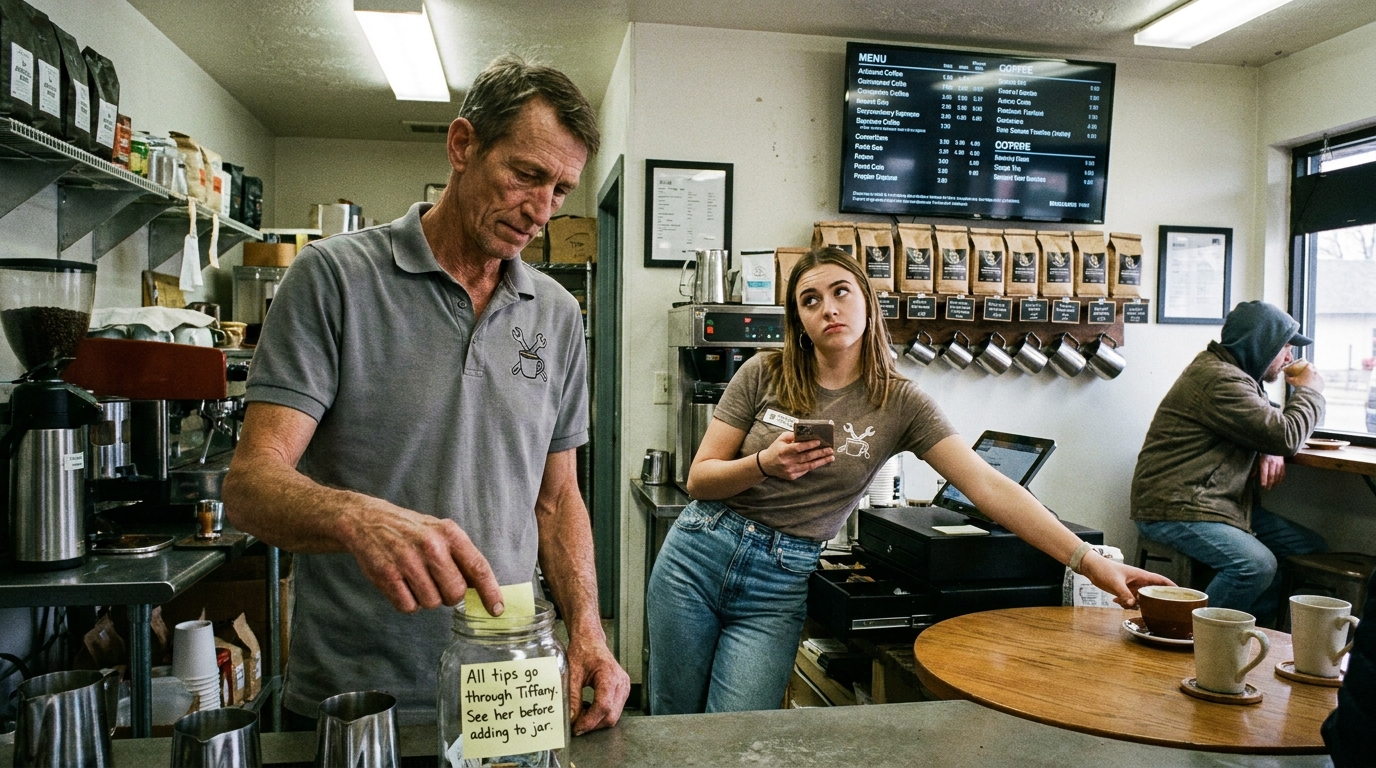
Harold stepped back into the prep alcove, his hand brushing against the ceramic tip jar sitting on the shelf between the napkins and the sanitizer. The sunflowers painted on its side caught the fluorescent glare.
On the front of the jar, taped down with aggressive neatness, a sticky note caught his eye.
All tips go through Tiffany. See her before adding to jar.
Harold reached out, his thumb catching the edge of the paper. It peeled away with a dry, quiet hiss, revealing the hand-painted ceramic sunflower petals underneath, faded from too many wipes with industrial cleaner.
CHAPTER 3: THE INDEX CARD
The card was thick, yellowed at the crease, and marked with columns of erratic handwriting that smelled faintly of cheap vanilla hand lotion.
Harold held it beneath the lip of the register drawer, out of sight of the front mirror where Tiffany was reapplying lipstick.
The left column was headed with small, hastily drawn hearts next to names he recognized from his morning observations.
Tech guy Jake—tips five dollars.
Instagram girl—tags us, free extra shot.
Blond couple—good vibe.
The right column carried neat, sharp X’s.
Old guy Walter—just sits, nurses one drink.
Lady with three kids—messy, don’t encourage.
Flannel man—doesn’t fit.
Harold stared at the final entry on the list. Flannel man.
That was him. The disguise he had worn on his first morning back, the scuffed shoes and the worn wool jacket he pulled from the back of his Capitol Hill closet.
He flipped the card over.
On the back, scrawled across the blank cardboard in Tiffany’s sharp, impatient script, a single operational rule laid bare the philosophy of the front counter.
If they’re not brand fit, slow service. They’ll leave on their own. Don’t make a scene, just make it clear they’re not welcome.
Harold slid the card back into the slot between the fifty-dollar bills and the receipt rolls, his thumb pressing it flat until it vanished from view.
The bell above the door chimed, and a woman in mid-50s hospital scrubs stepped out of the cold morning air, her lanyard swinging against her hip.
Patricia Davis stood at the counter, her shoulders tight with the exhaustion of a twelve-hour nursing shift.
Tiffany didn’t look up from her phone screen immediately, letting three full seconds pass before she dragged her gaze up to meet Patricia’s eyes.
“What do you want?” Tiffany asked, her voice dropping into that flat, transactional register reserved for the X column.
“A vanilla latte, please, and a muffin,” Patricia said, her voice tired but polite.
Tiffany punched the order in with heavy, resentful keystrokes, scribbled a hasty set of letters across a paper cup without asking for a name, and shoved it across the laminate without a word.
When Patricia picked it up, her brow furrowed at the marker ink scrawled across the side.
“Excuse me, my name is Patricia, not Pat,” she said softly.
Tiffany turned her back to wipe down the syrup bottles.
“Same thing,” she muttered over the hiss of the steam wand.
Patricia walked to a corner table, took one sip of the lukewarm milk, set the cup down with a dull thud, and walked out into the rain.
Harold watched her go, his jaw locking into a hard, immovable line as the heavy glass door clicked shut behind her.
CHAPTER 4: THE STOLEN NOTEBOOK
Harold flipped the cover back with a dry scrape of cardboard against steel, his thumb tracing the frayed cloth spine.
Inside, page after page of meticulous handwriting mapped out flavor combinations that had saved his company millions during the previous fiscal quarter.
Autumn Maple Cortado. Summer Berry Cold Brew. Holiday Spice Latte. Banana Pecan Bread.
Each recipe carried a date written in Emma’s sharp, precise hand—two full months before regional manager Ron Hadley ever submitted them to corporate as his own original initiatives.
Harold pulled his phone from his pocket, angling the lens to capture the inked dates under the dim fluorescent tube.
Footsteps echoed softly in the narrow hallway behind the break room, heavy and deliberate.
Emma stood in the doorway, her arms full of clean white hand towels, her eyes locking onto the open notebook in his hands.
She didn’t flinch or drop the towels. A quiet, heavy tension settled between them, dense with the unspoken weight of four years of stolen labor.
“You found them,” Emma said. Her voice didn’t shake. It carried the dull, flat resonance of someone who had long since stopped expecting justice.
“I found them,” Harold replied, his thumb pressing against the paper edge. “Every single one.”
“Ron said corporate development is a regional function,” she whispered, her fingers tightening around the linen folds until her knuckles whitened. “He said individual contributions don’t get names on menus.”
“Ron lied,” Harold said, his voice dropping into a register that left no room for argument.
Emma stared at him, her dark eyes searching his face, looking past the scuffed work shoes and the faded gray polo, looking for the man beneath the disguise.
“Why do you care, Henry?” she asked, using the fake name he had built in the system. “You’re just a transfer from the Springs. It’s just coffee.”
“It’s not just coffee,” Harold said, setting the notebook flat against the steel. “It’s the foundation.”
Before Emma could answer, the front bell chimed with a sharp, aggressive ring, followed by the sound of Ron Hadley’s expensive leather shoes clicking across the hardwood floor.
“Emma!” Ron’s voice boomed through the narrow corridor, thick with false cheer and sharp cologne. “We need those restocked before the lunch rush hits. Stop chatting with the new guy.”
Harold slid his phone into his pocket, his jaw locking into place as the heavy scent of designer fragrance drifted closer to the break room door.
CHAPTER 5: THE CONFERENCE ROOM
The fluorescent tubes hummed with a thin, metallic whine that cut through the silence of the windowless room.
Harold stood at the head of the long wooden table, his worn wool jacket pulled close across his chest, his scuffed shoes planted firmly on the floor.
Tiffany Grant sat in the second row, her fingers locked tightly around the strap of her leather handbag, her knuckles stark white against the dark leather.
Beside her, Jenna Moore chewed furiously on a piece of gum, her eyes darting toward the closed door as if looking for an exit.
In the front row, Ron Hadley crossed his legs with an exaggerated display of ease, his arms spread wide across the adjacent chair, his expensive cologne thick enough to taste.
Emma Sullivan sat quietly in the very last row, her hands folded over her lap, her shoulders straight.
“Four days ago,” Harold began, his voice low and level, cutting straight through the hum of the overhead lights, “I walked into this store and ordered a cortado. The cashier looked at me and told me to go sit on the curb.”
Tiffany’s breath hitched, a sharp, ragged sound that broke the stillness.
“My name is Harold Coleman,” he said, resting both hands flat against the wooden table. “I founded this company. I built this store with my own hands 23 years ago in a garage in Englewood.”
The color vanished from Tiffany’s face all at once, draining down past her jawline until her lips were pale as paper.
Jenna stopped chewing, her jaw hanging slack as her gaze whipped back and forth between Harold’s worn cap and his steady eyes.
Ron Hadley uncrossed his legs instantly, his boots hitting the floor with a heavy thud, his posture stiffening as he tried to find somewhere else to look.
“This is inside the register drawer,” Harold said, sliding a yellowed index card across the polished wood toward the front row. “Columns of hearts and X’s. You decided who fit the brand and who didn’t.”
He tapped the card once with his forefinger.
“And Flannel man was me. You put an X next to the man who built the roof over your heads.”
Ron’s nostrils flared, a sudden twitch of anger breaking through his calculated composure.
“This is completely out of line,” Ron barked, half-rising from his chair, his voice sharp and defensive. “You can’t just barge in here with a handful of random accusations and—”
“I’m not finished, Ron,” Harold said softly. The quiet drop in his tone carried more weight than any shout.
Harold opened the first manila folder and slid it across the table toward Tiffany.
“Tiffany Grant, you’re terminated for maintaining a systemic pattern of discriminatory customer profiling and manipulating the tip pool to siphon eighty percent of shared gratuities away from your colleagues.”
Tiffany stared at the folder, her lips moving without sound, the sharp tongue that had dismissed customers completely paralyzed.
Harold pushed the second folder toward Jenna.
“Jenna Moore, terminated under the same terms for co-maintaining the exclusion list and participating in the tip diversion scheme.”
Jenna’s eyes filled with hot, sudden tears, her hands trembling as they hovered inches above the cardboard cover.
Finally, Harold lifted the thickest folder and placed it squarely in front of the regional manager.
“Ron Hadley, you’re terminated for falsifying intellectual property claims over four consecutive quarters, systematically stealing original recipe developments from Emma Sullivan, and burying three formal employee complaints because the person violating company policy was your niece.”
Ron slammed both hands down onto the table, his face flushing dark red with rage.
“That’s a lie!” Ron shouted, his voice cracking against the ceiling tiles. “Those recipes came from regional development! She’s just a floor worker! She didn’t invent anything!”
“Her original notebooks predate your corporate submissions by precisely two months,” Harold said, his gaze fixed unblinkingly on Ron’s face. “Every single time. The dates don’t lie, Ron. And neither do the security logs.”
Ron scrambled backward, knocking his plastic chair against the wall with a sharp clatter.
“You’re making a massive mistake,” Ron snarled, pointing a trembling finger across the table, his voice rising in desperate panic. “I’ll take this to corporate legal! I’ll sue this entire company into the ground before the week is out!”
“There’s no one left at corporate to take it to,” Harold said quietly. “Your access was revoked twenty minutes ago.”
Ron stared at him for three long, agonizing seconds, searching desperately for a loophole, a bluff, or an exit that wasn’t there.
Realizing every door was bolted, Ron snatched his jacket from the back of the chair, spun on his heel, and wrenched the conference door open, storming out into the alleyway with his expensive cologne trailing behind him like smoke.
The door clicked shut, leaving behind a heavy, echoing silence that settled over the remaining chairs.
Harold turned his attention away from the empty doorway, letting his eyes travel all the way to the back row where Emma Sullivan sat quietly watching.
CHAPTER 6: THE NEW OPENING
The glass door swung open with a light, clear chime that carried no weight of dread.
Harold sat at the corner table by the drafty window, his fingers wrapped around a ceramic mug filled to the brim with a hot oat milk cortado.
Patricia Davis stood behind the front counter, her posture upright and welcoming, her smile reaching all the way to her eyes as she greeted a young nurse walking in off the street.
“Good morning, Sarah,” Patricia said clearly. “Vanilla latte and a muffin, extra warm?”
Sarah laughed, her shoulders dropping with relief. “You remembered.”
“Every single time,” Patricia replied, handing over the cup with both hands.
Walter walked through the door at precisely 6:45 a.m., his heavy wool coat brushing against the frame as he took his slow, familiar steps toward the counter.
Before he could even speak, the new barista looked up and beamed.
“Oat milk cortado, extra warm, Walter?”
Walter stopped dead in his tracks, staring across the polished wood with a look of utter, disbelieving wonder.
“How do you know my name?”
“Emma told us,” the barista said, pointing toward the back prep area. “You’re at the top of our list.”
Walter chuckled, a warm, rumbling sound, and settled into his favorite window table right beside Harold.
In the back alcove, Emma Sullivan pinned her new name badge onto her apron—Emma Sullivan, Regional Innovation Lead.
She ran her thumb across the engraved letters, feeling the crisp edge of a title that finally belonged to her name, earned through years of unyielding quiet grit.
On the wall beside the entrance, a chalkboard listed the season’s menu items in her handwriting, with her name clearly printed beside the Autumn Maple Cortado and the Summer Peach Iced Tea.
Beside it hung the faded black-and-white photograph of a young man standing beside a steel cart in a garage twenty-three years ago.
Below the frame, the brass plaque caught the morning light.
Everyone deserves a seat.
Harold bit into a slice of warm banana bread, finishing every last crumb while the espresso machine hummed softly in the background.
The door remained open, the air was clear, and nobody was ever told to sit on the curb again.