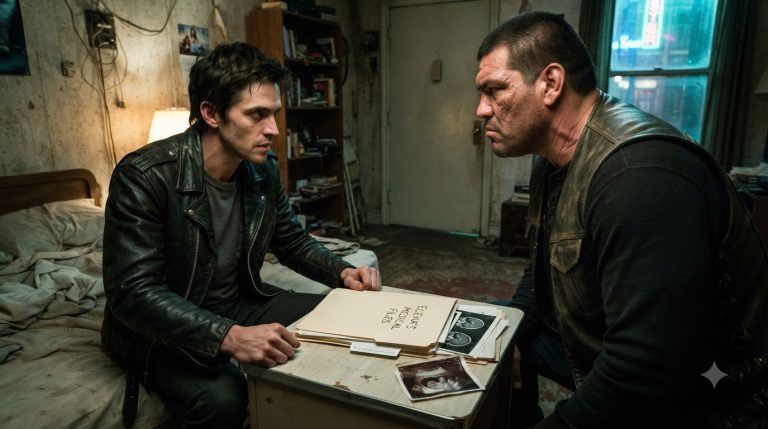
The Weight of Cheap Brass and the Long Road to Hard-Earned Respect
CHAPTER 1: THE BICYCLE AND THE BRASS KEY
The polyester lace on Amarachi’s gown was coarse against her throat. It didn’t have the soft, heavy drape of Cynthia’s imported silk, and every time the humid morning air swept through the sitting room, the cheap fabric stiffened against her skin like dried palm fronds.
Across the tiled floor, three women hovered around Cynthia, pinning fresh white roses into her elaborate hair. The scent of expensive hairspray was so thick it made the back of my teeth ache.
“Hold your head straight, Cynthia,” their father, Charles, commanded from his leather armchair. He didn’t look up from his folded newspaper. “A girl marrying into the Martins family doesn’t slouch.”
“I am holding it straight, Daddy,” Cynthia cooed. She tilted her chin toward the tall mirror, then cast a quick, pitying glance across the room toward the corner where Amarachi sat alone on a wooden stool. “Sister… if your veil is too tight, I have extra pins. You don’t have to look so miserable.”
Amarachi didn’t flinch. She kept her hands folded in her lap, her knuckles pale against the thin chiffon. “My veil is fine, Cynthia.”
“Expensive clothes cover the skin, but they cannot hide a poor spirit,” Charles muttered, turning a page of his paper with a sharp, dry snap. “Remember the family you come from, Amarachi. Do not embarrass us today. The Nwasu family took pity on your situation. You accept what is given.”
“I accept it, Daddy,” Amarachi said quietly. Her voice didn’t shake, but her shoulders tightened beneath the coarse lace.
Outside, the heavy metal iron gate of the compound creaked on its hinges.
The low rumble of an engine should have followed. Victor Martins had already arrived thirty minutes prior in a polished black sedan that left grease marks on the driveway bricks. But instead of an engine, there was only the metallic rattle of a dry chain and the crunch of thin rubber tires rolling over gravel.
Cynthia’s mother rushed to the window, parting the sheer curtains with two manicured fingers. She let out a sudden, sharp bark of laughter that cut straight through the room.
“Look,” she sneered, turning back toward the chairs. “Charles, come and see the great procession.”
A few distant guests gathered near the doorway leaned out to look. The laughter spread in a ripple—quiet at first, then loud and unchecked.
“A bicycle?” Victor Martins stepped into the doorway, adjusting the golden cufflinks on his blazer. He smirked, leaning his shoulder against the doorframe. “At a wedding? Only Kelechi could pull off an arrival like that. What kind of family sends a man on two wheels to fetch a bride?”
I stepped off the pedals, letting the rusted kickstand drop into the dirt with a dull clank.
The heat of the morning sun hit my neck immediately, but I didn’t wipe the sweat. In my right trousers pocket, my thumb slid over the flat edge of a brass key—worn smooth at the notches, attached to a faded red plastic tag marked Gate House 2. I pressed the metal edge into my palm until it bit into the skin, grounding myself against the noise on the porch.
“Amarachi,” I called out, my voice flat, practical, and clear through the open doorway. “I came for you.”
Charles stood up from his armchair, his face dark with embarrassment. “Why couldn’t the family send a single car? Why agree to take a daughter from this house if you bring nothing?”
“You speak very boldly for a man who hasn’t paid for the chair he’s sitting on,” I said, looking Charles dead in the eye. I didn’t raise my voice. I didn’t advance up the steps. I just stood by the handlebars, my boots caked in fresh road dust.
“Listen to him!” Cynthia’s mother shrieked. “Amarachi, if you reject this man now, no one will blame you! Look at him!”
Amarachi stood up from her wooden stool. The cheap lace rustled against her knees. She looked at her father, then at Cynthia’s polished gown, and finally out the door toward the dusty front wheel of the bicycle.
“I will marry Kelechi,” Amarachi said.
“Amarachi, think!” Cynthia stepped forward, her hand fluttering near her chest. “Poverty is not a burden you have to carry just to prove a point.”
“I want peace,” Amarachi said, her eyes fixed on mine as she walked past her family without looking back. “I want a simple life where I am not treated like an unwanted bill.”
She stepped off the porch into the dirt. I held the frame steady while she gathered the tail of her white dress, wrapping it carefully around her knees so the grease from the chain wouldn’t stain the hem.
“Hold me well,” I told her quietly as she settled onto the small padded rack behind my seat. “The road back isn’t smooth.”
As I stepped onto the pedal and pushed us forward onto the main road, the laughter from the porch faded behind the sound of dry leaves churning under our tires.
CHAPTER 2: COLD TEA IN THE GUARD ROOM
The room was six paces wide.
The walls were bare cement, still gray and damp from the rainy season, but Amarachi didn’t complain when the rusted iron door scraped against the floorboards. She set her small vinyl traveling bag—the only thing her father had allowed her to carry out of the house—on the edge of the single wooden table.
“It is dry inside,” Amarachi said quietly. She reached out and touched the unpainted wood of the tabletop, running her fingers along the grain. “That is what matters. A dry roof.”
I leaned the bicycle against the exterior wall, the chain rattling once before settling into silence. “It’s a security guard’s quarters. The estate owners let me use it while I work the front gate. It isn’t a palace, Amarachi.”
“I didn’t ask for a palace, Kelechi.” She turned toward me, her coarse wedding lace catching on the rough edge of the doorframe. “In my father’s house, every chair came with a price tag attached to your pride. Here, the air is quiet.”
She didn’t wait for me to clear the space. She stepped over to the narrow window overlooking the east perimeter fence, pushing open the rusted wooden shutter.
“We could put a small shelf right here,” she murmured, her voice steady and practical. “A tin of tea, maybe two metal cups. The morning light hits this side first.”
I reached into my trousers pocket, my fingers brushing past the grease-stained rag wrapped around my grandfather’s signet ring, and pulled out the brass key. I laid it on the center of the table between us.
“I work twelve-hour shifts at the main gate,” I said, watching her face closely for any sign of regret. “The pay is basic. It buys rice, kerosene, and clear water. If you want more than that—”
“I don’t need more,” she cut in. She looked directly at me, her dark eyes entirely unblinking. “I have hands, Kelechi. I can work. I am not a delicate ornament like Cynthia, to be put on display so a wealthy man can feel important.”
Before I could answer, a loud, theatrical gasp echoed from the narrow gravel pathway outside.
“AMARACHI! MY DAUGHTER-IN-LAW!”
The door swung open before I could reach the handle. My mother, Beatrice, bustled into the narrow room, her colorful headwrap catching on the low wooden lintel. She was wearing three layers of synthetic gold bead necklaces that clinked like loose coins every time she moved her shoulders.
“Oh, look at this small place!” Beatrice cried, throwing her arms wide and instantly taking up half the room. “Kelechi, you brought this beautiful girl into a box!”
“Mom,” I warned under my breath, stepping between her and the table. “You said you would dress simply.”
“This is simple!” she insisted, tapping a thick, gold-painted plastic bangles against her wrist. “Most of it is fake anyway! Just for show! You know your mother likes a little fashion when she meets family!”
Amarachi didn’t shrink back. She stepped forward immediately, taking my mother’s hands with gentle respect. “Welcome, Mummy. The room is small, but it is clean. Thank you for coming.”
Beatrice stopped her loud drama. She looked down at Amarachi’s hands—rough around the nails from years of doing the heavy chores Cynthia refused to touch—and her loud expression softened into something genuine.
“Welcome to the family, my child,” Beatrice said, her voice dropping its performative edge. “A home is not built of grand stone. It is built by the people inside it.”
“Thank you, Mummy,” Amarachi replied, offering a faint, tired smile.
“Kelechi has been too serious since he was a boy,” Beatrice added, casting a sharp look in my direction. “Always carrying the weight of the world like an old man. Maybe now he will learn how to smile.”
A sudden knock rattled the thin wooden door frame. It wasn’t the soft touch of a visitor; it was the sharp, impatient tap of expensive fingernails against painted wood.
Cynthia stood in the doorway, dressed in a tailored lavender dress that practically screamed against the dull gray background of the security compound. Behind her, Victor Martins remained near the gravel path, his hands shoved into the pockets of his designer trousers, his eyes scanning the mud with open disgust.
“So this is where you live now,” Cynthia said, stepping across the threshold without an invitation. Her eyes swept over the single table, the iron bed frame, and the brass key sitting in the dust. “Amarachi, I came to give you an invitation. Victor and I are attending a banquet at the Luxury Hotel tonight. The Nwasu family is hosting a reception for their business partners.”
“I don’t think I need to come, Cynthia,” Amarachi said flatly, keeping her position beside my mother.
“Oh, don’t be like that,” Cynthia purred, leaning forward with a thin, mocking smile. “Are you already ashamed to be seen in public? Or is your husband afraid he won’t look right standing near men who actually own the ground they walk on?”
“The invitation is not clean, Amarachi,” I said, my voice low and heavy in the small room. I didn’t look at Cynthia; I kept my eyes on Victor, who was currently checking his gold watch with an exaggerated sigh. “Don’t go.”
Amarachi looked at the brass key on the table, then at her sister’s smug face. Her jaw set into a firm, stubborn line.
“If I stay hidden here, Cynthia will tell everyone I am cowering because I married a security guard,” Amarachi said quietly to me. “It is a trap either way, Kelechi. But I will not spend the rest of my life hiding in the dark.”
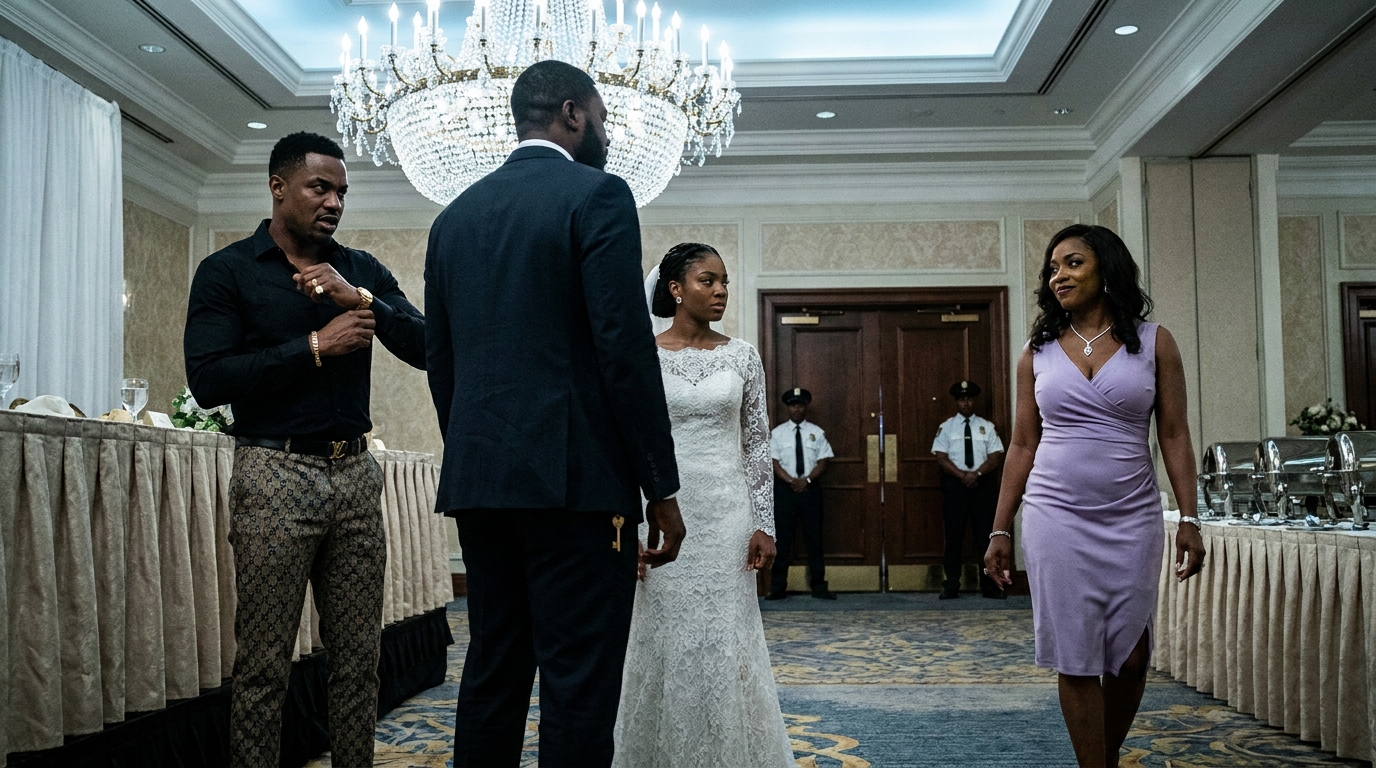
CHAPTER 3: GLASS ON THE MARBLE FLOOR
The grand ballroom of the Luxury Hotel smelled of expensive lilies and polished mahogany, a cold and artificial air that made every cough echo off the high ceilings.
I walked half a pace behind Amarachi, my heavy work boots making a dull, blunt thud against the marble floor compared to the sharp click of Victor Martins’ leather dress shoes. In my coat pocket, my fingers curled around the soft, greasy bundle of cloth housing my grandfather’s signet ring, the hard metal edge pressing against my palm.
“Look who decided to show up,” Victor said, turning with a wine glass held loosely between two fingers. He glanced down at my faded jacket, his lips twisting into a faint, practiced sneer. “Amarachi, that dress must be your best yet. It really complements the fact that you married a gatekeeper.”
“Victor, please,” Cynthia laughed softly, adjusting the diamond pendant resting on her collarbone. “Don’t embarrass them too quickly. Amarachi is still proud, you know.”
Amarachi didn’t retreat. She stood straight, her shoulders level, ignoring the small cluster of suit-wearing businessmen who had turned to stare. “You invited me, Cynthia. I came.”
“Of course I did,” Cynthia said, stepping closer. “I wanted you to see what real life looks like before Victor closes his partnership with the Nwasu estate. Come, let me introduce you to people who actually matter.”
She dragged Amarachi toward a group near the buffet table, where a silver-haired man in a bespoke suit was holding court.
“Mr. Benson,” Cynthia cooed, her voice pitching higher. “I’d like you to meet my sister, Amarachi. And her husband… Kelechi Nwasu.”
The older man froze, his glass stopping halfway to his mouth. He looked past Cynthia, his eyes locking directly onto my face. A sudden, sharp tension tightened his jaw. “Nwasu? As in… the young master?”
“Oh, no!” Cynthia let out a musical, mocking laugh. “It’s just a coincidence, Mr. Benson. My sister’s husband is a security guard at the gate. Nwasu is a very common surname.”
“A common name,” Victor added, stepping up to rest a heavy hand on Cynthia’s shoulder. “But a very different life.”
Mr. Benson didn’t join the laughter. His eyes drifted down to my hand, where the outline of the grease-cloth bulged slightly in my pocket, then back up to my eyes. His face went pale, a thin bead of sweat forming near his hairline despite the chilled air of the room. “I… see. My mistake. A simple misunderstanding.”
He backed away without another word, disappearing into the crowd before Cynthia could stop him.
“Even the hotel management gets confused by low-class people sharing big names,” Cynthia smirked, turning her back on Mr. Benson’s sudden retreat. She reached out and plucked a thin silver band from Amarachi’s finger—the simple wedding ring I had given her on our first night. “What is this cheap thing, Amarachi? Is this all your husband could afford?”
“Give it back, Cynthia,” Amarachi said quietly, reaching out her hand.
“If it means so much to you,” Cynthia said, tossing the small band casually over her shoulder into the dark space beneath the heavy linen draperies of the head table, “FIND IT YOURSELF.”
Victor let out a loud snort of amusement. “That’s right. On your knees, Amarachi. That’s where wives of gatekeepers belong.”
I took one step forward, the floorboards beneath the carpet groaning under my boots. I didn’t reach for a radio. I didn’t call for help. I simply stood directly in Victor’s line of sight, blocking the bright chandelier light above him until his smirk began to falter.
“You have no right to touch my wife,” I said, my voice low, dry, and absolute.
“Look at you,” Victor spat, taking a nervous step back even as he tried to puff out his chest. “Still pretending you’re someone important. You’re making a fool of yourself, Kelechi. Security!”
No one moved. The two guards posted near the double doors remained motionless, their eyes fixed strictly on the far wall.
“Security! Get this man out of here!” Victor shouted, his voice cracking slightly under the silent weight of the room.
“They won’t help you, Victor,” I said quietly, taking another slow step groundward. “And neither will your money.”
CHAPTER 4: THE HAND IN THE DIRT
The morning air in the main compound back at the estate tasted of exhaust fumes and damp earth.
I hauled two heavy bags of potting soil toward the gravel flowerbeds near the outer gate house. The friction of the burlap dragged against my knuckles, but the simple physical work was a welcome relief from the hollow luxury of the hotel ballroom.
Amarachi knelt near the garden border, her fingers digging through the dirt to clear away dead palm fronds. Her hands were dark with mud, but her posture remained straight, unyielding, and patient.
“You don’t have to work the garden beds, Amarachi,” I said, setting the bags down with a heavy thud that kicked up a small cloud of dust. “The housekeeper only asked for help inside.”
“I am not afraid of dirt, Kelechi,” she replied without looking up. She tossed a cluster of pulled weeds into a plastic bucket. “Work is work. It keeps the mind clean.”
Before I could answer, the crunch of gravel signaled a sudden arrival.
Vanessa Cole stepped around the side of the main estate house. She was wearing a cream-colored silk blouse that looked absurd against the dusty driveway, her high heels sinking half an inch into the soft ground with every step.
“Look at this,” Vanessa said, stopping two paces away and folding her arms tightly over her chest. “The new domestic help is already making a mess of the front drive.”
Amarachi wiped her forehead with the back of her forearm, leaving a streak of dark soil across her temple. “Good morning, Miss Vanessa. We are just preparing the soil for the rain.”
“Don’t ‘good morning’ me,” Vanessa snapped. Her eyes darted from Amarachi to me, her jaw tightening with an irritation she couldn’t mask. “I have a special connection to this household. If I tell the manager you are fired, you are fired. Your services here are no longer required.”
Amarachi stood up slowly, dusting the loose dirt from her apron. “I was hired by Madam Beatrice to help with the grounds. Only she can tell me to leave.”
“Are you talking back to me?” Vanessa’s voice pitched higher, cut through with the arrogance of someone who believed she owned the air she breathed. She stepped forward, her heel catching on a sharp decorative stone. She stumbled, her elbow knocking into a glass tray of seedling jars sitting on the low concrete wall.
The glass shattered against the gravel with a sharp, explosive pop.
“Look what you did!” Vanessa shrieked, backing away immediately and pointing a manicured finger at the jagged shards scattered across the dirt. “You pushed me! Clean this up now!”
“Vanessa, you tripped,” I said, stepping between her and Amarachi. My voice remained flat, dry, and immovable. “No one touched you.”
“Shut up!” Vanessa turned on me, her neck flushing red. “You are just a gate guard! You don’t speak to me! Amarachi, pick up every piece of that glass right now or I will have your husband thrown off this property before noon!”
Amarachi didn’t argue. She looked at me once—a quiet, steady look that asked for no intervention—and knelt directly into the dirt near the shattered shards.
“Don’t, Amarachi,” I said softly, reaching down toward her shoulder.
“It is fine, Kelechi,” she murmured.
She reached for a curved piece of glass embedded near a rock, but Vanessa aggressively nudged the plastic bucket with her toe. The heavy rim clipped Amarachi’s forearm, forcing her hand down onto the sharp edge.
Amarachi gasped, pulling her hand back immediately. Dark red droplets pooled quickly on her palm, dripping onto the gray stones below.
“Amarachi!” I dropped to one knee, grabbing her wrist to hold the wound clear of the dirt.
“It’s just a scratch,” she whispered, through clenched teeth, though her fingers trembled slightly from the sharp sting.
“You see?” Vanessa laughed nervously, taking another step back as she saw the physical reality of what her temper had done. “She was careless! She did it to herself!”
“Don’t you ever,” I said, standing up slowly and looking down at Vanessa with a coldness that made her laughter die instantly in her throat, “speak to my wife again.”
CHAPTER 5: THE COLLAPSE AT THE GATE
I caught her before her shoulder hit the gravel.
Her skin was clammy, pale beneath the dust, her head heavy against my arm. The blood from the palm cut smeared against my jacket sleeve as I lifted her off the ground, her breathing shallow and uneven against my neck.
“Kelechi!” My mother rushed out from the side porch, her fake gold bangles clattering wildly against her wrists. “What happened? What did that woman do to her?”
“Get the car,” I ordered, not waiting to explain. I didn’t look back at Vanessa, who was scrambling backward on the driveway stones, her silk blouse stained with mud where she had lost her footing.
The white curtain of the estate clinic room smelled of rubbing alcohol and old disinfectant. The doctor, a grey-haired man with silver spectacles sitting low on his nose, pulled off his rubber gloves with a quiet snap.
“She is stable,” the doctor said, turning his back on the chart to look directly at me. “It was emotional exhaustion, severe stress, and sudden physical strain.”
My father, Gabriel, stepped into the doorway, his driver’s cap held tightly in both hands. His knuckles were white against the brim. “Doctor, is my daughter-in-law alright?”
“She is fine,” the doctor replied, offering a faint, weary smile. “And there is good news. She is early in her pregnancy. The baby is completely unhurt, but she requires rest. No more physical work, and no stress.”
My mother let out a soft, stifled sob, pressing her apron to her mouth. “A grandchild… my first grandchild.”
“Kelechi,” Gabriel said, his voice dropping into a heavy, resonant tone that filled the small clinic room. He set his driver’s cap on the corner of the metal desk. “This secret cannot continue. The child makes the truth urgent. You are letting her suffer insults because you are playing at being a poor gatekeeper.”
“I was afraid, Father,” I said, my thumb tracing the edge of the grease-stained cloth in my trousers pocket. “She hates wealthy people. She sees them as arrogant, controlling monsters who use money to crush everyone around them. If I told her before I proved my heart—”
“Did you not already make her look like a fool?” Gabriel interrupted, his dark eyes sharp. “She accepted you as a security guard. She stood beside you when her family threw her out on a bicycle. What are you still testing?”
Before I could answer, the clinic door rattled on its hinges.
Cynthia stepped inside, flanked by Victor, who was holding a leather folder packed with legal documents. Behind them stood Vanessa, her jaw set into a bitter, hostile sneer.
“So this is where you’ve been hiding,” Cynthia said, her voice dripping with artificial sympathy as she glanced toward the bed where Amarachi lay sleeping. “I heard she fainted from picking weeds. How embarrassing for you, Kelechi. Wives of gatekeepers really aren’t built for hard work.”
“Leave this room, Cynthia,” I said without moving from the bedside.
“We aren’t here for you,” Victor interjected, holding up the leather folder with a cold, triumphant grin. “We came to deliver notice to the estate manager. The Martins family has finalized our commercial contract with the Nwasu holdings. As of tomorrow, my firm controls the maintenance and gate contracts for this entire property.”
He leaned forward, tapping the edge of the folder against the metal bed frame with a sharp, metallic clink.
“Which means,” Victor sneered, “your job at the gate is officially terminated, Kelechi. Pack your things from the guard house by sunset.”
“You think this piece of paper gives you power here?” I asked, stepping away from the bed and standing between Victor and my family.
“It gives me total authority,” Victor declared loudly, stepping directly into my space. “You are nobody, Kelechi. You are a nameless guard, your wife is a servant, and your whole family lives on scraps from this estate!”
“Victor, stop!” Amarachi’s voice was faint, but clear, from the bed. She sat up slowly, clutching the blanket to her chest. “Don’t… don’t speak to my husband like that.”
“Look at her,” Cynthia laughed, gesturing toward Amarachi’s pale face. “Still trying to defend him! You chose poverty, Amarachi, and now you’re being thrown out into the mud where you belong.”
I reached into my pocket. My fingers unwrapped the grease-stained rag, pulling out the heavy, pristine signet ring—the solid gold band bearing the crest of the Nwasu family line. I didn’t raise my voice. I didn’t shout. I simply slid the ring onto my right ring finger and rested my hand on the metal bedpost where the sunlight hit the polished gold.
Victor’s eyes fell on the ring, and the smug smile froze on his face.
CHAPTER 6: THE UNBROKEN GROUND
“Where… where did you steal that?” Victor’s voice rasped, the arrogant pitch completely gone. He gripped the leather folder so hard the cardboard edges bent under his knuckles.
“My grandfather wore it for forty years,” I said, stepping past him toward the doorway. I didn’t reach for a phone. I didn’t summon guards or invoke corporate security. I simply stood in the open hall where the light from the main courtyard washed over the floor. “And the contract you are holding is signed with a forged corporate seal. Mr. Benson invalidated your family’s bid three hours ago.”
Cynthia’s face turned white as chalk. She grabbed Victor’s sleeve, her manicured nails digging into the cloth. “Victor… what is he talking about? You said the partnership was signed! You said we owned the gate contracts!”
“He’s lying!” Victor spat, his eyes darting frantically from my face to my father, Gabriel, who stood quietly by the window with his arms folded. “He’s just a gate guard playing tricks! He stole that ring from the main house while cleaning!”
“I don’t steal from my own home, Victor,” I said evenly.
A quiet step rustled behind us. Amarachi stood up from the clinic bed, swinging her legs over the edge. She rested one hand over her stomach—where our child was growing—and used the metal bedframe to steady her footing.
“You brought us here to humiliate us, Cynthia,” Amarachi said, her voice dry, steady, and entirely free of anger. “You wanted me to beg. You wanted to prove that without your father’s house, I was nothing.”
“Amarachi—” Cynthia started, taking a hesitant step forward, but her voice cracked.
“I don’t need a mansion to have peace,” Amarachi continued, looking directly into her sister’s eyes. “And I don’t need a rich husband to have dignity. Kelechi stood by me in the mud when everyone else walked away on two wheels.”
Victor made one last desperate move. He thrust the legal folder toward my chest, his face contorted in a dark, frantic sneer. “You think this changes anything? I’ll sue this estate! I’ll tell the newspapers that the Nwasu family uses fake guards to deceive investors! I’ll ruin your name before nightfall!”
“Do whatever you want with your papers, Victor,” I said quietly, stepping back to let him pass. “The gate is open. Leave.”
He stared at me, waiting for me to argue, waiting for me to lose my temper or call for help. When I offered nothing but cold, immovable silence, the silence of the room collapsed over him like heavy damp earth.
Without another word, Victor turned sharply on his heel and stumbled out the clinic door, the leather folder dropping into the dirt outside. Cynthia hovered for a second, her lips trembling as she looked at Amarachi, before turning to run after him, her high heels clicking frantically down the driveway.
The room settled into absolute quiet.
My mother, Beatrice, reached down and picked up the brass gate key where it sat on the corner table, wiping a speck of dust from the red plastic tag before laying it gently in Amarachi’s hand.
“A good key opens a safe door,” Beatrice said softly. “It doesn’t matter if the metal is cheap or gold, so long as it turns the lock.”
Amarachi looked down at the brass key in her palm, then up at me. The sunlight from the open shutter caught the dark soil still smudged under her fingernails.
“You lied to me about the guard job, Kelechi,” she said quietly.
“I did,” I admitted, stepping closer to her bed. “And I won’t ask you to pretend it didn’t hurt. But I am the same man who pedaled you away from that porch.”
Amarachi closed her fingers over the key, her jaw relaxing as she took a deep, clear breath of the afternoon air.
“Then let’s go back to the room,” she said, offering a small, genuine smile. “We still have to put that fish tank by the window.”
I took her uninjured hand, resting my thumb over her knuckles, and together we walked out onto the clean, unbroken ground of the estate.