The Iron Harvest: How an Honest Hand Kept the Soil
CHAPTER 1: GROUND AND IRON
The steel barrel of the grease gun felt ice-cold against my palm as I pumped the lever three times into the kingpin fitting.
A bead of dark brown lithium grease squeezed out around the seal, smelling of heavy mineral oil and forty years of dust.
Tobias Marquez stood two paces back on the gravel driveway, his hands shoved deep into the pockets of a faded canvas coat that was three inches too short in the sleeves.
He didn’t fidget. A boy who had spent eight years moving between group homes in Waterloo knew how to stand still when an older man had work to do.
“You’re pumping it too fast,” I said, not looking up from the front spindle of the 1962 John Deere 4010. “Speed traps air in the cylinder. Slow, steady pressure lets the grease force the grit out of the bronze bushing.”
The boy took a step closer, his eyes locked on the nickel-plated nozzle. “Sounds different when it seats.”
“It does,” I said.
A heavy silver pickup truck turned off the county road, its tires grinding slow and deliberate over the crushed limestone of my driveway.
The driver’s door swung open before the engine killed, revealing Dale Crowley in a crisp blue dealer jacket with the green leap-deer logo stitched over the breast pocket.
He didn’t walk toward the shop bay; he walked toward the tractor, his polished work boots stopping right at the edge of the grease splatter on the concrete apron.
“Silas,” Dale said, nodding once toward the rear tires. “You’re still dragging this iron around the yard?”
I wiped my hands on a red shop rag, feeling the coarse weave drag against the thick calluses on my thumbs. “Runs every time I turn the key, Dale.”
“Running isn’t the issue anymore,” Dale said, pulling a leather-bound iPad case from under his arm. “County board met in Eldora on Monday. New emissions and hydraulic pressure audits for commercial acreage over five hundred.”
Tobias shifted his boots on the gravel, his eyes narrowing as he watched Dale’s hand rest on the 4010’s side sheet.
“This property isn’t a corporate fleet,” I said, stepping between Dale and the boy. “It’s eight hundred acres of black dirt, and every rod of it is paid for.”
Dale smiled, but his eyes stayed flat like cold river stone. “The soil doesn’t care who paid for it, Silas. The new regional equipment standards require verified telemetry units on all primary work units by spring, or the county elevator won’t take the yield.”
He tapped the green hood of the 4010 with his fingernail—a sharp, metallic ping that made Tobias’s right hand tighten into a fist inside his jacket pocket.
“You can’t retrofit a sixty-year-old mechanical pump with digital sensors,” Dale added softly. “I’ve got two new 8 series on the lot in Iowa Falls. Ten percent down, eight-year paper.”
I looked down at the brass-handled grease gun sitting on the tractor’s frame rail. Next to the rear axle, tucked behind a fresh coat of green enamel on the hydraulic housing, was a tiny, hand-stamped serial tag that didn’t match the standard Waterloo factory sequence.
“We finish harvest first,” I said, my voice low and flat. “Then we talk about what this machine can and can’t do.”
Dale stepped back, his boots crunching on the stone as he glanced over at Tobias. “You’re wasting your time teaching the kid on a museum piece, Silas. Times have moved past this dirt.”
He got back into his truck and backed out onto the road, kicking up a cloud of grey limestone dust that hung in the still autumn air.
I turned to Tobias and handed him the grease gun. “Take the left spindle. Five pumps, slow.”
The boy took the tool, his fingers wrapping around the cold steel right where mine had been.
CHAPTER 2: FRICTION IN THE DIRT
Tobias didn’t ask about the audit.
He just kept his shoulder pressed against the green sheet metal of the 4010, his knuckles white around the grip of the brass grease gun.
“The spindle’s greased,” he said, his voice flat as a iron wedge. “What’s next?”
“The drag link,” I told him, tapping the worn steel bar under the front axle with the toe of my boot. “Then we check the hydraulic pressure before the rain hits tomorrow night.”
We worked through the heat of the afternoon while the sky to the west turned the color of bruised plums.
By six o’clock, the wind had flipped out of the south, carrying the bitter, damp smell of wet river bottom dirt.
When Tobias went to hook up the three-bottom plow, the main hydraulic supply hose on the 4010 didn’t just drip—it split wide open right at the steel collar, spraying a dark arc of fluid onto the dry gravel.
I caught the shut-off valve before the pump ran dry, but the damage was already done.
“The rubber rotted out inside the crimp,” Tobias said, kneeling in the dirt, his fingers dripping with warm, amber-colored hydraulic oil. “We need a female swivel fitting and six feet of two-wire hose.”
“We won’t get it from the co-op,” I said, wiping my forehead with the back of my sleeve. “Dale bought out their fluid-power inventory last winter.”
We drove into Eldora anyway, taking my old Ford pickup with the rusted bed floor.
The neon sign in the window of Crowley Ag Supply was flickering red against the dusk when we pulled into the gravel lot.
Dale was behind the high counter, writing up a ticket for a young farmer in a clean brand-new cap, but his eyes drifted right to us the second the screen door slapped shut.
“Out of stock on two-wire hose, Silas,” Dale said before I even reached the register. “Suppliers are backordered until November. Global supply chain issues.”
“You’ve got three spools sitting right through that double door,” Tobias said, his voice quiet, pointing a dark-stained finger at the gap in the storage room curtain.
“Those are allocated for contract lease repairs,” Dale said, leaning his forearms on the counter and looking down at the boy like he was an oil spill on a clean tile floor. “I don’t sell loose hydraulic fittings to non-certified mechanics. New county safety liability.”
I placed my palm flat on the cool formica counter, feeling the slight vibration of the air conditioner humming overhead.
“You’re squeezing the small acreage, Dale,” I said softly. “It’s planting week.”
“I’m running a business, Silas,” Dale snapped, his face reddening around his collar. “Agriculture isn’t a hobby for old men holding onto junk. You sign a machinery lease with me, or you let the dirt sit till June.”
Tobias didn’t yell, and he didn’t slam his fist on the counter.
Instead, he slowly reached into his pocket and pulled out a small, bent steel retaining clip he’d pulled off the broken hose, setting it down on the formica between us with a quiet clink.
“We’ll build our own fitting,” Tobias whispered, looking Dale square in the eye.
Dale chuckled, a short, dry bark. “Good luck finding a thread die that matches a sixty-year-old John Deere manifold in this county.”
We walked back out to the truck without saying another word.
“My dad had an old South Bend metal lathe in his barn before he passed,” I said as I turned the ignition key and the 351 engine sputtered to life. “It’s buried under thirty years of scrap iron in the back shed.”
Tobias looked out the side window at the darkening cornfields rolling past in the twilight.
“Then we better start digging,” he said.
CHAPTER 3: THE BROKEN LINE
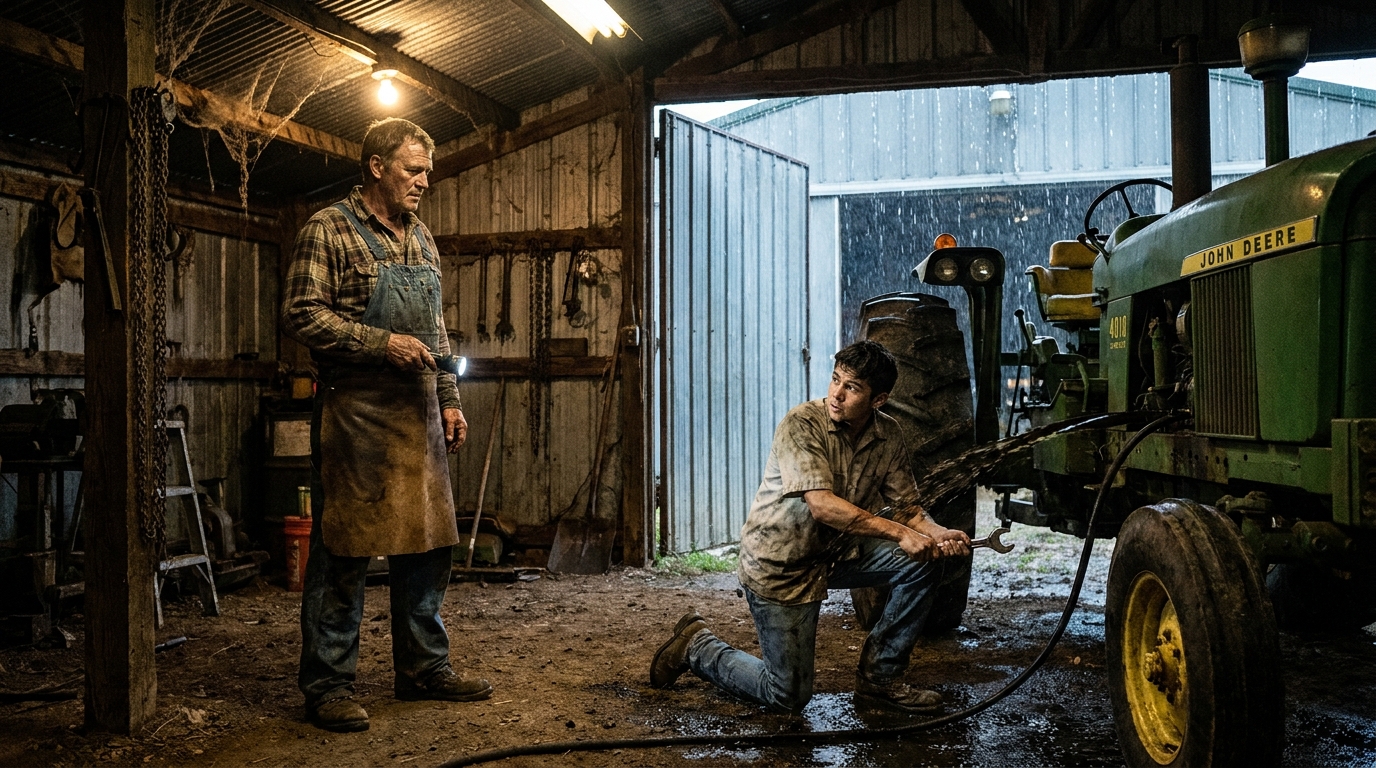
Cobwebs hung like gray wool from the bare bulb overhead, swaying each time the north wind shook the metal roof of the back shed.
The old lathe was buried under three decades of forgotten homestead scrap—broken mower blades, brittle fan belts, and oil-caked gear sets—but the heavy iron bed underneath showed dark grease where the rust hadn’t taken hold.
“The motor winding might be shorted,” Tobias said, his thumb flicking dust off the frayed cloth cord that ran to the wall toggle.
“It isn’t,” I said, unspooling a line of emery cloth. “My father wrapped those lead wires in paraffin canvas before he passed. Turn the spindle by hand first.”
The boy grabbed the three-jaw chuck with both bare hands, leaning his weight into it until the dried tallow in the headstock bearings gave way with a wet, sticky pop.
He turned it twice, feeling the gears mesh through the thick leather belt. “It turns smooth enough.”
I pulled a four-inch rod of scrap brass out of a wooden crate under the workbench and clamped it into the chuck jaw.
“Dale thinks he controls every hydraulic fitting in Hardin County because he signed an exclusive vendor contract with the factory,” I told Tobias, flipping the motor toggle with my knuckle.
The electric motor hummed, a low, sixty-cycle thrum that vibrated right through the concrete pad beneath our boots.
Tobias took the handwheel on the cross-slide, his fingers light on the iron crank as the high-speed steel cutter touched the spinning brass.
A long, razor-thin spiral of bright yellow metal curled off the bar, hot and smelling of sulfur oil as it dropped into the chips below.
“He doesn’t own the threads,” Tobias said, his profile sharp against the yellow light of the bulb. “He just owns the building where they sell them.”
By two in the morning, the rain hit the shed roof with the sound of thrown gravel.
Tobias wiped the finished brass adapter with a rag, holding the newly cut threads up to the light of the bare bulb to inspect the pitch against the tractor’s manifold port.
“It fits,” he said, handing me the part.
We didn’t go back to the house to sleep.
We walked back out to the main shop through the downpour, the mud clinging thick and heavy to the heels of our boots.
I held the flashlight while Tobias threaded the shop-cut brass sleeve into the 4010’s high-pressure hydraulic valve, tightening the jam nut until the copper washer crushed flat against the iron body.
“Start her up,” I said.
The starter drive gear clanked into the flywheel, and the four-cylinder diesel coughed once, spewing a blue ring of exhaust toward the rafters before settling into a steady, rhythmic idle.
Tobias reached over and pulled the hydraulic lever back.
The high-pressure line snapped taut, vibrating with three thousand pounds of oil pressure, but the brass fitting held bone dry—not a single drop leaked onto the clean rag I held underneath.
“That fixes the plow,” Tobias said, wiping grease off his jaw with his sleeve.
“It fixes the plow for tonight,” I replied, watching the pressure gauge needle sit dead center in the green. “Tomorrow, Dale Crowley brings the county inspector out to check the registration tags on our field implements.”
Tobias looked over at the shop door where the rain was running down the metal siding in sheeted gray lines. “Let him come.”
CHAPTER 4: THE PRESSURE TEST
The white sedan’s door opened, and a thin man in a tan work jacket stepped out into the mud, clutching a clipboard against his chest.
Dale didn’t wait for the inspector to lead; he marched straight up the gravel incline toward the machine shed, his face set in a hard, triumphant grin.
“Silas,” Dale called out, stepping right into the doorway. “This is Wayne Miller, county agricultural inspector. We’re doing a mandatory equipment registration check on all non-telemetry machinery working active commercial acreage.”
Wayne shifted his boots on the gravel, looking everywhere except at my face. “It’s standard protocol, Silas. Any primary utility power unit operating without verified factory-sealed hydraulic bypass valves can be impounded under Code 41.”
Tobias stepped out from behind the rear tire of the 4010, wiping his grease-stained hands on a rag, his eyes locked on the clipboard.
“Code 41 applies to commercial custom applicators,” Tobias said, his voice ringing flat and clear inside the high tin shed. “This is a farm utility unit. Section 3 exempts private operators working historical machinery under eight hundred acres.”
Dale turned on the boy, his brow furrowing as he weaponized his posture. “You don’t know the code, kid. You’re a hired farm hand from a group home, not an equipment technician. Wayne, run the serial on that hydraulic manifold.”
Wayne stepped forward with a flashlight, kneeling near the pump housing where our new brass adapter gleamed under a fresh coat of grey oil.
He clicked the light on, leaning close to read the stamped numbers on the housing face.
“Wait a minute,” Wayne muttered, tracing his finger along the steel edge. “This isn’t a factory replacement loop. This fitting was turned custom.”
“Custom and uncertified,” Dale chimed in, leaning over Wayne’s shoulder. “That’s an illegal modification on a high-pressure line. You can’t run this unit on county roads or sell grain pulled by an uncertified tractor, Silas. Tag it, Wayne.”
“Hold on,” I said, setting my coffee cup down on the tractor’s iron fender with a quiet thud. “Wayne, look two inches left of that brass hex nut.”
The inspector dropped his beam lower, squinting through the film of mineral oil.
“There’s an original Iowa State Agricultural Mechanics certification stamp,” I said, pointing with a calloused index finger. “Stamped in September of 1962 by Heinrich Hassell. That stamp guarantees the housing for fifty thousand hours of continuous pressure up to four thousand pounds.”
Wayne ran his thumbnail over the tiny, hand-stamped crest buried under sixty years of paint.
“He’s right, Dale,” Wayne said, standing up and wiping his knees. “The original state grandfather clause covers custom fittings built on certified historical housings. I can’t red-tag this machine.”
Dale’s face flushed dark red, his fingers twitching against the side of his leather binder. “This is absurd, Silas. You’re stringing together obsolete scrap with homemade brass while the rest of the county is trying to modernize!”
“The machine works, Dale,” Tobias said quietly, stepping between Dale and the tractor door. “And the dirt doesn’t care about your lease terms.”
Dale stared at Tobias for three long seconds, his jaw clamped shut so tight the muscles in his cheek twitched.
“We’ll see how well it works at the public machinery consignment auction on Saturday,” Dale spat, turning on his heel toward his truck. “Every major elevator board member in the district will be there. Let’s see if they buy your yield when they see what you’re running.”
He slammed his truck door so hard the side mirror vibrated, spinning his tires in the wet gravel as he backed down the driveway.
Wayne gave me a quick, apologetic nod before climbing into his sedan and following the truck out to the highway.
Tobias looked at me, his knuckles resting on the green hood of the 4010. “He’s going to try to block our grain drop at the co-op.”
“He can try,” I said, grabbing the oil can off the bench. “Get the grease gun. We’ve got two hundred acres of corn to finish before Saturday morning.”
CHAPTER 5: THE MASTER MECHANIC
The loudspeaker squealed twice over the dirt lot before Dale tapped the grill with his thumb, his gaze sweeping over the crowd of local operators in muddy work boots.
“Before we start bidding on the machinery lots today,” Dale announced, his voice booming out across the fence lines, “the regional ag board wants everyone to understand the reality of operating non-compliant equipment in this county.”
He pointed a gloved finger directly at our 1962 John Deere.
“Silas Bontrager is running uncertified, home-machined fittings on his high-pressure hydraulic lines,” Dale yelled, leaning into the mic. “If independent operators are allowed to bypass factory safety standards with scrap-iron modifications, the local grain elevator can’t guarantee pressure compliance for any crop harvested with this equipment!”
A low murmur rippled through the crowd, old farmers shifting their weight and looking between Dale and me.
Tobias took two slow steps toward the trailer, holding an iron wrench in his right hand.
I laid a firm hand on the boy’s shoulder, holding him back, then walked straight to the back of Dale’s personal supply trailer parked behind the auction block.
I pulled back the canvas tarp covering Dale’s cargo bed.
Sitting in the corner was a wooden supply crate—factory-sealed from Waterloo—stamped with original John Deere part numbers, but the white paper inventory tags over the crate latch had been freshly pasted on with local store adhesive.
“Dale,” I called out, my voice cutting through the speaker static. “You told every farmer in Eldora that original hydraulic valves were backordered worldwide until winter.”
Dale’s jaw tightened, a sharp drop of sweat running down his neck despite the chilly morning air. “That’s trade inventory! Private distribution!”
“You didn’t just hoard them,” Tobias said, stepping up beside the crate and peeling back the edge of the forged paper label to reveal the factory delivery manifest underneath. “You altered the distribution tags so the regional warehouse couldn’t trace the shipment you withheld from the independent co-op.”
The crowd pushed forward, three local elevator board members stepping up to the side of the trailer to look at the shipping numbers stamped into the raw pine wood.
“You’ve been holding back critical replacement parts to force us onto eight-year lease agreements,” I told Dale, looking him right in the eyes. “It was never about safety standards or code compliance. It was about controlling who gets to farm this dirt.”
Dale snatched the microphone away from his mouth, his face turning dark purple as he realized every farmer in the district was watching him.
“You don’t have the authority to inspect my inventory!” Dale roared, stepping off the trailer bed so fast his boot slid in the wet gravel. “You’re running an illegal operation with an uncertified kid, and I’ll have the county seal your field gates by sundown!”
“Try it,” Tobias said quietly, dropping his iron wrench into the 4010’s tool box with a loud, metallic ring that ended the debate.
CHAPTER 6: THE TRANSFER OF POWER
The yellow shop light caught the fine sheen of oil on the tractor’s green side sheets, reflecting off the clean brass fitting we’d cut on the lathe four nights ago.
Dale Crowley’s threat had dissolved by noon; the elevator board had voted unanimously to accept every bushel from independent holdings after seeing those altered shipping tags at the auction lot.
Tobias dropped his shop rag into the red steel tin, his hands rough and stained dark around the cuticles with diesel grime that wouldn’t wash out until winter.
“The air filter housing is clear,” Tobias said, his voice quiet in the stillness of the shed. “She’s ready for the morning pull.”
I reached into my breast pocket and pulled out the three folded vehicle titles, setting them flat on the tractor’s steel step.
“The 4010 is the one you need to run first,” I told him, tapping the faded blue paper seal on top. “It teaches you patience when the cold weather sets in.”
Tobias looked at the papers, his jaw tightening as he took a slow step back from the machine rail. “I can’t buy these from you, Silas.”
“I know you can’t,” I said. “And I’m not asking you to.”
“I don’t understand why you’re handing me three machines,” he said, his eyes searching mine.
“You will,” I replied, the exact words Emmett Hassell had spoken to me in this same driveway back in 1979 falling off my tongue without effort.
Tobias stood there in the quiet shed for a long moment, the cool evening breeze bringing the smell of damp river dirt and cut corn stalks through the open bay door.
He reached out his hand, his calloused fingers wrapping firm around the paper titles.
I picked up the brass grease gun from the bench, hooked it onto my tool rack, and walked out into the yard toward the house, leaving the boy alone in the shop with the iron.