Broken Doors and Quiet Iron: How a Discarded Teenager and a Scarred Outlaw Found an Unbreakable Sanctuary Against the Weight of Privilege
CHAPTER 1: The Cold Porch
The kitchen table inside was warm, bright, and smelling of brewed coffee. Outside, the November air had teeth. Ivy did not look back at the brass numbers pinned to her father’s front door. Her mother’s voice still hung in the damp air like a clipped business directive. You’ve made your choices.
The walk from the subdivision to the county road took twenty minutes through steady, unrelenting drizzle. Her sneakers soaked through within the first five hundred yards. Her fingers grew numb around the strap of her backpack. The town of Mil Haven slept behind drawn blinds and security lights, its reputation intact and unblemished by her existence.
A rusted sedan slowed down beside her on the shoulder. An older woman rolled down the passenger window, peering through the gray sheet of water. Get in, honey, the woman said, her voice rough and entirely devoid of judgment. You’re fifteen miles from anywhere warm.
Ivy climbed into the passenger seat without a word. The heater clicked, blowing dry air that smelled of old upholstery and peppermint. The woman drove in silence for twenty minutes, dropping her off where the county road met the highway near a flickering neon sign.
The sign buzzed in the dark, spelling out MAZE in flickering amber tubes. Ivy stepped out into the mud, thanking the woman with a slight nod. The truck stop across the asphalt was pitch black and locked tight. But the diner window leaked a yellow square of light onto the wet gravel.
She pushed the glass door open. A bell chimed overhead. The air inside smelled of grease, hot coffee, and floor wax. A heavy-set woman behind the counter looked up from wiping down the laminate surface. Her expression didn’t shift with surprise or pity. Just a quiet acknowledgment of another stray out in the weather.
Sit down, honey, the woman said, pointing to a stool near the register. I’ll get you a cup of soup before you turn to ice. Ivy slid onto the vinyl seat, setting her dripping backpack at her feet. She placed both hands over her coat, feeling the quiet, steady reassurance of her four-month pregnancy beneath the fabric.
The diner was mostly empty. Two men sat in a far booth talking in low, dull murmurs. In the far corner table, a large man sat alone with a black cup of coffee and an open notebook that remained entirely blank. He wore a heavy leather jacket with a faded patch stitched across the back.
He didn’t look up when she entered. He just stirred his coffee with a worn silver spoon, staring into the dark liquid as if watching something beneath the surface. Ivy wrapped her cold fingers around the warm ceramic mug May slid across the counter. The warmth seeped slowly into her bones.
For the first time since the front door clicked shut, the ringing in her ears began to fade. Outside, the rain drummed a heavy, monotonous rhythm against the tin roof. Inside, the clock on the wall ticked forward through the quiet hours.
Then the front door banged open against the wall. A blast of cold wind swept across the linoleum, bringing three men in heavy work coats who smelled faintly of stale beer and bad intentions. May’s jaw tightened instantly behind the counter, her hands pausing on the cloth.
The tallest of the three men strode directly toward the counter, scanning the room with heavy, bloodshot eyes. He spotted Ivy sitting alone near the register. A slow, unpleasant grin spread across his face as he veered off course, heading straight for her stool.
The world narrowed to the sound of heavy boots hitting the floorboards. Ivy tightened her grip on her mug, her heart giving a sharp, hard thump against her ribs. She didn’t flinch. She just straightened her spine, staring straight ahead as the shadow fell across her stool.
CHAPTER 2: The Maze Diner
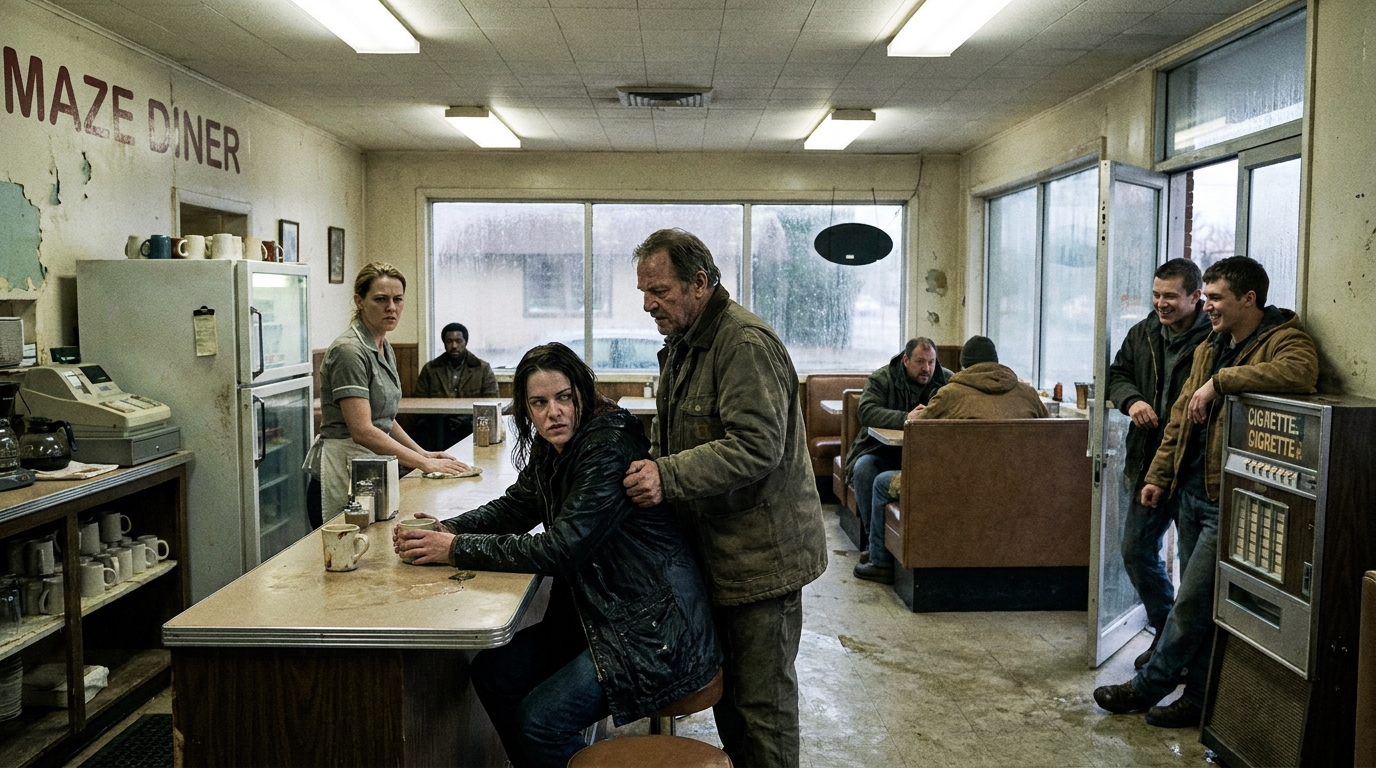
Ivy’s hand slammed flat against the sticky surface, her other arm dropping instinctively across her midsection to shield the baby. The man loomed over her, his breath reeking of cheap lager and cold grease.
Where you headed, girl? he demanded, tightening his grip on her sleeve.
May dropped a heavy ceramic plate behind the counter, the shatter cutting through the fluorescent hum. Don’t touch her, May said, her voice dropping into a dangerous, flat register that brooked no argument. Get your hands off the kid before I call the state police.
The man’s two friends laughed from the doorway, leaning against the cigarette machine with dull, heavy amusement. Let the old lady talk, one of them muttered, spitting a toothpick onto the linoleum.
The heavy man grinned, his fingers biting harder into Ivy’s fabric. She didn’t scream. She didn’t grant them the satisfaction of a sob. Instead, her eyes locked onto his with a cold, piercing defiance that made the man momentarily blink.
That was when the dark leather chair in the corner scraped backward against the floorboards.
The sound was slow, heavy, and deliberate. It carried the distinct weight of a man who had already weighed the consequences and found them entirely acceptable. Gabriel Mercer stood up from the small corner table, his massive frame nearly brushing the low ceiling tiles.
The scar running from his left ear to his jaw caught the harsh overhead glare. He didn’t rush. He walked with the heavy, unhurried gait of a man crossing an empty pasture.
The tall man let go of Ivy’s arm and turned, squaring his shoulders as Gabriel closed the distance. You got a problem, leather? the man sneered, stepping forward to block the aisle.
Gabriel stopped three feet away, his expression entirely neutral. Yeah, he said quietly.
The first punch never landed clean. Gabriel slipped the swing with a minimal twitch of his chin, caught the man’s wrist, and redirected his momentum straight down into the floorboards. A single shove to the center of the chest sent the intruder sprawling backward over a stool like a sack of wet feed.
The second man lunged forward, grabbing an empty glass bottle from a neighbouring table. Gabriel reached out, took the glass away with the casual indifference of a parent taking a toy from a toddler, and set it gently back onto the counter.
Step back, Gabriel said. It wasn’t a threat; it was a physical law of gravity.
The second man looked at the scar, looked at the cold, unblinking eyes, and took two hurried steps toward the exit. The third man was already holding the door wide, dragging his fallen friend up by the collar of his jacket.
They scrambled out into the rain without a backward glance, the screen door slamming behind them on a broken hinge.
The diner settled back into a heavy, tense quiet, broken only by the hum of the refrigerator. Gabriel turned his head, his dark eyes fixing on Ivy where she sat rubbing her bruised arm.
He walked back to his corner table, sat down, and picked up his black coffee without a word. May slid a fresh ceramic mug across the laminate toward Ivy, her hands steady.
That’s Hell, May murmured, nodding toward the corner. He comes in most nights.
Ivy stared across the room at the scarred man sitting in the shadows. She stood up, picked up her warm mug, and walked across the checkered floor to take the empty chair opposite him.
You got somewhere to be tonight? Gabriel asked, his gaze still fixed on the black surface of his coffee.
No, Ivy said.
Gabriel looked up then, his deep-set eyes taking a silent measure of her posture, her soaked sneakers, and the quiet, immovable resolve in her face.
There’s a couch at the warehouse, he said, his voice low. Warm. Nobody will touch you there.
Ivy thought of the forty dollars in her pocket and the dark, freezing highway outside. She held his gaze for three long seconds.
Okay, she said.
CHAPTER 3: The Iron Warehouse
The heavy steel door of the warehouse rolled shut behind them with a muffled clang that cut off the highway’s wet hiss. Gabriel flicked a wall switch, flooding the high-ceilinged room in amber light.
Card tables clustered near the center where four men sat sorting through motorcycle parts under a drop-light. A wood stove hummed in the far corner, radiating a dry, deep heat that smelled of seasoned oak and machine oil.
Every head in the room lifted at once.
She’s staying on the couch tonight, Gabriel said, his voice cutting across the open space without raising a decibel. Anybody has a problem with that, they have a problem with me.
Not a single man spoke. The card player on the left merely dealt the next hand, his eyes flicking briefly to Ivy’s soaked jacket before returning to his cards.
Gabriel tossed a thick wool blanket onto the leather sofa near the stove. Bathrooms are down the hall, he said, keeping his distance. Food is in the kitchen. Help yourself.
Why are you doing this? Ivy asked, her fingers tightening around the empty mug.
Gabriel paused by the hallway entrance, his scarred cheek catching the yellow light. Because nobody else was.
He vanished down the corridor, leaving her alone with the hum of the fire. The physical contrast between her father’s pristine, silent hallways and this cluttered, echoing garage settled heavily over her shoulders. But for the first time since the front door clicked shut, the tightness in her chest unlocked.
Morning brought the dry rattle of a wrench against concrete and the smell of boiled coffee. Gabriel sat at the small kitchen table with two chipped mugs, pushing one across the laminate as she walked in.
Where were you actually trying to go? he asked, looking straight into her eyes.
Ivy sat down, her hands wrapping around the hot ceramic. She told him everything. The bank accounts locked by her father, the lawyer retained before she even reached the driveway, the quiet calculation of a small-town family protecting its asset value.
Gabriel listened without a muscle in his face shifting. When she finished, he stood up and walked down to the back of the warehouse.
Two hours later, the small storage room at the rear was cleared of broken fan parts and rusted engine blocks. He had dragged in a narrow cot, leveled its wobbly legs with a folded matchbook, and fixed the sticky drawer on the wooden dresser without uttering a single self-congratulatory word.
You can stay here, Gabriel said, leaning against the doorframe.
You don’t even know me, Ivy said.
I know enough, he replied, turning away to pick up his toolbox. You didn’t leave because you wanted to, and you didn’t cry once telling me what happened. That’s someone worth knowing.
CHAPTER 4: The Quiet Defense
The phone call came through just as the warehouse wood stove was settling into a dull, rhythmic crackle. Priest stood by the scarred metal desk, holding the receiver with a look of cold calculation that didn’t miss a single detail.
Two investigators from Mil Haven, Priest said, his voice dropping into a flat, gravelly register. They’ve been asking questions at the diner, showing photographs, testing the water with local authorities.
Gabriel stepped out from the tool alcove, wiping a grease-stained rag across his knuckles. What did May tell them?
She told them she sees a hundred strangers a week, Priest replied, tossing the receiver back onto its cradle. But Raymond Hail isn’t looking for small talk. He’s setting up a framework.
Ivy walked out of the back room, her jacket zipped tight against the draft. She didn’t flinch or look away. She stepped right up to the desk where the men stood.
It’s not about the diner, Ivy said, her voice steady and clear. My former father doesn’t panic when things go wrong. He gets methodical. If he can’t drag me back by force, he’ll manufacture a reason to prove I’m an unfit resident in a place like this.
Priest narrowed his eyes, studying her with a new, grudging intensity. You catch on fast, kid.
Gabriel didn’t look at Priest. He looked straight at Ivy. We have a lawyer who handles things outside local county lines, he said quietly. Teresa Cole isn’t afraid of bank presidents or real estate dynasties.
An hour later, Teresa sat at the folding card table in the center of the warehouse, spreading legal forms across the scarred wood. Her briefcase clicked shut with a sharp, metallic snap that echoed in the quiet space.
You’re an adult, Teresa told Ivy, sliding a formal tenancy agreement across the table. You established independent residence here voluntarily. Raymond Hail cannot touch your custody rights before birth, provided we keep your documentation airtight.
She drafted a formal warning letter to the Hail family legal counsel within minutes, spelling out the full consequences of harassment. But as Teresa sealed the envelope, her expression remained tight with warning.
Men like your father don’t fight straight when they hit a wall, Teresa said, looking up at Gabriel. He won’t send investigators next time. He’ll look for an incident. Something he can hand to a compliant local judge to manufacture an emergency.
Gabriel’s jaw tightened, a muscle ticking beneath his scarred skin. Then we make sure nothing gives him an inch.
CHAPTER 5: The Waiting Room
The fluorescent bulbs overhead buzzed with a dull, steady frequency that grated against the nerves. Gabriel didn’t sit in the orange plastic chairs. His large frame remained planted near the corner trash receptacle, his arms crossed over his leather jacket, staring at the scuffed linoleum floor.
Decker pushed through the maternity ward doors at seven-forty in the morning, his prosthetic hand clicking lightly against his belt buckle. He looked tired, but the corners of his mouth carried a faint, undeniable twitch.
She’s here, Decker said softly, stopping two feet from Gabriel. Both of them are fine.
Gabriel let out a slow, measured breath, pressing two fingers against the bridge of his nose to steady the sudden, heavy lurch in his chest. Can I go in?
They’re asking for you, Decker said.
The hospital room was flooded with pale, clinical winter light that smelled faintly of antiseptic and newborn skin. Ivy propped herself up against the pillows, her face pale and drawn from exhaustion, but her eyes held a brilliant, fierce clarity.
She looked up as Gabriel crossed the threshold, his heavy boots making a muffled sound against the tile.
Come here, she whispered.
Gabriel stopped beside the narrow hospital bed, his massive hands hanging awkwardly at his sides. He looked down at the tiny bundle wrapped in a striped flannel blanket resting against her arm.
Do you want to hold her? Ivy asked, tilting the bundle slightly toward him.
I don’t know how, Gabriel said, his voice dropping an octave.
You figure it out, she replied, her gaze steady.
He reached out, sliding his heavy, work-roughened arms beneath the infant with agonizing care, lifting the fragile weight as if handling unexploded ordnance. The baby stirred, let out a tiny, hiccuping breath, and blinked dark, unfocused eyes against the light.
Gabriel stood completely frozen, his breath caught somewhere in his throat, feeling a profound, terrifying anchor drop straight to the bottom of his soul. What’s her name?
Grace, Ivy said, watching his face with quiet intensity.
Gabriel looked down at the tiny fist resting against his thumb, a small, involuntary twitch of muscle working at the corner of his jaw. Hey, Grace, he murmured.
The infant gave a soft, bubbling sigh of acknowledgment. In that quiet room, miles away from the gated subdivisions and locked doors of Mil Haven, something hard and rusted inside Gabriel Mercer gave way for the first time in forty-one years.
CHAPTER 6: The Unbroken Threshold
The front step of the warehouse was cool beneath her palm as the spring evening settled over the county road. Inside, Grace was fast asleep in her crib, her breathing light and steady against the quiet hum of the wood stove.
Gabriel sat beside her on the worn wooden planks, his arm resting securely across her shoulders.
The letter from Teresa Cole had arrived that afternoon, delivered with the finality of a closed ledger. Raymond Hail had formally dropped all inquiries, realizing too late that manufacturing an emergency against a legally documented household only exposed his own heavy-handed overreach to public scrutiny.
The town of Mil Haven had retreated behind its gated subdivisions, leaving their reputations intact and their hands completely empty.
I keep waiting for it to feel temporary, Ivy murmured, leaning her head against Gabriel’s scarred shoulder.
Does it? he asked, his voice low and steady.
No, she replied.
Gabriel looked out across the dark asphalt toward the distant line of bare spring trees and the scattered lights of neighboring farms. For the first time in his life, the road ahead wasn’t a tactical problem to be solved or an escape route to be calculated.
Neither do I, he said.
A dog barked twice down the county road, then faded into silence. There were no private investigators lurking in the shadows, no midnight knocks at the door, and no doors closing against her in the cold.
There was only the quiet weight of a hard-earned morning, the solid warmth of the porch beneath them, and the absolute certainty of a boundary that no amount of privilege could ever break again.