
The Quiet Hand: How an Unlikely Alliance Saved an Eastern Coast Heiress
CHAPTER 1: THE LINE IN THE HALLWAY
The receiving room smelled of expensive leather, cold wax, and rain beating against the double-paned glass.
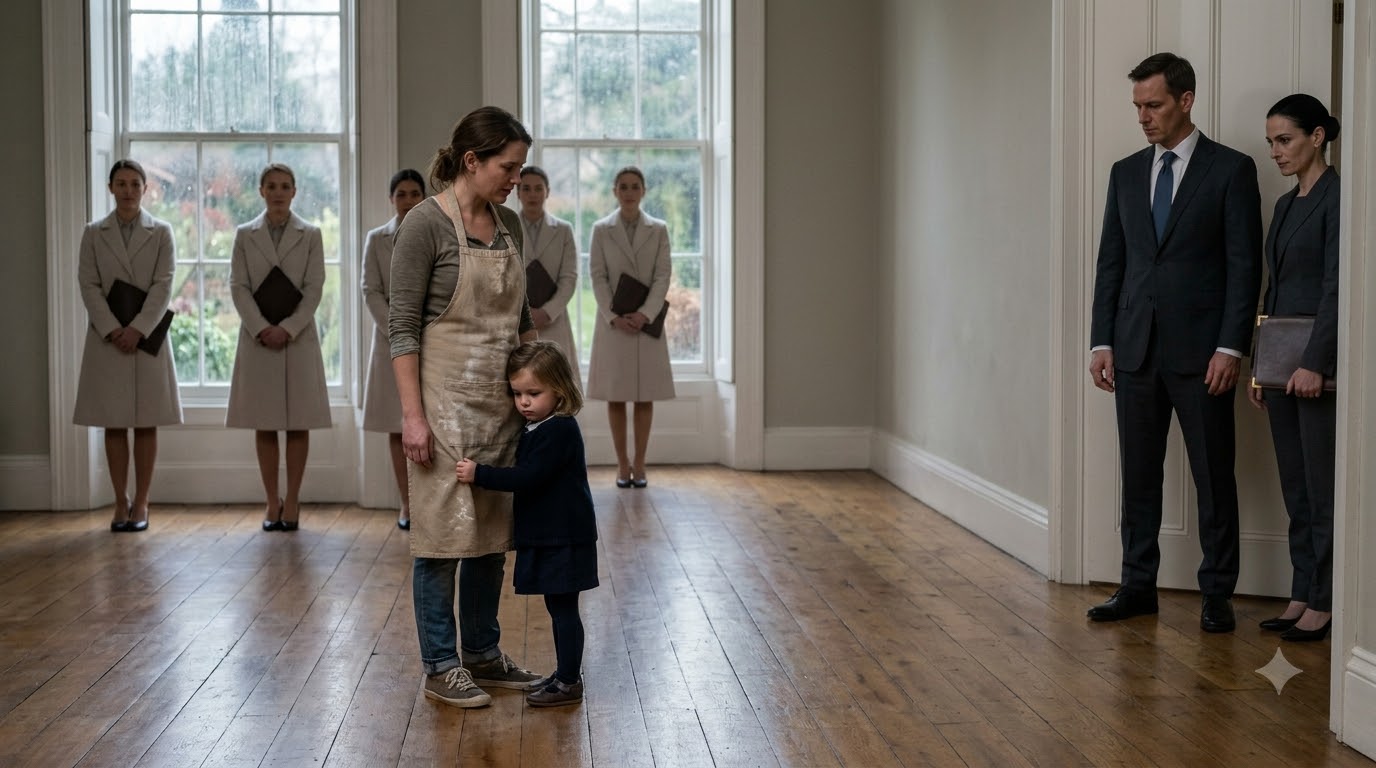
Adrienne Vance kept his hands in his trouser pockets, his thumbs catching on the seam of his dark trousers. Five women stood in a perfectly spaced line along the far wall, their pale wool coats spotless, their leather folders pressed tight against their ribs. They didn’t move. They didn’t fidget. They had been trained by the premier placement agency on the Eastern Seaboard, and each one wore the exact same warm, symmetrical smile.
“Go ahead, Lily,” Adrienne said. His voice was low, flat, carrying the quiet gravity of a man used to signed contracts doing the heavy lifting for him. “Choose one. That’s why they came.”
Six-year-old Lily didn’t step forward. Her small shoes stayed planted on the border of the Persian rug. She looked at the first woman in line—a tall blonde named Margaret whose silver brooch caught the dim afternoon light.
Margaret took one controlled step forward, bending slightly at the waist to reduce her height. “Hello, Lily. I heard you love horses. I used to manage a estate with three ponies. I could teach you to ride by spring.”
Lily’s face stayed entirely still. “No, thank you.”
The second woman didn’t hesitate. She smoothly adjusted her folder under her arm, her smile widening just enough to show even white teeth. “I speak French, Spanish, and Italian, sweetheart. We could practice every single morning.”
“No, ma’am,” Lily said quietly.
From the hallway archway three rooms back, Cora Bennett stood motionless in the shadow of the doorframe. She held a flower-dusted kitchen towel rolled tightly between her hands, her thumb dragging rhythmically across the worn metal frame of her late daughter’s pocket watch inside her apron pocket. She knew she shouldn’t be standing near the threshold. Flour was still caked under her fingernails, and two loaves of rye were rising on the butcher block behind her. But the stiff, calculated pitch of those outside voices had drawn her out into the cold draft of the corridor.
“Why don’t you come stand with us for just a minute, honey?” the third woman murmured, stepping down onto one knee, extending a gloved hand in a soft, netting gesture. “You can ask us anything you want.”
The five women closed the gap slightly, shifting into a neat half-circle around the small girl. They moved with the synchronized grace of professionals who knew precisely how to corner a timid child with polite attention.
Lily didn’t ask a question. She turned her back on the half-circle. Without looking at her father, she broke into a quick, steady walk across the polished oak floor, her shoes clicking faster and faster until her small frame hit the archway at a full run.
She slammed into Cora’s apron, wrapping both arms around the old cook’s waist and burying her face deep into the flour-dusted cotton.
“I choose her,” Lily said into the fabric.
Cora froze, her hands hovering two inches above the child’s back, terrified to leave a white smudge on the dark navy sweater. “Lily, baby…”
“I choose Miss Cora,” the girl repeated, her grip tightening until her knuckles turned pale.
The air in the receiving room snapped taut. The five women straightened in unison, their practiced smiles thinning at the corners as Margaret’s eyes tracked the grease-stained apron and the graying hair pinned back with plain wire clips.
Adrienne took two slow steps across the rug, stopping just short of the threshold. He didn’t raise his voice, but the edge in his tone was sharp enough to slice glass. “Lily. Miss Bennett cooks. She isn’t one of the choices.”
“Yes, she is,” Lily said, her small fingers locking into Cora’s worn hand, anchoring herself to the only thing in the room that smelled like warm bread instead of cold perfume. “She’s my choice.”
CHAPTER 2: UNSPOKEN BOUNDARIES
“Mr. Vance,” Margaret said, her voice dropping the cheerful cadence she had used with the child, adopting instead the crisp, measured cadence of a senior administrator. “We have seen this dynamic in dozens of high-value homes. Domestic staff often form improper emotional dependencies to secure their position.”
Adrienne didn’t look at Margaret. He looked down at Lily’s hands, which were still buried deep into the faded cotton of Cora’s apron.
He didn’t call for the house manager to clear the room. He couldn’t simply wave a hand and have five agency-backed professionals removed without creating a public record that the agency’s legal counsel would exploit by nightfall.
“Miss Bennett,” Adrienne said quietly, his voice low and stripped of warmth. “Please take your hands off my daughter.”
Cora didn’t flinch, but her thumb dug deeper into the watch glass until the edge pressed against her callus. She slowly lifted her hands, holding them open in the space between them, white flour flaking off her knuckles and settling on the dark parquet floor.
“I didn’t ask her to come out here, sir,” Cora said. Her voice didn’t shake. It was flat, dry, carrying the heavy weight of forty years spent working in other people’s houses. “And I don’t drag children into things that aren’t theirs.”
“She isn’t accusing you of dragging her, Miss Bennett,” Margaret interrupted, stepping into the space between Adrienne and the archway, her leather folder resting against her forearm like a clipboard. “She is pointing out an obvious boundary violation. A cook does not provide emotional regulation for a six-year-old child in an environment like this. It creates confusion.”
Lily turned her head just enough to keep one eye on Margaret. “She held my hand when the thunder came last month.”
Margaret smiled down at the girl, a quick, mechanical flash of white teeth. “Sweetheart, that was very sweet of her, but that was because she happened to be nearby. A professional nanny stays awake because it is her duty, not because she is using your fear to make herself indispensable.”
Adrienne’s jaw tightened. “Margaret.”
“I am speaking frankly because you hired our agency to bring order to this house, Mr. Vance,” Margaret said, turning her posture entirely toward Adrienne, effectively turning her back on Cora. “If you allow a member of your kitchen staff to dictate the child’s developmental boundaries, you will have an unmanageable situation within six months. We cannot leave any of our candidates in a home where domestic authority is this compromised.”
Cora stepped back half an inch, her heel catching on the lip of the hallway runner. She looked at Adrienne, waiting for the brief, dismissive nod that usually ended a conversation between an employer and the staff.
Adrienne didn’t nod. He looked at Margaret’s leather folder—specifically at the brass corners, worn slightly at the edge, where a thick yellow document tab stuck out beyond the leather margin. It wasn’t an agency evaluation form. It bore the heavy, block-printed stamp of a civil compliance filing.
“The candidates will return to the city for the evening,” Adrienne said, his voice flat and immovable. “You will leave your dossiers on the table.”
Margaret didn’t hand over the folder. She tightened her arm around it. “We require a decision by eight in the morning, Mr. Vance. Otherwise, we will be forced to file a formal placement withdrawal with the board.”
“Eight in the morning,” Adrienne repeated.
He didn’t reach for the folder. He didn’t order her out. He simply stood there, an immovable block of quiet resistance, until Margaret’s smile finally vanished completely. She inclined her head once, turned on her heel, and marshaled the four silent women out toward the heavy oak front door.
When the latch clicked shut, the hall felt twice as large and cold as it had ten minutes ago.
Lily didn’t let go of Cora’s skirt. She looked up at her father with eyes that held no fear, only a terrifying, plain clarity. “They’re going to tell you she’s bad tomorrow.”
“Lily,” Adrienne said softly, crouching down until he was at eye level with his daughter on the cold floor. “Go to the kitchen with Mrs. Pruitt.”
“Are you going to make her leave?”
Adrienne didn’t answer right away. He couldn’t offer a promise backed by his firm’s legal weight; the agency’s board held institutional connections that could tie his household up in public welfare inquiries if they alleged an unsafe environment. He had to deal with the plain facts in front of him.
“Go wash your hands for dinner,” he said gently.
Lily looked at him for two long seconds, then turned and walked slowly toward the back stairs, her small hand brushing against the wall as she went.
Adrienne stood up, his eyes meeting Cora’s across the three feet of open floor separating the kitchen from the grand hall.
“You’ve been here eleven years, Miss Bennett,” he said.
“Eleven years in October, sir,” Cora replied, her hand returning to her apron pocket, her fingers wrapping around the cold silver watch. “And I’ve never once stepped over a threshold I wasn’t called across.”
CHAPTER 3: THE COLD NIGHT WATCH
The digital clock on the desk read two in the morning when the floorboards in the upper hallway groaned under a light footstep.
Adrienne stepped out into the corridor, his socks swallowing his tread on the runner. He expected to find Lily wandering toward the kitchen for water, but the soft yellow spill of light wasn’t coming from the kitchen stairs. It was leaking from the crack under Lily’s bedroom door.
He pushed the door open three inches without making a sound.
Cora sat in the straight-backed armchair beside the nightstand. She wasn’t sleeping. Her knees were turned toward the bed, a soft blue quilt draped over her lap, her thumbs moving rhythmically back and forth across the cracked glass face of the pocket watch resting in her palm. On the bed, Lily slept with one arm thrown over her stuffed rabbit, her breathing steady and deep.
“You should be in the quarters, Miss Bennett,” Adrienne murmured from the doorway.
Cora didn’t jump. She slowly closed her hand around the watch, the metallic snap of the casing small and sharp in the quiet room. “She woke up twice around midnight, sir. Thought she heard women talking in the hall.”
Adrienne stepped inside, stopping near the foot of the bed. “She’s safe. The doors are locked.”
“Locks don’t mean much to a six-year-old who thinks people are coming to pick her up like a parcel,” Cora said softly. She didn’t look up at him; her eyes remained fixed on the child’s face. “When a child’s been moved once, every trunk closing sounds like a moving van.”
Adrienne looked down at the silver pen still clamped between his fingers. Without his corporate leverage—without the ability to simply instruct his legal team to crush the placement agency’s administrative board—he felt an unfamiliar, grinding friction in his chest. “Margaret mentioned filing an administrative oversight report first thing tomorrow.”
“I know what she’s filing,” Cora said flatly. “She thinks I’m an ignorant woman trying to dig my heels into a rich man’s carpet.”
“Are you?”
Cora finally raised her head. Her eyes were rimmed with red, the lines around her mouth deep and carved by years of quiet endurance, but there was no fear in her face. “I buried my own girl thirty years ago, Mr. Vance. She had a chest cold that turned before the doctor could get out to our road. I know what it looks like when a child is frightened, and I know what it looks like when adults are calculating.”
She smoothed the edge of the blue quilt over Lily’s shoulder with two rough, calloused fingers.
“That woman in the gray coat wasn’t looking at Lily like she was a girl,” Cora added, her voice dropping into a hard whisper. “She was looking at this room like she was measuring the square footage for a tenant.”
Adrienne felt a cold spark catch in his mind. He remembered the yellow-tabbed filing protruding from Margaret’s folder—the one stamped not with the placement agency’s crest, but with an industrial corporate seal he recognized from his own board meetings.
“She isn’t here for a nanny’s salary,” Adrienne said quietly.
“I don’t know about salaries,” Cora replied, standing up with a quiet stiffness in her joints, folding the quilt neatly over the arm of the chair. “I just know she’s coming back at eight, and she isn’t coming to listen to a little girl.”
CHAPTER 4: THE SECOND STANDING
Margaret walked in first, her heels hitting the polished parquet with the sharp, rhythmic snap of a parade march. The four women trailed behind her, their wool coats buttoned tight, hands folded across their dark leather portfolios.
“Good morning, Mr. Vance,” Margaret said, her voice dropping into that smooth, polished tone that left no room for domestic negotiation. She didn’t acknowledge Cora, who stood three inches behind Adrienne’s shoulder, apron on, hands tucked inside her pockets. “We are here for your decision.”
Lily walked quietly into the room from the side archway. She didn’t run. She walked straight to Cora, reaching out until her small fingers caught the edge of the old cook’s linen apron.
“We gave you overnight to consider the long-term impact on your household,” Margaret continued, stepping forward and opening her main leather folder. “Allowing non-professional staff to assume developmental roles is a violation of standard agency care protocols. We have drawn up a formal assignment agreement for our lead candidate.”
Adrienne didn’t look at the paper she held out. His eyes went directly to the second document visible beneath her palm—the thick yellow tab poking out from the side, bearing the bold black lettering of Apex Logistics, his primary corporate competitor.
“You didn’t bring five candidates for a child,” Adrienne said, his voice flat, dropping into the cold register he used across boardroom tables. “You brought a regulatory audit team.”
Margaret’s hand paused on the leather seam. A tiny pulse fluttered once along the left side of her neck, but her smile didn’t break. “Mr. Vance, that is absurd. We are a certified domestic placement firm.”
“Your folder has an unsealed industrial transit tag from Apex Logistics,” Adrienne said, taking one slow step toward her, forcing her to tilt her chin up. “That isn’t a nanny credential. That’s a site surveillance agreement.”
The four women behind Margaret shifted their weight, their neat line breaking by half an inch as they looked at each other.
“You think because you wear expensive coats and carry smooth folders, nobody notices what you’re holding,” Cora said from behind Adrienne. Her voice was low, rough, and completely free of panic. Her thumb worked the cracked glass face of her daughter’s watch inside her pocket. “You spoke to a six-year-old girl like she was an asset on a ledger.”
Margaret turned her gaze to Cora, her eyes narrowing into cold slits. “You are a domestic cook, Miss Bennett. You have zero standing to comment on agency operations or child welfare.”
“I know when a child is being lied to,” Lily spoke up, her voice clear and calm, ringing across the quiet room. She looked directly at Margaret. “You told me yesterday you were only trying to explain how big houses work. But you brought a yellow paper that doesn’t have my name on it.”
Margaret’s fingers tightened on the folder until her knuckles turned white, her composure fracturing under the plain weight of the child’s observation.
“If you refuse to sign the agency placement contract today, Mr. Vance,” Margaret said, her voice dropping all pretense of warmth, “we will immediately file a formal child care environment complaint with the regional administrative board before noon.”
CHAPTER 5: THE CHECKMATE IN THE STUDY
Margaret gripped the other side of the portfolio, her knuckles turning bone-white under her leather glove. “This is proprietary agency documentation, Mr. Vance. You have no legal right to seize it.”
Adrienne didn’t yank the folder. He simply held his ground, letting the physical weight of his posture lock her in place in the center of the study threshold. “You brought an unsealed transit seal into my home under the guise of a placement interview. That makes it evidence of corporate trespass.”
Cora stepped into the doorway behind them, her frame blocking the hall exit. She reached into her apron pocket, pulled out her late daughter’s silver pocket watch, and set it down with a heavy, metallic clink on the edge of the side table.
“You’ve been checking your wrist every three minutes since you walked in here, ma’am,” Cora said, her voice dry and steady as gravel. “You aren’t waiting on a child care board. You’re waiting on a courier.”
Margaret’s jaw twitched, a muscle near her ear knotting tight as her eyes darted from Cora to the desk clock. “You are completely out of your depth, cook. This household is about to be audited by state welfare officials for maintaining an unauthorized, unvetted caregiver in proximity to a minor.”
“Then let them audit,” Adrienne said flatly, sliding his thumb under the yellow tab and flipping the cover open.
The first page wasn’t a child development assessment. It was an asset-mapping contract printed on Apex Logistics letterhead, detailing access points, internal security schedules, and staff rosters—signed by Margaret three weeks prior to the nanny search.
The four candidates in the hall froze, their polished expressions finally shattering into open panic as they realized what kind of paper trail they were standing next to.
“You aren’t going to file a welfare complaint,” Adrienne said, holding the open document right in front of Margaret’s face. “Because the second an inspector looks at this seal, your agency loses its corporate license, and Apex Logistics gets served with an industrial espionage suit.”
Margaret didn’t drop her head. Her face flushed a dark, angry crimson, her posture stiffening into absolute fury as she realized she was cornered without a clean exit. “You think a piece of paper changes anything? You’re a single father running a house on corporate contracts! You can’t run this home without a certified agency, and no board in this state will clear a domestic cook to raise an heiress!”
“She isn’t raising an heiress,” Cora said, taking one step forward, her hand resting firmly on the back of Lily’s chair. “She’s raising a child. And we don’t need your board to tell us who stays.”
Margaret snatched her empty folder back, her eyes burning with pure, unadulterated venom. “This isn’t over, Vance. We will tie this house up in administrative injunctions until you can’t hire a driver without a court order!”
CHAPTER 6: THE NEW FOUNDATION
“You think this holding pattern protects you?” Margaret sneered, her voice cracking through the quiet hall as the four subordinate candidates retreated down the stone steps toward their idling sedan. “You are harboring an unvetted domestic cook as a legal guardian. The moment I reach the central office, I will personally file an emergency injunction against this residence.”
Adrienne took a slow, measured sip of the coffee, letting the steam rise between them. He didn’t raise his voice. He didn’t reach for a phone or threaten a lawsuit.
“You won’t reach the central office,” Adrienne said softly, setting the porcelain cup back down onto its saucer with a sharp, clear ring. “Because while you were standing in my study trying to posture, I laid the open Apex contract flat on the hall table in plain view of your four junior associates. They saw your signature right next to the corporate retainer fee.”
Margaret froze, her hand stiffening on the door handle.
“They know that if an injunction is filed, their names are attached to an active corporate espionage investigation,” Adrienne continued, his gaze remaining locked on hers. “They are already sitting in that car deleting their digital correspondence with your office. You aren’t leading an agency deployment anymore, Margaret. You are standing alone in a hallway holding a worthless piece of leather.”
Margaret looked past him to the car idling at the curb. The rear doors clicked shut, and without waiting for her, the sedan pulled smoothly away from the snow-dusted driveway.
Her face drained of color. The rigid, arrogant posture that had dominated the house for forty-eight hours caved in, her shoulders slumping into a hollow, defeatist sag. She didn’t offer a final speech or a dramatic exit. She simply pulled open the heavy oak door, stepped out into the biting winter air, and let the latch fall home behind her with a heavy, final thud.
The house fell completely silent.
Lily stepped out from behind the hallway curtain, her stuffed rabbit held loosely under one arm. She walked over to the dining table, pulled out a chair, and sat down beside her father.
“Is she gone?” Lily asked.
“She’s gone,” Adrienne said. He turned to look at Cora, who was still standing by the side table, her fingers gently winding the stem of her daughter’s silver watch before slipping it back into her apron pocket.
“Miss Bennett,” Adrienne said quietly. “Your kitchen duties are officially reassigned to the morning staff starting today. Your sole responsibility in this house is Lily.”
Cora looked at the child, then down at her calloused hands, hands that had spent decades working in silence behind closed pantry doors. She didn’t cry. She simply nodded once, a solid, unshakeable movement.
“I’ll go get her breakfast started then,” Cora said softly.
Lily smiled, reaching across the table to touch the worn cotton edge of Cora’s sleeve. “Animal pancakes today?”
“Animal pancakes today,” Cora agreed, her voice steady and warm as she smoothed down her apron.
Adrienne watched the two of them step into the sunlit kitchen, picking up his coffee cup as the quiet routine of a real home took root in the quiet morning.