The House on Cascade Road Was Never Built on Promises
CHAPTER 1: THE LOCK CODE AT DUSK
The keyless entry panel beeped four times, high and sharp against the cool October air.
Darius didn’t look up from his phone screen as his thumb pressed the glass. The deadbolt clicked into the doorframe with a heavy, final thud.
“Take your personal belongings and go, Ammani,” he said. His voice was flat, measured, carrying the rehearsed calm of a man who thought he had rehearsed every outcome. “Whatever is yours personally. The rest stays here for us.”
He was sitting on the caramel linen sofa. I had driven forty minutes to Buckhead to select that fabric, paid for it out of my design account, and carried the swatches in my purse for three weeks until the dye lot matched.
Beside him, Tiana Simmons uncrossed her legs. The silk blouse she wore was familiar; I had ordered it two Christmases ago as a gift set for Darius, right down to the mother-of-pearl buttons. She tilted her head, her smile polite and practiced.
“He explained everything to me, honey,” Tiana said, setting her glass on the hand-carved walnut coffee table I had hauled back from a salvage yard in Savannah. “You’re getting older now. It’s just time to step aside and let the younger generation handle things.”
I didn’t answer her. I didn’t raise my voice. I rolled a heavy, cold piece of metal between my fingers inside my coat pocket—a solid brass canopy bracket I had unbolted from the entryway hardware earlier that afternoon to check the wiring. The rough edge bit into the meat of my thumb, keeping my pulse steady.
Darius picked up my old leather suitcase from the corner—the one I used for SCAD design trips a decade ago—and set it outside on the porch steps. The thud of leather hitting cold concrete vibrated through the floorboards under my block heels.
“I’m going to take exactly what’s mine,” I said quietly.
I reached into my shoulder bag, pulled out the clean, unfiled divorce petition I had printed two days ago at the office, and laid it flat on the walnut table. I didn’t have a color-coded binder. I didn’t have a folder of bank transfers or a lawyer standing in the driveway. I just had the land deed my grandmother Dorothy left me in 1978 and the physical memory of every nail, board, and fixture I had paid for with my own hands.
Darius smiled, a thin, self-satisfied curve of his mouth, assuming the paper was a surrender. Tiana glanced up at the reclaimed iron chandelier hanging from the center beam, her eyes already tracing the room with the hungry calculation of someone moving into a fully furnished life.
Neither of them asked what I meant. Neither of them looked at the floorboards beneath their feet.
I turned around, walked down the brick steps past my suitcase, and got into my car without looking back at the red Japanese maple in the yard.
CHAPTER 2: UNEARTHING THE TIMBER
I didn’t turn off the engine when I pulled into the College Park driveway.
The front porch light was on at my mother’s place. Through the living room window, I could see Zion’s head tilted toward his tablet and Ila’s strawberry-print pillow wedged into the corner of the sofa. The smell of dark roux and blue crab drifted out the moment I stepped across the threshold.
My mother didn’t ask why I was back before seven, or why my hands were empty. She took one look at my face, turned down the flame under the gumbo pot, and set a clean mug of black coffee on the table.
“The locks?” she asked.
“Changed,” I said. “He gave Tiana my gift blouse.”
“And the land?”
I reached into my coat, took out the brass canopy bracket, and set it on the oilcloth table between us. The heavy metal made a dull thump. “The land is Dorothy May’s. It was always Dorothy May’s.”
My mother picked up the bracket, turned it over in her palm, and rubbed her thumb against the hand-stamped ‘1978’ mark near the screw threads. She didn’t offer sympathy. She didn’t tell me it was going to be alright.
“Then you don’t need a lawyer to tell you what’s sitting on top of her dirt,” she said, setting the brass back down. “Call Gerald.”
Gerald owned heavy trucks and employed six men who didn’t ask questions when a property list came with original receipts and a clean deed. I called him from the kitchen while Ila slept on the pullout couch in the next room.
“Five-thirty A.M.,” Gerald said, his voice gravelly from thirty years of commercial hauling. “We bring the box trucks and the pneumatic drivers. If it’s attached by screws or floating underlayment, Mrs. Washington, it comes out clean. But you sure about the floors?”
“Dark honey reclaimed pine,” I told him, looking at my daughter’s small, rhythmic breathing under the quilt. “Decatur Salvage yard, 2018. I paid the invoice from my SCAD project account. The underlayment is floating. It’s not structural.”
“We’ll be there before the sun,” he said.
I didn’t sleep. I sat at my mother’s table, matching physical receipts from my design business ledger to every fixture in that house. I didn’t have a pre-packaged legal binder compiled over seven months of domestic spying. I just had my business tax filings, my bank statements, and the physical memory of where every dollar went.
By four in the morning, the rain had stopped. I pinned my hair up, changed into slate-gray culottes and block-heeled mules, and drove back toward Cascade Road.
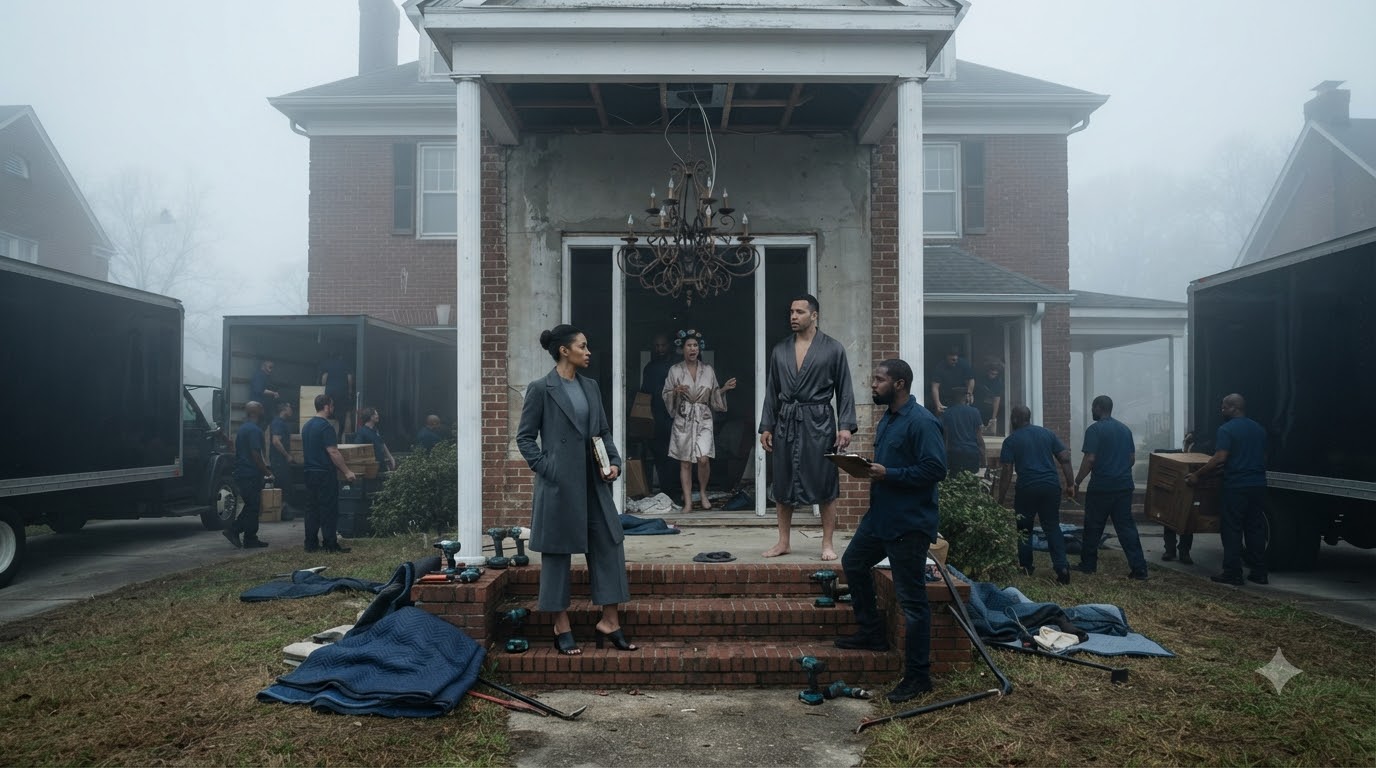
The morning fog lay thick over the cul-de-sac when Gerald’s two diesel trucks air-braked to a stop at the curb at 5:58 A.M. Eight men in dark blue work shirts stepped out into the damp air, carrying padded blankets, cordless impact drivers, and crowbars wrapped in rubber sleeves.
Gerald walked up the brick path, clipboard in hand. He didn’t look at the house; he looked at the paper.
“Itemized personal property,” Gerald said, checking his watch as the sweep-second hand hit six. “Let’s get the door.”
I stood on the sidewalk, the cold morning air biting my face, hands deep in my pockets around that scratched brass bracket.
“No drama, Gerald,” I said quietly. “Just the inventory.”
Gerald rang the bell. Inside, a dog barked once, and then came the heavy, confused footsteps of a man who thought six numbers on an electronic lock made him untouchable.
CHAPTER 3: THE EMPTY SHELL
Darius blinked against the gray morning light, his charcoal silk bathrobe tied loose around his waist.
“What is this?” His voice was thick with sleep, but the irritation flared instantly. He looked past Gerald at the two idle box trucks, then at the eight men standing silently on the brick walkway with folded mover’s blankets over their arms.
Gerald didn’t flinch. He adjusted the metal clip on his board with a loud snap. “Itemized removal of documented personal property, Mr. Jefferson. We have three hours to clear the scheduled inventory.”
“You’re out of your mind,” Darius snapped, stepping forward onto the threshold. “This is private property. Get off my lawn before I call the city police.”
I walked up the porch steps, my heels clicking sharp against the concrete. I pulled my hands from my coat pockets and handed Gerald the certified copy of my grandmother’s original 1978 land deed, alongside the itemized fixture invoices stamped by Fulton County.
“Call them,” I said, my voice quiet enough that the morning fog seemed to catch it. “The land is under my sole name. The house is built on my family’s dirt. You changed the lock code on a door that hangs on my hinges.”
Darius went pale, the exact shade of unwashed canvas.
From the end of the hallway, a bedroom door clicked open. Tiana appeared in a silk kimono robe, a pair of expensive drop earrings already catching the hall light. Her hair was wrapped in rollers.
“Babe? Who is at the door at six in the morning?” She stopped cold when she saw the movers lining the driveway. “Darius, what’s going on? The caterers aren’t coming until five.”
“Inside, Tiana,” Darius growled, his jaw tight.
“Item seventy-four,” Gerald called out, ignoring them both as he signaled his crew inside. “Living room reclaimed iron chandelier. Four-man lift. Disengage the canopy box.”
“Touch that light and I’ll—” Darius started, lunging slightly toward the crew leader.
Gerald’s largest mover, a man named Marcus with forearms like telephone poles, stepped smoothly between Darius and the entryway archway. He didn’t raise his hands; he just occupied space with six feet four inches of solid weight.
Darius stopped dead. His chest heaved once, his expensive bathrobe slipping off one shoulder.
Inside, the impact drivers began to whine—high, sharp bursts of mechanical torque unseating heavy steel screws from structural studs.
The caramel linen sofa came out first, wrapped tight in blue padded moving blankets. Tiana shrieked as two men carried it past her, her hands flying to her mouth as she watched the custom-built walnut coffee table follow right behind it.
“Darius! Do something!” she yelled, her voice dropping its smooth, honeyed cadence, turning sharp and shrill. “They’re taking the furniture! What about tonight? The invitations went out two weeks ago!”
Darius didn’t answer her. He stood on the porch, his bare feet cold against the concrete, watching his living room dismantle itself piece by piece.
At 6:45 A.M., the floor crew started at the edge of the foyer. The pneumatic pullers made a rhythmic thunk-clack as the dark honey pine planks released from the floating underlayment.
As Marcus carried down the heavy ceiling fixture, I noticed something strange at the base of the junction box—a fresh, zinc-plated steel mounting plate screwed directly into the subfloor header above the ceiling line. It didn’t belong to my 2018 renovation. It was commercial-grade, stamped with a bank serial number.
I touched the cold brass bracket in my coat pocket, feeling the old 1978 mark beneath my thumb. Darius hadn’t just taken my house; he had tried to anchor something else inside the framing.
A white BMW pulled up to the curb at 7:10 A.M., the driver slowing down to stare at the exposed bare concrete foyer visible through the wide-open front door. It was the first guest’s caterer delivering fresh flowers.
Tiana stood in the bare doorway, her hair half-done, her heels clicking on raw subfloor, staring at an empty room with dangling copper wires hanging from the ceiling.
CHAPTER 4: THE SURVEY SPIKE
The serial code stamped into the galvanized steel wasn’t a standard residential permit number. It started with MCC-COMM-2022—Midsize Construction Consulting, Darius’s firm.
I traced the cold metal edge with my thumb. He hadn’t just taken out a secondary loan for his portion of the build six years ago; he had quietly pledged the real property on Cascade Road as asset collateral for a commercial line of credit to keep his business afloat.
Gerald walked up behind me, wiping grease off his knuckles with a red shop rag. “That plate was lag-bolted right into the main ceiling joist. Whoever put it up there intended to tie commercial weight to the framing.”
“He thought the house was his,” I said, setting the plate onto the truck bed with a metallic clatter. “Because he was the one signing the construction draws.”
“Trucks are loaded,” Gerald said, checking his watch. “Every fixture, plank, and cabinet on your list is tied down. Where are we taking it?”
“The storage unit off Edgewood,” I said. “And Gerald? Thank you.”
He gave a sharp, single nod. “You paid the invoice in 2018, Mrs. Washington. The lumber belongs to who bought it.”
I drove directly to my new office space on Edgewood Avenue. The morning sun was finally breaking through the overcast sky, throwing thin golden light across the drafting table near the window. Outside, the bare branches of a dogwood tree rattled gently against the glass.
I didn’t call a high-priced defense attorney. I didn’t reach for a thick legal binder. Instead, I pulled out the original hand-drawn land survey my grandmother Dorothy May had tucked inside her family Bible back in 1978, alongside the Fulton County municipal records for the Cascade Road parcel.
I laid the brittle, yellowed paper flat under the desk lamp.
There it was, written in black ink that had faded to deep brown over forty-eight years: a clear municipal homestead restriction. Dorothy May had established the land under a single-owner matrilineal conveyance clause. Under Georgia land laws of that era, no secondary lien, commercial encumbrance, or corporate pledge could attach to the real estate without the explicit, sole signature of the primary blood heir.
Darius had signed those commercial loan documents with his bank assuming my name on the deed was a harmless formality—a domestic detail he could bypass because we were married.
He had borrowed two hundred thousand dollars against land he didn’t own, using a corporate signature that had no legal footing on Dorothy May’s dirt.
The brass canopy bracket sat beside the paper on my desk. I picked it up, rolling the hand-stamped ‘1978’ mark over my knuckles. The bracket wasn’t just a piece of hardware I’d bought in Inman Park; it was mounted into the original frame anchored by that exact survey spike.
My office door clicked open. My assistant looked in, her hand resting on the brass knob.
“Ammani?” she said softly. “There’s a man downstairs in a suit with a younger lawyer. He says he’s your husband.”
“Soontobe former husband,” I corrected her, setting the 1978 survey flat on the wood table. “Bring them into the conference room.”
CHAPTER 5: THE RECKONING ON EDGEWOOD
Darius walked into the conference room first. His gray dress shirt was rumpled at the collar, a faint smudge of drywall dust still on his left sleeve from the hollow shell on Cascade Road.
Behind him, a young associate in a sharp blue suit carrying a thin manila folder pulled out a chair with practiced efficiency. Darius didn’t sit immediately. He stood opposite me, leaning his palms against the oak grain, trying to leverage his six-foot-one height over the table.
“You had your point to prove, Ammani,” Darius said, his voice raspy, holding tight to a thin veil of composure. “You made a scene. Tiana’s guests saw the trucks. The house is gutted. But you’re going to put every fixture back, or we file for unlawful conversion of marital property before noon.”
The young lawyer opened his thin folder, sliding a single sheet of paper forward. “Mrs. Washington, my client has a secondary construction lien recorded on that property. By stripping the fixtures, flooring, and electrical hardware, you have intentionally devalued a bank-secured asset.”
I didn’t reach for a thick binder. I didn’t quote a private lawyer’s letter. I simply slid the yellowed 1978 land survey across the polished wood, right beside the zinc-plated commercial mounting plate I’d unbolted from the living room ceiling joist.
“Read section four of the Fulton County municipal deed,” I said, my voice level.
The young attorney frowned, picking up the yellowed document. He read the hand-inked script for thirty seconds before his eyes slowed down, tracking back to the top of the page.
“That’s an original single-owner matrilineal conveyance clause,” I told him, as the room went completely quiet. “Dorothy May Washington probated this land in 1978. Under Georgia real property statutes, no spousal lien, corporate guarantee, or secondary loan can attach to this parcel without the explicit, sole signature of the primary blood heir.”
The lawyer looked at Darius. “Darius… did your wife sign the corporate guarantee on your commercial line of credit?”
“It was our house!” Darius slammed his palm onto the table, the silver watch on his wrist rattling against the wood. “We built it together! My name was on the construction draws!”
“Your name was on a secondary personal loan that was paid in full three years ago,” I said, holding his gaze. “The commercial line you took out for Midsize Construction Consulting last summer was secured using my land as collateral. Without my signature, that bank hold is invalid. In fact, Fulton County flagged the improper encumbrance two hours ago when the title check cleared.”
The young lawyer quietly closed his thin manila folder, his posture shifting entirely. He leaned over and whispered three short words into Darius’s ear.
Darius’s face twisted into an ugly, desperate mask. “You think you won? You think you can just take the children, rip the floors out, and walk away like seven years meant nothing?”
“I didn’t rip the floors out to ruin you, Darius,” I said, standing up and sliding my hands into my pockets, feeling the cold weight of the brass canopy bracket. “I took them because I paid for them. And I am not leaving my children’s foundation inside your debt.”
Darius didn’t apologize. He didn’t break down into remorse. He leaned over the table, his knuckles turning white as he snarled, “I’ll take you to court for every dime of the business revenue. You won’t see a cent.”
“You own forty-nine percent of a company drowning in back-tax holds,” I said, stepping past him toward the door. “I own fifty-one percent of the voting shares from the capital check I signed in 2021. The Georgia Department of Revenue has already frozen the business accounts.”
He stood frozen in the middle of my office, his lawyer already stepping toward the door with his briefcase, leaving Darius standing alone in his wrinkled shirt.
CHAPTER 6: STARS UNDER RECLAIMED LIGHT
Terrence wiped his forehead with a blue handkerchief, his fiberglass ladder creaking slightly as he leaned back to check the alignment.
“That’s central,” Terrence said, clicking the wall switch down before flipping the main breaker back on. “It’s anchored to the double header, Mrs. Washington. That box isn’t going anywhere.”
I stepped back onto the bare heart-pine floor of our new front room. The iron arms of the chandelier held forty cut-glass prisms, every single one wiped clean by hand with warm water and white vinegar the night before.
The copper wire inside the chain hummed once, a quiet electrical vibration, and then the lights came on.
Warm amber light spilled across the fresh cream plaster, throwing sharp geometric shadows against the ceiling. It looked different here than it had on Cascade Road. There was no pretense in it, no performance for neighbors or guests arriving for a party. It was just honest light hitting solid wood.
Ila ran into the room barefoot, her stuffed rabbit tucked firmly under one arm. She stopped right in the center of the floor, tipped her head all the way back, and gasped.
“Mama,” she whispered, her small voice echoing in the uncarpeted space. “It looks like stars.”
“It does, baby,” I said, reaching down to smooth her dark curls.
Zion walked in from the kitchen holding a glass of water, his tablet tucked under his elbow. He looked up at the ceiling, then at me, giving a single, solemn nod of approval that belonged to a grown man twice his age.
“The Wi-Fi router is set up in my room,” Zion reported, setting his glass on the small oak side table. “It’s fast.”
“Good,” I said. “Go help your grandmother unload the casserole dish from her trunk.”
My mother came in through the front door a minute later, carrying a heavy cast-iron Dutch oven wrapped in a dish towel. She didn’t say anything about Darius, or the foreclosure notice Fulton County had placed on the empty shell off Cascade Road, or the fact that Tiana had packed her bags for Macon three days after the housewarming guests drove away.
She set the pot on the dining table, looked up at the chandelier, and then looked at me.
“Dorothy May bought those same glass prisms at a flea market in 1982,” my mother said softly, setting her hands on her hips. “She kept them in a cigar box under her bed until you were born.”
I pulled the scratched brass canopy bracket out of my pocket one last time. The hand-stamped ‘1978’ mark was smooth against my thumb now, stripped of all the dirt and friction from the last two weeks. I set it neatly inside the drawer of the entryway desk.
Darius had believed that taking six numbers on a digital lock could strip seven years of labor from a woman who knew how to build from scratch. He had learned the hard way that a home isn’t held together by drywall, contracts, or empty promises.
It is held together by the person who keeps the receipts, knows the boundaries of her land, and refuses to leave her children’s future inside someone else’s lie.
Outside the front window, the December rain began to fall soft and steady against the glass. Inside, the light stayed bright.