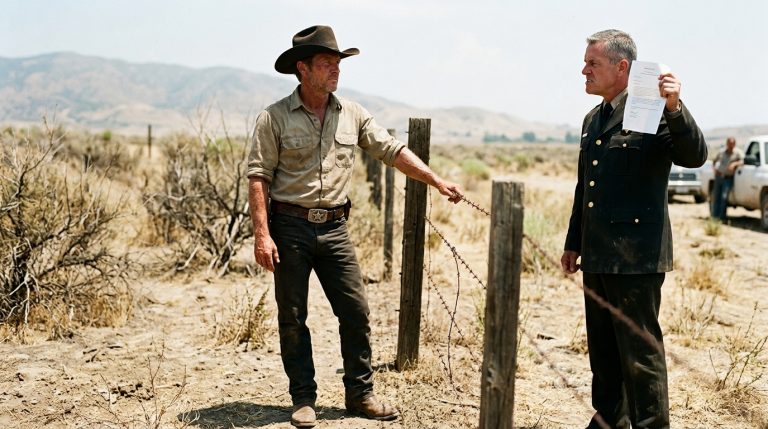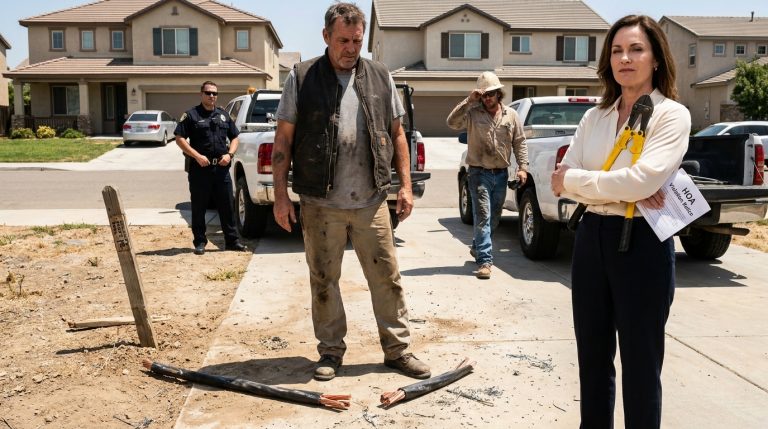
The Keeper of the Ditch: An Architecture of Silence in the Faded Valley
CHAPTER 1: THE ARCHITECTURE OF SILENCE
The courtroom smelled of recycled air and the dry, papery decay of files that hadn’t seen the sun in decades. It was a texture Pressler had grown accustomed to—the scent of lives being filed away, one procedural win at a time. He sat with a cold cup of coffee in his holder, his legal pad resting on his knee like a shield, watching the man in the third row.
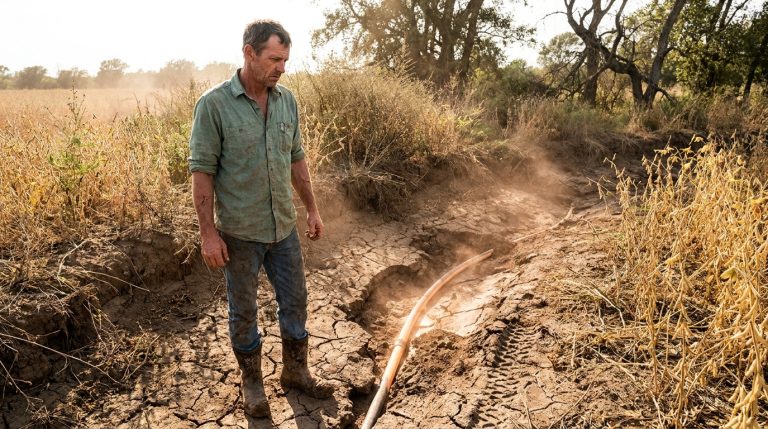
Everything about the man—the terracotta-burned neck, the frayed cuff of his jacket, the broad, working-man knuckles—spoke of a life defined by the horizon. But the boots were different. They were black, broken in, and polished to a matte finish that defied the dust of the valley. It was a habit of maintenance, the way a person cares for the tools that keep them alive.
Leon Pressler had spent years in intelligence, learning to study people as if they were terrain. You didn’t look for the loud things; you looked for the friction. And there was no friction here, only a stillness that defied the jagged energy of the attorneys at the front.
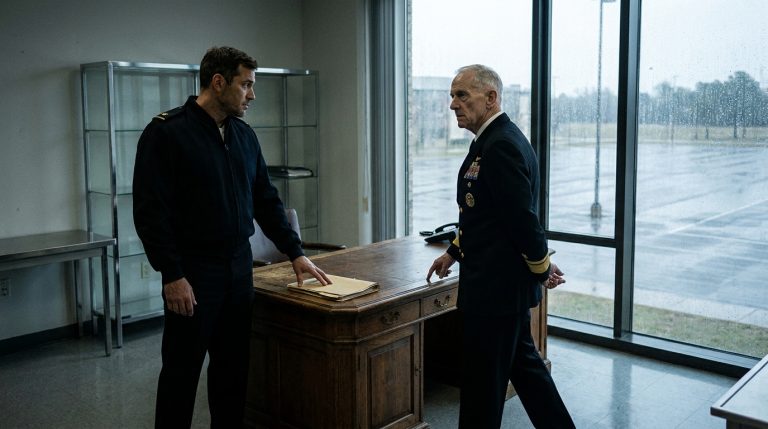
Harlan Wick, the judge, moved his reading glasses with a rhythmic, metronomic cadence that punctuated the monotony of the afternoon. Down the bench, Drummond, the county’s lead counsel, was constructing a masterpiece of exclusion. He was building a wall of 1987-dated documents that effectively strangled the cooperative’s claim to the water. He held the room with a confidence that felt heavy, a deliberate weight meant to settle the issue before it was ever argued.
Gwen Tao, the cooperative’s attorney, stood at the podium. She was three years out of law school and looked as though she hadn’t slept since the late nineties. Her notes were a tapestry of desperate, scrawled shorthand. She was fighting a fire with a paper fan, and everyone in the room knew it. The fire, of course, was the 2003 blaze at the extension office, the one that had scrubbed the crucial survey plats from the record.
Pressler watched Tao’s hands. They were steady, but the fraying edge of her sleeve betrayed the tension. She knew. She knew the county had the upper hand, and she knew the weight of the silence that would follow when she inevitably lost.
Then, the man in the third row—the man with the immaculate boots—shifted.
It wasn’t a sudden motion. It was a slow, deliberate redistribution of weight. He unfolded his hands from the crown of his hat. He leaned forward, his spine straight without being rigid, a posture Pressler recognized from decades of naval service: the readiness of a man who knows exactly when to stand.
Pressler turned his attention back to Drummond. The lead counsel was currently describing a map from 1987.
The man in the third row moved his right thumb against the brim of his hat. A single, rhythmic press. The gesture was so small it might have been an itch, but Pressler’s eyes, honed on the observation of small anomalies, fixed on it. The thumb pressed, held, and released.
It was a correction.
Drummond stopped his sentence, caught by a sudden, inexplicable shadow falling over his notes. He blinked, looking out at the gallery as if searching for a heckler, but there was only the old man, hands folded again, face as neutral as a stone.
Pressler looked down at his own legal pad. He had been doodling the geometric shape of the irrigation ditch, but his hand stopped mid-stroke. He glanced back at the man in the third row. The man’s eyes were locked on the documents Drummond was holding—not on the man, but on the paper itself.
There was a discrepancy. Something in the way the light hit the old man’s face revealed a flicker of iron-gray recognition. Pressler leaned in, his own heartbeat suddenly audible over the hum of the ventilation. He looked closely at the photocopy Drummond had submitted, the one Tao had argued against.
There, in the corner of the exhibit, near the seal, Pressler saw it. A faint, smudged stamp that Drummond had glossed over as a filing error. But the old man was looking at the stamp as if it were a heartbeat.
The courtroom light shifted, catching the edge of the old man’s sleeve. Pressler noticed then that the thread used to repair the cuff wasn’t just a different color—it was a specific, industrial-grade twine he’d seen only once before, on a piece of classified maritime logistics gear in the Navy.
The man wasn’t just a farmer.
Pressler looked back at the document in Drummond’s hands, then at the old man. The silence in the room suddenly felt hollowed out, as if the air had been sucked away to make room for something else. The old man reached into his jacket, and for a fleeting, terrifying second, Pressler thought he saw the corner of a sealed envelope, thick with age, peeking out—not a deed, but an archival record that couldn’t possibly exist.
The judge’s gavel fell, ending the session, but the sound didn’t break the tension; it shattered it. Pressler stood, his pulse drumming against his ribs. He had to know. He started to turn toward the third row, but as he moved, his shoulder brushed against a court officer who was walking past. The officer dropped a stack of papers.
Pressler paused to help, and in that split second of distraction, he glanced back.
The third row was empty.
The man with the immaculate boots was gone, but he had left behind a small, handwritten note on the wooden bench, tucked neatly beneath the spot where his hat had rested. Pressler moved forward, ignoring the officer’s thanks, his hand hovering over the wood. He reached down and slid the paper toward him.
It wasn’t a note. It was a partial copy of a survey plat—one that the county claimed had burned in 2003. And at the bottom, in the same precise, small handwriting Tao used, were the coordinates for the very place the county claimed the ditch didn’t exist.
Pressler’s blood went cold. He looked up, searching for the man, but the gallery doors were swinging shut, the heavy wood muffling the sounds of the hallway. He turned to show Tao, but she was already walking toward the exit, looking defeated.
Then, he heard it: a soft, metallic click from the gallery entrance. Someone had locked the doors from the outside.
Pressler looked at the survey plat again. The ink was fresh. The fire hadn’t burned the records. The fire had been a receipt.
CHAPTER 2: THE SOUND OF THE LOCK
The click was not loud. In the cavernous, hollow acoustics of the courtroom, it was a surgical sound—sharp, decisive, and unmistakably final. Leon Pressler stood frozen by the third row, the photocopy of the survey plat feeling uncomfortably heavy in his hand. The weight of the paper was negligible, but in the silence that followed the locking of the doors, it possessed the gravity of a confession.
He stared at the heavy oak doors, the varnish peeling in thin, brittle strips near the brass handle. He didn’t run for them. His body, tuned by years of operational discipline, rejected the instinct to scramble. Instead, he drew a slow, deliberate breath, letting the cooling air settle in his lungs. He felt the familiar, cold precision of a shift in his own mental state—the move from observer to participant.
Pressler glanced at the empty seat where Dale Purcell had been sitting. The hat was gone, the space on the bench now just a barren rectangle of dusty wood. The old man had timed his exit perfectly, moving through the doors exactly when the mechanism was meant to be engaged. Or perhaps he had known it was coming. The thought rippled through Pressler’s mind, triggering a sudden, intrusive phantom—the memory of a briefing room in the capital, five years ago, where a simple operational detail had been missed, leaving a team stranded in a blind spot. The taste of that metallic failure, that sharp, bitter bite of realized negligence, washed over him now.
He didn’t panic. He walked to the center aisle, his boots silent on the buffed tile. He checked his watch. 3:15 PM. The courthouse would be transitioning into its evening cycle—skeleton staff, tired bailiffs, the slow exodus of the day’s bureaucracy. If the doors were locked from the outside, it wasn’t a malfunction; it was an isolation event.
He smoothed the survey plat against his thigh. The coordinates scribbled at the bottom were not just geographic markers. They were a challenge. He looked at the room, really looked at it, beyond the witness stand and the judge’s bench. The courtroom was a theater of performance, but tonight, it was a pressure cooker.
He moved toward the defense table, his eyes scanning the floor for any trace of what had happened in the last few minutes. There, near the leg of the table, was a faint, smudge-like streak of grease—the same dark, industrial residue he had seen on the cuff of Purcell’s jacket. It tracked toward the side exit, the one Gwen Tao used for her private consultations.
He followed the trail. The silence in the room was absolute, amplified by the low hum of the fluorescent lights that flickered with a rhythmic, dying stutter. Each flicker seemed to underline the fragility of the paper in his hand. He wasn’t just holding a map; he was holding the reason for the 2003 fire, the reason the water rights were being strangled, and the reason the county was willing to lock a courtroom to keep this room, and everything in it, from leaking into the light.
He reached the side door and pressed his ear against the wood. Nothing. He reached for the handle, half-expecting it to be locked as well, but it turned with a smooth, well-oiled ease that suggested it had been left unlatched on purpose.
He pushed it open just an inch. The hallway beyond was dim, illuminated only by the thin, amber glow of an emergency exit sign. Standing at the far end of the corridor, his silhouette framed by the stark lines of the architecture, was Dale Purcell.
The old man wasn’t moving. He stood with his hands folded in front of him, hat back on his head, watching the intersection where the main hallway met the clerk’s office. He wasn’t waiting for Pressler. He was waiting for something else—something Pressler couldn’t see, but could feel in the sudden drop of the room’s temperature.
Pressler stepped into the hallway, the wood floor beneath the carpet creaking once, a soft, dry protest. Purcell didn’t turn.
“You should have left with the others, Mr. Pressler,” the old man said. His voice was flat, devoid of admonishment, just a simple statement of a miscalculation.
“The doors were locked,” Pressler replied, keeping his distance. “You knew they would be.”
Purcell turned then, his face partially obscured by the shadow of his hat brim. The light caught the deep, dense lines of his skin, and for a moment, Pressler saw the absolute clarity in his eyes—the same clarity he had seen in the parking lot. It wasn’t the look of a conspirator. It was the look of a man who had been expecting a specific storm to break for seven years.
“They aren’t locking it to keep us in,” Purcell said, gesturing with a slow, steady hand toward the clerk’s office. “They’re locking it to keep someone else out. They’ve realized what was in the lockbox.”
A muffled, rhythmic thud came from the direction of the records basement—the heavy, industrial sound of a service elevator being forced open. It wasn’t the sound of an authorized maintenance crew. It was the sound of someone who had a key they weren’t supposed to have, coming up to finish the job that the 2003 fire had started but failed to complete.
Pressler looked down at the plat in his hand. He realized then that he wasn’t just a consultant anymore. He was the only person in the building who knew the map’s true value. He looked back at Purcell, the silence stretching between them, thick with the weight of years.
“They’re coming for the originals,” Pressler said, the realization settling into his bones.
“They’re coming for the only thing that proves we didn’t just forget our own history,” Purcell corrected, his voice dropping to a whisper. “And we are currently the only thing standing between the history and the shredder.”
He stepped toward Pressler, holding out his hand. He didn’t demand the paper. He waited for Pressler to give it to him, to choose his side in the architecture of the coming quiet. The hallway seemed to narrow, the walls closing in as the sound of the elevator reached the third floor. Pressler looked at the man, then at the map, and then at the dark, yawning threshold of the record’s office. He took a single, decisive step forward.
CHAPTER 3: THE FRAGILITY OF EVIDENCE
Pressler didn’t wait for an invitation. He surged forward, his boots making no sound on the thin, industrial-grade carpet of the corridor. Purcell was already moving, his pace deceptively quick, his left knee showing no sign of the delay Pressler had observed earlier. It was as if the urgency of the moment had stripped away the limp, replacing it with the efficiency of a machine primed for a specific task.
They reached the clerk’s office door, a heavy slab of fire-rated steel. The thudding from the service elevator echoed through the building’s skeletal ventilation shafts, closer now—a rhythmic, grinding metallic groan.
“The lockbox,” Pressler whispered, his eyes scanning the office’s frosted glass. “You said you had the key.”
Purcell produced a small, silver-toned key from his pocket, his hands as steady as a surgeon’s. He didn’t look at the office; he watched the corridor’s end, his body positioned to pivot at a moment’s notice. “Raymond didn’t just give me a document, Pressler. He gave me a way to prove that the 2003 fire wasn’t an accident. It was a clean-out.”
Pressler looked at the frosted glass. “A clean-out?”
“Look at the records,” Purcell said, his voice a low vibration in the quiet hallway. “The fire started in the electrical room, but the survey plats were kept in a room three floors up, isolated by fire doors. There was no rational reason for those documents to have been involved unless someone moved them.”
The elevator doors downstairs opened with a sharp, pneumatic hiss. Footsteps followed—heavy, confident, and echoing with the ring of authority. Whoever was coming didn’t feel the need to be quiet. They weren’t intruders; they were owners.
Pressler pushed the office door open. The room inside was a tomb of forgotten paper. Rows of metal shelving stretched toward the ceiling, holding thousands of cubic feet of history, all of it smelling of damp pulp and slowly decaying adhesive. The air was thick with the grey, suffocating dust of a place where things went to be erased.
He clicked on his pen-light. The beam cut through the dark like a blade, revealing the faded textures of file spines and the fraying edges of ledger books. He turned to Purcell, but the old man was already moving down the middle aisle, heading toward a small, reinforced cabinet bolted to the concrete floor near the back wall.
“They’ll be here in seconds,” Pressler said, his pulse accelerating. He felt the phantom of his past failures rising again—the urge to look for the exit, to calculate the odds of retreat. But then he saw the plat in his hand, the ink still smelling of fresh toner, and he realized that for the first time in twelve years, he wasn’t observing the data. He was the data.
“Get the plat,” Purcell commanded, his tone leaving no room for negotiation. “I need to open the cabinet.”
Pressler jammed the paper into his coat pocket and moved to the shelf indicated by the coordinates on the plat. His fingers trembled as he pulled a heavy, leather-bound volume from the shelf. The spine cracked with the protest of years of neglect. He began to flip through the pages, his heart thumping against his ribs.
He was looking for a specific stamp—the same stamp he had seen on the photocopy. He skipped the 1990s, the 80s, the 70s. He reached the early 50s.
The footsteps in the hall slowed just outside the office door. Pressler stopped breathing. He watched the shadow cast under the door—it stretched, deepened, and then remained still. A hand touched the handle.
In the back of the room, Purcell was hunched over the cabinet, his face masked in shadow. He was working with a rhythmic, mechanical focus, the metal key twisting in the lock with a faint, metallic groan.
“They’re waiting,” Pressler hissed, his eyes locked on the door. “If they enter, we’re caught.”
“Let them wait,” Purcell replied, his voice devoid of fear. “They need to see what we’re doing. It’s part of the architecture of the truth.”
The door handle turned. It was locked, but the person on the other side didn’t seem surprised. There was a moment of silence—a long, agonizingly slow pause where the only sound was the building’s own groaning machinery—before the person on the other side tapped on the glass.
Tap. Tap. Tap.
It was the cadence of a summons, not a search.
Pressler felt a sudden, sharp spike of paranoia. He checked the shelf again, his light trembling. He found it. The entry for 1952. It wasn’t a filed document; it was a ghost. A blank space where a map should have been, with only the impression left in the paper where the original had once rested before being forcibly removed.
The decoy was gone. The layer below—the truth—was starting to show its jagged edges. The file wasn’t empty because it was lost; it was empty because the records had been systematically re-indexed, rewritten, and replaced by the very institution that now sat in the courthouse above them.
“I have it,” Purcell said, standing up. He held a thick, heavy-duty envelope. He didn’t look at the door. He looked at Pressler. “The audit trail of the erasure.”
“They’re going to break the door,” Pressler warned.
“They won’t break anything,” Purcell said, stepping toward the center of the aisle. “They’re county officials. They rely on the illusion of procedure. If we open this door and hand them the evidence, we shift the entire weight of the case.”
The door handle rattled again, more forcefully this time. The glass began to spider-web with fine, hairline cracks. Pressler moved to stand beside Purcell, his back against the cold, unyielding metal of the shelving. He felt the weight of the situation—the history, the fire, the boots, the long, slow wait of seven years—compressing into this single, narrow aisle of dead paper.
He wasn’t an observer anymore. He was a witness.
“Ready?” Pressler asked, his voice steadying, his eyes fixed on the inevitable moment the glass would shatter.
Purcell nodded, his expression as blank as a stone. “We were ready in 1952. We’re ready now.”
The door shivered under a heavy, calculated strike. The frosted glass gave way, raining down in a shower of glittering, dangerous debris that settled silently on the floor like snow. Pressler tightened his grip on his light, his body coiled, waiting for the light from the hallway to finally pierce the dark.
CHAPTER 4: THE VERIFICATION OF THE PAST
The jagged remains of the frosted glass lay scattered across the linoleum like frozen tears. Pressler kept his back pressed against the shelving, the cold metal biting through his jacket. He watched as the figure in the hallway stepped over the threshold, his movements slow, deliberate, and entirely unbothered by the violence of his entry.
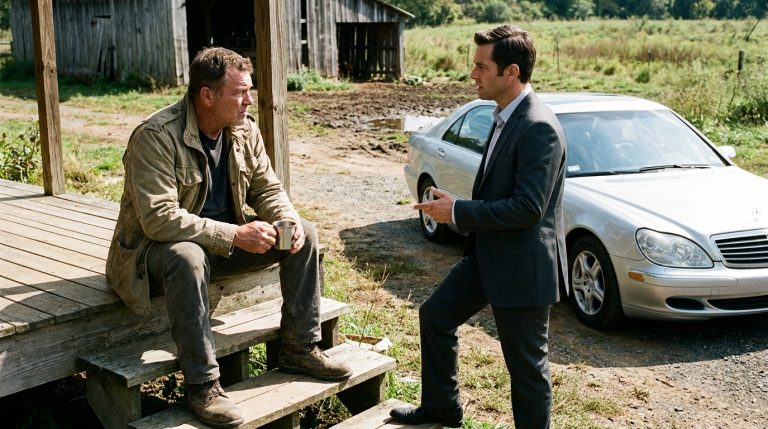
He was a man in his late forties, wearing a suit that cost more than Pressler’s truck. His expression was not angry; it was the practiced, clinical indifference of an administrator. He didn’t look like a thug. He looked like an auditor. He walked into the aisle, his polished shoes crunching softly on the glass.
“Mr. Purcell,” the man said, his voice smooth and devoid of any jagged edges. “I think you’ve made a significant administrative error.”
Purcell stood his ground. He didn’t raise his voice, and he didn’t move. He simply held the thick envelope with both hands, the same way he had handled his hat earlier that morning—with the reverence of a man who knows the object’s true weight.
“The only error here, Mr. Drummond, is the one the county has been making since 2003,” Purcell said.
Drummond stopped five feet away. He adjusted his cufflinks, his eyes flickering briefly to Pressler, dismissing him with a glance that felt like a cold draft. “There is no ‘error’ in a records fire. There is only loss. And what you’re holding is unauthorized material. It’s an archival violation. I’m going to need you to hand it to me.”
Pressler looked at the shelves behind him. He needed a distraction, an opening. He remembered the survey plat in his pocket—the copy Purcell had given him. He felt the paper, its texture now familiar and grounding. He glanced at the stacks. If he could trigger the fire suppression system, or even just force a localized collapse of these precarious, overloaded shelves, he might buy them the time to move. But he noticed something else: the file indices on the shelf behind Drummond. They weren’t arranged by date. They were arranged by department, and the sequence was missing a crucial block of serial numbers.
“The numbers,” Pressler said, his voice cutting through the quiet. “The 2003 records weren’t just burned, were they? They were re-indexed. That’s why the survey plats disappeared. You didn’t lose them. You moved them into the current administrative audit to create a false chain of title.”
Drummond turned toward Pressler, his mask of indifference slipping just enough to reveal a flicker of sharp, tactical annoyance. “Intelligence analysis, Mr. Pressler? That’s a redundant skillset in a civil dispute.”
“It’s not a dispute anymore,” Pressler said, stepping forward, his confidence growing with the realization of the pattern. “It’s a verification of intent. You’ve been sitting on this for years, relying on the fact that the cooperative couldn’t afford to perform a deep-dive forensic audit of your digital filing system. You didn’t expect anyone to look at the physical backup.”
“And you think a piece of photocopied paper is enough to unravel a decade of county law?” Drummond’s smile was thin, a line drawn in sand.
“The photocopy isn’t the evidence,” Purcell said. He pulled a small, silver-backed micro-film reel from the envelope. “The photocopy was the bait. This is the truth.”
Drummond’s eyes went to the reel. The change in his demeanor was instantaneous. The clinical indifference vanished, replaced by a sudden, predatory focus. He moved with a speed that belied his expensive suit, lunging not at Purcell, but at the light Pressler was holding.
Pressler didn’t hesitate. He swung the heavy metal flashlight, not at Drummond, but at the support bracket of the nearest shelf. The metal groaned and gave way.
Thousands of pages of cold, dead history poured off the rack like a waterfall of paper. The air became a storm of dust and ink-stained leaves. Drummond was buried instantly, his suit jacket snagged on a metal corner, his movement halted by the sheer, overwhelming volume of the past.
“Go!” Pressler shouted, grabbing Purcell by the arm.
They scrambled through the aisle, stepping over the debris, their feet kicking up a cloud of grey, choking particles. They reached the broken door and spilled out into the hallway, the sound of the falling shelves still reverberating in the office behind them.
The corridor was empty. The silent, flickering lights seemed to mock them. They didn’t stop. They moved toward the stairwell, their breathing ragged in the sudden, oppressive quiet. Pressler felt the texture of the paper in his pocket—the plat—and realized he had inadvertently become the carrier of the very secret he had spent his life observing from the shadows.
They reached the stairwell door and pushed through, descending the concrete steps two at a time. The sound of Drummond’s muffled cursing, the rattling of shelves, and the distant, rising alarm of the building’s security system followed them down. They didn’t speak. They didn’t need to. They were moving in a perfect, unspoken rhythm, the same rhythm that had defined the morning—the cadence of survival.
As they reached the lobby, the courthouse was a hive of activity. Security officers were rushing toward the elevators, their radios crackling with confused reports of a localized structural failure in the records wing. Pressler and Purcell merged with the crowd of departing employees and lawyers, their movements fluid and unremarkable.
They stepped out into the crisp, cooling air of the late afternoon. The sky was turning a bruised, deep purple, the kind of light that signaled the end of a long, bruising cycle. They walked to Purcell’s truck without looking back.
“He’ll call the sheriff’s office,” Pressler said as he climbed into the passenger seat.
Purcell started the engine. It turned over with a rough, honest roar that felt like a promise. “Let him. The paper is in the lockbox. And the micro-film… that’s going somewhere where even a county attorney can’t reach.”
He looked at Pressler, his eyes clear and steady. “You chose a side today, Leon. That’s a hard thing to undo.”
Pressler looked out at the courthouse—the massive, grey-stone monument to a system that had tried to erase a family’s legacy. He felt the map in his pocket, the physical weight of it, and for the first time, he didn’t feel the need to observe. He felt the need to act.
“I didn’t choose a side,” Pressler said. “I just followed the evidence.”
Purcell pulled away from the curb, his driving careful, measured, and perfectly in control. They headed toward the valley, leaving the city’s grey architecture behind for the vast, open horizon, but Pressler knew that the case was only just beginning. The decoy had been shattered, but the reality—the full, unvarnished truth—was still buried under seven years of silence.
CHAPTER 5: THE JUDGES QUIET METRONOME
The road out of the county seat was a ribbon of slick, rain-darkened asphalt, bordered by skeletal trees that seemed to lean away from the headlights. Inside the cab of the truck, the silence was heavy, broken only by the rhythmic, mechanical thwack of the wipers. Pressler watched the reflection of the dashboard lights in the rain-streaked glass, his mind replaying the scene in the records office.
Drummond hadn’t just been angry. He had been terrified.
“How deep does the re-indexing go?” Pressler asked, breaking the silence. His voice sounded thin against the roar of the engine.
Purcell didn’t look at him. His eyes were fixed on the road, his hands light but firm on the wheel. “Deep enough to cover the entire drainage history of the valley. If they successfully claimed the ditch, they weren’t just taking water rights. They were taking the physical infrastructure of every farm in the cooperative. They would’ve owned the flow itself.”
A sudden gust of wind slammed against the truck, forcing Purcell to correct the steering. The rain intensified, turning the world outside into a blurred, monochromatic smear. The truck shuddered, the suspension groaning as they hit a stretch of rutted pavement.
“They’re going to come after the micro-film,” Pressler said. It wasn’t a question. “Drummond knows we have it. He saw you take it.”
“He knows I took an envelope,” Purcell corrected, his tone pragmatic. “He doesn’t know for certain it was the micro-film. He’s counting on the fact that we’ll try to use it the same way we tried to use the other documents—through the front door.”
Pressler looked at his hands. They were still stained with the grey, suffocating dust of the records office. He thought about Judge Harlan Wick. Wick, with his reading glasses and his metronome-like rhythm. Wick, who had stared at the photocopies for sixty seconds without saying a word.
“Wick,” Pressler whispered. “He knew. He wasn’t surprised by the continuance. He was waiting for someone to force his hand.”
Purcell nodded once. “Wick’s a man who respects the architecture of the law, but he’s spent nineteen years watching the county dismantle it. He needs a reason to intervene that doesn’t look like an intervention.”
The truck swerved violently as a massive branch, stripped of its leaves by the storm, lay across the lane. Purcell braked hard, the tires locking for a heartbeat before biting into the saturated gravel. They came to a halt inches from the wood, the truck’s engine idling in the frantic, wet dark.
“We can’t go to the main road,” Purcell said, looking out at the blocked path. “If they’re tracking the truck—and they will be—the main highway is a trap.”
He cut the headlights. The sudden plunge into darkness was absolute. Pressler felt the air pressure shift as the storm intensified, the sound of the rain drumming against the metal roof like thousands of tiny, urgent fingers. He reached into his pocket and touched the plat. It felt different now—less like a piece of evidence and more like a target.
“We’re exposed,” Pressler said, his old habits of threat assessment kicking in. He began to scan the periphery, his eyes straining against the black.
“We’re hidden,” Purcell countered. “In the dark, they’re looking for movement. If we stay still, we’re just another shadow.”
They sat in the quiet, the smell of ozone and wet earth filtering through the vents. Pressler felt the familiar, cold edge of paranoia, but beneath it, he felt something else—a strange, quiet peace. For the first time in years, he wasn’t just observing a problem from the sidelines; he was part of the machinery of the solution.
Minutes passed. The storm raged, but then, a pair of headlights appeared in the distance, creeping slowly along the road behind them. They weren’t moving with the frantic speed of a search party; they were moving with the deliberate, scanning crawl of someone who knew exactly where their prey had vanished.
“Drummond,” Pressler breathed.
“No,” Purcell said, his voice tightening. “Not Drummond. He’s too impatient to move this slow. This is the county sheriff’s department. They’re here to ‘secure’ the scene.”
The headlights swept the area, the beams cutting through the rain, momentarily illuminating the truck before moving on, scanning the ditch, the trees, the empty fields. They were hunting, but they were hunting for a vehicle, not for the truth.
Purcell reached over and turned the ignition, his movements smooth and economical. “Stay low.”
He shifted the truck into four-wheel drive and eased it off the road, driving directly into the dense, rain-soaked brush of the valley’s edge. They bumped along the uneven terrain, the truck’s frame complaining, branches scraping against the metal doors. They were moving into the uncharted territory of the cooperative’s land—the places the maps said were empty, but that Purcell knew like the back of his own hand.
“If we can make it to the old pump house,” Purcell said, his voice a low, focused rasp, “we can bypass the main grid. We’ll be off the map entirely.”
Pressler gripped the door handle as the truck tipped, the darkness swallowing them whole. He knew that if they reached the pump house, they would be safe for tonight, but he also knew that the storm was only going to get worse. And somewhere in the dark, the truth of the fire—the reality that the county had actively erased the very land they were currently driving across—remained a ghost they hadn’t yet laid to rest.
CHAPTER 6: THE APPELLATE RECONFIGURATION
The old pump house sat in a hollow of the valley, a skeletal structure of rusted corrugated metal and rotting timber that looked as though a strong wind might finally claim it. Inside, the air was stagnant, heavy with the smell of wet iron and the deep, abiding chill of water that had been trapped in subterranean pipes for decades.
Purcell killed the engine. The silence that rushed in to replace the mechanical growl was absolute, save for the rhythmic, dripping sound of the storm leaking through the roof.
“Stay close,” Purcell said. He pulled a heavy-duty flashlight from the console, its beam cutting a harsh, clinical path through the dust-choked interior.
They stepped out into the rain. Pressler felt the mud pull at his boots, a thick, insistent resistance that mirrored the way the day had slowly tightened around them. He followed Purcell toward the rear of the building, where a heavy, iron-reinforced hatch led down to the sub-level drainage controls.
“Why here?” Pressler asked, his voice low.
“The 2003 fire didn’t just happen at the extension office,” Purcell said, his voice echoing slightly in the hollow space. “The pump house was the secondary site. When the records were being ‘re-indexed,’ they were moved here, temporarily, before they were supposedly destroyed. This was the transit point.”
He knelt by the hatch, the metal cold and slick under his touch. He worked the lock with a tool Pressler hadn’t seen before—a long, slender tension wrench that spoke of decades of practice. The lock clicked, a soft, final sound that felt like the snapping of a thread.
They descended into the dark. The stairs were narrow, steep, and coated in a slick layer of algae. At the bottom, they found themselves in a concrete chamber that felt more like a bunker than a utility room. The air here was drier, the temperature regulated by the depth of the earth. In the center of the room, arranged on a low, wooden table, were several large, heavy-duty storage crates.
Pressler stepped forward, his heart hammering against his ribs. He shone his light on the crates. Each was stamped with the same county insignia he had seen on the fake documents at the courthouse.
“They weren’t destroyed,” Pressler realized, his breath catching. “They were hidden in plain sight. They were just waiting for the statute of limitations on the property dispute to expire.”
Purcell moved to the first crate, his hands trembling—not with age, but with the raw, suppressed energy of someone who had spent seven years waiting for this exact moment. He pried the lid open. Inside were files, row after row of them, pristine and untouched by the fire that had supposedly consumed them.
“This is the chain of title,” Purcell said, lifting a leather-bound logbook. “This is everything.”
But as he opened the logbook, the light from Pressler’s torch flickered, once, twice, and then went dead.
In the sudden, suffocating dark, Pressler heard it. A soft, measured sound—the clicking of a safety being disengaged.
“I was wondering when you’d decide to stop running, Mr. Purcell,” a voice came from the shadows.
It wasn’t Drummond. It was someone older, someone whose voice had the gravelly, authoritative weight of someone who had been signing the county’s orders for decades.
Pressler crouched, his muscles coiled, but he was trapped by the narrow space of the bunker. He could hear Purcell breathing, a slow, steady inhalation that suggested he wasn’t afraid.
“You’re a long way from the courthouse, Director,” Purcell said into the darkness.
“And you’re a long way from home, Dale,” the voice replied. A beam of light cut across the room, harsh and blinding. It focused on the open crate. “You should have kept your head down. You had a good farm. You had a quiet life. Why involve a consultant?”
“Because the water doesn’t belong to you,” Pressler said, his voice tight. “It never did.”
The Director laughed, a dry, humorless sound. “Water is a resource, Mr. Pressler. It’s an asset. And assets are managed by those with the foresight to secure them. Your little ‘evidence’? It’s a relic of a time that no longer exists. History is determined by who gets to keep the records.”
He stepped into the light. He was a man in his sixties, his face a map of carefully managed power, his eyes cold and devoid of anything resembling empathy. He held a firearm, not as if he wanted to use it, but as if it were a tool he was entirely comfortable deploying if necessary.
“Give me the micro-film, Dale. And then we can talk about how you get to walk out of here.”
Purcell held the envelope. He looked at Pressler, and in the harsh glare of the Director’s light, Pressler saw the flicker of a signal—a subtle nod toward the rear of the bunker, where the main water intake valve was housed.
“If we give it to you,” Purcell said, “the whole valley dries up.”
“If you don’t,” the Director said, his tone turning as sharp as a razor, “you won’t be around to see it.”
Pressler shifted his weight, his eyes locked on the Director’s hand. He knew the odds. He knew the risk. But he also knew that the truth was no longer just a memory. It was sitting in the crate. And if they died here, the truth would be buried with them. He braced himself, waiting for the split-second of hesitation that would be his only chance to break the cycle.
CHAPTER 7: THE APPELLATE RECONFIGURATION
Pressler watched the Director’s finger tighten around the trigger, a minute, calculated movement. The man’s eyes weren’t looking at Pressler; they were locked onto the microfilm reel in Purcell’s hand, his fixation absolute. It was a moment of crystalline clarity. The Director believed the threat was the evidence. He hadn’t realized that the threat was the fact that Pressler and Purcell were no longer playing by the rules of the archive.
“Move, Dale,” Pressler whispered, his voice barely audible over the rush of blood in his ears.
As the Director shifted his aim toward Purcell, Pressler didn’t lunge for the gun. He lunged for the main water intake valve—the massive, cast-iron wheel Purcell had been eyeing since they entered. He gripped the cold, rusted spokes and threw his entire body weight into a counter-clockwise turn.
The pipe shrieked. It was a sound of tortured metal, a protest against years of stagnation. The valve didn’t just turn; it shattered its seal, the internal pressure of the subterranean flow releasing with the force of a tectonic shift.
The Director stumbled, his balance compromised by the sudden violent tremor of the chamber. His shot went wide, a deafening crack that echoed against the concrete walls, shattering the intake lamp. The room plunged into near-total darkness, illuminated only by the frantic beam of the Director’s light.
“You idiot!” the Director roared, but his voice was swallowed by the sudden, rising hiss of pressurized water surging into the chamber.
Pressler didn’t wait. He tackled the Director. They hit the wet concrete floor, the weight of the man surprising—he was denser than he looked, solid with the cold, unyielding ego of a career bureaucrat. They grappled in the dark, the water rising rapidly around their ankles, cold and biting. Pressler could feel the Director’s hand scrabbling for the gun, his grip desperate and erratic.
Pressler jammed his elbow into the man’s ribs, a sharp, professional strike that forced a grunt of air from his lungs. He didn’t use finesse; he used the blunt, mechanical reality of the situation. He felt the cold iron of the handgun against his palm, and he twisted, using the Director’s own momentum to pry it away.
He rolled clear, his chest heaving, his boots sliding on the algae-slicked floor. He scrambled up, leveling the weapon toward the center of the room.
“Drop it!” Pressler barked, his voice amplified by the chamber’s acoustics.
The Director lay on the floor, gasping, his hand clutching his ribs. The water was now calf-deep, a swirling, dark current that pulled at them with deceptive strength. Purcell stood near the crate, the microfilm still safe, his expression as calm as if he were watching a weather pattern shift.
“It’s over,” Purcell said. He pointed his own flashlight directly into the Director’s face. “The valve you just ruptured? It’s not just water. It’s the overflow for the drainage basin. The pressure gauge is going to register in the control room the moment the basement floods. You didn’t just lose the evidence, Director. You triggered an alarm that you can’t silence.”
The Director stared up at them, his eyes wide, the mask of power finally falling away to reveal the raw, shaking reality of a man who had staked his entire existence on a lie that had just collapsed. He looked at the water, then at the crates, and finally at Pressler.
“You think you’ve won,” the Director wheezed. “You think one file is going to change the fact that this county owns everything that flows through this valley? Even if you go to the press, even if you go to the judge… the infrastructure is already gone. It’s been rewritten. You’re just a ghost fighting a storm.”
“I’m not fighting the storm,” Pressler said, his voice steadying. “I’m just pointing out where the dam is broken.”
They stood there for a long moment, the sound of the rushing water filling the bunker, a roar of reclamation. The Director didn’t move. He looked broken, the weight of his own hubris pinning him to the floor. Purcell moved forward, his steps measured and careful, and recovered the Director’s phone. He didn’t call the police. He called Judge Harlan Wick’s private chambers—a number that only a man who had studied the county’s architecture for decades would possess.
“Judge,” Purcell said, his tone respectful, calm. “I have a situation at the old pump house. I think you’ll find the missing survey plats you were looking for. And I believe the Director would like to discuss the fire.”
He listened for a moment, then looked at Pressler. A faint, nearly imperceptible smile touched his lips.
“Yes, sir. We’ll wait.”
Pressler lowered the gun. He felt the adrenaline beginning to ebb, leaving behind a profound, bone-deep exhaustion. He looked at the water, which was now swirling around his knees. They had done it. The truth was out, not as a revelation, but as a physical, undeniable force that was currently flooding the very evidence the county had tried to hide.
He walked over to Purcell and took the envelope. He didn’t need to look inside. He knew what was there. He looked at his boots, stained with the grime of the office and the bunker, and realized that the “dust” he had been observing all day was actually the debris of a broken system. The case was closing, but for the first time in his life, he wasn’t looking for a conclusion. He was looking forward to the quiet.
The sound of sirens began to bleed into the distance—faint, but unmistakable. The authority was coming, but it was the kind of authority that had to listen, for once, to the reality of the landscape.
CHAPTER 8: THE FENCE LINE CLOSURE
The sirens faded into the distance, replaced by the rhythmic, persistent drumming of the rain on the pump house’s corrugated roof. Pressler stood in the shallow, swirling water, his chest heaving, watching the Director slumped against the intake valve. The man looked diminished, the expensive fabric of his suit clinging to him like a second, ill-fitting skin. The authority he had commanded in the courthouse was gone, dissolved by the very water he had sought to control.
Purcell stepped forward, his movements slow and deliberate. He picked up the envelope, wiped the moisture from its surface with a steady hand, and tucked it back into his jacket. He didn’t look at the Director. He looked at the valves.
“The water’s going to flow, Pressler,” Purcell said, his voice quiet, lacking any triumph. “The pressure is balanced. By morning, the lower fields will be soaked.”
Pressler watched as the light of dawn began to bleed through the cracks in the walls, a pale, milky gray that washed out the harshness of the bunker. The transition was absolute; the violence of the night felt like a dream, something distant and already fading. He looked at the weapon in his hand and slowly set it down on the concrete shelf, the metallic click sounding final.
“They’re going to come for you, Dale,” Pressler said, his voice raspy. “Even with the evidence, the county won’t let this go easily.”
“They don’t have to,” Purcell said. He knelt by the floor, picking up a heavy, steel-headed wrench that had been discarded in the dark. He walked over to the intake valve that Pressler had ruptured and began to tighten the bolts. “The truth is a hard thing to unmake. Once the fields are wet, once the people see the water they were told didn’t exist, the ‘erasure’ becomes impossible to maintain.”
The sirens finally arrived, the flashing blue lights reflecting against the wet exterior of the pump house. Pressler didn’t move to hide. He walked out of the bunker, stepping back into the mud and the gray, cold light of the morning.
Judge Wick was the first one out of the patrol car. He didn’t look like a man who had been dragged out of bed for an emergency. He looked exactly as he had in the courtroom—composed, economical, his reading glasses perched on his nose, holding a thick, leather-bound folder. He stopped in front of Pressler, his eyes scanning the scene, taking in the water, the Director, and the evidence crates.
“I trust you have everything, Mr. Purcell?” Wick asked, his voice steady.
“Everything,” Purcell said, stepping out behind Pressler.
Wick nodded, then looked at the fields beyond the pump house. “The appellate court recommendation is already being rewritten. I’ve spent the last six hours filing the preliminary injunctions against the county authority’s administrative actions. By the time the sun is high, they won’t have the legal standing to touch a single drop of this water.”
It was done. The mechanism of the law, slow and cumbersome, had finally aligned with the reality of the valley.
Pressler walked toward his truck, his limbs feeling heavy, weighted with the absolute stillness of a finished job. He reached the driver’s side and paused. The air smelled of wet earth and newly turned soil. He took a deep breath, the cold bite of the morning air cleaning the dust from his lungs.
He leaned against the truck and looked out across the cooperative’s land. He could see the irrigation ditch, a dark ribbon snaking through the fields, the water beginning to pool in the low spots, mirroring the gray, waking sky. It was simple, necessary, and for the first time in his life, it was enough.
He reached into the bed of the truck and found a small, rusted hand-trowel he had used for years. He turned it over in his hand, the handle worn smooth by his own palm. The metal was pitted, the edge dull, but it held the weight of the work he had done. He didn’t toss it aside. He began to scrape the dried mud from the blade, the metallic rasp of the stone against the steel creating a soft, rhythmic sound that harmonized with the flow of the water nearby.
Purcell appeared by his side, his own boots finally showing the grime of the night. He watched Pressler clean the tool, a faint, tired smile playing on his lips.
“You’re a long way from intelligence, Leon,” Purcell said.
“I was never really there,” Pressler replied. He put the trowel away and looked at the valley. “I was just waiting for the right problem to solve.”
“We’ll need someone to manage the new distribution logs,” Purcell said, his voice casual. “The cooperative has a lot of work to do, and someone needs to make sure the records are… accurate this time.”
Pressler looked at him, then at the ditch. He didn’t answer immediately. He let the silence stretch, the morning light finally breaking through the cloud cover to illuminate the fields in a sudden, sharp clarity. He felt a profound sense of lightness, a shedding of the weight he had carried for so long.
“I think I’m done with files,” Pressler said. “But I wouldn’t mind helping with the fence lines.”
Purcell nodded once, a gesture of deep, shared understanding. He turned toward his own truck, his gait as steady as it had been at the gallery rail. Pressler watched him go, then climbed into his own cab. He started the engine, the sound strong and vibrant in the cool, waking valley. As he pulled onto the road, he saw the sunlight catching the water in the ditch, a flash of silver moving steadily, inexorably toward the fields. The mystery was gone, the truth was out, and for the first time, there was nothing left to observe.