A Fragile Shield: The Price of Command and the Echo of Steel in the Silent Dark
CHAPTER 1: THE DESCENT
The jump was textbook, but the air felt thin, metallic, tasting of ozone and high-altitude frigidity. Evelyn Reed cut through the darkness, her body arched in a rigid, practiced spread, watching the altimeter count down with a clinical detachment that felt more like arithmetic than combat. Beside her, the shadows of Gold Squadron were little more than silhouettes against the starless void.
Every muscle in her frame was locked, a coiled spring ready to snap. Below them, the desert floor remained an inkblot. No ambient light, no flickering embers from a camp—just the yawning emptiness of the Horn of Africa.
Something is wrong.
The thought wasn’t a panic; it was a data point. Her training screamed it. An enemy hideout, even one harboring a high-ranking financier, should have registered on their thermal scans as a jagged smear of heat—the residual warmth of life, of machinery, of breath. But the scans had been eerily, unnervingly cold. A vacuum.
She tapped her oxygen mask, the intake hiss sharp and rhythmic in her ears. She looked toward Hawk, drifting a hundred yards to her left. He gave no signal, but the way he pulled his weapon closer to his chest—the subtle, instinctive adjustment of a man who senses a shadow behind him—told her everything. They were descending into a tomb, not a strike zone.
Four thousand feet.
The descent rate hit the threshold. Evelyn grabbed her ripcord, the sensation of the canopy snapping open violent and jarring, a sudden deceleration that shook her teeth. She drifted down, the night air rushing past her ears with a hollow, whistling moan. The target compound emerged from the darkness below, a collection of low-slung, slab-sided walls that looked less like a home and more like a funnel cast in concrete.
There were no sentries. No movement on the perimeter. The compound sat beneath the moonlight like a bleached skull.
The geometry is wrong, she noted, her gaze tracking the wall angles as she neared the dirt. It’s an amphitheater. A kill box.
She hit the ground, tucking into a roll that killed her momentum instantly, the dry earth crunching beneath her tactical boots. She didn’t hesitate. She buried her chute, her movements fluid and efficient, a silent ghost in the scrub brush. She signaled the team with a flick of her hand. They converged on her position, their forms coalescing in the darkness.
“Talk to me,” she murmured into her comms, her voice barely a breath. “Hawk, you see anything?”
The silence that followed was heavy, pressing against her eardrums. Then, a low crackle of static. “Viper, I’ve got eyes on the courtyard. It’s a ghost town. No heat. No movement. It’s like we’re walking into an empty room.”
Evelyn reached the compound wall, pressing her palm against the stone. It was stone cold. There was no residue of human activity, no scent of cooking fires or unwashed bodies. Just the stale, dead smell of dry earth and old concrete.
The discrepancy sparked a sudden, violent realization: if the intelligence provided by Cole was a lie, then the entire mission was not a capture. It was a baiting operation. She looked at the heavy iron gate standing slightly ajar, a gaping mouth waiting to be fed.
What if he needs us to fail?
The thought hit her with the weight of a physical blow, grounding her in the center of a trap she had just willingly stepped into.
CHAPTER 2: THE TRIGGER
The gate didn’t just open; it groaned, a deep, rusted sound that tore through the desert night like a physical scream. Evelyn didn’t wait for the sound to die. She was moving before the heavy wood had finished its arc, her boots finding purchase on the hard-packed, dusty earth of the courtyard.
The interior of the compound was an exercise in sensory deprivation. The moonlight failed to reach the inner sanctum, leaving only the oppressive, heavy darkness that smelled of stagnant heat and something else—a faint, chemical tang that made the back of her throat burn. Her night vision goggles painted the world in shades of luminous, ghost-green, turning the debris into towering, jagged obstacles.
Carter stacked up behind her, his LMG a solid weight against his shoulder. His breathing was the only sound in the world, a rhythmic, controlled rasp that mirrored her own. They were a single, articulated limb, moving through the structure with a grace that ignored the exhaustion gnawing at their muscles.
“Clear,” Carter whispered, his voice a low vibration that traveled through her own gear.
Evelyn didn’t believe him. She didn’t believe the silence. It was too hollow, too curated. As she swept the room, her gaze caught on the baseboard—a dark, thin line that shouldn’t have been there. It wasn’t shadow; it was a wire, a surgical thread of high-tension steel running along the floor.
Flashback: The memory struck her with the force of a physical impact—not the war, but the early days in Coronado. The smell of cold salt, the abrasive grit of the sand under her fingernails during a night swim, and the instructor’s voice: The environment will always try to kill you before the enemy does. Look for the discrepancy.
She stopped, her boot hovering inches from the floorboard. The wire was anchored to the heavy iron door frame behind them. She turned slowly, her heart rate spiking, not with fear, but with a cold, calculated precision. She caught Brooks in the periphery of her visor. He was moving toward the door, his eyes locked on a dark shape in the corner.
“Brooks, stop!”
The command left her lips with the force of a gunshot. Brooks froze, his boot dangling mid-air, a fraction of a centimeter from the hidden trigger. He looked back at her, his eyes wide in the green-tinted night.
In that micro-second of suspension, the world seemed to warp. The silence of the desert compound shifted, vibrating with a sudden, discordant frequency. The air pressure dropped.
“Back,” she hissed, her hand slamming onto Brooks’s shoulder plate to drag him backward.
But the mechanism was already hungry.
The sound wasn’t a bang; it was a roar, a deep, guttural thrum that pulsed through the concrete floor. The blast wave arrived before the fire—a wall of concussive force that picked them up and slammed them against the far wall. The stone buckled, dust and pulverized masonry exploding into the air in a blinding, choking cloud.
Evelyn hit the wall, the breath driven out of her lungs. Her goggles flickered, dying in the deluge of dust, leaving her in absolute, terrifying blackness. The world narrowed to the ringing in her ears and the metallic taste of blood on her tongue.
She scrambled to her feet, her hands finding her rifle, her fingers dancing over the cold metal controls by touch alone. The silence was gone. In its place came the stuttering, rhythmic bark of automatic fire.
Muzzle flashes erupted from the shadows, strobing through the dust cloud like lightning in a storm. They hadn’t been in the house. They were all around them—in the ground, in the tunnels, behind the very walls they had just cleared.
“Contact!” Carter’s voice was a bellow, raw and uncontrolled. “Left! Right! They’re everywhere!”
Evelyn rolled, seeking cover behind a slab of collapsed pillar. Bullets chewed into the concrete, throwing sharp, stinging fragments into her neck and face. She didn’t think; she calculated. She fired, controlled double-taps directed by the flashes, her mind operating on a level of detachment that felt alien.
The compound was a funnel. They were the bait, and the trap had just snapped shut. She keyed her comms, the static screaming back at her, a chaotic mess of gunfire and shouting.
“TOC, this is Viper One! We are under heavy contact! Repeat, we are in a kill box!”
She didn’t wait for a response. She didn’t need one. She already knew the answer. The trap was perfect. The logic was sound. And for the first time since the jump, Evelyn Reed realized she wasn’t just fighting an enemy force—she was fighting a script written by someone who expected them to die exactly where they stood.
She turned to Brooks, his shadow slumped in the corner, clutching his leg. The blood was dark and viscous, staining the dust. She realized then that they weren’t getting out of this by following the mission parameters. If they stayed, they were dead. If they moved, they were targets.
She leveled her rifle, the barrel cold against her cheek, and looked toward the north wall, where the dust was swirling, thick and suffocating. The only way out was to break the box entirely.
CHAPTER 3: THE CHOICE
The dust was settling in thick, choking layers, coating the interior of the compound in a fine, gritty powder that tasted of pulverized limestone and spent brass. Evelyn’s vision swam, the green phosphor of her night vision oscillating as if the very air were vibrating at a hostile frequency. The ringing in her ears had become a high-pitched, crystalline whine that refused to subside, but through the agony, one sound cut through with brutal clarity: the crackling, insistent demand in her earpiece.
“Viper 1, this is TOC. Negative on exfil. You hold your ground. The target must be in those tunnels. I am ordering you to push into the subterranean level and secure the HVT.”
Cole’s voice was too smooth, too measured for the chaotic ruin that now defined the courtyard. He was looking at a monitor, tracking heat signatures that no longer existed, a man playing a game where the pieces were made of flesh and blood. Evelyn shifted, her knee digging into a sharp shard of concrete. Pain blossomed—a hot, electric jolt—but it only served to sharpen her focus.
She looked toward Carter. He was braced against the pillar, his LMG barrel glowing a dull, angry red in the shadows. He was feeding a fresh belt into the receiver, his hands steady despite the tremor in his shoulders. Beside him, Jenkins was pressed low, his hands slick with the dark, wet crimson of Brooks’s injury. The smell of copper was pervasive, thick enough to cling to her lungs.
“Doc,” she rasped, her voice sounding foreign in the hollowed-out room. “Status?”
“He’s stabilized for now, but he needs to get out, Viper,” Jenkins snapped back, not looking up. “The leg is chewed up. If we don’t move him, we lose him.”
Evelyn keyed her mic, her thumb hovering over the transmit button. She stared at the dark maw of a heavy iron door at the back of the room—the entrance to the tunnels Cole was so desperate for them to enter. It was a black hole, a geometric impossibility that didn’t belong in a simple militia hideout.
“TOC, Viper One,” she replied, her tone dropping into that dangerous, dead calm that always unnerved the junior operators. “We are currently suppressed by heavy machine gun fire from three azimuths. We have one urgent surgical casualty. Pushing into a subterranean structure while under active fire is a violation of every tactical protocol in the book. Confirm order.”
The delay on the other end was a heartbeat—a single, silent second that told her everything. Cole wasn’t analyzing the situation. He was calculating the cost of her disobedience versus the risk of losing the “package.”
“I gave you a direct order, Lieutenant,” Cole’s voice cracked, the veneer of professionalism finally slipping to reveal the raw, panicked ego underneath. “You will breach those tunnels and you will not leave without the target. That is an order.”
Evelyn watched a shadow move across the courtyard outside. It was a deliberate, tactical movement. The enemy wasn’t just waiting; they were tightening the noose. Every second they spent debating in the comms was a second closer to a grenade being tossed into their position. The logic was inescapable: Cole had sent them into a box, and now he was demanding they crawl into the basement of that box to die, all to satisfy a metric on a spreadsheet.
She looked at her team. Carter, Jenkins, Brooks—these weren’t tools. They were the product of years of shared sweat, blood, and the unspoken trust that is forged only in the furnace of high-stakes operations. Her identity, her place in the world, had always been defined by the Trident on her chest—a symbol of the chain of command. But the chain was currently being used to pull them down, not to pull them forward.
She looked down at her rifle. The weapon was a finely tuned machine, as precise and disciplined as she was. It felt heavy—unbearably, impossibly heavy.
If I obey, we die. If I disobey, I am finished.
The realization was a cold, quiet whisper in her mind. There was no third option. No miraculous rescue. No room for compromise. She saw the dust dancing in the moonlight, a chaotic, aimless pattern that mirrored the randomness of the violence they were currently enduring.
She keyed her mic, her heart hammering a steady, rhythmic beat against her ribs—not of fear, but of absolute, chilling resolve. The air around her seemed to freeze, the heat of the fire and the smell of blood fading into the background of her consciousness.
“TOC, Viper 1,” she said, her voice steady, dropping an octave until it resonated with a finality that brooked no debate. “Your intel was compromised. Your order is fundamentally flawed and suicidal. I am declaring a tactical abort. We are shifting to exfil immediately.”
The silence that followed was absolute. It was the sound of a bridge burning.
“Lieutenant Reed,” Cole’s voice was no longer commanding; it was a shriek of high-pitched hysteria. “If you take one step back, I will end your career. I will charge you with mutiny. You are disobeying a direct, lawful order.”
Evelyn looked at Carter, who was already shifting his weight, eyes locked onto her for the signal. She knew the consequences of her next breath. She knew the paperwork, the tribunals, the stripped rank, and the public disgrace that would be waiting on the flight deck. She didn’t care.
“Then charge me, Captain,” she said, her voice devoid of any emotion. “Viper out.”
She hit the toggle on her radio, severing the connection with a sharp click. The silence that filled the gap was glorious. For the first time in her career, she was truly alone, and in that isolation, she found the only freedom that mattered: the freedom to be responsible for the lives of her men, and only them.
“Carter,” she commanded, her voice slicing through the static of the incoming fire. “Blow the north wall. We’re leaving.”
CHAPTER 4: THE GAUNTLET
The world vanished in a white-hot bloom of light and a shockwave that felt like the earth itself had been struck by a hammer. Evelyn didn’t wait for the debris to settle. She was already moving, her muscles bunched and straining against the pull of the vacuum created by the blast. Behind her, Carter’s LMG continued to spit fire, the heavy, rhythmic thrum providing the only beat for their escape.
They moved as a single, bruised organism. Carter was in the lead, his massive frame shielding the gap they had just carved into the compound’s north perimeter. The air was a thick, chaotic soup of dust, burning propellant, and the ozone-heavy scent of high-grade explosives. Jenkins trailed behind, hauling Brooks by his plate carrier, the wounded man’s boots dragging through the dirt in a gruesome, uneven rhythm.
Evelyn kept her eyes glued to the breach. Through the swirling gray haze, she saw the silhouette of the desert—a jagged, unforgiving line of scrub brush and rock. They were almost out, but the enemy was not yet broken.
Don’t look back, she commanded herself. Her internal compass was narrowed to a single, burning objective: the extraction point.
A bullet struck the stone near her ear, sending a spray of sharp, crystalline grit into her cheek. She didn’t flinch. She pivoted, her rifle coming up to eye level, and placed two precise, controlled rounds into the muzzle flash blinking in the darkness. The target dropped. She moved again, her feet finding purchase on the uneven, debris-strewn floor with a terrifying, rhythmic precision.
As they cleared the jagged remains of the wall, the desert opened up like a dark, silent ocean. The wind, dry and biting, hit them with the force of an insult.
“TOC, Viper One!” Evelyn screamed into her comms, knowing full well the line was dead. “Requesting immediate extraction at Rally Point Echo! We are egressing north!”
She didn’t need the acknowledgement. She needed the birds. The sky above was a vast, empty expanse, save for the indifferent, cold light of the stars. If they were to be left here, if Cole’s betrayal was truly absolute, then the extraction wouldn’t come.
They reached a shallow depression in the sand, a natural defensive position that offered a sliver of protection against the open ground. Carter collapsed behind a rock, his weapon still scanning the perimeter with the vigilance of a man who didn’t know how to stop.
“Doc, report!” Evelyn barked, dropping to her knees beside Brooks.
Jenkins was panting, his face a mask of sweat and pulverized limestone. He ripped away a piece of Brooks’s uniform, revealing the tourniquet he’d applied. It was soaked. “He’s losing volume, Viper. He needs a transfusion, and he needs a surgeon. Now.”
Evelyn checked her watch. The luminous dial seemed to crawl. Every second they sat in the open, exposed and bleeding, was a second the enemy could close the gap. She looked back toward the compound. It was silent again, the smoke drifting in lazy, ethereal ribbons.
Something is off.
The realization clawed at her. The resistance hadn’t pursued them. They hadn’t swarmed the breach. They had simply let them leave, as if they were being herded like cattle toward a slaughterhouse.
She scanned the ground near the wall. Her night vision goggles, still flickering with static, picked up something—a metallic, reflective sliver caught in the dust. She crawled toward it, her movements slow and deliberate. It was a fragment of the North Wall’s support beam. She picked it up, expecting it to be bent or twisted by the blast, but as she wiped away the dust, her breath hitched.
The steel wasn’t just sheared; it was pre-cut. A clean, mechanical slice that suggested the structural integrity of the wall had been compromised before Carter had even set his charge.
The trap wasn’t just the compound. The trap was the path of least resistance. Cole had ensured they would blow that specific wall, that specific route, leading them directly into a pre-calculated ambush zone where the local terrain was perfectly calibrated for a crossfire.
The weight of the betrayal was cold, absolute, and suffocating. She stood up, her jaw clenched, the piece of steel feeling like a dagger in her hand. They weren’t fighting a military operation. They were fighting an architect who had spent weeks mapping their every possible reaction.
“Viper,” Carter whispered, his voice catching her attention. He pointed toward the horizon.
A distant, faint thrum of rotors pulsed in the air. Not one, but two. They were coming, but they were approaching from the wrong bearing—a wide, sweeping arc that skirted the edge of the engagement zone.
“They’re late,” Jenkins said, his voice laced with the first hint of genuine fear.
“They aren’t late,” Evelyn corrected, her eyes fixed on the horizon, her mind racing through the tactical implications. “They’re being directed. Cole is feeding the pilots the same bad data he fed us.”
She leveled her rifle, not at the darkness, but at the sky. If they were going to survive, they weren’t going to be extracted—they were going to have to force their way into the only safety they had left: their own professional excellence.
“Carter, signal them. Use the IR strobes. But keep your heads down. If this is a setup, the choppers are just as dangerous as the tunnels.”
They huddled in the depression, a small, battered island of resolve in a sea of absolute, crushing uncertainty. The roar of the rotors grew, the wind whipping the sand into a stinging, blinding wall, but for the first time, Evelyn didn’t trust the sound of salvation. She watched the sky, her finger hovering over the trigger, waiting to see if the lights approaching were a rescue or a final, devastating closing of the trap.
CHAPTER 5: THE BRIEFING ROOM EXECUTION
The sandstorm died as quickly as it had risen, replaced by the deafening, rhythmic thrum of the two Blackhawks hovering like predatory insects above the desert floor. Dust whipped into a cyclone, stinging Evelyn’s eyes, but she didn’t blink. She held her ground, her boots locked into the grit, her rifle braced against her shoulder.
“Easy, Viper,” Carter growled, his voice barely audible over the turbines. “We don’t know who’s on those birds.”
Evelyn watched as the landing struts kissed the dirt. The doors slid open, and armed personnel spilled out—not the familiar silhouette of her own support element, but a specialized security detail in polished, sterile gear. Her stomach tightened. This wasn’t a standard extraction; this was a containment protocol.
The lead man moved with a calculated, robotic efficiency. He didn’t offer aid; he formed a perimeter, his weapon pointed not at the horizon, but inward, toward her. Evelyn watched him, her mind dissecting the threat. They were being treated like a rogue variable to be neutralized, not a team to be saved.
“Evelyn Reed,” the lead operator shouted, his voice amplified by a tactical comms-mask. “Surrender your weapon. You are to be transported directly to the flag bridge for immediate debriefing.”
She stood there, the heavy weight of her rifle suddenly feeling like the only anchor she had in a world that had gone completely sideways. She looked at Carter, then at Jenkins, who was still cradling Brooks. They were battered, bloody, and exhausted, their eyes reflecting the same hard, cold defiance she felt in her own marrow.
She stepped forward, her movements slow, deliberate, and entirely calm. She unslung her weapon. She didn’t drop it; she placed it in the dirt with a finality that sounded like a verdict.
“We go together,” she said, her voice cutting through the rotor wash. “Every one of us. Or none of us move.”
The operator paused, his tactical awareness warring with the undeniable aura of authority that clung to her. He gestured. “Move. Now.”
The flight back to the carrier was an exercise in absolute, suffocating silence. Evelyn sat on the cold, metal deck, watching the ocean roll beneath them, a dark, churning void that felt as deep and dangerous as the situation she was currently navigating. She had been here before—in the aftermath of missions where everything went right—but the air inside the bird felt thin, stripped of oxygen, as if the reality of the carrier deck ahead was already sucking the life out of the room.
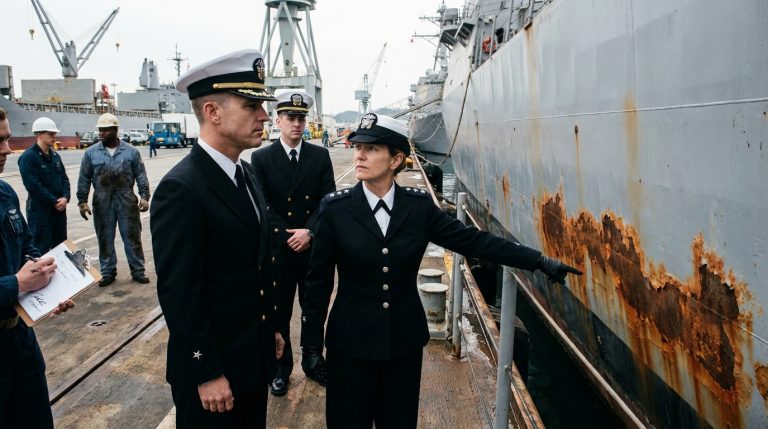
When the wheels finally touched the flight deck, the transition was jarring. The world stopped being a wild, chaotic struggle and became a rigid, sterile theater. Armed master-at-arms stood in a phalanx, their faces expressionless, their weapons held at the low-ready. And there, standing in the center of the arc, was Captain Cole.
His uniform was an insult to the grime and blood on Evelyn’s own. Every button was polished, every crease razor-sharp. He looked like he had never spent a day in the dirt in his life. As she stepped off the bird, the deck crew shifted, turning their heads, a collective, silent witness to the public execution he was about to stage.
Cole didn’t wait. He stalked toward her, his face a mottled, furious purple. He didn’t see the blood on her arms or the exhaustion in her gait; he saw a career that had almost imploded, and he was there to make sure it stayed intact.
“Lieutenant Evelyn Reed,” he roared, his voice carrying over the wind, designed to reach every ear on the deck. “Surrender your Trident. You are relieved of command, effective immediately. You are being charged with direct insubordination and the willful endangerment of government assets.”
The words hit the air like physical blows. Evelyn stood tall, her uniform coated in the salt and grit of the mission, her hair matted with sweat. She looked past him, to the senior staff gathered by the superstructure, and then to her men, who were being hustled off the second chopper under guard.
She felt the weight of the gold pin on her chest—the heavy, tactile history of every sacrifice she’d ever made. She reached up, her fingers grazing the cool, hard metal. She looked Cole in the eye. He was a creature of spreadsheets, a man who thought history was written in ink. He had no idea the power of the legacy he was trying to erase.
With steady, deliberate hands, she unclasped the pin. She didn’t hand it to him; she stepped forward, the sound of her boots on the non-skid deck resonating like a countdown, and placed it onto the center of a small, folding briefing table that had been set up on the deck. It clattered—a sharp, clear, defiant sound that silenced the roar of the ship.
“I saved my men, Captain,” she said, her voice dropping to a whisper that traveled further than his shouting. “I’d do it again.”
Cole’s face twisted, his hand reaching for the pin as if it were a burning coal. He turned to the crowd, his mouth opening to deliver the final, crushing blow, but he stopped.
The sound started as a dull, metallic thud, then another, then a dozen—a percussion of gold against wood that echoed across the carrier deck. Brooks, leaning heavily on his crutch, had stepped forward, his eyes locked on Cole, and pulled the Trident from his own chest. Then Carter. Then Jenkins.
One by one, the men of Gold Squadron—the most lethal, disciplined, and capable operators in the world—stepped up to the table. They didn’t look at the brass; they didn’t look at the guards. They looked only at their commander.
The pile of gold on the table grew—a gleaming, chaotic monument to everything Cole had tried to strip away. It was a roar that didn’t need words. The deck fell into a silence so profound it felt like the ship itself had stopped moving through the water. Cole stood frozen, his face drained of color, his terrified gaze flickering from the gold to the wall of silent, stone-faced men, realizing for the first time that he hadn’t just lost a commander—he had started a war he could never hope to win.
CHAPTER 6: THE FINAL VERDICT
The heavy steel doors of the briefing room groaned as they swung open, a sound that seemed to drain the last reserves of oxygen from the room. Admiral John Gallagher stepped in, his presence not merely a matter of rank, but of a physical displacement of the air. He was a man carved from the very salt and iron of the Navy, and as he walked down the aisle, the sea of operators and staff seemed to part before him like water.
He stopped at the mahogany table. He didn’t look at the gathered Pentagon brass, nor at the cowering, ash-faced Captain Cole. He looked at the pile of golden Tridents. He reached out with a hand that bore the thin, jagged scars of a career spent on the front lines, his fingers lingering on the cold metal of an eagle and anchor.
“I’ve been in the United States Navy for forty-one years,” Gallagher said, his voice a low, gravelly rumble that vibrated through the floorboards. “I have served through four major conflicts. And in all my time, I have never—not once—seen an entire Tier One element surrender their birds.”
He raised his head, his blue eyes locking onto Cole. The captain was trembling, his mouth working in a silent, pathetic rhythm, but no sound emerged. He was a man who had built his entire reality on the foundation of the ‘Plan’—the spreadsheet, the metric, the absolute control—and the sight of thirty-five operators voluntarily dismantling their lives had shattered that foundation into dust.
“Captain Cole,” Gallagher continued, his voice dropping an octave, turning into the sound of an approaching earthquake. “You have thirty seconds to explain to me what in the name of God you did to my operators.”
Cole’s knees seemed to buckle. “Admiral—sir—Lieutenant Reed blatantly disobeyed a direct lawful order. She abandoned a primary objective and initiated an unauthorized retreat. Her men… her men have been corrupted by her insubordination. I was simply enforcing the chain of command.”
Gallagher didn’t blink. He reached into his pocket and produced an encrypted drive. He tossed it onto the desk. “Plug that in. Echo 7 Delta. Audio only.”
The room became a tomb. As the audio filled the space—the roar of machine-gun fire, the frantic calls for tourniquets, and Cole’s own hysterical, panicked voice screaming for a suicide charge into the tunnels—the truth didn’t just come to light; it scorched the air. The “target” hadn’t been in the compound. The “intel” had been a hollow lie, a bait-and-switch engineered to force a chaotic, high-casualty event that would justify a promotion for a man who had never seen the color of a combatant’s eyes.
When the audio cut, the silence was absolute. The senior staff looked at Cole not with curiosity, but with the visceral, primal disgust one reserves for a traitor.
Gallagher paced slowly, his shadow stretching across the table. “Forty-eight hours before you greenlit Operation Crimson Dawn, NSA analysts flagged that compound as a honey trap. A kill box, Captain. A death sentence for anyone who stepped inside. That report was sent to your desk. You signed it, you acknowledged it, and then you buried it.”
Gallagher stopped, leaning in until he was inches from Cole’s face. “You were willing to send thirty-five of the most capable operators in the world into a meat grinder, knowing the intelligence was bad, just to gamble on a star. You weren’t winning a war, Cole. You were pruning the garden of anything you couldn’t control.”
Cole wheezed, a pathetic, dying sound. “I was trying… I was trying to secure the future…”
“You were trying to secure a promotion,” Gallagher roared, the sound snapping like a whip. “Master-at-arms! Relieve this man of his sidearm. Confine him under guard. He will face a general court-martial.”
As the guards seized Cole, his struggle was brief, frantic, and entirely empty. He was a man stripped of his armor, his status, and his lies. He was led away, his footsteps echoing in the silence until the steel door slammed shut, sealing his fate.
Gallagher turned his back on the empty space where Cole had stood. He faced Gold Squadron. He looked at them—not as subordinates, but as soldiers who had paid the price for the truth.
“Lieutenant Reed,” he said, his voice suddenly, unexpectedly soft.
Evelyn stepped forward. Her uniform was still stained with the dust of the desert, her hands still raw from the struggle, but she stood with a poise that made the gathered brass look small.
“You have a hell of a team, Lieutenant,” Gallagher said. He reached out and picked up her Trident. He held it out, his hand steady. “Put your birds back on. We have a very important war to win, and I’d prefer to win it with people who know the value of a life over the value of a metric.”
Evelyn took the pin. It was heavy, warm from the heat of his hand, and as she pinned it back onto her chest, she felt the weight of the previous forty-eight hours dissolve. She looked at Brooks, who was standing tall despite his injury, and at Carter and Jenkins. They were battered, they were scarred, and they were, collectively, the only truth left in a world of illusions.
The cool-down began, a slow, rhythmic return to the normalcy of the carrier deck. The wind still blew, the ocean still churned, but the suffocating pressure in the room had vanished. She walked over to the desk, her fingers brushing the surface where the gold had once clattered. She picked up a small, stray fragment of the compound’s concrete that had fallen from her boot—a jagged, gray piece of the prison she had escaped. She held it for a moment, then dropped it into the trash, a quiet, symbolic end to the nightmare.
She didn’t need the fragment. She had the weight of the Trident, and she had the team. She looked at her brothers, their faces etched with the fatigue of the struggle but illuminated by the same, quiet fire. They had walked through the fire, and they had come out, not as they were, but as they were meant to be—anchored not by the chain of command, but by the unbreakable steel of each other.
She offered a small, weary smile. It was enough.