Echoes of the Slag Heap: A Daughter’s Return to the Light of Unfiltered Recognition and Grace
CHAPTER 1: THE SERVICE ROAD
The air in the loading dock was heavy with the thick, cloying scent of hydraulic fluid and recycled air. I stood there for a beat longer than necessary, listening to the rhythmic, distant mechanical hum of the expo floor—a heartbeat I had spent ten years helping to cultivate. My shoes, flat and sensible, felt heavy against the concrete.
Sergeant Lambert didn’t look at me. His eyes were locked on the rolling case, a sleek, scuffed piece of luggage that carried the blueprint for the next two decades of Marine Corps lethality. To him, it was merely an obstruction in a morning full of high-value distractions. He jerked his thumb toward the service road, his eyes already flickering past me, searching for someone who looked like they belonged on the blue carpet.
“Vendors around back, ma’am,” he said. The word ma’am was automatic, a tactical courtesy drained of all actual respect.
I didn’t reach for my badge. I didn’t reach for the keynote speaker packet that would have turned his face pale. I watched his thumb—that singular, callous motion—and realized that the universe had finally provided the most accurate diagnostic tool I had ever seen. I had spent forty years trying to navigate the complex architecture of my brother Mitchell’s approval and my father’s narrow light, but it had never been that complicated. It was just this.
I looked up. Beyond the glass, illuminated by the bright, flattering atrium light, Mitchell stood on the blue carpet. He was adjusting his lanyard, his profile sharp and successful, the quintessential engineer who built things that kept people strong. He had watched the entire exchange. He had seen the thumb. He had seen me, a woman in a gray suit standing in the shadow of a caterer’s truck, and for a fleeting second, our eyes locked through the reinforced glass.
Mitchell smiled—a small, practiced, utterly hollow gesture—adjusted his coat, and turned his back on me.
“Around back’s not so bad,” I could almost hear him say, though the glass muffled the words. He walked away, moving toward the warmth of the hall, toward the people who mattered.
I turned back to the loading dock. I didn’t feel the sudden, white-hot urge to destroy him. Instead, I felt a strange, chilling clarity. The “machine” of my family had finally finished its construction, and for the first time, I could see the seam where the metal had been welded shut against me. My brother had made his choice, and the sergeant had made his, and the weight of the rolling case suddenly felt less like a burden and more like an anchor, holding me steady in a world that had forgotten how to see.
I took the handle again, the texture of the rubber familiar against my calloused skin, and started to walk. The path was long, winding between humming catering trucks and discarded crates, a slow, deliberate march away from the light I had once begged to stand in.
I was not just a woman in a gray suit anymore. I was a witness to the final, quiet collapse of a thirty-year-old lie.
CHAPTER 2: THE FRONT ROW
The transition from the loading dock to the speaker suite was a blur of calculated, silent motion. Captain Vega met me in the corridor, her face a carefully composed mask of professional agitation, but when she saw me—gray suit, rolling case, hair pulled tight—she said nothing. We did not speak of the sergeant or the service road. We moved with the economy of a unit that understood that the mission had not changed, only the stakes.
I locked myself in the small, sterile speaker suite. The room smelled faintly of lemon floor wax and the stale perfume of a hundred previous speakers. My garment bag hung on the door, a heavy, silent presence. I unzipped it, and the sight of the dress blues—the midnight wool, the stark white of the shirt, the crisp, unforgiving lines—felt like stepping into an old, immutable skin.
There is a particular quiet that comes with putting on the uniform, even after thirty years. Every button is a promise; every ribbon is a piece of history I had curated in silence. I dressed slowly, my movements rhythmic and deliberate. I checked the alignment of my insignia in the mirror, the silver stars catching the harsh fluorescent light. In the mirror, the woman in the gray suit vanished, replaced by the deputy commandant who owned the requirements, the budget, and the future of the force.
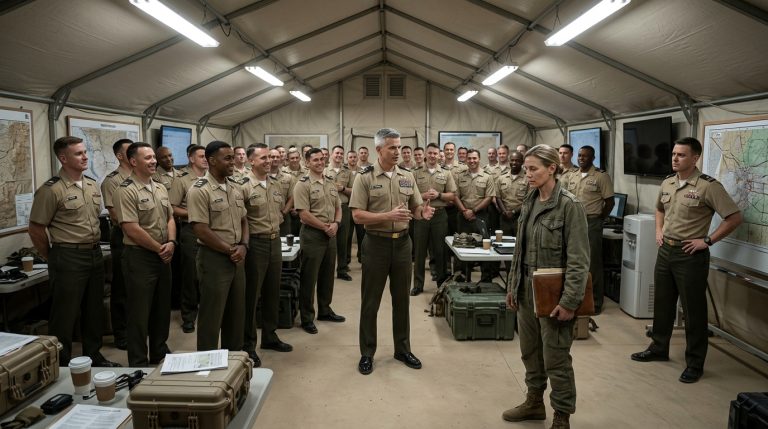
When I stepped out of the suite, the quiet was gone. I walked toward the wings of the keynote hall, my boots tapping a steady, measured beat on the concrete. The hall was massive, a cavernous space draped in black and muted navy, and it was packed. Two thousand people sat in expectant silence, a hum of collective anticipation that vibrated through the floorboards.
I stood in the darkness of the wings. Through a gap in the heavy velvet curtains, I saw them. The Joint Chiefs, a front row of four-star brilliance, sat with the relaxed authority of men who knew exactly how much power they held. General Everett Stone, the chairman, was leaning toward General Pratt, a low-voiced conversation that likely held the fate of a dozen programs. And near the back, by the doors, I saw the flicker of a clipboard. Sergeant Lambert was there, relocated from the morning’s VIP lane to support the security detail. He stood perfectly still, his eyes scanning the crowd with a new, frantic vigilance.
My throat felt tight. The memory of the slag heap—the smell of dry earth, the metallic tang of the radio parts Mitchell had scavenged—suddenly crowded the space. I remembered the way Mitchell had looked at me when he said I was the smartest person in the family. It was a phantom, a whisper from 1985 that tried to make me feel small. I took a steadying breath, grounding myself in the weight of the ribbons on my chest. That girl was gone. She had been replaced by a woman who knew exactly what her signature was worth.
“Ladies and gentlemen,” the announcer’s voice boomed, rich and resonant, filling every corner of the hall. “The deputy commandant for combat development and integration, Lieutenant General Audrey Callaway, United States Marine Corps.”
The house lights dimmed. A single, focused beam of white light hit the stage.
I walked out. The sudden exposure felt like stepping into an ocean. The room was vast, an expanse of faces turned toward me. I reached the center of the stage, the light warm and blinding on my face. Before I could even open my mouth to begin the keynote, General Everett Stone rose from his chair in the front row.
He didn’t rise with the polite, practiced nod of a man paying respects to a subordinate. He stood to his full height, his posture perfect, his face lit with a genuine, welcoming smile. One by one, the other chiefs followed, a chain reaction of four-star brass lifting from their seats. The motion flowed backward through the room like a wave, and then two thousand people were on their feet, the sound of their movement a low, thundering rumble that drowned out the hum of the air conditioning.
I stopped at the podium, my hands resting on the cool wood. General Stone walked to the edge of the stage, ignoring the security detail, and reached out to take my hand. His grip was firm, a soldier’s greeting.
“General Callaway,” he said, his voice loud enough to carry through the microphones, carrying a tone of absolute, unshakable respect. “We’ve been waiting for you.”
I glanced toward the back of the room. Near the doors, I saw the exact moment the realization hit Sergeant Lambert. His arm, poised to hold his clipboard, went limp at his side. His face was a study in rapid-fire arithmetic: the gray suit, the rolling case, the thumb, and now, the three stars and the chairman of the Joint Chiefs standing at my side. He didn’t look away, and he didn’t shrink. He stood in the open, taking the weight of his own misjudgment, and for that one second, I found a shred of respect for him.
Then my eyes moved to the contractor section, beneath the banner of my brother’s division. Mitchell was there. He wasn’t applauding. He stood perfectly still, his hands at his sides, his face pale as he watched the wall of his own design begin to crack.
CHAPTER 3: THE RECEIVING LINE
The applause died away, not as a sudden collapse, but as a long, receding tide that left me standing at the edge of the stage. My palms were dry, my breathing measured. The adrenaline that had surged while General Stone rose to greet me was still present, a controlled burn in my chest, but I suppressed it. I had been a guest of honor and a keynote speaker, but now, I was a functional component of the event’s machinery. I had to descend.
I walked down the steps, the heavy wool of my dress blues swishing softly. General Stone met me halfway. He didn’t offer a platitude; he simply nodded, his eyes searching mine with a terrifying, professional clarity.
“The requirements you outlined,” he said, keeping his voice low enough to avoid the roaming microphones. “They’re going to force some difficult conversations in the next budget cycle, Audrey.”
“If they weren’t difficult, sir, we wouldn’t be having them,” I replied.
He smiled, a dry, humorless movement of his lips, and moved on to the next person. He knew. In the way only a man who had navigated forty years of Pentagon corridors could know, he understood that the keynote hadn’t just been a briefing on combat systems. It had been an audit of institutional priorities.
Then came the receiving line. It was a chore, a performance of democratic accessibility that felt, in this specific moment, like a gauntlet. The chief executive of my brother’s firm, a man named Henderson who had built a career on the back of the very networks I managed, approached with his entourage. He was a creature of high-gloss corporate culture, smelling of expensive cologne and anxiety.
“General Callaway,” Henderson said, taking my hand in both of his. His grip was too moist, too eager. “Your team’s requirements made this program. Honestly, your fingerprints are on every single frame of that machine.”
I didn’t pull my hand away, but I didn’t return the warmth. I kept my expression neutral, professional, and entirely unreadable. “It’s a robust platform, Mr. Henderson. I expect it to perform.”
“Oh, it will, it will,” he bubbled. He gestured behind him, his smile widening as he pulled Mitchell into the light. Mitchell’s face was stiff, the skin around his eyes pulled tight as if he were trying to hold a mask in place. “You know Mitchell Callaway, I believe. One of our senior vice presidents. He’s been instrumental in the guidance integration.”
Mitchell stepped forward. The lanyard around his neck looked like a leash. Our eyes met, and for a second, the years of Scranton, the slag heaps, and the kitchen table silences compressed into a single point of friction. He reached out a hand, his fingers slightly trembling.
“Audrey,” he began, his voice caught somewhere between a greeting and a plea. “I… I didn’t realize that you were the one who—”
I took his hand. I didn’t squeeze it, and I didn’t linger. I held it for exactly as long as the protocol required—a rigid, measurable duration—and then I released it. The physical sensation of his palm against mine was like touching a relic from a dead language.
“Good to see the company represented,” I said. My voice was clipped, a flat tone that allowed for no interpretation. I didn’t call him Mitchell. I didn’t look for the brother who had taught me to solder; I looked at the executive who had walked through the glass doors while I had walked around the loading dock.
I moved down the line, my focus shifting to the next stranger with a badge. Behind me, I could feel the space where Mitchell stood. The silence he left behind him was heavy, a physical weight in the air. He hadn’t asked for a meeting, hadn’t tried to bridge the gap; he had simply been exposed. He was a man watching a wall in his life come down in slow motion, and he had no idea how to rebuild it.
I caught a glimpse of Sergeant Lambert near the exit. He was still at parade rest, his clipboard tucked under his arm, his gaze fixed on the floor. He looked diminished, a young man who had realized that his perception was not reality, but merely a failure of observation. I didn’t offer him a nod. I didn’t need to. He was already doing the work of his own correction.
As I finished the receiving line, Captain Vega hovered near my elbow. She leaned in, her voice barely a whisper. “Ma’am, there are three separate inquiries about the keynote—media, industry, and the joint staff. The chair wants a brief follow-up in the holding room.”
“Take the media inquiries,” I said, my gaze sweeping the room, finding Mitchell again. He was still standing near the banner, his posture slightly slumped, the corporate mask beginning to fray at the edges. “I’ll handle the joint staff. And Vega?”
“Yes, ma’am?”
“Find out who cleared the service road entrance for the VIPs this morning. Don’t make a report. Just find out.”
I turned away, moving toward the holding room, leaving the ballroom and my brother behind me. The “subsidy” was gone. For thirty years, I had held the umbrella to keep them dry, and now, for the first time, I felt the cold, bracing sting of the rain myself. And it was, in its own way, the most invigorating sensation I had ever known.
CHAPTER 4: THE HOLDING ROOM
The holding room was an architectural afterthought—a windowless box of beige walls and synthetic carpeting, tucked behind the massive stage of the convention hall. It was designed for comfort but radiated the cold, clinical efficiency of a space where people were processed rather than hosted. I walked in, my heels clicking sharply against the floor, to find the expo’s security director, a man named Miller, waiting by the small conference table.
He looked as though he had spent the last hour trying to untangle a knot he hadn’t realized he’d tied. His tie was loose, and he held a digital tablet like it was a live grenade.
“General Callaway,” he said, rising as I entered. His voice was pitched to an octave of nervous deference. “Captain Vega informed me that you were… dissatisfied with the access control management at the service entrance this morning.”
I didn’t sit. I walked over to the table and laid my briefing packet down. The wood was cold, a neutral surface for a conversation I had already mapped out in my mind. “Dissatisfied is a generous word, Mr. Miller. I’m concerned about the lack of process.”
“Of course, ma’am. I’ve already reviewed the logs. The sergeant on duty, Lambert, has been rotated to general floor support. We’re conducting a full—”
“I don’t need a scapegoat,” I interrupted, my voice steady, stripped of the conversational warmth I usually reserved for my staff. “I need an audit of your standard operating procedures. The sergeant wasn’t the failure. The protocol was. He was given a lane and a task, and he improvised because your guidance left him no other option. If your personnel are making snap judgments about ‘vendors’ based on the appearance of their luggage, then your entire distinguished visitor program is a liability.”
Miller blinked, his gaze flickering from my face to the three stars on my collar. He had expected an angry demand for retribution—a classic bureaucratic reaction—and instead, he was getting an engineering critique of his security infrastructure.
“I… I apologize, General. We’ll rewrite the entry criteria by tomorrow morning.”
“See that you do,” I said. “And keep Sergeant Lambert on the detail. Don’t punish him for a failure that belongs to you. If he’s as capable as his file suggests, he’ll be the one to help you draft the new policy.”
Miller hesitated, a flicker of confusion crossing his face before he nodded. He left the room in a hurry, likely grateful that the fallout had been contained to a policy memo rather than a formal complaint.
Once he was gone, the room felt suddenly, intensely quiet. I sat down at the table and let out a breath I hadn’t realized I was holding. My phone, sitting on the table, buzzed—a sharp, rattling sound against the polished wood. I didn’t look at it immediately. I knew who it was. The notification displayed the familiar name of the contact in Scranton, a name that had been a load-bearing wall in my life for three decades.
I picked up the device. A voicemail.
I listened to it in the dim, climate-controlled light of the holding room. Mitchell’s voice, crisp and yet somehow thin, filled the space. Audrey, hey, it’s me. Listen, I’m sorry about the mixup at the doors. That was the whole thing was ridiculous. Anyway, I hope this isn’t going to be a thing. We’ve got the program review cycle coming up and the last thing anybody needs is awkwardness. Call me.
I set the phone back down. He wasn’t apologizing for the choice; he was apologizing for the “awkwardness” of the situation. He was worried about the program review, about the optics of his vice president position, and about the fear that his sister—the woman he had dismissed with a thumb—now held the pen that could rewrite his entire professional narrative.
The silence that followed the recording was heavy with the truth of it. I felt no rage, no impulse to call him back and unleash the power of my office. That was the trap. If I used my rank to make his life miserable, I would be no different than the man who had turned his back on me to walk into the warm, blue-carpeted atrium. I had to be better than the machine he had built.
I stood up and walked to the wall, tracing the seam between two drywall panels. The work was simple: I had to protect the integrity of the program. I had to remain the professional I had spent thirty years becoming. Mitchell would have to face the consequences of his actions on his own, without my intervention, and without my help.
I checked my watch. I had a briefing with the Joint Staff in fifteen minutes. I smoothed my jacket, adjusted the stars on my shoulders, and prepared to leave. The hallway outside was filling with the sounds of the expo resuming its rhythmic, industrial pace. I walked toward the door, my footsteps light, my mind already pivoting to the next requirement. The ledger was still there, but for the first time, it didn’t feel like it was mine to balance.
CHAPTER 5: THE DINER ON MUSK STREET
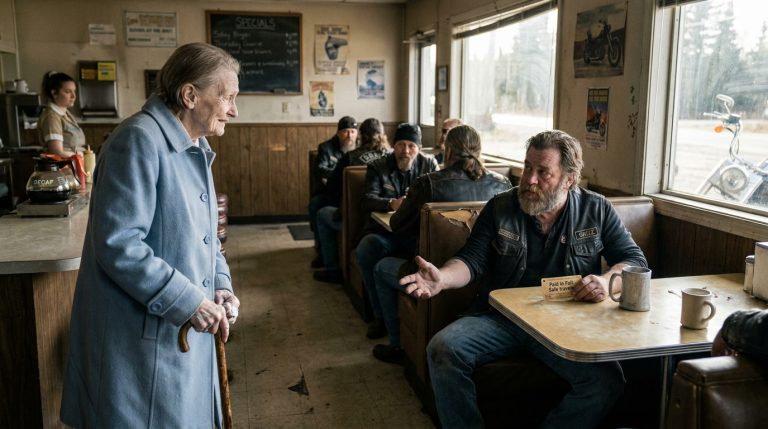
The diner on Musk Street was a relic of a Scranton that had mostly been paved over. The vinyl booths were the color of root beer, cracked along the seams where generations of regulars had slid in and out, and the air held the permanent, nostalgic scent of burnt coffee and griddle grease. I pushed the door open, the bell overhead giving a sharp, impatient chime. I didn’t scan the room. I knew exactly where he would be.
Mitchell was already there, tucked into a back booth near the window. He was early—two minutes ahead of the appointed time, a detail that was less a courtesy and more a survival mechanism. He sat with his hands flat on the table, a stark, open posture that felt like a tactical surrender. As I approached, he didn’t rise; he simply watched me, his eyes tracking my movement with a mixture of apprehension and an exhausting, long-held hunger.
I slid into the opposite side of the booth. The vinyl groaned beneath me. I didn’t take off my coat. I didn’t lean in to soften the space between us. I kept my posture straight, my shoulders back, the habit of the uniform still dictating my physical presence even in civilian clothes.
“Audrey,” he said, the name sounding brittle in the confined space.
“Mitchell,” I replied.
The waitress, a woman named Sharon who had been working this shift since we were children, arrived with a pot of coffee. She didn’t ask; she just filled our mugs, the dark, steaming liquid creating a thin veil of steam between us. I watched the swirl of it, the heat radiating against my face.
“What happened at the expo?” he asked, his voice low, lacking the performative polish of his corporate life. “I didn’t expect… I didn’t think the chairman would—”
I stopped him with a sharp, singular look. “The expo was a Tuesday, Mitchell. I’m not here to talk about a Tuesday. We have thirty years of arithmetic to audit, and I’m not interested in the current quarter’s results.”
He looked down at his mug, his fingers tracing the rim. “Okay. Go ahead.”
I began, not with an attack, but with the ledger. I spoke of the weekends I had spent driving the corridor between Quantico and Scranton, the four hours of road time that had felt like a second job, a life I had carved out of my own limited leave. I told him about the home aid I had hired for our mother, the way I had laundered the money through a fictional veteran’s benefit to spare my father the indignity of knowing he couldn’t afford his own care. I spoke of the commissioning at Penn State, and the emptiness of the third row, a void that had felt like a physical ache in my chest for decades.
I didn’t use adjectives to describe the hurt; I used dates, locations, and the cold, hard facts of the labor I had performed while they lived in a version of our childhood where I was always the one with the broom. I talked about the joke at the Thanksgiving table in 2012, how the laughter of our cousins had felt like the final, structural failure of a support beam.
Mitchell didn’t interrupt. He didn’t defend the decisions. He didn’t try to explain the milestones or the reviews or the flights he couldn’t move. He sat there, his hands still flat on the table, and for the first time in my life, I watched him listen without a filter.
“I told myself you didn’t need anything from us,” he said, his voice breaking, the sound of it raw against the clatter of silverware and the low hum of the diner’s refrigerator. “You were the strong one. You were the one who always had the answer, the one who was squared away. I made it so easy to believe that because believing it meant I never had to show up. And never showing up meant believing it harder. It was a machine, Audrey. I built it. I’m an engineer, and I built a machine for not knowing my sister, and I ran it for thirty years.”
The confession hung in the air, heavy and undeniable. I looked at him—really looked at him—and saw the mirror image of the man who had stood beneath the banner in the convention hall. He wasn’t a monster; he was a man who had built a wall out of convenience and lived behind it until it had become a prison.
“I don’t need you to be sorry,” I said, my voice barely audible over the sound of the fry cook’s spatula scraping the grill. “I need you to understand that the machine is dismantled. There is no more subsidy. There is no more ‘lesser sister’ to buffer the awkwardness.”
“I know,” he said.
I looked out the window, where the cold morning light was hitting the pavement, turning the wet asphalt into a slick, grey ribbon. For a moment, a wave of doubt washed over me—the V-4 phantom of my own paranoia. Was this real? Was he truly repentant, or was he just performing the necessary steps to secure his professional future? The thought was a sudden, jarring intrusion. I looked back at him, searching his eyes for the crack in the facade, for the hidden agenda.
But he wasn’t looking at the exit. He wasn’t looking at his phone. He was looking at me, his eyes tired, the exhaustion of the last thirty years etched into the lines of his face. He wasn’t an executive in this moment; he was a brother who had finally run out of reasons to look away.
“What do you do?” he asked then, the question genuine, devoid of the cocktail-party casualness. “What does your work actually look like, Audrey?”
I took a breath, the air in the diner tasting of coffee and old dust. I began to talk about the networks, the combat systems, the decade of arguing with the Joint Staff to get the requirements right, the long, grinding process of turning the future into a machine that actually worked. And he listened. He didn’t interrupt to ask about the rank or the prestige or the budget; he asked about the engineering. He asked how the systems held together under stress.
For the first time in our lives, we were off the clock. The bond didn’t return in a rush of warm, cinematic light. It flickered, a faint, scarred, adult thing struggling to hold its ground against the weight of the past. We sat in the booth, two people who had spent a lifetime reading from different scripts, finally starting to find the same page.
CHAPTER 6: THE PORCH
The drive back from Musk Street took less than twenty minutes, but each mile felt like a measured step backward through the layers of my own history. The town of Scranton hadn’t changed, but the way I saw it—the rusted skeletons of the old machine shops, the grey Victorian houses leaning against one another for support—was fundamentally altered. I wasn’t driving toward a destination; I was driving toward a closing.
I pulled into the driveway of the house on Capoo’s Avenue. It was late afternoon, the light hitting the siding with a golden, waning clarity that made the house look both larger and more fragile than I remembered. My mother was already on the porch. She was sitting in the same wicker chair she had occupied for the better part of a decade, a heavy wool blanket pulled over her knees despite the mild spring air.
I stepped out of the car. My legs felt stiff, the adrenaline of the diner meeting still thrumming beneath the surface. I walked up the porch steps, the wood giving a familiar, rhythmic creak that had been the soundtrack of my childhood.
“You look tired, Audrey,” she said. Her voice was thin, but it held the same steel it had always contained. She didn’t look up from the street, her eyes fixed on the distant horizon where the hills began to climb.
“I am,” I admitted. I sat in the empty chair beside her, letting my head rest against the high wicker back. The air smelled of cut grass and the faint, sulfurous tang of a distant thunderstorm.
We sat in silence for a long time. It was the kind of silence that usually required an “upholstery” of polite, meaningless chatter to sustain, but today, that felt unnecessary. I watched a robin forage in the yard, its movements jerky and precise. The distance between us, which I had spent my entire life trying to navigate, felt suddenly vast—not as a divide, but as a space that had finally been cleared of debris.
“He called,” she said, finally turning to look at me. Her eyes were clouded with age, but they were remarkably sharp. “Mitchell. He told me you two went for rice pudding.”
“We did,” I said.
“And?”
“And we’re done arguing about the loading dock.”
She gave a small, slow nod, a movement so subtle it was almost invisible. “That’s a start. Though I’m not sure he ever really knew how to hold a conversation that didn’t involve a blueprint.”
I looked at her, at the hands that had folded so many small things into my life—fifty-dollar bills, graduation cards, the quiet support that she wasn’t allowed to voice at the dinner table. “You held the umbrella, Mom. For fifty years. You stood there in the rain so we could pretend it was dry.”
She laughed then, a sharp, sudden sound that reminded me of glass breaking. “I was a translator, Audrey. I was translating a man who didn’t know how to speak, and a son who didn’t know how to see, and a daughter who was too busy proving she didn’t need the light to notice it was shining on her all along.”
Her words landed with a physical weight. I had spent my life believing that my family had withheld their recognition, but looking at my mother now, I saw the truth of the “emotional subsidy” I had been paying. I had needed them to see me, yes—but I had also needed to keep them in the dark about how much that lack of recognition hurt, because to let them see my pain would have been to admit that I was vulnerable.
“I’m not doing it anymore,” I said. The confession felt like a physical release, a loosening of the muscles in my neck and shoulders.
“I know,” she replied. She reached out and took my hand, her skin papery and cool against mine. “You stopped the day you walked around the back of that convention center. And it’s the best thing you’ve ever done for yourself, honey. Even if it took a lifetime to get there.”
The evening settled around us, the cicadas beginning their rhythmic, droning pulse. I didn’t feel a sense of triumph. I didn’t feel the sudden, surging relief of a conflict resolved. I felt a profound, quiet exhaustion—the kind that only comes when you are finally allowed to set down a weight you didn’t know you were carrying.
The photograph of the slag heap, the one Mitchell had restored, was sitting on the mantle inside, visible through the screen door. For the first time, it didn’t look like a relic of a lost past. It looked like an artifact from a different, earlier phase of a mission I was only now completing.
“What happens tomorrow?” I asked.
“Tomorrow?” she said, looking back out at the street. “Tomorrow, you go back to that desk in Washington and you do the work you were built for. And Mitchell goes back to his office, and he carries the lesson of that morning with him. And the world keeps turning, regardless of whether we’re standing in the light or not.”
She squeezed my hand, once, a firm, final pressure. “You’ve spent your life making sure the networks stay connected, Audrey. Maybe it’s time you just let yourself be part of one, instead of the one holding the cables.”
I didn’t answer. I just leaned back, closing my eyes, listening to the world move in the distance. The porch, the house, the yard—they were no longer the walls of a prison or the center of a debate. They were just a place where I was sitting, for the first time in my life, as myself.
CHAPTER 7: THE BIRTHDAY BACKYARD
The transition from the porch into the backyard was like moving from a vacuum into a pressurized chamber. The air was thick with the scent of charcoal smoke and the aggressive, synthetic sweetness of potato salad. The family was there, a constellation of cousins, aunts, and family friends who had gathered in the name of my mother’s eightieth, but who were, in truth, performing the same ritualistic dance they had been practicing for decades.
I walked down the steps into the grass. The sun was hanging low in the sky, casting long, distorted shadows across the lawn. I wore a plain jacket and flat shoes—no uniform, no stars, no markers of my rank or my role. I wanted to be seen as the person who had driven that corridor for two years, not the person who had been thumbed to a loading dock.
“Audrey!” my aunt shouted from the folding table, waving a plastic fork with an enthusiasm that felt rehearsed. “Look at you, you look just like your mother in that light.”
I offered a smile that didn’t reach my eyes and kept walking. My brother, Mitchell, was by the grill, his face flushed from the heat and the labor. He had been working the backyard with a manic, performative efficiency—refilling drinks, moving chairs, keeping the momentum of the party going so that no one had a moment to notice the fissures forming in the foundation.
As I approached the grill, he looked up. There was a flicker of something in his expression—a desperate, fleeting hope that I would step into the role he had prepared for me. I didn’t. I stood back, observing the way he handled the tongs, the way he laughed at a cousin’s joke, the way he still carried himself like the center of a gravity well.
“Glad you made it,” he said, his voice straining to be casual.
“Wouldn’t miss it,” I replied.
A cousin’s recent groom, a man named Eric who had clearly been briefed on the family hierarchy, gravitated toward us. He was bright-eyed and, according to the standard operating procedure of these gatherings, looking to solidify his place in the clan. He looked at me, then at Mitchell, and then at the plate he was holding, clearly navigating the social topography.
“So, General Callaway,” Eric said, his tone a mix of deference and genuine curiosity. “This family has been doing such impressive things since the Reagan administration. It’s hard to keep track. What is it that you actually do for the Corps?”
It was the question. The same question that had been asked at a dozen Thanksgiving tables, the one that had always been answered by Mitchell, the one that had served as the pivot point for my own erasure. I felt the old reflex tighten my jaw, the urge to give the small, quiet, administrative answer that would keep the peace and preserve the family’s preferred version of reality.
I took a breath. I looked at Mitchell. He was holding the tongs, his knuckles white against the metal. He was waiting.
I didn’t answer immediately. I let the silence hang there, heavy and uncomfortable, until the cousins nearby stopped talking and the sound of the grill’s hiss became the only noise in the yard.
“My sister,” Mitchell said then. He didn’t raise his voice, but the acoustic of the backyard—that peculiar, trapped pocket of air—amplified him. He set the tongs down on the side of the grill with a deliberate clatter. “My sister is Lieutenant General Audrey Callaway, United States Marine Corps. She is the deputy commandant who decides what Marines will carry into harm’s way for the next twenty years.”
He looked at me, his eyes wide and unblinking. “The system that half the jobs in this valley depend on exists because of her. And I have been getting that introduction wrong for thirty years. So, I wanted to get it right in front of everybody.”
The yard went quiet. It was the absolute, total silence of a family hearing a truth it had spent three decades collectively suppressing. The wind rustled the trees, a dry, papery sound. I looked at Mitchell, and for the first time, I didn’t see the brother who had taken the light; I saw a man who was finally, painfully, tired of holding it.
“Thank you, Mitchell,” I said. My voice was steady, clear as a bell.
The quiet broke like a wave. The cousins started to move in, their faces transformed from the practiced, surface-level recognition of “Aunt Audrey” to the genuine, curious intensity of people who realized they had been living next to a stranger. They started asking questions—real questions about the work, the strategy, the decision-making.
I looked over at my mother. She was watching the entire scene from her lawn chair, a small, triumphant smile on her face. She looked like a woman who had just finished a very long, very complicated calculation.
I leaned against the fence, the wood rough and sun-baked against my back, and watched the crowd. The performance was over. The ledger was open on the table, and for the first time in my life, I didn’t feel the need to close it.
CHAPTER 8: THE MANTLE
The sun had finally dipped below the horizon, leaving the backyard in the long, soft shadows of a late spring evening. One by one, the cars had pulled out of the driveway, the crunch of gravel beneath tires marking the departure of the cousins, the aunts, and the last of the family friends. The noise of the party—the clatter of plates, the forced laughter, the questions—had faded, leaving behind a sudden, absolute stillness that felt like a return to equilibrium.
I walked back into the house, the screen door clicking shut behind me. My mother was already in her chair, the blanket folded neatly across her lap. She looked smaller in the dim light of the living room, but her eyes held a steady, quiet contentment.
“Well,” she said, the word hanging in the air with the weight of a long-overdue verdict.
I didn’t answer. I walked toward the mantelpiece. The house was quiet, the smell of charcoal still clinging to the curtains, but the room itself felt different. It was no longer a stage. It was a space I could inhabit without performing.
I looked up at the mantle. The photograph that Mitchell had restored was there, sitting in the center of the space where the portrait of the machine shop used to hang. I reached out and touched the frame. The glass was cool, the wood frame solid and steady beneath my fingers. I shifted it a fraction of an inch—a tiny, imperceptible adjustment that made the composition feel suddenly, perfectly balanced.
Mitchell walked into the room. He had been cleaning up the grill, his movements slower now, the manic energy of the afternoon replaced by a quiet, contemplative exhaustion. He stopped near the doorway, watching me. He didn’t approach; he didn’t try to bridge the distance with a hollow word or a nervous apology. He just stood there, a man who had finally stopped building the machine.
“You’re leaving tonight?” he asked.
“Early tomorrow,” I said, my hand still resting on the frame. “I have a briefing in Quantico.”
He nodded slowly. “You’ll be back for the holidays?”
“I’ll be back,” I said. It wasn’t a performance. It was a fact.
I pulled my hand away from the photograph and turned to face him. The tension that had defined our interactions for thirty years—the invisible, load-bearing wall of my own smallness—was gone. In its place was something else: a recognition that the past was a fixed sequence of events, but the future was a space we could actually navigate together.
I walked past him toward the hallway, stopping only to place a hand on his shoulder. It was a brief, light contact—no lingering, no emotional weight-shifting—but it was honest. “The photograph looks good on the mantle, Mitchell.”
“It belonged there,” he said.
I went to my room, the space that had held the echoes of a dozen different versions of myself over the years. I took the plain jacket off, feeling the weight of the day settle into my bones, a deep, satisfying exhaustion. I sat at the small desk by the window and looked out at the street. The lights of the neighbor’s house flickered, a steady, rhythmic blink.
I realized then that the “truth” I had been searching for—the core of the mystery that had driven me through wars and promotions and long, lonely nights of command—hadn’t been a secret buried in a folder or a hidden agenda in a boardroom. It had been the simple, brutal realization that I had spent my life waiting for an introduction that I already had the power to make for myself.
The emotional subsidy was over. My brother was no longer the architect of my identity; he was just my brother. My father’s memory was no longer a shadow I had to stand in; it was just a memory. And my own life, the life I had built with my own hands, was finally mine.
I lay down on the bed, staring up at the ceiling. The silence of the house was not the silence of erasure, but the silence of peace. I was a Lieutenant General, a deputy commandant, a woman who held the future of the force in her hands, and as I drifted off, I realized that the only rank that mattered was the one I had finally earned: the rank of being myself.
When I woke the next morning, the sun was just cresting the trees, painting the yard in hues of orange and gold. I stood at the kitchen counter, drinking a cup of coffee with my mother as the world woke up. There was no more ledger on the table. There was no more machine. There was only the quiet, steady rhythm of a morning that belonged to no one but us.
I left for Quantico shortly after, driving the long, familiar road with the windows rolled down. I didn’t look in the rearview mirror. I didn’t think about the convention center, or the loading dock, or the empty third row at my commissioning. I thought about the road ahead, the network of connections that were still mine to build, and the simple, profound fact that I was finally standing at my full height.