The Frozen Perimeter: A Tactical Game of Inches, Solitude, and Lethal Restraint
CHAPTER 1: THE WEIGHT OF THE ICE
The black steel gate didn’t just break; it sheared at the bolt, the sound cracking across the frozen pasture like a dry sniper round.
Through the frost-rimed kitchen window, the world was a study in desaturation, save for the obsidian gleam of the luxury BMW tearing through the perimeter. Clayton’s hand remained steady on the rim of his ceramic mug, though the lukewarm coffee inside vibrated. His eyes, trained by three tours of calculating trajectories through dust and heat, now tracked the trajectory of cold German engineering sliding sideways on black ice.
The impact was quiet. Snow absorbed the worst of the noise, but it couldn’t hide the violence of the movement. The bumper caught the corner post of the winter garden. Under the tires, the brittle, frozen stalks of wintergreen and echinacea—the ones Sarah relied on to settle her stomach after the red-stripe infusions at the clinic—shattered like green glass. Soil, frozen into dark clods, sprayed across the pristine white drift.
“Clayton,” Sarah whispered. Her voice was thin, competing with the rhythmic, low-frequency hum of the oxygen concentrator beside her chair.
“Stay inside,” he said. The words were flat, stripped of heat.
He didn’t run. Running was for the panicked. Instead, he stepped onto the porch, his boots sinking precisely into the crust of old snow. The wind off the ridge was a physical blade, carrying the sharp, synthetic bite of premium exhaust fumes and the sweet, ruined scent of crushed herbs.
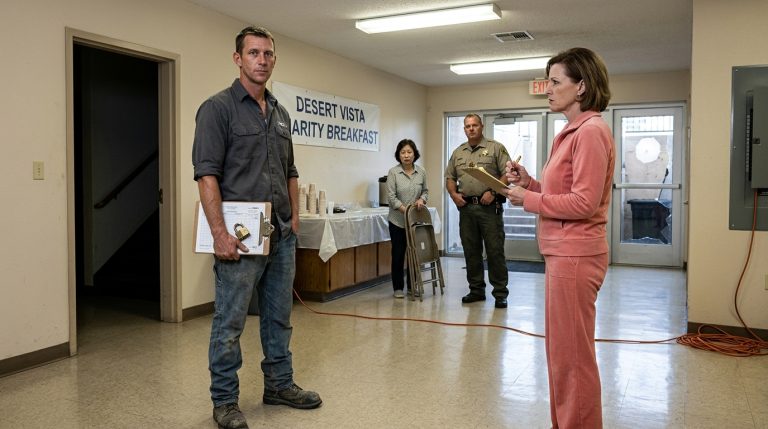
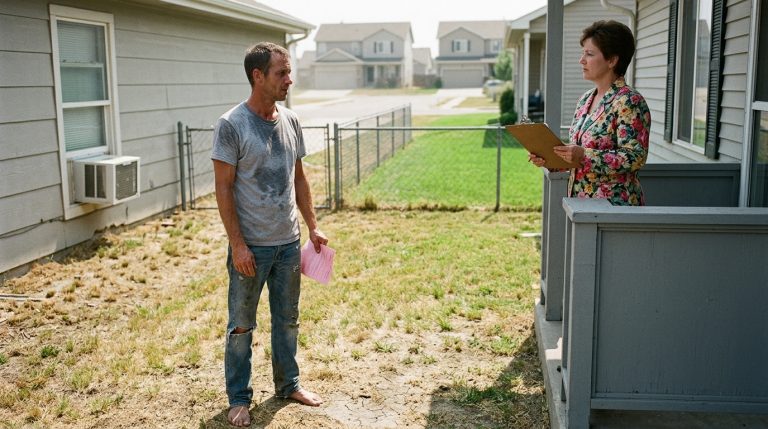
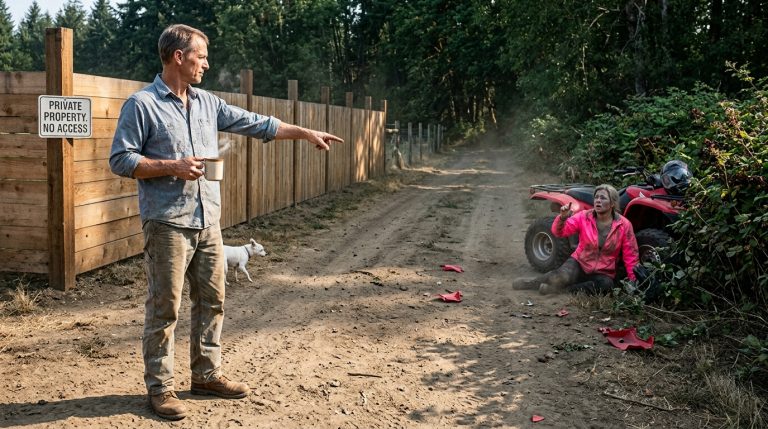
At the end of his driveway, forty yards out, the BMW sat idling. Its exhaust rose in a thick, arrogant plume. Behind the tinted glass, Clayton could see the pale, sharp silhouette of Melissa Hart. She didn’t roll down the window. Instead, she raised a yellow clipboard against the glass, pointing a manicured finger toward the crushed timber of his fence line, then toward the county road behind her. It was a projection of clinical, bureaucratic dominance.
A lesser man would have reached for the iron bar leaning against the porch rail. Clayton only watched the tire tracks. He noted the depth of the ruts in the icy mud, the exact point where the vehicle lost traction, and the slight, telltale lean of the chassis that suggested a worn strut.
To Melissa, this was a property dispute. To Clayton, it was an intrusion into an active defensive sector.
His eyes drifted to the ditch beside the driveway. There, half-buried in the fresh drift, was a tiny, reflective plastic stake that hadn’t been there yesterday—bright orange, stamped with letters that didn’t belong to the county surveyor. A physical discrepancy. A quiet lie planted in his soil.
The BMW reversed, its tires screaming against the frozen gravel before catching traction and disappearing back down the mountain road, leaving the pasture to settle back into its cold, fragile silence.
Clayton reached into his pocket and pulled out the small remote transmitter. With a dull click of his thumb, he armed the first set of hidden sensors.
CHAPTER 2: THE STATIC GRID
The physical click of the plastic transmitter was a small, dry sound that was immediately swallowed by the vast, frozen emptiness of the pasture. For a long, suspended second, nothing moved. The valley seemed to hold its breath under a slate-gray sky, the only sound the low, mechanical rattle of Sarah’s oxygen concentrator through the partially open porch door.
Clayton let his thumb rest on the transmitter’s rubber button, feeling the cold plastic leach the warmth from his skin. The BMW was gone, its black paint swallowed by the bend in the county road, but the dark, jagged ruts it left behind in the snow remained. They looked like open wounds in the earth, bleeding gray mud and torn roots. The smell of high-performance exhaust lingered, heavy and synthetic, refusing to dissipate in the freezing air.
He stepped down from the porch, his boots crunching through the hard, icy crust. Each step was a calculated placement of weight. He walked toward the shattered fence line where the medicinal herbs had been ground into the frozen mud. Sarah had spent three seasons cultivating that patch—lavender, wintergreen, and the precious ginseng that helped her endure the chemical fire of her treatments. Now, it was just debris.
The wind surged, carrying with it a faint, high-pitched hum. Clayton stopped. His shoulders tightened beneath his canvas jacket. The sound was thin, electrical, like the whine of a cooling fan on an armored vehicle.
In an instant, the frozen pasture faded. The smell of crushed lavender was replaced by the dry, choking heat of Al-Anbar province. Clayton was crouching behind a concrete barrier, his fingers slick with sweat on the receiver of his rifle, waiting for the high-frequency buzz of a low-altitude surveillance drone to pass overhead. The same helplessness, the same invisible eye tracking his every movement, tightened in his chest.
Clayton forced a breath in, then out, grounding himself in the freezing Pennsylvania wind. The illusion shattered, but the vigilance remained. He looked up.
There was no drone. It was just the wind whistling through the high-voltage lines of the utility pole at the edge of his property line. He wiped a hand across his face, his skin rough and chapped from the cold.
He knelt by the crushed ginseng plants. The soil here was wetter than it should have been for mid-winter. It had a strange, greyish hue and a chemical slickness that didn’t belong on a mountain ranch. He rubbed a pinch of the mud between his fingertips. It felt gritty, leaving a dull, powdery residue on his skin that smelled faintly of lime and wet cement.
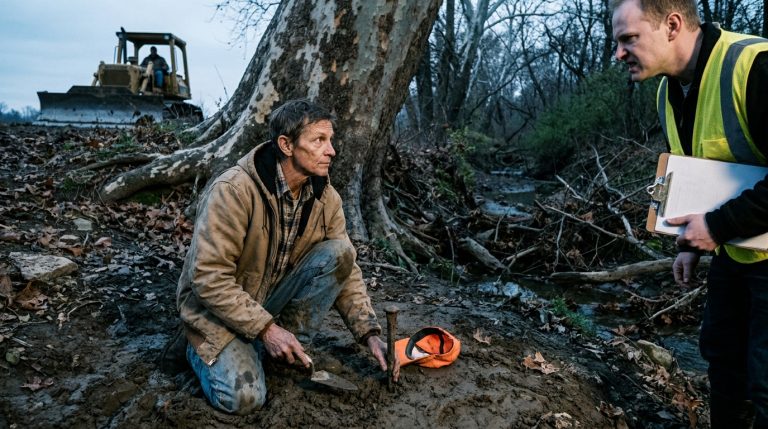
A few feet away, the orange survey stake he had noticed earlier stood out against the snow like a drop of fresh blood. Clayton walked over to it, his movements slow and deliberate. He reached down and gripped the plastic marker. It was cheap, flimsy, but it had been driven deep into the frozen ground. Stamped on the side in black ink was a reference code: Route 4-D.
He didn’t pull it up. Removing it would be a tactical error, a premature disclosure of his awareness. Instead, he pulled out his ruggedized phone, snapped three high-resolution photos of the marker, the chemical-stained mud, and the tire tracks, ensuring the GPS coordinates were embedded in the metadata.
He needed eyes on the perimeter that didn’t sleep.
Clayton walked back to the machine shed, the heavy iron door creaking on its rusted hinges. From the dark interior, he retrieved a wooden crate containing six trail cameras. These weren’t standard commercial models; they were black-bodied, thermal-imaging units he’d customized with low-signature infrared emitters.
Working with practiced, silent efficiency, Clayton began mapping the grid. He mounted the first camera inside the hollowed-out trunk of a dead white pine overlooking the driveway. The second went high up on a fence post behind a screen of blue spruce, its lens angled directly at the newly placed orange stake of Route 4-D.
As he worked, his mind ran through the logistics of Melissa’s intrusion. She wasn’t just checking storm drains. She was measuring. She was hunting for something on his land, wrapped in the authority of the Homeowners Association.
He secured the final camera near the northern boundary line, camouflaging the casing with frozen cedar boughs. He tapped his phone, syncing the feeds. One by one, six green indicators flickered to life on his screen, casting a cold, digital glow over his face. The static grid was live. Every heat signature, every mechanical movement across his fifty acres would now be logged, timestamped, and uploaded to a secure remote server.
A soft, electronic chime sounded from his pocket. Clayton looked down at the screen. A warning notification flashed.
A vehicle was approaching the main gate from the county road. Not the BMW. Something heavier.
Clayton slipped the phone back into his pocket, his hand naturally dropping to his side as he turned toward the road, his face hardening into a mask of silent, unyielding resolve.
CHAPTER 3: THE IRON LINE
The rumble of the approaching diesel engine vibrated through the soles of Clayton’s boots, transforming the silent tension of the armed perimeter into a physical, throbbing countdown.
A heavy, dual-wheeled Ford F-350 painted a matte, utility gray rounded the snowy bend. Its massive tires ground the ice into fine powder, the tire chains clinking rhythmically like iron teeth. Clayton didn’t relax his posture when he recognized the weathered face of Pete behind the mud-splattered windshield. On this mountain, every arrival was a variable that had to be weighed.
Pete cut the engine. The sudden silence that followed was heavy, filled only with the ticking of the hot manifold. He stepped out of the cab, his boots sinking into the drift with a dull thud. He was a man built like a concrete pillar, dressed in oil-stained Carhartt canvas that rustled like dry leaves as he moved.
“Clayton,” Pete said, his breath blooming in a white cloud. He didn’t offer a hand; he knew better. Instead, he reached into the truck bed and pulled out a yellow hard-case containing his high-precision surveyor’s GPS. “You said there was an alignment issue.”
“Pasture line,” Clayton replied, his voice clipped. “There’s a new orange stake by the ditch. Stamped with Route 4-D. I need a hard benchmark.”
Pete grunted, pulling the carbon-fiber rod and the high-performance receiver from the case. The screen of the handheld data collector flickered to life, its blue backlighting casting a cold hue over his calloused hands. They walked in silence toward the boundary fence, their boots carving a straight trail through the virgin snow.
Pete set the base of the carbon-fiber rod directly on the rusted iron pin buried beneath the frost at the true corner of Clayton’s deed. He stood motionless, waiting for the satellite link to lock. The receiver emitted a series of rapid, high-pitched chirps as it connected to the military-grade positioning network.
“GPS lock is solid,” Pete muttered, squinting at the digital display. “Now let’s look at that orange stake of yours.”
They walked twenty paces north, where the cheap plastic marker of Route 4-D cut through the snow. Pete set the rod down beside it. He tapped the screen, the numeric coordinates scrolling rapidly. Suddenly, his thumb paused. He frowned, his eyes narrowing as he adjusted the scale on the digital plat map.
“That’s impossible,” Pete said, tapping the glass. “This stake is sitting twelve feet inside your deeded acreage. But that’s not the discrepancy. Look at the reference line.”
Clayton leaned in, his eyes scanning the digital overlay. A bright red line representing the HOA’s claimed emergency easement was superimposed over his property. “What am I looking at, Pete?”
“This easement line isn’t registered with the county GIS database,” Pete said, his voice dropping. “It’s pulled from an external file. The system flags the metadata. It’s labeled as The Cadwell Deed, but the digital signature is completely severed from the courthouse registrar.”
Before Clayton could process the implication, a sharp, metallic screech tore through the valley.
An HOA-marked Chevrolet Silverado came barreling down the public road, its nose diving as it braked hard against the icy shoulder. The door flung open, and Melissa Hart stepped out onto the packed snow. She wore a tailored black winter coat, her leather boots immaculate despite the slush. Clipboard clutched to her chest like a shield, she marched toward them, her eyes locked on Pete’s GPS rig.
“This is an active infrastructure safety zone,” Melissa barked, her voice thin and sharp as shattered ice. “You have no authority to conduct private surveys on land designated for community winter routing.”
Clayton stood his ground, his shoulder checking the angle of the wind. He kept his hands open, hanging loosely near his pockets, his eyes tracking her fingers. “You’re twelve feet over the line, Melissa.”
“The Board has a registered easement,” she countered, thrusting a laminated sheet of paper toward him. “The Cadwell Deed of 1994 grants Meadowbrook Heights full maintenance and emergency access along this entire corridor. If you interfere with our safety inspections, I will have the sheriff remove you.”
Clayton didn’t reach for the paper. Instead, he looked past her shoulder to the truck, noting the low-slung rear axle and the faint, dusty grey residue coating the wheel wells. It was the same grey powder he had just scraped off his crushed ginseng plants.
“Let me see that document,” Pete said, stepping between them and reaching for the laminated page.
Melissa hesitated, but her grip loosened. Pete took the paper, holding it flat against his clipboard. He compared the listed benchmarks on the deed with the live satellite coordinates on his handheld unit. A cold smile touched the corners of Pete’s mouth, though his eyes remained dead.
“This is a joke,” Pete said flatly, looking up at Melissa. “The physical benchmarks listed here—the old oak tree and the stone culvert—don’t exist on this topography. You’ve offset the grid coordinates by exactly thirty degrees north to force this line across Clayton’s pasture. This document is a complete fabrication.”
Melissa’s face drained of color, her eyes darting to the trail cameras Clayton had hidden in the trees, though she couldn’t see them. The cold, unyielding precision of the trap was beginning to close around her, but her jaw tightened with a desperate, defensive fury.
“We have the county filings,” she whispered, her voice shaking but still carrying a threat. “You think a digital reading changes what’s on record? The HOA owns this path. We’ll be back with the plows by morning.”
She snatched the document back from Pete’s hand, spun on her heel, and retreated to her truck, the tires throwing up a spray of dirty gray slush as she sped away.
Pete turned to Clayton, his expression grim. “The easement is a fake, Clayton. She forged The Cadwell Deed to get on your land. But she didn’t do it just to run plows. She’s covering something up, and she’s running out of time.”
Clayton looked down at the gray, chemical-slick mud on his boots. The decoy was broken, but the deeper, darker reality of what lay beneath his frozen soil was still locked in the dark.
CHAPTER 4: THE TRIGGER CONDITION
Pete’s heavy dual-wheel F-350 had barely cleared the driveway when the drop in hydraulic line pressure triggered a quiet, rhythmic warning hum inside the dark machine shed, pulling Clayton instantly from the fading tail lights into a race against the freezing dark.
The gray winter twilight was collapsing fast over the ridge, bringing with it a biting, crystalline frost that seemed to settle directly onto the exposed metal of the ranch. Clayton didn’t go back inside the warm house. The diagnostic warning on his phone screen showed a sudden, steep drop—fluid pressure on the snowgate’s primary deployment cylinder was failing. If the oil froze or leaked out now, the steel barrier wouldn’t rise when the convoy hit the sensor loop.
He moved quickly to the tool bench, his boots grinding down the icy crust along the gravel pathway. Inside the unheated machine shed, the air was a vault of frozen iron and old grease. He grabbed a heavy crescent wrench and a bottle of low-viscosity hydraulic fluid. His fingers, already stiffening from the bitter wind, struggled slightly to align the wrench on the locknut of the backup manifold.
With a slow, muscle-straining pull, Clayton forced the rusted valve open. The cold oil resisted, thick as honey, but his hands knew the exact torque required to bleed the air bubbles out of the line. Slowly, the low hum of the pump smoothed out, settling back into a quiet, rhythmic vibration that pulsed through the floorboards. The diagnostic screen on his phone flickered green once more. The physical barrier was primed.
Leaving the shed, Clayton walked back toward the house to establish his tactical communication link. Sarah was asleep, her breathing synchronized with the soft, mechanical sigh of the oxygen concentrator. The sight of her pale face against the dark flannel pillow tightened something deep in his chest. Every move he made tonight was to preserve the quiet of this room.
He sat at the kitchen table, the dim light of his laptop screen illuminating the coordinates of his perimeter map. The six thermal-imaging trail cameras were feeding data without delay. He split his screen, opening an encrypted chat channel to a secure server.
“The grid is active,” Clayton typed, his keystrokes quiet in the silent house. “GPS data confirmed. The Route 4-D marker is twelve feet inside our deed line. The Cadwell Deed they are using is a complete digital fabrication.”
A reply blinked back almost instantly from the federal liaison. “Confirmed, Clayton. We’ve checked the registry metadata. The forged deed was generated on an external workstation. But there’s a secondary layer. The physical easement route they’ve drawn overlays a subterranean infrastructure system labeled as The Solum Bypass. If they breach your pasture, they’re trying to physically access that junction.”
Clayton stared at the words on the screen: The Solum Bypass. It wasn’t on any public township map.
He leaned back, his eyes tracking the red overlay lines on his digital map. The bypass ran directly beneath the low-lying northern drainage ditch where he had found the grey, chemical-stained mud. It wasn’t a standard storm drain. It was a private, unlogged conduit.
A sudden alert pinged at the top of his dashboard. Camera four—the unit angled toward the northern spruce line—had picked up a thermal spike.
Clayton zoomed in on the pixelated image. Two figures in heavy winter coats were moving through the trees just beyond his fence. They weren’t carrying clipboards. One of them held a long, T-shaped iron key used for turning municipal water valves, while the other carried a heavy sample bottle. They were testing the soil density near the drainage ditch, their boots treading directly over the frozen turf of the herb garden.
He felt the cold, familiar stillness of his military training settle over him, displacing the frustration. They weren’t waiting for morning. The safety inspections were a front, and Melissa was accelerating her timeline.
He tapped his phone, sending a direct signal to Jennifer Martinez and the sheriff’s terminal. “We have unauthorized entry on the northern sector. They are actively locating the bypass entry. Moving to defensive positions.”
“Hold your ground, Clayton,” Jennifer’s message read. “Let them establish the physical trespass. The federal warrant is signed. We need them to commit to the breach before we move in.”
Clayton closed the laptop. He walked to the back door, his hand pausing on the heavy brass latch. The wind outside was screaming now, rattling the loose corrugated metal on the barn roof. He checked the transmitter in his vest pocket, feeling the solid, mechanical click of the armed toggle.
The stage was set. Every camera was recording, every sensor was calibrated to the microsecond, and the physical barrier beneath the snow was pressurized and waiting for the first heavy axle to cross the line.
CHAPTER 5: THE COLD CATCH
The cold brass of the door latch bit into Clayton’s palm as he depressed the mechanism, stepping seamlessly into the howling, snow-blind dark to spring the final trap.
Freezing air immediately filled his lungs, sharp and clean, carrying the high-voltage hum of the mountain. He moved along the side of the house, his shadow cutting through the pale blue glow cast by the kitchen window. On his phone, the red indicators on the northern sector flashed. The two trespassers near the drainage ditch were moving toward a heavy concrete manhole cover buried beneath a clump of frozen sumac—the access point to the hidden network.
Suddenly, a pair of headlights swept across the lower driveway, slicing through the blowing snow. The white BMW was returning, followed by two dark SUVs. Melissa Hart had brought her board members to witness the final push. They were moving fast, trusting the artificial authority of their forged easements to sweep Clayton’s resistance aside.
Clayton reached the edge of the porch, his hand slipping into his vest pocket to grip the heavy aluminum remote transmitter. He didn’t yell. He didn’t run. He watched the headlights reach the property threshold, the tires crunching over the buried sensor loops he had calibrated hours earlier.
The BMW’s front tires crossed the invisible line.
Clayton pressed the toggle.
Underneath the fresh snowdrift, the heavy hydraulic system he had bled and pressurized in the machine shed fired with a muffled, metallic thud. The steel snowgate—an angled, reinforced plate painted the exact white of the surrounding drifts—rose instantly from the ground, locking into position with the rigid finality of a vault door.
Melissa saw the obstacle too late. She slammed on the brakes, her tires screaming and throwing up a wall of icy slush, but the momentum of the luxury vehicle carried it forward. The undercarriage struck the steel barrier with a deafening, hollow grind of tearing metal. The impact jarred the BMW to a dead stop, its front wheels lifted inches off the frozen ground, spinning helplessly in the winter air. The SUVs behind her swerved violently, sliding into the snowbanks on either side of the driveway, their headlights pointing uselessly into the pines.
Before the echoes of the crunching metal could fade, dark figures emerged from the treeline. The local sheriff’s cruisers, flanked by two unmarked black utility vehicles, activated their emergency lights, washing the white landscape in a relentless, flashing rhythm of red and blue.
Melissa scrambled out of the driver’s side of the wedged BMW, her face twisted in a mixture of shock and fury. She held her laminated papers high, her voice cracking against the wind. “This is an illegal obstruction! We have county authority! The Cadwell Deed grants us—”
“The Cadwell Deed is a forgery, Melissa,” Clayton said. He walked down the porch steps, his voice calm and carrying clearly over the idling engines. Behind him, Jennifer Martinez stepped into the light, flanked by two federal environmental investigators.
Clayton tapped his tablet, projecting a high-resolution map onto the screen. “You fabricated the easement coordinates for Route 4-D to force a right-of-way through my pasture. But you didn’t care about winter safety access. You needed to control this land because of what’s buried twelve feet inside my deed line.”
Melissa froze, her hands lowering slowly.
“The Solum Bypass,” Clayton continued, his finger tracing a blue line on the screen that mapped directly to the concrete junction box in the northern sumac patch. “Your family’s concrete manufacturing plant has been dumping highly alkaline wash-water and chemical additives directly into this unmapped bypass for five years, draining the toxic runoff through my pasture and poisoning my wife’s medicinal garden. You knew the state environmental audit was scheduled for this week. You needed to open the bypass valve tonight to flush the remaining sediment before the inspectors took soil samples.”
The federal agent stepped forward, holding a clear glass jar containing the grey, chemical-stained mud Pete and Clayton had documented earlier. “Melissa Hart, you are under arrest for federal clean water violations, document forgery, and wire fraud.”
The cold wind whipped Melissa’s hair across her face as the deputy stepped forward, the metallic click of the handcuffs sounding incredibly loud in the quiet valley. She didn’t speak. The calculated arrogance that had driven her across his fence posts for months evaporated, leaving only a hollow, exhausted silence.
By dawn, the flashing lights had faded, replaced by the pale, soft pink of a clear winter sunrise. The silence of the mountain settled back over the ranch, deep and undisturbed.
Clayton walked to the edge of the garden, carrying a fresh cedar post, a post-hole digger, and his heavy framing hammer. The air was still freezing, but the wind had died down to a gentle breeze that carried the clean scent of pine. He set the post in the earth, aligning it perfectly with the true boundary line Pete had marked. With slow, rhythmic strokes, he drove the timber deep into the soil, securing the structural frame of Sarah’s sanctuary.
He knelt, using his gloved hand to brush a soft layer of snow off the wintergreen and ginseng roots. The soil beneath was clean now, protected forever by the legal boundaries he had so meticulously established.
A quiet sound made him look up. Sarah was standing on the porch, wrapped in a thick wool blanket, her breathing steady and peaceful in the crisp morning air. She wasn’t holding her oxygen tank. She smiled down at him, her eyes reflecting the gold of the rising sun.
Clayton stood up, wiping the frost from his hands. He walked up the steps, his boots leaving clean, deep prints in the fresh snow. He wrapped his arms around her, holding her close against the cold, knowing that the perimeter was secure, the sanctuary was preserved, and their home was finally at peace.