The Ledger of Broken Fences: A Calculus of Bitter Winter and Cold Retribution
CHAPTER 1: THE LIQUIDATION METRIC
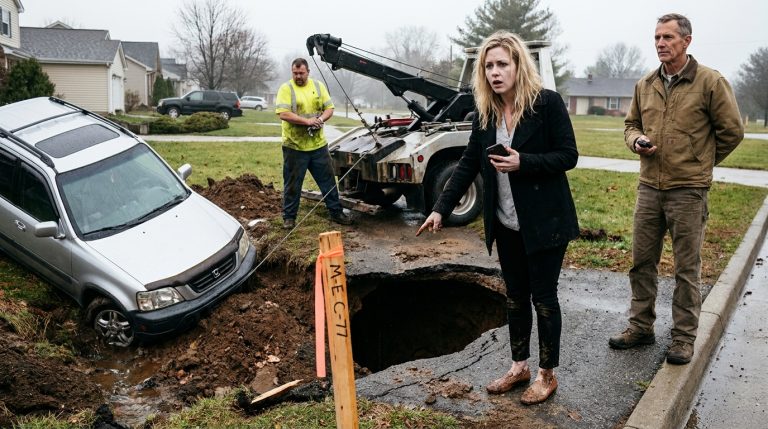
The sound of steel shearing wire didn’t arrive as a warning; it arrived as a structural failure. Through the frost-rimed pane of the barn door, the perimeter fence didn’t merely tip—it disintegrated. The yellow blade of an industrial plow hit the corner braced post at forty miles an hour, sending treated pine splintering into the frozen dirt. Before the echo of the impact could clear the valley floor, the air filled with the low-frequency thrum of two-ton diesel engines.
The first dump truck backed through the gap, its hydraulic lift cylinders groaning against the sub-zero chill. It didn’t pause for a spotter. The tailgate tripped, and a mountain of gray, chemical-choked slush slammed into the winter pasture, burying the north feed trough under three tons of municipal waste. Road salt, yellow anti-icing polymers, and liquid magnesium chloride spread across the hardpan like a chemical spill.
The older bulls reacted instantly. They didn’t bunch; they scattered along the southern wire, their hooves slipping on the glazed mud. One yearling slammed his flank against the oak rail of the sorting pen, his breath exploding into the gray air in frantic, white plumes.
“Get the gates!” I didn’t shout it to the drivers. They weren’t looking at the ground; they were looking at the mirrors. I shouted it toward the barn where Martha stood, her frame wrapped in three layers of stained canvas, her fingers frozen into white knots around a lead rope. The cold wasn’t just dropping; it was accelerating, riding the back of a north wind that smelled of exhaust and wet iron.
Then the red BMW cleared the drift by the main road. It crawled along the ruined line of the fence, its tires crunching over the shattered posts with an unhurried, mechanical rhythm. It stopped exactly three inches from the twisted cattle panel. The door opened, and she stepped out into the slush. Her boots were black leather, clean, unmarred by the grease of the job site. She didn’t look at the panicked livestock, nor at the black runoff already pooling near the creek bed. She reached into her tailored coat, produced an uncreased sheet of twenty-pound bond paper, and smoothed it against the cold.
“Emergency winter authority,” she said. Her voice didn’t carry the strain of the wind. It was flat, measured, the tone of an insurance adjuster logging a total loss. “Temporary land seizure for community safety corridor clearance. This pasture is now the designated disposal terminal for the southern subdivision.”
Behind her, the engines didn’t drop their RPMs. Another truck was already entering the turn. The young bull near the ditch went down on his knees, his hocks shaking as the salt-slush reached his shins.
“This is deeded agricultural ground,” I said, my boots sinking into the gray mud between us. I didn’t move my hands from my pockets. In this valley, if you show your teeth before you have your ledger ready, they use them to count your years. “The stock won’t survive the runoff.”
She didn’t argue. People who have the county’s signature on a temporary emergency mandate don’t need to use adjectives. She simply adjusted her collar against the blowing flurries, her eyes scanning the barn, the house, and finally settling on the small, stone ridge three hundred yards behind the house where the cedar trees blocked the wind. Her mouth twisted into something small and dry—not a smile, but a calculation verified.
“Then you should have adapted sooner,” she said. “Winter doesn’t wait.”
She reached back into the car, flipped a toggle on the console, and the external loudspeaker attached to the roof rack crackled to life with a high, piercing whistle of feedback.
CHAPTER 2: THE METRIC OF ENCROACHMENT
“You’re measuring the wrong line,” I said. My voice didn’t rise above the drone of the idling truck engines, but it cut through the crisp, frozen air between us.
The driver of the lead plow, a man with grease-stained knuckles and a faded neon vest, didn’t look up from his clipboard immediately. He spit a dark stream of tobacco juice into the gray slush gathered at his boots, the liquid sizzling slightly against the chemical-burned snow. “Orders say the fence line is the baseline, mister. We clean the roads, the snow goes here. Simple math.”
“The fence line was five feet further north before your blade took the corner post out,” I replied, stepping closer until the shadow of his high-cab truck fell across my shoulders. The metal skin of the vehicle radiated an intense, oily heat that smelled of burnt transmission fluid and cheap antifreeze, a stark contrast to the biting cold slicing off the ridge. “You’re dumping on deeded pasture. That’s not a safety corridor. That’s a trespass.”
He finally looked at me, his eyes small and bloodshot under the brim of a frayed cap. He didn’t look angry; he looked exhausted, the look of a subcontracted gear in a machine that didn’t care about property deeds. “Look, buddy. Go talk to the lady in the BMW. I just turn the key. The HOA pays the voucher, I drop the load.” He turned away, his boots crunching heavily through the salt-encrusted crust as he climbed back into the cab, slamming the heavy iron door with a solid, metallic ring that vibrated down the length of the frame.
I walked back toward the barn, each step crunching against ice that felt as rigid as concrete. The air was thick with the foul, sulfurous stink of the municipal runoff. The younger bulls had clustered near the far south corner of the paddock, their massive heads lowered, breath rising in synchronized, ragged clouds. They wouldn’t touch the water in the central trough anymore. The surface had frozen over with a greasy, iridescent film—the telltale sign of liquid magnesium chloride migrating through the drifts from the dumping zone.
Inside the barn, the silence was sharp. The cold here didn’t move; it settled into the timber and the iron bolts like a weight. Martha was sitting on an upturned crate near the grain bin, her hands buried deep in her pockets, her face pale beneath the woolen scarf. She didn’t ask what the driver said. She had heard the doors slam. She had seen the next truck already lining up at the break in the wire.
“The young one isn’t standing up,” she said quietly, her eyes fixed on the low-ceilinged stall at the back.
I walked over to the partition. The yearling lay on his side in the straw, his flank shivering in rhythmic, violent spasms. When I knelt beside him, the straw beneath his belly felt damp and freezing, soaked through by the moisture creeping up through the dirt floor. I pressed my palm against his neck; the skin was tight, the pulse underneath rapid and shallow. The salt-burn from the pasture runoff wasn’t just killing the grass—it was fouling the bedding, turning the shelter into an icebox.
“We need to move them to the upper paddock,” I said, rising and wiping the grit from my palms onto my jeans. The friction felt raw against my chapped skin.
“The upper paddock has no windbreak, John,” Martha said, her voice dropping into that guarded, fragile register she used when the old grief started to knock at the door. “If the storm swings around from the east tonight, they’ll freeze against the high wire. We can’t keep them out there without the shelter.”
“They stay in here, they drink that runoff, and we won’t have a herd by Monday,” I said. My fingers tightened around the iron latch of the stall gate, the frozen metal sticking to my skin for a split second before pulling away. “She knows the capacity numbers. She’s counting on the stress to break them before the lawyers can even look at the emergency filing.”
I pulled my phone from my belt, my stiff fingers clumsy against the glass screen. I opened the digital notice the HOA had zip-tied to the main gate an hour ago. It looked official enough—complete with the county seal and a string of alphanumeric routing codes at the margin. But as I zoomed in on the legal description of the temporary easement, something caught my eye. The property coordinate code didn’t match the master deed I had kept in the desk drawer for thirty years. It was off by two digits at the terminal index—a subtle alteration that shifted the designated safety corridor exactly eighty yards south, directly through our winter shelter.
A shadow crossed the barn door, blocking out the pale, gray light of the afternoon.
It wasn’t the president this time. It was a younger man, dressed in a clean, state-issue canvas jacket, a digital surveying transit slung over his shoulder like a weapon. He didn’t step inside; he stood on the threshold, his boots resting on the shattered pine threshold where the plow had dragged the debris.
“John Vance?” he called out, his voice sharp and transactional.
“Depending on who’s asking,” I said, stepping out from the stall into the main alley of the barn.
“County Code Enforcement,” he said, tapping a plastic clipboard against his thigh. The sound was flat, like a dead branch snapping in the frost. “We received an automated log on an obstruction of a public transit corridor. I need to verify the coordinates for the temporary storage basin.”
“You mean the illegal dump site,” I said, moving toward him until I could see the reflection of the gray pasture in his protective eyewear.
“The paperwork calls it a basin,” he replied, his face remaining entirely expressionless. He didn’t look at the shivering yearling in the back. He didn’t look at Martha. He looked at the screen of his handheld terminal, his thumb scrolling through a list of backdated approvals that had never crossed my desk. “According to the emergency winter declaration filed on the twenty-fourth, this parcel was cleared for community maintenance access. If your livestock is interfering with the disposal timeline, the daily non-compliance fine triggers at midnight.”
I reached out and tapped the edge of his clipboard with a single, blunt finger. “Who signed the verification on that twenty-fourth filing?”
The inspector didn’t flinch, but his eyes shifted slightly toward the red BMW still idling by the road, its exhaust pipe sputtering pale, blue smoke into the falling snow. “The signature is locked under executive authority for the duration of the weather event. You want to contest the validity, you take it up at the municipal session.”
He turned to step off the threshold, his boots sinking into the fresh layer of salt-slush. But before he could clear the gate line, he stopped, his gaze dropping to a small object half-buried in the snow near the fence post. It was a rusted iron hinge pin from the old gate, its surface scarred with fresh, bright yellow paint from the plow’s blade. He didn’t pick it up. He just stared at the metallic scrape for three seconds, his jaw tightening slightly before he walked toward his vehicle without another word.
I looked down at my phone again. The coordinate index on the screen seemed to glare back at me in the dimming light—a deliberate, legal fiction designed to bury us before the spring thaw could even begin.
CHAPTER 3: THE SEGMENTED FAULT
“The easement code doesn’t just shift the coordinates,” I told the attorney over the static-heavy receiver. “It cuts thirty yards deep into the historic family plot.”
The line clicked, dry and sharp, as the heater in the truck cabin hummed against the ice forming along the lower edge of the windshield. On the passenger seat, the folder containing the master deed lay open, its yellowed parchment stark against the cold gray dashboard vinyl. The attorney’s voice came through thin, compressed by the lack of local towers. “John, if the document has an executive emergency stamp, the county clerk won’t pull the file without a formal injunction. They’re running a clean sequence. On paper, it looks like a standard public-safety accommodation.”
“It’s not standard when the boundary pins are fresh plastic driven through frozen topsoil,” I said. My fingers tightened on the steering wheel, the leather cold and unyielding against my palms. “I’m looking at the cemetery ridge right now. There are tracks up here that didn’t come from a county utility vehicle.”
I ended the call before he could advise caution. Caution doesn’t stop magnesium chloride from leaching into the groundwater, and it doesn’t repair a fence line crushed by three-ton steel blades.
The wind on the ridge was different from the wind in the low pasture. It didn’t swirl; it drove straight out of the north, carrying the clean, sharp smell of pine mixed with the chemical taint rising from the valley floor below. I stepped out of the truck, the door catching a gust and swinging back against my shoulder with a dull, heavy thud. The ground beneath my boots was uneven, frozen hard enough to ring like anvil iron with every step.
The cemetery plot was small, enclosed by an old four-rail iron fence that my grandfather had set into dry-pour concrete. The gate was intact, but the snow around the perimeter had been chewed into a dirty slush by heavy, lugged tread patterns. Someone had backed a small utility machine up the incline—deep ruts cut straight across the drainage swale, leaving parallel scars of raw, frozen clay.
I walked past the first row of granite markers, my eyes tracking the disturbance in the snow. At the base of my son’s headstone, the white blanket was gone, scraped down to the gray turf. The small wooden cross we had placed beside the stone after the service—carved from a piece of old barn beam he’d helped me salvage—lay five feet away. It hadn’t been knocked over by the wind. The vertical shaft was snapped clean in two, the fibers splintered where a heavy rubber tire had rolled directly over the center.
A localized chill settled behind my jaw, distinct from the freezing air.
Beside the broken wood, driven deep into the frozen dirt where the cross had stood, was a newly placed surveyor’s stake. It wasn’t the standard orange lath used by the road crews. This was a heavy, square aluminum surveyor pin, capped with an anodized red serial tag. I knelt down, the cold of the ground soaking instantly through the knees of my denim trousers. The aluminum felt like dry ice against my bare fingers as I brushed away the remaining frost from the metal cap.
The serial index read: HOA-PROP-RECLASS-04.
“John.”
Martha’s voice came from behind me. She had walked up the ridge path without me noticing, her boots tracking light footprints into the ruts left by the machinery. She stood at the iron gate, her wool coat pinned against her frame by the wind, her eyes fixed on the splintered wood near my boots.
“They were up here this morning while we were in the lower paddock,” she said. Her voice didn’t shake. It had gone thin and clear, the tone she used when the calculus of our situation became entirely absolute. “I heard a small engine around dawn. I thought it was the county clearing the culvert.”
“It wasn’t the county,” I said, standing up and holding the two broken pieces of the cross in my left hand. The wood was dry-rotted at the break, but the grain was still dense, holding the scent of old oil and aged pine. “The county uses blue caps for temporary easements. This is an HOA internal inventory stake. They’re marking a permanent land adjustment before the public hearing even opens.”
“Why the ridge?” she asked, her gaze drifting down to the valley where the red BMW was once again visible, parked like a spotter’s post near the main pasture gate. “There’s no snow storage up here. There’s nothing but the stones.”
“The ridge is the anchor point for the entire parcel,” I said. I reached down and pulled the aluminum stake from the ground with a single, hard jerk. The frozen earth held it for a second before releasing it with a sharp, sucking pop. “If they reclassify the cemetery boundary as non-agricultural or abandoned municipal property, the agricultural exemption for the entire lower valley drops. The easement becomes non-reversible.”
I turned the aluminum pin over in my hand. Stamped into the lower shank, beneath the mud and the frost, was a set of initialed coordinates that hadn’t been generated by an automated county system. They were hand-stamped, the letters slightly out of alignment, the metal deformed by a manual punch.
The initials beside the tracking code were E.V. — my son’s name.
Martha stepped forward, her hand reaching out to touch the metal shank before pulling her fingers back from the freezing surface. “He filed that report three years ago, John. The one about the capital improvement fund. He said the numbers for the drainage ditch didn’t match the county outlays.”
“He didn’t just file a report,” I said, looking down at the red BMW idling by the road below, its headlights cutting two sharp, white tunnels through the graying afternoon. “He logged the original coordinate fraud. She didn’t forget it. This isn’t a modern snow disposal emergency. This is the ledger being balanced.”
I walked back to the truck, the broken wood heavy in my hand, the aluminum pin striking the side of the truck bed with a loud, metallic clatter as I threw it inside. The primary action wasn’t in the pasture anymore, and it wasn’t in the county clerk’s office. It was behind the red paint of that car, and the time for patient documentation was narrowing down to the thickness of the frost on the wire.
CHAPTER 4: THE AUTOMATED PERIMETER
The heavy orange flag didn’t flutter; it sheared through the wind like a plastic blade. It was driven deep into a three-foot drift cutting directly across the winter feeding zone, its fiberglass staff vibrating with a high, thin whistle. The moment my boot crossed the invisible threshold between the stake and the frozen creek bed, the phone in my pocket buzzed with a sharp, dual-tone alert.
I pulled it out. The screen flickered against the gray glare of the storm, displaying a freshly generated digital citation from an external portal: Violation logged. Unauthorized entry within marked public safety buffer. Automated fine pending compliance: $500. The routing code at the bottom didn’t belong to the county surveyor’s office. It carried the same proprietary corporate index I’d found on the reclassification stake up at the ridge. The loop wasn’t just tightening on paper anymore; it had become an active, electronic fence closing around the livestock in real time.
“John, don’t step past it again,” Martha said, her voice catching as she dragged a fifty-pound bale of alfalfa through the knee-deep crust behind me. The canvas of her coat scraped against the rough twine, a flat, dry friction that sounded like teeth grinding in the cold. “The system is recording every movement. It’s an automated log.”
“It’s an automated trap,” I said, my voice low as I watched a fresh convoy of dump trucks turn off the secondary highway.
The rumble of their engines was louder now, a synchronized, heavy pounding that traveled through the frozen mud straight into the soles of my boots. The salt piles were taller than the fence posts now, gray and pitted with chemical crusts, bleeding a dark, oily slush into the soil. The bulls were bunched tight against the far southern rail, their flanks slick with frozen sweat, their eyes tracking the high-set yellow lights of the plows. They had stopped moving entirely, their bodies compressed into a single, defensive mass. Fear does that to animals—it turns their muscle into stone until the pressure triggers an explosion.
A loud, sudden squawk tore through the wind.
The red BMW had crawled back down the lane, its tires churning through the chemical mire. It didn’t stop at the gate this time; it pushed inches past the shattered post, its front bumper resting against the wire. The external loudspeaker on the roof rack crackled, the sound slicing through the muffled thrum of the storm with an aggressive, metallic edge.
“This property is under emergency municipal control,” her voice burst through the horn, amplified until it vibrated the iron panels of the barn behind us. “Any further interference with community clearance operations will be documented as a felony obstruction. Remain outside the marked boundaries.”
She didn’t roll down the glass. The windshield was a dark, reflective sheet of gray, mirroring the dirty snow and the black silhouettes of the cattle. She simply put the car in reverse, the tires spinning for a split second on the ice with a high, metallic shriek before she began to patrol the line, the speaker blaring a continuous, low-frequency warning tone that hit the bulls like a physical blow.
The lead yearling shifted, his hooves sliding sideways on the glazed mud near the runoff ditch. He let out a sharp, panicked snort, his head lifting high as his nostrils flared against the diesel exhaust.
“She’s trying to force a break,” I said, my hand closing around the rusted handle of the wire cutters in my pocket, the cold steel biting through my glove. “If they bolt through the south wire into the subdivision, she gets the immediate destruction order from the sheriff. The pasture gets cleared legally by midnight.”
“John, look at the truck by the gate,” Martha whispered, her hand tightening on my forearm. Her grip was cold, the fabric of her sleeve stiff with frost.
A white contractor pickup had idled near the main breach. A man in a heavy thermal hood stood by the open door, his back to the wind as he spoke into a handheld radio. His voice carried across the frozen crust during a sudden lull in the gale, thin but distinct. “…yeah, the auto-renew kicks in if the site stays active past Sunday. The disposal layout is locked. It’s a gold mine if we keep the trucks moving. Two-point-eight on the recovery ledger alone. Just keep the old man off the line.”
He slammed his door, the noise identical to the iron click of a trap setting.
I didn’t step back across the orange line. I stood in the gray slush, my eyes locked on the digital display of my phone as a second notification pinged: Secondary violation logged. Cumulative penalty applied.
Every piece of the machinery was moving in unison now—the trucks, the automated fines, the speaker blaring from behind the tinted glass of the red car. They weren’t waiting for a legal challenge because they had already built a framework where the challenge itself was a financial liability. The decoy of a winter emergency had completely dissolved, leaving only the cold, sharp edges of an eviction metric that had been calculated years ago, starting with a report my son had left behind in a county filing cabinet.
“We aren’t moving the herd,” I said, turning back toward the barn as the low-frequency drone from the car speaker began to rattle the loose tin on the roof.
“They won’t stand another night of the noise, John,” Martha said, her face pale as she looked at the packed cluster of cattle.
“They won’t have to,” I said. My fingers were completely numb now, but my grip on the folder in my coat was absolute. “She wants a spectacle in the dark where nobody can see the signatures. We’re going to give her a room with the lights on.”
I walked toward the utility truck, my boots breaking through the salt crust with a sharp, rhythmic snap. The system was closing in, but a system built on a forged easement has a single, structural flaw: it requires everyone to keep looking at the paper instead of the hand that held the pen.
CHAPTER 5: THE FINAL AUDIT
The linoleum floor of the community center was mapped with gray salt-trails from forty pairs of heavy winter boots. Overhead, three banks of industrial fluorescent tubes hummed a low, alternating frequency that flickered against the wood-paneled walls. The room smelled of wet canvas, stale potboiled coffee, and the sharp, chemical heat of an overtaxed radiator knocking in the corner.
She stood at the laminated podium, her fingers braced flat against its edges. Her black leather coat was unbuttoned just enough to reveal the gold weave of her collar, her posture perfectly vertical despite the thirty-mile-an-hour gusts hammering the reinforced glass windows behind her. The projection screen above her head displayed the master parcel map—our pasture shaded in an aggressive, cross-hatched red, newly labeled as a Permanent Municipal Utility Basin.
“The emergency data is absolute,” she said into the microphone. Her voice came out through the wall-mounted horns with a clean, compressed authority that left no room for acoustic decay. “The safety of the southern development requires an unhindered disposal vector. Private agricultural holdouts cannot override municipal clearance protocols during a verified weather event.”
A few board members near the front row nodded in unison, their movements small, rhythmic, and rehearsed.
I didn’t sit down. I stood in the central aisle, the folder from the passenger seat tucked firmly under my left arm. The cardboard was damp from the flurries that had followed us into the foyer, its surface stiffening as it dried in the stale heat of the room. Martha sat two paces to my right, her hands clamped tightly over her knees, her face static under the glare of the lights.
“The safety corridor isn’t municipal,” I said. I didn’t use the microphone, but the acoustics of the low ceiling carried my voice straight to the stage, flat and dry. “And the signature on the twenty-fourth conversion filing isn’t mine.”
She didn’t move her hands from the podium. Her eyes shifted toward me, two dark points reflecting the white light of the projector screen. “Mr. Vance, this assembly has already verified the executive emergency routing. If you have a civil dispute regarding the boundary indices, the proper venue is the regional appellate clerk after the winter restriction lifts.”
“The clerk is already here,” I said.
The heavy double doors at the back of the hall clicked open, the iron latch striking the brass strike plate with a loud, metallic ring that cut through the low murmur of the crowd. A woman in a dark gray wool coat stepped onto the linoleum, her boots leaving clean, wet wedges of moisture on the floor. Behind her stood two men in state-issue winter jackets, their badges pinned openly to their left lapels, their faces expressionless under the low brims of their uniform caps.
The room went entirely silent except for the rhythmic, heavy knock of the radiator pipe.
I walked to the front of the stage, my boots making a slow, deliberate scrape against the floor. I laid the blue folder flat on the table directly beneath her podium, opening it to show the high-contrast photographic overlay of the county easement file. Beside it lay the tracking code from the aluminum pin I’d pulled from the cemetery ridge.
“Look at the lower loop on the capital ‘J’ in the authorization box,” I said, pointing to the glowing screen as the clerk adjusted a handheld thumb-drive at the main system console. “The stroke velocity is uniform. A manual signature has friction—it slows down at the terminal curve when the pen changes direction against the grain of the paper. This was traced from a single digitized signature on an old fence-line maintenance voucher from three years ago.”
The clerk hit a key. The projection shifted, replacing the red cross-hatched map with a side-by-side ledger spreadsheet. Line after line of multi-digit transfers appeared, each one marked with a proprietary vendor code that matched the tracking stamp on the surveyor stake from my son’s grave.
“Two million, eight hundred thousand,” I said, looking up at her from the foot of the stage. The distance between us was less than six feet now, close enough to see the small, rhythmic pulse jumping at the base of her throat. “Routed through a third-party environmental logistics LLC registered to a PO box in the capital. The contract doesn’t expire when the snow melts. It auto-renews every November if the agricultural exemption on the primary anchor parcel is broken.”
She looked down at the paper, her fingers tightening until the laminate on the podium creaked under the weight. “This is an unverified documentation leak. It has no standing in an emergency safety session.”
“Ma’am,” the man from the back said, his voice coming down the aisle with a slow, heavy precision that didn’t require amplification. He stopped at the edge of the stage, his right hand resting naturally against the leather trim of his utility belt. “The county board rescinded the emergency designation forty minutes ago. The signatures on the conversion deed have been flagged for an active forensic audit.”
She didn’t look at him. She looked past him, toward the window where the distant, yellow revolving lights of the municipal plows were slowly turning away from our road, their engines dropping into a low, receding hum as they began the long retreat toward the highway. The system wasn’t closing in on the pasture anymore; the walls of the room had become the metric, shrinking down to the size of the iron hinges on the back exit.
“This is retaliation,” she said, her voice dropping into a sharp, dry whisper that hit the microphone with a wet pop. “This property was an obstruction to the development’s infrastructure. It was calculated for removal.”
“It was calculated for an eviction,” I said, reaching down to close the blue folder, the snap of the cardboard loud against the silence of the room. “But your ledger was short by one name.”
The officer stepped onto the short wooden riser of the stage, his boots heavy on the hollow steps. The sound of the iron handcuffs clearing the leather case was small—a light, fluid click of ratchets that signaled the absolute end of the calculation.
Outside, through the heavy double-paned glass, the snow continued to fall in long, diagonal sheets, covering the fresh ruts in the road, smoothing out the jagged edges of the broken posts until the land looked like nothing more than open, quiet ground waiting for the spring.