The Silent Ledger: A Commander’s Measured Descent into the Absolute Dismantling of a Corrupt Officer’s Life
CHAPTER 1: THE TACTICAL BENCH
The morning air in Oak Haven was sharp, tasting of ozone and manicured grass, but Isaiah Washington only registered the humidity. It was a tactical disadvantage. He sat on the wrought iron bench, his heels planted, his spine a straight, unyielding line. In his hand, the cardboard cup was a decoy, a prop to maintain the illusion of civilian life. He knew the patrol cruiser had been idling at the red light for exactly forty-two seconds.
The driver, Sergeant Rick Miller, wasn’t just patrolling. He was hunting.
Isaiah felt the shift before it happened. The cruiser surged forward, the tires biting into the asphalt with a predatory snap. Miller parked it at an angle—a blocking maneuver intended to cut off any potential exit. It was amateur work, the kind of clumsy, aggressive posturing that preceded a collapse in discipline.
Here, Isaiah thought, the internal clock in his head counting down. Three, two, one.
The heavy thud of the car door slamming sounded like a gunshot in the quiet park. Miller approached with his thumb hooked near his belt, his posture a textbook display of manufactured authority. His sunglasses were the dark, reflective kind, designed to hide the flicker of insecurity behind his eyes.
Isaiah didn’t stand. He didn’t offer the performative deference Miller clearly expected. Instead, he simply watched. He tracked the way Miller’s shoulder dipped, the slight, rhythmic twitch in his left cheek—a tell of a man who was already losing his pulse control. He noticed the way the officer’s foot tapped the pavement, a nervous, erratic beat against the ground. It was an indicator of adrenaline-fueled instability.
“You live around here?” Miller demanded, his voice a gravelly bark that carried across the lawn, making a group of nearby joggers slow their pace.
Isaiah took a slow, measured sip of his coffee. The heat of it was grounding, a sharp contrast to the cold calculation humming behind his ribs. He felt the weight of his own training—the years in the Horn of Africa, the silence of the mountains, the discipline required to stand down when every instinct screamed to neutralize.
“Visiting,” Isaiah replied. His voice was a flat, deep calm that seemed to irritate Miller more than a retort ever could.
Miller stepped into his personal space, the scent of stale tobacco rolling off him like a warning. He reached up, adjusting his utility belt, a move designed to draw attention to his holstered weapon. The silence that stretched between them wasn’t just empty; it was a vacuum, waiting to be filled with the consequences of Miller’s next mistake.
Isaiah’s eyes flickered to the officer’s utility belt, noting the specific angle of the taser. He realized then that Miller wasn’t just looking for an arrest; he was looking for a validation of his own existence.
“Does this friend have a name?” Miller pressed, leaning closer, his chest puffing out.
Isaiah kept his hands perfectly still on his knees. The trap was set. Every word, every aggressive step, and every heavy, labored breath Miller took was a link in a chain that would eventually lead to the man’s total undoing.
“He does,” Isaiah said, his gaze steady, locking Miller in a stare that didn’t hold fear—it held judgement. “But I’m not sure why that’s relevant.”
Miller’s jaw tightened, the skin pulling thin over his cheekbones. He reached for his sunglasses, fingers fumbling for a fraction of a second, his confidence visibly fraying at the edges. Behind him, the park grew unnaturally quiet. The joggers were gone. The distant traffic had faded.
Then, Isaiah saw it—a flickering red light on Miller’s shoulder. The body camera had just been manually deactivated. Miller hadn’t just made a mistake; he had signed his own termination order.
CHAPTER 2: THE CRUISERS WEIGHT
The slam of the door was absolute. It vibrated through the steel frame of the back seat, a flat, ringing echo that cut through the silence of the park. Isaiah didn’t move. He sat exactly as he had been placed, his hands still cuffed behind him, his spine pressed against the hard, unyielding plastic of the prisoner cage. The air in the car was aggressively cool, filtered through vents that smelled of old tobacco and chemical disinfectant.
Through the reinforced partition, he saw Miller’s silhouette. The officer was moving with a frantic, jerky energy, adjusting his mirror, shifting in his seat, clicking buttons on the dashboard with unnecessary force. Isaiah’s gaze remained fixed on the back of Miller’s neck. He watched the way the muscle spasmed near the jawline. Miller was running on a cocktail of adrenaline and ego, the kind of combination that made a man dangerous because it made him unpredictable.
A sudden, sharp flash of memory tore through the quiet—the heat of the Horn of Africa, the grit of sand against his skin, and the calculated, terrifying silence of a mission that had required him to vanish into the shadows. He had navigated insurgent checkpoints and survived ambushes, yet here he was, in a quiet, manicured suburb, restrained by a man who couldn’t even keep his own heartbeat steady. The irony was a cold, sharp blade in his chest. He suppressed it. Empathy was a luxury he couldn’t afford; in this confined space, focus was his only weapon.
Miller punched the accelerator, and the cruiser lurched forward, tires biting into the gravel before finding the asphalt. The motion was violent, designed to rattle, but Isaiah’s core remained locked. He tracked the movement of the car through the side window—the blurred, pristine houses of Oak Haven passing by in a smear of green and gray.
“Not so tough now, are you?”
Miller’s voice came through the partition, thin and distorted by the glass. He didn’t turn around, but he glanced into the rearview mirror. Isaiah could see the officer’s eyes—small, beady, and hungry for a reaction. Miller wanted the fear. He wanted the struggle. He wanted a reason to believe that his authority was real, that he was the apex predator of this small, artificial world.
Isaiah didn’t blink. He didn’t provide the satisfaction of a retort. He leaned his head back against the cage, the hard surface cool against his skin. He was counting. In the distance, he heard the faint, rising wail of sirens that Miller had flipped on—not because of an emergency, but to announce his passage, to demand the attention of the neighborhood.
Three blocks, Isaiah thought. Three blocks of theater.
“The military might let you get away with murder overseas, but here, in Oak Haven, I am the general,” Miller sneered, his hand slamming onto the dashboard.
Isaiah looked at the dashcam mounted near the rearview mirror. The red light was off. Miller had killed the video, but the audio—the device’s internal pre-event buffering and the hot mic—was likely still recording. Miller didn’t know the tech he wore. He treated it like a blunt object, unaware that it was, in fact, a digital tripwire. Every word Miller spoke was being archived, every aggressive tone, every admission of his own power trip was being cataloged for the record.
“You have the right to remain silent, Sergeant,” Isaiah said. His voice was steady, perfectly modulated, cutting through the background noise of the siren. “I suggest you use it. Everything you say is being recorded by your own dashcam.”
The car swerved, a momentary lapse in Miller’s control. The silence that followed was heavy, thick with the scent of Miller’s panic. The officer reached out and flicked a switch, a sharp, metallic sound. The interior camera light died.
“Whoops,” Miller muttered, the smirk audible in his tone. “Technical malfunction.”
“That,” Isaiah continued, his voice calm, “is a felony. Tampering with evidence.”
The cruiser turned sharply, the tires screeching as they pulled into the police station’s sally port. The sudden plunge into the shadows of the precinct was jarring. As the heavy steel garage door rumbled down behind them, the darkness was absolute for a heartbeat before the harsh, artificial fluorescent lights hummed to life.
Miller stepped out and opened the rear door, his face flushed with the exertion of his own adrenaline. He grabbed Isaiah’s arm, his grip unnecessarily firm, trying to convey a physical dominance that felt increasingly hollow. Isaiah stood, his movements fluid and precise, stepping out into the cold, sterile air of the precinct.
He didn’t look like a prisoner. He looked like an observer, taking in the geometry of the room, the placement of the cameras, the exits, the posture of the duty officer at the front desk. Every detail was being filed away, an inventory of the place that was about to serve as the tomb of Miller’s career.
“Get in,” Miller barked, pushing him toward the booking area.
Isaiah walked. He didn’t stumble. He kept his stride rhythmic, deliberate. As he passed the booking desk, he caught the eye of the younger officer, Grimes. He saw the shift in the man’s posture, the way his eyes tracked the movement of the handcuffs. He saw the moment of recognition, the flicker of confusion as the reality of who he was clashed with the narrative Miller was trying to construct.
The stage was set. The play was in motion. Miller thought he was the director, unaware that he was just the lead actor in a tragedy of his own making. Isaiah focused on the concrete floor, his boots making a dull, rhythmic thud—the sound of a clock ticking toward midnight.
CHAPTER 3: THE ARTIFICIAL CAGE
The booking area was a tomb of gray linoleum and peeling paint, illuminated by flickering fluorescent tubes that hummed at a frequency capable of inducing a migraine. Miller moved with a swagger that didn’t match the environment, his hand hovering near his belt as if expecting a physical threat that simply wasn’t there. He pointed toward a metal chair bolted to the floor.
“Sit,” Miller commanded.
Isaiah sat. He didn’t rush, nor did he drag his feet. He moved with a mechanical economy of motion that seemed to irritate Miller. The officer turned his attention toward the booking desk, where Officer Grimes sat, his gaze darting between Miller and the handcuffs binding Isaiah’s wrists.
“Rick,” Grimes muttered, his voice dropping as he looked at the wallet resting on the desk. “This DOD card… it’s a high-level access. You sure about the charges?”
“I’m sure he’s a problem,” Miller snapped. The confidence in his voice was brittle, a thin veneer of bravado stretched over a framework of mounting anxiety. “Book him. Fingerprints, mugshot, the works. I want him in the system before I finish my report.”
Isaiah watched the exchange, his face a mask of neutral, professional observation. He noticed the way Miller’s fingers tapped a nervous, erratic rhythm against the edge of the booking counter. It was a tell—the same twitch he had seen in the park. Miller was losing the thread of his own narrative, and he was trying to compensate by leaning into the only tools he understood: bureaucracy and intimidation.
Suddenly, the precinct’s booking computer flickered. A soft, electronic ping echoed through the room, followed by a screen filled with scrolling error text. The internal system, a relic of aging municipal infrastructure, had seized.
“What now?” Miller groaned, his face flushing with irritation. He slammed his palm against the counter. “I need this in the system now, Grimes. Get it working.”
“It’s the server, Rick,” Grimes said, his voice laced with the weariness of a man who dealt with system failures daily. “It’s been glitchy all morning. It’ll take a few minutes to reboot.”
A few minutes. In the context of a tactical operation, three minutes was an eternity. Isaiah looked at Miller, who was now pacing the small, cramped space behind the counter. The officer’s breathing was heavy, uneven. He was a man who needed the machine to function because, without the computer to validate the booking, the detainment was effectively an empty gesture. Miller was trapped in a vacuum of his own making, waiting for a piece of hardware to justify his overreach.
Isaiah used the delay. He didn’t speak, but he observed the environment with the clinical detachment of a combatant scanning a battlefield. He memorized the layout—the single entrance, the placement of the security monitors, the fact that there was no supervisor currently present in the room. He realized that Miller was operating in a bubble; he hadn’t informed a watch commander, hadn’t documented the stop according to proper procedure. Everything was being done “off the books,” a choice made to maintain the appearance of control.
“You’re making this hard on yourself, pal,” Miller grunted, pacing back toward the chair. He stood over Isaiah, trying to project a shadow of authority, but he only looked tired. His uniform, once crisp and sharp, now appeared rumpled, the stress of the morning beginning to weigh down his posture.
“I’m sitting,” Isaiah said, his voice as calm as a steady tide. “I’m not moving. You’re the one running in circles, Sergeant.”
Miller’s hand dropped to his side, his fingers twitching near his holster. The urge to lash out was written clearly on his face, but he stopped himself, glancing toward the door as if expecting someone to walk in. He was waiting for the world to validate his actions, and the world was currently providing nothing but a frozen computer screen.
Isaiah leaned his head against the cold cinder block wall behind him. The grit of the concrete was sharp, grounding. He was waiting, too. He knew that Admiral Nathan was already moving. He knew that the moment Miller had engaged the sirens to draw attention, the Sergeant had inadvertently turned his own actions into a public event. The delay in the booking system was simply a grace note, a pause that allowed the friction of Miller’s poor decisions to grind against the reality of the situation.
Grimes tapped a key, and the monitor flickered, a progress bar beginning to crawl across the screen. Miller watched it with a desperate intensity, his knuckles white. The atmosphere in the precinct was heavy, not with the danger of a criminal threat, but with the suffocating weight of an ego that had nowhere left to go.
Isaiah closed his eyes for a second, feeling the rhythmic, mechanical pulse of the building. He wasn’t the prey in this cell; he was the anchor. Miller was the one thrashing, trying to swim against a current that was already pulling him under. He didn’t need to do anything. He just needed to wait for the system, the very machine Miller relied on, to finish processing the information that would render the officer’s power completely obsolete.
The machine let out a sharp, dissonant beep. The system was back online. Miller exhaled, a ragged, uneven sound of relief, and moved toward the booking desk. “Alright,” he said, his voice regaining its sharp, abrasive edge. “Let’s finish this.”
Isaiah opened his eyes. The clock on the wall read 10:32 a.m. He was exactly where he needed to be.
CHAPTER 4: THE STATION ENTRY
The electronic chime hung in the air, a high, piercing note that seemed to crystallize the tension in the room. Miller’s hand, which had been poised over the keyboard, descended with a renewed, frantic energy. He began inputting data, his fingers stabbing at the keys with a rhythm that suggested he was trying to exorcise his frustration through sheer physical force.
Isaiah sat still, his presence an immovable contrast to the chaos Miller was projecting. He watched the reflection of the screen in the glass partition. The system was populating the entry. Name. Offense. Complainant. Miller was typing fast, editing the narrative in real-time, building a case out of distorted perceptions and bruised ego. Isaiah leaned slightly, his peripheral vision catching the heavy, leather-bound booking ledger sitting next to the computer.
Officer Grimes stood by the printer, his attention momentarily diverted by a phone call, leaving the desk unattended. Isaiah noted the ledger—a physical record of every interaction in the station, a detail that couldn’t be wiped or edited by a “technical malfunction.” The irony wasn’t lost on him. Miller was focused entirely on the digital record, the one he could manipulate and delete, while ignoring the physical permanence of the paper log.
“Resisting arrest,” Miller muttered under his breath, his eyes glued to the monitor. “Failure to comply. Assault on an officer.”
He was constructing a ghost story, a series of claims designed to insulate him from the consequences of his own behavior. Isaiah didn’t feel anger. He felt a cold, clinical curiosity. He watched the way Miller’s shoulder hunched forward, the way his breathing had become shallow and labored. The man was drowning in his own narrative, failing to see that the more he wrote, the more evidence he created for his eventual downfall.
Isaiah shifted his position, the metal handcuffs digging into his wrists. He used the movement to subtly tilt his head, catching a glimpse of the ledger’s open page. Miller had entered the time of the arrest as 10:15 a.m., but Isaiah knew, based on the ambient light and the park’s security timeline, that the initial interaction had begun closer to 9:45 a.m. Thirty minutes of “lost” time. Miller was attempting to fabricate a timeline to justify a longer period of detention, likely to give himself more time to manufacture a scene that never occurred.
“Something wrong, Sergeant?” Isaiah asked, his voice low, steady, and perfectly calm.
Miller spun around, his face a mask of jagged, unresolved irritability. “Keep your mouth shut,” he barked, his voice cracking. “You’re in deep enough.”
“The time seems off,” Isaiah said, gesturing toward the desk. “Or perhaps you’re just trying to account for the gap in your camera footage.”
Miller turned back to the screen, his hand trembling as he reached for a coffee mug—a heavy, ceramic thing with the department’s logo cracked along the rim. He took a sip, but the liquid didn’t seem to soothe him; he looked like a man trying to swallow a stone. He was deep in the bunker now, isolated by his own choices, and the silence of the precinct—a silence that should have been his protection—was now pressing in on him, amplifying every small mistake.
Grimes walked back over, dropping a file folder onto the counter. He looked at Miller, then at the monitor, his brow furrowed. “Computer’s lagging again, Rick. You sure you want to finalize this right now? The Captain’s coming in for the briefing in twenty.”
“It’s finished,” Miller snapped, hitting the enter key with a force that rattled the desk.
He stood up, grabbing the printed intake form and thrusting it toward Isaiah. “Sign it.”
Isaiah didn’t reach for the paper. “I’m not signing a falsified record.”
Miller leaned in, his face inches from Isaiah’s. The air between them was thick with the smell of stale coffee and the metallic tang of fear. “You don’t have a choice,” Miller whispered, his voice desperate. “You’re in my station now. You play by my rules.”
“Your rules just created a paper trail, Sergeant,” Isaiah replied, his eyes locked onto Miller’s. “And every line you wrote is a piece of evidence.”
The precinct door buzzed—a heavy, magnetic lock disengaging. Footsteps echoed in the hallway, a rhythmic, heavy sound of approaching authority. Miller stiffened. The arrogance that had fueled him since the park flickered, replaced by a momentary, reflexive panic. He looked at the door, then back at Isaiah, his eyes darting toward the booking log, toward the monitor, toward the exit—anywhere that offered a path out of the trap he had laid for himself.
Isaiah didn’t look at the door. He didn’t have to. He felt the shift in the air, the sudden, sharp decrease in the temperature of the room. He knew exactly what was about to happen. He reached back with his cuffed hands, adjusting his position on the metal seat, his posture calm, ready. The play was entering its second act, and the stage was about to be cleared.
CHAPTER 5: THE HOLDING CELL
The door swung open with a heavy, rusted groan, revealing the narrow corridor beyond. Miller stood in the threshold, his hand instinctively reaching for his belt, only to find nothing there to grasp. The realization that he had already begun to disarm—a procedural necessity he had resented—flickered across his face like a shadow. He looked past the booking desk and directly into the holding cell, his eyes locking onto Isaiah.
Isaiah remained on the metal bench, his back against the cinder block. He hadn’t shifted an inch since the computer reboot. He watched Miller with a calm, patient gaze that seemed to peel back the layers of the officer’s performative anger.
“You’re in for a long wait,” Miller said, his voice straining to maintain its former authority. He walked toward the cell, his boots echoing against the concrete. “The Chief is in a meeting. And when he comes out, he’s going to be looking for someone to blame for the paperwork backup. I’m making sure it’s you.”
He was rambling now, the words tumbling out in a disjointed stream of justification. Miller paced in front of the cell door, his eyes darting to the corner of the ceiling where a security camera hummed, its red light blinking with hypnotic regularity. To anyone else, it was just equipment. To Miller, in his current state of frayed nerves, the static from the intercom system sounded like deliberate, coded interference. He paused, tilting his head, convinced he heard his colleagues whispering about him through the comms.
“You hear that?” Miller hissed, leaning toward the bars. “They think they can just talk behind my back? I know how this game is played.”
Isaiah didn’t respond. He didn’t have to. The silence he projected was a mirror, reflecting Miller’s own deterioration back at him. Isaiah observed the way Miller’s hands shook as he tucked his shirt into his waistband, a futile gesture to regain a sense of uniform, a sense of order. The man was unraveling, the stress of the “off the books” detention pushing him past the point of rational decision-making.
“You think you’re so calm,” Miller spat, his voice rising, drawing the attention of the other officers in the precinct. “But you’re just a target. Once the union rep gets here, you’ll be the one explaining why you were loitering in a neighborhood you had no business being in.”
“I’m a visitor, Sergeant,” Isaiah reminded him, his voice low and steady. “And the only thing being explained today is the legality of this detention.”
Miller laughed, a harsh, jagged sound that didn’t reach his eyes. “Legality. That’s funny. You’re in a room with four walls and a concrete floor. I am the one holding the keys. That’s legality enough.”
He turned away, stomping toward the desk to grab a file, but he stumbled, his foot catching on a floor drain. He recovered quickly, but the moment of vulnerability was visible to everyone in the room. Grimes looked up from his paperwork, his expression shifting from mere compliance to something else—pity, perhaps, or a burgeoning, careful distance. The “blue wall” wasn’t falling, but it was showing cracks, and Miller was the one hitting them with his own body weight.
Isaiah watched the internal dynamic of the room shift. The other officers weren’t coming to Miller’s defense. They were retreating into the safety of their tasks, avoiding the radioactive epicenter of Miller’s meltdown. They knew that the longer they stayed near him, the more his failure would contaminate their own standing.
Miller slammed the file onto the desk, the sound echoing through the precinct like a gunshot. “Grimes! Get the camera logs for the last hour. I want to make sure the server didn’t dump the data.”
“We can’t access that, Rick,” Grimes said, not looking up. “You need the watch commander’s clearance for the server room.”
“I’m the watch commander!” Miller shouted, his face reddening.
“You’re acting like a patrol sergeant, Rick,” Grimes replied, finally looking up. The tone was professional, but the implication was a stinging rebuke.
Miller stared at him, the air leaving his lungs in a sudden, sharp rush. He was alone. The realization seemed to hit him with the force of a physical blow. He stood in the middle of the room, surrounded by the sterile, fluorescent reality of the station, looking for an enemy to fight, but finding only empty chairs and the hum of the cooling systems.
Isaiah watched the officer’s shoulders slump. Miller walked toward the coffee machine, his movements heavy, dragging. He poured a cup of the burnt, bitter liquid that sat at the bottom of the pot, his hand trembling so violently that a dark stain splattered onto the linoleum floor. He didn’t even notice. He just stared at the wall, his eyes unfocused, lost in the architecture of a crisis he couldn’t control.
The precinct returned to its natural rhythm—the steady, low-frequency hum of a station functioning in spite of him. Isaiah adjusted his position, feeling the cold metal of the bench bite into his skin. He was ready for the next phase. He didn’t need to force the conclusion; he only needed to hold his position while Miller finished building the cage he would eventually occupy. The escalation was peaking, and the weight of the sergeant’s own choices was becoming more than he could carry.
CHAPTER 6: THE INTERROGATION OF EGO
The sound was not a knock, but a command issued in steel. The precinct’s heavy front door didn’t just open; it was shoved aside with a force that sent the doorstop clattering across the floor. Miller, still standing by the coffee machine with a stained cup in his hand, spun around. He expected a citizen, a lawyer, perhaps another reporter—he was not prepared for the figure that strode through the booking area.
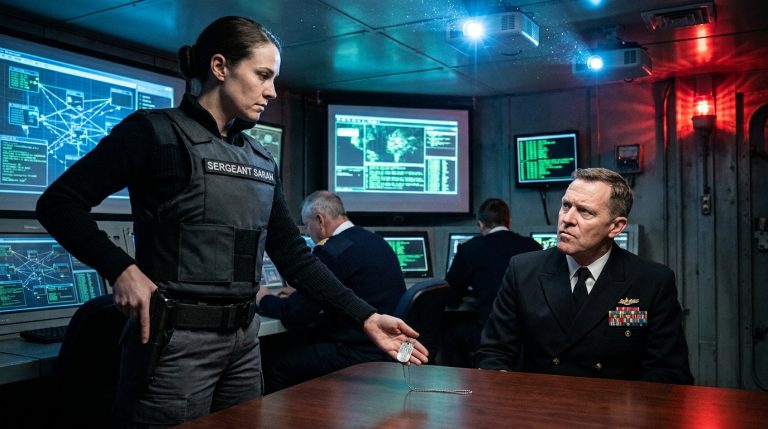
Admiral Thomas Nathan moved with the gravity of a man accustomed to having his presence recognized as an absolute. His silver hair caught the harsh fluorescent light, and his posture was a stark, vertical challenge to the cramped, disheveled nature of the station. Behind him, two men in dark, charcoal suits moved with synchronized, predatory efficiency. They didn’t look like attorneys; they looked like the kind of men who managed the things that didn’t exist in the public record.
“What?” the Admiral roared. The sound wasn’t a shout, but a booming, resonant projection that vibrated against the cinder block walls, drowning out the hum of the computers. “In God’s name do you think you are doing to my commander?”
Miller felt the blood drain from his face, leaving his skin a pale, sickly gray. His grip on the coffee cup tightened, his knuckles straining, but the ceramic felt fragile, suddenly insufficient. He recognized the name, the rank, the carriage of the man. The Admiral was an icon in the service, a figure of legend even in the periphery of local law enforcement circles.
Miller took a step back, the heel of his boot hitting a puddle of spilled coffee. He tried to summon the reflexive, abrasive defiance that had served him for twenty years, but his voice failed him, producing only a ragged, choked sound. “Step back, sir,” he managed, the words sounding hollow, alien in his own ears. “This is an active crime scene. Interfere and you’ll join him in the back of the cell.”
The Admiral didn’t flinch. He didn’t even acknowledge the threat. He continued his forward momentum, cutting through the space between the booking desk and the holding cell like a ship parting water. Every step he took brought the tension to a breaking point.
Miller felt a sudden, sharp, and terrifying intrusion: a phantom memory from his early years on the force, a disciplinary review where his badge had been inches from being stripped away. The smell of the Admiral’s polish, the precise, rigid lines of his uniform, triggered the same visceral, paralyzing dread. He wasn’t a Sergeant in his own station anymore; he was a subordinate, standing before a power structure he couldn’t manipulate, couldn’t bully, and couldn’t hide from.
“I am Admiral Thomas Nathan, United States Navy, retired,” the older man announced, his voice slicing through the humid, stale air of the station. He reached the cell door, ignoring Miller entirely, and stood in front of the bars. “And the man you have in handcuffs is Lieutenant Commander Isaiah Washington, a decorated Navy SEAL. You have exactly ten seconds to take those cuffs off, apologize, and pray he doesn’t sue this department into the Stone Age.”
Miller’s gaze flickered to Isaiah. The Commander hadn’t shifted. He was sitting on the bench, watching the interaction with the same calm, unreadable expression he had maintained since the park. But in the way Isaiah held his jaw, in the deliberate, steady rhythm of his breathing, Miller saw the truth: Isaiah hadn’t been defeated. He had been waiting. The entire arrest, the holding cell, the wait—it had all been a calibrated process, a trap that Miller had walked into with his eyes wide open, his ego blind to the reality of the situation.
“I don’t care if he’s Captain America,” Miller shouted, the desperation bleeding into his tone, stripping it of its professional veneer. He grabbed the keys from his belt, his hand shaking so violently the metal jangled. “He assaulted a police officer. He resisted arrest.”
“Assault?” The Admiral turned, his eyes narrowing, fixing Miller with a stare that seemed to see directly into the hollowed-out center of his ambition. “I was watching from my car, Sergeant. He didn’t touch you. You touched him. You escalated a consensual encounter into a civil rights violation because you didn’t like the way he looked.”
Miller looked toward Grimes, seeking an ally, seeking a confirmation of his version of the night, but the younger officer was staring at his own shoes, his posture hunched, desperately attempting to become invisible. The “blue wall” hadn’t just cracked; it had dissolved.
The weight of the station—the cinder blocks, the buzzing lights, the cold linoleum—suddenly felt like it was shifting, turning into the walls of a prison he was building for himself. Miller gripped the edge of the desk, his knuckles aching. He realized then that he wasn’t the one in control. The Admiral hadn’t come to argue. He had come to execute a process that had already begun the moment Miller had turned off that camera.
“You’re making a mistake, son,” the Admiral said, his voice dropping to a dangerous, low whisper, the kind of quiet that precedes a storm. “A career-ending mistake.”
Miller wanted to respond, to shout, to claim his territory, but the silence in the precinct was deafening. He felt the gaze of every officer in the room, the collective weight of their distance, their refusal to share his burden. He was standing in the center of his own life, watching it be dismantled by the cold, precise machinery of a world that didn’t care about his badge. He turned to the booking computer, his fingers hovering over the keys, but the screen was just a grid of meaningless, flickering data. He had run out of time, and the consequences he had spent years avoiding had finally arrived, wearing the uniform of the man he was supposed to respect.
CHAPTER 7: THE DIGITAL TSUNAMI
The flashes were constant, a rhythmic, violent pulsing of light that bled through the reinforced glass of the precinct windows. Miller stood frozen, his hand still gripping the edge of the booking desk, but the authority he had been trying to project had evaporated. Outside, the world had descended. A sea of satellite trucks, television crews, and local reporters had transformed the quiet suburban street into a makeshift news studio.
Every flash was a spotlight. Every shutter click was a record. Miller looked toward the window, his eyes stinging from the strobe-like effect. He felt exposed, stripped of the anonymity that had always been his shield. He had spent his career operating in the shadows of the “blue line,” but the wall had been dismantled, and now, he was standing in the open, fully illuminated.
“Rick!” Grimes shouted, not looking up from his monitor, but his voice was tight, thin. “The street’s packed. They’ve got the full feed of the park incident playing on a mobile screen out there. They know.”
Miller didn’t answer. He couldn’t. His gaze was fixed on the window, where the silhouette of a reporter from a major national network was gesturing toward the entrance, the microphone catching the light. He saw his own face—captured in a still image from a smartphone—held up by a protestor standing near the police tape. The image was grainy, distorted, but it was unmistakably him.
He felt a profound, physical sense of vertigo. The floor seemed to tilt. He grabbed the desk, but his grip was clammy, slipping against the laminate. The station, once his fortress, now felt like a glass cage. The “blue wall” wasn’t just cracking—it was non-existent. The other officers weren’t looking at him because they were already distancing themselves, their backs turned, their focus on their own paperwork, their own survival. They weren’t his colleagues anymore; they were witnesses.
“I need to get out there,” Miller whispered, his voice a dry, rasping sound. “I need to tell them. It wasn’t how it looked.”
“There is no ‘telling them,’ Rick,” Grimes said, his voice cold, devoid of the camaraderie that had existed between them for years. “The narrative has already left the building. Look at the numbers.”
Grimes tapped the screen of the booking computer, which was now displaying a real-time dashboard of trending topics. The hashtag #oakhaven_tyrant was at the top of the list, a vertical, unstoppable spike in activity. The full, four-minute clip of the park confrontation—the one Miller had tried so desperately to excise—was playing on a continuous loop, circulating through millions of devices in seconds.
Miller leaned forward, his reflection caught in the dark, unlit screen of the monitor. He saw a man he didn’t recognize—haggard, his hair thinning, his eyes wide and vacant. The man behind the badge was gone. He looked at his holster, his hand twitching toward it, but the belt was bare, the leather empty. He realized, with a sickening, cold clarity, that he hadn’t just lost his job. He had lost his identity.
The front door buzzed again—a frantic, high-pitched alarm. The Chief of Police had finally arrived.
He didn’t walk; he stormed, his face a mask of purple, vein-throbbing fury. He bypassed the booking desk entirely, heading straight for the sally port where the Admiral still stood with his federal escorts. The Chief looked like a man who had just seen a house burn down, his tie undone, his breath coming in short, sharp bursts of panic.
Miller tried to step forward, to intercept, to explain, but his legs felt leaden, anchored to the linoleum. He watched as the Chief stopped in front of Admiral Nathan, his posture shifting from defensive to pleading in a single, gut-wrenching second. The power dynamic of the room had inverted. The precinct wasn’t a place of law anymore; it was a site of surrender.
“Commander,” the Chief said, his voice tight, aimed at Isaiah in the holding cell. “I apologize. This—this is not the standard procedure of this department.”
“Procedure is irrelevant, Chief,” Isaiah replied, his voice calm, ringing out clearly through the bars. “The evidence is already in the public domain. The question isn’t whether your department has a procedure. It’s whether you have an integrity.”
Miller felt a cold shiver run down his spine. The Admiral turned to face him, the motion slow, deliberate. The federal agents behind him shifted, their hands moving with the practiced, disciplined grace of men who had done this a thousand times. They didn’t need to shout. They didn’t need to threaten. They simply existed in the space, a physical manifestation of a system that Miller had spent his entire career underestimating.
The flashes outside the window hit again—a blinding, synchronized burst of light that turned the room white for a second. In that strobe-like clarity, Miller saw his own future. He saw the empty apartment, the silent phone, the long, hollow years ahead. He looked at the holding cell, and for a fleeting, terrifying moment, he understood that the lock on the door wasn’t holding Isaiah inside. It was holding Miller out. The role of the observer and the observed had flipped, and he was finally, irrevocably, on the wrong side of the glass.
CHAPTER 8: THE FINAL VERDICT
The courtroom air was filtered, sanitized, and stifling. It lacked the grit of the precinct, replacing the smell of burnt coffee and industrial cleaner with the scent of old paper and floor wax. Miller sat at the defense table, his suit hanging off his frame like a shroud. It was a cheap, discount-store garment that felt like sandpaper against his skin. Beside him, his court-appointed attorney, Greg Sauer, was busy shuffling papers, his eyes avoiding Miller’s. The lawyer’s lack of engagement was the most honest piece of evidence in the room.
Across the aisle, the prosecution table was an organized machine. Elena Rostova arranged her exhibits with surgical, terrifying precision. Beside her, Arthur P. Holloway sat with the stillness of a predator waiting for the kill. And in the front row of the gallery, Admiral Thomas Nathan sat like a pillar of salt, his eyes fixed on Miller with a cold, unrelenting focus.
Isaiah sat beside him. He wasn’t in uniform, but his posture was the same—calm, observant, and entirely removed from the chaos of Miller’s internal disintegration. He had seen this conclusion coming since the moment Miller had touched his shoulder on that park bench. It wasn’t revenge; it was physics. Miller had exerted force, and the system—built on rules, laws, and the inevitable weight of documented truth—had exerted an equal and opposite reaction.
“We the jury,” the foreman announced, the words vibrating through the silence of the packed room, “find the defendant, Richard Miller, guilty on all counts.”
Miller didn’t collapse, but he felt the world fall away. The gavel, wielded by Judge Sarah Klein, struck the wood with a sound like a rifle shot, sealing the finality of the moment. Twelve years of service, twenty years of ego, and a lifetime of manufactured power were being erased in the span of a single sentence.
“Richard Miller,” Judge Klein said, her voice an icy, detached instrument. “You have disgraced the trust of this community. You took a position of public service and weaponized it for your own gratification. For the federal charges of deprivation of rights, witness tampering, and perjury, I sentence you to one hundred and twenty months in a federal correctional institution. There is no possibility of parole.”
One hundred and twenty months. Ten years. It was an eternity. Miller tried to speak, to beg, to offer a final, frantic explanation, but the bailiffs were already moving. They reached for his arms, their movements practiced and indifferent.
“Furthermore,” the judge continued, her gaze dropping to the civil judgment, “the court finds that your actions were conducted with clear, demonstrable malice. Qualified immunity is denied. You are personally liable for the four-point-five million dollars in punitive damages. Your assets—every account, every vehicle, every property—are subject to immediate seizure to satisfy this judgment.”
Miller felt the last pillar of his life collapse. He was bankrupt in every sense—legally, financially, and morally. He watched as the court officers led him away, his movements clumsy, his head bowed. He caught a final glimpse of Isaiah through the crowd. The Commander didn’t look triumphant. He didn’t look vengeful. He looked like a man who had successfully finished a difficult, necessary task and was already mentally moving on to the next assignment.
Two days later, the “Cool Down” arrived. It was a quiet, gray morning in Oak Haven. The news vans were gone, the protest signs had been swept away, and the town was settling back into its manicured, expensive silence.
Isaiah stood in the center of the Nathan-Washington Youth Center. The building, purchased and renovated with the seized funds of Miller’s estate, was bustling with activity. It was no longer a warehouse of shadows; it was a space filled with the sounds of boxing gloves hitting pads, the hum of computers, and the laughter of kids who had a safe place to grow.
He walked to a heavy, iron weight station—a piece of equipment that had been broken, its finish rusted, its mechanics seized. He had spent the morning working on it, his hands covered in grease, his focus total. He tightened the final bolt, the metal snapping into place with a satisfying, tactile click. He wasn’t just fixing the machine; he was symbolic of the restoration of the environment.
Admiral Nathan walked over, his cane tapping on the fresh, polished concrete. “The money wasn’t the goal, Isaiah.”
“I know,” Isaiah replied, wiping his hands on a clean cloth. “The goal was the restoration of the balance. Miller thought he was the system. He needed to be shown that he was merely a flaw in it.”
“He’s in Petersburg now,” Nathan noted, looking toward the window. “In solitary. He’s writing to the governor. He doesn’t understand that no one is listening.”
“He’ll have time to learn,” Isaiah said. He stood up, looking around the room. The gym was clean. The machines were functioning. The kids were active. He felt a profound, quiet sense of relief, the weight of the previous months finally lifting from his shoulders. He hadn’t fought a war; he had corrected a deviation.
He walked toward the exit, the late afternoon sun casting long, golden shadows across the gym floor. He stepped out onto the street, the air crisp and clean. He saw a patrol cruiser pass by—a new officer, focused, professional, observant. She saw him, gave a respectful nod, and continued on her route.
Isaiah nodded back. The ecosystem was functioning. The predator had been removed, and the community was, for the first time in a long time, simply a place where people lived. He turned and walked down the sidewalk, his gait steady, his mind already clear, ready for whatever required his attention next. The ledger was balanced, the truth was documented, and the silence was, once again, a peace he had helped secure.