They Came with Forged Authority and Left Their Fortunes Buried Deep in Sovereign Soil
CHAPTER 1: THE SCENT OF IRON AND ASH
The acrid drift of two-stroke engine exhaust still hung in the humid North Carolina air, a greasy film that seemed to cling to the back of John’s throat. He didn’t look at Karen Bishop’s face. If he looked at her eyes—those small, glittering beads buried in the soft flesh of her self-importance—the twenty-five years of discipline he’d forged in the dirt of foreign outposts would evaporate. He looked instead at the corner of his property line where the metal surveyor’s stake, once driven deep into the red clay, was missing. Only a small, raw hole remained in the dirt, fresh and dark.
Between his thumb and forefinger, John rolled the single, deeply grooved walnut shell he’d pulled from the sawdust. The wood was cold, though the morning sun was already beginning to bake the yard.
“They were a menace, John,” she said. Her floral mumu rustled as she crossed her arms, the loud, chaotic pattern of the fabric contrasting with the stark, pale faces of the four colossal stumps behind her. “I did you a favor. Now your property finally looks clean.”
“A favor,” John repeated. His voice didn’t rise. It was flat, carrying the low, rhythmic vibration of an engine idling in neutral. He could feel his heart hammering—a steady, heavy thud against his ribs—but his hands remained loose at his sides, knuckles pale, fingers twitching only slightly against his thighs.
“As president of the HOA, I am authorized to maintain community aesthetic standards,” Karen said, her chin tilting upward. She was reading from an invisible script, her posture stiffening with the cheap authority of a municipal clerk. “Those trees dropped walnuts all over the street. They were a hazard to vehicles. We have standards here.”
John looked past her shoulder to the street. A pristine, silver crossover sat idling in the cul-de-sac, its air conditioning humming. The street was empty, grey, and completely indifferent.
Underneath his boots, the ground felt loose, churned up by the heavy treads of a commercial lift that had backed onto his turf in the dead of night. The smell of raw sap was thick, sweet, and metallic—the blood of things that had stood there since before the concrete had been poured, before the developer had carved these identical lawns out of the North Carolina pines.
“You have no record of warning,” John said.
“Bylaw 7.4 gives the committee sole discretion,” she sneered, her eyes narrowing as she registered the total absence of flinching in the older man before her. “We don’t need a formal warning when the hazard is active, Mr. Davis. You can clean up the debris today, or the board will issue a fine for the maintenance.”
She turned, her sandals crunching on the stray gravel near the driveway, leaving him alone in the glare of the morning. John didn’t move. He stood in the silence of the empty yard, his fingers tightening around the walnut shell until the sharp ridges bit deep into his palm. He reached into his pocket, his hand brushing against a folded piece of paper—the property deed Sarah had signed twenty-five years ago.
Below his feet, near the edge of the first stump, a tiny piece of blue plastic caught his eye. It was a shredded corner of a commercial tarp, half-buried under the fresh sawdust. John knelt, his boots sinking into the dry, red earth, and pulled it free. On it, printed in faded yellow ink, were the letters: S-N-Y-D…
CHAPTER 2: THE FRICTION OF THE STATUTE
The shredded blue plastic was stiff, sun-baked, and smelled of cheap petroleum. John ran his thumb over the yellow lettering, feeling the raised ink of the D before folding the fragment into his palm. He stood up slowly, his knees popping—a dry, mechanical sound that belonged to fifty-six years of hard mileage.
Down the street, the white-and-blue cruiser of the county sheriff’s department bounced over the transition from asphalt to gravel, its suspension squeaking. The driver’s side door was dented near the handle, a long strip of rusted trim peeling away like dead skin. When the engine finally shut down, it died with a metallic rattle that lingered in the humid air.
Deputy Ror was young, his tan uniform too stiff, the leather of his utility belt creaking as he stepped out into the heavy heat. He adjusted his flat-brimmed hat, his eyes immediately dropping to the four raw stumps weeping sap into the dirt.
“Mr. Davis?” Ror asked, pulling a small, sweat-stained notepad from his chest pocket. “You the one who called about the timber?”
“I am,” John said. He didn’t offer a hand. He pointed a finger toward the deep, rutted tracks flanking the driveway. “Heavy lift vehicle. Dual axle. They backed in from the curb around three in the morning. Cut them down, loaded the trunks, and left the crown branches in a heap by the ditch.”
Ror walked over to the nearest stump, kneeling where John had been a moment before. He touched the wet face of the wood, his fingers coming away sticky with sap. “These were big. Black walnut?”
“Over a century old,” John said, his voice dropping into the steady register he used when reporting supply discrepancies. “My wife planted the perimeter garden around them. They were healthy.”
Before the deputy could answer, the first heavy, hot drop of a summer storm hit the dry red clay between them. It left a dark, dime-sized crater in the dust. Within seconds, the sky turned the color of a bruised iron skillet, and the heat broke into a sudden, driving downpour. The rain hissed against the hot asphalt of the street, instantly turning the fresh sawdust into a sodden, heavy pulp that smelled of vinegar and wet wood.
“Inside,” John said, turning toward the porch.
Ror followed, his heavy boots clucking against the wooden steps. He took off his hat and shook the water from the brim. His hair was cropped short, his face carrying the tired, flat expression of a man who spent his days refereeing domestic disputes and livestock escapes.
“I talked to Ms. Bishop before I pulled up,” Ror said, leaning his hip against the rusted iron railing of the porch. His hand stayed close to his belt, a habit rather than a threat. “She says the board voted on this last month. Said she’s got a paper trail showing they’re nuisance trees under the community charter.”
“The charter requires fourteen days written notice,” John said. “And an appeal process. I received neither.”
Ror sighed, a slow, wet sound that joined the rush of the rain draining off the tin roof. “Look, Mr. Davis, I’m going to write this up. I’ll take the photos, and I’ll get her official statement on the record. But you need to understand how the county looks at this. If she’s acting under color of her authority as the HOA president—even if she bypassed the fine print—it’s a civil contract dispute. The sheriff isn’t going to cuff her for a property management decision.”
“She trespassed,” John said. His voice was quiet, but it had the hard, unyielding weight of a structural beam. “She hired a private crew to dismantle private property. In this state, that’s timber larceny.”
“Only if it’s done with criminal intent,” Ror countered, his eyes scanning the grey sheet of rain falling over the yard. “If she’s got a piece of paper signed by three board members saying the trees were a structural hazard, the DA won’t touch it. They’ll tell you to hire a lawyer and sue for the value of the logs.”
Ror walked back down the steps, his boots splashing through the red puddles forming at the base of the porch. He reached into his cruiser through the open window to grab his camera. Through the rain-speckled glass of the passenger side, John’s eyes caught a stack of gray folders on the console. The top one was secured with a heavy black band, a faded white label across the spine reading Annex-9 Ledger.
The deputy didn’t notice John’s stare. He snapped three quick photos of the stumps, his camera lens fogging instantly in the steam rising from the hot ground. When he climbed back into the driver’s seat to leave, he turned the key.
Nothing happened. The starter gave a dry, rapid click, then went dead.
“Damn it,” Ror muttered under his breath, turning the key again. The dashboard lights flickered and died.
John stepped off the porch, the rain soaking his flannel shirt in seconds, pasting the cold fabric to his shoulders. He walked to the driver’s side window. “Pop the hood.”
Ror pulled the latch. John walked to the front of the cruiser, lifting the heavy steel lid. The scent of hot oil and wet copper rose from the engine bay. The positive battery terminal was choked with a thick crust of blue-white corrosion, the copper lead rusted down to a thin, frayed wire.
John reached into his back pocket, pulling out a small, flat-head screwdriver and a pair of rusted pliers he kept in his work trousers. He didn’t speak. He scraped the white powder off the lead, the metallic screech of the steel against copper cutting through the sound of the rain. With a hard twist of the pliers, he clamped the frayed connector back down onto the post.
“Try it now,” John called out.
The engine cranked, coughed once, and then rumbled into a rough, uneven idle.
Ror rolled the window down, his face slightly flushed. “Appreciate it, Mr. Davis. The county’s behind on fleet maintenance.” He handed a small, white card through the gap. “Here’s your case number. Report will be ready Friday.”
John took the card. The wet cardboard immediately began to soften in his fingers. “Tell your sergeant I’ll be back for the certified copy.”
He watched the cruiser back out, its tires slipping twice in the red mud before catching the asphalt. John stood in the downpour, his pliers heavy in his hand, his eyes fixed on the deep ruts where his trees used to be. The rain was washing the sawdust down into the drainage ditch, but the grease from the tire tracks remained, iridescent and stubborn on the water’s surface.
CHAPTER 3: THE FORENSIC APOLOGY
The paper of the deputy’s card split under the pressure of John’s thumb, the blue ink of the case number bleeding into a pale violet smear. He slipped the ruined cardboard into his pocket alongside the brass pliers. The downpour had died back to a heavy, suffocating mist that rose from the clay in waves of humid heat, smelling of baked topsoil and rotten pine.
John didn’t go inside to change out of his soaked flannel. He walked the length of the deepest rut, his boots making a wet, sucking sound in the mud. Near the base of the third stump—the largest of the four walnut titans—his toe struck something hard. He reached down into the red water, his fingers brushing against a small, threaded cylinder of heavy metal.
He pulled it free and wiped the grit away on his wet thigh. It was a brass grease-fitting cap, stripped and scarred by high-torque gears. Stamped into the rim was a six-digit serial number and a tiny, clean engraving: S.L. The brass was bright, untouched by the rust that covered every other piece of scrap in the neighborhood ditches. It was fresh. He dropped the brass cap into his pocket with the blue plastic fragment.
By noon, the sun was a white glare behind the low, grey clouds, baking the moisture out of the sodden yard until the air felt like a wet wool blanket. John spent the hours in the garage. He didn’t pace. He sat at his workbench, using an old wire brush to clean the corrosion from the jaws of his pipe wrenches, the rhythmic scrape of the steel bristles against iron the only sound in the small space.
At exactly one-forty, John walked back to the house. He retrieved the crisp white envelope Karen had stuffed into his front door handle earlier. On the back of the fine notice, printed in tiny, pale-grey ink beneath the payment terms, was a legal disclaimer: Subject to the terms of the North State Exemption, Article IV, Section 2. He stared at the phrase, his thumb running over the dry, cheap paper. The ink didn’t smear like the deputy’s card had. It was set deep, permanent, and cold.
At precisely two o’clock, the low rumble of a diesel engine approached. A white, dual-cab utility truck with a clean steel ladder rack pulled up to the curb. Painted on the door in dark green, unassuming block letters was Legacy Tree Consultants.
Dr. Alistair Evans climbed out of the cab. He was a tall man, his spine straight but slightly stiffened by the years, wearing a faded khaki field shirt and heavy leather boots scarred by climbing spikes. He carried a heavy-duty aluminum clipboard under his arm and a leather satchel that clinked with steel tools.
“Mr. Davis?” Evans’s voice was dry, carrying the gravelly raspy tone of a man who worked outdoors in all weathers.
“John,” the veteran replied, meeting him at the edge of the driveway.
Evans looked at the yard. His eyes didn’t waste time on the mud or the messy piles of leaves Karen’s crew had left behind. They went straight to the stumps. The arborist’s jaw tightened, a small muscle twitching near the hinge of his cheek. He walked to the first stump, kneeling in the wet clay without a word of complaint about his trousers.
“Juglans nigra,” Evans murmured, his hand resting on the pale, weeping wood. “Look at the ring density here. This wasn’t yard ornamental growth. This was old-forest stock. These were standing when the county lines were first drawn.”
He pulled a core borer from his satchel—a T-shaped steel tool with a hollow bit—and pressed it against the heartwood. With two deliberate, heavy turns of his shoulders, he drove the steel into the stump. The friction made a low, protesting groan before he backed the bit out, retrieving a clean, five-inch cylinder of tight-grained wood.
“Consistent growth,” Evans said, holding the core up to the white light of the sky. “No rot. No structural decay. They weren’t a hazard, John. They were pristine.”
“What’s the timber worth, Doctor?” John asked, standing over him, his shadow falling across the stump.
Evans stood, wiping his hands on a grease-stained rag. He looked at the remaining three stumps, his clipboard resting on his forearm as he began calculating. “For high-grade veneer log of this diameter? The furniture mills in High Point would have fought over these. Each trunk would yield three clear logs before the first branch.”
He tapped his pencil against the aluminum board. “I’ll run the formal appraisal through the regional market database tonight, but I can give you a baseline now. At current timber values, you’re looking at sixty-five thousand dollars per tree, minimum. That’s a conservative assessment of what was taken off this lot last night.”
John didn’t blink. He rolled the brass grease cap in his pocket. “Two hundred and sixty thousand total.”
“At least,” Evans said, his voice dropping into a harder, more professional tone. “And under North Carolina General Statute ninety-five, if someone cuts timber without consent, the court doesn’t just ask for the value. They treble it. That’s nearly eight hundred thousand dollars, John. That’s not a neighbor dispute. That’s a felony-level financial liability.”
A quiet hum of a lawnmower started three houses down, the distant noise cutting through the thick, humid air. John looked at the white truck parked at the curb, then down at the raw, wet wood of his wife’s grove.
“They used a heavy-duty lift,” John said, pointing to the ruts. “They were gone in three hours.”
“They knew what they were doing,” Evans said, packing the core borer back into his leather bag. “This wasn’t a standard residential tree service. Standard crews don’t have the gear to haul four walnut trunks of this size in the dark without waking the whole cul-de-sac. It takes logistics.”
He handed John a carbon copy of his field notes. “I’ll have the certified report to you by Friday. If you need me in court, my fees are standard, but for this? I’ll make the time.”
“Thank you, Doctor,” John said.
He watched the white truck pull away, its tires leaving fresh tracks over the wet gravel. He stood alone as the sun began to slip behind the pines, the shadows of the stumps stretching long and sharp across the ruined grass like dark, pointing fingers.
CHAPTER 4: THE SILENT MEASURE
The carbon sheet felt cold and greasy against John’s fingers, the high-tensile blue ink of Alistair Evans’s neat handwriting already setting into the coarse paper. He didn’t return to the empty porch. Instead, he folded the document with a single, sharp crease and slid it into his breast pocket behind his military ID. The sun was lingering low over the tree line, bleeding a dull, rust-colored light through the remaining pines, casting the long shadows of the stumps all the way to the edge of the asphalt.
He walked. His boots made no sound on the gravel shoulder, a habit of movement that twenty-five years of service had made permanent. His neighborhood was quiet, the kind of quiet that felt brittle, like dried leaves waiting for a boot. Two doors down, the Miller property sat in the fading light. The grass was trimmed, but the edges along the ditch were unkept, a subtle sign of a household running out of hours.
John turned down their gravel driveway. At the side of the house, near a stack of weathered cedar planks, Tom Miller was leaning against his workbench, a block plane in his hand. He wasn’t working. He was simply staring at the empty square of dirt in his backyard where the custom swing set had once stood. The earth there was still pale and unseeded, a patch of grey clay surrounded by healthy turf.
“John,” Tom said. He didn’t straighten up, his forearm remaining flat against the timber. His face was lined with the grey, soft fatigue of a man who spent his nights calculating interest rates on medical bills.
“Tom,” John said, stopping at the edge of the gravel. His eyes traveled to the pile of dismantled wood under the tarp. The yellowed pine beams were marked with clean, precise carpenter’s joints, now split where the lag bolts had been pried out.
“They’re bidding on a new commercial contract down in Raleigh,” Tom said, his voice flat, dry. “Rick’s outfit. Snyder Logistics. I saw the flatbeds hauling their steel framing past the highway intersection this morning. They have three new rigs, John. Painted white. Clean.”
John felt his finger touch the brass grease cap in his pocket, the stamped S.L. pressing into his skin. He didn’t mention the fragment. “They had the gear for the walnut trunks. A crane lift with dual-rear wheels.”
Tom gave a short, humorless grunt, his thumb tracing the rusted throat of his plane. “Karen said it was a safety hazard. Said Lily’s ramp didn’t have the standard three-inch safety lip. She brought two board members with her at seven in the morning while Jenna was at the clinic. Didn’t even bring a notice. Just a printout of the aesthetic standards with the fine schedule highlighted in red.”
A screen door creaked. Jenna Miller stood on the back step, a faded dish towel wrapped around her hand. Her face was pale, her hair pulled back into a tight, practical knot. She looked at John, her eyes dropping to his damp flannel, then to the carbon paper protruding slightly from his pocket.
“The sheriff’s deputy was over there,” Jenna said, her voice carrying the thin, tight vibration of someone who had spent two years speaking only in quiet rooms. “He spent twenty minutes in her driveway. I saw her hand him a grey binder from her car. It had that same blue logo on the cover. The one from the newsletter.”
“The exemption,” John said.
“She’s telling people it’s for the drainage,” Jenna said, her fingers tightening around the towel. “She told Mrs. Gable that if we didn’t get rid of the gnomes and the swing set, the county would reassess the cul-de-sac’s runoff rating. Said it would cost us thousands in individual grading fees.”
John looked back toward the street. The light was almost gone, the sky a deep, bruised indigo that made the uniform siding of the houses look like rows of identical teeth. “The county doesn’t reassess drainage based on lawn ornaments.”
“We didn’t know,” Tom said. His hand finally dropped from the plane, his fingers curling into his palm. “We couldn’t risk the lien, John. Not with the therapy schedule. If they put a hold on the title, the bank pulls the equity line. We had thirty days.”
“They didn’t vote,” John said.
Tom looked up, his brow furrowing in the dim light. “What?”
“The board,” John said. His voice was cold, carrying the steady, mechanical weight of a firing pin. “An expenditure of that size requires a formal record. Evans valued the timber at two hundred and sixty thousand. The removal crew alone was five thousand minimum. There’s no minute entry for it.”
Tom stared at him, the block plane slipping slightly on the workbench. “She told us the county paid for the contractor out of the municipal clearing fund.”
“The county didn’t touch those trees, Tom,” John said. He turned back toward the driveway, his boots crunching once on the hard-packed clay. “The trees are gone, but the wood is still somewhere in this state. And so is the money.”
He walked back toward the road before Tom could answer, leaving the couple standing in the grey shadow of their house. The dampness in the air had turned to a cold cling, the smell of wet earth rising from the ditches as the neighborhood settled into its quiet, uneasy dark.
CHAPTER 5: THE CORE AUDIT
The mist had thickened into a cold, clinging shroud by the time John reached the end of the block. He didn’t turn back toward his own dark house. He kept his stride rhythmic, his shoulders hunched slightly against the damp wool of his collar until he stood outside David Chen’s half-open garage door. Inside, the sharp, medicinal tang of carburetor cleaner competed with the musty dampness of old concrete.
David was sitting on a low wooden crate next to the disassembled frame of his Triumph motorcycle, but he wasn’t holding a wrench. His desk lamp was turned away from the engine, its yellow bulb focused entirely on three thick, green-bound ledger binders laid flat across a grease-stained sheet of plywood.
“Tom called me,” David said without looking up. His fingers, stained dark with oil near the cuticles, were holding a small steel magnifying glass over the columns of a printed spreadsheet. “He said you were asking about the contract.”
John stepped inside, the soles of his boots squeaking on the slick concrete. “The work crew had Snyder Logistics markings on their grease caps. Rick Snyder’s company.”
David let out a dry, rattling breath that smelled faintly of cold coffee. He reached for one of the ledger binders—the oldest one, its spine cracked and held together by oxidized brass binder clips. “It’s worse than a family favor, John. Look at this.”
John leaned over the plywood table. The yellow light of the lamp showed rows of neat, typed figures from the HOA’s historical maintenance accounts. David ran his finger down a column labeled Emergency Operations.
“Two years ago, the board approved an eighty-five hundred dollar emergency disbursement for a main-line block behind the clubhouse,” David said, his voice dropping into a low, transactional whisper. “The invoice is made out to Frank Bishop Plumbing. But look at the stamp on the clearing deposit. The routing code doesn’t go to a plumbing service. It goes to an account registered in Raleigh under Snyder Logistics.”
John watched the magnify glass slide over the faded ink of the bank stamp. “The decoy.”
“A dummy invoice,” David muttered, his finger tracing the edge of the ledger page. He paused, his nail catching on a slight physical discrepancy—the paper of the current year’s sheet was marginally thicker than the rest, the left margin showing a clean, freshly pasted paper edge where it met the rusted metal binding. “They’re covering the tracks retroactively. They cut those four walnut trees to feed Rick’s timber mill, John. He was short on high-grade hardwood veneer for a state contract down in Fort Bragg. But they couldn’t just log private property without a paper trail.”
“So they invented a nuisance complaint,” John said, his hand sliding into his pocket to touch the cold brass cap. “And cited the North State Exemption to keep the local code officers from inspecting the lot before the wood was hauled.”
“Yes. But here is the real leak,” David said. He slid the ledger aside and pulled out a stack of loose, photocopied pages. “This is a partial copy of the Annex-9 Ledger. I kept these sheets when I resigned last year. Look at the reserve fund balance. It’s listed here as sixty-four thousand dollars in reserve for emergency infrastructure. But the actual bank statement from North State Mutual—the one they use to maintain their liability exemption—shows less than three hundred dollars in the operating account.”
John’s jaw set, the small muscle beneath his ear tightening. “They’ve been emptying the reserve to pay Rick’s freight debts.”
“Every month for three years,” David said. “The HOA is completely dry. If you file a formal suit for the value of those trees, the association can’t cover the baseline defense fees, let alone a judgment. The moment a lawyer opens a discovery motion, the whole structure collapses. They didn’t just steal your trees, John. They stole the entire neighborhood’s security.”
A sudden sound cut through the damp air—the slow, heavy roll of tires on wet gravel outside. John didn’t jump. He stepped back into the shadow of the garage’s steel shelving unit, his hand dropping naturally to the heavy handle of his socket wrench on the bench.
Through the gap in the garage door, the headlights of a white sedan swept across the driveway. It sat idling for three seconds, its wipers scraping dryly against the windshield, before it slowly backed out and disappeared down the mist-filled cul-de-sac.
“She’s watching the street,” David said, his hand shaking slightly as he closed the green binder. “She knows I have the books, John. She’s been checking my trash bins since Tuesday.”
“Let her watch,” John said, his voice cold and dry as the rusted concrete. “The books stay here. We don’t move them until Thorne has the hold in writing.”
He stepped back out into the cool, damp night, the smell of old iron and rotten wood settling over his clothes as he began the quiet, calculated walk back to his own dark yard.
CHAPTER 6: THE LITIGATION HOLD
The dark was absolute between the spacing of the subdivision’s uniform streetlamps. John kept his pace measured, his boots catching the wet grit of the asphalt edge as he walked the three hundred yards back to his driveway. The air had cooled, but it remained heavy, carrying the scent of pine sap and the distant, oily exhaust of big rigs shifting gears on the bypass mile away.
As his heel hit the first transition of his gravel driveway, the automatic security floodlight above his garage door tried to trigger. It hummed—a high, wet vibration—before the ballast cracked with a dry pop. The light flickered thrice, casting long, erratic shadows across the raw stumps, before dying completely. The smell of scorched copper wire drifted down from the fixture.
John stopped at the bottom of his porch steps. In the dark, the silhouette of his house looked hollowed out, the cathedral canopy of the walnuts no longer there to break the sky.
Across the cul-de-sac, the porch light of Karen Bishop’s beige house was a sharp, yellow spear. A car door closed—not the heavy clunk of a utility truck, but the thin, plastic rattle of a mid-sized sedan. John stayed in the shadow of his broken floodlight, his hand dropping to the cold iron railing of his porch as he watched.
Gary, the retired car salesman who held the vice-president’s seat on the HOA board, was standing beside his vehicle. He didn’t lock the door. His shoulders were hunched, his hands jammed deep into his pockets as he walked up Karen’s driveway. In the quiet of the midnight air, the sound of his shoes shuffling through the wet oak leaves was distinct, loud.
John’s phone vibrated in his chest pocket—a single, heavy pulse. He pulled it out. The screen illuminated his face with a pale blue glare.
Thorne: “Hold served. Hand-delivered to Bishop’s door ten minutes ago. Registered copies landing in the board’s personal mailboxes by eight tomorrow. Let the ice crack.”
John slipped the phone back into his shirt. Across the street, the front door of the Bishop house swung open. The yellow light caught Karen’s silhouette, her arm extended as she waved a thick white packet of papers in Gary’s face. Even from eighty yards away, the sharp, nasal tone of her voice carried over the damp lawns, though the specific words were swallowed by the mist.
Gary didn’t go inside. He stood on the lower step, his head shaking, his arm gesturing toward the street, then toward John’s dark house. The movement was erratic, the physical posture of a man who had suddenly calculated the distance between a neighborly dispute and personal financial ruin.
John climbed his own steps, his fingers tracking the rough, weathered grain of the cedar door frame until he found the brass handle. He didn’t turn on his lights. He stood in the dark of his kitchen, his shoulder resting against the window frame, watching the two figures across the street.
The argument lasted four minutes. It ended with Karen slamming the door so hard the glass pane in her entryway rattled. Gary stood on the porch for a moment, his head lowered, before walking back to his sedan with a slow, heavy gait that carried the weight of a man who had just realized his signature on the Annex-9 Ledger was no longer a secret.
John reached into his pocket and pulled out the brass grease cap. He set it on the laminate counter in the dark. It made a small, solid click—the sound of a small cog falling into place within a larger, heavier machine. The board was beginning to look at their own assets, and for the first time, they were realizing that the shield of the North State Exemption was made of paper, and the fire was already touching the edges.
He pulled a chair to the window and sat, his eyes remaining on the quiet, dark street, waiting for the sun to rise over the red clay.
CHAPTER 7: THE RECKONING IN BEIGE
The transition from night to dawn was not a clean break; it was a slow, exhausting bleed of grey light that turned the mist over the cul-de-sac into a dull, yellow steam. John did not stretch or shake off the cold. He rose from the kitchen chair, his boots pressing down hard on the linoleum, and picked up the brass cap. He dropped it into his pocket, where it clinked against his pocketknife and the metal surveyor’s peg he had retrieved from the dirt earlier.
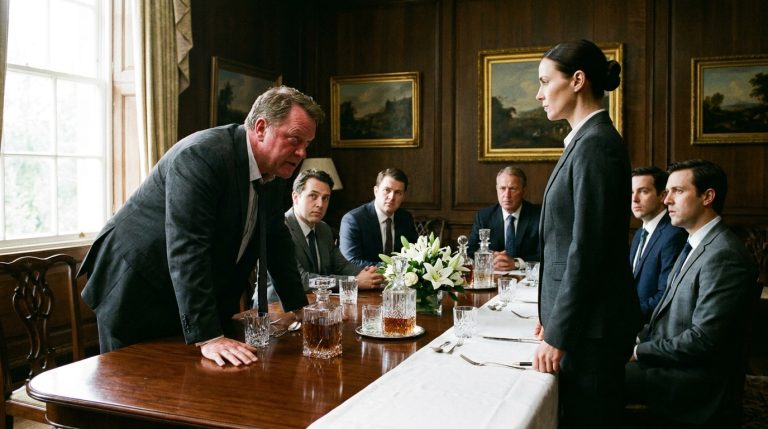
The community clubhouse was a low, single-story building of beige stucco and green shingle, sitting at the center of the development’s circular loop. It smelled of commercial floor wax and stale air-conditioning filters. Inside, the folding chairs had been set out in neat, uniform rows, but the crowd that filled them by seven in the evening did not look neat. They sat with their coats kept on, their knees pressed together, their eyes darting toward the head table where Karen Bishop sat flanked by Gary and Brenda.
A single, rusted steel fan hummed in the corner, its blades slicing through the dry, stagnant heat of the room with a rhythmic, metal clicking.
Marcus Thorne sat beside John on the left side of the room, his long legs tucked under a folding table. He didn’t have a briefcase. He had a single, thick manila folder held closed by a frayed red rubber band. On the top sheet, visible in the harsh glare of the fluorescent tubes, was the title: Annex-9 Ledger – Disbursal Reconciliation.
“Let her start,” Marcus said, his voice a low, gravelly rasp that didn’t travel past John’s shoulder. “She’s going to use the drainage assessment to try and force a general vote. She has to lock the exemption before the insurance investigators pull the county permits.”
John didn’t look at the crowd. His eyes were fixed on the slight tremor in Karen’s left hand as she adjusted her microphone. The silver-plated jewelry on her wrist rattled against the plastic edge of the podium—a rapid, desperate clatter that she tried to cover by clearing her throat.
“This meeting of the Oakridge Estates Board is called to order,” Karen said, her voice dry, cracking slightly at the register. “We are here to discuss a critical infrastructure update regarding our stormwater management and the local easement. Due to recent non-compliance by certain individual lots, our eligibility under the North State Exemption is under review by the county.”
She paused, her eyes scanning the front row, looking for the familiar flinch of her neighbors. She found none. The room remained flat, the silence heavy and smelling of wet wool and cedar dust.
“We have received a preliminary estimate of eight thousand five hundred dollars to clear the lateral lines,” she continued, her fingers tightening around the edge of her podium. “This will require a temporary assessment of three hundred dollars per household, to be collected alongside the monthly dues starting next week.”
“Point of order, Karen,” David Chen said from the third row. He didn’t stand up, but his voice had the clear, dry resonance of an auditor who had spent his life counting beans. “Who is the contractor for the line clearing?”
Karen’s chin tilted up, her shoulders squaring behind the floral print of her top. “The board has selected a qualified commercial operator under our emergency clearing provisions. As per Section 12.3—”
“The contractor is Snyder Logistics,” David said, his voice cutting through her explanation like a spade hitting hard clay. He stood now, his fingers holding a loose leaf of green ledger paper. “And the invoice for the emergency block from two years ago wasn’t cleared by a plumber. It was signed over to Rick Snyder’s freight terminal in Charlotte to cover three months of warehouse lease defaults.”
A low, dry murmur rippled through the chairs—not a shout, but the collective, heavy sigh of forty families realizing their retirement funds had been traded for diesel fuel.
Karen’s face didn’t red; it went the dull, pasty color of old limestone. “The board is not required to justify individual vendor selection under the sole discretion clause—”
“You are when the operating reserve is empty, Ms. Bishop,” Marcus Thorne said, standing up slowly, his fingers releasing the red rubber band on his folder. The paper expanded with a soft, dry rustle. “And you are when you file a fraudulent lien on Mr. Davis’s property to cover the sixty-five thousand dollar logging fee you paid to your brother-in-law’s stump-grinding company.”
“That was a municipal safety action,” Karen hissed, her eyes darting toward Gary, then Brenda. But Gary was looking at his own fingernails, his hands flat on the table, his shoulders curved inward as if he were trying to disappear into his beige blazer. Brenda was pale, her mouth open slightly, her pen rolling off the legal pad onto the linoleum floor with a plastic click.
“The county has no record of any safety citation for those walnut trees,” Marcus said, his voice dropping into a hard, measured cadence that filled the room. “And North State Mutual has already notified your legal representation that they are reserving their rights to deny coverage for any claim arising from the unauthorized logging of Mr. Davis’s land. You aren’t covered, Karen. None of you are.”
John stood up. He didn’t walk to the podium. He stood beside his chair, his tall, weathered frame casting a long shadow across the middle aisle. He reached into his pocket and pulled out the brass grease cap, dropping it onto the table in front of Marcus. It made a sharp, clear ring that seemed to silence the hum of the fan.
“Your brother-in-law’s truck left its grease cap in my clay, Karen,” John said. His voice was quiet, but it had the absolute, unyielding density of a Marine’s final muster. “The serial number matches the heavy lift rig registered to Snyder Logistics on the Fort Bragg veneer contract. You didn’t cut those trees for the community. You cut them to fulfill a supply delivery your family couldn’t afford to miss.”
Karen stared at the brass cap on the table. Her lips parted, her breath coming in short, rattling gasps that sounded like dry leaves scraping across concrete. She looked at Brenda, then at Gary, her hand reaching out to touch Gary’s sleeve.
Gary pulled his arm back, his chair scraping loudly against the floor as he stood up. “I didn’t sign the ledger transfer, John,” he said, his voice thin and wet. “She told us the county had cleared the variance. I have the emails from her personal account. She said the North State Exemption covered the private timber sale.”
“The exemption covers clearing,” David Chen said from the row behind him. “Not commercial logging of deeded heritage trees. You signed the balance sheet, Gary. You’re jointly liable.”
The room broke—not into violence, but into the rapid, coordinated movement of people who had found the thread and were pulling it. Neighbors stood, their voices low but constant, surrounding the head table with a wall of quiet, furious faces. Tom Miller was there, his hand resting on his daughter’s shoulder as he looked down at Karen with the cold, patient eyes of a man who had waited two years to see his daughter’s swing set rebuilt.
Karen didn’t shout. She sat back down in her chair, her hands falling into her lap, her eyes fixed on the small brass cylinder reflecting the cold fluorescent light.
John turned away from the table, his boots catching the dry grit of the floor as he walked toward the double doors of the clubhouse. He didn’t look back to see the board fall apart. The rain had stopped, and through the glass doors, the morning air was clear, cold, and smelling of the wet, clean earth that was finally his own again.
CHAPTER 8: THE HARVEST OF STONE
The morning sun finally broke through the dense pine branches to the east, casting long, pale-yellow shafts of light that sliced through the lingering moisture of the neighborhood. The wet gravel of the road crunched beneath John’s boots with a steady, grinding rhythm. His clothes felt heavy, carrying the dampness of a long night and the sharp, sour smell of the cedar and pine pulp he had walked through since dusk.
He reached the boundary of his own lot and stopped. Across the asphalt, Karen Bishop’s front lawn was empty. No moving trucks had arrived yet, but the blinds in her upstairs bedroom were drawn tight, the dark glass reflecting the gray cloud line above like flat, sightless eyes. The white sedan that had watched the street was gone.
John walked to the middle of his front yard, stopping where the oldest of the four black walnut trees had once stood. The ground around the massive stump was a soft, dark crater of mixed topsoil and red clay, still wet from the heavy storm. The smell of raw sap was fainter now, beginning to turn sour as the wood dried in the sun, mixing with the mineral odor of the deep earth.
He reached into his pocket and pulled out the old iron hand-trowel he had carried from his garage. He knelt, his knees pressing into the damp ground, his trousers soaking through as he began to clear away the thick layer of pine-shavings and sawdust.
With slow, deliberate strokes, he dug.
The tool rasped against small, buried roots, the wet earth clinging to the rusted steel blade in heavy, red clumps. Ten inches down, his trowel struck something hard—not the yielding fiber of a root, but the solid resistance of granite. He cleared the dirt with his fingers, exposing the rough, gray corner of the boundary stone his wife Sarah had set twenty-five years ago, its face carved with her initials and the date they bought the house.
John ran his calloused thumb over the rough-cut letters. The stone was cold, but the red clay surrounding it was warm from the morning sun. He didn’t speak. He took the brass grease-fitting cap stamped with the S.L. initials and the blue plastic fragment of the tarp and laid them into the hole beside the stone, burying them deep beneath the red clay. He packed the dirt down with the heel of his boot until the surface was level, solid, and indistinguishable from the rest of the soil.
“John,” a voice called from the curb.
John stood, his knees making a dry, cracking sound in the quiet morning. He wiped his muddy hands on his trousers and turned.
Tom Miller was standing at the edge of the asphalt, his hands tucked into the pockets of his worn canvas jacket. Behind him, the street was starting to wake. Farther down the block, Mrs. Gable was on her porch, carefully setting a small, cracked ceramic figure back onto its pedestal beside her steps. Her movements were slow, but her spine was straight.
“The insurance lawyers called Chen’s office,” Tom said, walking toward the edge of the mud. “They’re executing the asset hold. Rick Snyder’s warehouse in Charlotte is shut down as of six this morning. They found the log inventory behind the freight terminal. It’s all there, John. Every foot of the walnut.”
John nodded. His face remained a flat, weathered mask, but his shoulders settled, the tension that had held him straight since the first chainsaw cut finally leaving his frame. “And the association?”
“The special assessment is being drafted,” Tom said. He looked down at the dark, packed earth over the boundary stone, then back up at John’s house. “It’s going to be four hundred dollars a house to cover the remaining balance on the legal fees and the replanting. But nobody’s complaining, John. Not one of us. David’s setting up the cooperative account today. It’s clean.”
Tom reached into his jacket pocket and pulled out a small, green plastic bag. He held it out. Inside were four young, pale-green saplings, their root balls wrapped tight in damp burlap and tied with jute twine.
“They aren’t a hundred years old,” Tom said, his voice dropping into a quieter, softer register. “But they’re black walnut. From the nursery in High Point. I figured we should start today.”
John took the saplings, his rough fingers brushing against the damp burlap. The roots felt solid, heavy with the weight of wet peat. “We’ll put them in the corners,” John said. “Outside the easement line.”
“I’ll get the post-hole digger,” Tom said. He turned and walked back toward his own yard, his stride lighter than it had been in two years.
John knelt once more by the boundary stone. He placed the first sapling into the fresh hole he had dug, his fingers working the loose red clay around the small root ball. He packed the dirt tight, securing the thin, green stem against the wind that was starting to rise from the pine forest to the west.
He stood and looked across the cul-de-sac. The sun was fully up now, its light striking the wet roofs of the uniform houses, turning the water into rising steam. The smell of wet earth and fresh, green leaves was thick in the air, washing away the grease of the engines and the scent of cut wood. The silent land was quiet, but it was no longer empty.