The Weight of the Wrench: A Cold Account of Discipline in the Shadows of Fort Ridge
CHAPTER 1: The Salutation of Ghosts
The silence wasn’t empty; it was pressurized.
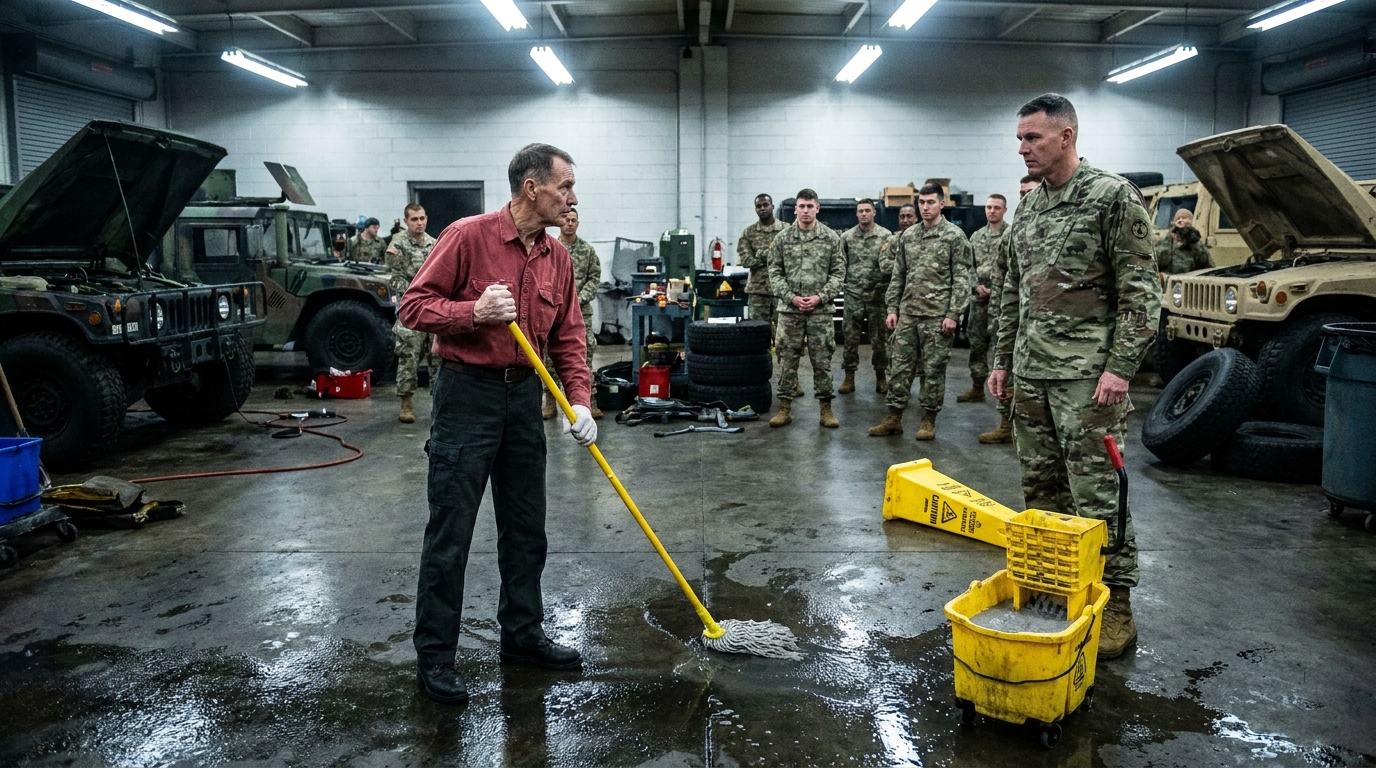
Miller stood amidst the cold, gray expanse of the Fort Ridge motor pool, his posture a mockery of the discipline he’d spent his career mimicking. The Base Commander’s hand remained locked in a rigid salute, a granite statue carved out of military tradition, pointed directly at the man in the faded red shirt. The yellow mop bucket, with its stained water and gray sludge, suddenly looked less like a janitor’s tool and more like an altar.
Miller’s throat felt as though it had been packed with dry, grit-filled sand. Every time he tried to swallow, the sound echoed in his own ears, deafeningly loud against the absolute quiet of the bay. The other soldiers—the ones who had laughed, the ones who had nudged the caution cone with the callous indifference of the uninitiated—were frozen, their faces pale masks of sudden, visceral comprehension. They weren’t looking at a janitor anymore. They were looking at a living manifestation of their own professional failure.
“Sergeant Major Robert Hail,” the Commander’s voice cut through the air, resonant and devoid of the easy familiarity that had defined the morning. “United States Army, retired.”
The name didn’t just hang in the air; it acted upon the room. It brought with it the weight of every manual, every safety briefing, and every rigid, unforgiving standard that had been drilled into their skulls since Basic Training. It was the name at the bottom of the very directives Miller had sneered at minutes ago.
Miller felt the blood drain from his extremities, leaving him lightheaded. He looked at the floor—at the hydraulic slick he had so carelessly ignored, the slick that had nearly sent his comrade sprawling—and then up at Hail. The old man looked exactly the same as he had before the Commander arrived: the beard neatly trimmed, the red shirt tucked with precision, the posture straight as a load-bearing beam. He didn’t look like a hero. He looked like a man who was tired of watching the world break its own bones.
Hail lowered his salute, the motion slow and deliberate, a master of kinetics even in his twilight. He didn’t look at Miller. He didn’t look at the other soldiers. His gaze was fixed on the Commander with a quiet, unsettling neutrality.
“The floor is still slippery, Commander,” Hail said, his voice flat, textured with the rasp of sandpaper on metal. “The spill hasn’t been properly contained.”
The Commander didn’t flinch. He didn’t offer a platitude. He simply turned, his eyes locking onto the cluster of young soldiers, and the look he gave them was worse than a shout. It was the look of an inspector examining a structural defect he intended to demolish.
Miller realized then that the silence wasn’t going to end. The motor pool, once a place of noisy, careless routine, had become a chamber of judgment, and he was the primary exhibit. As the Commander signaled for the senior NCOs, Miller caught a glimpse of a missing maintenance log resting on the nearby workbench—a small, physical discrepancy, a detail he had skipped over this morning in his rush to be the loudest one in the room.
The realization hit him: the rules weren’t written to punish them. They were written to keep them alive. And he had just spent his morning trying to tear them down.
CHAPTER 2: The Geometry of Silence
The silence in the motor pool was not merely the absence of sound; it was a physical weight, like the sudden atmospheric drop before a summer storm. Hail stood with his hands gripped tightly around the rubberized handle of his mop. His knuckles were white, the skin stretched thin over bone that had held firm against decades of military pressure. He did not look up. He did not need to. He could feel the eyes of the Base Commander and the senior enlisted staff pressing into the back of his neck, scanning him for the man they thought they knew, searching for the legend in the janitor’s faded red shirt.
He turned slowly, his boots grating against the oil-stained concrete with a rhythmic, measured cadence. Each step was a practiced movement of economy, designed to carry him away from the center of their gaze, but he knew the space had already narrowed. There was nowhere left to retreat.
As he hauled the mop bucket toward the storage alcove, a flash of memory caught him—sharp and sudden as a flare in the night. He saw the cold, brutal geometry of a maintenance bay floor from thirty years ago, the exact same shade of oil-slicked gray, the frantic shouting of men who didn’t understand the physics of a poorly secured load. His chest tightened, a phantom constriction that made his lungs protest. It was the same smell: hydraulic fluid, stagnant dust, and the underlying, metallic tang of an accident waiting for an audience.
He reached the alcove and set the bucket down. The metal clanged—a flat, dead sound that vibrated through the floorboards. He took a breath, letting the iron-scented air settle in his chest, forcing the ghost of that memory back into the dark corner of his mind.
Behind him, the soft, rhythmic clatter of the soldiers’ boots resumed, but it was different now. The careless swagger was gone, replaced by a tentative, shuffling hesitation. They moved like children walking through a house of glass, terrified that a single wrong step might shatter the remaining air.
“Sergeant Major,” the Base Commander’s voice drifted over, formal and tempered, though the edge of curiosity still lingered in the cadence. “The maintenance logs are missing from the primary desk. We’re conducting a full sweep of the safety protocols this afternoon.”
Hail paused, his back to the Commander. He kept his posture straight, his shoulders squared against the impending interrogation. He knew what the Commander was doing; it wasn’t just an inspection. It was a search for authorization—a hunt for the reason why the architect of Fort Ridge’s survival strategy was currently pushing a mop in the same bay he once governed.
He didn’t turn around immediately. He counted the steady, rhythmic dripping of the mop—drip, drip, drip—each one a heartbeat in the long, exhausting duration of his exile.
“The logs are where the oversight is, Commander,” Hail said, his voice low, projecting just enough to carry without breaking the quiet of the hangar. “Check the sub-basement files under the ‘Training Deficiency’ index. You’ll find the discrepancies there.”
The silence that followed was even more jagged. He heard the Commander exhale, a sharp, surprised sound. It was the first time Hail had offered an unsolicited direction, the first time the janitor had stepped back into the role of the master tactician.
“How would you know that, sir?” the Commander asked, his voice narrowing in scope, becoming personal, stripping away the hierarchy of the moment.
Hail finally turned. He looked at the Commander, not with the deference of a subordinate, but with the steady, piercing focus of an equal—a man who had seen the foundation of the base crumble and had spent the rest of his life trying to shore it up.
“Because I was the one who recorded the failure,” Hail said simply.
The soldiers had stopped moving entirely now. The air in the hangar felt brittle, as if the secret he had just uttered had cracked the temperature of the room. Hail gripped the edge of the mop bucket, his fingers digging into the rim. He had not intended to speak the truth—not yet. But the Commander’s push for the logs had stripped away the safety of his anonymity. He could feel the gaze of the young soldier, Miller, still fixed on him from across the bay—a look of confusion and growing, dawning terror.
Hail didn’t wait for a response. He picked up the handle of the mop and began to guide the sheen toward the drain once more, his motions slow, precise, and entirely undisturbed by the sudden, tectonic shift he had just caused in the command structure of the base.
“Keep working,” Hail said, his voice a low command that directed the soldiers back to their tasks, even as he knew the Commander was still watching him, already calculating the depth of the shadow he had just stepped out of. “The floor isn’t clean yet.”
CHAPTER 3: The Aftershocks of Disregard
Miller did not move. He stood in the gray haze of the maintenance bay, his fingers clamped around the handle of a wrench as if it were a talisman that could ward off the reality sitting behind him. A few feet away, the caution cone lay exactly where he had kicked it, a bright, mocking piece of plastic that had suddenly become the most important object on the base. The Commander’s gaze, which had been cutting and absolute, had shifted to the senior enlisted staff, but Miller could still feel the phantom pressure of it on his skin, a steady, rhythmic pulse of disapproval that didn’t let up.
He glanced toward the storage alcove. Hail was still there, his back to the bay, his shoulders moving in the slow, mechanical rhythm of a man who had long ago traded the chaotic noise of command for the quiet certainty of labor. The old man wasn’t just working; he was erasing the evidence of the chaos Miller had cultivated. Every stroke of the mop was a silent correction, a physical rebuttal to the sloppy disregard that Miller had spent the last hour trying to pass off as “soldiering.”
“Miller,” a voice snapped. It was his section leader, Sergeant Vance, and the tone was devoid of the camaraderie that usually flavored their morning exchanges. Vance wasn’t looking at him; he was looking at the maintenance log on the bench, the one Miller had barely glanced at before the shift began. “Report to the sub-basement. You’re tasked with the record retrieval.”
The sub-basement. The location Hail had mentioned. Miller felt a cold spike of dread in his stomach. He didn’t want to go down there. He didn’t want to see the files, to find the “Training Deficiency” index, or to understand what failure looked like when it was printed on official paper. But Vance was waiting, his jaw set in a line of grim, efficient authority. The hierarchy had been re-established with a single name, and Miller was no longer a loud-mouthed private commanding a circle of friends; he was a liability being routed to the source of his own ignorance.
He set the wrench down on the table. It made a sharp, percussive clack that sounded like a gunshot in the subdued hangar. As he walked toward the corridor that led to the depths of the base, he had to pass Hail. He slowed, his feet dragging against the oil-stained concrete.
“Sergeant Major,” he started, his voice cracking slightly. He stopped, realizing the title felt heavy and strange on his tongue, but he couldn’t bring himself to call him anything else. “I… I didn’t know.”
Hail stopped mopping. He didn’t turn around, but his posture shifted—the slight, tired slump of a man who had heard this apology a thousand times before. He looked down at the gray, turbid water in the bucket, then at the floor where the slick had been.
“You didn’t look,” Hail said, his voice quiet, lacking the bite of a lecture but carrying the crushing weight of a verdict. “That’s the mistake. You think you’re in a motor pool, Miller. You’re in a graveyard of habits. Every loose screw, every skipped log, every joke made at the expense of a precaution—that’s just the topsoil. You start digging, you find the iron beneath it.”
Hail turned then, his eyes gray and steady, like the cold steel of a hangar door. He wasn’t looking at Miller; he was looking through him, at the young soldiers who were still hovering in the distance, waiting for a cue on how to behave. “Go to the sub-basement. Don’t just look for the files. Look at the names on the bottom of the pages. You’ll find more than just training deficiencies.”
Miller felt a chill that had nothing to do with the drafty hangar. He nodded once, unable to find a counter-argument, and continued toward the shadows of the corridor. As he walked, the hum of the engines seemed to grow distant, replaced by the sound of his own footsteps echoing against the damp, concrete walls of the base.
He didn’t look back. He couldn’t. He knew that if he did, he would see Hail standing there with that mop, a man who had once written the laws of this place, waiting for the next error to manifest. Miller kept walking, his hands sweating, the reality of the “Training Deficiency” index looming in his mind like a physical trap he was walking into of his own accord. He had wanted attention, he had wanted to be the loudest voice in the room, and now he was getting exactly what he had asked for: a front-row seat to the history he had spent his career ignoring. The air grew cooler as he descended, the smell of damp earth and machine oil intensifying, and for the first time in his life, the structure of the base felt less like a support and more like a cage.
CHAPTER 4: The Archives of Accountability
The sub-basement was a tomb for paperwork. It smelled of ozone, stagnant water, and the dry, acrid scent of decaying wood pulp. Miller’s flashlight cut a lonely beam through the dust-choked air, illuminating rows of steel shelving that stretched into the darkness like the ribs of some long-dead, prehistoric beast. He had been walking for ten minutes, the transition from the orderly, albeit tense, motor pool to this subterranean labyrinth leaving him disoriented. Here, the rigid hierarchy of the base above seemed to lose its meaning. Down here, there was only the record—the cold, objective documentation of what had gone wrong.
He reached the “Training Deficiency” index, as instructed. The cabinets were rusted, the metal weeping orange flakes of oxidation that coated his fingertips as he pulled the drawer open. It groaned, a protest of neglected hinges, before sliding out to reveal a dense, chaotic stack of logbooks.
His hands were trembling. He didn’t want to admit it, but the air down here was heavy with the presence of ghosts—not the literal kind, but the ghosts of decisions made by men like Hail, men who had stood in the light of authority and, apparently, lost their footing.
He grabbed the first binder, the leather cover cracked and smelling of mildew. He didn’t look at the dates immediately. Instead, he flipped to the back, to the signature lines. He traced the lines with his thumb, looking for the name. There it was: Robert Hail, Sergeant Major, USA (Ret). The handwriting was firm, legible, and utterly devoid of the tremor that had come to characterize Miller’s own movements.
He began to read. The logbook wasn’t a standard maintenance record; it was a post-incident analysis of a training exercise from twenty-two years ago. Miller skipped over the procedural jargon, his eyes darting to the descriptions of the fault. Hydraulic failure in the loading bay. Unauthorized override of safety protocols. Failure to secure the primary arrestor line.
Miller’s breath hitched. He looked at the next page, then the next, his flashlight beam wavering as he realized what he was holding. This wasn’t just a failure of a machine; it was a failure of a man. Hail hadn’t just reported the accident—he had chronicled it with a brutal, microscopic intensity that left no room for excuse. He had documented his own oversight in the setup of the bay’s safety architecture.
He moved to the next book, then another. The deeper he went into the index, the more he realized the scope of it. Hail hadn’t just retired; he had been dismantled. The documents showed a man who had stripped himself of every commendation, every rank-based privilege, and had slowly re-integrated into the system not as a leader, but as the lowest possible operative—the person who held the broom, the person who kept the floor safe so that no one else would ever have to write a report like the ones currently weighing down Miller’s hands.
Clang.
The sound of a door closing at the far end of the aisle made Miller spin around, his flashlight beam dancing wildly against the rafters.
“Who’s there?” Miller called out, his voice sounding thin and terrified in the vast, subterranean space.
No answer. Only the low, distant hum of the facility’s ventilation system, a sound that Miller now recognized as the steady, mechanical breathing of the base itself.
He lowered his flashlight, his heart slamming against his ribs. He turned back to the cabinet, his eyes catching a small, blue folder shoved into the back of the drawer—a physical discrepancy, out of place among the rigid logbooks. He pulled it out. It wasn’t a maintenance record. It was a photograph.
In the grainy, black-and-white image, a younger, harder-faced Hail stood before the same motor pool bay, his hands buried deep in the pockets of his fatigue jacket. Beside him was the Base Commander—not the current one, but a man Miller recognized from the historical plaques in the lobby. And in the background, half-hidden by a transport truck, was the shadow of a man Miller had seen in the mess hall only yesterday—a man who had been whispering to the senior NCOs about “personnel adjustments” and “downsizing the old guard.”
The realization hit Miller with the force of a physical blow. The safety issues in the motor pool weren’t just a byproduct of careless soldiers; they were a calculated, deliberate decay. Someone was manipulating the standards, using the old protocols as a way to sabotage the base’s operational integrity—and they were using the janitor as the scapegoat for every “oversight.”
Miller shoved the photograph into his pocket. He didn’t have time to process it. He needed to get out, to return to the light of the motor pool, to see if Hail was still there, still holding the mop, still watching the floor for the cracks that everyone else was too proud to notice.
He didn’t bother re-filing the logbooks. He turned and sprinted toward the distant flicker of light that marked the corridor exit, the weight of the past pressing down on him, forcing him to understand that he had been walking through a minefield, and for the first time in his career, he realized he wasn’t the one who had laid the traps.
CHAPTER 5: The Lockdown of Truth
The fluorescent lights didn’t just go out; they died with a violent, electric pop that echoed through the concrete throat of the sub-basement. In the sudden, oppressive blackness, Miller skidded to a halt, his boots scraping against the uneven floor. He clutched the blue folder against his chest as if it were a shield. His breath came in ragged, jagged bursts, each one sounding unnaturally loud in the void. He was trapped in a space that had suddenly become hostile, the very structure of the building turning against him.
“Vance?” he called out, his voice wavering. “Sergeant? The power’s out.”
There was no reply. Only the distant, rhythmic dripping of a pipe somewhere in the dark—a slow, maddening count that measured the seconds he was losing. He fumbled for his flashlight, his hands slick with sweat, but as he clicked the switch, nothing happened. The battery—newly installed just an hour ago—was dead.
He stayed motionless, his back pressed against the cold, grit-covered steel of a shelving unit. The metallic smell of the base had intensified, turning bitter and biting. This wasn’t a random power failure. He realized that with a jolt of pure, adrenaline-fueled terror. This was a lockdown. Someone had seen him in the archives. Someone had seen him pull the file.
He moved cautiously, sliding his palm along the rusted shelving. The edges were sharp, biting into his skin, but he barely felt the pain. He was listening for footsteps, for the deliberate, heavy tread of an NCO or the soft, tactical padding of a security detail. Instead, he heard the faint, metallic scrape of a janitor’s bucket being pushed across the floorboards far off in the distance.
Scrape. Thump. Scrape.
The sound was agonizingly slow. It was the same rhythm Hail had used in the motor pool, but amplified, distorted by the narrow acoustics of the sub-basement corridors. Miller’s pulse hammered in his throat. Was it Hail? Was the man who had warned him about the graveyard of habits coming to finish the audit?
Miller abandoned the shelves and moved into the center of the aisle, his eyes straining against the black. He moved by touch, fingers tracing the cold lines of floor tiles, trying to navigate the path toward the main stairwell. He needed to reach the ground level, to get back to the open air of the motor pool where the bustle of the base might offer him some semblance of safety.
As he reached the junction where the archives met the main maintenance tunnel, he stopped. A sliver of light appeared—not the harsh, white glare of the overhead fluorescents, but the dim, amber glow of a service lantern. It was sitting on the floor, casting long, distorted shadows against the corrugated metal walls.
Standing over the lantern was the man Miller had seen in the mess hall—the one who had been whispering about “personnel adjustments.” He was staring down at the floor, his back to Miller, his shoulders hunched in concentration. He was holding a heavy-duty bolt cutter.
Miller realized what was happening. They weren’t just locking him in; they were destroying the archives. They were purging the record of the very failures Hail had spent decades documenting.
“You’re not supposed to be down here, Private,” the man said, his voice smooth, professional, and entirely devoid of heat. He didn’t turn around. “Most people know that the sub-basement is for dead files and dead ends.”
Miller’s grip on the blue folder tightened. “I’m just doing my job,” he said, trying to emulate the steadiness he had seen in Hail, though his voice betrayed him with a high-pitched tremor.
“Is that right?” The man finally turned. His face was obscured by the low angle of the lantern, but the glint of his eyes was sharp, hungry. “And what does your job tell you about the man you were talking to? The ‘janitor’?”
“He’s a Sergeant Major,” Miller countered, stepping backward, his heel catching on a protruding pipe.
The man laughed—a dry, humorless sound that mirrored the scraping of the floor. “He’s a ghost, Miller. And ghosts are very good at leading the curious into traps. He didn’t tell you to come here because he wanted you to find the truth. He told you to come here so there would be a witness when the archives ‘accidentally’ caught fire.”
Miller looked at the bolt cutters, then at the rows of shelving that stretched out behind the man—miles of paper, decades of history, all of it marked for erasure. He felt the cold iron of the wall against his spine, the weight of the folder in his hands, and the crushing realization that he was the bridge between the janitor’s penance and the saboteur’s purge.
“The rules are written in blood,” Miller whispered, remembering Hail’s words.
“And now,” the man replied, taking a slow, deliberate step toward him, “they’re going to be written in ash.”
Miller bolted. He didn’t head for the stairwell—that was where they expected him to go. Instead, he dove into the dark, tangled narrow-aisle of the secondary storage, the one labeled for chemicals and hazardous waste, knowing that the only way to survive the fire was to know exactly what was fueling it.
CHAPTER 6: The Architect of Shadows
The secondary storage unit was a claustrophobic maze of industrial cleaning supplies and discarded maintenance parts. Miller’s lungs burned. The air here was heavy with the sharp, acidic sting of spilled solvents, a chemical fog that made his eyes water and his vision swim. He navigated by instinct, his hands grazing stacks of abrasive pads and rusted metal drums that groaned under his touch. Every sound was distorted—the hum of the ventilation system felt like the droning of a hive, and the dripping of a leaky pipe in the distance sounded like a countdown.
Scrape. Thump. Scrape.
The sound was right behind him, just on the other side of a barricade of stacked shelving units. Miller froze, his back pressed against a drum of industrial degreaser. His heart was a trapped bird against his ribs. He looked at the blue folder in his hand; the paper was damp with his sweat, the edges beginning to curl. He had to keep moving, but he had no idea where the exit was in this suffocating gloom. The man with the bolt cutters was out there somewhere, but this—this presence following him—felt different. It felt heavy, measured, and ancient.
“You’re making a mess, Miller,” a voice said. It wasn’t the man with the bolt cutters. It was raspy, dry, and resonated with the cold authority of a command issued on a parade deck.
Miller spun around, his flashlight still dead, his eyes darting through the dark. “Hail?”
A shadow detached itself from the gloom. It wasn’t just a man; it was a frame of absolute, unyielding posture. Hail stood there, the mop handle in his hand held like a staff, the mop head itself darkened by oil and age. He didn’t look like an old janitor. In the dim, flickering light filtering in from the main corridor, he looked like a monument to a collapsed era.
“You weren’t supposed to find the blue folder,” Hail said, his voice void of malice but heavy with a profound, weary sadness. “That wasn’t for you. That was for the ghosts.”
“They’re destroying the records,” Miller whispered, his voice failing him. “The archives—they’re burning them.”
Hail moved forward, a single, fluid step that covered the distance with terrifying grace. He wasn’t aggressive, yet Miller felt an instinctive need to retreat. “The records are already ash, Miller. They have been for years. What you found were the echoes. The men running this base now—they aren’t soldiers. They are technicians of convenience. They don’t care about the rules because they don’t believe that anything can truly break.”
Hail gestured with the mop toward the main maintenance tunnel. “The man with the cutters is coming. He’s going to seal this sector. He thinks he’s cleaning up a mistake, but he doesn’t understand that you can’t clean away history. It just seeps into the floorboards.”
“Why did you lead me here?” Miller asked, his frustration boiling over, fueled by the toxic air and the absolute confusion of the night. “You knew what would happen. You knew they would come for me.”
Hail stopped, the mop handle vibrating slightly in his grip. For the first time, he looked at Miller not as a subordinate, but as a mirror. “I needed to know if there was anyone left on this base who could actually read the signs,” Hail said, his voice dropping to a low, intense rasp. “Everyone else looks at a cone and sees an inconvenience. Everyone else looks at a safety report and sees a reason to sleep. I needed to see if anyone else would stop to look at the damage.”
A heavy, echoing crash came from the main tunnel—the sound of a heavy steel door being forced by hydraulic pressure. The man with the bolt cutters had reached the secondary sector.
“You want to survive?” Hail asked, holding out his hand for the folder. “Give me the evidence. Go through the ventilation shaft above the drum. It leads to the roof of the motor pool. From there, you can see the secondary command circuit. If you cut the power from the exterior box, you trigger an automated hard-lock on the whole facility. It will freeze every digital record, every deletion, and every gate on this base. They won’t be able to hide the failures then. The entire Command Sergeant Major’s office will be exposed.”
Miller hesitated. His mind reeled. If he handed over the folder, he was effectively ending his career—perhaps his life. But as he looked at Hail, he saw the truth he had been missing: Hail wasn’t a janitor, and he wasn’t a savior. He was a man who had spent twenty years in a cage of his own design, waiting for someone to finally take the key.
“Why don’t you do it?” Miller asked.
“Because I’m the one who built the cage,” Hail said, his eyes darkening. “And the architect can never be the one to break it.”
He stepped aside, pointing toward the ceiling grating, which hung loose and inviting. Miller understood. The weight of the wrench, the responsibility of the cone, the burden of the logbooks—it all culminated here, in the cold, iron-scented dark of a basement that was meant to be his tomb. He climbed, his muscles screaming with fatigue, leaving the janitor behind in the gloom to face the man with the bolt cutters. As he reached the top, he looked down one last time and saw Hail standing perfectly still, his mop held like a weapon, waiting for the shadows to arrive.
CHAPTER 7: The Circuit of Consequence
The roof of the motor pool was a landscape of desaturated steel and frozen shadows. The night air was biting, smelling of distant rain and the heavy, metallic tang of the base’s massive electrical grid. Miller moved low, his body pressed against the corrugated surface, the cold seeping through his uniform until his bones felt as brittle as the rusted hardware he was crawling past.
Every movement was an exercise in precision. He remembered the feel of the caution cone in the hangar, the simple, yellow plastic object that had started this entire collapse. Now, as he reached the exterior command circuit box, he understood that the entire base was a machine held together by a fragile series of warnings, and he was about to rip the heart out of the mechanism.
His hands were numb, his fingers stiff against the latch of the circuit box. He glanced back toward the ventilation shaft he had crawled out of. Below him, he could hear the muffled, frantic shouting of the man with the bolt cutters. They had discovered the archives were empty. They had discovered that the “janitor” was no longer just a mop-pusher, but a ghost who had finally decided to haunt them.
Clang.
The sound of a heavy door opening below made Miller jump, his heart hammering against his ribs. He forced himself to focus. He wasn’t the loud-mouthed private anymore, performing for an audience of peers. He was a link in a chain of accountability, and for the first time, he felt the heavy, sobering weight of what it meant to be a soldier.
He unlatched the circuit box. Inside, the wires were a tangle of logic and electricity—the nervous system of the base’s entire regulatory function. He reached for the primary kill-switch, a thick, red lever that looked heavy enough to anchor a ship.
A phantom thought intruded: the memory of a different bay, a different failure, where a lever like this had been mismanaged, turning a routine operation into a catastrophic hazard. He saw the face of an NCO he hadn’t thought of in years, a man whose career had been vaporized by a single second of hesitation. He shook his head, pushing the memory away. He couldn’t afford the luxury of doubt. He had to finish what Hail had started.
He grabbed the lever. It didn’t move. It was locked with a secondary security override—a digital keypad that required a code he didn’t have. Miller felt the panic rising, a cold wave of helplessness. He stared at the keypad, his breath hitching. They had anticipated this. They had locked the truth behind a final gate of silence.
“You’re looking for a code, Miller,” a voice said—quiet, resonant, and disturbingly calm.
Miller spun around. The man with the bolt cutters had reached the roof. He stood by the access hatch, his silhouette a dark, jagged stain against the moonlight. He held a sidearm, his grip loose and terrifyingly practiced. Behind him, two other security personnel emerged, their faces obscured by tactical gear.
“You really think a kid like you can just walk in and shut down twenty years of institutional streamlining?” the man asked, stepping forward. He didn’t rush. He didn’t need to. He had the high ground, the tactical advantage, and the absolute certainty of a man who owned the machinery. “The Sergeant Major is a relic. He wants you to believe that there’s a ‘truth’ worth saving, but all there is, is the next maintenance cycle. Now, step away from the circuit.”
Miller’s hands were still on the lever. He looked down at the motor pool bay below, at the faint glow of the work lights where Hail was still standing. He realized then that Hail hadn’t just given him the task of shutting down the base. He had given him the task of becoming the final, living piece of evidence.
“I’m not a relic,” Miller said, his voice stronger than he had ever felt it, the rasp of the sub-basement air still clinging to his throat. “And this isn’t a maintenance cycle. It’s a confession.”
He pulled the folder from his pocket—the one containing the photograph, the one that proved the command staff had been orchestrating the safety failures—and held it up, knowing that even if the man shot him, the folder would drop to the motor pool floor, into the light where the base commander could see it.
“Go ahead,” Miller challenged, his fingers tightening on the lever, his thumb pressing against the emergency override button Hail had subtly pointed out earlier—the one that wasn’t a code, but a physical breaker. “But if you shoot me, you’re not just silencing a private. You’re acknowledging exactly what’s in this file.”
The man hesitated. For a second, the cold, pragmatic logic of the situation failed him. He saw the folder, saw the photograph, and knew that the game was changing. He raised his weapon, but Miller felt the override button click under his thumb. The circuit box groaned, the internal magnets disengaging with a sound like a guillotine.
The entire base went black. Not just the lights—the power, the ventilation, the digital systems, the entire hum of the facility died instantly. In the sudden, unnatural silence, the base felt like it had ceased to exist.
“Now,” Miller whispered, bracing himself for the impact of the final consequence.