The Quiet Resonance of the Patriot Bell: A Chronicle of Fading Metal, Shared Scars, and the Unbroken Thread of Memory
CHAPTER 1: THE SUNBAKED TARMAC
The heat coming off the concrete flight line at Fort Holloway didn’t just rise; it pressed against the chest like a damp wool blanket. Kyle Kramer wiped a streak of synthetic grease from his forearm, leaving a dark, smudged line across his crisp, brand-new coveralls. Beside him, the olive-drab flank of the UH-1 Huey sat in absolute silence, its long rotor blades drooping toward the pristine tarmac like the frayed leaves of a dying palm tree. The green-lit diagnostic screens on the portable tables showed a flawless landscape of horizontal lines, every system registry reporting a clean bill of health. Yet, every time Kramer turned the ignition key, the machine offered nothing but a hollow, clicking breath.
Eli Vance stood exactly three paces beyond the safety perimeter line, his hands buried deep into the pockets of a faded denim jacket that had lost its original color sometime during the previous century. The fabric was fraying at the cuffs, showing the pale, white threads of long-worn cotton, a sharp contrast to the starch-stiff uniforms of the dozen technicians crowded around the nose of the helicopter. Eli didn’t look at the flashing digital multimeters or the diagnostic cables snaking across the ground. He looked at the seam where the tail boom met the main fuselage, his eyes steady and unblinking, tracing the faint, uneven line of decades-old rivet heads.
“Sir, this is a controlled maintenance zone,” Lieutenant Wells said, his voice carrying the sharp, brittle edge of an officer who had spent more time reading manuals than smelling burning oil. He stepped into Eli’s line of sight, his posture rigid, his hand hovering near his polished leather belt. “General’s orders or not, my people are running a level-three system sweep. We don’t have the clearance to let civilians wander through the active grid.”
Eli didn’t pull his hands from his pockets. He merely shifted his weight, his worn boot scuffing against a small, dry patch of oil on the concrete. “The grid isn’t the problem, son,” Eli said, his voice a low, gravelly scrape that sounded like two river stones rubbing together in the dark. “You’re feeding juice to a bird that’s already decided to keep her eyes shut. She’s tired of the noise.”
Kramer let out a short, sharp laugh, throwing his grease rag onto the top of an aluminum toolbox with a heavy clang. “A soul? Is that what the general pulled you out of a retirement home for, Mr. Vance? To tell us about the aircraft’s feelings? The digital continuity is immaculate. The fuel pressure is holding at thirty pounds. The computer says she should be in the air right now.”
Eli’s pale blue eyes drifted from the lieutenant’s silver bar to the small, silver snap button on his own leather pouch, tucked safely away beneath his jacket. The metal of the snap was worn down to a dull, smooth grey, polished by years of thumbs pressing it closed against the rain. He could feel the small, hard shape of the custom wrench inside, a weighted reassurance against the shrill hum of the modern laptops. He didn’t answer Kramer. Instead, he stepped an inch closer to the portside cowling, noticing a tiny, three-millimeter gap where the edge of an old access plate met the air frame—a gap that wasn’t listed on any digital blue print, but one that smelled faintly, unmistakably, of old aviation fuel and wet earth.
CHAPTER 2: THE FRACTURE OF AUTHORITY
The smell of old aviation fuel didn’t dissipate in the heavy air; it hung low over the three-millimeter gap in the cowling, a thick, sweet memory of combustion that only Eli seemed to recognize. Kramer’s incredulous laughter was still echoing off the aluminum toolboxes when a sudden, sprawling shadow rolled across the flight line. A massive thermal cloud, heavy with the unreleased moisture of the Gulf, choked out the harsh afternoon sun, instantly draining the bright glare from the Huey’s oxidized olive-drab flank. The sudden shift in light turned the aircraft from a gleaming artifact into a dark, silhouetted monument of weathered metal.
Lieutenant Wells took a step forward, his boot heels clicking with a sharp, defensive rhythm against the concrete. His face was flushing a dark, blotchy red beneath his starch-stiff patrol cap. “Mr. Vance, I won’t ask you again,” he said, his voice dropping into a register that tried desperately to mimic a seasoned commander but only managed to sound thin and strained. “Step back behind the yellow line. You’re distracting my lead technician, and we are operating under an absolute deadline from the base commander.”
Eli didn’t look at the officer. He remained perfectly still, his calloused thumb rubbing the smooth, worn silver snap of his leather pouch through the thin fabric of his pocket. He could see the micro-tremor in Wells’s jaw, the frantic way the young lieutenant’s eyes kept darting toward the command tower at the far end of the airfield. “The boy isn’t distracted, Lieutenant,” Eli murmured, his voice retaining that soft, river-stone rasp. “He’s just reading a map that doesn’t have the roads painted on it yet.”
Across the portable table, Kramer’s fingers froze over the keyboard. A high-pitched, metallic chime pierced the humid quiet—a warning note from the diagnostic software that made three other technicians lean forward in unison. The green horizontal lines on the Toughbook screen suddenly fractured, twisting into a jagged block of crimson warnings.
“What is that?” Wells demanded, pivoting on his heel, grateful for a target he could address with regulatory anger. “Kramer, report. Why is the grid turning red?”
“It’s… it’s a structural impedance fault,” Kramer muttered, his youthful arrogance evaporating into the frantic, rapid clicking of his mouse. His eyes widened as he scrolled through the newly generated telemetry. “The digital avionics table is flagging a massive pressure differential in the auxiliary feed block. Code 404-Delta. It’s showing a total fuel-line obstruction right at the primary manifold junction.”
The young technicians began to murmur, their postures breaking from rigid confidence into a scattered, anxious cluster. A fuel-line obstruction on a heritage turbine wasn’t a matter of adjusting code; it meant a full system teardown. It meant high-pressure line swaps, breaking the ancient, brittle factory seals on the fuel cell, and exposing the historic engine core to the humid, corrosive air of the tarmac. It was an operational nightmare that would ensure the Patriot Bell remained grounded for weeks, a permanent stain on the maintenance detachment’s record.
“That’s impossible,” Wells whispered, his rigid posture sagging by a fraction of an inch as the weight of administrative failure pressed down on his shoulders. “We flushed those lines yesterday. The certification was clean.”
“The computer doesn’t lie, Lieutenant,” Kramer said, his voice rising a frantic octave as he stared at the red error block. “If the manifold is choked, we have to pull the entire upper housing. We need to order standard-issue logistics gear from the main depot, and that’s a three-day turnaround just for the permits.”
A few yards away, near the idling support utility vehicle, Airman Peterson watched the panic unfold. He was nineteen years old, his uniform still smelling of the laundry starch from basic training, but his eyes were wide and clear. He looked at Lieutenant Wells, whose hand was now visibly shaking as he reached for his tactical radio. Then he looked at Eli Vance.
The old man hadn’t moved an inch. He stood in the newly fallen shadow of the storm cloud, his face a calm, unreadable landscape of deep lines and weathered skin. There was no triumph in Eli’s expression, no smug satisfaction at the digital system’s collapse. There was only a profound, quiet empathy—a look that Peterson recognized from the old photographs his grandfather kept in a cedar box beneath his bed. It was the look of a man who had watched young men break under the pressure of things they couldn’t control, and who knew that shouting never fixed a broken gear.
Peterson took a slow, deliberate breath, his heart hammering against his ribs like a trapped bird. He knew the regulations. He knew that reaching across the chain of command was a direct path to a disciplinary hearing, a mark that could end his career before it truly began. But he looked at the faded denim jacket, the quiet dignity of the old crew chief standing silent while the modern world screamed around him, and something inside the young airman snapped clean.
He stepped backward into the deep shadow of the utility vehicle’s open rear door, shielding his movements from Wells’s frantic radio chatter. He pulled his personal cell phone from his interior pocket, his thumb sliding quickly over the scratched glass screen. His contact list was short, but near the bottom was the direct number for Major Davies, the general’s personal aide-de-camp—a number he had been given during a routine administrative detail three weeks ago and told never to use unless the base itself was on fire.
The phone pressed against his ear felt incredibly heavy. The dial tone rang once, a cold, mechanical beep that sounded like a countdown.
“Major Davies,” the voice snapped on the second ring, crisp, hurried, and surrounded by the distant, echoing murmur of the air-conditioned command center miles across the base.
“Sir, this is Airman Peterson at the flight line,” Peterson whispered, his voice steady despite the tremor in his knees. He turned his back fully to the tarmac, his eyes locked on the fraying edge of his own cuff. “I’m breaking protocol, sir. You need to tell the general. The technicians… they’ve lost the grid. They’re trying to tear the bird apart, and they won’t let Mr. Vance touch the metal.”
There was a three-second silence on the line—a silence so absolute that Peterson could hear the soft, distant hum of the main frame computers through the receiver.
“Say that again, Airman,” the major said, his tone instantly shifting from harried bureaucracy to a sharp, dangerous clarity. “What are they doing to Elias Vance?”
CHAPTER 3: THE ARRIVAL OF THE THREE STARS
Airman Peterson lowered the tactical phone, his hand pressed firmly against the warm plastic casing to stop the subtle shaking of his fingers. The line had gone dead with a heavy, administrative click, leaving only the distant, hollow hum of the airfield’s main power transformers vibrating through the soles of his boots. Five yards ahead, the crisis at the nose of the Patriot Bell was worsening in real-time. Kramer’s fingers continued their frantic dance across the mud-splattered keyboard of the diagnostic terminal, his face catching the pale green back-light of a system that kept cycling through the same catastrophic error code.
“The secondary pressure transducer is completely dead now,” Kramer yelled over his shoulder, his voice echoing off the flat, unyielding metal of the cockpit door. “It’s not just a soft blockage, Lieutenant. The software is trying to vent the main manifold because it thinks the feed block is structurally compromised. If I can’t override the factory parameters within the next three minutes, the central system is going to trigger an automated safety purge. It will lock down the entire fuel cell.”
Lieutenant Wells stepped closer to the portable table, his eyes wide as he stared at the crimson blocks overlapping the diagnostic grid. His hand rested on his radio holster, his knuckles turning white. “Can we manually override the purge from the cockpit?” he demanded, his voice tightening. “There has to be a physical circuit breaker we can pull to keep the software from freezing the line.”
“There isn’t,” Kramer shot back, a bead of sweat tracing a pale line through the grease on his cheek. “This is a modernized conversion harness. The digital bus controls the mechanical gates. If the bus says the line is choked, the gates stay shut. We’re completely locked out.”
Eli Vance stood perfectly still under the gray expanse of the thermal cloud cover, his thin frame silhouetted against the dark, dormant shape of the fuselage. He didn’t offer a suggestion, nor did he look toward the panic-stricken technicians. His gaze remained fixed on the tiny, three-millimeter discrepancy beneath the exhaust plate—a minute irregularity that seemed to pull the light away from the surrounding metal. To anyone else, it was a minor manufacturing variance, a simple unevenness in the plating. To Eli, it was a physical signature, a deliberate marker left behind in a mud-soaked tent decades ago when the manual bypass had been slipped into place to save a platoon from a hilltop that no longer existed on any modern map.
“The computers are looking at a phantom,” Eli murmured, his voice cutting through the mechanical hum of the laptops with a low, gravelly weight. “They’re trying to read a valve that isn’t in their code. Every time your software pushes electricity into that manifold, she thinks she’s taking on water. You’re choking her with your own metrics.”
Kramer didn’t look up from his screen, but his shoulders stiffened. “Mr. Vance, with all due respect, you don’t know how the digital bus architecture integrates with the fuel regulators. This isn’t a mechanical system anymore. It’s a closed-loop network.”
Before Wells could interject to enforce the safety perimeter, a distant, high-pitched squeal of tires tore through the heavy silence of the flight line. From the eastern access gate, three black command utility vehicles rounded the edge of the main hangar, their tires gripping the rain-slicked asphalt with a harsh, tearing sound. They didn’t slow down as they entered the active maintenance grid; they moved in a tight, aggressive echelon, their front grilles cutting through the humid haze until they screeched to a halt exactly ten paces from the dormant helicopter.
The doors flew open in perfect unison before the suspensions had even settled. From the rear passenger compartment of the lead vehicle stepped General Michaelelsson. His three silver stars caught the dim, filtered light of the cloud cover, gleaming against the crisp fabric of his combat uniform. Behind him, Colonel Hayes, the base commander, stumbled slightly as he hurried to keep pace, his face pale and drained of color beneath his starched cap.
The effect on the flight line was instantaneous. The technicians froze, their hands hovering over their toolboxes and laptops like men caught in a sudden frost. Lieutenant Wells went rigid, his arms snapping down to his sides as his heels came together with a flat, hollow pop against the concrete. Kramer stood up so fast his chair scraped violently backward, his mouth slightly open as the general’s boots struck the tarmac with a deliberate, rhythmic force.
General Michaelelsson didn’t look at the diagnostic screens. He didn’t look at the crimson error logs flashing on the Toughbooks. His eyes, cold and sharp as chipped flint, locked directly onto Eli Vance. He strode past the young lieutenant and the petrified lead technician as if they were nothing more than standard-issue landscape details, coming to a dead stop three inches from the old man in the faded denim jacket.
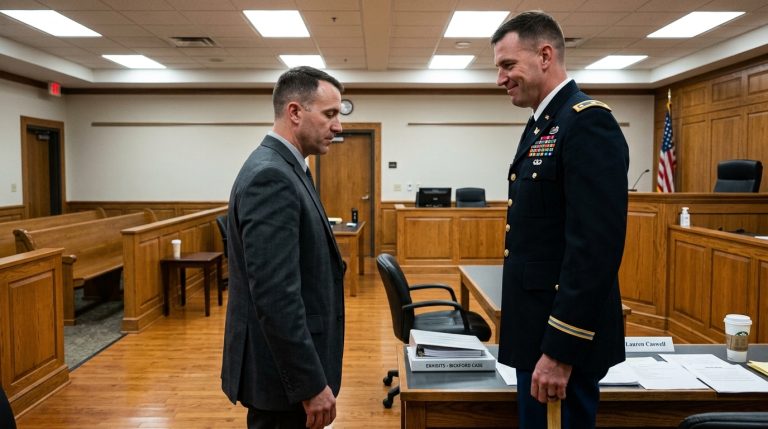
In the absolute quiet that followed, the general brought his boots together with a sharp, audible crack. He snapped his right hand to the brim of his cap, delivering a salute so precise, so formal, that it seemed to pull the entire attention of the base into the small space between them.
“Mr. Vance,” the general said, his voice booming across the concrete, clear and hard enough to vibrate through the metal skin of the Patriot Bell. “It is an absolute honor to have you on my flight line, sir. I deeply apologize for the reception you’ve encountered here today.”
Eli let his hands slide slowly out of his denim pockets. He looked at the general’s face, tracing the sharp lines around the older officer’s eyes, finding the faded remnants of the young, terrified second lieutenant he had dragged out of a hot landing zone while the jungle burned around them. A small, tired nod was Eli’s only response—a gesture of quiet recognition that carried no malice, only the heavy weight of shared memory.
The general dropped his salute but remained at attention, his posture unyielding as he turned his gaze slowly toward Wells and Kramer. The warmth left his face entirely, replaced by a cold, dangerous stillness that made the young lieutenant’s chest heave with shallow breaths.
“Lieutenant Wells,” the general said, his voice dropping into a lethal, quiet register that nonetheless carried to the edge of the support vehicles. “You have a team of twelve certified specialists and an array of equipment that costs more than the annual budget of a regional depot. And yet, you’ve spent six hours trying to force a machine to speak a language it doesn’t know, while threatening the one man who gave this specific aircraft its name.”
Wells swallowed hard, his throat dry. “General, the… the level-three diagnostics indicated a critical fuel obstruction. We were simply following the protocol to protect the structural integrity of the asset—”
“Your protocol doesn’t include the history of this branch, Lieutenant,” Michaelelsson interrupted, his voice cutting like a razor through the humid air. He stepped closer, his shadow falling completely over Kramer’s diagnostic table. “The man you were about to escort to the base stockade is Elias Vance. In 1968, he kept sixty percent of the First Cavalry’s lift capacity operational in the A Shau Valley using nothing but scavenged parts and sheer determination. They didn’t call him a mechanic. They called him the Ghost, because he could make dead birds fly when the logistics lines were cut completely.”
The general pointed a rigid finger toward the portside engine cowling of the Huey. “This specific aircraft isn’t a museum piece for your team to run software patches on, Mr. Kramer. It’s the centerpiece of our heritage fleet because Mr. Vance personally field-stripped and re-engineered its fuel flow system in a mud-soaked tent during a monsoon to ensure my platoon could be pulled off a ridge before we were overrun. The modification that’s keeping your screens red isn’t a fault. It’s a secret. And it’s a secret that isn’t inside your manuals.”
Kramer looked down at his keyboard, his face burning with a deep, systemic shame that left him entirely speechless. The young technicians shifted their feet, their eyes dropped to the concrete, unable to meet the steady, pale blue gaze of the old man they had ridiculed only minutes before. The balance of authority on the tarmac had shattered completely, leaving the advanced computers looking like useless glass boxes against the quiet reality of the veteran standing beside the metal.
CHAPTER 4: THE HEART OF THE MACHINE
The silence that settled over the tarmac after the general’s words was thick, heavy, and absolute, broken only by the faint, rhythmic ticking of cooling laptop chassis. Kyle Kramer kept his head lowered, his gaze pinned to the grease-stained concrete near his boots, his face burning beneath the cold gaze of three stars. Beside him, Lieutenant Wells remained frozen at attention, his eyes staring straight ahead into the olive-drab flank of the helicopter, his posture so rigid it looked ready to fracture under the weight of his own sudden insignificance.
Eli Vance slowly closed his hand around the smooth, worn pouch inside his pocket. He didn’t look at the base commander, nor did he look at the humiliated technicians who had spent the last six hours trying to force a historic asset into a modern container. With a deliberate, measured step, Eli moved past General Michaelelsson, his worn boots making no sound against the damp concrete. He stopped directly beneath the portside engine cowling, right before the small, unnoticeable access plate that Kramer had dismissed as an insignificant detail.
“She’s spent a long time listening to people who only know how to read what’s written on a glass screen,” Eli said softly, his gravelly rasp dropping into a tone that was almost conversational, yet it carried clearly into the quiet. “But this bird doesn’t think in code, son. She thinks in friction and fuel flow.”
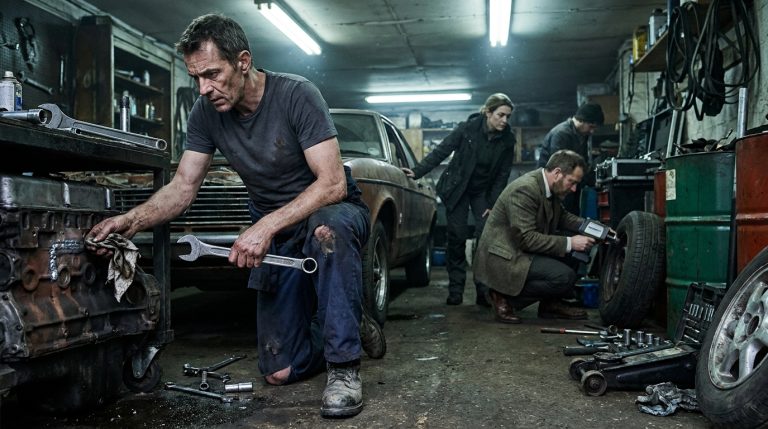
He reached into his pocket and pulled the leather pouch into the light. The old leather was scarred, stained with dark rings of ancient turbine lubricant and hydraulic fluid that had soaked into the hide decades ago. Eli unfastened the smooth silver snap with a soft, clean click. From inside the velvet-lined interior, his fingers wrapped around the curved, custom-ground steel wrench. The tool was dark, its edges worn smooth by the constant pressure of his thumb, its unique angle forged by hand on a cold grindstone in a place that the manuals had forgotten.
Kramer raised his head slightly, his eyes tracking the movement of the old tool with a mixture of burning shame and intense curiosity. For all his reliance on diagnostic metrics, his mechanical intuition was sharp enough to realize that the tool in Eli’s hand didn’t belong to any standard-issue logistics kit. It was a singular object, designed for a singular purpose.
Eli raised the wrench to the access plate. He didn’t look at the torque specifications or the digital indicators. He simply pressed the custom lip of the tool against the first flush bolt head. The curved metal slotted home with a clean, seamless precision that left no gap. With a gentle, uniform pressure from his calloused palm, Eli turned the tool counterclockwise. The ancient bolt, which Kramer had insisted would require an automated impact driver and a factory seal permit to loosen, yielded with a smooth, silent rotation.
One by one, the four bolts came free, their threads coated in a dark, sticky layer of historic zinc paste that had preserved them against the salt air of the coast. Eli caught each bolt in his palm, placing them in a neat line along the top of the aluminum toolbox without looking down. He lifted the small access plate away from the fuselage, revealing a dark, recessed cavity nestled behind a complex tangle of modern braided wiring harnesses and digital sensor lines.
The technicians surged forward by a collective fraction of an inch, their breath catching in their throats. On Kramer’s portable monitor, the crimson error logs suddenly flickered, the horizontal lines jumping erratically as the system detected a manual shift in the physical framework.
Inside the dark recess, hidden beneath the layer of modern conversion cables, lay a small, unpolished bronze lever. It was no larger than a man’s thumb, its surface dull and oxidized, completely disconnected from the digital bus architecture that ran the rest of the modernized aircraft. It sat in the vertical position—the standard factory baseline.
“This is what your computer thinks is a blockage,” Eli murmured, his pale blue eyes focused on the hidden mechanism. “When they installed the digital fuel regulators, they ran the diagnostic lines right over the bypass gate. The software sees the drop in pressure across the auxiliary line and thinks the whole block is collapsing. But it isn’t a failure. It’s a choice.”
He hooked the curved edge of his custom wrench under the lip of the bronze lever. With a steady, unhurried push, Eli nudged the lever down.
The movement was small, but the sound it made was unmistakable—a solid, deep mechanical click that vibrated through the core of the Huey’s frame. It was the sound of an internal valve sliding across a hidden channel, opening a direct, unmetered passage between the primary fuel cell and the turbine’s combustion chamber, completely bypassing the safety gates of the electronic bus.
Eli replaced the access plate, spinning the four bolts back into place with his fingertips before using the curved wrench to cinch them down to a practiced, hand-tight precision. He slipped the tool back into the leather pouch, fastening the silver snap with a dull pop, and stepped back three paces until his shoulder was aligned with General Michaelelsson.
“The line is open,” Eli said, turning his gaze toward Kramer. “The software won’t see the gate anymore. Go ahead and turn the key, boy.”
Kramer looked at the general, who gave a single, imperceptible nod of his head. The young technician stumbled forward, his fingers shaking slightly as he grabbed the edge of the cockpit door and pulled himself up into the high pilot’s seat. He didn’t look at his Toughbook screen. He went through the manual startup sequence from pure memory, his hands hitting the battery switches and the fuel pump toggles with a rapid, mechanical rhythm.
He reached for the central ignition switch. His thumb pressed down.
For a second, the flight line held its breath. Then, from deep within the upper housing of the Patriot Bell, a low, guttural cough rippled through the metal. A single wisp of pale grey smoke drifted from the main exhaust, followed instantly by a sudden, deafening roar that tore through the humid afternoon air. The turbine didn’t sputter or hesitate; it screamed to life with a fierce, high-pitched resonance that shook the concrete beneath their feet.
The long, drooping rotor blades began to move, turning slowly at first, clearing the heavy air before spinning faster and faster until they became a shimmering, invisible disc above the fuselage. The familiar, rhythmic wump-wump-wump of the blade tips cutting the atmosphere beat down upon the tarmac, a steady, ancient heartbeat that seemed to wake the entire base from its long silence.
The technicians erupted into a spontaneous, uncoordinated cheer, their previous frustration completely forgotten in the presence of a machine that had defied their code but answered the touch of its old crew chief. Airman Peterson stood near the support vehicle, a quiet smile breaking across his young face as he watched the shimmering air distortion rising from the exhaust.
Eli Vance didn’t cheer. He stood in the cool wash of the rotating blades, his denim jacket flapping against his frame, his eyes fixed on the turning mast with a small, sad expression that looked less like victory and more like an old friend saying goodbye.
CHAPTER 5: THE FADING TEXTURES OF TIME
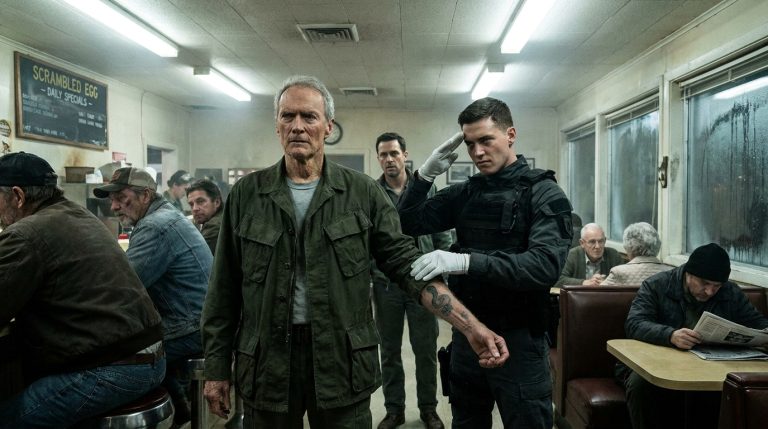
The thrum of the Patriot Bell’s turbine didn’t truly leave Eli’s ears, even a week after the dust had settled on the flight line at Fort Holloway. It remained as a faint, rhythmic frequency buried deep beneath the ordinary noises of the town—the low hum of refrigerator units, the intermittent rush of passing highway traffic, and the clink of silverware against thick ceramic plates. He sat by the far window of the local diner, his calloused hands wrapped around a heavy mug of black coffee, watching the pale amber afternoon light slant across the scuffed Formica tabletop. The fabric of his denim jacket felt soft and pliable, thoroughly worn down by decades of labor, its frayed cuffs holding the faint, ghostlike scent of rain-slicked asphalt and aged oil.
The diner’s screen door creaked on its spring, letting in a brief swirl of warm air before closing with a dull slap against the wooden frame. Two figures stepped into the entryway, their shadows long and hesitant on the linoleum floor. Lieutenant Wells and Kyle Kramer stood with their service hats held tightly in their hands, their eyes sweeping the booths until they locked onto the quiet profile of the old crew chief. They looked noticeably different than they had under the heavy grey clouds of the tarmac; the stiff, aggressive certainty had bled out of their postures, replaced by a quiet, measured humility that showed in the slow cadence of their steps.
They stopped at the edge of the booth, their knuckles white against the brims of their caps. Wells was the first to speak, his voice dropping below the low murmur of the diner’s jukebox. “Mr. Vance,” he said, his posture defaulting to a respectful stiffness that had nothing to do with regulations. “We hoped we might find you here. We went by your workshop, and the neighbor said this was where you took your coffee.”
Eli didn’t look up immediately. He watched a solitary dust mote drift through a beam of sunlight, its tiny form catching the gold light before disappearing into the shadow of the napkin dispenser. He gave a single, slow nod, gesturing with his hand toward the empty bench across from him. “Sit down, boys,” he said, his voice a low, river-stone rasp that carried no edge, only the calm patience of a man who had seen the world break and mend itself a thousand times. “The coffee’s fresh.”
Kramer slid into the booth first, his large shoulders hunched as if he were trying to occupy as little space as possible. He set his cap on the table, his fingers tracing the polished plastic brim. “Mr. Vance, we didn’t just come to track you down,” Kramer said, his voice thick with a genuine, unvarnished weight. “We came to say what we should have said before the general arrived. What we did out there… the way we spoke to you, the way we threw the metrics in your face. There’s no excuse for it. We were blind to what was right in front of us.”
“We let the pressure of the deadline distort our judgment,” Wells added, his eyes meeting Eli’s pale blue gaze with absolute directness. “I forgot that the uniform I’m wearing was built by the people I was trying to push behind a yellow line. I am deeply sorry for the disrespect, sir.”
Eli set his mug down, the ceramic bottom hitting the Formica with a soft, solid thud. He looked at the two young men, tracing the dark circles of exhaustion under Kramer’s eyes, the slight tightening in Wells’s jaw that spoke of a long week spent rewriting their understanding of their own craft. The “Heritage Program” that General Michaelelsson had instituted was already sweeping through the maintenance detachments, but the real repair wasn’t happening in the classrooms; it was happening right here, across a scarred table over two cups of bitter coffee.
“Your computers aren’t your enemy,” Eli said softly, his fingers moving to the pocket of his jacket, where the worn leather pouch rested against his ribs. He didn’t pull it out; he simply let his hand rest over the smooth silver snap, finding a quiet comfort in its familiar weight. “They tell you what the metal is doing when it’s broken. But they can’t tell you why the man who built it chose to shape it that way. Every piece of equipment in that fleet has a scar from someone who had to make a choice under a sky that wasn’t friendly. If you don’t learn the scar, you don’t know the bird.”
He reached out, his wrinkled, oil-stained fingers sliding a pair of clean sugar packets toward Kramer. “The bypass lever I put into the Patriot Bell wasn’t there to beat a diagnostic test. It was there because in sixty-eight, the fuel we were getting was full of river silt and water from the monsoon pods. The electronic regulators would have choked on it within twenty minutes. I needed a line that would pull whatever was in the tank directly into the fire, even if it ruined the turbine over time, because five more minutes of lift meant six more lives on the ground.”
Kramer listened, his fingers stopping their nervous movement against his cap. The technical architecture of the system suddenly aligned in his mind, not as a malfunction or an anomaly, but as a calculated act of preservation. The decoy secret of the fuel obstruction wasn’t a failure of modern engineering; it was the historic reality of a war that didn’t care about factory seals.
“I didn’t see it,” Kramer whispered, his shoulders dropping as the last remnant of his defensive pride left him. “I was looking for a variable in the code, and I didn’t see the man who wrote the logic.”
“You see it now,” Eli said, a small, faded smile wrinkling the corners of his eyes. “That’s what matters. The metal remembers the people who touch it. If you treat her like a machine, she’ll break like one. But if you listen to her, she’ll carry you home.”
He reached into his pocket and pulled a small, silver-handled pocketknife from his pouch—an old tool with a worn bone casing that had gone dull near the tip. He set it on the table between them, along with a small brass screw he had scavenged from his workshop earlier that morning. With slow, deliberate movements, Eli began to clean the oxidized grit from the threads of the screw, the tiny scrapes of the blade creating a small, rhythmic ticking in the quiet booth.
Wells watched the old man’s hands, noticing how the tremor vanished the moment the steel touched the brass. The discipline of the craft hadn’t faded with age; it had simply settled into the bone, a permanent repository of care that no software update could replicate.
“The general said you’re scheduled to oversee the first heritage flight next month,” Wells said, his voice holding a quiet note of pride. “My detachment has been assigned as your direct support crew. We’ve already started pulling the old tech manuals from the archives. The paper ones, sir. The ones with the grease stains on the margins.”
Eli stopped scraping the screw. He lifted his head, his pale blue eyes catching the last full ray of the setting sun as it dipped below the highway treeline, filling the diner with a warm, golden resonance that softened every sharp edge in the room. He extended his hand across the Formica, his grip dry, coarse, and firm as iron.
“Then we’ve got a lot of work to do, Lieutenant,” Eli said gently. “Let’s start with that coffee.”