The Concrete Line: A Disabled Veteran’s Cold War Against the Suburban Elite
CHAPTER 1: THE CUTTING EDGE
The steel blade clicked twice.
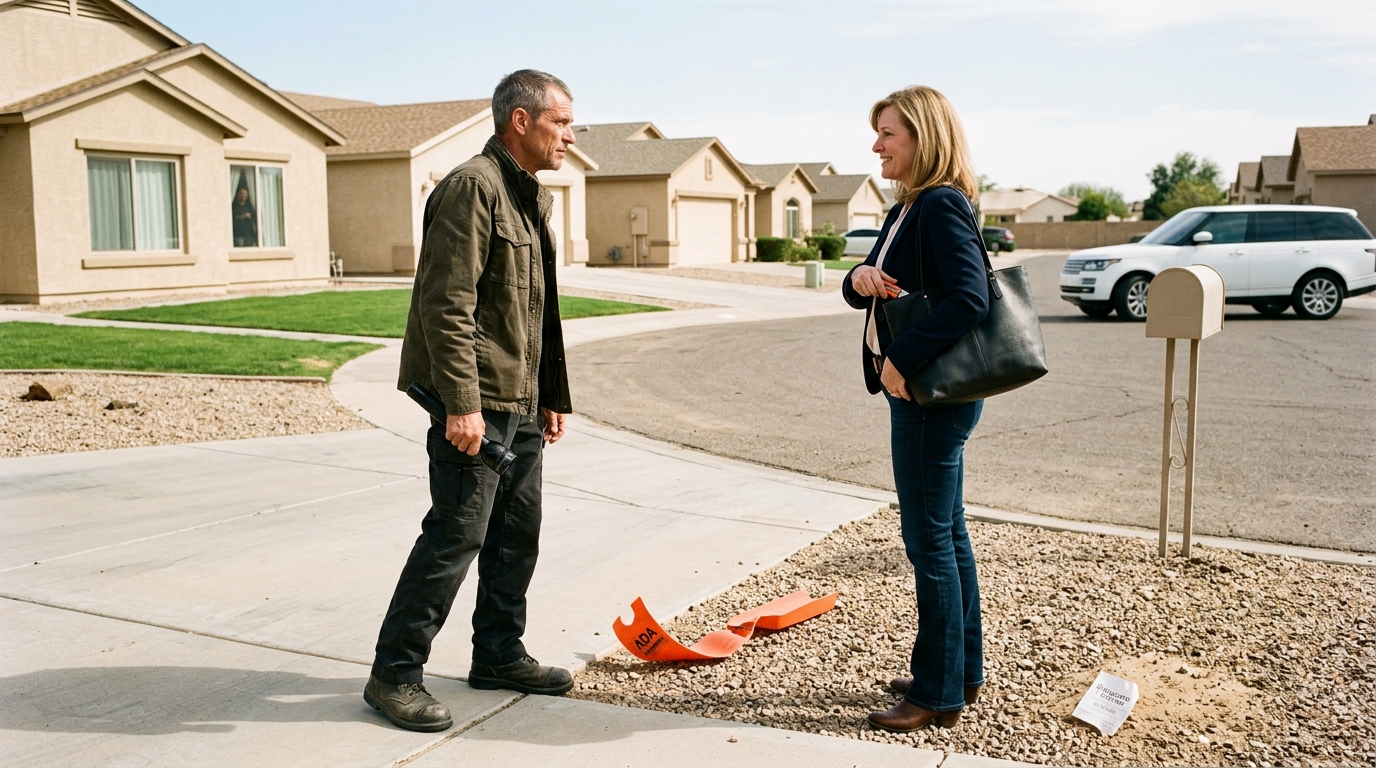
6:47 a.m. High-desert sun, white-hot and flat against the stucco. Brenda Clearwater didn’t see me in the doorway shadow. She was down on one knee in my gravel border, designer denim stretched tight, dragging a utility knife across my orange path markers.
Slicing.
The heavy-duty orange polymer didn’t snap. It groaned, curling back like peeled skin under the steel edge.
I didn’t yell. I shifted six inches to the left, planting my right heel firm against the concrete threshold, taking eighty percent of my body weight off my bad knee. My left leg was cold lead from the hip down—shrapnel scars pulling tight like dried leather under my jeans. I thumbed the textured grip of the heavy black Maglite in my palm. Four D-cell batteries. Heavy enough to drive a tent peg.
“That’s federal property, Brenda.”
Her shoulders jerked. The box cutter slipped, nicking the white marble rock in the flowerbed with a dry clink.
She stood up slow. No rush. She brushed two specks of red dirt off her knee, flicked the thumb-lock to retract the blade, and tucked the tool into her leather tote.
“It’s a nuisance, Miles,” she said. Her voice was pure syrup—smooth, high-register, practiced over twenty years of selling Pfizer pharmaceuticals to tired doctors. “Section 4, Paragraph B of the Desert Winds CC&Rs. Non-conforming exterior fixtures. Bright orange looks like a road construction site.”
“It’s a court-ordered ADA marker,” I said. My voice stayed low, flat, trapped in my chest. “Judge Hernandez signed the order Tuesday. You were served at eight this morning.”
Brenda smiled. Her lips were painted the color of dried bricks. She stepped over the severed orange stub, her expensive leather heel crunching into the gravel, and pointed toward the street.
Her white Range Rover sat idling right at the base of my apron. The back bumper hung six inches across my driveway line, blocking the ramp Carmen used for the night shift.
“This isn’t a VA clinic, Sergeant,” she said. She didn’t look at my leg. She looked at my eyes, testing for a twitch, a flare, an anger she could log into the HOA portal as ‘resident hostility’. “We preserve equity here. Orange strips lower the comps on the entire cul-de-sac. Clean it up by noon, or the daily fines double.”
She turned her back on me—a calculated show of absolute safety—and walked toward her SUV.
I didn’t move. My left hand stayed jammed in my jacket pocket, my thumb pressing the side-record button on the digital audio recorder tucked beside my keys. The red light was solid. One-party consent state. Arizona law.
Under her front driver-side tire, pinned against the blacktop, was a fresh yellow billing slip from Apex-Four Landscaping. The print was fresh. The ink had smeared on the hot asphalt.
I took one limping step forward, the steel flashlight swinging in my right hand, keeping my eyes locked on the paper, not the woman.
“You’re paying Apex-Four four grand a month for border trimming,” I said, my tone strictly business. “They haven’t run a trimmer down this street since March.”
Brenda stopped with her hand on the Range Rover’s chrome handle. The engine hummed, smooth and expensive. She didn’t turn around. Her chin lifted half an inch in the side mirror.
“Check the portal, Miles,” she whispered, her voice dropping the syrup, revealing the cold iron underneath. “Your account’s already flagged. Pay the violation fees or we place the lien.”
The door slammed shut. The Range Rover pulled away, leaving a faint haze of exhaust against the crisp desert air.
I knelt—slowly, letting the right quad take the burn—and picked up the slashed piece of orange marker. The cut was clean. Straight line. Deliberate.
Beside it, half-buried in the dust where her tire had rolled, lay a small printed receipt stub she’d dropped from her bag. It wasn’t for landscaping.
Printed across the top in block text was a single header: Saguaro Escrow – Account Verification.
CHAPTER 2: PAPER WARFARE
The exhaust fumes settled into the creosote bushes, leaving behind the stink of unburnt premium fuel.
I stood on the edge of the apron for three full seconds, letting the heat from the blacktop soak through the thin rubber of my work boots. My left knee throbbed—a dull, rhythmic pulse that matched the ticking of the cooling metal in my flashlight casing. I didn’t reach down to rub it. You rub a bad joint, you tell everyone on the street where to hit you.
I smoothed the paper against my thigh.
The receipt was thermal print, standard three-inch roll, slightly curled from being jammed in a leather bag. The top line read Saguaro Escrow – Account Verification. Below that, typed in a tight, sans-serif font: Ref: Deed-71B / Pending Authorization. No client name. No dollar figure. Just a stamp in pale blue ink near the bottom margin: AUDIT HOLD – APEX-FOUR CROSS-MATCH.
A white commercial van with no side windows turned slow onto the cul-de-sac, its tires grinding over the loose gravel near the storm drain. On the driver-side door, painted in faded blue stencil, was the name: Apex-Four Landscaping.
It didn’t stop at my house. It didn’t stop at any house. It rolled past at ten miles an hour, the engine rattling with a loose heat shield, and turned out toward the main gate.
They weren’t here to cut grass. They were logging mileage. Establishing a physical presence on the street to justify whatever invoice Brenda cleared through the portal every Friday at midnight.
I folded the paper once, longways, and slipped it into my back pocket next to my notebook.
“Miles?”
Tom Rodriguez was standing on his porch across the street, holding a red plastic watering can. He was seventy-one, retired high school math teacher, wore his white hair clipped short like he was still enforcing dress codes in 1994. He had a yellow legal pad tucked under his arm.
I limped across the street, keeping my pace steady, right foot planting hard, left foot dragging just enough to clear the seams in the concrete.
“She cut ’em again, didn’t she?” Tom asked. He didn’t look down at my hand where the severed orange polymer hung like a piece of dead hose. He looked at my face.
“She used a box cutter this time,” I said. “Progress. Last month she used her shears.”
“I took pictures from the kitchen window,” Tom said, his voice dropping into that flat, quiet register people use when they know the HOA portal logs every phone call as a potential dispute. He tapped the legal pad. “She parked her Range Rover four inches over your boundary line. That’s three violations under her own parking addendum. I logged the timestamp. 6:46 a.m.”
“Keep the log, Tom. Don’t upload it.”
“Why not? We take it to the board on Friday, we show them she’s breaking her own rules—”
“The board is Dale Pinkerton and Judy Whitmore,” I said. I leaned my weight against his porch railing, feeling the cheap pine give half an inch under my palm. “Dale signs the checks. Judy writes the minutes. You give them that log, Dale files it under ‘resident harassment’ and bills you fifty bucks for a frivolous submission.”
Tom’s jaw tightened. His thumb rubbed a smooth spot on the handle of his watering can, back and forth, stripping away the red paint until the gray plastic showed underneath.
“My wife’s pension check came yesterday, Miles,” he whispered. “There was a sixty-dollar line item deducted at the bank before it even hit our checking account. ‘HOA Special Assessment – Legal Contingency’. We didn’t vote on a special assessment.”
“Check your title papers,” I said. “Look for a rider marked Deed-71B.”
Tom frowned. “What is that?”
“I don’t know yet,” I said. “But Brenda dropped a receipt from Saguaro Escrow ten minutes ago. It’s tied to that code. And it’s tied to Apex-Four.”
Tom looked toward the end of the street where the landscaping van had vanished. “They haven’t pruned my mesquite tree since November. I had to hire my nephew to do it.”
“That’s the point,” I said. I pulled my hands out of my pockets and adjusted my grip on the heavy Maglite. “They aren’t getting paid to trim trees, Tom. They’re getting paid to generate paper.”
My phone buzzed in my hip pocket. Two sharp pulses.
I pulled it out. Text message from Carmen: Just finished 12-hour shift. ICU was a war zone. Home in twenty. Did the markers survive?
I typed back with my thumb: Working on a new set. Drive safe.
I turned back toward my house. The sun was fully over the ridge now, turning the beige stucco of Desert Winds Estates into a long, monotonous wall of baked clay. Eighty-four houses, all painted the same shade of ‘Sandalwood Desert’, all managed by three people with a checkbook and a rubber stamp.
Inside my garage, the air smelled of saw dust, old oil, and hot iron. I shut the side door, slid the deadbolt, and walked over to my workbench.
My IT rig sat in the corner under a plastic dust sheet—two 27-inch monitors, a custom-built liquid-cooled tower, and an encrypted hard drive running a local SQL database. I flipped the power strip. The fans hummed to life, blue LED lighting up the dark concrete floor.
I plugged my digital recorder into the front USB port and pulled up the audio file from 6:47 a.m.
Brenda’s voice came through the desktop speakers, crisp and sharp, stripped of the desert wind:
“…Section 4, Paragraph B of the Desert Winds CC&Rs… Non-conforming exterior fixtures… Check the portal, Miles… Your account’s already flagged. Pay the violation fees or we place the lien.”
I paused the track, highlighted the word lien, and ran an audio analysis to isolate the background noise behind her voice.
Underneath her tone, clear as a bell, was the double-tone beep of an automated bank teller line. She hadn’t just been standing in my gravel border cutting my property—she had been on a open speaker call with an automated clearinghouse while she did it.
I opened a secondary browser window and entered the public land records portal for Maricopa County. I typed in my own parcel number first.
Status: Active.
Lien Status: Clear.
Pending Action: Notice of Non-Compliance – Filed July 19 by Desert Winds HOA.
Then I typed in Tom Rodriguez’s parcel number.
Status: Active.
Lien Status: Conditional Hold.
Document Code: Deed-71B – Saguaro Escrow / Apex-Four Services Group.
My fingers stayed still over the mechanical keyboard. The keys were cold under my pads.
The conditional hold wasn’t for unpaid dues. It was a pre-foreclosure lien, filed forty-eight hours ago, quietly attached to the property title without a public notice. Tom didn’t even know his home was on the block.
A sharp knock rattled the thin wood of the garage side door. Three quick thuds, followed by a heavy palm flat against the panel.
“Miles?”
It was Carmen’s voice, but her tone wasn’t tired from an ICU shift. It was tight. Controlled. The sound she made when a trauma patient went into cardiac arrest before the gantry hit the bay.
I minimized the county portal window, walked to the door, and slid the bolt back.
Carmen stood on the hot gravel path, her blue scrubs rumpled at the elbows, her hair pulled back in a loose clip. In her right hand, she held a white certified letter with a yellow certified mail receipt tucked under the plastic window.
“This was jammed in the front door,” she said. She didn’t come inside. She held the envelope out toward me like it was contaminated medical waste. “They aren’t fining us anymore, Miles.”
I took the envelope. My thumb caught on the coarse paper edge.
“What is it?” I asked.
“Notice of Default,” she said, her voice dropping into a low, vicious whisper. “They’re claiming six thousand dollars in back legal fees for the ADA lawsuit. They gave us seventy-two hours to clear the balance or they start the foreclosure process on the house.”
CHAPTER 3: THE WIRETAP THRESHOLD
The printer pulled another sheet of paper from the tray with a dry, screeching slide.
Whir-clack.
Carmen didn’t look back at the machine. Her eyes stayed locked on my right hand—the way my thumb dug into the white weave of the envelope until the cardboard stock creaked under the pressure.
“Seventy-two hours,” she said. Her voice didn’t shake, but her jaw muscle twitched once, hard. “They filed it through a trustee called Saguaro Escrow. Miles, we don’t even have a mortgage with them.”
“We don’t,” I said. “The HOA board signed an assessment rider two years ago. Page forty-two of the CC&Rs. Any legal expense incurred while ‘defending community standards’ gets attached directly to the parcel deed.”
I didn’t open the envelope right away. I hooked my thumb under the top flap, feeling the sharp paper edge bite into my callous, and pulled the document out. The red seal at the header was thick, cheap wax.
Demand for Cure or Sale.
The printer behind me stopped. The mechanical hum died down, leaving only the soft click-clack of the cooling fan inside my rig tower.
I took three slow steps backward into the shade of the garage, dragging my left heel over the concrete floor. “Get inside, Carmen. Wash your hands. Put the kettle on.”
“Don’t talk to me like I’m a patient in triage,” she said. She stepped over the threshold, her rubber-soled nursing shoes squeaking against the painted slab. She reached out, her fingers catching the front of my canvas jacket, pulling me half an inch forward until I had to balance my weight on my good right leg. “We have three thousand dollars in savings. Zoe needs her braces adjusted next week. If they attach a lien—”
“They already attached it,” I said.
I turned the top sheet of the county printout toward her. The paper was still warm from the drum.
Her eyes scanned the bold text halfway down the page.
Parcel 104-22-019. Primary Lienholder: Desert Winds Homeowners Association. Secondary Assignee: Apex-Four Services Group. Instrument Type: Deed-71B.
She swallowed. The tight fold between her eyebrows deepened. “That’s Tom’s house number.”
“It’s Tom’s house,” I said. “And ours is right under it on the docket. They aren’t trying to collect six grand, Carmen. Six grand is just the threshold to trigger an expedited foreclosure under Arizona revised statutes.”
She let go of my jacket. Her hand dropped to her side, her fingers curling into a tight fist against her thigh. “She’s doing this because you filed the federal accommodation claim.”
“She’s doing this because the federal claim forces an independent audit of the HOA accounts,” I said. I walked over to the workbench, picked up my heavy Maglite, and set it down hard next to my keyboard. The metal hit the wood with a dull, hollow thud. “If the judge looks at our account, she sees the legal fees. If she sees the legal fees, she looks at the escrow line. Once she looks at the escrow line, Brenda’s entire operation collapses.”
I pulled up my local audio database and opened a fresh recording track.
On the secondary monitor, the audio spectrum analyzer flickered in green bars—silent, waiting for an input.
“What are you doing?” Carmen asked. Her voice was lower now, cautious.
“Arizona is a one-party consent state,” I said, my voice flat. “That applies to phone calls. It applies to doorstep conversations. But it also applies to public meetings if there’s no reasonable expectation of privacy.”
I clicked an icon on the desktop labeled Bridge-V.
A small window popped up, prompting for an IP address and a port configuration.
“The HOA board uses an internet-based PBX system for their emergency calls,” I said, pointing at the screen. “Dale Pinkerton set it up three years ago to save forty bucks a month on a landline. He left the default administrative password active on the local gateway.”
Carmen stared at the green bars flickering on the screen. “That’s a federal wire violation if you break into a private network.”
“I’m not breaking into a private network,” I said. “I’m accessing the public resident access line listed on page two of our monthly newsletter. Dale forgot to isolate the board member bridge from the main trunk.”
I hit Enter.
A sharp burst of white noise hissed through the desktop speakers, followed immediately by the hollow acoustic ring of a speakerphone sitting on an oak table.
Two clicks. Then a voice—thin, metallic, slightly distorted by cheap compression:
“…he’s not paying it, Brenda. I checked his portal account ten minutes ago. He logged off at 7:15.”
That was Dale Pinkerton. The accountant.
A chair scraped against a tiled floor in the background. Then Brenda’s voice came through, clear as broken glass:
“He doesn’t have to pay it, Dale. That’s the beauty of the seventy-two-hour notice. Once the clock runs out on Monday morning, Saguaro Escrow automatically executes the default transfer under Deed-71B. Apex-Four takes title by noon.”
“What about the federal judge?” Dale asked. Paper rustled near the microphone. “Hernandez signed the order for his path markers. If she finds out we issued a default during an active civil rights review—”
“Hernandez doesn’t matter if there’s no owner of record to hold the accommodation,” Brenda interrupted. Her voice had no syrup now. It was cold, precise, stripped down to pure mechanical leverage. “A foreclosed parcel reverts to the association pool. The accommodation becomes moot. We clear the markers, we clear the lien, and we settle the escrow account with Apex-Four before the annual meeting on Friday.”
A long pause hung over the line. The white noise hissed through the garage.
“And the Rodriguez property?” Dale asked quietly.
“Tom’s ninety days behind on his special assessment,” Brenda said. “Same packet. Same trustee. Judy’s dropping the certified notice in his box at four o’clock.”
I reached out with my left hand and tapped the Spacebar.
The audio feed cut off instantly. The green bars dropped to zero.
The garage was silent again, save for the faint sound of the wind rattling the metal garage door tracks outside.
Carmen stood frozen near the workbench. Her face was pale under the dim fluorescent bulb overhead. Her eyes moved from the quiet screen to the white certified envelope sitting next to my keyboard.
“They’re taking the houses,” she whispered.
“They’re taking the land,” I corrected her. “The houses are just collateral.”
I reached down to my back pocket, pulled out the crushed thermal receipt Brenda had dropped in my gravel border, and flattened it against the desk next to the Notice of Default.
The pale blue stamp was still visible under the halogen light: AUDIT HOLD – APEX-FOUR CROSS-MATCH.
“She thinks she has seventy-two hours,” I said. I picked up my phone, unlocked the screen, and dialed Tom Rodriguez’s number.
“Miles?” Carmen asked, her voice tight. “What are you going to do?”
I put the phone to my ear and waited for the dial tone to clear.
“I’m going to give Tom his legal pad,” I said. “And then we’re going to rewrite the agenda for Friday’s meeting.”
CHAPTER 4: AUDIT ON THE WIRE
“Miles?” Tom’s voice came through the earpiece, thin and strained over the speaker. “I saw Judy Whitmore’s car pull up to my curb two minutes ago. She didn’t get out. She slipped a yellow envelope into my door slot and drove off.”
“Don’t open it yet, Tom,” I said, keeping my eyes locked on the two documents side by side under the desktop lamp. “I’m coming over. Bring your water bill and your original purchase deed from 2019.”
“What’s happening?”
“The landscaping invoices were a blind,” I said. “Apex-Four isn’t taking kickbacks for unperformed yard work. They’re buying the HOA’s defaulted paper.”
I hung up before he could ask a second question.
Carmen was already standing by the side door, holding her car keys in her right hand. Her thumb worked the plastic casing, clicking the lock button over and over until the little red LED flashed like an alarm.
“I’m coming with you,” she said.
“No,” I said, grabbing my heavy black Maglite and sliding the printed county records into an accordion file folder under my arm. “Stay inside. Keep the side door bolted. If anyone from the board steps onto our apron, don’t talk to them. Point to the window camera and stay on the porch.”
She took one deep breath, her nostrils flaring, then nodded once. “Seventy-one hours left on that default clock, Miles.”
“The clock stops when the fraud breaks,” I said.
I stepped out into the blinding afternoon glare. The heat hit my face like a furnace door swinging open. 104 degrees. The concrete driveway radiated heat straight through the soles of my work boots, making the scar tissue in my left calf pull tight.
I walked across the asphalt cul-de-sac, taking deliberate, measured strides. Right heel down firm, left leg swinging through, taking the impact on the hip.
Tom was waiting behind his screen door. The yellow envelope sat on his entryway table, unopened, the black marker print on the front reading: OFFICIAL BOARD COMMUNICATION – URGENT.
“It’s the same wax seal,” Tom said, unlocking the latch and letting me in. The air inside his house smelled of old coffee, lemon furniture wax, and stale air conditioning. “I looked up Deed-71B in my closing packet while I was waiting for you. It wasn’t in the primary deed.”
I set the accordion folder on his dining table next to a pile of neatly organized utility receipts. “Where was it?”
“It was in the rider,” Tom said. He pulled a yellowed stapled document from a blue paper sleeve and laid it flat under the chandelier light. “Page fourteen. Paragraph C. ‘Special Escrow Authorization’.”
I leaned over the table, supporting my upper body with my left palm flat on the polished oak.
My eyes scanned the dense, eight-point legal type.
…In the event of uncollected administrative assessments exceeding six calendar weeks, the Board of Directors retains sole discretionary authority to assign collection rights to Saguaro Escrow, LLC, under master covenant reference Deed-71B…
Below the text was a signature line.
It wasn’t signed by Tom. It was signed by Brenda Clearwater as Declarant Agent, dated three days before Tom took the keys to his house in 2019.
“She built the trap before you even bought the place,” I said.
“Is it legal?” Tom’s hand hovered over his chest, his fingers clutching the fabric of his polo shirt right over his sternum.
“It’s legal if the debt is real,” I said. I opened my folder and pulled out the county title printouts I’d pulled ten minutes earlier. “Look at the numbers. They billed you eight hundred dollars for ‘unapproved exterior modifications’ in March. What did you change?”
“Nothing,” Tom said, his voice rising a fraction of an octave. “I replaced a broken porch light fixture with the exact same model from Home Depot.”
“They flagged it as non-conforming,” I pointed out, tracing the line item with my thumbnail. “Then they added a fifty-dollar late fee every seven days. When you didn’t pay the non-conforming fine, they transferred the debt to Apex-Four as an delinquent account.”
I pulled out the Apex-Four cross-match receipt Brenda had dropped in my driveway.
“Apex-Four doesn’t just collect,” I said. “Look at the registration code on the bottom of the escrow receipt. Apex-Four Services Group, LLC. Registered agent: Judy Whitmore. Managing partner: Dale Pinkerton.”
Tom stared at the paper. The color drained from his face until the age spots on his temples stood out like dark ink on parchment.
“Judy and Dale?” he whispered. “They own the landscaping company?”
“They own the collection entity,” I corrected him. “Brenda writes the violation notices. Dale flags the portal accounts as delinquent. Judy’s shell company buys the debt for pennies on the dollar through Saguaro Escrow. Once they own the debt, they execute the Deed-71B rider to file a pre-foreclosure lien against the property.”
“They’re stealing our homes,” Tom said, his voice dropping into a hollow, terrifying whisper.
“They aren’t keeping the homes,” I said. “They don’t want the houses. Once the foreclosure clears, Apex-Four sells the title to an institutional landlord group at market value, pays off the fake HOA lien, and pockets the equity spread. That’s why Brenda doesn’t care about the federal court order for my markers. The markers don’t matter. Me filing the accommodation claim threatened to bring a federal monitor into the portal books before they could finish clearing your title.”
The front doorbell rang.
A sharp, two-tone chime that vibrated through the quiet living room.
Tom jerked back from the table. “That’s Judy.”
“Stay here,” I said.
I picked up my Maglite from the table, gripped the textured aluminum handle, and walked to the front window, pulling the sheer curtain back two inches.
Standing on the front porch wasn’t Judy Whitmore.
It was a man in a gray polo shirt with no logo, wearing a black nylon utility belt with a holstered sidearm and a radio handset clipped to his shoulder. Behind him, idling at the curb, sat a black tow truck with its winch assembly raised.
Behind the wheel of the tow truck was Dale Pinkerton.
The man on the porch reached out and slapped a red adhesive notice directly onto the center glass of Tom’s front door.
I unlocked the deadbolt and pulled the door open before the man could pull his hand back.
“Can I help you?” I asked, stepping onto the threshold and blocking the doorway with my shoulder.
The guard didn’t flinch. He was fortyish, short-cropped hair, eyes like dull steel marbles. “Private security enforcement for Desert Winds HOA. Vehicle on the property line is in violation of emergency access codes. We’re clearing the driveway.”
Behind him, down on the street, Dale Pinkerton leaned out the window of the tow truck cab, holding a clip board.
“That’s Tom’s sedan,” I said, pointing toward the blue Buick parked neatly inside the garage apron. “It’s inside his property boundary.”
“Read the sticker, sir,” the guard said, his voice completely dead of emotion. “Notice of Immediate Abatement under Deed-71B. As of 2:00 p.m., the driveway apron is designated as a corporate access zone. Move the vehicle or it gets hooked.”
From the truck cab, Dale called out over the idling rumble of the diesel engine: “Seventy-two hours is up for the driveway, Miles! Check the portal!”
I didn’t look at Dale. I looked at the guard’s radio handset.
A faint burst of static clicked through the small speaker on his shoulder, followed by Brenda’s voice, distorted and sharp:
“Is the veteran interfering?”
The guard reached up, clicked his lapel mic, and spoke without taking his eyes off my face: “He’s on the threshold.”
“Serve him the secondary injunction,” Brenda ordered over the radio. “Both of them. Block their portal access until Friday.”
CHAPTER 5: THE ANNUAL TRAP
The guard’s gloved fingers hooked the corner of a stiff legal document, pulling it three inches out of the vinyl pouch.
Down at the curb, Dale Pinkerton slammed the tow truck into reverse. The back tires bit into the gravel, shooting a spray of white rock against Tom’s mailbox post. The steel winch hook clattered against the bed with a heavy, rhythmic thunk-thunk-thunk.
I didn’t move my foot off the threshold.
“You have six seconds to step off the porch, sir,” the guard said. His voice didn’t rise. His thumb rested lightly on the snap buckle of his belt pouch.
“That document isn’t signed by a magistrate,” I said. My voice was low, carrying just enough weight to cut through the idle of the diesel engine. “It’s an administrative hold signed by Judy Whitmore acting as an unregistered escrow officer for Saguaro Escrow.”
The guard’s left eyelid twitched once. He didn’t pull the paper out any further.
“Dale!” I called out over the guard’s shoulder, my voice swinging toward the street like a length of iron pipe. “Your hydraulic line on the bed cylinder is weeping fluid onto the asphalt!”
In the cab, Dale’s head jerked toward his side mirror.
His hand instinctively hit the PTO lever inside the cab. The winch gave a loud, metallic screech—a dry steel cable grinding against an ungreased drum—and jammed dead. The engine sputtered, coughing a thick cloud of black diesel smoke into the dry air.
“It’s 104 degrees, Dale,” I said, taking half a step forward on the porch, putting my good right boot flat on the top step. “Your pump’s overheating because Judy bought cheap fluid from the Apex-Four supply yard.”
Dale shoved the truck door open and stumbled out onto the hot pavement, his face dark red under a sweat-stained golf cap. He held a clipboard in his left hand, his thumb clutching a yellow carbon sheet.
“Don’t talk to him, Miller!” Dale shouted at the guard. “Serve the paper! Clear the apron!”
“He can’t serve a civil injunction on private property without a deputy present, Dale,” I said. I pulled my right hand out of my jacket pocket, holding my phone flat in my palm. The screen was live, displaying a direct file transfer progress bar. “And while you’ve been standing here idling, the county recorder’s office just received three certified copies of the Saguaro Escrow ledger.”
Dale froze five feet from the bumper. His grip on the clipboard slackened. “What ledger?”
“The one Judy saved on the shared board drive under Deed-71B,” I said. “The one listing eighty-four properties, the fake non-compliance fines, and the direct wire routing numbers to Apex-Four’s account in Nassau.”
The guard slowly took his hand off his belt pouch. He looked from me to Dale, his jaw tightening into a hard, rigid line. “Mr. Pinkerton? What is he talking about?”
“Shut up, Miller!” Dale snapped, his voice cracking on the high note. He turned toward the truck cab, grabbing the radio microphone off the dash. “Brenda! Brenda, come in! He’s got the Nassau file!”
Static hissed over the guard’s shoulder mic, but no voice answered.
“She cut the feed, Dale,” I said, stepping off the porch now, my left leg tracking clean and hard across the concrete path. “She locked the portal ten minutes ago. She’s at the clubhouse getting ready for the 6:00 p.m. annual meeting, and her name isn’t on the Apex-Four corporate registry. Yours is. Yours and Judy’s.”
Dale took two steps backward, his heels catching on the curb drain. The paper on his clipboard rattled in the rising desert wind.
“The meeting starts in twenty minutes,” I said, stopping three feet from his front tire. “Every homeowner in Desert Winds received an automated text notification five minutes ago. Not from the board portal. From my server.”
Dale stared at me, his eyes wide, bloodshot, fixed on the phone in my hand. “You can’t contact the association membership. That’s a CC&R violation—”
“I didn’t use the association list,” I said. “I used the public tax roll numbers from the Maricopa County Assessor. Eighty-four owners. All eighty-four are sitting in the clubhouse right now waiting to see why their escrow accounts have audit holds.”
Tom Rodriguez stepped out onto the porch behind me, holding his yellow legal pad in one hand and his white water bill in the other. His shirt sleeves were rolled up to his elbows. He looked at Dale, then at the stalled tow truck blocking his driveway.
“I brought my calculator, Dale,” Tom said, his voice quiet, steady, carrying forty years of high school algebra logic. “We’re going to go over those landscaping line items line by line.”
Dale looked down the street toward the main entrance of Desert Winds.
At the end of the cul-de-sac, two garage doors opened simultaneously. Mrs. Smith stepped out onto her driveway, holding a manila folder. Across the street, the double doors of the Henderson house swung wide.
The street was moving. No one was yelling. No one was rushing. They were just walking out onto the pavement, folders and paper packets in their hands, heading toward the main road that led to the clubhouse.
The guard looked at the folded paper still sitting in his pouch, then looked at Dale. He pulled the red adhesive sticker off Tom’s front glass, balled it up in his gloved fist, and tossed it into the bed of the flatbed.
“My shift ended five minutes ago,” the guard said flatly. He turned and walked down the sidewalk toward his personal sedan parked by the fire hydrant.
Dale stood alone by the idling truck, his face pale under the blazing sun, the sweat dripping off his chin onto his yellow clipboard.
I looked at my watch. 5:48 p.m.
“Twelve minutes, Dale,” I said, turning toward my own driveway where Carmen was waiting by our car with the air conditioning already running. “Let’s go see what Brenda’s planning to present to the board.”
CHAPTER 6: FEDERAL EXECUTION
The sedan’s air conditioner hummed against the dashboard, blowing cold air that smelled of dried copper and foam insulation.
In the side mirror, Tom’s blue Buick pulled out behind us, followed by Mrs. Smith’s silver station wagon. A convoy of five cars moving down Desert Winds Way at twenty miles an hour.
“The room is already full,” Carmen said, her hands fixed at ten and two on the steering wheel. Her scrubs were dry now, stiffened with salt around the collar. “Tom texted the neighborhood chat twenty minutes ago. Over sixty residents signed into the lobby stream.”
“Brenda won’t use the podium,” I said, setting the accordion folder across my lap and adjusting the heavy Maglite between my knees. “She’ll stand near the side exit by the kitchen. That’s where the municipal gateway box is mounted.”
Two minutes later, Carmen pulled into the recreation center parking lot.
The white Range Rover was parked diagonally across two handicapped spaces near the front ramp, its engine off, tires cut hard toward the curb.
Inside the multipurpose room, ninety padded metal chairs were arranged in neat rows facing an oak dais. Every seat was occupied. Residents stood three deep along the back wall under the fluorescent strip lights. The air was thick with the smell of cheap drip coffee, desert dust, and low, nervous whispers.
At the front table sat Judy Whitmore, her fingers shuffling through a stack of blue cardstock folders, and Dale Pinkerton, his shirt collar unbuttoned, his face pale and wet under the overhead lights.
Brenda Clearwater stood to the left of the dais, holding a wireless microphone in a gloved hand. She wore a tailored beige suit, her hair slicked back without a strand out of place. Her expression was perfectly still—the cold, practiced composure of an executive managing a minor shareholder dispute.
The room quieted as the double doors behind us hissed shut.
“Good evening, neighbors,” Brenda said. Her voice came through the wall-mounted speakers smooth and resonant. “Before we open the floor to public comments regarding the annual landscape assessment, I want to address the administrative rumors circulating on social media.”
I walked down the center aisle. My left boot made a heavy, rhythmic thud against the linoleum floor with every second step. Right heel, left drag. The crowd parted quietly, stepping back against the folding chairs to let Carmen, Tom, and me pass.
I stopped ten feet from the table, right at the microphone stand set up for resident questions.
“We aren’t here about landscaping, Brenda,” I said. My voice didn’t need the amplifier. It bounced off the high drywall ceiling, flat and dry.
Judy Whitmore didn’t look up from her folders. Her right hand twitched, her index finger tapping the plastic edge of a blue binder over and over.
“Sergeant,” Brenda said, her smile widening by a fraction of an inch. “This is an executive board meeting. Individual grievance appeals are handled during the Tuesday subcommittee sessions. Please take a seat so Mr. Pinkerton can read the financial minutes.”
“Read the line item for Deed-71B, Dale,” I said, turning my eyes directly onto the accountant.
Dale’s hand shook so violently he dropped his pen. It clattered across the oak table and rolled off the edge, bouncing twice on the floor.
“There is no Deed-71B on the public agenda,” Brenda stated, her tone dropping half an octave into sharp, authority-line precision. “Security, please clear the aisle.”
No one moved. The private security guard from Tom’s house was standing by the emergency exit doors at the back of the hall, his arms folded across his chest. He looked straight ahead at the wall clock, completely motionless.
“Page fourteen of the master covenant rider,” I said, opening the accordion file on the podium shelf and pulling out the three certified county deeds. “A master clause allowing the board to reclassify non-payment of arbitrary aesthetic fines as a direct lien against property titles.”
A murmur rippled through the back three rows. Mrs. Smith stood up from her chair, holding her manila folder high above her head. “Why is there an escrow hold on my title from Saguaro Escrow?” she called out.
“It’s a standard collection mechanism for delinquent accounts, Mrs. Smith,” Brenda said, stepping forward, her microphone hum rising in pitch as she approached the table. “Our legal counsel utilizes standard third-party servicing—”
“Saguaro Escrow isn’t a third-party service,” I interrupted. “It’s an shell company registered to an offshore routing address in Nassau. The managing directors are Judy Whitmore and Dale Pinkerton.”
Judy slammed her binder shut. The sharp crack echoed through the room like a gunshot. “That is an unverified defamation claim, and if you repeat it—”
“I don’t need to repeat it,” I said. I pulled my phone from my pocket and tapped the screen once, routing the output to the hall’s AV projector system via the open local bridge.
The white projection screen behind the board table flickered, blue light washing over Brenda’s suit, then resolved into a high-resolution spreadsheet.
Columns of numbers stretched from top to bottom. Eighty-four parcel numbers. Next to each parcel, a list of accrued fines—forty dollars for trash cans, sixty dollars for lawn height, eighty dollars for reflective markers. And beside every fine, a secondary column showing automatic transfer approvals to Apex-Four Services Group.
“That’s the full ledger,” I said to the room. “Seventy-two hours after a notice is served, the debt is bundled and transferred to Apex-Four. Apex-Four executes the pre-foreclosure lien under Deed-71B through Saguaro Escrow. They don’t want your fine money. They want the title so they can sell the deeds to institutional investment buyers at thirty percent under market.”
The quiet in the room shattered.
Ten people stood up at once. Tom Rodriguez walked straight to the table and laid his yellow legal pad flat in front of Dale Pinkerton.
“My house was paid off in 2021, Dale,” Tom said, his voice trembling with a cold, clear fury. “You put a sixty-thousand-dollar cloud on my deed for a broken porch light.”
Dale didn’t answer. He shrank back into his chair, covering his mouth with his hand, staring down at the table surface.
Brenda didn’t panic. She reached into her blazer pocket, pulled out her cell phone, and turned toward the side kitchen exit. “This meeting is adjourned due to resident disruption. The board will reconvene in closed executive session—”
The side exit doors swung inward.
Two men in dark suits stepped into the room, followed by a woman in a grey tailored coat holding a leather briefcase.
It was Judge Patricia Hernandez. Beside her stood Assistant U.S. Attorney David Vance, holding a signed federal warrant folder with a gold foil emblem on the cover.
“Sit down, Mrs. Clearwater,” Judge Hernandez said. Her voice was quiet, but the entire hall fell instantly silent. She didn’t look at the crowd. She looked at Brenda’s hands.
Brenda stopped three inches from the door. Her thumb hovered over her phone screen. “Judge Hernandez. This is a private association matter under state civil jurisdiction—”
“You served a Notice of Default on an active federal court claimant while under an injunction review,” Attorney Vance said, opening the warrant file and placing it on the table directly over Judy’s blue binders. “That’s civil rights intimidation under Title 42, combined with wire fraud across state lines via the Nassau clearinghouse.”
Two federal agents stepped through the main entrance doors behind the crowd, carrying heavy grey plastic evidence totes.
Judy Whitmore began to cry—a quiet, breathless sob—as she pushed her chair back and put her hands flat on the desk. Dale didn’t move at all; his chin rested against his chest, his eyes fixed on the floor.
Brenda stood motionless by the kitchen door. The wireless microphone slipped from her fingers, dropping onto the carpeted runner with a heavy, muffled thump that resonated through the room speakers. She looked at me once—not with anger, but with the cold, calculating metric of a salesman who had finally run out of leverage.
“The liens are vacated as of 4:00 p.m. today, Sergeant,” Judge Hernandez said, turning toward me and offering a brief, firm nod. “Your accommodation order stands.”
The desert air at 8:30 p.m. had dropped to eighty-two degrees.
The parking lot was almost empty. The federal vans had driven off twenty minutes earlier, taking the server boxes from the board office and the three corporate ledgers. A flatbed tow truck from the county sheriff’s office was currently hooking Brenda’s Range Rover from the handicapped space, its yellow strobe lights flashing slowly against the stucco walls of the clubhouse.
Tom Rodriguez sat on the tailgate of my pickup truck, drinking a bottle of water, watching the tow truck pull away.
“They’re appointing an interim receiver on Monday,” Tom said, wiping his brow with his sleeve. “A court-appointed trustee to run the accounts until we can hold a real election.”
“Good,” I said.
I sat on the edge of my tailgate, letting my left leg hang down straight toward the cool asphalt. The ache in my knee had settled into a dull, manageable hum.
Carmen walked out from the side path carrying a small cardboard box from the garage. Inside were six brand-new pathway markers—heavy-duty composite polymer, bright orange, backed with high-visibility reflective tape, each stamped with an official federal compliance seal along the lower shaft.
She set the box down next to my boots.
I reached in, picked up the first marker, and tested the weight in my hand. It was solid, heavy, unyielding.
I pulled my cordless driver from my tool bag, aligned the stainless steel mounting bracket against the bottom edge of the strip, and drove the first screw home.
Zrr-clack.
The screw seated flush against the hard composite surface, locking the bracket permanently in place.
“How many do we need?” Carmen asked, leaning her shoulder against mine, watching the orange reflector catch the yellow glow of the streetlamp.
“Four,” I said, setting the finished marker down and picking up the second one. “Two for our walkway. Two for Tom’s driveway.”
I drove the second screw in, the sound of the tool sharp and clean against the quiet desert night. The sky above Desert Winds was completely dark now, clear and wide, filled with a million cold, silent stars stretching out past the mountain ridge.