The Price of Breath: When Private Power Meets Cold Steel on the Asphalt
CHAPTER 1: THE ASPHALT PROTOCOL
One. Two. Three. Four.
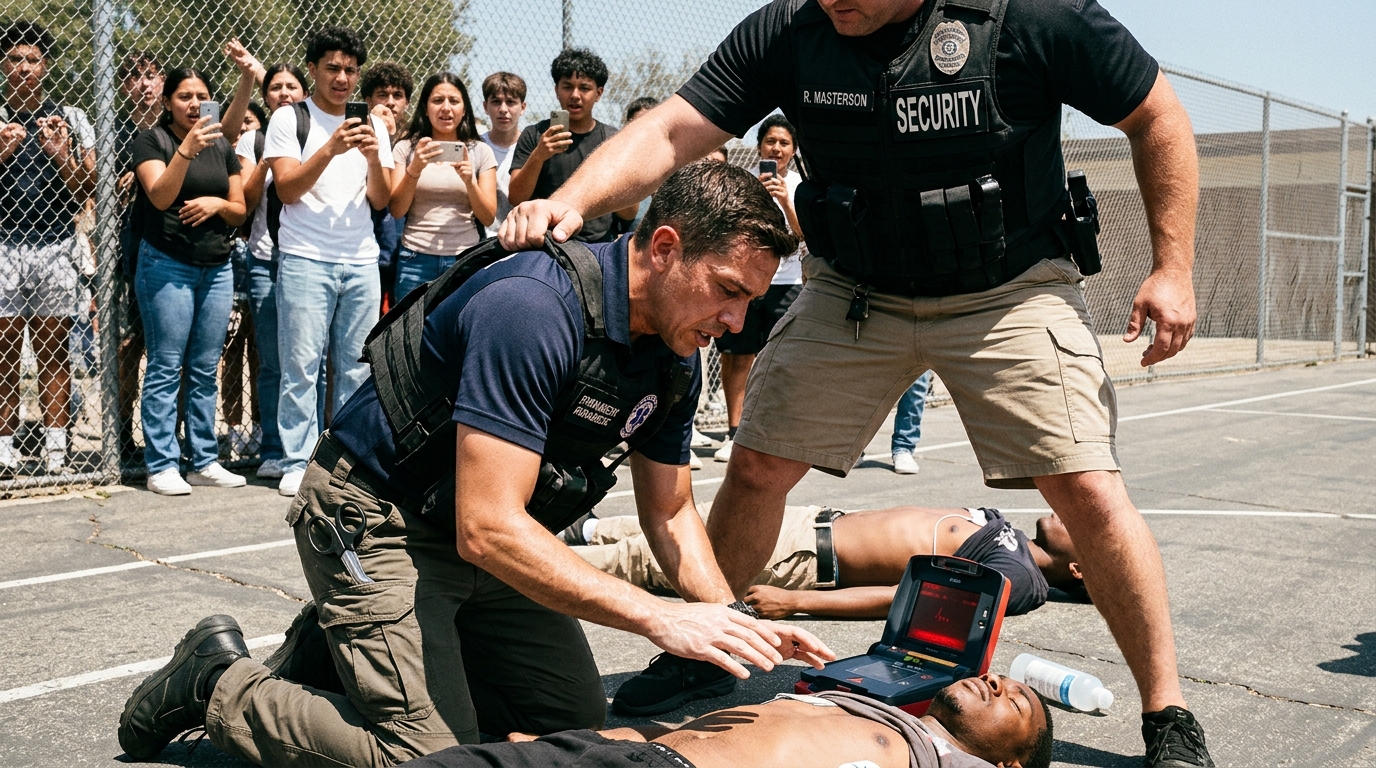
My palms burned against the kid’s sternum. The asphalt beneath my knees radiated heat like an oven door left open. Sixteen years old. Blue lips. Fixed pupils. Ribcage yielding just enough under thirty pounds of downward force.
Five. Six. Seven.
“Breathe, Jalon,” a girl sobbed behind the chain-link fence. Her phone camera reflected the harsh 2:00 PM glare. “Please, Jalon, breathe.”
Eight. Nine. Ten.
A heavy rubber sole planted hard three inches from my left knee. Cargo shorts. Tactical vest. The smell of cheap synthetic leather and synthetic authority.
“Off the deck. Now.”
I didn’t look up from the chest. “Teenage male. Ventricular fibrillation. Get back.”
“You are in violation of Pine Ridge Private Property Code 12,” the voice rasped, tight and practiced. A hand clamped onto my left forearm. The grip was coarse, pinching muscle against bone. “Step clear of the resident.”
“I’m a licensed paramedic,” I growled, driving my hands down for impression eleven. The tension screw on the stainless-steel trauma shears folded inside my hip pocket bit into my thigh. “Call 911. Tell them CPR is in progress.”
“Unauthorized medical intervention,” the guard said. His name tag read R. MASTERSON. His thumb unclipped the retention strap on his belt holster. “This is private property owned by the Pine Ridge Community Association. You do not reside here.”
“He doesn’t have five minutes, Rick!” a kid screamed from the baseline.
The AED on the pavement beside us chimed in a synthetic female voice: Analyzing heart rhythm. Do not touch the patient.
I froze, hands hovered two inches above Jalon’s ribs. The machine clicked. Internal capacitors hummed, charging.
Shock advised. Charging. Stand clear.
“I told you to clear!” Masterson roared.
He didn’t grab my shirt. He hooked his forearm under my chin, leveraging two hundred pounds of momentum backward. The air ripped out of my lungs as my spine slammed into the painted key line of the basketball court. My head bounced off the concrete, sending a sharp, white needle of pain across my vision.
The AED discharged with a flat, dry thud. Jalon’s torso jerked off the ground.
I scrambled to my knees, blood in my mouth from a bitten tongue. “You idiot! He needs continuous compressions!”
Masterson didn’t check the boy. He dropped his weight onto my shoulder blades, pinning my cheek against the coarse blacktop. The scent of hot acrylic paint filled my nose. His knee dug directly into the soft spot below my ribs, cutting off my air.
Snap.
Cold steel clicked around my right wrist. Masterson wrenched my arm behind my shoulder blade until the joint popped.
“You’re under citizen’s arrest for trespass and unlawful endangerment,” Masterson grunted, his breath smelling of stale coffee and peppermint.
“Look at the kid!” I choked out, fighting the crushing weight on my torso. “Look at him!”
Beside my eye, two inches away on the sun-baked court, Jalon lay motionless. The AED screen flashed red: Resume CPR.
Nobody touched his chest.
Masterson pulled the second cuff tight, the ratchet teeth locking with three sharp clicks. The crowd roared in terror, a wall of teenage voices breaking down into shrieks.
Six minutes passed. I counted every single one by the sound of my own heart hammering against the asphalt, my hands locked behind my back, watching the pulse in Jalon’s neck fade into absolute, irreversible silence.
When the city rig finally tore through the security gates, the siren died instantly. An EMT I worked night shifts with stepped out, took one look at my cuffs, looked at the AED, and then looked down at the black bag on his stretcher.
He didn’t open the trauma kit. He reached for the zipper.
CHAPTER 2: COLD FRICTION
The brass key turned in the cylinder with a dry, metallic snick.
The pressure released from my wrists, but the numbness stayed, a dull pins-and-needles burn creeping through my thumbs. I didn’t rub the red furrows left by the steel. I kept my hands open, flat against the cold chrome bumper of the squad car.
Twenty feet away, two city paramedics lifted the black vinyl bag onto the gurney. The zipper was fully pulled. The teeth caught slightly near the top, a tiny hitch in the sound that felt louder than the engine idling nearby.
Masterson stood near the gatehouse. He had his mirrored sunglasses tucked into the neck of his tactical vest now, wiping the sweat off his brow with a clean white handkerchief. His walkie-talkie squawked with static—a sharp, rhythmic burst that sounded like someone trying to tear paper.
“You can head out, Rivera,” the city cop said, tossing the key into his palm. He didn’t look me in the eye. He looked at my trauma kit resting on the pavement, the corner of the nylon bag stained with grease from the basketball court. “The detective will follow up for your statement tomorrow.”
“He intercepted CPR for four minutes,” I said. My voice came out flat, dry as raw flour. “Put it in the report.”
The officer’s jaw tightened. “I put down what I saw when I rolled up. Make your statement to the precinct.”
I picked up my trauma kit by the webbed handle. The weight swung heavy against my thigh, the stainless-steel trauma shears inside clinking against an unopened bottle of saline. I didn’t look back at Masterson. Looking at him would give him something to react to, a line to hold. Instead, I walked out through the pedestrian turnstile of Pine Ridge, where the heavy iron gate slammed shut behind me with a solid, definitive clack.
My sister’s condo sat outside the south perimeter wall, three blocks down on a public avenue where the streetlights flickered against damp palm fronds. I didn’t go inside. I sat on the hood of my rusted sedan, the cold sheet metal biting through my denim, and dialed one number.
It rang twice.
“Diego,” Emilio answered. No greeting. Just the hum of a ceiling fan in his downtown office and the distinct rustle of legal bond paper. “You sound like you’re breathing exhaust. What happened?”
“A kid died at Pine Ridge,” I said. “Sixteen. Sudden cardiac arrest on the court.”
“Did you work him?”
“I tried. HOA enforcement put me in cuffs halfway through the second cycle. Held me down while the AED cycled off.”
The line went dead quiet. Not the quiet of a dropped call, but the dense, heavy silence of my brother processing a crime scene. I could hear his pen drop onto his desk blotter.
“Who cuffed you?” Emilio asked, his tone dropping an octave, slipping straight into court-admissible precision.
“Guard named Masterson. Wore a vest labeled security, but the car said HOA enforcement. He claimed private property laws gave him the right to halt unauthorized medical procedures.”
“He’s wrong,” Emilio said sharply. “Good Samaritan statutes cover off-duty licensed personnel explicitly, even on private residential plots. They can trespass you afterward, but they can’t physically sever life support.”
“He didn’t just trespass me, Emilio. He pulled my hands off the kid’s chest.” I squeezed the frame of the car door until my knuckles turned white. “The kid’s name was Jalon. His parents were still at work when the rig pulled out.”
“Stay where you are,” Emilio commanded. “Don’t talk to their board. Don’t post anything on social media. I’m leaving the office now.”
Ten minutes later, the headlights of Emilio’s black crossover cut through the light drizzle settling over the street. He pulled up to the curb, killed the engine, and stepped out into the damp air. He wore a rumpled gray suit, his necktie loosened, a dark leather briefcase slung over his shoulder.
He didn’t offer a dramatic hand on the shoulder. He walked around my car, grabbed my right hand, and flipped my wrist over to inspect the raw, bruised skin where the cuffs had bit into the bone.
“Double-locked?” he asked, tracing the hematoma with a thumbnail.
“Single-locked. He ratcheted them down hard when I tried to pull free.”
“Good,” Emilio muttered, his eyes narrowing as he took a pocket camera from his jacket and took three quick, high-resolution flashes of my wrists. “That’s excessive force under color of authority. He’s pretending to operate as a municipal agent without a commission.”
He snapped the camera shut and pulled an iPad from his briefcase, tapping the screen with a rapid, practiced rhythm.
“I ran Pine Ridge’s corporate filing while I was driving over,” Emilio said, turning the screen toward me. “They aren’t just an HOA. They’re structured under a master commercial umbrella called The Apex Indemnity Policy. Their liability carrier mandates strict perimeter isolation to keep insurance premiums down.”
“What does that mean in plain English?”
“It means they don’t want external claims on their pavement,” Emilio said coldly. “If a guest gets hurt inside their walls, their legal strategy is to claim the guest was an illegal trespasser who assumed all personal risk. But Masterson took it a step further. He wasn’t just acting on impulse, Diego. Look at this.”
He pulled up a PDF scan of a internal memorandum—a document leaked six months ago during a civil dispute over parking enforcement in the same complex.
At the top of the letterhead, stamped in red ink, were the words: Directive 4-B: Unauthorized Incident Mitigation.
My eyes scanned the dense, bureaucratic text. ‘Under no circumstances shall non-resident emergency or medical personnel be granted unescorted access or permitted to initiate high-liability interventions without prior verification from Board Security Command.’
“They wrote it down,” I whispered, the cold air lung-heavy in my chest. “They put a price tag on a heartbeat.”
“They wrote down an illegal directive to protect their underwriting rating,” Emilio corrected, sliding the tablet back into his bag with a sharp zip. “Masterson was just the blunt instrument executing it. But this goes higher than a guard in cargo shorts.”
Across the street, a dark tinted SUV pulled up to the curb fifty yards away. It didn’t park. It sat idling, its amber fog lights cutting through the mist, illuminating the rain pooling on the blacktop. On the driver-side door, almost invisible in the gloom, was a small gold decal featuring a stylized shield and three letters.
Vanguard Defense Logistics.
Emilio noticed it a second after I did. He didn’t turn his head fully, just adjusted his stance so his shoulder blocked their direct line of sight to my wrists.
“They’re already running damage control,” Emilio said quietly. “That’s not the HOA’s local patrol. That’s the private firm contracted by the Board President.”
“Let them watch,” I said, reaching into my pocket and pulling out the stainless-steel trauma shears. I clicked the blades together—a dull, precise snip that cut clean through the quiet rain. “They think they’re managing a liability.”
“They’re about to manage a disaster,” Emilio replied, opening his car door. “Get in. We’re filing the emergency injunction before the midnight clerk closes the window.”
CHAPTER 3: THE BROKEN LINE
The metallic click of the trauma shears hung in the damp air, sharp enough to cut through the idle rattle of Emilio’s engine.
“Get in,” Emilio repeated. His voice was lower this time, a quiet vibration against the dashboard lights. “We don’t give them a target.”
I didn’t move. I kept my boots planted on the wet asphalt, staring straight through the tinted windshield of the black SUV fifty yards out. The headlights flickered once—a brief, deliberate flash of high beams that painted our shadows long and dark against the concrete wall behind us. Then the vehicle shifted into reverse, its tires giving a low, wet hiss against the slick pavement before backing around the corner and disappearing into the night.
I climbed into the passenger seat, slamming the heavy door shut. The smell of old coffee and leather filing folders filled the cabin.
“Where are we going?” I asked, setting the trauma kit between my feet.
“A diner on 4th,” Emilio said, shifting into drive. The crossover pulled away from the curb, its wipers sweeping across the glass in a rhythmic, squeaking arc. “Someone’s waiting. A guy named Marcus Vance.”
“Who is he?”
“Ex-Pine Ridge gate supervisor. Resigned six weeks ago. He tried to claim unpaid overtime, but the HOA board buried him under non-disclosure agreements.” Emilio’s thumb tapped the leather-wrapped steering wheel. “When the news hit tonight about Jalon, Marcus texted me one line: They put the handcuffs on him before he even picked up the shift.”
The drive took eleven minutes. Neither of us spoke. I sat with my right hand jammed into my jacket pocket, my thumb continually tracing the serrated edge of the shears until the skin at the base of my nail felt raw and tender.
The diner sat tucked under an elevated highway overpass, its red neon sign buzzing with a faint, electrical pulse. Inside, two fluorescent tubes flickered over a corner booth where a man sat with his jacket zipped to his chin. He was thin, mid-forties, with sunken eyes and a faded tan line on his left shoulder where a heavy security patch used to be sewn onto his shirt.
On the laminate table in front of him sat a styrofoam cup, half-full of black coffee, surrounded by small flakes of torn napkin.
Emilio slid into the booth first. I sat beside him.
Marcus glanced at my hands immediately. His eyes locked onto the dark red rings encircling my wrists. “You’re the paramedic,” he said. His voice sounded like gravel being kicked down a drain.
“Diego,” I said.
Marcus nodded once, his thumb restlessly rolling a burned matchstick across the Formica table. “They’re going to blame you, you know. Masterson’s already on the radio with the night guards. They’re telling everyone you brought expired drugs onto the court and tried to administer a controlled substance without a doctor’s order.”
“I used an AED and my hands,” I said coldly. “No drugs. No IVs.”
“Doesn’t matter what you used,” Marcus spat, his voice dropping as a waitress walked past with a pot of decaf. “It matters what Directive 4-B says. You breached the perimeter. To them, every outsider is a liability walking on two legs.”
“You worked under that directive?” Emilio asked, opening his briefcase and laying a legal pad flat on the table.
“I signed off on it,” Marcus whispered, staring down at his coffee. “Three months ago. Masterson brought the binder around at two in the morning during the graveyard shift. Said it came straight from Board President Vance Holloway.”
“Holloway,” I repeated. “Any relation?”
“No relation,” Marcus sneered. “Just the guy who owns half the rental units in the complex through three different shell accounts. Holloway told us that if an ambulance gets called onto the property without security clearing the call first, Pine Ridge loses its tier-one insurance rating under The Apex Indemnity Policy. A drop in that rating means a twenty-percent spike in annual premiums.”
Emilio’s pen stopped mid-line. “So the security guards weren’t enforcing safety. They were acting as loss-prevention agents for an insurance bracket.”
“It’s worse than that,” Marcus said. He reached inside his jacket, his fingers trembling slightly as he pulled out a folded piece of paper, stained with grease along the margins. He pushed it across the table toward us. “Directive 4-B wasn’t written by the HOA legal team. Look at the bottom stamp.”
I leaned over the table. At the bottom of the page, beneath the bold instructions authorizing guards to use physical restraints on unverified personnel, was a corporate seal pressed into the paper.
Vanguard Defense Logistics — Operational Division.
“Vanguard doesn’t just supply the guards,” Marcus muttered, his eyes darting toward the diner’s glass front doors. “They wrote the rulebook. Every time a guard executes a physical detainment under Directive 4-B, Vanguard bills the HOA an additional ‘Incident Management Fee’ of twelve hundred dollars. Masterson gets a fifty-dollar bonus for every cuffing logged.”
The diner’s neon sign gave a loud, metallic pop outside, dropping the interior into a dim, amber gloom for two seconds before the lights sputtered back on.
I stared at the paper. The greasy margin smelled of tobacco and damp paper. “He cuffed me for a fifty-dollar bonus,” I said, the words falling out of me with sickening clarity.
“He cuffed you because the system pays him to cuff you,” Marcus corrected. “And Holloway signs the checks.”
Emilio took out his phone, snapped a crystal-clear photograph of the document, and slid the original into a manila folder inside his briefcase. “Will you testify to this in an injunction hearing tomorrow morning, Marcus?”
Marcus stared at the torn napkin bits on the table. He picked one up, rolling it between his thumb and index finger until it rolled into a tight, hard ball. “If I go on record, Vanguard cancels my severance. They’ll sue me for breach of contract.”
“If you don’t go on record,” I said, leaning forward until I could see the reflection of the buzzing neon sign in his bloodshot eyes, “Jalon is just a kid who stopped breathing on a basketball court, and Rick Masterson gets fifty bucks added to his paycheck.”
Marcus swallowed hard. His throat clicked. “Ten o’clock,” he whispered. “County courthouse. But don’t let Masterson see me in the hallway.”
Outside, a low rumble echoed under the overpass. I turned my head toward the diner window.
Parked across the four-lane avenue, idling quietly under the dripping concrete support beams, was the black SUV. The gold decal on the door caught the flash of a passing streetcar’s yellow light.
Vanguard Defense Logistics.
They weren’t just watching us. They were counting the minutes until the morning docket opened.
CHAPTER 4: THE POISONED WELL
The gold emblem on the SUV’s door glinted through the rain like a copper coin at the bottom of a dirty well.
I kept my eye on the side mirror as Emilio threw the crossover into gear. “He didn’t follow,” I said, my knuckles white against my thigh.
“He doesn’t need to,” Emilio replied, his eyes fixed on the slick road ahead. “He knows where we have to be at ten o’clock.”
The night dissolved into five hours of restless silence on Emilio’s office couch. By 8:30 AM, rain was still graying the glass windows of the County Courthouse. The air inside the third-floor corridor smelled of damp wool, industrial floor wax, and cold espresso.
Emilio stood by the heavy oak doors of Courtroom 302, flipping through three stapled copies of the preliminary injunction petition. His thumb moved across the margins, leaving faint smudges on the crisp white bond.
“Where is Marcus?” I asked, my back pressed against the cold marble wall. My right thumb was hooked into my belt loop, right next to the bulge of the trauma shears in my pocket.
“He’s got ninety minutes,” Emilio said, not looking up. “The clerk hasn’t called the preliminary calendar yet.”
A pair of heavy leather dress shoes clicked against the marble behind us. Sharp, measured, unhurried.
Vance Holloway didn’t look like a man facing a public inquiry. He wore a tailor-fitted charcoal suit, his hair swept back with immaculate precision, holding a slim leather folder under his arm. Two associate attorneys walked half a pace behind him like flank guards.
Beside Holloway walked Rick Masterson.
Masterson wasn’t wearing his tactical vest or cargo shorts today. He was stuffed into a cheap dark suit that pinched under the armpits, his thick neck spilling slightly over a stiff white collar. He kept his eyes locked straight ahead, but his jaw muscles ticked rhythmically.
Holloway stopped three feet from Emilio. He didn’t look at me at all. To him, I was an operational variable, not a person.
“Counselor Rivera,” Holloway said, his voice a smooth, low baritone that sounded like a corporate webinar. “You’re wasting the court’s time with this filing.”
“We’re filing for an immediate stay on Directive 4-B,” Emilio said, his tone dropping into a icy, formal register. “And an emergency order freezing Pine Ridge security records.”
Holloway let out a quiet, dry breath that barely registered as a laugh. He opened his leather folder, pulled out a single sheet of watermarked paper, and held it out by the corner.
“Directive 4-B was formally rescinded by the Board of Directors at 6:00 AM this morning,” Holloway said calmly. “It was an unauthorized draft authored by a third-party vendor without Board oversight. We’ve already terminated Masterson’s patrol contract.”
Masterson didn’t flinch, but his eyes darted sideways toward Holloway for a fraction of a second, his fingers twitching against his seam line.
“You can’t burn a paper trail by rescinding a memo after a child stops breathing,” Emilio snapped, refusing to touch the offered sheet.
“We aren’t burning anything, Mr. Rivera,” Holloway said, stepping closer. For the first time, his gray eyes shifted to me, cold and devoid of friction. “In fact, we’ve conducted our own internal review of the medical equipment left on the scene. The AED bag registered to your brother had an expired battery indicator log from three weeks ago. The district attorney’s office is currently evaluating whether your uncalibrated device interfered with the boy’s natural rhythm.”
A cold spike of adrenaline slammed into my chest. “The AED charged and delivered a shock,” I said, stepping forward until Emilio’s arm blocked my chest. “The log on the internal card will prove the rhythm was VF.”
“The internal card is in police evidence,” Holloway replied smooth as silk. “And your brother’s primary witness—the former employee you met at a diner at two in the morning—just signed an affidavit retracting his statements. He acknowledged receiving five thousand dollars from your legal defense fund to fabricate claims regarding Board liability.”
I froze. “Marcus didn’t take a dime from us.”
“The cancelled check bears your brother’s trust account routing number,” Holloway said, handing a second slip of paper directly to Emilio. “You might want to review your accounting before the judge calls the docket, counselor. Extortion is a felony.”
Emilio looked down at the slip. His posture didn’t break, but I saw his thumb rub a raw blister on his left palm—a micro-action he only ever did when a case took a catastrophic turn.
“They bought him,” I whispered, the marble wall behind me suddenly feeling ice-cold against my shoulder blades. “Or they broke him.”
“They didn’t just buy him,” Emilio said quietly, his eyes scanning the fine print on the banking document. “Look at the remitting entity on the draft, Diego.”
Beneath the false endorsement stamp, printed in microscopic light gray ink, was the issuing corporate account name.
It wasn’t Pine Ridge HOA. It wasn’t even a legal defense fund.
Vanguard Defense Logistics — Treasury Account #4092.
The decoy layer—the idea that Masterson was just a rogue guard executing an overzealous HOA directive—shattered right there on the courthouse floor.
Holloway wasn’t protecting the neighborhood from an insurance spike under The Apex Indemnity Policy. Vanguard was the exact mechanism he was using to bleed the HOA’s capital dry, using fake incident fees and staged security alerts to pay off his own shell accounts.
And now, that leak was turning straight into a weapon aimed at my brother’s law license.
“Ten minutes to docket, gentlemen,” Holloway said, adjusting his cuffs with a crisp click of gold links. “I suggest you withdraw the motion before we file the counter-claim.”
CHAPTER 5: CHECKMATE ON THE PAVEMENT
Holloway turned on his heel, his gold cufflinks catching the sharp corridor light as his legal team fell in behind him.
Emilio didn’t move. His thumb stayed locked against the raw blister on his palm, the skin white around the edges, but his breathing didn’t change. He looked down at the banking slip, then over at Masterson, who was hovering four feet away like an unexploded shell.
“Masterson,” Emilio said. His voice wasn’t loud, but it had the flat, cut-iron weight of a verdict.
Masterson stopped. He didn’t turn around completely, just angled his head, his thick neck straining against the stiff collar of his cheap suit.
“He just threw you to the court,” Emilio said, stepping forward until the distance between them shrank to two feet. “He told the judge Directive 4-B was your unauthorized draft. He signed your termination at six this morning. When the grand jury looks at the obstruction charge for Jalon’s death, who do you think is holding the paper?”
Masterson’s jaw worked silently. His eyes flicked past Emilio toward Holloway’s retreating back. “I followed protocol,” he rasped, his voice dropping into a desperate, dry murmur. “Vanguard protocol.”
“Vanguard isn’t a security firm, Rick,” I said, stepping up beside my brother. I pulled the trauma shears halfway out of my pocket, letting the blunt steel tip catch the light before resting my hand back over the nylon handle. “Vanguard is Vance Holloway’s private siphon. You cuffed me for fifty bucks while he billed the HOA twelve hundred for every incident report you generated.”
Masterson’s eyes widened slightly, a sudden, ugly realization cutting through his stiff posture. “The Incident Management Fees… they went through the treasury account.”
“Treasury Account 4092,” Emilio said smoothly, pulling a single folded subpoena from his internal jacket pocket. It was crisp, white, and stamped with the clerk’s red seal from twenty minutes ago. “We didn’t file an injunction on Directive 4-B, Rick. That was the decoy to draw Holloway into the hallway. We filed a third-party audit order against Vanguard Defense Logistics under the Municipal Corporate Fraud Act.”
Masterson swallowed. The sound was audible in the quiet marble hall. “He told me the board approved the account.”
“The board doesn’t know the account exists,” Emilio said. “And when the bank records unlock at ten fifteen, every check stamped with Directive 4-B points directly to the corporate officer who signed the Master Service Agreement. That’s not you. Unless you keep quiet.”
Holloway paused at the heavy oak doors of Courtroom 302. He turned slowly, his calm expression fracturing for the first time as he saw Masterson standing frozen between us, his hands trembling against his trouser seams.
“Rick,” Holloway called out, his baritone losing its smooth polish, dropping into a sharp, commanding edge. “Step inside. We’re on the docket.”
Masterson looked at Holloway. Then he looked down at my hands—at the faint, angry red rings still visible around my wrists where his cuffs had bit into the skin two afternoons ago.
“He offered me five thousand to sign the affidavit about the AED battery,” Masterson said. He didn’t yell. The words spilled out of him in a flat, bitter stream that echoed off the high marble walls. “He brought the cashier’s check to my truck at seven this morning. Said if I didn’t take it, Vanguard would name me as the sole liable party for the boy’s death.”
Holloway’s face turned the color of dry plaster. He took one step back toward us, his hand reaching into his suit jacket, but Emilio was already turning toward the double doors of the magistrate’s chamber.
“The check is in my glovebox,” Masterson added, his posture slumping as if a two-hundred-pound weight had just slipped off his shoulders. “Drawn on Vanguard Treasury Account 4092. Signed by Vance Holloway.”
Emilio stopped at the chamber door, his hand resting on the brass handle. He didn’t look back at Holloway. He looked at me, giving a single, short nod that locked the entire morning into place.
“The clerk is waiting, Mr. Holloway,” Emilio said softly. “Let’s talk about The Apex Indemnity Policy.”
CHAPTER 6: THE FINAL BALANCE
The heavy brass handle yields under Emilio’s palm with a quiet, mechanical click.
Holloway took one step forward, his jaw set, his hand tightening around the edges of his leather folder until the seam lines strained. “You don’t have standing to open that audit,” he said. The voice was still low, but the smooth, practiced resonance was gone, replaced by a thin, dry rattle. “Vanguard Defense Logistics is a private entity operating under a confidential Master Service Agreement.”
“The agreement was signed using Pine Ridge HOA funds,” Emilio replied without turning his head. “And every dollar funneled into Treasury Account 4092 came from assessment hikes tagged as emergency liability reserves under The Apex Indemnity Policy. That makes it municipal wire fraud.”
The oak door swung open, and the county magistrate’s clerk stepped into the doorway, holding a thick ledger. He looked at Holloway’s white face, then at Masterson, who remained standing flat-footed on the marble, his hands hanging uselessly at his sides.
“Mr. Holloway,” the clerk said flatly. “The judge is ready for the emergency deposition.”
Holloway didn’t move for three full seconds. His eyes flicked to his associate attorneys, but both men were already stepping half a pace back, their hands quietly sliding their file folders into their briefcase pockets. The corporate wall he had built around himself hadn’t fallen with a crash—it had simply unraveled, thread by thread, leaving him standing alone on the polished floor.
Four hours later, the afternoon light broke through the high stained glass of the courthouse lobby, casting long gold rectangles across the stone steps outside.
The paper trail didn’t take days to untangle. Once Masterson handed over the cashier’s check drawn directly on Vanguard’s account, the bank’s legal compliance team released the ten-thousand-page ledger for Treasury Account 4092. Over three million dollars in HOA reserves had been systematically converted into “Incident Management Fees” for non-existent security threats, all authorized by Holloway under the umbrella of Directive 4-B.
By two o’clock, two state investigators met Holloway at the side exit of the building. There were no flashing lights, no dramatic shouts. Just a quiet, formal exchange of documents before Holloway was escorted down the concrete ramp into an unmarked sedan. Vanguard Defense Logistics was served with an asset freeze before the market closed.
Emilio and I walked down the broad granite steps into the cool afternoon air. The rain had finally stopped, leaving the pavement dark and reflective.
“His defense team will try to negotiate a plea on the wire fraud charges,” Emilio said, unbuttoning his jacket and letting out a long, heavy breath that fogged slightly in the chilly air. “But the obstruction indictment for Jalon’s death stays on the state docket. They can’t settle that out of court.”
“And Masterson?” I asked, looking down at my right wrist. The deep red furrows from the handcuffs had faded into a dull, yellowish bruise, but the skin was still tender to the touch.
“He’s cooperating,” Emilio said. “He turned over his personal logs. Every bonus payment, every directive memo. He won’t serve state time, but he’ll never wear a security badge again.”
We drove in silence across the city to St. Jude’s Chapel, a small stone building tucked between two brick apartment complexes. Inside, the sanctuary was dim and quiet, smelling of beeswax candles and old pine pews.
Jalon’s parents sat in the second row, near a small table holding a framed photograph of their son in his navy basketball uniform. Beside the frame lay his folded jersey, the yellow numbers worn along the edges from dozens of games on sun-baked courts.
I walked down the central aisle, my boots making no sound against the worn carpet. When I reached the pew, Jalon’s father stood up slowly. He was a tall man with broad shoulders, his dark coat dusted with dry rain marks.
He didn’t ask about the court hearing. He didn’t ask about Holloway or Vanguard or the legal filings.
“Diego,” he said, his voice deep and raspy from two days of quiet grieving.
“Mr. Reed,” I said softly. I reached into my jacket pocket and pulled out my trauma kit’s stainless-steel shears. The tension screw was slightly loose from the friction of the past forty-eight hours. I placed them on the wooden ledge beside the jersey. “The board’s directive is gone. The firm is dissolved. It won’t happen to anyone else.”
Jalon’s mother reached out, her fingers closing over the cold metal of the shears, then wrapping her hand over mine. She didn’t cry. She just looked at me with eyes that held the immense, unyielding weight of a loss that no court ruling could ever repair.
“Did he suffer?” she asked quietly.
“No,” I said, holding her gaze directly, refusing to look away or soften the truth. “The rhythm took him instantly. He didn’t feel the ground.”
She nodded once, a slow, deliberate movement, and squeezed my hand before releasing it.
Outside the chapel, the sun was setting behind the city skyline, painting the clouds in dark shades of orange and violet. I sat on the hood of my car for a long time, watching the streetlights flick on one by one along the avenue.
I reached into my pocket, found a small precision screwdriver I kept in my glovebox, and carefully tightened the tension screw on the trauma shears until the blades met with a firm, silent click. The tool was clean, solid, and ready for the next shift.