A Quiet Calibration: Captain Emily Brooks Begins the Arc of Forging the Next Generation of Phantoms
CHAPTER 1: The Weight of Dust
The air inside the C-130 was a stale mixture of hydraulic fluid, unwashed youth, and the distinct, metallic tang of suppressed adrenaline. Emily stood in the shadows near the bulkhead, her hands buried in the pockets of her utility jacket. She wasn’t watching the landscape; she was watching the five of them.
They looked exactly how she remembered herself—clean, hungry, and dangerously unaware of the price of the badge they were chasing.
The heavy ramp slammed down with a hydraulic shudder. Dust, fine and ancient, billowed into the belly of the plane, turning the incoming light into a hazy, golden veil. The five recruits stood, their gear rattling with a chaotic, unrefined energy. They were already shifting weight, already scanning the perimeter with the jittery precision of men and women who had watched too many training films and lived through too few real ones.
Emily stepped forward. She didn’t shout. She didn’t make a grand entrance. She simply walked into the light, her boots crunching into the gravel as the ramp touched down.
“Eyes on me,” she said. Her voice wasn’t loud, but it had the quality of a dry creek bed—firm, steady, and devoid of unnecessary vibration.
The group stiffened. One of them, a lanky kid with a fresh buzzcut and a patch that looked like it had been bought at an online surplus store, blinked. He started to open his mouth, likely to offer a greeting, but Emily didn’t give him the space. She walked past them, not toward the waiting transport trucks, but toward the firing line that sat empty in the distance.
“Drop your bags at the barracks. You have ten minutes to strip your primary rifles and lay the components on a clean white cloth. If I find a single grain of dust or a smudge of oil that hasn’t been cycled through the bolt, you’ll be walking back to the mess hall. Every. Single. Time.”
The lanky recruit, Specialist Miller, exchanged a glance with the woman to his left. He seemed to be weighing the gravity of her request. Emily didn’t wait for his compliance. She just kept walking. The heat hit her like a physical hand, a warm, suffocating pressure that she had learned to treat as a neutral fact of life.
As she moved, she felt the familiar pull of the rifle case she held in her left hand. It wasn’t the issued equipment the recruits were hauling. It was a fragment of the past. Her fingertips brushed the leather, tracing the worn, faded texture of the casing. The desert was vast, a sea of muted browns and bleached whites, but as she reached the firing line, she stopped.
There was a discrepancy.
She leaned down, her gaze locking onto a small, metallic object buried half-deep in the dry earth. She picked it up—a stray casing from a 7.62 round, but the primer was indented twice. Not a standard strike. A deliberate double-fire, or a malfunction cleared in a way that spoke of panic.
She turned the casing over in her fingers. The metal was pitted, rusted at the rim. It didn’t belong here, not on a range that was supposed to be sterile.
Behind her, the sound of boots on gravel intensified. The recruits were following, their formation sloppy, their rhythm broken. She didn’t turn around. She slid the casing into her pocket and looked out at the target line, where the mirage was already beginning to dance, distorting the world into a series of shimmering, unreliable ghosts.
“Ten minutes,” she repeated to the empty air, her voice barely a whisper, yet it cut through the hum of the desert wind.
She knew they were watching her now, waiting for the demonstration, waiting for the ‘Viper’ to show them why they were here. But she wasn’t going to give them a performance. She was going to give them a mirror. She pulled her kit from her bag, the light catching the faint, worn edges of her equipment, and felt the distinct, sinking realization that the game had already begun. The manifest she’d signed yesterday had been moved. Someone had been in her workspace.
The silence that followed was heavy, broken only by the dry, rasping breath of the desert, and the sudden, sharp sound of a recruit dropping his gear behind her.
CHAPTER 2: The Calibration of Failure
The metallic tang of the spent 7.62 casing in Emily’s pocket felt like a lead weight, shifting against her hip with every step she took back toward the barracks. She didn’t look at the recruits, but she felt them. Five pairs of eyes, all tracking her, all trying to read the set of her shoulders. She knew the rhythm: the tentative silence, the collective held breath, the expectation of a show.
She walked into the center of the barracks floor. The air inside was trapped, smelling of dry dust and the faint, sweet scent of heated metal. The recruits had complied—or at least, they had tried. Five rifles were laid out on five white sheets. To the untrained eye, it looked like a display of military discipline. To Emily, it looked like a map of carelessness.
“Close the door,” she said, her voice dropping into the quiet.
Specialist Miller, the lanky recruit who had tried to greet her earlier, hesitated, then moved to the heavy steel door, pulling it shut. The outside light was snuffed out, leaving them in the dim, amber glow of the overhead fluorescent strips. The shift in light brought out the imperfections; the dust motes dancing in the air looked like tiny, suspended shrapnel.
Emily began her rounds. She didn’t speak. She moved from sheet to sheet, her movements methodical, glacial. She stood over the first rifle—a high-end tactical piece, pristine on the outside. She didn’t reach for the barrel. She reached for the bolt.
Her fingers, calloused and steady, caught the handle and cycled it. The action was smooth, perhaps too smooth. She tilted the weapon into the light. There, in the feed ramp, a tiny, almost invisible speck of debris sat—a fragment of a cleaning patch, torn and forgotten.
“Specialist,” Emily said. She didn’t look up. “If this were a 4,000-meter shot, the pressure difference alone would turn that fiber into a microscopic obstruction. Your round would travel six inches off-center before it even cleared the muzzle.”
She didn’t wait for a response. She moved to the next station. The woman, whose name Emily recalled from the manifest as Corporal Sarah Vance, had a decent setup. But as Emily picked up the optic, she felt the phantom sensation of a shift. Her thumb brushed the turret adjustment, and she felt a subtle, sickening ‘click’—a minute loosening of the internal screw.
Emily went cold. It wasn’t just poor maintenance. This was a forced misalignment.
The memory of the casing in her pocket flashed in her mind—the double-struck primer. Someone had been here. Someone hadn’t just used these rifles; they had tampered with them to ensure that the first round fired on this range would be a calculated, humiliating miss. The psychological phantom of her own failures in the mud-walled maze of Kandahar surged forward, a cold, intrusive thought: They want them to break before they ever learn to shoot.
“Vance,” Emily said, her tone level, stripped of all warmth. “Take the optic off. Now.”
“Captain?”
“Do it.”
Vance moved, her hands shaking slightly. Emily watched her, noting the way the woman’s skin paled. They were scared. Not just of the training, but of the sudden, suffocating intensity Emily brought into the room.
Emily set her own rifle case down on the central table. She opened it, and the sight of her retired M2010—the weapon that knew her heartbeat, the weapon that had once been the only thing standing between her squad and the dark—centered her. The texture of the stock, worn smooth by years of palm-sweat and friction, felt like the only truth in a room full of lies.
“You think this is about hitting steel,” Emily said, finally looking up. She locked eyes with each of them, starting with Miller and ending with Vance. “You think you’re here because you’re the best. You’re not. You’re here because you’re broken in ways you haven’t realized yet.”
She reached out and picked up Miller’s bolt, the one with the trapped cleaning fiber. She placed it squarely in the center of his white cloth, a stark, dark contrast against the linen.
“We are going to start over,” she said. “Not with rifles. Not with wind-calls. We are going to start with the cost of a single, clean motion. Every one of you will strip these components, record the batch number of every screw, the wear pattern on every spring, and the exact grain count of the load you’ll be using. You will write it down. Then, you will do it again. And again. Until your hands understand the physics better than your ego does.”
“Captain,” Miller started, his voice cracking, “we were told we’d be on the range by—”
“The range is a lie,” Emily cut him off. She leaned over the table, her face close enough that he could see the fine, faint lines around her eyes—the map of a thousand sleepless nights. “The range is where people go to gamble. We aren’t here to gamble. We are here to endure.”
She stood back, picking up her ledger. The rhythmic, scratching sound of her pen as she began to log their failures—one, two, three, four, five—filled the room. It was a cold, methodical sound, a heartbeat of pure, unadulterated reality.
Someone had been in this room, someone had sabotaged these weapons to make her unit look like a failure before they’d even begun. Emily didn’t know who, but she knew the texture of the betrayal now. It was in the feel of the turret, the weight of the debris. She would catch the ghost in the machine, but not by shouting, and not by complaining. She would catch them by turning these five raw, trembling recruits into something so precise, so surgically sound, that the sabotage would be rendered irrelevant.
“Again,” Emily commanded, not looking up from her ledger.
The recruits moved, their motions clumsy with fresh frustration. Emily watched the door. She could feel the lingering heat of the desert outside, but in here, in the fading light, the only thing that mattered was the weight of the steel and the steady, unbreakable scratch of her pen.
CHAPTER 3: The Geometry of Resilience
Emily didn’t look up from the ledger immediately. She let the silence stretch, a deliberate, suffocating tether that forced the five recruits to sit with the weight of their own incompetence. The only sound in the room was the ticking of the wall clock—a slow, irregular pulse that seemed to count down their remaining patience.
Finally, she set the pen down. It clattered against the wood, a sharp, crystalline sound that made Miller flinch.
“You’re tired,” Emily said, her voice neutral. She stood and walked toward the center of the table, her hands clasped behind her back. “Your shoulders are slumping. Your focus is fraying. And you’re wondering why you aren’t on the range, firing rounds into steel.”
She picked up the ledger and turned it around, sliding it across the table toward Vance.
“Look at the entry for the firing pins,” Emily commanded.
Vance leaned in. Her eyes scanned the lines of precise, cramped handwriting. “There’s a discrepancy, Captain. The physical count I just took… it’s two short of the manifest total.”
“It’s not just two short,” Emily replied, her gaze tracking the way the air shimmered near the windows. “The batch numbers listed in the manifest don’t align with the production dates of the pins in your kit. Whoever prepared your gear didn’t just sabotage the optics. They played a game of musical chairs with your hardware.”
The room went deathly quiet. The recruits looked at each other, their bravado completely evaporated. They weren’t just being trained; they were being hunted by a ghost within their own ranks.
“Is this… is this a test?” Miller asked, his voice barely audible.
“This is the reality of the field,” Emily said, her tone hardening. “The enemy doesn’t play by the rules of the manual. If you rely on a manifest that someone else wrote, you’re already dead. If you rely on an optic that you haven’t checked with your own eyes, you’re a liability to the people standing next to you.”
She walked to the far end of the room and picked up a heavy, steel-toed boot, tossing it onto the table with a dull thud. It wasn’t hers. It was an extra pair she had pulled from the logistics depot earlier that morning.
“Put them on,” she ordered. “All of you. We’re going to the storage yard. We’re going to spend the next four hours moving the crates of 7.62 from the lower shed to the bunker at the far end of the perimeter. By hand. No carts, no lifts.”
“Captain, that’s four miles,” one of the other recruits, a man named Halloway, protested. “We’ve been cleaning gear since dawn.”
Emily didn’t blink. She walked over to Halloway, her presence suddenly commanding the entire space. She didn’t tower over him, but her stillness was more intimidating than any shadow.
“You think cleaning gear is work?” she asked. “Work is doing the thing that makes you want to quit, and then doing it anyway because the mission requires the effort. If you can’t move a crate of ammo across the desert without whining, you certainly can’t hold a position while the wind is trying to peel the skin off your face at 4,000 meters.”
She turned toward the door. “Five minutes. If you aren’t moving, you’re off the program.”
The journey to the storage yard was an exercise in attrition. The Arizona sun was a physical weight, a hammer that beat against their necks and turned the air into a shimmering, distorted haze. Emily didn’t lead from the front. She paced them, walking in the rear, her eyes constantly scanning the horizon, not for the recruits, but for the subtle signs of observation. She knew someone was watching—Powell, or one of his lieutenants, waiting for the moment when the ‘supply clerk’ would collapse under the weight of her own unconventional methods.
Every step was a lesson in friction. The grit of the desert floor found its way into their socks, rubbing against their skin, a constant, nagging reminder of the environment’s hostility. Emily watched their form. She watched the way Miller’s gate became uneven, the way Vance’s breathing lost its rhythm. They were fighting the desert instead of negotiating with it.
As they reached the shed, the heat radiating off the corrugated metal was intense enough to sear. Emily stood by the entrance, her arms folded, watching them struggle with the heavy, splintering wooden crates.
“Break the crate down,” she instructed as they stumbled. “Use the crowbar. Carry the rounds in the canvas bags. Distribute the weight equally. If one of you falls, the weight of the others increases. That is the architecture of a unit.”
She watched them dismantle the wood, their hands bleeding, their faces masks of sweat and dirt. It was ugly, visceral work. It was the antithesis of the ‘elite’ experience they had been promised. But as she watched, she saw something else: a shift in their dynamics. They stopped looking at her for permission. They started looking at each other for balance.
Vance and Miller synchronized their pace, their movements becoming a mirrored set of actions. Halloway, who had complained earlier, stepped in to take the heaviest load when one of the others faltered.
Emily pulled a small, silver casing from her pocket—the one from the range—and rolled it between her thumb and forefinger. The texture was cold, despite the furnace heat of the afternoon.
She was planting seeds. Not for the range, but for the inevitable moment when Powell would try to pull the rug out from under them. If they learned to value the weight of the crate and the friction of the desert now, they wouldn’t panic when the rifles failed. They would already know how to build a solution out of nothing.
“Keep moving,” she called out, her voice cutting through the wind. “The sun doesn’t care how tired you are. And neither do I.”
As the sun began to dip, painting the horizon in bruised shades of purple and gold, the last crate was delivered. The recruits collapsed against the concrete of the bunker, their chests heaving, their faces streaked with dust. They were broken, exhausted, and completely stripped of their illusions.
Emily walked over to the last crate, her own boots heavy with the grit of the day. She looked at them—really looked at them—and saw the first, fragile spark of something different. It wasn’t the polish of a trophy winner. It was the grit of someone who knew how to survive the desert.
“Get up,” she said, though her tone was devoid of the biting edge it had carried that morning. “The day isn’t over. We’re going to the depot. You have a ledger to rewrite, and the count needs to be perfect.”
They stood, slowly, painfully, but they stood. And as they walked back, their gait was no longer the disjointed shuffle of the morning. It was a unit in motion. Emily felt the weight of the silver casing in her pocket, a silent, hard promise. She was building her team, one grueling inch of reality at a time. And she was going to make sure that when Powell finally decided to strike, he wouldn’t be attacking a group of recruits. He’d be attacking a wall of her own construction.
CHAPTER 4: The Ghost in the Manifest
Emily didn’t react. She didn’t flinch, and she didn’t look toward the shadows where the hum originated. She simply kept her pen moving across the ledger, her hand steady, her breathing calibrated to a rhythm that suggested absolute indifference. But beneath the table, her fingers had gone rigid. The hum was low, barely audible against the ambient drone of the base’s cooling systems, but to her ears, tuned by years of listening for the telltale click of a safety or the shift in wind against a distant wire, it was as loud as an alarm.
She finished the line, double-checked the inventory count—thirty-two units, all accounted for—and then, with agonizing slowness, she set the pen down.
She turned on her stool, her boots making a soft, dry sound against the concrete. She faced the far wall of the depot, where the restricted ordnance cages were stacked high. Major Powell’s office window overlooked this floor. He liked to say he liked to see his people at work. Now, she knew exactly what he was seeing—or, more accurately, what he was hearing.
She stood up and walked toward the supply cage, her stride purposeful. She reached for the heavy chain-link gate and pulled it open, the metal groaning with a sharp, piercing protest. She stepped inside, moving into the deep, artificial gloom of the back storage area.
She wasn’t looking for ammo. She was looking for the source.
She moved behind the second row of crates, her fingers ghosting over the cold, rough textures of the metal containers. She stopped by a junction box that looked undisturbed. She leaned close, her ear pressed to the steel. The hum was stronger here. It was a digital vibration, the sound of a device tapping into the base’s internal line.
She realized then that this wasn’t just about Powell trying to catch her in a technical error. They were monitoring her communications, her movements, her every interaction with the recruits. The sabotage of the firing pins and the optic misalignment were just the appetizers. The real play was to frame her for a security breach.
She pulled a small, multi-tool from her pocket—a habit of a decade, never leaving the kit behind—and began to work on the junction box casing. She didn’t strip it; she simply loosened the outer screws just enough to look inside. A small, black module was hardwired into the primary data feed.
Her heart didn’t race. She felt only a cold, clarifying focus. She understood the game now. This was the “decoy”—the Layer 1 mystery she had suspected. Powell wanted her to find this. He wanted her to react, to pull it out, to destroy it, so he could claim she was tampering with authorized monitoring equipment. It was a classic trap, designed for a soldier who acted on instinct rather than calculation.
She closed the junction box, tightening the screws with a satisfying, metallic click. She didn’t pull the module. She left it exactly where it was.
She walked back to the workbench, her composure a mask of professional apathy. She sat down and pulled the ledger back toward her. If they wanted to listen, she would give them something worth hearing.
She began to narrate her work, her voice calm, measured, and perfectly suited for a recording.
“Inventory check, item 74-Alpha,” she said aloud, her voice echoing slightly in the hollow expanse of the depot. “Standard maintenance performed. Scope adjustment performed to factory specifications. Alignment verified against manual 4-0-2. Everything is within standard tolerance.”
She was feeding them a string of lies. She had intentionally left the scope alignment exactly as the saboteur had shifted it. If Powell was listening, he would hear her ‘fixing’ it, then he would expect to see the recruits fail on the range tomorrow. By the time they arrived at the line, she would have already re-zeroed the weapons in the dark, without leaving a trace of her hand.
The hum of the recorder remained constant, a persistent, invasive presence.
She spent another hour at the desk, meticulously checking the manifest against the phantom numbers she’d seen earlier. She noticed a pattern. The discrepancies in the firing pins and the optics all originated from the same requisition order—a mid-level command approval signed by a name she didn’t recognize, but whose signature style was unmistakably Powell’s.
She finished the ledger, closed it, and stood up. She grabbed her pack, leaving the light on, and walked out of the depot into the crushing heat of the desert night. The sky was a vast, unblinking dome of obsidian, the stars sharp and cold as glass.
She didn’t head straight to the barracks. She took the long way around the perimeter, walking in the shadows of the hangars. She felt the weight of the silver casing in her pocket again. She was being watched, monitored, and set up for a fall. But she had the advantage of the ghost—they knew she was a soldier, but they had forgotten that she was a phantom.
She reached the edge of the firing range, where the silence was total. She stood at the line, the same line where she had rung the steel four days ago. She looked out into the darkness, visualizing the target at 4,000 meters.
She didn’t need the electronics, and she didn’t need their permission. She needed only the rhythm of the wind, the memory of the math, and the iron-clad certainty that if she could endure the silence of the Kandahar mud, she could survive the petty, bureaucratic traps of an Arizona training range.
She turned and began the walk back to the barracks, her steps light, her shadow trailing behind her—a ghost moving through the dark, preparing to rewrite the rules while the monitors were still listening to her echoes.
CHAPTER 5: The Sands of Attrition
The wind didn’t announce itself. It began as a low, mournful vibration against the metal siding of the depot, then escalated into a guttural roar that turned the Arizona sky from a bruised purple to a choking, opaque brown. Emily was already at the range, the five recruits lined up behind her, their eyes shielded by goggles, when the first wave of the storm hit.
It wasn’t just wind; it was a wall of sand, abrasive and blinding, scouring everything in its path.
“Move!” Emily’s command was swallowed by the storm, but they saw the motion of her arm. She didn’t head for the shelter of the barracks—that was where Powell’s people would expect them to hide, where the monitoring was easiest. Instead, she pushed them toward the old drainage tunnels, a labyrinth of concrete tubes that honeycombed the base’s northern perimeter.
They scrambled, their movements frantic, their voices lost to the howling gale. Emily led the way, her hand shielding her face, her feet finding the concrete lip of the tunnel entrance by memory. They tumbled into the darkness, the sudden silence of the tunnel a jarring, visceral shock after the violent sensory overload outside.
The air inside was stale, smelling of damp earth and rust. They collapsed on the cold floor, chest-heaving, sand coating every inch of their gear. Miller was the first to speak, his voice thin in the cramped space.
“Captain, the rifles… they’re packed with sand.”
Emily pulled her headlamp on. The narrow beam cut through the dark, illuminating the fine, gritty dust that had already worked its way into the crevices of their equipment. She looked at them. They were covered in grit, their faces strained, their eyes wide with the adrenaline of the sudden shift.
“Strip them,” she said. Her tone was no longer cold; it was urgent, stripped of all pedagogical theater. “You have ten minutes to clear every grain. If you don’t, the action will seize when you need it most. That isn’t a training failure—that’s a death sentence.”
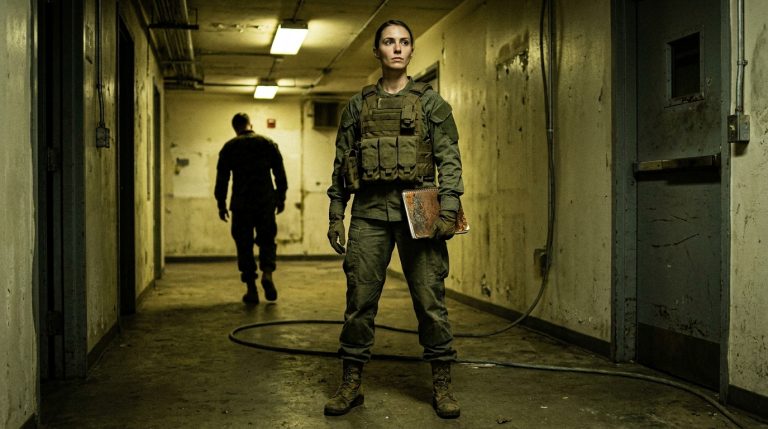
She watched them work. The tunnels were small, forcing them to crowd together, their movements restricted. The claustrophobia was palpable, a physical weight that made the air feel thin. But as she watched, she noticed something she hadn’t seen before: they weren’t panicked. They were methodical.
Vance was using a piece of wire from her kit to clear the firing pin channel, her hands moving with a surgeon’s precision. Miller was shielding Halloway’s receiver with his own body, creating a wind-break even in the sheltered tunnel. They were learning the most important lesson of the Phantom program: the gear was an extension of their survival, not a tool for convenience.
Emily moved to the back of the tunnel, her light dimmed to a faint, red glow. She pulled the silver casing from her pocket again, holding it up. This environment—the crushing darkness, the confined space, the constant, low-frequency roar of the wind above—was exactly the kind of chaos Powell wanted them to break in. But he had made a mistake. He assumed they were fragile. He didn’t understand that friction, when applied correctly, doesn’t break a component—it polishes it.
“Captain,” Halloway said, his voice echoing off the concrete walls. “Why aren’t we back at the barracks? The storm might last all night.”
“Because the barracks have ears,” Emily replied. She didn’t elaborate. She didn’t need to. The way they looked at her changed. They weren’t just recruits anymore; they were five people huddled in the dark with a leader who was clearly operating on a different frequency.
“Listen,” she said, raising a hand.
They went silent. Through the concrete, they could hear the faint, erratic clanking of metal on metal—a sound that shouldn’t have been there. It was the sound of someone trying to force a lock on the tunnel access hatch from the outside.
Emily’s pulse didn’t spike. She felt a cold, sharp clarity. Powell wasn’t waiting for them to return to the barracks. He was coming to them, likely to catch them in a ‘violation’ of the training protocols, perhaps even planting the final piece of evidence needed to shut her down.
“Halloway, Miller,” she whispered, her voice barely audible. “Move to the maintenance port three hundred yards down. Do not make a sound. Vance, cover the rear. If someone comes through that hatch, you don’t engage. You observe. You document. You stay invisible.”
They moved, their bodies ghosting through the tunnel with a grace that surprised even Emily. They were learning. They were becoming the phantom she had promised to forge.
She stayed by the hatch, her own rifle held against her chest, the weight of it a familiar, comforting presence. She looked at the hatch—a circular, rusted steel door that was slowly, agonizingly being turned from the outside.
She felt the ghost of her squad from 2016 beside her—Reed, Wong, Holt, Quinn. She could almost hear them whispering, not about the danger, but about the math. The tension on the hinges, the weight of the man on the other side, the exact moment the latch would snap.
The hatch gave a final, metallic shriek and began to swing inward. A sliver of grit-filled light from the storm above spilled into the tunnel, silhouetting a figure. It was a man in standard combat gear, but he moved with the swagger of a floor-manager, not an operator.
Emily stepped out of the shadow. She didn’t aim the rifle; she held it at the low-ready, her posture a silent, devastating threat. The intruder froze, his hand dropping to his holster.
“You’re lost, Sergeant,” Emily said, her voice so soft it was almost a hum. “And you’re trespassing on a closed training site.”
The intruder looked at her, his eyes darting to the tunnel behind her, looking for the recruits, looking for the evidence. He found nothing but the cold, impenetrable dark.
“I was told there was a breach,” he stammered, his bravado instantly punctured by the absolute, lethal stillness of her stance.
“The only breach here is your conduct,” Emily replied. She took one step forward, forcing him back toward the hatch. “Report back to Major Powell. Tell him the trainees are currently engaged in a deep-tunnel survival simulation. And tell him that if he wants to see how they handle pressure, he can wait until the morning. They’re busy right now.”
The Sergeant didn’t argue. He backed out, his boots slipping on the sand-slicked concrete, and disappeared into the howling dark.
Emily watched him go, then latched the door. She stood there for a long moment, the wind screaming on the other side of the steel, her hand resting on the rusted surface. She had won the moment, but the war for her team had just escalated. They had tried to push her into the open, and she had pulled them into the dark.
She turned and began walking back toward her team, the tunnel narrowing into a path that was becoming, with every step, the only road they had left.
CHAPTER 6: The Paper Trail of Shadows
Emily didn’t head back to the barracks. She turned toward the logistics depot. The storm had left the facility shrouded in an eerie, unnatural quiet, the desert air still thick with hanging dust that diffused the moonlight into a sickly, amber haze. She moved through the yard like an extension of the shadows, her footsteps muffled by the layer of fine silt deposited by the gale.
The depot was a cathedral of unfinished business. Inside, the air was warmer, smelling of stale machine oil and the persistent, artificial hum of the cooling systems. She bypassed the main entrance and slipped through the side loading dock, a small, manual hatch she had keyed into her memory during her first week.
She needed the original requisition logs—the real ones, the ones that hadn’t been filtered through the digital monitor she’d found.
Her heart beat with a slow, disciplined rhythm. She navigated the rows of crates and shelving units, her movements fluid and devoid of wasted energy. She reached the back-office desk, where the physical manifests were kept in a heavy, lock-keyed cabinet. She didn’t bother with the lock. She reached into her kit, withdrew a thin, tempered-steel shim, and slipped it into the hinge. The mechanism didn’t fight her; it yielded with a soft, metallic sigh.
She opened the cabinet, her light dimmed to a sliver. She flipped through the files, her hands moving with the rapid, rhythmic efficiency of a machine. There, buried behind a list of routine maintenance requests, she found it: a series of handwritten notes on plain bond paper.
They weren’t official documents. They were directives.
Target: Brooks. Objective: Operational failure through mechanical attrition.
The handwriting was jagged, hurried—the signature style of a man who viewed the military as a corporate ladder rather than a duty. It was Major Powell’s hand, unmistakably so. And beneath his signature, a set of dates and codes that tracked the sabotaged optics and the missing firing pins. The decoy secret she had found earlier—the monitor—was merely a distraction to keep her looking at the network, while the real sabotage was being logged by hand, just a few feet away from where she sat every day.
She heard a floorboard creak.
Emily didn’t jump. She didn’t panic. She closed the cabinet, the sound swallowed by the vastness of the depot. She stepped into the darkness between two rows of high-stacked shelves, her hand closing over the grip of her rifle.
“I know you’re in here, Brooks.”
It was Lieutenant Parker. He wasn’t the man who had come to the tunnel; he was the man who had mocked her on her first day. His voice was unsteady, a sharp contrast to the cold, dead stillness of the depot. He didn’t sound like a soldier on duty; he sounded like a man forced to do something he didn’t want to do.
“Major Powell said you’d be here,” Parker continued, his voice echoing. “He said you’d try to dig for something that didn’t belong to you. Just walk out, Captain. Hand over whatever you’ve got, and we can move past this.”
Emily shifted her stance. She was in the center of the depot, the shelves acting as a maze. She knew every inch of this space—the layout, the echoes, the blind spots. Parker was standing near the loading dock, his silhouette a jagged, uneven shape against the amber light from outside.
“Move past it, Parker?” Emily asked, her voice calm, projecting from the far side of the room to pull his attention away from her actual location. “You’ve spent your career hiding behind the manuals. You think that by following an order, you’re exempt from the math of what you’re doing?”
She moved, a silent, fluid blur in the darkness. She wasn’t running; she was pacing.
“I’m not a target, Lieutenant,” she said, her voice now coming from behind him. “And you aren’t an operator. You’re just a witness to a failure.”
Parker spun, his weapon swinging wide. He was panicked. He was fighting the dark, fighting the echoes, and fighting the very real knowledge that he was out of his depth.
Emily didn’t engage. She stayed in the shadows, her presence a weight he could feel but not touch. She was orchestrating his exhaustion, letting his own fear do the work of a dozen combatants.
“The requisition logs, Lieutenant,” she said, her voice whispering through the shelves. “They’re not in the digital system. They’re right here. Why do you think he had you keep the physical copies? Because he knew the digital trail would be traceable. He was making you the fall guy.”
The silence that followed was thick with the sound of Parker’s breathing. It was ragged, shallow.
“That’s a lie,” he snapped, but the conviction had drained out of his voice.
“Is it?” Emily stepped out into the light, but she stayed well beyond the reach of his weapon. She didn’t have her rifle aimed at him. She was holding the small, leather-bound manifest she had been working on. “Look at the log, Parker. The signatures on the requisitions aren’t yours. But the file path says they were generated on your terminal. He’s been using your credentials for months.”
Parker stared at her. He didn’t move. The realization, slow and agonizing, washed over his face. The depot was cold, but the sweat was visible on his brow.
“He’s not protecting the unit, Lieutenant,” Emily said, her voice soft, almost empathetic. “He’s protecting his legacy. And he’s perfectly willing to burn yours to keep his clean.”
She placed the ledger on a crate and stepped back into the shadows.
“Take the logs. Read them. Then go tell the Major that you’ve done your job, and that I’ve disappeared.”
She turned and walked into the darkness toward the back exit. She didn’t wait to see what he would do. She had planted the seed of doubt, and in this environment, it would grow faster than any sandstorm. She moved through the night, a phantom in the desert, knowing that the confrontation with Powell was no longer a question of if, but exactly when the math would reach its final, inevitable sum.
CHAPTER 7: The Mirror of Command
The command center was a hive of synthetic efficiency. The low, rhythmic hum of servers, the flickering blue light of monitors, and the crisp, clipped tones of radio traffic created a sanitized atmosphere that felt alien compared to the grit and raw truth of the depot. Emily walked through the center with the steady, unhurried pace of someone who had nothing left to lose and everything to prove.
She felt the weight of the forged requisition logs against her thigh. They were her ammunition. But as she approached the double doors of Major Powell’s office, the air shifted. It was a subtle, almost imperceptible change in atmospheric pressure—the way the room went quiet the moment she reached the threshold.
She pushed the door open without knocking.
Major Powell sat behind his desk, a glass of water and a pristine tablet positioned perfectly on the mahogany surface. He didn’t look surprised to see her. He looked patient. He leaned back, the leather of his chair groaning softly, and gestured toward the seat opposite him.
“Captain Brooks,” he said, his voice a smooth, practiced baritone. “I was just reviewing the status reports for the extreme range program. It seems your team has had quite an unconventional training schedule over the last forty-eight hours.”
Emily didn’t sit. She remained standing, her posture a silent, rigid defiance of the authority he tried to project. She leaned her hands on the edge of his desk, her knuckles pale.
“The training is proceeding exactly as required, Major,” she said, her voice cool and level. “The environment isn’t something you can write a manual for. It’s something you survive.”
Powell smiled, a thin, tight line that didn’t reach his eyes. He tapped a finger against the tablet. “Survival is an admirable trait, Captain. But discipline is a requirement. I have reports of unauthorized access to the logistics depot. I have reports of personnel wandering off-protocol into restricted tunnel systems. This isn’t survival. This is a liability.”
The phantom sound of distant thunder rumbled through the heavy, sound-proofed walls. For a heartbeat, Emily’s world tilted. The sound was too sharp, too precise—a perfect mimicry of a high-powered rifle report echoing through a canyon. Her hand twitched on the desk, a micro-second of involuntary muscle memory. She suppressed it, the movement so subtle that only she felt the internal friction of it.
Stay, she told herself. The math is the only thing that separates a shooter from a gambler.
“Liability?” Emily asked, her voice dropping into a register that made Powell’s smile falter. “Or a threat to the narrative you’ve been building, Major?”
She pulled the ledger of forged documents from her pocket and dropped it onto his desk. The sound was sharp, final.
Powell glanced at the papers, his expression a mask of manufactured confusion. “What is this?”
“Those are the physical requisitions for the firing pins and the optics you had sabotaged,” she said, leaning closer. “The digital logs were a nice touch, but you’re a traditionalist, Major. You didn’t trust the cloud. You kept a paper trail. And you left it exactly where I knew you’d keep your safety net.”
Powell didn’t flinch. He didn’t reach for the papers. He let his hand rest near the glass of water, his posture remaining perfectly, unnervingly still. The tension in the room was a physical thing, a wire pulled to the point of snapping.
“You think this is a kill-switch, Emily?” he asked, his voice low. “You think some scrawled notes on bond paper will bring down a program that has the full backing of the command chain? You’re a relic. You’re trying to play by the rules of a war that ended years ago. The Phantom program doesn’t need people who can ‘feel’ the wind. It needs people who can follow orders and maintain the brand.”
“The brand is a lie,” Emily said, her voice hard. “You’re not building shooters. You’re building paper soldiers who will crumble the moment the first variable changes. You were so busy monitoring me that you missed the fact that my recruits are already better than the men you sent to watch them.”
Powell finally leaned forward. His mask cracked, revealing the cold, predatory hunger beneath. “Your recruits are an experiment. And experiments are often discarded when they no longer serve a purpose.”
He stood, his height suddenly imposing, his presence filling the small office. “You have until dawn, Captain. You can take your team, sign the transfer orders, and disappear into a support billet in the middle of nowhere. Or, I will ensure that the record reflects a complete breakdown of command—a failure that will follow you into every job, every pension, and every memory of what you think you accomplished in Kandahar.”
Emily looked at him—really looked at him—and saw the reflection of the man she had been fighting for years: the man who believed that if you couldn’t control the variables, you had to crush them.
“I won’t be taking those orders,” Emily said, turning toward the door.
“If you walk out of this office,” Powell threatened, his voice echoing, “you won’t be walking back to a team. You’ll be walking into a dead end.”
Emily stopped, her hand on the latch. She didn’t turn back. “I’ve been in dead ends before, Major. That’s where the best shots are taken.”
She stepped out, the heavy door clicking shut behind her. The corridor was empty, the fluorescent lights humming in the oppressive quiet. She didn’t look back, and she didn’t stop. She moved toward the barracks, the weight of the confrontation now behind her, leaving her with the only thing that mattered: the absolute, terrifying freedom of having nothing left to hide. The final act was beginning, and for the first time in years, the target was perfectly aligned.
CHAPTER 8: The Final Calculation
Emily walked to the firing range as the first hint of gray light bled into the horizon. The desert was cooling, the heat of the previous day retreating into the earth, leaving behind a crisp, fragile clarity. She didn’t hurry. She reached the firing line and set her gear down, the rhythmic thud of the rifle case against the wooden bench the only sound for miles.
Major Powell was already there. He stood near the command trailer, his silhouette sharp against the rising sun. He wasn’t alone; he had brought two of his senior armorers, men whose loyalty he had purchased with promises of rank and stability. They stood like bookends, their expressions carefully neutral.
Powell walked toward her, his movements smooth, his demeanor radiating a practiced, professional calm. “I gave you until dawn, Captain. I trust you’ve reconsidered your position.”
Emily opened her rifle case. She didn’t look at him. She reached in and pulled out her M2010. She moved with deliberate, hypnotic slowness, performing a function check that was entirely unnecessary, her fingers tracing the steel as if it were a prayer.
“I didn’t reconsider,” she said, her voice carrying easily in the thin, morning air. “I calculated.”
Powell stopped ten feet away. “And what does the math tell you?”
“That you’ve spent your entire career building a system designed to fail,” she replied. She stood up, the rifle held in a low, non-threatening carry. She looked past him, toward the storage bunker, where her five recruits were already forming up. They didn’t look like recruits anymore. They moved with the silent, fluid coordination of a unit that had learned the true weight of the mission.
“You’re a distraction, Brooks,” Powell said, his voice hardening. “You’re a loose end that needs to be tied off.” He signaled to the armorers. “Security, escort the Captain to the administrative office. We have discharge paperwork to finalize.”
The armorers stepped forward. They were trained, they were armed, and they were confident. But as they neared Emily, they didn’t see the woman they had mocked as a ‘supply clerk.’ They saw the focus that had made them shudder in the tunnels.
Emily didn’t raise her rifle. She simply stepped to the side, a motion so quick it was almost an illusion, and pointed toward the far end of the range. “Look.”
Following her gaze, the armorers and Powell turned. Emerging from the maintenance tunnels, the five recruits stood at the edge of the range. They weren’t holding their rifles in the standard, manual-prescribed way. They were holding them with the same relaxed, ready balance Emily had taught them. They didn’t advance, and they didn’t speak. They simply stood, a living wall of discipline.
“I didn’t train them to follow orders, Major,” Emily said, her gaze fixed on Powell. “I trained them to understand the physics of their own existence. I trained them to know that the only thing protecting this unit isn’t your policy—it’s their competence.”
Powell’s face flushed a mottled, ugly shade of red. He looked at his men, then at the recruits, and finally at Emily. “This is an act of insubordination. You’re finished, Brooks. You’re done.”
“No,” she replied, a faint, small smile touching her lips. “I’m exactly where I’m supposed to be.”
She reached into her pocket and pulled out the forged requisition logs, tossing them onto the gravel at his feet. “These are the copies. The originals were sent to the Command Oversight office three hours ago. I sent them through the same secure channel you used to monitor the depot. It seems your ‘internal oversight’ wasn’t as private as you thought.”
Powell stared at the papers. His composure finally shattered. The predatory mask slid away, revealing the terrified, small man underneath—a man who had gambled everything on the assumption that everyone else was as shallow as he was.
“You think you’ve won?” he hissed, his voice trembling. “You’ve just ruined your own career along with mine.”
“I was never here for a career,” Emily said.
She turned away from him, walking toward her recruits. She saw the way their eyes tracked her—not with hero-worship, but with the quiet, profound respect of equals. She walked to the center of the range, picked up a single, standard-issue 7.62 round, and held it up to the morning light.
The payoff wasn’t a fight. It was the simple, undeniable fact that she had survived him without becoming him. She didn’t need to see him dragged away in cuffs; his own insecurity, his own need for control, had already dismantled his world.
She walked to the firing line and began the process of closing down the range for the day. She packed her kit, her movements slow, meditative. She reached into her pocket one last time and pulled out the cedar box. Inside, the silver casing from Kandahar sat perfectly still. She closed the lid, the soft click of the wood a final, resonant sound.
She walked to the memorial wall on the east fence, the black granite cold beneath her fingertips. She traced the names of her original squad, the phantom family that had fueled her journey back from the edge. She didn’t feel the sharp, cutting ache of the past anymore. She felt a quiet, settled peace—the atmosphere of a life finally repaired.
Halloway and Vance approached her, stopping a respectful distance away. They didn’t salute, and they didn’t ask for instructions. They simply stood in the quiet morning light, part of a unit that had learned the hardest truth of all: that precision is not just about the shot, but about the mercy of knowing when to stop, when to build, and when to let the light settle on the ground you’ve earned.
Emily looked out over the desert. The wind was gone, the air was still, and for the first time in years, the math of her life added up to exactly what she needed it to be. She picked up her duffle, her movements steady and unhurried, and began the walk back to the barracks, a commander who had finally found the path home.