The Perimeter of Maplewood: A Cold War in the Cul-de-Sac
CHAPTER 1: THE TACTICAL AUDIT
The latch on the cedar gate was off by three millimeters.
I didn’t need a calipers to know it. Twenty years on the force teaches your eyes how to measure the gap between normal and wrong. The galvanized iron hook wasn’t seated flush in the eyelet; it hung loose, dangling by a sliver of zinc plating.
I stood in the wet grass. Cold dampness seeped through the soles of my work boots. Beside me, Rex sat motionless. His ears were rotated forty-five degrees toward the dark alleyway running behind the cul-de-sac. Eighty pounds of line-bred German Shepherd didn’t waste energy on idle growls. He just held his breath, waiting for my hand to drop to his collar.
I didn’t touch him. I pulled the heavy brass K-9 whistle from my jacket pocket, rolling the cold, oxidized metal between my thumb and forefinger.
“Stay,” I muttered.
The grass along the fence line had been crushed. Not by a dog’s paw, and not by an animal chaser. A sharp heel print—narrow, deep, cutting four inches into the black soil—marked the dirt right outside the cedar fence.
Emily Lopez.
She’d been standing here. Lingering while the streetlight at the corner flickered out its fifty-cycle hum.
My phone buzzed against my hip. The screen illuminated the dark yard with a harsh blue glow. A formal PDF notification from the Maplewood Estates Homeowners Association digital portal.
Citation #1042: Failure to comply with community tone and decorum. Unsanctioned perimeter modifications and structural intimidation.
I stared at the text. A hundred and fifty dollar fine, slapped on top of the three hundreds I’d already contested.
“She’s testing the reaction time,” I whispered to the night air.
Rex’s tail gave a single, hard thump against the wet grass. He felt the shift in my posture before I even registered it.
I turned back toward the brick house. Inside, behind the low-E glass of the patio door, four sets of golden eyes watched us from the dark living room—Atlas, Nova, Bear, Scout. No barking. No scratching. Just five veteran working dogs waiting for the perimeter to be declared clear.
I reached the backdoor, slid the deadbolt home, and listened to the heavy iron click into the strike plate.
The house was dark, but it wasn’t quiet. The hum of the refrigerator blended with the low, rhythmic ticking of the security hub I’d installed behind the pantry door. I picked up a pen from the counter, clicked it once, and marked the date on the yellow notepad beside my kitchen sink.
02:14 AM. Gate unlatched. Single point entry attempt.
I didn’t call the station. Not yet. A cop knows that a heel print in the dirt isn’t evidence; it’s just a promise of what’s coming next.
I turned off the kitchen light, sat down on the edge of the wooden table, and began spinning the brass whistle on its frayed lanyard, watching the shadows stretch across the yard through the rear window.
The war wasn’t about the dogs. It was about the ground I was sitting on.
CHAPTER 2: THE MEAT BAIT
The brass whistle was cold against my thumb.
02:17 AM. Outside, the rain had backed off to a needle-fine mist, slicking the cedar fence until it shone like wet slate under the corner streetlight. Inside, the only light came from the blue LED pinprick on the kitchen security hub mounted near the floorboards.
It flickered. Once. Twice. Then went dark.
Rex didn’t bark. His head came up three inches, his dark muzzle level with the draft under the patio door. The back of his neck went rigid.
I slid off the wooden chair without letting the legs scrape the linoleum. My boots made no sound on the floor mats. I reached the hub, dropped to one knee, and ran my index finger along the wiring harness. The main power link was solid, but the auxiliary loop—the one running to the silent motion sensor mounted high on the cedar post by the alley—had dropped voltage. A physical bypass. Someone hadn’t cut the line; they’d bridged it with a jumper wire. Professional enough to fool a basic box, but sloppy enough to drag the system bus down by two volts.
Someone knew electrical basics. Or someone had hired a man who did.
I stood up, pulled my heavy canvas jacket off the back hook, and slid my arms through the sleeves. I didn’t reach for a flashlight. You don’t illuminate your own perimeter when you’re checking a breach; you let your eyes keep their night vision and let the dogs handle the tracking.
“Atlas. Nova,” I breathed.
The two shepherds rose from the shadows of the hallway like ghosts. No tags jingling—I’d replaced their metal clips with rubber O-rings five years ago when we were still working the state forest line out of District 4.
I unlatched the patio door. The lock gave a faint, oiled thunk.
The cool night air hit my face, carrying the smell of wet pavement, rotting pine needles, and something else. Something heavy and sweet. Synthetic.
I stepped onto the damp lawn. Atlas took the left flank, keeping his shoulder pressed against the brick exterior of the house. Nova swept wide to the right, her head low, sniffing the air currents moving off the cedar fence. Rex stayed three paces behind my right heel, a silent anchor.
At the rear gate, the latch remained exactly where I’d left it—dangling by the zinc hook. But six inches inside the fence line, nestled in the overgrown clover near the bottom post, lay a raw, marbled ribeye steak.
It hadn’t been there twenty minutes ago.
I didn’t let the dogs near it. I raised a flat palm, and all three animals dropped instantly into the wet grass, their bellies pressed into the mud, eyes fixed on the shadows beyond the fence.
I knelt beside the meat. The fat was pale, almost gray under the overcast sky. Punctured across the thick central vein were four neat, round entry wounds—about the diameter of a twelve-gauge dart needle. A clear, viscous fluid seeped from the puncture sites, smelling faintly of almond extract and veterinary-grade xylazine. Tranquilizer. High dosage. Enough to drop an eighty-pound shepherd in under three minutes, or stop its heart if it hit an artery.
A tote bag. Darts. A calculated removal.
She wasn’t trying to fine me out of the neighborhood anymore. She was clearing the board.
My eyes swept the ground surrounding the bait. Half-buried in the mud near the fence post was a discarded paper receipt, waterlogged and yellowed. I pinched it by the dry corner and pulled it free. The ink was bled out, but the bold header at the top remained legible under the ambient streetlamp glow: Vanguard Capital – Disbursement Notice #04. Below it, scratched in faded ballpoint, was an internal filing code: Ledger-7.
I folded the paper carefully, slipping it into my interior jacket pocket without letting my bare skin touch the chemical residue on the steak.
A faint metallic click sounded from the alley behind the fence—the sharp, unmistakable snap of a car door latch being secured without being fully slammed shut.
I didn’t give chase. A veteran cop doesn’t run blind into a dark alleyway when his home perimeter is compromised. I picked up the tainted meat with a clean plastic garden trowel from the bench, sealed it inside a heavy Ziploc bag, and stepped back into the house, locking the gate behind me.
I walked straight to the kitchen counter, pulled out my encrypted handheld radio, and keyed the private channel to Harris down at the precinct.
“Harris,” I said softly, staring through the glass at the dark cedar line. “It’s Clark. She’s moving faster than we calculated. Get a mobile unit stationed two blocks over on Elm. And run a corporate search on a firm called Vanguard Capital.”
“Clark?” Harris’s voice came through the speaker, scratchy with static. “What did she do?”
“She just threw three hundred milligrams of liquid sleep over my fence,” I said, my thumb tightening around the brass whistle until the edges bit into my skin. “Fort Knox protocol is active. Tell the boys on shift not to approach the house without calling my cell first.”
I ended the transmission, turned off the kitchen hub, and activated the secondary hardwired silent loop.
The house was locked down. The dogs took their stations—two at the front bay window, two at the rear glass, Rex at my feet. We sat in the dark, waiting for the clock to strike three.
CHAPTER 3: SILENT BREACH
The second sweep hit at 02:17:45 AM.
The secondary circuit didn’t sound a buzzer. It gave off a tiny, pressurized puff of air through an acoustic pinhole in the kitchen wall—a pneumatic relay I’d rigged to bypass the main board entirely.
Rex’s ears flattened against his skull. Beside him, Scout’s tail gave a single, tight twitch.
I didn’t reach for my phone. I reached into my coat, pulled out my reading glasses, and slipped them onto the bridge of my nose. On the tabletop, the silent receiver’s liquid-crystal display glowed pale amber.
Front Porch. Deadbolt Stress: 4.2 PSI.
Someone was applying torque to the cylinder. Not a crowbar. A tension wrench.
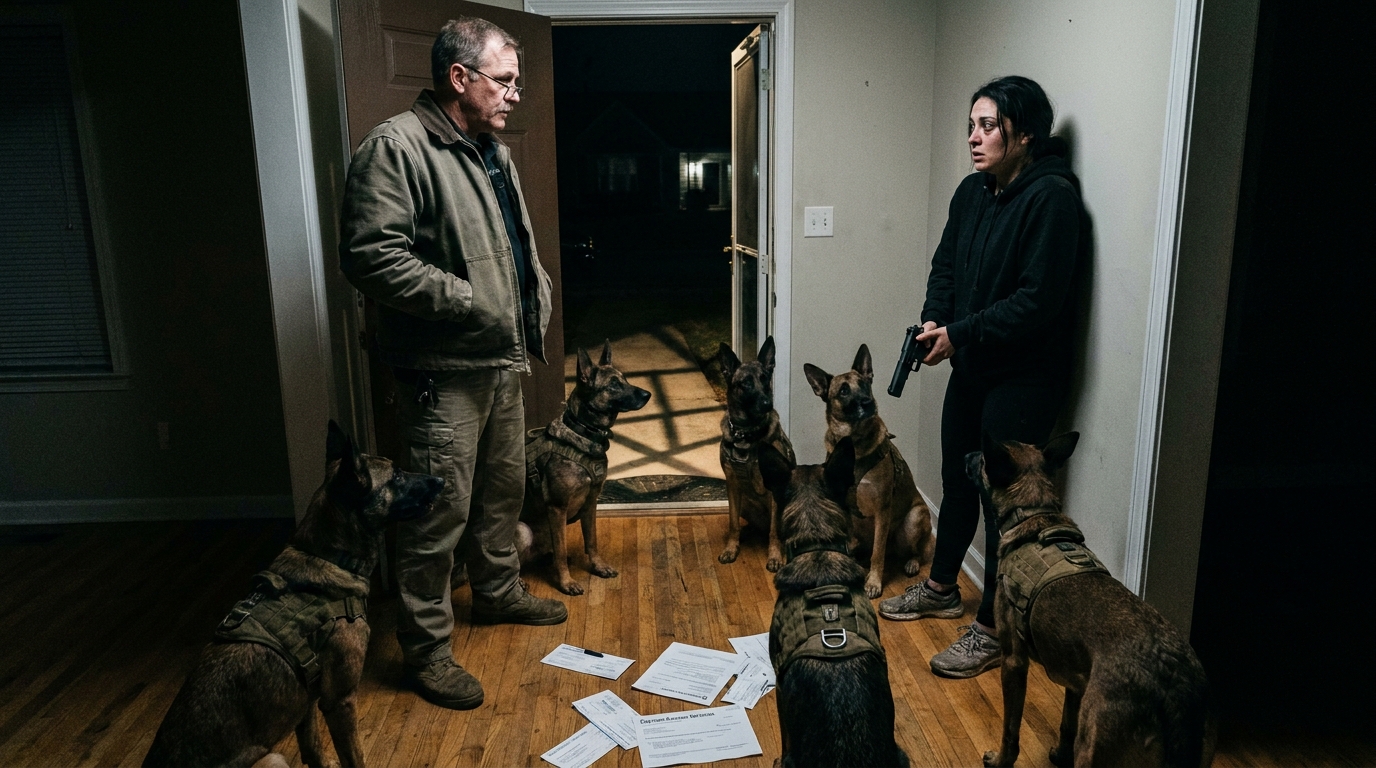
I moved down the hallway without lifting my heels, my palm trailing along the wainscoting. Behind me, five sets of padded paws moved in synchronized, deadened rhythm. No panting. No nails clicking on the oak planks. Five retired patrol dogs operating under tactical discipline.
Through the smoked glass side-panel of the entry door, the streetlamp cast a sharp shadow across the foyer floor. A thin silhouette in a tight black hoodie and running tights, crouching low near the brass lockset.
A faint tick echoed through the wood. The top tumbler set.
She’s fast, I thought. But she’s breathing through her mouth. I could hear the wet, ragged rasp of her inhalations through the draft-strip. Desperate.
Another tick. The bottom pin fell into place. The brass thumb-latch turned counter-clockwise with a metallic scrape that sounded like a saw blade on tin.
The front door swung inward three inches.
A dark canvas tote bag cleared the doorframe first, heavy and square-cornered, smelling of rubberized canvas and isopropyl alcohol. Then came the barrel of a black pneumatic tranquilizer pistol, CO2 canister threaded into the stock, loaded with a green-feathered dart.
Emily Lopez slipped inside.
Her running shoes were caked with the same dark clover-mud from the rear fence line. Her hair was pulled back so tight her cheekbones looked drawn, her lips pressed into a bloodless line. She didn’t look at the hall tree. She didn’t look at the floor. Her eyes were fixed straight ahead, wide and bloodshot, scanning the dark living room.
“It’s okay, babies,” she whispered. The tone was soft, artificial, the voice of a adult talking to a stray cat. “I’m here to save you.”
She stepped fully over the threshold, her right heel dropping into the entryway mat.
“Save them from what, Emily?” I asked.
I was standing three feet to her left, in the shadow of the coat closet, my hands resting casually in my jacket pockets.
She flinched so hard the tote bag slammed against the doorframe. The pneumatic pistol came up, the aluminum barrel wobbling violently as her grip tightened on the plastic stock. Her thumb fumbled with the safety lever, clicking it twice in frantic succession.
“Don’t move,” she hissed. Sweat was running down her temple, cutting a pale channel through the dirt on her cheek. “I have… I have full authority under the emergency intervention clause. You’re starving them. You’re housing illegal assault animals.”
“You’re holding a Class-2 pressurized projectile weapon inside a private residence,” I said softly. My voice didn’t rise. “And you left your tension wrench sticking out of my exterior keyway.”
“They’re monsters!” Her voice cracked, pitching upward into a ragged scream. “They don’t belong in this neighborhood! You don’t belong here!”
Rex stepped out of the dark kitchen.
He didn’t bark. He took three long, deliberate strides and stopped eighteen inches from her knees. His chest was expanded, his weight distributed evenly on all four paws. To his left, Bear moved into the doorway leading to the dining room, blocking the rear exit. Atlas and Nova flanked her right, cutting off the living room, while Scout sat squarely behind her heel.
A five-point wedge. Perfect perimeter control.
Emily’s eyes darted down. The tranquilizer gun lowered two inches, the barrel shaking against the black nylon of her tights.
“Call them off,” she whispered. Her knees were trembling, the fabric of her pants rustling in the quiet hall. “Call them off, Clark! They’ll tear me apart!”
“They won’t touch you,” I said. “They’re trained. They know the difference between a threat and a trespasser with a bad plan.”
I stepped forward, pulled my left hand from my pocket, and pointed at the tote bag hanging from her shoulder.
“Drop the bag. Open it.”
“No,” she stammered, backing up half an inch until Scout’s shoulder pressed firmly against the back of her calf. She froze, a dry gasp catching in her throat.
“Open it, Emily. Or I let Rex take the strap.”
Her fingers unclutched the pistol handle. It clattered against the oak floor, the pressurized gas tube giving a tiny, sharp hiss as the fitting loosened. With shaking hands, she unzipped the heavy canvas tote and tipped it sideways.
Three more green-feathered darts spilled onto the floorboards. A pair of heavy bolt-cutters. A stamped Manila folder thick with papers. And a printed set of forged animal seizure warrants bearing my name at the top, stamped with a fraudulent municipal seal.
Below the warrants lay a carbon-copy bank deposit slip. Printed across the header in bold courier font was the destination account: Cayman-Escrow Services, cross-referenced to an internal filing tab marked Ledger-7.
Layer 1 was sitting right on my floorboards: a staged animal rescue to declare the house an imminent public hazard.
But as I stared at the Cayman-Escrow routing code on that deposit slip, the rest of the picture locked into focus. This wasn’t just a neighborhood crusade. She was moving money. Big money. And my K-9 unit on the corner was the only surveillance point she couldn’t control.
Outside, the first red and blue strobe lights began to sweep across the living room ceiling, casting long, geometric shadows through the blinds. Harris had arrived.
Emily collapsed against the doorframe, sliding down until her knees hit the mat, her hands covering her face as the sirens cut off in the driveway.
Rex didn’t move. He kept his eyes on her hands, his tail motionless, holding the line until the front door was pushed fully open.
CHAPTER 4: THE PAPERWORK TRAP
The glare of red and blue strobes painted the foyer walls in rhythmic, blinding pulses.
Emily stayed collapsed against the doorframe, her fingers still digging into her hair, elbows propped on her knees. Rex didn’t back off an inch. His shoulders remained locked, his dark muzzle hovering fourteen inches from her ear until I lifted two fingers off my belt.
“Break,” I said softly.
Rex shifted back, his paws making a soft shuck-shuck sound on the damp entryway rug. Bear and Nova dropped their flank positions, clearing the hallway just as heavy boots crunched across the porch gravel outside.
Deputy Harris stepped through the open door, his rain-slicker dripping onto the threshold. Two patrol officers flanked him, their flashlight beams cutting narrow yellow shafts through the dim entryway. Harris stopped dead, his eyes sweeping the scene—the dropped tranquilizer pistol, the green-feathered darts scattered across the floor, the heavy bolt-cutters, and the trembling HOA president pinned to the trim.
“Clark,” Harris said, his voice low, gravelly from a twenty-year night shift habit. “Tell me this isn’t what it looks like.”
“She picked the lock,” I said, pointing down with my shoe toward the tension wrench still protruding from the exterior cylinder. “Brought a gas-powered dart gun, three hundred milligrams of liquid sedative, and a set of fraudulent seizure warrants.”
Harris dropped to one knee, snapping on a pair of black nitrile gloves. He picked up the Manila folder with two fingers, flipping it open under his flashlight beam.
“These have municipal seals,” Harris muttered, frowning as he ran his thumb across the raised emblem on the thick paper. “Looks official at a glance. Except…” He paused, angling the page toward the light. “The department code is wrong. This isn’t Animal Control’s regional identifier. It’s a commercial filing stamp.”
“Vanguard Capital,” I said.
Harris glanced up, his brow furrowing. “How do you know that name?”
I reached into my coat pocket, pulled out the waterlogged receipt I’d retrieved from the clover near the rear fence, and handed it to him inside a clean plastic sleeve. “Found that twenty minutes ago beside a drug-laced steak tossed over my back gate. Check the sub-heading.”
Harris held the paper under the light. “Disbursement Notice Number Zero-Four. Account reference: Ledger-7.” He looked over at Emily, who was shivering uncontrollably now, her chin tucked tight into her collar. “Emily, what is a commercial investment firm doing printing municipal animal control warrants?”
She didn’t answer. Her jaw was locked, her teeth clicking together in a tiny, rapid rhythm.
“She isn’t trying to quiet the neighborhood, Harris,” I said, stepping closer as the second deputy secured the dart pistol in an evidence bag. “She’s clearing out a fixed observation point. She knew I had three cameras mapped across the alleyway. Cameras that record thirty frames a second directly to an off-site cloud server.”
“Record what?” Harris asked, standing up and motioning for his deputy to place the cuffs on Emily’s wrists.
“The late-night drop-offs at the community clubhouse,” I said. “The ones matching the wire transfers to Cayman-Escrow.”
Emily’s head snapped up. The fear in her eyes instantly curdled into something sharper—a vicious, desperate coldness.
“You don’t know anything,” she spat, her voice raspy, stripped of its usual rehearsed composure. “You’re a retired dog handler living on a pension. You think a court is going to take the word of a crazy old cop over an elected board president?”
“They won’t have to take my word,” I said calmly, pulling my reading glasses off and folding them into my shirt pocket. “They’ll take the forensic audit on Ledger-7. The one Harris’s financial crimes unit is going to pull the moment he steps back to his desk.”
Emily didn’t scream this time. She went completely rigid as the deputy pulled her to her feet. Her eyes lingered on the floor where the deposit slip lay inside the plastic bag, her mouth opening slightly as if she wanted to reach down and tear the paper to shreds.
“Get her in the car,” Harris told the officers.
They walked her down the porch steps, her heels dragging through the wet gravel where she’d stood taking photos two days ago.
Harris stayed behind in the doorway, looking out at the rain as the cruiser door slammed shut. “If what you’re saying about Vanguard Capital is real, Clark… this isn’t just a crazy neighbor with a grudge. Eighty grand missing from a residential capital fund is grand larceny.”
“It’s more than eighty,” I said, looking down at Rex, who had settled back into a sit beside my boot. “She’s been running it for three years. And tomorrow morning at eight, the emergency HOA board meeting convenes at the clubhouse.”
“You going?” Harris asked.
“I’m bringing the projector,” I said.
CHAPTER 5: CHECKMATE IN THE BOARDROOM
The match-cut from the rainy porch to the clubhouse recreation room was seamless. Six hours vanished in a blur of digital video extraction and thumb-drive compilation.
At 08:00 AM, the air inside the Maplewood Estates Community Hall smelled of stale filter coffee, damp wool coats, and floor wax. Thirty residents sat in folding folding-chairs arranged in uneven rows. At the head of the room sat the three remaining HOA board members—Frank Lopez, his face gray and hollow-eyed, staring at his unlaced boots, flanked by two nervous committee chairs who kept shuffling blank legal pads.
I stood at the back near the double doors, Rex resting motionless across my boots. My hand hovered over the power button of a portable digital projector sitting on a metal utility cart.
The vice president cleared his throat, his knuckles white against his legal pad. “We… we don’t have a formal agenda this morning. As many of you know, President Emily Lopez was taken into municipal custody early this morning regarding a… private domestic disturbance.”
“It wasn’t domestic,” I said.
My voice hit the back wall like a iron strike. The thirty heads in the room turned as one.
I walked down the central aisle, the rubber wheels of the metal cart squeaking on the linoleum floor. Rex matched my pace step for step, his head level, shoulders relaxed.
“Mr. Clark,” the vice president stammered, raising a hand. “This is an internal administrative session. You aren’t on the speaker docket.”
“I’m on the docket now,” I said.
I plugged the cart’s heavy extension cord into the wall socket. The projector lamp whined, kicking on with a sharp, white glare that sliced through the room’s fluorescent hum. I didn’t open a speech. I pressed Play.
The wall behind the board table bloomed with high-definition infrared footage.
02:17 AM. The timestamp flickered in the bottom corner. The screen showed Emily in her black tights and hoodie, crouching at my front door, picking the brass cylinder with a tension wrench, her canvas tote bag slung over her shoulder.
Gasps rippled through the rows of folding chairs. Denise from two houses down stood up halfway, her phone held high, recording the wall projection.
“That’s a midnight home invasion,” I said, my voice echoing off the concrete block walls. “She brought a CO2-powered dart gun loaded with veterinary-grade xylazine. She brought forged animal seizure orders stamped with fake municipal department seals.”
“She was trying to protect the neighborhood!” Frank Lopez shouted, bolting upright from his chair. His chair scraped violently against the floorboards. “She told me your dogs were dangerous! She was executing an emergency nuisance removal!”
“She wasn’t removing a nuisance, Frank,” I said, hitting the remote again.
The screen shifted. The video cut away, replaced by high-resolution scans of the documents recovered from her canvas bag.
The room went dead silent.
“This is Disbursement Notice Zero-Four,” I said, pointing a laser marker at the header. “Issued by a shell entity registered as Vanguard Capital. Cross-referenced directly to an internal accounting log titled Ledger-7.”
I stepped up to the edge of the board table, leaning forward until my palms rested flat on the cool mahogany veneer.
“For three years, Emily Lopez has been routing eighty-four thousand dollars out of the Maplewood infrastructure reserve into a private holding fund labeled Cayman-Escrow,” I said, looking Frank straight in the eyes. “She didn’t target my home because of barking. She targeted my home because my rear patio security array sits directly opposite the clubhouse service gate. She couldn’t complete the courier drops with five K-9s watching her perimeter.”
Frank’s jaw worked silently. He looked down at the paper scans on the wall, then at the vice president, then at his own hands. The fight drained out of him in a single, long exhalation, leaving him slumped over the mahogany table like a deflated suit.
“The police financial crimes unit froze the Cayman-Escrow account twenty minutes ago,” I added, clicking the projector off. The room plunged back into the flat, clinical glow of the ceiling lights. “The county prosecutor is filing grand larceny and felony break-in charges by noon.”
No one spoke. The committee chairs stared at the blank screen, their pens motionless on their pads.
I turned back toward the rear exit, whistling once softly. Rex stood up, shook his coat until his brass collar ring clicked, and followed me out into the crisp morning air.
As the heavy glass doors hissed shut behind us, I pulled my reading glasses off, folded them into my pocket, and took a long breath of the cool, rain-washed air. The perimeter was cleared.
CHAPTER 6: THE FINAL LEDGER
The morning rain stopped completely by ten o’clock.
The air off the cul-de-sac smelled of wet cedar, earth, and exhaust fumes from the municipal utility trucks driving out of the neighborhood. The white noise of sirens and emergency board shouting was gone, replaced by the low, steady hum of a quiet neighborhood returning to its natural frequency.
I walked back down the brick driveway with Rex trotting beside my left knee. At the gate, Atlas, Nova, Bear, and Scout were lined up along the cedar fence, noses pressed against the wooden slats, tail tips sweeping gently back and forth against the wet clover.
They knew the perimeter was clear before I even unlatched the hook.
I pulled a small tin of oil and a brass wire brush from my jacket pocket. I knelt in the damp clover right where Emily’s heel had dug into the soil two nights ago. The galvanized gate latch was still sitting loose in the eyelet, scarred from where her tension wrench had gouged the iron.
I didn’t rush. I brushed away the grit, worked the stiff brass bristles into the hinge joints until the rust flaked off in fine red powder, and applied three drops of mineral oil to the pin.
When I swung the gate shut, the iron bar didn’t bounce or rattle. It dropped into the cradle with a heavy, solid thunk that resonated through the cedar post.
My phone vibrated once in my pocket. A text message from Harris at the precinct.
Plea agreement signed. Emily accepted two counts of grand larceny and criminal trespass. Restitution order issued for $84,200 back to the Maplewood capital reserve. 300 hours court-ordered community service at the county animal shelter. Case closed.
I read the text twice, then locked the screen and slid the phone back into my pocket.
Poetic justice has a way of balancing things without needing a speech. The woman who tried to drug five working dogs under the guise of an emergency rescue operation would spend her weekends shoveling kennels and cleaning water bowls under the supervision of eighteen-year-old shelter techs.
Frank Lopez sold his house three weeks later. The sign went up on a Tuesday and was gone by Friday. Nobody asked questions, and nobody threw a farewell party.
The HOA held a quiet election in June. No PowerPoint slides. No citations for grass height or fence paint shades. Just a two-page printed audit handed out at the door showing every dollar accounted for down to the last penny.
I sat on the front porch as the afternoon sun broke through the clouds, warming the brick facade. The heavy brass K-9 whistle sat on the wooden side table beside a mug of black coffee, its surface freshly polished and dry.
Rex stretched out across my boots, his heavy head resting squarely on my toes. Nova and Bear were chasing a shadow along the cedar fence, while Scout and Atlas lay in the warm patch of sunlight near the porch steps, ears twitching at the distant sound of a lawnmower two streets over.
Twenty years on the force taught me that authority isn’t something you prove with a clipboard, a ordinance rulebook, or a weapon in the dark. Authority is just knowing where your line is drawn, standing on it, and keeping the gate locked when the storm rolls through.
I picked up the coffee mug, leaned back against the brick, and listened to the five sleeping dogs breathing in unison at my feet.
The perimeter was silent.