The Turf War of Cascadia Hills: A Hardboiled Tale of Suburban Siege and Methodical Retribution
CHAPTER 1: THE BREACH ON THE FENCE LINE
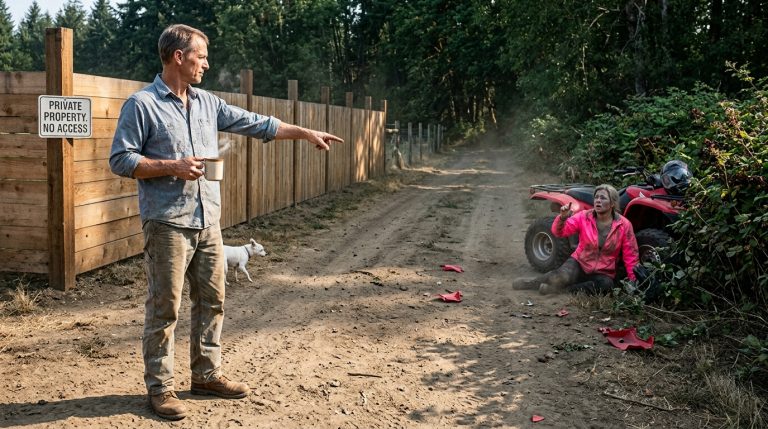
The third cedar fence board from the southern post was split. Clean, fresh grain exposed to the damp morning air.
I didn’t step onto the patio right away. I stood behind the double-paned glass of the kitchen door, adjusting the micro-screw on my brass drafting calliper. Click. Twist. Half a millimeter off. Someone had kicked the latch open from the outside.
A silver Honda Civic sat idling directly on my turf—my Kentucky bluegrass, watered every Tuesday, fertilized twice a year, paid for with forty-eight monthly mortgage installments that ate sixty percent of my software engineering salary. Near the pool, three children were diving headfirst into four feet of water, their screams cutting through the quiet morning air. A man in a grease-stained apron stood at my stainless-steel Weber grill, flipping hot dogs with a pair of my own tongs.
“Hey,” the guy called out, spotting me through the glass. He didn’t drop the tongs. “You got Dijon? Or just the cheap yellow stuff?”
I didn’t answer. My thumb pressed into the cold brass edge of the calliper until the metal bit into the flesh below the nail.
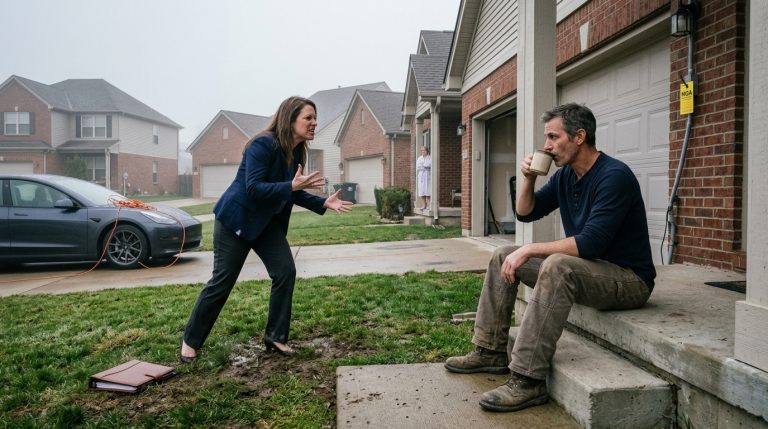
Across the lawn, a woman with oversized black sunglasses, khaki capris, and a heavy wooden clipboard stepped around the edge of the pool. Karen Thompson. HOA President.
“Jake,” Karen said, her voice carrying the dry, unyielding weight of an auditor closing an account. She didn’t slow her pace as she walked toward my back door. She held the clipboard against her chest like a ballistic shield. “Glad you’re awake. We’re using the rear parcel for the District Three summer mixer.”
I opened the door three inches. Cold air leaked out; warm grease leaked in.
“This is private property, Karen,” I said. My voice was flat. No inflection. No raise in pitch.
“The original developer plat lists the rear fifteen feet as shared greenbelt space,” she said. She didn’t look at me; her eyes scanned the fence line, noting the overhang of my maple tree. “You’re non-compliant on the branch overhang anyway. Consider this a temporary variance.”
“My deed says otherwise. The county records say otherwise.”
Karen finally turned her head. Behind the dark tint of her lenses, her eyes were fixed and unblinking. “Maps can be misleading, Jake. And besides—you weren’t using the space anyway.”
She turned back to the crowd, raising a hand to motion a woman with a mud-caked golden retriever toward my garden hose.
I closed the door. The latch clicked shut. I walked back to the desk, set the brass calliper beside my laptop, and pulled up my cousin Tank’s contact card.
Tank didn’t answer on the first ring. On the third, the heavy rumble of a custom V-twin engine vibrated through the speaker before his voice cut through the static.
“Talk to me, kid,” Tank said.
“You still looking for a venue for fifty bikes and a justice of the peace?” I asked.
A pause on the line. The sound of leather scraping against a steel frame. “Places keep turning us down once they hear the motor count. Why?”
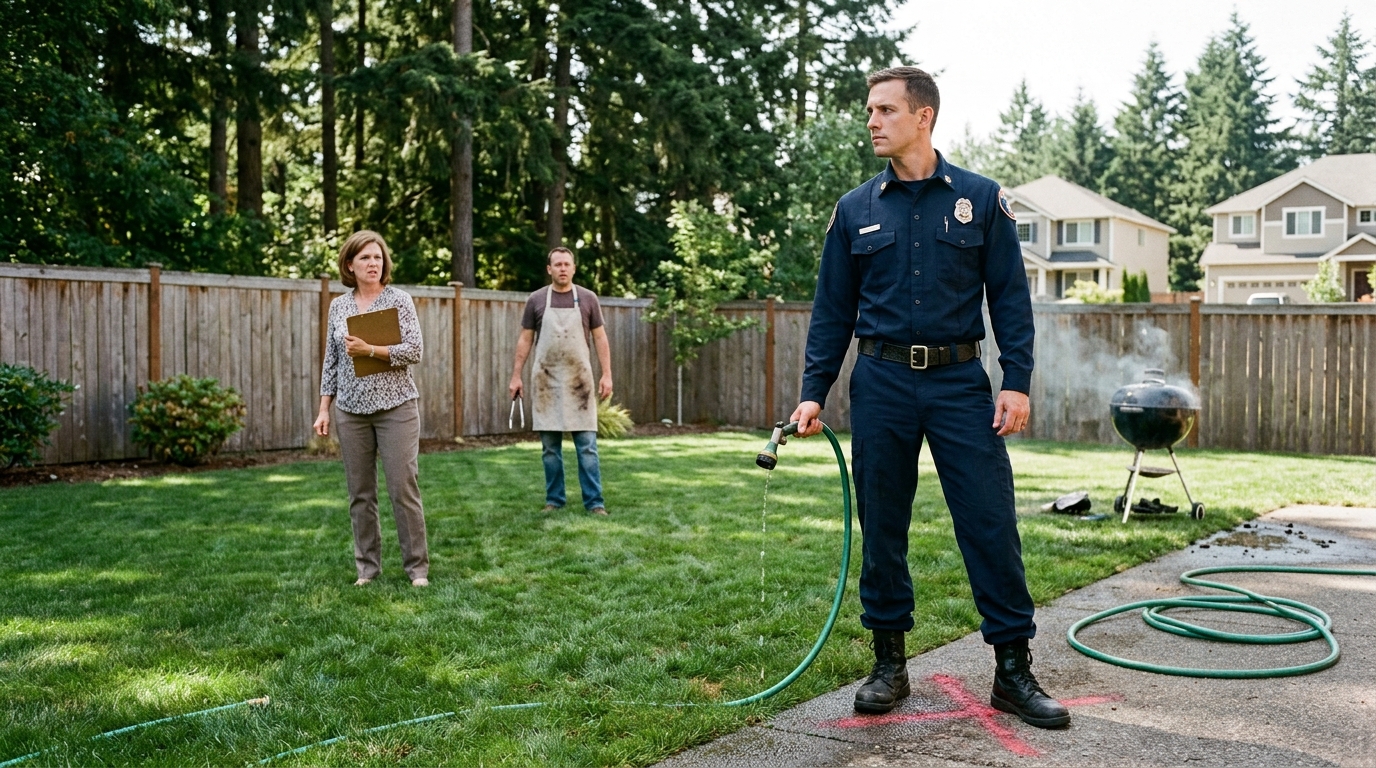
I looked through the window. Karen was currently marking a red ‘X’ in chalk on my patio stone near the pool pump.
“I’ve got a hundred and twenty feet of green grass,” I said. “Bring the whole chapter.”
CHAPTER 2: THE PAPER TRAIL AND THE BIKER PIVOT
The brass calliper was still cool against my palm. Through the double-paned glass, the bright red chalk ‘X’ Karen had scraped into my patio stone looked like a fresh wound on the concrete. Across the yard, the dog owner was lazily winding my hose back around its reel, leaving a clump of wet mud against the cedar baseboard.
I slid the calliper into my pocket and walked over to the desk. The printed land plat from the county auditor’s office lay flat under the desk lamp. I ran my thumb along the boundary lines. Parcel 412-B. One hundred and ten feet deep. Eighty feet wide. Fully titled, fully tax-assessed, and free of any municipal easements.
The kitchen door rattled when I pushed it open again. Karen was standing near the property line, reviewing her clipboard while two men in folding chairs cracked open cans of cheap lager.
“Karen,” I said.
She didn’t turn around immediately. She tapped the top of her pen against the aluminum clip three times before spinning on her heel. “Jake. I told you, we’re wrapping up the setup for the afternoon. You don’t need to hover.”
“You marked my patio stone,” I said, pointing down at the chalk.
“That marks the fifteen-foot offset,” she replied, her tone completely devoid of warmth. “According to the neighborhood master survey—Survey-94—the greenbelt corridor extends past your pool deck. The HOA board has administrative authority over all contiguous green space.”
“There is no Survey-94 in the county registry,” I said. “I checked the public land records an hour ago. My deed doesn’t reference an HOA corridor.”
A tiny muscle near the corner of Karen’s left eye twitched, but her expression didn’t break. She adjusted her clipboard, shifting her grip so the top page folded over. For a fraction of a second, I caught a bold header printed in black ink across the margin: Vanguard Development & Logistics – Site Assessment. Beneath it, a line item was highlighted in yellow: Protocol-Eighty Compliance.
She flipped the page back down before I could read the rest.
“County records are often outdated, Jake,” she said smoothly. “The developer filed secondary covenants before the final subdivision phase. As HOA President, it’s my duty to enforce the layout as intended. If you have an issue, you can submit a formal grievance to the committee. It will be reviewed in ninety days.”
“Ninety days.”
“That is the standard administrative window,” she said, already turning her back to me. “Now, if you’ll excuse me, we have forty more guests arriving for the mixer.”
She walked toward the lawn edge where a low wooden survey stake had been driven into my turf. Painted across the side of the stake in faded white stencil were three letters: V-N-G.
I didn’t argue. I didn’t raise my voice. Arguing with a bureaucrat who owns the clock is a fool’s game.
I pulled my phone out of my pocket, unlocked the screen, and tapped Tank’s number back up.
“Tank,” I said when he answered.
“Yeah, kid? I’m in the garage. What’s the word on the yard?”
“The wedding is on,” I said, watching Karen direct a guy with a portable speaker toward my outdoor outlet. “In fact, I need you to move the date up. This Saturday.”
“Saturday?” Tank let out a low whistle. “That’s four days out. Darla’s gonna lose her mind with the planning.”
“Tell Darla she gets full artistic control,” I said. “Food trucks, stage, banners. Tell her to bring the loudest sound system the club owns. And tell the chapter to park all fifty bikes right along the cul-de-sac curb.”
A slow, heavy laugh rumbled through the speaker. “You’re building a wall, aren’t you?”
“I’m establishing a boundary,” I corrected. “And I’m using two-ton American steel to do it.”
“We’ll be there Friday night for staging,” Tank said, his voice dropping into a hard, protective tone. “Nobody touches that yard once the Sons set up camp.”
I hung up the phone and dropped it back into my pocket. Out on the lawn, the man in the apron was sliding another batch of hot dogs onto my grill.
I walked over to the patio edge, stooped down, and picked up the garden hose. I turned the brass nozzle all the way to the right, raised the spray, and aimed it directly at the smoldering charcoal bed inside the Weber.
A massive cloud of white steam exploded into the air, hissed violently, and smothered the fire in seconds.
The guy with the tongs froze, his mouth open. Karen whipped her head around from across the yard, her face turning pale with sudden, suppressed fury.
“Mixer’s over,” I said, setting the hose nozzle down on the wet grass. “Clear the lot.”
CHAPTER 3: THE FORTRESS ON THE GRASS
The last wisps of gray steam drifted off the wet charcoal bed and vanished into the pine canopy. The man in the apron stood frozen, tongs dangling uselessly from his hand, while the hot dogs hissed on the cold grate.
Karen didn’t move for three long seconds. Her jaw worked silently, her posture stiffening until her spine looked ready to snap. She stared at the dripping nozzle lying on the grass, then turned her gaze up to mine.
“You’re making a catastrophic legal mistake, Jake,” she said, her voice dropping into a low, venomous register that barely carried past the fence line.
“The lot is cleared,” I said, setting my foot over the red chalk ‘X’ on the stone and dragging my rubber-soled boot across it until the mark was nothing more than a pink smear. “Get off my grass.”
She didn’t reply. She turned on her heel, her clipboard clipped tightly under her arm, and marched her remaining guests through the split cedar fence board.
By Friday afternoon, the quiet cul-de-sac of Cascadia Hills ceased to exist.
It started as a distant, low-frequency hum vibrating through the floorboards of my home office. I stopped typing, my fingers resting on the mechanical keyboard, as the vibration rose into a thunderous, rolling roar. Chrome flashed through the blinds.
Tank was riding point on a custom matte-black Glide, his long beard split by the wind, flanked by two dozen heavy cruisers. Behind them came the convoy: a forty-foot flatbed hauling a steel stage rig, two commercial smoker trailers venting Hickory smoke into the suburban air, and Darla’s black SUV loaded to the roof with folding chairs, floral arches, and heavy cabling.
Within forty-five minutes, forty-eight motorcycles were parked wheel-to-curb along the street, effectively forming a solid wall of iron along the perimeter of my lot.
“Where do you want the main sound rig, kid?” Tank asked, swinging his heavy frame off the saddle. His boots crunched on the gravel drive, his leather vest creaking under the weight of his broad shoulders.
“Right along the southern border,” I said, walking out to meet him. I pointed to the low wooden survey stake with the faded stencil. “Cover that stake entirely. Stage goes over the greenbelt line.”
“Done,” Tank grunted.
Darla stepped out from behind a trailer, a thick binder tucked under her arm and a headset resting around her neck. She looked around the yard, her eyes glinting with tactical precision. “We’re running three hundred feet of heavy-gauge extension cord from your garage panel, Jake. If your HOA president wants to complain about noise, she’s going to have to talk over two thousand watts of live brass and organ.”
By dusk, the yard looked less like a private lawn and more like an fortified staging ground. Strings of Edison bulbs spanned the oak trees, casting a warm amber glow over the thick grass. The smell of slow-roasting pork shoulder overpowered the neighborhood’s manicured fertilizer scent.
Across the street, curtains twitched. A few neighbors walked down their driveways holding coffee mugs, drawn by the sudden spectacle. Old Mr. Henderson from house 408 stood near my mailbox for ten minutes before chuckling softly and giving Tank a thumbs-up.
Then the local patrol car pulled up.
Cruiser 12 rolled slowly along the line of parked chrome, its tires creeping over the asphalt. The driver’s door opened, and Deputy Miller stepped out, his hand resting casually near his belt. Behind him, standing on her porch with her arms crossed, was Karen.
“Evening,” Miller said, looking over the stage setup, the food trucks, and the thirty leather-jacketed club members adjusting lighting trusses. “Got a noise and zoning complaint from the HOA board.”
I walked to the edge of the driveway, pulling a folded sheath of papers from my back pocket.
“Private event on private land, Deputy,” I said, handing him the county permit printout alongside my land title. “Noise ordinance doesn’t take effect until 10:00 PM. All vehicles are legally parked on public road right-of-way. Fire department already cleared the smoker trailers this morning.”
Miller took the papers, flipping through them under the beam of his flashlight. He looked at the property boundary diagram, then looked at the stage sitting squarely over the area where the red chalk used to be.
“Everything looks airtight,” Miller said, folding the papers back up and handing them back. He looked over at Karen’s porch, then back to me. “Keep the decibels reasonable until sunset.”
“Appreciate it, Deputy.”
As the cruiser rolled away, I looked across the street. Karen wasn’t looking at the police car. She was on her front steps, illuminated only by the screen of her cell phone, speaking rapidly into the receiver while her other hand adjusted her clipboard. She wasn’t filing an HOA citation anymore. She was calling someone else.
Tank walked up beside me, leaning his heavy forearm against my shoulder as he watched her. “She’s not backing off, Jake.”
“I know,” I said, watching her fingers tap frantically against her phone screen. “She’s running out of local leverage. Which means whatever she does next, she has to do it herself.”
CHAPTER 4: BLACKOUT AND SABOTAGE
Karen didn’t look back as her porch light clicked off, plunging her front steps into shadow. Across the street, the bass line from the stage speaker shook the leaves of my silver maple, sending a vibration straight through the soles of my boots.
Saturday afternoon arrived under a high, pale sky.
By four o’clock, three hundred people filled my backyard. The Edison bulbs strung between the oaks swayed in a light breeze, throwing long ribbons of yellow light over the crowd. Tank stood at the altar—a rustic arch constructed from polished exhaust pipes and cedar beams—his hands resting calmly over his leather belt. Darla marched down the lawn aisle to a heavy acoustic guitar riff, her white lace dress sweeping past the front tires of fifty parked motorcycles.
The vows were short, punctuated by laughter, the clinking of soda bottles, and tears from two-hundred-pound club members sitting on folding chairs.
“I now pronounce you husband and wife,” the justice of the peace shouted into the microphone.
The crowd erupted. Tank pulled Darla into a crushing embrace, and the lead guitarist slammed his pick against the strings to kick off the reception set.
Then the yard went dead.
The music cut mid-chord. The Edison lights vanished, leaving three hundred people in sudden, deep twilight. The hum of the food truck refrigerators died with a metallic whine. Confused muttering swept through the crowd like wind through dry leaves.
I didn’t pause to ask questions. I turned toward the south corner of the house where the main electrical service panel met the meter base.
My boots crunched over the gravel pathway alongside the foundation. The side yard was dark, shadowed by the high cedar fence. As I cleared the corner of the garage, a faint, metallic scraping sound echoed off the siding—the rasp of steel sliding against iron hinges.
“Karen,” I said.
She was standing right in front of the open gray utility enclosure. In her right hand, she held a sixteen-inch iron crowbar, its curved wedge jammed directly between the main service disconnect and the copper bus bar. Arc marks scarred the gray paint, smelling strongly of burnt copper and ozone.
She didn’t drop the tool. She tightened her fingers around the rubber grip, her chest heaving behind her oversized sunglasses despite the twilight.
“I warned you,” Karen said, her voice trembling with a erratic, brittle edge. “This event is illegal. This whole assembly violates every code in the district. I have the authority to shut down unpermitted commercial utility draws.”
“That box belongs to the city power authority, Karen,” I said, taking one deliberate step forward. “That’s a felony utility bypass.”
“It’s community infrastructure!” she snapped, raising the crowbar an inch. “Survey-94 gives the HOA jurisdiction over all utility access corridors! You think you can just bring these people here? You think you can ruin the valuation of this whole street?”
“Ma’am.”
A deep, quiet voice cut through the dark from behind me.
Chief Vance—the county fire marshal, invited as a guest by Tank’s chapter—stepped around the garage corner. He was dressed in his dress uniform, a brass belt buckle gleaming in the dim light. Beside him stood Deputy Miller, his flashlight beam slicing through the darkness and pinning Karen against the breaker box.
“Drop the iron, ma’am,” Miller said, his hand resting flat over his holster latch. “Slowly.”
Karen froze, the bright white beam reflecting off her sunglasses. “Chief, you don’t understand. He’s operating an unauthorized commercial grid load—”
“I understand that you just jammed a steel bar into a two-hundred-amp energized service panel,” Vance said smoothly, stepping past me to look at the scorched copper. “You created an immediate fire hazard for three surrounding structures. Deputy, take the tool.”
Miller stepped in, wrapping his fingers around the crowbar and pulling it free. As he did, the clipboard tucked under Karen’s arm slipped from her grip, hitting the concrete foundation and spilling its contents across the damp grass.
I knelt down, sweeping my flashlight over the scattered papers.
Past the HOA bylaws and the fake Survey-94 map lay a thick blue folder with a heavy seal. My eyes locked onto the header page: Vanguard Logistics Group – Municipal Acquisition Proposal under Protocol-Eighty. Attached to the back was a draft map of Cascadia Hills—with my lot, and four others along the greenbelt, shaded in dark red and tagged for mandatory municipal easement seizure.
“What is Vanguard, Karen?” I asked, lifting the document off the grass.
Karen’s jaw snapped shut. She pulled her wrists back as Miller clicked the first steel cuff over her left arm, her eyes flashing with pure, cornered malice.
“You think you’re smart, Jake,” she whispered, her voice dropping into a harsh rasp. “You think this is about a fence? That land is already gone. The city council approves the easement extension on Monday. You just bought yourself a front-row seat to a demolition.”
“Deputy,” Vance said softly, “take her to the car.”
CHAPTER 5: CHECKMATE ON CASCADIA
The rear door of Cruiser 12 clicked shut with a heavy, double-latched thud. Inside, Karen sat rigid against the vinyl seat, her face illuminated by the red flare of the taillights as Miller pulled out of the driveway.
In my left hand, the blue folder felt heavy. The paper was cold, damp from the grass, but the crisp ink on the cover page remained legible under the yard’s amber floodlights: Vanguard Logistics Group – Municipal Acquisition Proposal under Protocol-Eighty.
Chief Vance stepped up beside me, pulling a pair of work gloves from his pocket and looking at the scorched electrical base. “The backup generator’s keeping your music on, kid. But tomorrow morning, you and I are going down to the municipal annex.”
“We don’t have to wait until tomorrow,” I said, thumbing through the dossier. “Monday’s city council vote is where this dies.”
Forty-eight hours later, the municipal council chamber smelled of old floor wax and stale coffee.
The long oak dais was elevated three feet above the audience seats. Four council members sat behind microphone stands, skimming through their agendas while a low hum of chatter filled the gallery. In the third row, two men in tailored charcoal suits—Vanguard’s regional corporate counsel—sat with leather briefcases resting across their knees.
When the mayor called for public commentary on Item 4-B—the greenbelt easement extension under Protocol-Eighty—I didn’t step to the lectern empty-handed.
I laid three items flat on the wooden podium: the county land title for Parcel 412-B, the blue dossier recovered from Karen’s clipboard, and a certified copy of the county recorder’s plat index dating back to 1988.
“The proposed easement extension relies entirely on an administrative document labeled Survey-94,” I said into the microphone. My voice was calm, measured, carrying clearly through the ceiling speakers. “Survey-94 was never filed with the county clerk. It was drafted privately by Vanguard Logistics and funneled through the Cascadia Hills HOA board to create an unrecorded boundary dispute.”
One of the corporate attorneys in the third row straightened his spine, his hand reaching down to snap the latch on his briefcase.
“Protocol-Eighty requires a contiguous public greenbelt to trigger municipal land condemnation,” I continued, holding up the certified plat. “There is no greenbelt. There are five private residential parcels whose deeds run directly to the centerline of the timber lot. The HOA president was using fabricated citations to manufacture a paper record of public usage.”
Chief Vance stepped forward from the front row, laying his official fire investigation report on the clerk’s desk. “Furthermore, the former HOA president is currently held on felony charges for tampering with energized municipal utility infrastructure in an attempt to enforce that invalid map.”
The lead council member looked from the fire marshal’s report to the blue dossier, then down at the two attorneys in the third row.
“Counsel,” the council member said, leaning into his microphone. “Is Vanguard relying on an unrecorded HOA survey for this annexation filing?”
The attorney opened his mouth, held it open for two seconds, then slowly closed his briefcase latch with a dull, metallic click. He didn’t answer. He stood up, motioned to his associate, and both men walked out the rear doors of the chamber without saying a word.
The council voted five to zero to strike Item 4-B from the docket permanently.
By three o’clock the following Saturday, the cul-de-sac had returned to its natural rhythm, but the air felt different.
The stage was gone. The fifty motorcycles had cleared out after a victory breakfast at the diner down the highway, leaving only a few faint skid marks near the curb. Across the street, Karen’s driveway stood empty. A commercial moving truck had come and gone before dawn, leaving the front lawn bare except for a small, white real estate sign sticking out of the dirt.
I sat on my back patio under the shade of the maple tree. On the outdoor table lay the three broken cedar fence boards.
I picked up my brass calliper, set the jaw against the edge of a fresh six-foot cedar plank, and tightened the micro-screw until it locked at precisely three-quarters of an inch. I tapped the wood, lined up the hand saw, and drew the blade back across the grain.
The saw bit deep, sending clean, pale shavings cascading down over the green grass.
Across the lawn, Mr. Henderson walked along the property line holding a hammer and a box of galvanized nails. He didn’t ask permission, and he didn’t check a clipboard. He simply lifted the end of the new fence rail, held it flush against the corner post, and waited for me to set the first nail.
I drove the nail home with two heavy strikes of the hammer. The steel bit flush into the heartwood, solid and unyielding.