The Friction of Sand and Iron: A Story of Sovereignty in the Broken Desert
CHAPTER 1: THE THRESHOLD FORCE
The heat coming off the porch floorboards smelled of dry pine and old sealer, a thin, bitter scent that tightened the throat. Three men stood in the glare. The tallest had a laminated card clipped to a webbing strap across his chest—no city department name, just a heat-sealed piece of plastic with his face on it and the words Emergency Ordinance printed in a bold, faded font. His hand stayed low, his thumb Hooked into the margin of his belt right above a heavy nylon baton pouch.
“I’m not giving you a key to my home,” I said. My palm was flat against the inner edge of the door, feeling the dry friction of the grain. I didn’t step out onto the concrete. I didn’t pull the door closed behind me. I just held the space, five inches of solid oak between my boots and theirs.
The man to the left shifted his weight, his heavy tactical boot leaving a fresh, pale gouge in the gray paint of the threshold. He didn’t look at my face; his eyes were fixed on the security camera bracket above the lintel, measuring the angle of the lens.
“Non-compliance escalates, Mr. Rios,” the tallest one said. His voice was flat, dried out by the desert wind that pulled through the cul-de-sac. “This is standardizing access. Emergency preparedness under the Mosquite Ridge guidelines. We take the key, or we document the refusal and let the legal team handle the lien.”
Across the asphalt, the late afternoon sun hit the windshield of a white SUV with magnetic Community Safety signs slapped crookedly on the doors. A phone was visible through the tint, its small glass lens glinting as it tracked the porch. Behind them, further down the curb, a second vehicle appeared—a clean, long-wheelbase black sedan. It moved without the gravel-crunch of the SUV, its tires tracking smoothly over the dusty asphalt before the engine died with a quiet, mechanical click.
Veronica Hail didn’t look at the sedan. She stood three paces behind her hired muscle, her red blazer stark against the desaturated stucco of the garage wall. Her fingers were busy on the edge of a plastic clipboard, tapping a rhythm against a stack of official-looking cream paper.
“You’re putting the entire block at risk, Arthur,” she called out, her voice carrying that specific, practiced rhythm of someone reading a notice aloud to an empty room. “We have seven houses already registered on this run. The Code-9 parameters require contiguous entry capability. It’s not a discussion.”
“Show me the county signature on the amendment, Veronica,” I said, keeping my breath steady, rhythmic. “The one with the Red Mesa seal. Not your personal letterhead.”
Her eyes narrowed, the skin around her temple tightening as she glanced toward the sidewalk where the sedan’s door was now swinging open. She didn’t answer. Instead, she gave a short, downward nod to the man closest to the screen door. The man took half a step forward, his shoulder blocking the light, his chest emblem—Security in raw silver thread—filling the frame until the smell of sweat and hot nylon crowded out the scent of the dry wood.
CHAPTER 2: THE PAPER TRAIL
The weave of the synthetic black fabric was so close I could see the tiny, distorted reflections of the desert sky in the polyester threads. The smell of hot nylon and stale tobacco rolled off his vest, thick enough to taste. My hand remained flat on the inner frame of the door, my knuckles absorbing the tiny, high-frequency vibrations of the house as the wind rattled the loose corrugated metal on the patio roof next door.
“Step back,” I said. The words didn’t carry weight because I yelled them; they carried weight because they didn’t vibrate. I kept my voice low, right in the chest, the way you speak when you’re trying to keep a high-voltage line from sensing your movement.
The guard didn’t drop his shoulder, but he stopped his forward lean. His boots ground a few grains of red desert sand into the porch floorboards with a dry, glassy crunch. On his chest, the cheap silver lettering of his patch caught the harsh glare of the sun, casting a jagged beam of white light across my entryway floor. Below the patch, clipped to a utility loop, hung his laminated ID. It was supposed to be an HOA security credential, but the corner of the plastic sleeve was peeling. Underneath the clear laminate, a tiny, stamped logo was visible—not the styled green quail of the Mosquite Ridge Homeowners Association, but a double-headed iron gear enclosing the letters RMAC.
My eyes locked onto the logo. Red Mesa Aggregate Corp.
I reached back with my left hand, my fingers trailing along the rough, unpainted edge of the drywall behind the door until they brushed the cold manila paper of the folder resting on the entry table. My fingertips knew the grain of that folder. I had spent three weeks assembling it, sheet by sheet, pulling the dusty ledger entries from the basement archives of the county recorder’s office while the clerk sneezed in the corner.
“You’re standing on Lot 42,” I said, sliding the folder forward until the edge of the cardboard peeked through the gap in the screen door. “The county plat map from nineteen-ninety-four designates this threshold as private easement. It doesn’t belong to the association. It never did.”
Veronica Hail took a step closer to the porch, the heels of her shoes clicking against the cracked asphalt of the driveway. “The county grant overrides historical plats, Arthur,” she said, her voice sharp as dry brush. “We are establishing the contiguous safety corridor. The documents were filed under the regional development board last month. It’s public record.”
“No,” I said, my thumb slipping inside the folder to touch the cold, ink-heavy surface of the printed county planning map. “The grant proposal is public. The execution plan isn’t. You filed a Code-9 Variance under the Vanguard Trust Proxy, but you left my lot number inside the red box on the zoning overlay. You marked it as a ‘centralized access hub’ to draw down the federal resilience funds.”
The guard’s eyes flickered down to the folder in my hand. He didn’t know what a Code-9 was, but he knew the tone of a man who had the paperwork to back up a refusal. I could see the tiny muscle at the corner of his jaw twitch under the grey stubble.
Behind them, the door of the black sedan stayed open. A shadow moved inside the air-conditioned interior, but no one stepped out yet. The dry heat of the afternoon seemed to pool in the space between the porch and the car, thick and unmoving, smelling of scorched oil and the dust of a hundred unpaved miles.
I turned the page inside the folder, the crisp paper rustling in the quiet. The top sheet was a photocopy of the grant application I’d pulled from the state oversight portal. At the bottom of the budget spreadsheet, listed under “Infrastructure Prep,” was a single line item that had been crossed out in blue ink but remained legible beneath the stroke: Lot 42 structural access modification — paid to Red Mesa Aggregate Corp.
The pieces were there, rough-cut and jagged, but they didn’t fit the picture of a simple security upgrade. This wasn’t about emergency keys; it was about the ground beneath my feet, and the rust on the hinges of my door was the only thing keeping them from taking it.
CHAPTER 3: THE INFORMANTS WHISPERS
The paper between my thumb and forefinger felt dry, almost chalky, as the heat from the porch rail curled its corners upward. I held my position at the door, the metal screen humming slightly against my knuckles as the black sedan idling at the curb vibrated at a low, heavy frequency. That vibration caught in the back of my teeth, dragging up the memory of a concrete mixer on a job site five years ago—the hot grease, the dust, the sound of structural wood splintering under a load it was never engineered to carry.
“Arthur,” Veronica’s voice cut through the mechanical hum. She didn’t look at the folder. She looked at my shoulder, measuring the physical barrier I presented. “You’re holding up a process that was approved by a quorum. We aren’t going to let one uncooperative driveway hold up the security certification for the entire development.”
The tallest guard didn’t wait for her to finish. He leaned his weight into his left heel, his hand sliding off his belt to grip the cold, textured composite of his flashlight casing. It wasn’t a weapon yet, but it was a leverage tool, and he was positioning it to wedge between the doorframe and my chest if I made a move to lock the latch.
Before he could bridge those last few inches of concrete, my pocket buzzed. The vibration was sharp, three rapid pulses against my thigh.
I didn’t break eye contact with the guard as I reached down with my left hand, keeping the manila folder pinned against my ribs with my elbow. My fingers found the glass screen of my phone. I slid it out, keeping it low, out of their direct line of sight but within the shadow cast by the heavy oak door.
The text was from an unlisted number, but the first line was a screenshot of an internal thread. The header read: Mosquite Ridge Maintenance Division.
Rios is the problem case. Once we get his access, the rest will comply. Use contracted officers if necessary. Vanguard has already authorized the clearing fee under the Red Mesa Aggregate allocation.
Below the image was a short, plain-text follow-up:
I’m done with this. She’s bypass-signing the variance filings under the Vanguard Trust Proxy to grant subsurface excavation rights. Check your mail. The structural integrity reports for Lot 42 are falsified.
The heat in the air seemed to dry out instantly, leaving only the smell of dust and the sharp, metallic tang of the screen wire. The decoy was falling apart in my hands. The emergency access initiative wasn’t about keys or local emergency preparedness. They weren’t trying to standardise a security route. They needed to get past my front door because the concrete slab of my garage sat directly over the main structural supports of the old drainage canal—the exact point where the Vanguard Trust Proxy wanted to run the conveyor lines for the Red Mesa Aggregate Corp quarry.
“Arthur,” Veronica said, taking a step onto the first concrete step of the porch. The plastic clipboard in her hand tapped against her thigh, a dry, rhythmic warning. “We have the sheriff’s department on standby for non-compliance. This is your final opportunity to hand over the duplicate before we execute the administrative entry.”
“You don’t have a sheriff’s deputy on standby, Veronica,” I said, my voice sounding flat, scraped clean of any hesitation. I raised the phone just enough for her to see the blue glow of the screen reflecting off the glass. “And you didn’t file the Code-9 Variance with the county. You filed it with a private engineering office that doesn’t hold municipal authority over Mosquite Ridge.”
The tallest guard’s knuckles went white against the black casing of his light. He looked over his shoulder at Veronica, his eyes darting to the black sedan, which had just opened its passenger side door.
The heat of the afternoon was still rising from the gravel, but the space between us felt cold, locked in the friction of a machine that had run out of grease and was beginning to tear its own gears apart.
CHAPTER 4: THE STANDOFF AT RED MESA
The rubber seal of the passenger door released with a wet, heavy suction sound that seemed to cut clean through the mechanical rattle of the sedan’s engine. The tallest guard’s hand remained frozen on his heavy composite light, but his torso angled slightly away from me, caught in the transition between holding his ground at my door and responding to the quiet threat behind his left shoulder.
“Gentlemen,” a calm voice said from the driveway.
The sound wasn’t loud, but it possessed a dense, physical presence that immediately pulled the heat out of the air. It was the tone of a man who had spent thirty years letting the weight of his office do the speaking for him.
The three men in tactical vests turned in unison, their boots dragging over the coarse sand scattered across the driveway. Veronica Hail paused mid-stride, her heels remaining wedged in the heat-softened asphalt. She lowered her clipboard by an inch, her fingers tightening around its plastic edge until the knuckles turned a pale, bloodless white.
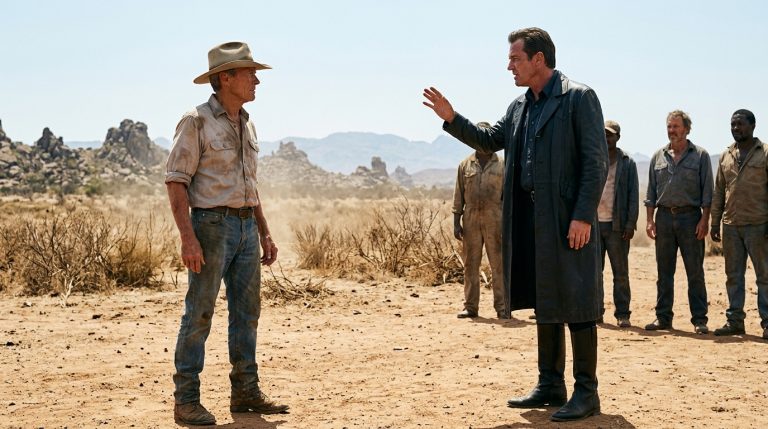
Daniel Mercer stood beside the idling sedan, his boots solid on the gravel. He wasn’t wearing a utility uniform or a tactical vest; he wore a faded denim shirt with the sleeves rolled twice to the forearm, revealing skin the texture of old saddle leather. His hands remained relaxed at his sides, fingers slightly curled, entirely clear of his belt. Yet, his posture carried no hesitation. He occupied the space because he had the absolute right to it.
“Who are you?” the tallest guard demanded, though his voice lacked the hard edge he had used on my threshold. His shoulders had rounded slightly, his chest patch—Security—suddenly looking like nothing more than cheap polyester and silver thread.
Daniel took one slow, measured step forward. His shadow stretched long across the concrete, crossing the property line before he did. “That depends on what you’re pretending to be.”
The porch went completely silent. Across the asphalt of the cul-de-sac, the curtains of a dining room window twitched, the pale glow of a mobile phone screen visible behind the mesh.
“Badge numbers,” Daniel repeated, his voice low and level. “Agency supervising authority.”
The tallest guard hesitated, his glance dipping toward his own chest, then toward the peeling RMAC logo hidden under his laminated sleeve. “We’re contracted,” he muttered, his fingers loosening their grip on the composite flashlight. “Authorized by the HOA under the regional safety initiative.”
“That wasn’t the question,” Daniel said. He reached into his back pocket, his movement deliberate and slow, ensuring every eye on the porch tracked his hand. When his fingers emerged, they held a worn leather wallet. He didn’t thrust it toward the guards; instead, he flipped it open and held it steady, letting the late afternoon glare hit the star-shaped piece of brass pinned inside. “Sheriff Daniel Mercer. County of Red Mesa.”
The reaction was immediate. The guard on the left took half a step backward, his boot heel catching on the edge of my flower bed with a dry crunch of cedar mulch. The tallest man’s jaw set hard, a thin bead of sweat cutting a clean line through the dust on his cheekbone.
Veronica stepped forward, her voice rising to block the shift in momentum. “Dan, this is a community safety directive. The board approved the standard access amendment under the Code-9 Variance Filing last month. We are completely within our regulatory rights.”
“The Code-9 Variance was never signed by the county commission, Veronica,” Daniel said, finally turning his head to look at her. “And the Vanguard Trust Proxy has no legal standing to lease the subsurface drainage easements of Lot 42 to Red Mesa Aggregate Corp. You filed the papers, but the county engineer flagged the fraud six hours ago.”
He closed the leather wallet with a dry, muffled snap. “You’ve got three men in unlicensed uniforms attempting to force entry into a private residence under a falsified municipal code. Deputies are already turning onto the main avenue.”
The distant, high-pitched warble of a siren cut through the dry desert air, growing louder as it bounced off the stucco walls of the neighboring houses. The illusion of authority on my porch vanished, leaving behind only three tired men in cheap vests and a woman whose clipboard had suddenly become very heavy.
CHAPTER 5: THE RECLAIMED GROUND
The high-frequency pulse of the sirens died, leaving only the dry tap-tap of cooling exhaust pipes and the low, heavy thrum of two county cruiser engines idling at the curb. Dust, kicked up by the rapid arrival of the patrol cars, settled over the hood of the black sedan like a fine sheet of desaturated rust.
Two deputies stepped out, their boots grinding into the parched dirt of the road margin with a synchronized, heavy weight. They didn’t draw their weapons. They didn’t need to. The raw jurisdictional reality of Daniel Mercer’s badge, glittering in the low desert glare, had already pinned the three guards to the concrete of my porch.
“Dan,” Veronica’s voice cracked, the pitch thin and dry as sun-bleached grass. She clutched the clipboard against her red blazer, her fingers digging so hard into the plastic frame that a small hairline fracture splintered across the top margin. “You’re operating outside the scope of the local district. The municipal board has sovereign oversight on residential utility zones. We have the filing—”
“The Vanguard Trust Proxy is registered to an inactive post office box in Delaware, Veronica,” Daniel said, his voice flat, cutting through her protest with the cold finality of an iron gate dropping into a slot. “And that Code-9 Variance Filing you submitted to the planning commission was missing the state engineering seal. You didn’t want emergency access to protect the community. You needed control of Arthur’s foundation because your preliminary tunneling for Red Mesa Aggregate Corp is already causing the shale shelf under Lot 42 to shift.”
The tallest guard let his flashlight hand drop entirely to his side, his fingers uncurling. He looked at Veronica, then back at the deputies who were now stepping onto the edge of my driveway, their leather duty belts creaking with every movement. “She told us it was a standard easement inspection,” the guard muttered, his shoulders dropping as he took a step away from my doorway, completely abandoning the threshold. “She said the homeowner was blocking a safety route.”
“Everything you signed under that proxy is asset-frozen as of three o’clock today,” Daniel continued, stepping closer until he stood directly between Veronica and her hired security. “The county surveyor found the subterranean markers fifty feet inside Arthur’s boundary line. You tried to force his door to hide the structural settling before the state inspectors could run their core tests.”
Veronica’s mouth opened, but no sound came out. The clipboard finally slipped from her fingers, striking the gravel driveway with a sharp, hollow crack. A single sheet of paper—the falsified access authorization—drifted across the sand, catching on a rusted irrigation pipe near the curb. A deputy stepped forward, his fingers catching her wrists with a quiet, metallic click that marked the absolute end of her authority.
The neighbors were coming out now. Slowly, almost silently, like animals emerging after a storm. Mrs. Gable from down the street stood near her mailbox, her hands clasped tightly around a ceramic mug. Behind her, two other homeowners watched in absolute silence as the three guards were escorted toward the back of the first cruiser, their heads bowed, their fake tactical patches catching the last of the red twilight.
Daniel turned back toward the porch. He didn’t offer a dramatic hand-shake or a speech. He just looked at me through the screen, his eyes calm, carrying the quiet understanding of someone who knew that a home wasn’t something you conceded, not even an inch of it. He gave a single
CHAPTER 5: THE RECLAIMED GROUND
The high-pitched pulse of the sirens bounced off the stucco eaves of Mosquite Ridge, growing sharper as two marked patrol units crested the hill. The blue and red strobes cut through the yellow desert glare, casting fast-flickering patterns over the dust-coated hood of the black sedan and the dry boards of my porch.
The tallest hired guard slowly opened his hand, letting his composite flashlight hang loosely from its wrist strap. It tapped against his thigh, a dull, plastic sound that signaled his absolute surrender. The two men beside him stepped off the porch steps entirely, their boots sliding into the gravel, heads lowered to avoid the gaze of Daniel Mercer.
“Arthur,” Veronica said, her voice dropping an octave, losing its public-address cadence. She reached out toward the passenger door of the sedan, her nails scraping once against the warm metal as if searching for leverage that wasn’t there. “We can settle this inside. There’s a structural reality here that you don’t understand. The entire eastern ridge—”
“The ridge is stable, Veronica,” Daniel Mercer interrupted, his heavy boots crunching deliberate paths through the sand as he closed the distance. “But your ledger isn’t. The state oversight office just executed a freeze on the pilot funds. The Vanguard Trust Proxy accounts registered to your name were linked to the Red Mesa Aggregate Corp payroll forty minutes ago. It’s over.”
She didn’t try to run. Instead, her jaw tightened, a tremor running through the collar of her red blazer. She clutched the plastic clipboard against her ribs like a shield, but a deputy was already stepping onto the driveway, his hand outstretched.
“I’ll take that, ma’am,” the deputy said. The transaction was quiet, almost polite, but the instant the clipboard left her fingers, her shoulders sagged, the illusion of her administrative authority collapsing into the dusty ground.
I watched from the threshold, my hand finally leaving the dry oak doorframe. The metal of my keys felt heavy in my pocket, cold and redundant now. The two deputies moved with a practiced, methodical efficiency, checking the credentials of the three hired men and taking their statements right there in the gravel. The tallest one didn’t try to defend her anymore; his head shook as he pointed a finger toward Veronica, his lips moving as he explained the contract.
When the metallic click of the handcuffs sounded, it was surprisingly quiet—just a dry, double-stroke of ratcheted steel that cut cleanly through the low hum of the idling squad cars. No one in the neighborhood cheered. Neighbors had gathered at the edges of their driveways, coffee mugs and phones held low, watching in a silence that felt more like a collective exhale than a triumph. The fear that had kept them handing over their keys and ignoring the orange notices was evaporating in the dry afternoon air.
After the patrol cars pulled away, their tires kicking up a light shroud of desert dust that smelled of baked clay and exhaust, the street returned to its natural rhythm. The wind brushed through the dry sage at the corner of my lot, carrying the clean, sharp scent of the open basin.
Daniel Mercer walked up the steps, his boots leaving faint gray prints on the porch paint. He looked at the gouge where the guard’s boot had chipped the threshold, then met my eyes. He didn’t offer a dramatic speech. He simply reached out and tapped the brass deadbolt on my door.
“Keep it locked,” he said quietly. “It’s yours.”
“Always has been,” I replied.
He gave a single nod, turned, and walked back to his sedan, the engine purring smoothly as he backed out of the cul-de-sac.
I remained on the porch for a long time after the dust settled. The sun was dipping below the red mesa, painting the stucco houses in long, cool shadows. I walked over to the workbench in the garage, picked up a small block of fine-grit sandpaper and a tin of gray exterior primer. Returning to the threshold, I knelt down on the dry timber.
I worked slowly, the rhythmic scratch of the sandpaper leveling out the deep scar left by the guard’s boot. The wood grain emerged beneath the dust—pale, clean, and solid. I brushed the shavings away with my palm, feeling the smooth, restored plane of the threshold under my fingertips. I dipped the brush into the primer, sealing the wood against the dry wind.
Across the street, a neighbor walked down his driveway, paused to look at my porch, and offered a quiet, tentative wave. I returned it with a nod. The front door was still mine. The house was still mine. And the ground beneath my boots was finally quiet.