The Weight of Ink: A Masterclass in Cold Reckoning and Sovereignty
CHAPTER 1: THE WATER LINE
The chain on the dock gate was still swinging when the county sedan settled into the gravel turnaround. The links were heavy, galvanized steel, weeping fresh zinc flakes onto the gray planks of the gangway. It was three in the afternoon, the sun a flat disk of white gold catching the sharp edges of the aluminum braces the contractors had left scattered across my shoreline.
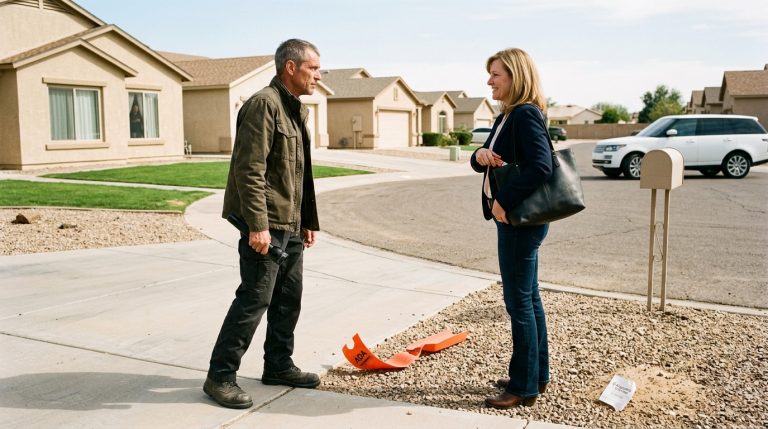
“Step back from the line, please, ma’am,” Deputy Nolan said. His boots made a dry, rhythmic crunch on the crushed rock. He didn’t unholster his duty weapon, but his thumb remained hooked behind his utility belt, right over the black polymer casing of his flashlight.
Karen stayed exactly where she was for three seconds. Her smile was a fixed thing—a pale, enameled stripe beneath the dark tint of her lenses that didn’t adjust for the shadow of the cedars. She stood between two board loyalists who had spent the last twenty minutes nodding at a clipboard, their pastel polo shirts leaking sweat in the humid lake air. To her left, the maintenance supervisor was still holding a socket wrench, his fingers grease-stained where he had unbolted the lower hinge of my gangway.
“This is a temporary access control measure,” Karen said. Her voice had the thin, practiced clarity of someone used to speaking over the hum of a microphone at a suburban country club. She didn’t look at me; she looked at Nolan’s shoulder patch. “The board has placed this structure under review as a historic community amenity. We are simply preserving the asset until ownership is clarified by the county.”
Mara Keen didn’t waste time with a greeting. She stepped around the hood of the sedan, her heels striking the stone with a short, metallic snap. Her briefcase stayed tucked under her arm, an old leather box with brass corners that had gone dull twenty years ago. She didn’t look at the chain, or the contractors, or the white SUV with the Echo Ridge HOA logo idling near my tool shed. She walked straight to the hood of the county vehicle, laid a blue-backed ledger abstract onto the hot enamel, and smoothed it flat with the palm of her hand.
“The asset is clarified,” Mara said. Her tone had the exact temperature of courthouse marble. “Parcel 402, Lot B. Section 12, range four. There are no easements, no covenants, and no shared recreational provisions in the chain of title. The estate of Arthur Vance closed five days ago. My client holds the deed, the title policy, and the keys.”
She tapped the certified seal at the bottom of the page. The sound was small, but in the silence between the lapping water and the idling SUV, it functioned like a closing door.
I watched Karen’s chin lift. The enameled smile didn’t vanish; it curdled. The skin along her jawline went tight, the small muscles tracking down to her collarbone hardening into ropes. She looked down at the blue paper, then at the socket wrench in her supervisor’s hand, and finally at me. For five days, she had used administrative language like a shield, hoping the weight of her letterhead would make me blink before I read the record.
“The plat amendment from ninety-eight—” Karen began, her voice dropping an octave into something transactional.
“Belongs to a subdivision two miles south,” Mara interrupted. She turned a page in her folder, her fingers steady. “You filed a false affidavit with the assessor’s office at nine-fifteen yesterday morning. We have the timestamp, the wrong plat reference, and the voicemail you left at the marina restricting my client’s furniture delivery. It’s a clean chain of tortious interference.”
The foreman of the dock company took a step away from the gate. He dropped his tool bag into the weeds with a heavy, metallic clatter. “She told us the paperwork would catch up,” he muttered, looking at Nolan. “She said the board authorized the recovery.”
Nolan didn’t look back at him. He reached down, took hold of the HOA chain, and gave it a sharp, testing tug. The padlock rattled against the latch. “Who brought the lock, Karen?”
She didn’t answer. She reached up, slowly sliding the sunglasses down the bridge of her nose. Without the lenses, her eyes looked small, pale, and entirely devoid of the authority she had spent the week projecting across the cove.
Mara pulled a final document from the leather case—a high-resolution printout of a digital log. “We also have the metadata from your closed board session on Tuesday,” she said softly, reading the text without a hint of drama. “‘If we jam the deed chain long enough, he’ll either settle cheap or leave it empty for summer. Use contractors, not residents. Workers don’t ask title questions if the check clears.'”
Karen’s attorney, who had been standing by the SUV with his hands in his pockets, finally moved. He didn’t look at his client. He walked over, gripped Karen by the elbow, and spoke two words directly into her ear.
The smile didn’t just fade; it fell away completely, leaving her face looking strangely gray in the sharp afternoon light.
CHAPTER 2: THE REJECTED DEED
The leather of Mara’s briefcase was cold against my palm, its brass latches snapping shut with a sound like a small-caliber pistol clearing its chamber. We were standing on the stone steps of the county recorder annex, the mid-morning sun doing nothing to soften the concrete geometry of the plaza. Behind us, the double glass doors were still vibrating from the force of Karen’s departure. Her attorney had practically dragged her toward the parking garage, his hand a white-knuckled clamp on her elbow while her two remaining board loyalists lingered near the water fountain, staring at their phones as if looking for an algorithm that could undo a sworn deposition.
“She’s going to ground,” Mara said. She didn’t look up as she adjusted the strap of her case. Her breath came out in a thin, controlled line. “The injunction keeps her off your dirt, but women like that don’t stop because a hearing officer signs a piece of paper. They stop when the accounts go empty.”
“We have the transcript,” I said. My thumb brushed the edge of the old fishing guide’s iron key in my pocket, its jagged teeth biting into my skin through the denim. “We have the intent.”
“We have the execution,” Mara corrected, her voice dropping into that rhythmic, transactional cadence she used when she was calculating a strike. “But we don’t have the origin. Karen didn’t invent this play last Tuesday. She’s been digging this trench for a year.”
She reached into the side pocket of her portfolio and pulled out a manila envelope, its edges crisp and unbent. She didn’t hand it to me; she held it against her chest, her fingers pinning the heavy paper. “My title officer didn’t just pull the index. He found a quarantine file in the back of the ninety-eight ledger. Someone tried to slide a quit-claim through the automated registry twelve months ago, right before Arthur Vance’s estate went into probate.”
I took the envelope. The paper was stiff, smelling of vinegar and old toner. Inside were three pages of a rejected deed application, the top right corner struck through with a purple ink stamp from the county registrar: REJECTED – LACKS EXECUTOR SIGNATURE.
Arthur Vance’s name was printed at the bottom in the shaky, tracking script of a man whose fingers were failing him, but the signature line was completely blank. Below it, stamped with the official seal of the Echo Ridge Homeowners Association, was Karen’s name as the receiving agent.
“She tried to buy it before it hit the market,” I said, my eyes tracking the dates. “She tried to steal it from a dying man.”
“Look at the attachment,” Mara said, leaning closer until I could smell the sharp, chemical tang of her hairspray. “The legal description isn’t yours. Not exactly.”
I turned the page. Stapled to the back was a photocopy of an outdated blueprint fragment, its blue lines faded to a dull, chalky gray. It detailed the shoreline grid of my parcel, but the coordinates had been altered by hand—black ink over pre-printed grid lines, shifting the northern boundary three feet into the cove. It was the exact measurement of the sign I’d found wrapped in orange ribbon down my lane. But there was something else: a tiny, handwritten notation in the margin, scrawled in an old drafting pencil that had left a shiny lead smudge on the scan: Map 94-A revised per corporate instruction. Do not index.
“What is Map ninety-four?” I asked.
“That’s what we’re going to find out,” Mara said, her eyes narrowing as she looked past my shoulder toward the county record vault across the plaza. “The registrar didn’t flag the boundary change. They flagged the lack of Vance’s signature. If Karen had gotten him to sign that paper before his heart stopped, that three-foot shift would be legal reality right now. Your dock wouldn’t be yours. It would belong to the common edge.”
The implication settled between us like the cold weight of iron. This wasn’t an administrative error or a neighborhood ego trip; it was a systematic, calculated extraction. Karen wasn’t just trying to bully a new owner out of a summer amenity—she was covering up a physical alteration of the county grid that had been sitting in the dark for a year.
I turned back toward the annex doors, the glass throwing a sharp, fractured reflection of the plaza back at me. “The title officer only pulled the current index,” I said, my voice leveling out into the flat, dangerous tone I used when a calculation finally clicked. “He didn’t pull the historical plat for the whole cove.”
“No,” Mara said, her boots already turning toward the concrete steps. “He didn’t. Because nobody questions a ninety-eight subdivision map that’s been cited thirty times in public filings.”
“We’re going back down,” I said.
We didn’t take the elevator. We took the stone stairs to the basement archive, where the air was colder and smelled of damp cardboard and floor wax. The clerk behind the counter didn’t look up when we entered; he was focused on a blinking monitor, his fingers tapping a slow rhythm against the plastic casing of his keyboard.
Mara laid her credentials on the laminate counter with a sharp, distinct click. “We need the physical ledger for ninety-four,” she said. “Subdivision Plat Map ninety-four-A. The original vellum, not the microfilm.”
The clerk blinked, his eyes shifting from the screen to Mara’s face, then to the certified abstract still tucked under her arm. “Vellum’s in the deep vault,” he said, his voice thick with administrative boredom. “It takes twenty-four hours to pull historic engineering drafts.”
“You have twelve minutes,” Mara said, her voice dropping into a register that made the clerk’s fingers freeze on his keyboard. “Before I call Judge Vance’s former clerk and have an emergency subpoena delivered by the deputy currently sitting in the parking lot.”
The clerk looked at her for four long seconds, evaluating the sharp lines of her tailoring and the absolute lack of hesitation in her eyes. He didn’t say another word. He stood up, took a heavy ring of brass keys from a peg behind the desk, and disappeared through a gray fire door that clanged shut behind him, the sound echoing through the low-ceilinged room like a chain falling onto concrete.
I leaned against the counter, the laminate cold beneath my palms. My phone buzzed in my pocket—a text from the mover confirming that the second delivery truck was arriving at the cove in an hour. I didn’t reply. My eyes were fixed on the manila envelope in my hand, specifically that tiny, smudged pencil note in the margin: Do not index.
When the clerk returned ten minutes later, he wasn’t carrying a folder. He was wheeling a gray metal cart containing a flat, wide cardboard box that looked like it hadn’t been opened since the Clinton administration. The tape along the seam was yellowed and curling, its adhesive dried into a fine, white powder that drifted into the air as he sliced the seal with a utility knife.
“Ninety-four-A,” the clerk said, lifting the lid with a grunt. “Careful with the edges. The vellum’s brittle.”
Mara and I leaned over the box together. The map was huge, a three-foot sheet of translucent drafting paper that crackled like dry leaves under our fingers. It laid out the original layout of Echo Ridge before the first pastel mansion had even been framed. My cabin was there—a tiny, ink-drawn rectangle labeled Vance Fishing Camp.
But as my eyes tracked the shoreline toward the main subdivision, the calculations stopped making sense. The red survey lines that defined the HOA’s common beach area weren’t just close to my boundary—they were drawn over an entirely different set of original surveyor marks that had been erased with a chemical solvent, leaving faint, ghostly shadows on the translucent paper.
Mara reached out, her fingernail tracing the ghost line where the original boundary had been set thirty-two years ago. It didn’t stop at my lane. It kept going, cutting straight through the center of the HOA’s million-dollar clubhouse and across three separate waterfront parcels owned by the board members.
“This isn’t an overlap,” Mara whispered, her fingers going still against the vellum. Her voice was completely devoid of its usual legal polish, replaced by something raw and hollow. “The whole common area… the entire eastern cove development isn’t on HOA land at all.”
I looked at the coordinates at the bottom of the vellum sheet, then at the certified abstract from five days ago. The numbers didn’t align. The 1994 map didn’t just show a three-foot shift—it showed that the original developers had built the entire Echo Ridge infrastructure on land that belonged to the county park system, using a falsified plat to secure their construction loans.
The door behind us clicked open, the sound sharp in the basement silence.
I didn’t turn around immediately. I kept my eyes on the ghost lines on the paper, watching the shadow of a man in a tailored suit grow long across the gray metal cart as he stepped into the light of the fluorescent tubes.
“You shouldn’t be down here,” a voice said from the darkness near the fire door. It wasn’t the clerk. It was Karen’s attorney, his briefcase missing, his hands jammed deep into his coat pockets as his eyes locked onto the open box.
CHAPTER 3: THE PUBLIC SERMON
“We have exactly nine minutes of public access left in this room,” Mara said without looking up from the cart. Her fingers remained flat against the translucent edge of the 1994 vellum sheet, pinning it down against the gray steel mesh of the tray. “Which means you have roughly eight minutes to explain why your vehicle has been tracking my client since we cleared the courthouse annex.”
The attorney, whose nameplate in the hearing room had read Vance Miller, stepped fully into the pool of white light cast by the overhead fluorescent tubes. His hands stayed buried inside the pockets of his charcoal overcoat, forcing the fabric tight across his shoulders. He didn’t have the manic, frantic energy that Karen had displayed on the shoreline; his movements were slow, measured, and entirely transactional. He looked at the box, then at the chemical solvent shadow under Mara’s thumb, and finally at me.
“A title policy covers the asset description at the time of purchase,” Miller said. His voice was low, hitting the concrete walls of the archive basement and dying without an echo. “It doesn’t cover a historical deep dive into the municipality’s structural zoning from three decades ago. You got your injunction. Your cabin is secure. Take the win, pack your truck, and spend your summer on the water.”
“The win isn’t finished until the record is clean,” I told him. I stepped between the cart and the counter, my boots clicking against the gray linoleum. I wanted him to see the alignment—the manila envelope holding the unsigned quit-claim deed was still folded tightly in my left hand. “Karen tried to slide a forged boundary shift past the automated registry twelve months ago. She failed because Arthur Vance died before she could force his hand. Now I find out the line she was trying to steal wasn’t just three feet of gravel. She was trying to bridge a gap that goes all the way back to the original development loan.”
Miller’s face didn’t change color, but the corners of his mouth twitched, a tiny, subconscious spasm that lasted less than a second. He took his right hand out of his pocket and ran a thumb over the silver clasp of his watch. “The HOA has thirty-two homes on that cove. Families who paid seven figures for private beach access, a private pavilion, and a secured community identity. You think a bureaucratic discrepancy in a box of dry vellum is going to dismantle thirty years of established neighborhood infrastructure?”
“It isn’t a discrepancy when it’s done with a solvent,” Mara said. She pulled a small digital loupe from her portfolio, pressed it to the translucent sheet, and let the white LED illuminate the erased survey markers. “The chemical footprint is still active on the fiber. Someone manually scraped the county park system’s coordinate stamps from this sheet before it was scanned into the automated index in ninety-eight. Karen didn’t initiate the theft; she’s just spent the last twelve months trying to quarantine the one parcel that remained outside the altered grid.”
“Arthur Vance knew,” I said. The realization hit me with the cold, sharp precision of a chess piece dropping onto an empty square. “That’s why he kept the place outside the development. He wasn’t being stubborn. He was keeping his name off a multi-million-dollar land fraud.”
Miller looked at the map for a long, silent interval. The basement ventilation system kicked on, a low, mechanical rattle that smelled of damp dust and old oil. When he spoke again, the professional posture had dropped, replaced by the flat, dangerous pragmatism of a man who dealt exclusively in damage control.
“An exposure of this scale doesn’t just hurt the board,” Miller said softly, his eyes locking onto mine. “It freezes every asset in the cove. If the county determines the common beach and the clubhouse pavilion were built on public park reserve, the bank calls every mortgage on Echo Ridge by Friday afternoon. The title companies will litigation-lock the entire shoreline for a decade. Your cabin will be sitting next to thirty empty, rotting structures wrapped in orange construction fence. Nobody wins that fight.”
“I win it the second my gate opens without a padlock on it,” I said.
“Then take a private settlement,” Miller countered. He stepped closer, his breath coming out short. “The board will execute a permanent, non-appealable covenant boundary. We’ll pay your moving expenses, Mara’s fees, and provide a lifetime waiver for all recreational amenity fees in the development. In exchange, this box goes back into the deep vault, and we all forget ninety-four-A ever came out of the cardboard.”
Mara closed her portfolio with a sharp, leather slap. “My client doesn’t sign contracts with entities whose legal existence is predicated on a forged plat map, Mr. Miller. That’s not a settlement; that’s an accessory agreement.”
“You have an emergency board meeting at the pavilion across the cove at seven tonight,” I added, checking my watch. The white gold of the sun was already dipping behind the high concrete windows of the basement level. “Karen thinks she’s holding a sermon to rally the neighbors against an outsider. I think I’ll take a seat in the back row.”
Miller’s eyes went dark. He looked at the clerk, who was sitting three desks away pretending to be entirely absorbed in a printing log. “If you bring that file to the cove, you aren’t just starting a legal dispute. You’re destroying the retirement funds of thirty families who had nothing to do with what happened in ninety-four.”
“They should have checked the ink,” I said.
I didn’t wait for his reply. I gripped the manila envelope, nodded to Mara, and walked straight past him toward the gray fire door. The iron handle was ice-cold against my palm, the heavy latch clicking open with an unvarnished, physical snap that signaled the end of the context phase. The strategy was set, the lines were drawn, and the trap was about to spring in the middle of the coveside pavilion.
As we reached the parking garage, the first drops of a summer storm began to strike the hot asphalt, leaving dark, oily circles that smelled instantly of iron and wet earth. Mara didn’t get into her sedan. She stayed by the driver’s door, her eyes tracking the dark sedan that had just pulled out of the basement ramp behind us.
“He’s going straight to Karen,” she said.
“Let him,” I replied, climbing into the truck. “The sermon starts in two hours.”
CHAPTER 4: THE COVESIDE AMBUSH
The rain was hitting the metal roof of the coveside pavilion with the steady, deafening roar of a gravel chute. Wind swept off the black water of the cove, carrying the scent of rotting weeds and ozone, spraying fine mist through the open cedar pillars. Inside, thirty residents sat on rows of green folding chairs, their faces illuminated by the harsh, flickering glow of two halogen work lights that the maintenance staff had mounted to the crossbeams.
Karen stood behind a makeshift podium—a heavy oak picnic table pushed to the edge of the deck. Her cream slacks were damp at the cuffs, but her posture remained rigid, her fingers white where they clamped the edges of a thick, black leather binder.
“…temporary measures to ensure the continuity of our historical perimeter,” Karen was saying, her voice strained as she tried to project over the thunder. “We cannot allow our shared investments to be decoupled by opportunistic legal maneuvering from non-members.”
The crowd murmured, a soft, collective shifting of weight that rubbed synthetic fabrics against wood. I stood in the deep shadow of the rear rafters, my back pressed against a damp support post, the manila envelope tucked inside my heavy oilskin jacket. Mara stood a foot to my left, her arms crossed, her eyes tracking Vance Miller as he slid into the row directly behind Karen, his face slick with rain, his expression completely blank.
Miller leaned forward, catching Karen’s shoulder. He whispered something into her ear—short, rapid words that made her chin drop a fraction of an inch. Her eyes darted toward the back of the room, scanning the darkness until they locked onto me. The microphone in her hand picked up the sharp, ragged catch of her breath, a low pop that rattled the loudspeakers.
“The meeting is currently restricted to active deed-holders within the Echo Ridge plat,” Karen said, her voice shaking slightly before she brought it back under control. She pointed a manicured finger toward the shadow where I stood. “You are trespassing on community property. Security has already been notified.”
“I am a deed-holder in this cove,” I said. My voice didn’t have the amplification of the speakers, but it carried through the open rafters, flat and hard enough to turn twenty heads around in their seats. “And according to the county recorder’s deep index, the dirt you are currently standing on isn’t community property either.”
A sharp murmur rippled through the front rows. A man in a yellow sailing slicker stood up half-turned. “Listen, buddy, we settled the shoreline dispute at the morning hearing. This is an internal administrative session.”
“It’s an eviction notice,” I said, stepping out of the shadow into the white glare of the halogen lamps. I pulled the manila envelope from my coat, the heavy paper damp from the wind. “But not for me. Mara, show them what Miller just tried to bury in the basement archive.”
Mara didn’t offer an explanation. She walked down the center aisle between the folding chairs, her boots striking the wet pine planks with a slow, deliberate rhythm. She laid three copies of the 1994 vellum blueprint across the oak table, right over Karen’s black binder.
“What is this?” the man in the sailing slicker asked, leaning over the back of his chair to look at the translucent sheets.
“That is the original plat map for the eastern cove before the subdivision layout was altered,” Mara said, her voice cutting through the sound of the rain with razor-edge clarity. “Look at the red line defining the public park reserve. The county boundary doesn’t end at the lane. It runs directly through the center of this pavilion, across the beach, and cuts through thirty percent of the foundations on the eastern ridge.”
Karen didn’t look at the map. She slammed her binder shut, the leather crackling in the damp air. “This is an unindexed draft. It has no legal standing. The ninety-eight plat amendment is the controlling document—”
“The ninety-eight amendment is a forgery executed with a chemical solvent,” I said, reaching the front of the pavilion. I reached down and tapped a small, circular piece of weathered aluminum that I had pried from the base of the pavilion pillar ten minutes before entering. It was a vintage surveyor’s tag, stamped with an unlisted municipal serial number that matched the ghost lines on the vellum. “Your original developers ran out of funding in ninety-four. They didn’t buy the park reserve from the county; they just scraped the stamps off the vellum, rescanned the sheet into the automated registry, and let your title insurance companies assume the grid was honest.”
The room went entirely silent, save for the roar of the water hitting the tin roof. Vance Miller stood up from the row behind Karen. He didn’t look at his client. He looked at the residents, his hands open, his fingers twitching slightly.
“We have reviewed the historical filings,” Miller announced, his voice dropping into the flat, hollow cadence of a corporate liquidation specialist. “There appears to be an… inconsistency in the original dedication of the common areas. If these coordinates are verified by the county engineering council tomorrow morning, the Echo Ridge corporation holds no valid title to the beach, the dock system, or the clubhouse infrastructure.”
A woman in the third row let out a short, sharp gasp, her hand flying to her mouth. “My mortgage… I just refinanced last month. The bank required a clear common-area certification.”
“The certification is void,” Mara said smoothly. “Because the entity that issued it doesn’t own the land it’s regulating. Every fine, every assessment, and every boundary enforcement action this board has taken for thirty years has been performed on public park reserve.”
Karen looked around the room, her eyes wide, looking for the loyalists who had followed her down my turnaround that morning. But no one was looking back at her. The two board members who had signed the shoreline enforcement notice were already backing toward the side exit, their jackets zipped high against the rain, their phones pressed to their ears.
“This is an old man’s lie,” Karen whispered, her voice cracking as she clutched the microphone. “Arthur Vance tried to ruin this community because we wouldn’t let him run his commercial boats from the cove. He fabricated these drafts—”
“Arthur Vance didn’t fabricate the county park registry,” I said, leaning over the oak table until I was less than two feet from her face. I could see the fine line of sweat breaking through her foundation, the way her fingers were trembling against the leather binder. “He kept his cabin outside the plat because he knew the day someone finally checked the ink, the whole cove would fall through the floor. You knew it too, Karen. That’s why you tried to force his estate into an unsigned quit-claim last year. You weren’t trying to protect a community amenity. You were trying to bury the evidence before the property changed hands.”
She didn’t answer. She opened her mouth, a small, dry sound coming from her throat, then looked down at her own shoes as if the wood beneath her feet was already beginning to dissolve.
Miller stepped between us, his face tight. “The board is going into immediate executive session. All public comments are suspended.”
“There is no board, Vance,” I said, turning back toward the rain-swept exit. “The county surveyor’s truck is already parked at my gate. By sunrise, the orange pins are going in all the way down your beach.”
CHAPTER 5: THE LINE IN INK
“The dock company sent the settlement wire at four-forty,” Mara said. Her heels didn’t snap against the porch planks this time; she had changed into a pair of flat, dark leather shoes that caught the damp grain of the cedar without noise. She stood near the rail, watching the light drop over the cove. The storm had left the air completely clear, scrubbed of summer humidity, leaving only the cold smell of deep water and wet pine. “They threw in an extra three thousand for structural restoration on the gangway. Their corporate council spent twenty minutes on the phone trying to verify we hadn’t forwarded the ninety-four-A scan to the state licensing board yet.”
“Did you?” I asked. I sat on a low wooden bench, the cold sweat of a beer bottle resting against the palm of my right hand.
“I told them my fax machine was experiencing a temporary service delay,” Mara replied, a microscopic lifting of her lip the only sign of amusement. “It will remain delayed until the escrow clears.”
Down the shoreline, the cove was entirely dark. The halogen lights at the pavilion were gone, unbolted by the county maintenance crew that afternoon before they wrapped the entire common beach area in three hundred feet of orange plastic mesh. The white SUV with the Echo Ridge logo hadn’t moved from Karen’s driveway across the water all day, but the emergency board notice taped to its window had been scraped off, leaving a ragged white square of shredded adhesive sticking to the glass.
The crown was gone. The corporate resolution issued by the remaining three board members at noon had been simple: All pending compliance actions against Parcel 402 are dismissed with prejudice. All enforcement authority regarding shoreline access is suspended pending administrative restructuring.
“Karen’s attorney filed her formal resignation with the recorder’s office before three,” Mara said, leaning her shoulder against the cedar support post. “She’s selling her unit. Miller’s firm handles the listing. He has it structured under a blind trust to avoid the local search index, but the transfer notation hit the county desk an hour ago.”
” Possession by exhaustion,” I murmured, watching a lone mallard cut a clean, V-shaped wake across the gold reflection of the sky. “They just didn’t calculate who was going to get tired first.”
I stood up, the iron key of the old fishing guide cold against my thigh as I stepped down into the gravel lane. The turnaround was quiet now, the sound of my own boots the only friction against the stone. Halfway down the path, where the brand-new Echo Ridge sign had sat three feet inside my survey pin, there was only an empty hole in the damp earth, its edges starting to cave in under the weight of the running groundwater.
Beside the hole lay a fresh post of solid cedar. I had spent the afternoon with a heavy chisel, cutting the address numbers deep into the heartwood—four clean, unadorned blocks of ink-dark shadow that didn’t require an administrative explanation.
I lifted the post, its weight solid and heavy against my shoulder, the raw oil of the wood transferring to the canvas of my shirt. I dropped the base into the dirt, the impact settling with a dull, physical thud that echoed softly against the timber of the cabin. I didn’t use a level; I used my eye, lining the straight edge of the timber against the vertical line of the old guide’s porch. Then I packed the crushed gravel around the base with the heel of my boot, stamping the stone down until the post didn’t move a millimeter when I threw my weight against it.
My neighbor from down the lane, an old man named Miller who wore an grease-stained wool cap despite the July warmth, stopped his small aluminum boat twenty feet off my dock. He let the small outboard motor idle down into a wet, rhythmic cough, the blue exhaust drifting across the reeds.
“Heard the hearing officer had to call for a second desk to hold the paperwork,” he said, his voice carrying clearly over the flat water.
“One desk was enough,” I told him, leaning my arm against the fresh cedar post. “The ink was heavy.”
He looked at the orange mesh running across the resort beach down the cove, then back at the low, unpainted profile of my cabin. He didn’t offer a handshake or a speech. He just reached into a small plastic cooler between his knees, lifted a green bottle toward the sky in a single, silent gesture of recognition, and cracked the throttle. The boat spun on its heel, the propeller throwing a short spray of silver water against the gangway as he headed back out toward the main body of the lake.
I walked back up the walkway, my thumb checking the iron key one final time before I slid it into the brass padlock on the dock gate. The latch clicked open cleanly, without the drag of a zinc-flaked chain or the resistance of an enforcement order. The wood beneath my feet was old, splintered in places where the guide had dragged his nets for forty years, but it was completely level.
Mara was already gone when I reached the porch, her sedan a disappearing pair of red tail-lights at the top of the gravel lane. She had left the certified copy of the 1994 plat map sitting on the pine table, pinned down by a clean, dry stone from the shoreline.
I didn’t turn on the kitchen lights. I sat in the darkness of the front room, watching the shadow of the new post lengthen across the grass until the line between my dirt and the cove vanished entirely into the dark.
Gemini said
Rusted Water, Rusted Ink
Layer 1 (Midpoint Twist): The HOA’s cited “historic common property” easement is proven to be a forged plat map filed thirty years ago by the resort’s original developer to inflate investor valuation.
Layer 2 (Core Truth): The retired fishing guide’s estate held a certified copy of the original undivided county patent, but the county assessor’s clerk had been quietly removing physical pages from the deed ledger to cover the original developer’s ancestral land theft.
Seed Nouns (Layer 2 Anchors): The Orviston Patent, Ledger Book 12-A, and the Silt-Coated Survey Pin.
[INITIATE_CASE_A]
[Total Chapters: 8]
— MASTER ROADMAP (CASE A) —
Scene 1 (The Hook): The swing of the dock gate chain under a deputy’s eye, the public disintegration of Karen’s deed defense, and the physical weight of the moving bins on the shoreline.
Scene 2 (The Settlement): Unloading the cabin in real-time under the shadow of the uprooted Echo Ridge sign, analyzing the physical boundaries of the gravel turnaround.
Scene 3 (The Soft Siege): The cold morning the marina halts the furniture truck; tracking down the digital trail of the voicemail from a phone on the pine table.
Scene 4 (The Ledger’s Gap): Mara Keen examines the physical deed chain in the cabin; the discovery of the missing pages in the assessor’s digital index.
Scene 5 (The Intrusion): The contractors arrive with aluminum braces and the iron chain; recording the confrontation at the gangway as the cedar wood splinters.
Scene 6 (The Hidden Ledger): The former treasurer delivers the physical draft budget and the secret file containing the Orviston Patent reference.
Scene 7 (The Paper Storm): The county recorder’s office showdown; laying out the certified abstract and the Zoom transcript metadata under the fluorescent lights.
Scene 8 (The Symbolic Closure): The physical replacement of the HOA sign with a carved cedar post, the quiet evening on the dock, and the restoration of the gate’s movement.
Pacing: P=12% | Status: 1/8 | Mode: Mode A (The Hook Zone) | Layer 1: The Forged Plat Map | Layer 2: The Ancestral Land Theft | Seed Nouns: Orviston Patent, Ledger Book 12-A, Silt-Coated Survey Pin | Truth Status: Locked | Variance Matrix: [V-1] A physical discrepancy in the dock gate’s padlock serial number that doesn’t match the county standard | Sensory: Rusted iron, splintered gray cedar wood, cold lake fog
Selection Strategy: The Dialogue Cut
The heavy iron links of the gate chain were still vibrating against the cedar post when the county deputy pointed a blunt finger toward the road.
“Step back from the shoreline, Karen,” Deputy Nolan said. His voice had the dry, unhurried grit of a man who spent his days hauling stalled boats out of the shallows.
The smile on Karen’s face did not break immediately. It lingered for three slow seconds, suspended on her features like cheap varnish over dry-rotted pine. She adjusted her sunglasses, the oversized designer frames catching the gray noon light coming off Echo Ridge. Behind her, two HOA board members shifted their feet in the gravel, their cream-colored slacks already damp from the lake mist.
Mara Keen did not look up from the hood of the deputy’s sedan. The hood was coated in a thin film of grit from the county road, and the certified abstract she had just laid down looked offensively white against the dirty paint. She tapped the blue state seal at the bottom of the document. The paper made a flat, heavy sound in the damp air.
“It’s a public record, Karen,” Mara said. She didn’t raise her voice. She had the cold, stationary presence of courthouse limestone. “The probate of the Orviston estate was finalized six months before my client’s offer was accepted. The fishing guide owned the shore, the dock, and the bed beneath the gangway. It’s not a common amenity. It never was.”
I watched the color drain from the edges of Karen’s neck first. The sunburned skin beneath her collar went gray-white, the change accelerating as the deputy took the certified paper and held it up to the light.
“The plat amendment you cited in your notice,” Mara continued, her fingers tracing a line of rusted ink on the old county map, “belongs to the third addition. That’s two miles south, near the public landing. You filed an affidavit with the assessor’s office using a document that doesn’t legally exist in this township.”
The maintenance supervisor standing behind Karen lowered his clipboard. The metal clip made a small, sharp snap as his fingers slipped. He looked down at the gravel, then at the shoreline where the HOA’s padlock still held my dock gate closed.
“This is an administrative review,” Karen said, her voice dropping an octave, losing its polished, neighborhood-association lilt and taking on the hard, flat rattle of a dry creek bed. “The board has five days to verify the chain of title. We have a duty to preserve the aesthetic integrity of the cove.”
“You have a duty to stay off my land,” I said. My hands were still covered in gray dust from the storage bins I’d been hauling out of my truck. The wood of my cabin’s cedar siding was dry behind me, smelling of old pine needles and lake salt. “The gate stays open.”
I walked toward the gate, my boots crunching on the wet shale. The padlock Karen’s men had put on the latch was brand new, the zinc coating gleaming under the gray sky, but when I leaned closer, I noticed the serial number stamped into the metal had been roughly filed down with a hand tool. Only the letters E.R. remained, scratched deep into the iron.
CHAPTER 2: The Weight of Gravel
My thumb remained on the rough, filed edge of the padlock, the cold zinc transferring the damp chill of the lake shore directly into my joints. Deputy Nolan took two steps closer, the wet shale shifting under his heavy boots with a sound like grinding teeth. Behind us, the idle of the county sedan was a low, rhythmic vibration that seemed to rattle the dry cedar siding of the cabin.
“Don’t touch that lock just yet,” Nolan said. His hand didn’t go to his belt, but his posture went rigid, a subtle shift that made the two board members behind Karen take a collective step toward their white SUV. “I need a shot of those scratches.”
Karen did not move. Her expensive sunglasses remained fixed on Mara Keen, but the skin around her jaw had tightened so hard that a small muscle twitched beneath her ear. “The board has the authority to secure disputed assets pending formal review. It’s written into the bylaws under section four.”
“Your bylaws don’t override the county surveyor, Karen,” Mara said. She didn’t look up from her paperwork. She was slowly sorting the certified sheets back into a manila folder, her movements deliberate, almost mechanical. “And they certainly don’t authorize property damage or the falsification of public records. This padlock is on a gate that sits three feet inside my client’s deeded line.”
I let go of the lock. The scent of rusted iron and stagnant lake water clung to my skin. I turned to look at the gravel turnaround, tracing the dry tyre tracks of my trailer where they cut through the weeds. The Echo Ridge sign they had planted yesterday was still there, its pristine white paint and crisp blue lettering an aggressive, artificial dot against the ancient gray trunk of a leaning cedar.
Just beneath that sign, almost buried in the rotting pine needles and wet earth, was a solid, rusted cylinder of iron—the original county survey marker. It was a silt-coated survey pin, barely visible unless you were looking for the exact point where the dirt met the shale. I walked over to it, my boots sinking into the soft mud. I didn’t say a word. I just pointed my toe at the iron pin.
Nolan followed my movement. He looked down at the silt-coated metal, then up at the white sign, then back to Karen. “You put your post three feet past the marker. That’s trespass, Karen. Plain and simple.”
“It was an honest boundary dispute,” Karen said, her voice dry, almost hollow now, though she kept her shoulders squared. She began walking toward her SUV, her cream slacks already ruined at the cuffs by the wet clay of the turnaround. “We will resolve this through the proper legal channels on Monday. Come along, Harold.”
The board members didn’t wait for her to open her door. They were already climbing into the back seat, their movements hurried, eyes fixed on the dashboard to avoid looking at Nolan or me. The maintenance supervisor with the clipboard was the last to move, lingering for a second to look at the half-unbolted gangway before he practically ran to the passenger side.
“I want that lock off my gate before nightfall,” I said, my voice flat against the open water of the cove.
Karen paused with her hand on the driver’s side door. She didn’t turn around, but her reflection in the side mirror showed her teeth pressed hard against her lower lip. “You’ll get your access when the county confirms the filing, and not a minute before.”
The SUV’s engine started with a sharp, expensive whine. They backed down the gravel lane with more speed than was safe, the tires spitting loose stones against the low brush before they vanished around the bend.
Nolan sighed, a heavy sound that seemed to carry the cold lake fog with it. He pulled a small digital camera from his pocket and took three quick snaps of the padlock and the survey pin. “I’ll file the incident report before my shift ends. But Mara’s right—this isn’t just a neighborhood squabble anymore. She’s trying to dirty your title so the bank pulls your financing.”
“They won’t pull it,” Mara said, slipping the manila folder under her arm and stepping off the gravel onto the grass. She looked at me, her eyes completely devoid of the performative anger Karen had used as a weapon. “But we need to get inside. I want to see the original estate paperwork before the assessor’s office closes for the weekend.”
I nodded, the physical fatigue of the last five days finally settling into my shoulders. I walked up the three shallow steps to the cabin porch, the old gray planks groaning under my weight. The air inside the cabin was still cold, smelling of linseed oil, dry paper, and the faint, sweet scent of cedar wood that had spent fifty years absorbing the lake’s moisture.
I set my keys on the scarred pine table in the center of the main room. On the corner of the table sat the last two moving bins I hadn’t unpacked, their blue plastic lids dusty from the road. Mara set her folder down next to them, her fingers immediately tracing the edge of the old pine wood as if searching for a seam.
“The fishing guide lived here for forty years,” she murmured, looking around at the bare log walls. “He knew every square inch of this shoreline. He wouldn’t have left a messy deed behind.”
“He didn’t,” I said, reaching into the bottom of the open bin and pulling out a thick, leather-bound ledger. The cover was cracked, the black dye fading to a dull charcoal gray, and the paper inside was thick and yellowed, smelling of dust and dried river mud. “This was in the built-in cabinet by the stone chimney. It’s his personal logbook from his years as a guide, but there are old property tax receipts tucked into the back flaps dating back to the sixties.”
Mara pulled a chair out, the legs scraping sharply against the wide-plank floor, and sat down. She opened the ledger with a slow, practiced reverence, her fingers turning the brittle pages with extreme care.
Outside, the lake was silent again, the wind dying down until the water looked like a sheet of dark, cold iron. But as I watched Mara turn the pages, a small piece of folded, blue-lined ledger paper slipped from between the tax receipts and fell to the floor. It didn’t look like a receipt. It had a neat, hand-drawn map on one side, and at the top, written in a cramped, nineteenth-century hand, were the words: The Orviston Patent, Township 4, Range 12.