The Iron Perimeter: A Cold, Hardboiled Retaliation Against Suburban Tyranny and Fraud
CHAPTER 1: THE COLLISION AT THE BOUNDARY
The high-pitched whine of a 400cc engine sheared through the morning quiet, three hundred yards out and closing fast.
I didn’t reach for my rifle. I didn’t reach for my phone. I picked up the heavy brass plumb bob sitting on the porch railing, feeling its cold, solid six-ounce weight in the palm of my hand.
I rolled the brass between my thumb and forefinger, watching the sharp steel point hover two millimeters above the weathered deck boards.
Three hundred feet.
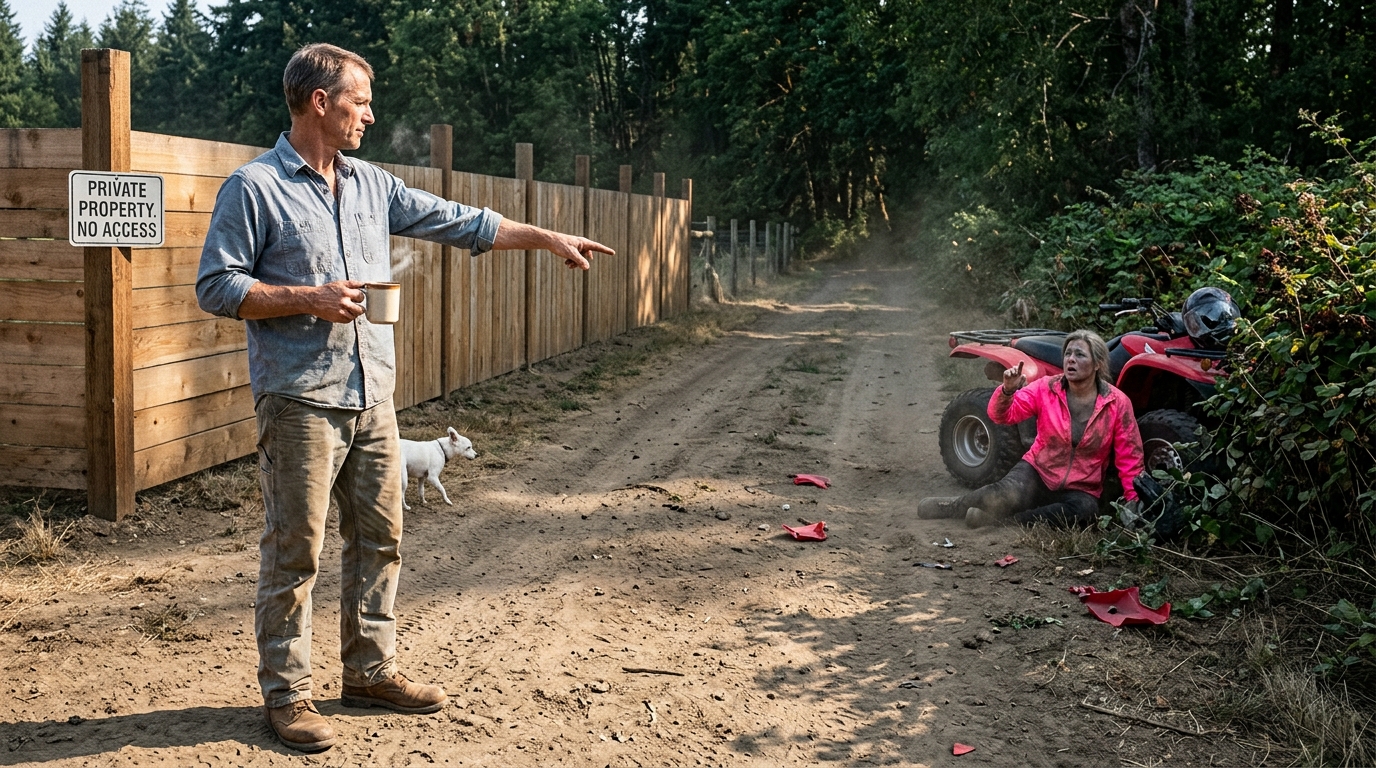
The engine RPMs didn’t drop. She wasn’t slowing down. She never slowed down. For six months, Karen treated the four-hundred-yard strip of packed dirt behind my barn like her personal transit corridor. Every morning at seven-fifteen, the bright red plastic fairings of her quad bike would tear through my property line, throwing gravel against my fence posts and churning up the pasture.
Two hundred feet.
I took a slow sip of black coffee. The steam stung my nose. On the dirt track sixty feet below my porch, the newly sunk six-by-six cedar posts stood like a row of iron teeth. I had spent forty-eight hours digging those holes four feet deep into the clay, anchoring them with three hundred pounds of quick-set concrete, and bolting double-ply three-inch oak planks across the frame.
One hundred feet.
A sharp screech of tires on loose shale rattled through the treeline. Then came the panic. A quick, desperate lock of the brakes. The heavy skidding sound of rubber losing its grip on loose dirt.
The impact was short, dull, and heavy.
THUD.
The front bumper of the red ATV smashed directly into the center oak plank. The wood didn’t yield an inch. The kinetic energy had to go somewhere. The rear wheels lifted, flipping the two-hundred-pound machine on its nose before it slammed sideways into the dirt.
A figure went flying over the handlebars in a blur of neon pink synthetic fabric, tumbling violently across the gravel before coming to a dead stop against a clump of wild blackberry bushes.
The engine sputtered once and died. Silence settled back over the yard, thick and heavy.
A tiny white dog tumbled out of the side basket, yapping hysterically as it skittered across the dirt.
I didn’t drop my mug. I didn’t rush down the steps. I set the brass plumb bob on the railing, alignment verified, and walked down the three wooden steps toward the perimeter wall.
“You tried to kill me!”
Karen rolled onto her hip, her face caked in gray dust, her visor cracked straight down the middle. She dragged herself up onto one hand, gasping, her finger pointing wildly at my chest.
“You set a death trap! You insane bastard, you set a death trap!”
I stopped three feet inside my line, right next to the three-foot-wide aluminum sign bolted to the center post. I pointed a single calloused finger at the black lettering printed across the reflective metal.
“Private Property,” I said. My voice was flat, dry, carrying zero weight. “No Access.”
“I have an easement!” She spat a mouthful of dirt onto the toe of her gardening clog, her face turning a deep, dangerous purple beneath the grime. “The HOA owns this trail! This is a historic community access route!”
“There is no easement on Document-9,” I said, leaning my forearm casually against the top rail of the wall. “Your quad bike is leaking transmission fluid onto my topsoil.”
“I’m calling the sheriff! I’m calling the board!” She scrambled to her feet, clutching her wrist, her chest heaving as she kicked a loose piece of her red fairing into the brush. “You’re getting sued for every dollar you have! You hear me? Every single dollar!”
I looked past her, down at the dust settling over the dirt road.
“You have ten seconds to get off my land,” I said softly, “before I file a formal complaint for criminal trespass with the county prosecutor.”
Her eyes went wide, cold hatred flashing behind the cracked plastic visor. But she didn’t step over the line. She grabbed the handlebars of her bent machine, dragging it backward with a harsh, metallic scrape that echoed through the trees.
She didn’t know it yet, but the wall was just the foundation.
CHAPTER 2: THE COUNTERSURVEY
The dusk had turned pitch black, the temperature dropping fifteen degrees the second the sun dipped behind the timber line.
I stood two inches from the wooden perimeter wall, my thumb rested on the cold rubber button of a steel flashlight. The beam cut through the dark, washing over the cedar planks. The wood was still wet with sap from the saw mill, but right across the center beam—spanning six feet of solid oak—was a jagged, dripping line of neon pink spray paint.
LAND THIEF.
The cursive was shaky, rushed, the bottom of the T pooling into a heavy pink tear that ran down into the dirt.
My left hand stayed deep inside my jacket pocket, my fingers curled around the cold brass of the plumb bob. I didn’t yell. I didn’t curse. I let the beam of light drift down from the paint line to the base of the wall, tracking the disturbed mud.
There were two sets of footprints stamped into the damp clay. One was a small, narrow sneaker print—maybe a women’s size six. Beside it, deeper in the mud, was a aggressive, knobby tread pattern that didn’t match Karen’s street-slick quad bike.
It was a dirt bike tire. A two-stroke, light frame, aggressive tread.
I knelt down, pressing two fingers into the edge of the tire track. The clay was still soft. The impression hadn’t filled with night dew yet. They had done this twenty minutes ago, right while I was inside finishing my evening meal.
I pulled my hand back, wiped the mud on the thigh of my canvas work pants, and stood up.
I walked twenty steps to the oak tree on the north side of the trail. Thirty feet up, tucked into the thick bark where the shadows clustered, the small green casing of the first trail camera sat silent. I reached up with a folding step, unhooked the security strap, and pulled the SD card from the bottom slot.
Ten minutes later, I was seated at the kitchen table inside my barn. The only light came from the glow of my laptop screen and the amber bulb hanging above the workbench.
I slotted the card into the reader.
The file list populated. I clicked the clip timestamped 8:42 PM.
The night-vision infrared kicked on in black-and-white grain. Two figures stepped into the frame. The first was small, wearing an oversized hooded sweatshirt—Karen’s teenage daughter, holding an aerosol can with both hands. Beside her stood a taller kid wearing a motocross helmet, leaning on a light frame bike.
They weren’t just vandalizing the wood. In the corner of the frame, the girl held up a folded piece of paper toward the camera lens, grinning, before pinning it to the side post with a heavy steel staple.
I paused the video. I zoomed in on the paper.
At the top, printed in bold, crude lettering, were the words: OFFICIAL NOTICE OF ENCROACHMENT — EASEMENT ACCESS RIGHT (THE VANGUARD PARCEL). Below it was a handwritten claim citing a historic community right-of-way, referencing an internal document number that matched nothing in the county registry.
I closed the laptop lid with a soft click.
I reached into my desk drawer and pulled out the Manila folder labeled PROPERTY DEEDS & COUNTY EXEMPTIONS. Inside was the original deed from 1984—the document that defined my boundary before the surrounding subdivision was even mapped.
My eyes ran down the third paragraph of the legal description. Document-9, the original land grant carve-out. Right next to the surveyor’s mark was a red ink imprint that had faded over forty years: County Stamp 44.
There was no easement. There had never been an easement. The Vanguard Parcel was a fictitious boundary label invented by the developer twenty years ago to sell suburban lots under the illusion of shared parkland. The HOA hadn’t just made a mistake; they had built their entire authority over the trail on a phantom paper trail.
I picked up the land line on my desk and dialed a ten-digit local number from memory.
The phone rang three times before a raspy, gravelly voice answered on the other end.
“Allen,” I said.
“It’s nine o’clock, John,” my cousin replied, the sound of papers shuffling softly over the line. “Tell me nobody’s dead.”
“Not yet,” I said, leaning back in the wooden chair, my eyes fixed on the pink paint visible through the window. “I need you to pull the charter filings for the neighborhood association tomorrow morning. Specifically, the exemption riders for County Stamp 44.”
There was a long pause on the line. I heard the faint click of a Zippo lighter, followed by a slow exhale.
“Karen’s still pushing it?” Allen asked.
“She brought spray paint and her daughter tonight,” I said flatly. “And she pinned a fake easement notice to my wall.”
“She’s setting up an HOA enforcement lien,” Allen said, his tone shifting from tired to sharp. “If she logs three documented notices of non-compliance in their private registry, the board tries to file an administrative cloud on your title. It’s a standard bully tactic. They count on homeowners getting scared and paying the fine before checking the county ledger.”
“She doesn’t know my land is exempt,” I said.
“She doesn’t care,” Allen corrected. “Power in those neighborhoods isn’t about law, John. It’s about momentum. If she makes enough noise, the board backs her because they don’t want to look weak.”
“I have her daughter on infrared camera,” I said. “High definition. Clear face shot.”
Allen chuckled softly, a cold, dry sound. “Hold the tape. Don’t call the deputy yet.”
“Why?”
“Because if you call the deputy now, it’s a hundred-dollar vandalism misdemeanor,” Allen said. “If you let her stand up at their emergency meeting tomorrow night and claim she has an official easement backed by the board, she commits legal fraud on public record. Then we don’t just clean up the paint. We tear her charter down.”
I looked down at the table. The brass plumb bob sat beside the Manila folder, its tip pointing straight at the red ink of County Stamp 44.
“Tomorrow night,” I said.
“Seven PM at the clubhouse,” Allen said. “Wear a clean shirt, John. We’re going to a trial.”
CHAPTER 3: THE WITCH HUNT ASSEMBLY
The amber light from the barn workbench faded as the clock on the dashboard clicked over to six-forty-five the following evening.
My palm rested flat against the cool vinyl steering wheel of my truck, parked in the gravel lot of the Oakridge Community Clubhouse. Through the double glass doors, the fluorescent tubes hummed, throwing sharp white light across four rows of metal folding chairs.
I slipped the brass plumb bob into my jacket pocket, its cold point settling against the thick lining, and picked up the leather briefcase on the passenger seat. Inside lay two certified copies of Document-9 and the county clerk’s notarized exemption ledger bearing County Stamp 44.
I stepped through the side door at six-fifty-five.
The air inside smelled of carpet cleaner, powdered lemonade, and cheap roast coffee burning on a hotplate. Forty residents filled the folding chairs. At the front of the room stood a long folding table where Karen sat flanked by two board members. A projector hummed on a small stand, casting a bright white rectangle onto a portable screen behind her.
Allen sat in the back row, his coat unbuttoned, a thick manila folder resting casually across his lap. He gave me a single, slow nod as I slid into the metal chair beside him.
“She’s armed,” Allen murmured, his voice barely audible beneath the low chatter of the room. “She circulated a printed agenda at the door. Item three is a special assessment for perimeter hazard removal.”
I opened my briefcase two inches, verifying the blue ink on the county seals, then snapped the brass latches back down.
At seven o’clock sharp, Karen stood up. She wore a tailored gray blazer, her hair pulled back into a tight bun. Her left wrist was wrapped in a beige compression bandage—a calculated touch for the crowd.
“Thank you all for coming on short notice,” she began, her voice carrying a practiced, rhythmic authority. She tapped a wireless clicker against her palm.
The projector clicked. A high-resolution image filled the screen. It was my wooden wall, captured from the trail side, the neon pink letters LAND THIEF glaring under the flash. Below it was a second slide showing the bent frame of her red quad bike sitting in a repair bay.
A quiet murmur ran through the middle rows.
“What you are looking at,” Karen said, stepping around the table with her arms crossed, “is a direct, violent violation of our community standards. An unapproved, dangerous obstruction erected across a historic access corridor—the eastern artery of The Vanguard Parcel.”
She paused, letting her eyes sweep the room before landing squarely on me.
“This board received an official notice of non-compliance three months ago,” she continued, her tone dropping into a solemn, grave register. “The owner of the adjacent lot has repeatedly refused to clear the corridor. Two nights ago, this illegal barricade resulted in a severe personal injury and thousands of dollars in property damage.”
A man in the third row leaned forward. “Is that trail part of the common elements, Karen?”
“It has been designated as an active access corridor in our master plan for eighteen years,” Karen stated without hesitation. She picked up a white sheet from the table and held it high. “We have logged three separate encroachment violations. Tonight, under Section 4-B of the HOA bylaws, the board is voting to authorize immediate removal of the barrier at the owner’s expense, alongside a twelve-thousand-dollar administrative penalty.”
She clicked her pointer against the table. “I move to open the floor for board ratification.”
“Seconded,” the board member to her left chimed in instantly.
Allen didn’t move. He leaned over, his elbow resting on his knee. “Let her lock it in,” he whispered. “Let her put the vote on the official minutes.”
“All in favor of ratifying the enforcement action and authorizing the removal crew for tomorrow morning,” Karen announced, her chin raised, “raise your hand.”
Three hands at the front table went up in unison.
“Motion carried,” Karen said, turning toward her notebook to record the entry. “Notice will be served—”
“Point of order,” Allen’s voice cut through the room like a steel wire snapping under tension.
It wasn’t loud, but the flat, dry pitch halted Karen’s pen mid-stroke. The room turned. Forty heads rotated toward the back wall.
Allen stood up slowly, unbuttoning his coat. He didn’t look at Karen; he looked directly at the recording secretary sitting at the end of the table with a laptop.
“My name is Allen Vance,” he said, pulling a white card from his pocket and placing it on the secretary’s table. “I represent John Miller, owner of the real property described in Deed Book 412, Page 9.”
Karen’s brow furrowed, her lips pressing into a thin line. “Mr. Vance, this is a private board meeting for association members. Non-members are not permitted to speak during executive voting.”
“This isn’t an executive vote,” Allen said, stepping into the center aisle. “It’s a recorded public statement of intent to commit trespass and extortion under color of private authority.”
A sharp gasp came from a woman in the second row.
“That’s enough,” Karen snapped, her cheeks flushing dark under the fluorescent light. “The Vanguard Parcel easement is recorded in the community registry!”
“It’s recorded in your binder,” Allen corrected. He reached down, opened my briefcase, and pulled out a single sheet of heavy white paper with a gold-embossed seal at the bottom. “It is not recorded at the County Recorder’s Office. Because the land your board just voted to seize does not exist within your jurisdiction.”
He walked down the center aisle, his dress shoes clicking crisply against the linoleum, and laid the paper directly over Karen’s meeting agenda.
“That is a certified copy of County Stamp 44,” Allen said, his voice ringing clear off the concrete walls. “Issued by the Board of County Commissioners in 1984. It confirms that my client’s parcel was explicitly exempted from the subdivision plat prior to the formation of this HOA.”
Karen didn’t pick up the paper. She stared down at the blue ink of the stamp as if it were a coiled snake.
“Furthermore,” Allen continued, turning to face the thirty-eight homeowners sitting in silence, “because this board has collected fees and issued fines based on a fictitious easement over non-HOA land, every assessment levied under the name of ‘The Vanguard Parcel’ over the past ten years constitutes administrative fraud under state statute.”
The room went completely dead silent.
Karen’s hand trembled slightly as she reached for her clicker, her knuckles turning white. “This… this is an invalid document. Our legal counsel verified the easement—”
“Your legal counsel,” Allen interrupted, “resigned from your representation at four o’clock this afternoon after I delivered a copy of Document-9 to his office.”
A whisper broke out in the back row, spreading instantly like wildfire through the chairs. The board member sitting to Karen’s right pulled his glasses off, looking down at the gold seal on the table, then looked up at Karen with cold realization.
Karen looked at the secretary, then at the room, her composure fracturing into sharp, panicked pieces. “The meeting is adjourned,” she blurted out, slamming her notebook shut. “The meeting is adjourned!”
“Not yet,” I said softly from the back of the room.
I stood up, holding my phone in my right hand, the screen lit up with the freeze-frame of the infrared video from twenty-four hours ago.
“We still need to discuss the spray paint,” I said.
CHAPTER 4: WEAPONIZED LAW
The blue-white light of my phone screen burned in the center of the quiet room.
On the forty-inch monitor at my shoulder, the black-and-white infrared recording played on a loop. The time code ticking across the top right corner read 20:42:11. In crisp, clear detail, Karen’s teenage daughter held the pink aerosol can with both hands, spraying the cursive letters across my center oak plank while her friend stood watch beside the light-frame dirt bike.
Karen’s throat clicked as she swallowed hard. She didn’t look at the screen. She looked at the floor, her fingers twitching against the plastic edge of her binder.
“That’s a private family matter,” Karen whispered, her voice stripped of its crisp cadence.
“It’s a Class B misdemeanor property crime,” Allen said from the aisle. He reached into his coat pocket, pulled out a second sheet of folded paper, and laid it flat on the desk in front of the board secretary. “Along with a formal notice of criminal trespass and civil conspiracy.”
The secretary looked at the paper, then pushed her rolling chair two feet backward, completely separating herself from Karen’s end of the table.
“I’m calling the county sheriff,” I said, sliding the phone back into my jacket pocket where my knuckles brushed the cool brass face of the plumb bob. “Not the township police. County Deputy Miller is waiting at the gate right now. He’s executing an evidence impound warrant on the red quad bike and the light-frame dirt bike sitting in your garage.”
“You can’t do that!” Karen snapped, her head whipping up, her eyes wide and bloodshot. Her hands slammed down onto the table, rattling the plastic water bottles. “That ATV is my primary transit for neighborhood inspections! You’re harassing my family!”
“The quad bike was driven onto non-HOA land in violation of a posted boundary,” Allen stated coldly, checking his watch. “It was involved in a collision during an unlawful act. It is physical evidence in a property damage suit. The county impound lot holds evidence for sixty days minimum, Karen. Unless you want to post a cash bond equal to its assessed value.”
A low rumble of conversation surged through the rows of folding chairs. Two homeowners in the third row stood up, zipped their jackets, and walked straight out the side exit without saying a word to the board.
Karen turned to the remaining board member—a retired accountant named Peters who had sat silently through the entire hour. “Peters, tell him! Tell him the board indemnifies enforcement officers!”
Peters slowly gathered his papers, tapping them against the table until the edges were aligned. He didn’t look Karen in the eye.
“The board indemnifies lawful actions taken under a valid charter, Karen,” Peters said, his voice dry and thin. “We don’t indemnify personal grudges on exempt land. I’m tendering my resignation to the secretary tonight.”
He stood up, tucked his folder under his arm, and walked out the back door, leaving Karen sitting alone at the head table.
She sat frozen for five seconds. Her breathing was fast, shallow. The room was emptying quickly now; chairs scraped against the linoleum as neighbors filed out into the cool night air, whispering in tight clusters as they passed her.
Allen stepped up to the table, leaned down, and tapped two fingers against the blue seal of County Stamp 44.
“The county prosecutor’s office received a copy of your illegal assessment notices at five o’clock today,” Allen said quietly, his voice carrying only to her ears and mine. “They’re opening an audit into every fine issued under the name of The Vanguard Parcel since 2014. If there’s missing money in those accounts, Karen, it won’t be a civil hearing.”
Karen’s hands shook as she pulled her binder toward her chest, trying to tuck the loose papers inside. “This is my neighborhood,” she muttered to the empty table, her voice cracking at the edges. “I built this community…”
“You built a fence around a lie,” I said, stepping past her toward the exit. “And the wall is staying up.”
Outside, the damp night fog hung low over the asphalt. Down at the end of the clubhouse driveway, the red and blue strobe of a county deputy’s cruiser flashed silently against the wet pine trees.
Allen walked beside me, his dress shoes crunching on the gravel as we reached my truck.
“The deputy is hooking up the trailer right now,” Allen said, pulling his collar up against the cold wind. “She’ll get the formal summons in the mail by Friday.”
I opened the driver’s side door, set my briefcase on the floorboard, and reached into my pocket. My fingers closed around the cold, heavy brass plumb bob. I set it on the dashboard, the pointed tip reflecting the distant blue flash of the police lights.
“It’s not over until the deed is clean,” I said.
“It’s over, John,” Allen said, looking back at the dark clubhouse doors where a single figure was walking alone toward the parking lot. “She just hasn’t realized how empty her house is yet.”
CHAPTER 5: CHECKMATE ON THE TRACTOR PATH
The engine idling in my truck sent a low vibration through the steering wheel. On the dashboard, the point of the brass plumb bob caught the strobing red and blue glint of the deputy’s cruiser down by the gate before fading into the damp gray fog.
Allen shut his passenger door with a dull thud. Through the glass, I watched his tail lights cut through the mist toward the main road.
I didn’t drive back to the barn right away. I sat in the cab for three minutes, listening to the ticking of the cooling manifold.
The match cut was clean: forty-eight hours passed in quiet, relentless motion.
By Friday morning, the morning air was cold, crisp, carrying the sharp scent of damp pine resin and wet soil. I stood at the perimeter wall, a gallon bucket of mineral spirits in one hand and a coarse wire brush in the other.
The pink aerosol paint on the oak plank had dried into a chalky crust. I dipped the brush into the solvent, pressing the stiff bristles against the wood grain, and began scrubbing. The neon dye dissolved, running down the timber in murky gray streams before dripping harmlessly into the dark mulch below.
A gravelly crunch sounded from fifty yards down the trail.
Karen walked slowly along the boundary line. She wasn’t wearing her blazer or her white gardening clogs. She wore a faded canvas coat, her hands shoved deep into her pockets. Her face was pale, thin, the skin beneath her eyes tight and dark.
She stopped ten feet back from the wall, on her side of the line.
She stared at the wood, watching the wire brush strip away the last pink stain, revealing the raw cedar beneath.
“The county auditor came yesterday,” she said. Her voice was flat, hollowed out, devoid of the sharp cadence she had used at the clubhouse podium. “They seized the bank ledgers from 2014 onward.”
I didn’t stop scrubbing. The brush made a rhythmic, rasping sound against the oak. Scrape. Scrape. Scrape.
“They’re calling it systematic conversion,” she continued, her eyes fixed on the wet wood. “Every fine issued under The Vanguard Parcel rider was deposited into an unauthorized capital improvements fund. There was no easement. There was never an easement.”
“I told you,” I said, dipping the brush back into the bucket. “Document-9 was clear.”
“We thought…” She swallowed, her throat moving against her collar. Her right hand came out of her pocket, her fingers nervously twirling a brass house key on a small ring before she forced her hand back into her coat. “We thought if we established the path as a public necessity, the county would grant a retroactive easement. We needed the access route to justify the expansion grant.”
“You built a extortion scheme on somebody else’s deed,” I said, setting the wire brush on top of the post. I wiped my hands on a shop rag. “And you used your daughter to paint a lie on my fence.”
She didn’t deny it. She couldn’t.
“The board dissolved this morning,” she said quietly. “Peters signed the formal surrender of the charter to the receiver. The neighborhood is reverting to county jurisdiction.”
She took a step backward, looking past me toward the barn.
“A ‘For Sale’ sign is going up on my lawn at noon,” she added, her voice dropping to a whisper. “The legal defense fund for the civil suit… I had to leverage the house.”
“That was your choice, Karen,” I said.
She stood there for a long moment, the fog curling around her boots. Then she turned without another word and walked back down the trail, her head down, her footprints leaving shallow depressions in the wet clay that would wash away by nightfall.
I watched her figure disappear around the bend.
I pulled the shop rag from my belt and wiped down the top beam one last time. The wood was clean, rough-hewn, and solid.
I walked up the three steps to the porch, pulled the brass plumb bob from my coat pocket, and set it on the wooden railing. I let the string hang free. The sharp tip hovered two millimeters above the center mark, perfectly plumb, perfectly stationary.
No engine whined in the distance. No tire treads churned the mud. The perimeter was quiet, locked down, and permanently sovereign.